
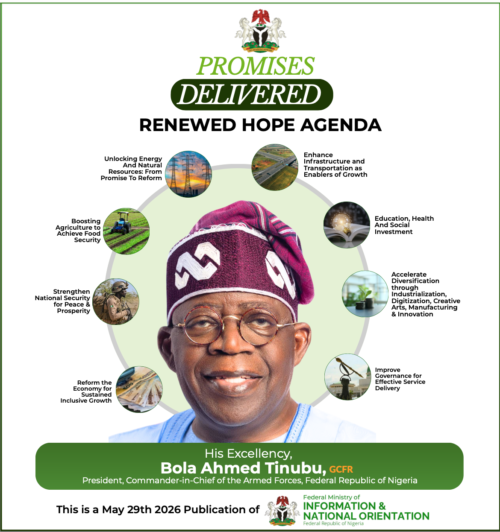

Nigeria’s Debt Rises By Over N1.5 Trillion Since Tinubu’s Coming – Report
 Photo credit: Vanguard Newspaper
Nigeria has borrowed over $1.95 billion from the World Bank, despite growing concerns by Nigerians and international bodies on the country’s rising debt burden.
Data from the Debt Management Office (DMO) shows that Nigeria’s total public debt has increased to N87.37 trillion at the end of June 2023.
This represents a 103.93% year-on-year increase compared to N42.84 trillion in Nigeria’s public debt as of June 2022.
Tinubu assumed office on May 29, 2023, the World Bank has approved three loans totalling $1.95 billion.
The loans are for education ($700 million), power ($750 million), and women empowerment ($500 million), the reports said.
Details revealed that on June 19, the federal government secured a $750 million loan from the World Bank to facilitate power projects across the nation.
The loan, with project ID P174622, was approved on June 9, 2023, making it the first World Bank loan approved under the administration of President Tinubu.
The global lender said the fresh loan would be additional financing for the power sector recovery performance-based operation. The World Bank document further disclosed that the new financing would run from 2023 to June 30, 2027.
Part of the document reads to justify the loan: “Lack of access to the electricity grid affects 45 percent of the population (90 million people), making Nigeria the country with the largest number of people not connected to electricity. As such, Nigeria accounts for 12 percent of the global access deficit.
Also, on June 27, 2023, the World Bank Group announced the approval of a loan of $500 million for women empowerment programmes.
This is the second loan approved under President Tinubu. World Bank Statement announcing the loan reads:
“The World Bank has approved $500m for Nigeria for Women Program Scale Up. The scale-up financing will further support the government of Nigeria to invest in improving the livelihoods of women in Nigeria”
Educating adolescent girls ($700 million)
The most recent loan is $700 million, approved in September 2023, to bolster educational opportunities and empowerment for adolescent girls in Nigeria.
Report has it that the new loan is to provide additional funds for an ongoing project known as the Adolescent Girls Initiative for Learning and Empowerment (AGILE).
Announcing the loan, World Bank also said: “The World Bank approved add
itional financing of $700 million for Nigeria to scale up the Adolescent Girls Initiative for Learning and Empowerment program whose goal is to improve secondary education opportunities among girls in targeted states.”
Meanwhile, the federal government has paid $1.17 billion to service foreign debt commitments in the first half of 2023.
This was captured in the Export and International Payment data released by the Central Bank of Nigeria (CBN).
Source: Fact Check.





Obasanjo And The Face Of Insolence, By Abiodun Komolafe
Former president, Olusegun Obasanjo’s recent discourteous behaviour against some of the traditional rulers in Iseyin, Oyo State has drawn an angry tirade from the public. Not unexpectedly, these comments have come as a mix of both the printable and unprintable words. For yours sincerely, the former president’s comments could only be viewed from two main perspectives.
The first is the pre-colonial era prestige attached to Nigeria’s traditional institution. During the period under review, traditional rulers were in full control to the extent that the then-visiting white men who later became their colonial masters were always at their mercy for acceptance to the kings and the locals. In their bid, the white men always came to these monarchs along with materials such as clothes, tobacco, salt, refined gold and beverages. In return for the perceived kind gesture from the white men, traditional rulers would always pack and sell or give our brothers and sisters who had either been bought or captured in inter-tribal wars as slaves as gifts in return to these foreigners. This relationship continued till it all culminated in what was later known as colonial administration.
It is also interesting to note that the colonial administration then brought the idea that traditional rulers needed to be subservient to the colonial administration. That was the genesis and the starting point of the gradual erosion of the power and influence of the traditional rulers in Nigeria. This was done to see the monarchs as middlemen through whom people were administered indirectly in the protectorates which in any case was resisted by the easterners. The Obas, too, really enjoyed it as it was seen in their fraternization and oppression of the people. But the monarchs had left their lofty positions and begun looking up to the white men or the colonial lords for decisions, directions and favours of all shapes and sizes in all things.
At independence, the colonial masters left, but they left behind the structure for the indigenous administration. Not only that they left, they also gave us a document known as the Independence Constitution which was meant to right all the wrongs of the past and restore the dignity of the traditional leaders, among others. The joy of independence of the year 1960 was however brought to a halt by a group of soldiers led by Major General Thomas Aguyi-Ironsi, who instead of sustaining the regional system of government that was in place, introduced the unitary system of government coloured in federalism, and that’s what has been in place, even till this day. That was how Nigeria went back to its colonial master-monarch relationship.
Needless to repeat, therefore, that Obasanjo and his co-travellers who later found themselves at the seat of power did not see anything wrong with the usurpation of the roles and powers of our revered monarchs. So, there’s no need to restore them. They went on as Nigerian leaders exploiting and further denigrating and desecrating our traditional stools. That is why governors and commissioners have been seen commanding and ordering these monarchs around against their wishes and those of their subjects.
Obasanjo could not have done less; and cannot do less. Here’s a man who places himself above others and with the colonial master’s mentality that is deeply ingrained in him. He sees himself as the eternal bank of the world’s knowledge. That’s why he could appoint and pay political advisers from the public coffers as a sitting president and still declare that he would not listen to them. On an altar of sheer arrogance, this man wasted the Yoruba slot for eight years by pursuing his agenda over that of the general public. For example, as a sitting president, he organized fundraisings that birthed his private university, revamped his erstwhile comatose farm project and established a world-class library for himself. He forcefully made his daughter Commissioner in Ogun, his home state, and senator representing the state at the National Assembly. Obasanjo was also reputed for the inglorious Third Term Agenda.
It is coming from this background that the former president believes that he has a lesson he must drive down the throats of the representatives of our ancestors, the Obas; and he did lead them in that Parade Ground of _‘E dide! E joko!’_ (Stand up! Sit down!), which they sheepishly obeyed.
Too bad! Whereas Obasanjo finds it pleasurable to be denigrating Yoruba Obas, he most certainly cannot try the same with any Emir in any part of the North. In the North, monarchs are recognized in their statute books as a result of the penal code system in operation which is different from what obtains in the South. Here in the South, our monarchs are treated as errand boys for politicians.
Hear The Rev’d ‘Toyin Adesokan’s view on the propriety or otherwise of Obasanjo’s impoliteness to the traditional institution in Yorubaland: _“I am aware that we have Kings in the Bible, from the Book of Genesis, to the Book of Revelation. Among the Kings were Pharaoh, Saul, David and Solomon. We have also read about Kings Ahab, Ahasuerus and Herod of the New Testament. They were all revered as leaders and as the aggregate of their people’s traditions and culture. Prophet Nathan never thought it right to confront King David even with the overwhelming revelation and backing of God in the case of Bathsheba the wife of Uriah, he treaded wisely. Prophet Elijah ran away from King Ahab and Joseph and Mary the earthly parents of Jesus Christ had to obey the divine instruction to escape the little Jesus to Egypt for fear of King Herod. However, what do you think would have become of Obasanjo in the presence of Kings like David, Pharaoh and Herod with that outburst?_
“Finally, the Bible says about kings: “The nations will walk by its light, and the kings of the earth will bring their splendour into it” (Rev. 21:24 NIV). We see here that Presidents, Prime Ministers and Governors were not mentioned. 1 Samuel 16:2 has also shown the paramount nature of the kings and how divine they are above the man-made presidents and governors.”_
With the above from a priest of the Church of Nigeria (Anglican Communion) Diocese of Lagos West, need Nigerians say more? After all, there are many ways to insult a Yoruba monarch and I’m sure Obasanjo knows them all.
May the Lamb of God who takes away the sin of the world, grant us peace in Nigeria!
_*Komolafe wrote in from Ijebu-Jesa, Osun State (ijebujesa@yahoo.co.uk; 08098614418 – SMS only)_