
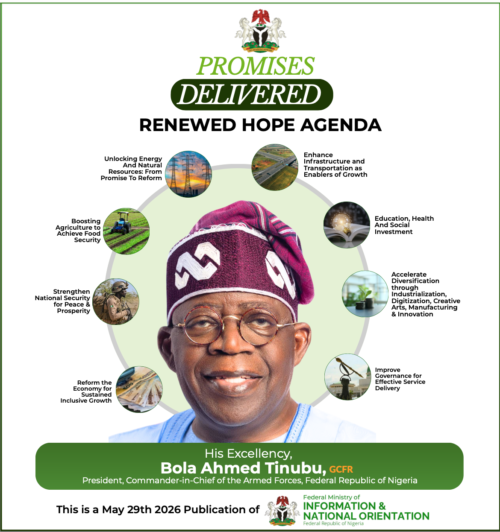

Tinubu Declares State Of Emergency On Food Production; To Crash Food Prices

President Bola Ahmed Tinubu has formally declared emergency in food security with back up agenda to bring about abundant food items, leading to crash in their prices
One of the items the President listed is the urgent move to create cattle ranch (Ruga) in each State, as a way of stopping Fulani herders from moving their cattles all over the place and streets in major cities.
Speaking to newsmen yesterday, July 13, at the Presidential villa, Abuja, Special Adviser to the President on Special Duties, Communications and Strategy, Dele Alake said that the President is fully aware of the current food inflation in the country.
“Mr. President is not unmindful of the rising cost of food and how it affects the citizens. “While availability is not a problem, affordability has been a major issue to many Nigerians in all parts of the country.
“This has led a significant drop in demand, thereby undermining the viability of the entire agriculture and food value chain.
“Accordingly, in line with this administration’s position on ensuring that the most vulnerable are supported, Mr. President has declared, with immediate effect, the following actions:
• That a state of emergency on food security be announced immediately, and
• That all matters pertaining to food and water availability and affordability, as essential livelihood items, be included within the purview of the National Security Council.”
He said that as a direct and immediate response to this crisis, a number of initiatives will be deployed in the coming weeks to reverse this inflationary trend and guarantee future uninterrupted supplies of affordable foods to ordinary Nigerians.
According to Alake, there would be immediate, medium and long-term interventions and solutions.
“In the immediate term, we intend to deploy some savings from the fuel subsidy removal into the Agricultural sector focusing on revamping the agricultural sector.
“In an earlier meeting with Agriculture Stakeholders (today), we drafted a memorandum of partnership between the government and the individual stakeholder representatives that encompasses the decisions taken and actions proposed from our engagements.
“The immediate intervention strategies are as follows:
1. We will immediately release fertilizers and grains to farmers and households to mitigate the effects of the subsidy removal.
2. There must be an urgent synergy between the Ministry of Agriculture and the Ministry of Water Resources to ensure adequate irrigation of farmlands and to guarantee that food is produced all-year round.”
He said that President Tinubu made it clear that we can no be comfortable with seasonal farming, saying: “we can no longer afford to have farming down times.”
Read part of the President’s measures to address the food security challenges in the country:
We shall create and support a National Commodity Board that will review and continuously assess food prices as well as maintain a strategic food reserve that will be used as a price stabilisation mechanism for critical grains and other food items.
Through this board, government will moderate spikes and dips in food prices.
To achieve this, we have the following stakeholders on board to support the intervention effort of President Bola Ahmed Tinubu: The National Commodity Exchange (NCX), Seed Companies, National Seed Council and Research institutes, NIRSAL Microfinance Bank, Food Processing/ Agric Processing associations, private sector holders & Prime Anchors, small holder farmers, crop associations and Fertilizer producers, blenders and suppliers associations to mention a few.
We will engage our security architecture to protect the farms and the farmers so that farmers can return to the farmlands without fear of attacks.
The Central Bank will continue to play a major role of funding the agricultural value chain.
Activation of land banks. There is currently 500,000 hectares of already mapped land that will be used to increase availability of arable land for farming which will immediately impact food output.
– Mechanization and land clearing – The government will also collaborate with mechanization companies to clear more forests & make them available for farming
River basins- there are currently 11 rivers basins that will ensure planting of crops during the dry season with irrigation schemes that will guarantee continuous farming production all year round, to stem the seasonal glut and scarcity that we usually experience.
We will deploy concessionary capital/funding to the sector, especially towards fertilizer, processing, mechanization, seeds, chemicals, equipment, feed, labour, etc.
The concessionary funds will ensure food is always available and affordable thereby having a direct impact on Nigeria’s Human Capital Index (HCI). This administration is focused on ensuring the HCI numbers, which currently ranks as the 3rd lowest in the world, are improved for increased productivity.
Transportation and Storage: The cost of transporting Agricultural products has been a major challenge (due to permits, toll gates, and other associated costs). When the costs of moving farm produce is significantly impacted – it will immediately be passed to the consumers, which will affect the price of food – the government will explore other means of transportation including rail and water transport, to reduce freight costs and in turn impact the food prices.
As for storage, existing warehouses and tanks will be revamped to cut waste & ensure efficient preservation of food items.
We will Increase revenue from food and agricultural exports. As we ensure there is sufficient, affordable food for the populace, we will concurrently work on stimulating the export capacity of the Agric sector.
Trade Facilitation: Transportation, storage and export will be improved by working with the Nigerian Customs, who have assured us that the bottlenecks experienced in exporting and importing food items as well as intra-city transportation through tolling will be removed.
These are some of the immediate interventions this government will put in place to tackle this crisis.
Principally, one of the major positive outcomes of these interventions will be a massive boost in employment and job creation.
Indeed, agriculture already accounts for about 35.21 percent of employment in Nigeria (as at 2021), the target is to double this percentage to about 70% in the long term.
President Bola Ahmed Tinubu’s mandate to create jobs for our teeming youth population will be achieved with between 5 to 10 million more jobs created within the value chain, working with the current 500,000 hectares of arable land and the several hundreds of thousands more farmlands to be developed in the medium term.
In closing, this administration understands that food and water are the bedrock of survival and therefore is calling on all Nigerians to partner us in ensuring the success of this strategic intervention. This administration is working assiduously to ensure that Nigerians do not struggle with their essential needs.
President Bola Ahmed Tinubu wishes to use this medium to continue to assure Nigerians that this administration will not relent in its efforts until all strategic interventions are deployed efficiently and effectively and until every household is positively impacted. Our president is the president of all Nigerians and the father of the nation. The renewed hope mandate remains alive and no one, absolutely no one, will be left behind.

 “The people of southeast believe in the unity of the country. And that’s an integral part of the Nigerian project also needs serious attention in terms of provision of security for our people to go about their businesses.”
 President Bola Tinubu has disclosed a plan by the Federal Government to transfer N8,000 to 12 million poor households in Nigeria for a period of six months to cushion the negative effect of the Federal Government’s recent removal of fuel subsidy.
 President Bola Tinubu has made it clear that his government is determined to retrieve Nigeria from the vested interests that have stifled its development for a long time.
 The Nigeria Civil Aviation Authority (NCAA) has suspended, indefinitely, the operations of all Boeing B737 aircraft of domestic carrier, Max Air.
 Soldiers of the three Division of the Nigerian Army deployed to quell the crisis in Mangu Local Government Area of Plateau state have killed three bandits.
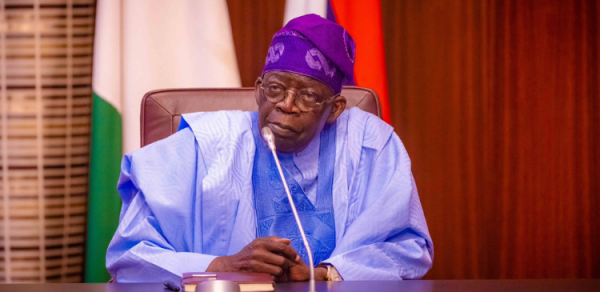 President Bola Ahmed Tinubu has formally declared emergency in food security with back up agenda to bring about abundant food items, leading to crash in their prices
 The Governments of Nigeria and the Republic of Equatorial Guinea have opened discussions on partnership opportunities for the establishment of a joint logistics base, deployment of indigenous capacities across countries, and lowering the costs of major oil and gas operations.

Subsidy Removal: Adopt Health Insurance As Statutory Palliative, By Muhammed Saraki Shehu
The recent removal of fuel subsidy by President Bola Tinubu’s administration has continued to generate discussions for and against the policy.
While some support it due to the inherent benefits to the nation’s economy in the long run, others are clearly against the decision. This is due to the hardships they say, the policy will impose on Nigerians.
The removal of the subsidy, according to some experts, would free up resources for the development of other key sectors such as education, healthcare, transportation and critical infrastructure. The government also added that the decision would curtail perennial corruption in the system and provide it with surplus revenue to spend on other projects.
Either way one may decide to join, the fact is that the subsidy is in itself a form of palliative. Now that it has been removed, there is genuine concern that many Nigerians will be unable to meet the costs of healthcare, education, transportation, food and welfare. Unfortunately, the government has yet to propose tangible palliatives to mitigate the impact of its decision on low-income people.
Aside from the inflationary effect of floating the naira, prices of essential commodities have skyrocketed beyond many Nigerians’ reach. And if the trend it is, is left unchecked, the policy will exacerbate poverty and further push Nigerians into extreme poverty.
In addition, the authority widened its target by launching an innovative programme called the Group, Individual and Family Social Health Insurance Programme (GIFSHIP), as a deliberate attempt to enrol more Nigerians, not covered by other health insurance programmes, into the health insurance ecosystem.
It will therefore be instructive for the Tinubu administration to speed up the implementation of these programmes to cover more poor Nigerians who cannot afford their own out-of-pocket health expenses.
These and other programmes of the authority, if carefully harnessed and supported, will provide individuals and families with financial security. This is done by covering a significant portion of their healthcare expenses and will reduce the burden of out-of-pocket payments, particularly for those on lower incomes.
It will also increase access to healthcare by offering affordable health insurance options; more individuals can access essential medical services without facing financial barriers. It will also provide a wide range of healthcare services a beneficiary will receive without incurring exorbitant costs.
Therefore, the adoption of health insurance as a subsidy palliative is crucial for addressing rising healthcare costs and ensuring financial access to quality healthcare for all individuals. Health insurance, as a statutory palliative, will surely ease the health burden of subsidy removal.
Muhammad S. Shehu wrote from the NHIA State Office, Bauchi.