Nigeria spent Buhari’s eight years locked in a senseless debate over cattle ranching and RUGA, while the world raced ahead with science, technology and industrial revolutions. That was the priority of a government that had no vision beyond grazing fields.Then came another absurdity: bold criminals spent millions of dollars to launch an airline that never existed Nigeria Air, a fraud paraded with fanfare, logos and photo ops, but no planes, no infrastructure and no passengers. A country of 200 million people reduced to a laughingstock by thieves in agbada and Babanriga. And now, the new gospel is “revenue generation.” Not wealth creation, not value addition, not human development just squeezing impoverished citizens of whatever crumbs are left for their survival. New taxes, higher tariffs, endless levies, all imposed on a population already crushed by hunger, unemployment and insecurity. Let’s stop pretending: when the focus of governance is only to collect revenue without creating value, what you have is not government. What you have is an extortion racket. What you have is a gang of criminals wearing the cloak of legitimacy, backed by the law to rob citizens in broad daylight. Governments exist to build, to create, to expand opportunity. Criminals exist to loot, to drain, to destroy. Nigeria’s tragedy is that its government has blurred the line so completely that you can no longer tell the difference. Eight years wasted on cows instead of classrooms. Millions of dollars wasted on a phantom airline instead of hospitals. Citizens punished with taxes instead of empowered with jobs. This is not mismanagement. It is systemic looting, packaged as governance. When government stops being a platform for service and becomes a tool for legalized robbery, destruction is inevitable. No economy can survive when its rulers act like bandits. No society can thrive when leaders drain instead of deliver. Nigeria is not short of resources. It is not short of talent. It is only short of honest leadership. Until that changes, every so-called “policy” will simply be a new scam in disguise. So, call it what it is: not government, but organized crime with a constitution.
I acted based on Jonathan’s instruction – Dasuki I didn’t give order – Jonathan I collected 350M from Dasuki for consultation – Iyorchia Ayu I only collected $30,000 from Dasuki not N100m – Bode George I got N4.6b from Dasuki for spiritual purposes – Bafarawa I got N650M from Dasuki for my Abuja burnt office – Thisday Obaigbena. I got N2.1b from Dasuki for publicity – Dokpesi I got another N100m from Yuguda he didn’t tell me from where – Bafarawa. I gave N100m each to Odili, Jim Nwobodo Bode George and others- Yuguda. The president asked me to change N10B to foreign currency for PDP delegates – Dasuki My boss asked me to get $11M from the CBN – Dasuki’s account officer. I got order from above to pay Tompolo N13B for Maritime university land. – Nimasa DG. 950m was shared in my house — Shekarau
“Over 20 billion dollars unremitted to the Federation account, and if nothing is done by 2015 upward, Nigeria will know what economic crisis is” *- Emir Sanusi Lamido Sanusi* “Whoever wins 2015 will NEVER find it easy to govern. Over 30 trillion is mismanaged, unaccounted for or missing under Jonathan.” *- Prof Charles Soludo* “Our reserve is depleted and our savings are squandered. Our nation is in trouble.” *- Dr Oby Ezekwesili.* “For seven months, NNPC did not remit any money into federation account. When I called as a sitting governor and major oil producing state, Deziani Alison Madueke refused to pick my calls.” *- Godswill Akpabio* “I told them to save ahead of eventualities but Jonathan had no political will to do so and this is the reason why we are in crisis, because we squandered our boom.” *- Okonjo Iweala* “Okonjo-Iweala, Sanusi urged us to save but we, state Governors refused to save for the unseen future during the tenure of Goodluck Jonathan, despite warning from economic experts.”
Garba Shehu, spokesperson to late former President Muhammadu Buhari has strongly condemned statement credited to former President Goodluck Jonathan to the effect that Boko Haram leader nominated Buhari as a mediator between the terrorist group and federal government. In a statement today, October 2, Garba Shehu said: “we are compelled to make a response to a terrible statement made on the late president Muhammadu Buhari by his predecessor in office, President Goodluck Ebele Jonathan, to the effect that Boko Haram had nominated him to represent them in a dialogue with government. “If this is a campaign statement towards his bid for the presidency in 2027, we want to say to him that “Mr. Jonathan, you are making a false start.” The Buhari spokesperson stressed that Muhammed Yusuf who was popularly known as Abubakar Shekau, the deceased leaders of the Boko Haram terrorist group, never nominated Muhammadu Buhari for any such role. According to him, Shekau routinely denounced and threatened Buhari, and that their ideologies were in direct opposition. He recalled that in 2014, Muhammadu Buhari escaped a bomb attack on his life by Boko Haram in Kaduna, in which his personal staff suffered various degrees of injury. “Buhari’s campaigns focused on fighting Boko Haram and restoring security to Nigeria whenever he became president, putting him in direct opposition to the terrorist group’s leader. “Contrary to the news making the rounds in those years that the radical Islamist extremist –Boko Haram had nominated General Muhammadu Buhari as the mediator between them and the Federal Government of Nigeria in the proposed peace talk, the retired Military General denied knowledge of his nomination. Garba Shehu’s statement continues: In a statement issued by the then National Secretary of the Congress for Progressive Change (CPC), Engr Buba Galadima, Buhari, the national leader of the CPC said he not aware of the appointment: “As at 10pm yesterday (Thursday) when I spoke with him, he said he has not even heard about it,” Galadima said. Continuing, the party secretary told reporters the “he (Buhari) said the whole thing to him, is just speculation. And since nobody has contacted him as a person for him to even know who is behind what, and what the motives of the whole exercise are, he would not speak to the press.” He revealed that Buhari, the 2011 presidential candidate of the CPC, further told him that as an elder statesman and a patriotic Nigerian, he will continue to pray until peace and tranquillity return to Nigeria. What led to the misleading information was that a faction of the terrorist group, possibly sponsored by Buhari’s opponents, staged a press conference in Maiduguri, Borno State, through a certain Abu Mohammed Ibn Abdulaziz, who claimed to be the Boko Haram commander in charge of Southern and Northern Borno, saying that the sect would prefer the former military leader, General Muhammadu Buhari, ex-Yobe State governor and the then Senator, now late Bukar Abba Ibrahim, first Nigerian Minister of Petroleum, Shettima Ali Monguno, also late, Chairman of the Presidential Committee on Insecurity in the North-East, Ambassador Gaji Gatimari, and other prominent members of the Borno Emirate to mediate between them and the federal government. Abdulaziz was roundly condemned by the leaders of Boko Haram who claimed that he had “no mandate of their leader, Imam Abubakar Shekau.” Speaking on to the issue , the then CPC national publicity secretary, Mr. Rotimi Fashekun, now late, lambasted President Goodluck Jonathan and the ruling Peoples Democratic Party (PDP) for latching on Buhari’s alleged nomination for political reasons. Fashekun described Buhari’s purported nomination as “the latest gambit in the desire of this organically corrupt PDP-led Federal Government in diverting the attention of the unsuspecting Nigerian public from the on-going massive looting of their common patrimony.” Fashekun also said: “Without any scintilla of equivocation, General Muhammadu Buhari has never been directly or remotely connected with any insurrection or insurgency against the Nigerian nation and her people. He remains the quintessential patriot that continues to magnetise the very best across the ethno-religious boundaries within the Nigerian nation-space.” The party chieftain accused the PDP of being responsible for the growing insecurity in the country, insisting: “As we have stated in an earlier communication, the (PDP), as a corporate entity, is the harbinger of the insecurity travails of the Nigerian people for the sole reason of ensuring perpetuity in governance.” Fashekun listed the three categories of Boko Haram and alleged that the PDP-led government is sponsoring one of them. “From recollection of events of the last two years, there are three variants of the Boko Haram: the original Boko Haram that is at daggers drawn with the Nigerian authority for the extra-judicial killing of their leader; the criminal Boko Haram that is involved in all criminality for economic reasons and of course, the most lethal of all, the Political Boko Haram, which this PDP-led Federal Government represents. “The President, Dr, Good-luck Jonathan, had once alerted the nation of the ubiquitous presence of Boko Haram in his government, a fact aptly amplified by his erstwhile National Security Adviser, General Andrew Azazi.” He further drew instances from the revelations made by State Security Service. “Undoubtedly, the latest revelations by the State Security Services (SSS) on the complicity of the top echelon of the PDP leadership in Boko Haram activities aptly bear testimony of the noxious subterfuge to extirpate the essence of our nationhood.” To win in 2027, Dr. Jonathan should look for a better story to tell Nigerians.
Kogi State Governor, Ahmed Usman Ododo has won the “Community Builder of the Year 2025” award in far away Canada. The Mayor of Brampton, His Lordship Patrick Brown, conferred the distinguished title of Community Builder of the Year 2025 on Governor Ododo during the celebration of the Nigerian Independence Day held in Brampton, Canada on October 1. The colourful event, which drew Nigerians in the diaspora, political leaders and dignitaries from across North America, became a historic moment for the Confluence State and for Nigeria as a whole. Governor Ododo as Community Builder of the Year 2025 by the Mayor of Brampton carries immense symbolic weight. It is a clear signal that leadership anchored on service and community impact resonates beyond national boundaries. The recognition, described as a testament to exemplary leadership and service to humanity, placed Kogi State in the international spotlight, highlighting its rising profile under the current administration. Governor Ododo was represented at the event by the Special Adviser on Arts and Culture, Juwon Olorunnipa, popularly known as Jumabee. The award underscored Governor Ododo’s enduring commitment to people-centred governance, infrastructural development and global partnership. In addition, Kogi State bagged three plaques at the celebration, reaffirming its position as a state steadily earning its place in both national and international discourse. The awards, received amidst applause, showcased the resilience, vision and dedication of Governor Ododo’s government to community growth, development and global representation. The Nigerian Independence Day Celebration in Brampton provided a grand stage for cultural exchange, national pride and diaspora engagement. Source: PRESSCODE
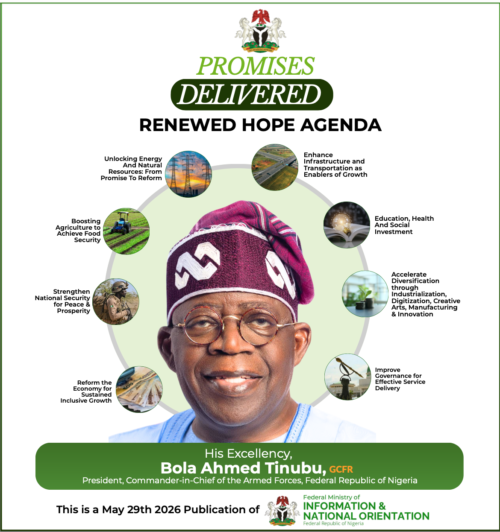
After painting a beautiful picture of the nation’s economic growth since he came to power in 2023, President Bola Tinubu has finally admitted that the measure of success of the government cannot be limited to economic statistics alone. In his radio and television broadcast to Nigerians today, October 1, to mark the country’s 65th Independence, President Tinubu said: “the accurate measure of our success will not be limited to economic statistics alone, but rather in the food on our families’ tables, the quality of education our children receive, the electricity in our homes, and the security in our communities.” He called on the governors of the 36 States, the Federal Capital Territory Administration and all the local governments to use their autonomy to translate the economic gains into reality. Tinubu assured the citizens of his government’s determination to ensure that the resources that have been saved and the stability that have been built are channelled into critical areas. “On this 65th Anniversary of Our Independence, my message is hope and a call to action. The federal government will continue to do its part to fix the plumbing in our economy. “Now, we must all turn on the taps of productivity, innovation, and enterprise, just like the Ministry of Interior has done with our travel passports, by quickening the processing. “In this regard, I urge the sub-national entities to join us in nation-building. “Let us be a nation of producers, not just consumers. Let us farm our land and build factories to process our produce. Let us patronise ‘Made-in-Nigeria’ goods. I say Nigeria first. Let us pay our taxes.” The President called for all hands to be on deck, stressing the need for the citizens to believe in the boundless potential of the country. Read the full text of the Presidential broadcast.
Fellow Nigerians, Today marks the 65th anniversary of our great nation’s Independence. As we reflect on the significance of this day and our journey of nationhood since October 1, 1960, when our founding fathers accepted the instruments of self-government from colonial rule, let us remember their sacrifice, devotion, and grand dream of a strong, prosperous, and united Nigeria that will lead Africa and be the beacon of light to the rest of the world. 2. Our founding heroes and heroines—Herbert Macaulay, Dr Nnamdi Azikiwe, Sir Abubakar Tafawa Balewa, Chief Obafemi Awolowo, Sir Ahmadu Bello, Margaret Ekpo, Anthony Enahoro, Ladoke Akintola, Michael Okpara, Aminu Kano, Funmilayo Ransome-Kuti, and other nationalists—believed it was Nigeria’s manifest destiny to lead the entire black race as the largest black nation on earth. 3. For decades, the promise of our Independence has been tested by profound social, economic, and political challenges, and we have survived. While we may not have achieved all the lofty dreams of our forebearers, we have not strayed too far from them. In 65 years since our Independence, we have made tremendous progress in economic growth, social cohesion, and physical development. Our economy has experienced significant growth since 1960. 4. Although, it is much easier for those whose vocation is to focus solely on what ought to be, we must recognise and celebrate our significant progress. Nigerians today have access to better education and healthcare than in 1960. At Independence, Nigeria had 120 secondary schools with a student population of about 130,000. Available data indicate that, as of year 2024, there were more than 23,000 secondary schools in our country. At Independence, we had only the University of Ibadan and Yaba College of Technology as the two tertiary institutions in Nigeria. By the end of last year, there were 274 universities, 183 Polytechnics, and 236 Colleges of Education in Nigeria, comprising Federal, State, and private institutions. We have experienced a significant surge in growth across every sector of our national life since Independence – in healthcare, infrastructure, financial services, manufacturing, telecommunications, information technology, aviation and defence, among others. 5. Our country has experienced both the good and the bad times in its 65 years of nationhood, as is normal for every nation and its people. We fought a bitter and avoidable civil war, experienced military dictatorships, and lived through major political crises. In all these, we weathered every storm and overcame every challenge with courage, grit, and uncommon determination. While our system and ties that bind us are sometimes stretched by insidious forces opposed to our values and ways of life, we continue to strive to build a more perfect union where every Nigerian can find better accommodation and find purpose and fulfilment. 6. Fellow Compatriots, this is the third time I will address you on our independence anniversary since I assumed office as your President on May 29, 2023. In the last 28 months of my administration, like our founding fathers and leaders who came before me, I have committed myself irrevocably to the unfinished nation-building business. 7. Upon assuming office, our administration inherited a near-collapsed economy caused by decades of fiscal policy distortions and misalignment that had impaired real growth. As a new administration, we faced a simple choice: continue business as usual and watch our nation drift, or embark on a courageous, fundamental reform path. We chose the path of reform. We chose the path of tomorrow over the comfort of today. Less than three years later, the seeds of those difficult but necessary decisions are bearing fruit. 8. In resetting our country for sustainable growth, we ended the corrupt fuel subsidies and multiple foreign exchange rates that created massive incentives for a rentier economy, benefiting only a tiny minority. At the same time, the masses received little or nothing from our Commonwealth. Our administration has redirected the economy towards a more inclusive path, channelling money to fund education, healthcare, national security, agriculture, and critical economic infrastructure, such as roads, power, broadband, and social investment programmes. These initiatives will generally improve Nigerians’ quality of life. As a result of the tough decisions we made, the Federal and State governments, including Local Governments, now have more resources to take care of the people at the lower level of the ladder, to address our development challenges. 9. Fellow Nigerians, we are racing against time. We must build the roads we need, repair the ones that have become decrepit, and construct the schools our children will attend and the hospitals that will care for our people. We have to plan for the generations that will come after us. We do not have enough electricity to power our industries and homes today, or the resources to repair our deteriorating roads, build seaports, railroads, and international airports comparable to the best in the world, because we failed to make the necessary investments decades ago. Our administration is setting things right. 10. I am pleased to report that we have finally turned the corner. The worst is over, I say. Yesterday’s pains are giving way to relief. I salute your endurance, support, and understanding. I will continue to work for you and justify the confidence you reposed in me to steer the ship of our nation to a safe harbour. 11. Under our leadership, our economy is recovering fast, and the reforms we started over two years ago are delivering tangible results. The second quarter 2025 Gross Domestic Product grew by 4.23%—Nigeria’s fastest pace in four years—and outpaced the 3.4 per cent projected by the International Monetary Fund. Inflation declined to 20.12% in August 2025, the lowest level in three years. The administration is working diligently to boost agricultural production and ensure food security, reducing food costs. 12. In the last two years of our administration, we have achieved 12 remarkable economic milestones as a result of the implementation of our sound fiscal and monetary policies: i. We have attained a record-breaking increase in non-oil revenue, achieving the 2025 target by August with over N20 trillion. In September 2025 alone, we raised N3.65 trillion, 411% higher than the amount raised in May 2023. ii. We have restored Fiscal Health: Our debt service-to-revenue ratio has been significantly reduced from 97% to below 50%. We have paid down the infamous “Ways and Means” advances that threatened our economic stability and triggered inflation. Following the removal of the corrupt petroleum subsidy, we have freed up trillions of Naira for targeted investment in the real economy and social programmes for the most vulnerable, as well as all tiers of government. iii. We have a stronger foreign Reserve position than three years ago. Our external reserves increased to $42.03 billion this September—the highest since 2019. iv. Our tax-to-GDP ratio has risen to 13.5 per cent from less than 10 per cent. The ratio is expected to increase further when the new tax law takes effect in January. The tax law is not about increasing the burden on existing taxpayers but about expanding the base to build the Nigeria we deserve and providing tax relief to low-income earners. v. We are now a Net Exporter: Nigeria has recorded a trade surplus for five consecutive quarters. We are now selling more to the world than we are buying, a fundamental shift that strengthens our currency and creates jobs at home. Nigeria’s trade surplus increased by 44.3% in Q2 2025 to ₦7.46 trillion ($4.74 billion), the largest in about three years. Goods manufactured in Nigeria and exported jumped by 173%. Non-oil exports, as a component of our export trade, now represent 48 per cent, compared to oil exports, which account for 52 per cent. This signals that we are diversifying our economy and foreign exchange sources outside oil and gas. vi. Oil production rebounded to 1.68 million barrels per day from barely one million in May 2023. The increase occurred due to improved security, new investments, and better stakeholder management in the Niger Delta. Furthermore, the country has made notable advancements by refining PMS domestically for the first time in four decades. It has also established itself as the continent’s leading exporter of aviation fuel. vii. The Naira has stabilised from the turbulence and volatility witnessed in 2023 and 2024. The gap between the official rate and the unofficial market has reduced substantially, following FX reforms and fresh capital and remittance inflows. The multiple exchange rates, which fostered corruption and arbitrage, are now part of history. Additionally, our currency rate against the dollar is no longer determined by fluctuations in crude oil prices. viii. Under the social investment programme to support poor households and vulnerable Nigerians, N330 billion has been disbursed to eight million households, many of whom have received either one or two out of the three tranches of the N25,000 each. ix. Coal mining recovered dramatically from a 22% decline in Q1 to 57.5% growth in Q2, becoming one of Nigeria’s fastest-growing sectors. The solid mineral sector is now pivotal in our economy, encouraging value-added production of minerals extracted from our soil. x. The administration is expanding transport infrastructure across the country, covering rail, roads, airports, and seaports. Rail and water transport grew by over 40% and 27%, respectively. The 284-kilometre Kano-Kastina-Maradi Standard Gauge rail project and the Kaduna-Kano rail line are nearing completion. Work is progressing well on the legacy Lagos-Calabar Coastal Highway and Sokoto-Badagry Highway. The Federal Executive Council recently approved $3 billion to complete the Eastern Rail Project. xi. The world is taking notice of our efforts. Sovereign credit rating agencies have upgraded their outlook for Nigeria, recognising our improved economic fundamentals. Our stock market is experiencing an unprecedented boom, rising from an all-share index of 55,000 points in May 2003 to 142,000 points as of September 26, 2025. xii. At its last MPC meeting, the Central Bank slashed interest rates for the first time in five years, expressing confidence in our country’s macroeconomic stability. SECURITY: 13. We are working diligently to enhance national security, ensuring our economy experiences improved growth and performance. The officers and men of our armed forces and other security agencies are working tirelessly and making significant sacrifices to keep us safe. They are winning the war against terrorism, banditry and other violent crimes. We see their victories in their blood and sweat to stamp out Boko Haram Terror in North-East, IPOB/ESN terror in South East and banditry and kidnapping. We must continue to celebrate their gallantry and salute their courage on behalf of a grateful nation. Peace has returned to hundreds of our liberated communities in North-West and North-East, and thousands of our people have returned safely to their homes. YOUTH: 14. I have a message for our young people. You are the future and the greatest assets of this blessed country. You must continue to dream big, innovate, and conquer more territories in your various fields of science, technology, sports, and the art and creative sector. Our administration, through policies and funding, will continue to give you wings to fly sky-high. We created NELFUND to support students with loans for their educational pursuits. Approximately 510,000 students across 36 states and the FCT have benefited from this initiative, covering 228 higher institutions. As of September 10, the total loan disbursed was N99.5 billion, while the upkeep allowance stood at N44.7 billion. 15. Credicorp, another initiative of our administration, has granted 153,000 Nigerians N30 billion affordable loans for vehicles, solar energy, home upgrades, digital devices, and more. 16. YouthCred, which I promised last June, is a reality, with tens of thousands of NYSC members now active beneficiaries of consumer credit for resettlement. 17. Under our Renewed Hope Agenda, we promised to build a Nigeria where every young person, regardless of background, has an equitable opportunity to access a better future—thus, the Investment in Digital and Creative Enterprises (iDICE) programme. The Bank of Industry is driving the programme, in collaboration with the African Development Bank, the French Development Agency, and the Islamic Development Bank. This initiative is at the cusp of implementation. Over the last two years, we have collaborated with our partners to launch the programme, supporting our young builders and dreamers in the technology and creative sectors. A MESSAGE OF HOPE 18. Fellow Nigerians, I have always candidly acknowledged that these reforms have come with some temporary pains. The biting effects of inflation and the rising cost of living remain a significant concern to our government. However, the alternative of allowing our country to descend into economic chaos or bankruptcy was not an option. Our macro-economic progress has proven that our sacrifices have not been in vain. Together, we are laying a new foundation cast in concrete, not on quicksand. 19. The accurate measure of our success will not be limited to economic statistics alone, but rather in the food on our families’ tables, the quality of education our children receive, the electricity in our homes, and the security in our communities. Let me assure you of our administration’s determination to ensure that the resources we have saved and the stability we have built are channelled into these critical areas. Today, the governors at the state level, and the local government autonomy are yielding more developments. 20. Therefore, on this 65th Anniversary of Our Independence, my message is hope and a call to action. The federal government will continue to do its part to fix the plumbing in our economy. Now, we must all turn on the taps of productivity, innovation, and enterprise, just like the Ministry of Interior has done with our travel passports, by quickening the processing. In this regard, I urge the sub-national entities to join us in nation-building. Let us be a nation of producers, not just consumers. Let us farm our land and build factories to process our produce. Let us patronise ‘Made-in-Nigeria’ goods. I say Nigeria first. Let us pay our taxes. 21. Finally, let all hands be on deck. Let us believe, once more, in the boundless potential of our great nation. 22. With Almighty God on our side, I can assure you that the dawn of a new, prosperous, self-reliant Nigeria is here. 23. Happy 65th Independence Anniversary, and may God continue to bless the Federal Republic of Nigeria. Amen. Bola Ahmed Tinubu, GCFR President and Commander-in-Chief of the Armed Forces of the Federal Republic of Nigeria, Presidential Villa, Abuja.
Bola Tinubu’s Presidency has rolled out negative indices that would make it impossible for former President Goodluck Jonathan to contest in the 2027 election. A statement today, September 29, by Tinubu’s Special Adviser on information and strategy, Bayo Onanuga said that Jonathan would have to contend with court issue as to whether he can contest and if he wins, be sworn-in for the third time as President. “…Jonathan will have his date in the court of the land. Indeed, the jury will determine whether Jonathan, who was sworn in twice as president, satisfies the constitutional requirements and is eligible to contest the presidency and be sworn in, if successful, for a third term in office. “Jonathan will also have his encounter with the people as to whether he has anything new to offer after his disastrous six years, for which they voted him out in 2015. “Let us remind ourselves about Jonathan’s record. We cannot forget in a hurry how his regime, devoid of any clear economic agenda, engaged in frivolous spending, ran the economy aground and put the country in dire straits. “The nation’s economic downturn, which President Tinubu is working very hard to overcome, actually began under President Jonathan. “The Jonathan administration severely damaged the economy, and all key indicators declined under his watch. Under him, the so-called business moguls allocated foreign exchange to import fuel, simply pocketing the dollars without importing anything. Some of those big men still have court cases on the issue today. “Jonathan and his National Security Adviser, Col. Sambo Dasuki (rtd), freely distributed security funds to friends and cronies. “In 2010, President Jonathan inherited a total of $66 billion, of which $46 billion was in foreign reserves and $20 billion in the noble-but-abused Excess Crude Account. By 2015, when the people democratically removed him from office, the foreign reserves had fallen below $30 billion, and the Excess Crude Account had been depleted to $2 billion, despite generating record revenue from crude oil sales that the country had never achieved in more than 25 years combined. “It is on record that between 2010 and 2013, crude oil sold for an average of $100 per barrel. By December 2014, however, the Jonathan-led Federal Government could no longer pay salaries to Federal Civil Servants. At least 28 states across the country owed workers huge salary arrears.” Onanuga took a swipe at those who he described as “desperation of the opposition ganging up against President Bola Tinubu” trying to prematurely foist Jonathan on the nation. “We are once again regaled with a cacophony of voices, most of them full of sound and fury, signifying nothing, to paraphrase inimitable Williams Shakespeare in one of his classic works, Macbeth.” He referred particularly to a statement by the former Minister of Information and National Orientation, Professor Jerry Gana who moved to draft former Jonathan into the 2007 presidential race. He said that Professor Gana had concluded that ex President Jonathan would contest the coming election on the platform of the discredited People’s Democratic Party (PDP), “which bequeathed a legacy of economic ruins, after 16 years of bad governance. “Gana even deluded himself, asserting that the former President would defeat President Tinubu to reclaim power after 12 years. “Prof. Gana of the defunct MAMSER fame is free to delude himself and engage in his usual comedy; after all, Jonathan’s entering the race would provide another job for the Niger State-born former university don. “However, we should caution former President Jonathan to be wary of the PDP sugar-coated cheerleaders. Politicians of Jerry Gana’s ilk merely want to lure him into the race to satisfy their personal, political, religious, and ethnic interests. They will abandon him midstream, as they did in 2015, and leave Gentleman Jonathan in the lurch. “Don’t get us wrong: President Jonathan reserves the right to run if he wishes. It is his inalienable right to contest the presidency again. ‘President Tinubu will wholeheartedly welcome him if he decides to enter the race.”
A Non Governmental Organisation (NGO), the Society for Rule of Law in Nigeria (SRLN), has accused Sahara Reporters online newspaper of treating its workers, especially Editorial Staff of what it calls “salary slavery.” It alleged that the editorial staff currently receive “paltry sum of money per story published without employment letters.” Rising from its meeting in Abuja yesterday, September 28, the group accused the owner of Sahara Reporters, Omoyele Sowore, of living large while underpaying his workers, and that editorial staff of the online newspaper do not have any letter of employment regarding their conditions of service and entitlements. A statement by its Coordinator, Dr Chima Ubeku, said that reporters who daily risk their lives to report stories for Sahara Reporters are paid peanuts while the owner, Sowore is paying over N200 million as school fees for one of his children per annum. The statement said that Sowore pretends as if his house is order, and has been everywhere, agitating that policemen should not earn less than ₦500,000 per month. “Meanwhile, his own editorial staff are not paid any salary.” The group sad that Sowore, who claimed to be a human rights activist is contravening the Labour Act, 2004, which is the principal legislation governing employment relation in Nigeria. It called on the Nigerian Union of Journalists (NUJ) to intervene and save journalists working in Sahara Reporters from slavery they are being subjected to by Sowore.
Sahad Store is a household name, especially in northern Nigeria. For many, the name is synonymous with a huge supermarket chain in the north. Yet, few people know the story behind its origin or the man behind the successful mega-business. Alhaji Ibrahim Mijinyawa, the businessman behind Sahad, was born in the Mandawari area of Kano. In an interview with Kaftan TV’s Sirrin Nasarar Kasuwa, he shared the story of how he started his business and how the name Sahad came to be. Reflecting on his life, he described it as a remarkable story — too many to recount in a single sitting. He explained that he was born after years of his parents’ childlessness, and shortly after his birth, his father separated from his mother, who was the only child of his grandmother. Following this, his grandmother, Mari Mai Koko, took over his upbringing. Raised solely by her, Mijinyawa did not attend an Islamic or Western school in his early years but as he matured, he recognised the value of education and enrolled himself in a boarding school, studying alongside younger students. Later, he joined a formal evening school known as Festival School, run by Igbo teachers. Throughout this journey, his only support came from his grandmother, a respected figure in Mandawari. Enjoy the interview:
Can you take us back to when it all began; when did you start your business?
I began my journey as a messenger in a company, earning between £7 and £10 a month. I worked there for nine months, carefully saving a few pounds in an Antikurya, a hidden pocket used in those days to keep money safe. It was so discreet that retrieving money from it was nearly impossible without the owner’s knowledge. Once I had saved enough, I decided to leave the job and start selling clothes. I had a bicycle and used it to carry my goods. Then, there was a popular fabric used for sewing trousers. We would buy remnants from second-hand clothing vendors and resell them at places like Tashar Kuka and Tashar Nasarawa. There were days I went three days without making a single sale. Eventually, I built a wooden kiosk, something no one had done at the time, as kiosks were mostly used for selling lemon juice or kunun zaki. My vision was to turn it into a proper fabric shop. The business picked up, and I moved to Kantin Kwari Market near Yan Tebur. As destiny would have it, a caretaker chairman named Uba Adamu was appointed and ordered all traders to relocate to Kofar Wambai Market. We were among the first to open there and were allocated stalls. I sold my stall and used the proceeds to reinvest in my kiosk. I developed a strategy: I would go out in the morning to retail on my bicycle and return in the evening to sell at my kiosk in Mandawari. When the fabric business flourished, I began traveling to source goods like women’s lace, English wax, and other premium brands. At that time, I was the only one in Kano selling such items.
Could you share a moment when you faced significant challenges in running your business?
It was during Shehu Shagari’s administration.
Could you share how the name ‘Sahad’ came to be?
The name originated during the Iraq War during the former president of Iraq – Saddam Hussein. My shop was known as Fahad at the time. During the Gulf War, Nigeria was supporting one of the warring parties, so people advised that I change the name of my shop or risk consequences. I wasn’t financially strong then, and changing the signage, which was written with a light-emitting diode, was expensive. I didn’t have the money to replace everything, so I sat down and started experimenting with names. I removed the letter “F” and tried “A” for Ahad—it didn’t work. Then “B” for Bahad, it still didn’t work. Finally, I tried “S” for Sahad, and it felt nice to me. That’s how I changed the name from Fahad to Sahad. By God’s blessing, the name drew attention, and I prospered. Radio stations would come to collect information, broadcasting that a store had changed its name to Saddam. They didn’t realise it was Sahad and the store became even more popular.
What happened next?
A tragedy occurred when Governor Abubakar Rimi began disrespecting President Shagari, calling him “Shagarai.” Shagari got angry and ordered Customs officers to crack down on foreign goods, including those at Kantin Kwari. We were worried, so I decided to change the business line. I bought a land on Mandawari Road and built a store as a “Supermarket” named Fahad — before the name changed to Sahad. We continued business until Buhari staged a coup and ordered that all stalls be demolished. I moved my shop to a location I had previously acquired but never used at Malam Nasir Kabara’s house. From there, I returned to Kantin Kwari and bought another shop. While there, a new brand of women’s wrapper called Batik was introduced, and I became famous for it. Eventually, by God’s grace, I opened a shop in the Federal Capital Territory, Abuja. With N8 million. I bought a land and built a store in Zone 4, with my house on top and commercial shops below.
Could you walk us through your pricing strategy and how it distinguishes you from others in the market?
I do not give goods on credit, but I reduce the cost of goods. If something sells for N1,000 elsewhere, I can sell mine for N950 or N980. That’s how I attract, win, and retain customers.
Apart from Kano and Abuja, are there other states where you have established outlets, and what influenced those expansion choices?
Yes, I have an outlet in Jigawa, where former Governor Sule Lamido generously allocated a land for me to build. I also have outlets in Minna, Niger State; Maiduguri; and Bauchi, which are nearing completion. In Kaduna, I was also given a land by former governor El-Rufai to establish another branch.
There’s talk that you own a hospital. Could you share how that initiative came about?
Yes, I have a hospital, but it wasn’t built for profit. I built it for reward, so that even after I’m gone, the blessings will continue. I also established a school and a mosque with the same intention: to serve the community and earn lasting spiritual benefit.
Are there any plans to take your business beyond Nigerian shores?
No, I don’t have plans to expand my business outside Nigeria. When you invest in a business, even if it is your child managing it, you must be patient. Without patience, success won’t come. My focus is on ensuring that my fellow countrymen benefit from my wealth and the opportunities it creates.
Tell us a bit about your family and the role they play in your journey.
I have four wives and nineteen children. Some of them studied medicine specifically to help manage the hospital I built. It’s a family effort, and I’m proud that they’ve chosen to contribute to something built for the benefit of the community.
As a businessman, you travel a lot. Do you know how many countries you’ve visited?
Although I’m not highly educated and do not speak English, there is no country in the world that I have not visited, and I didn’t just pass through; I conducted business in each one. Every country I’ve been to, I know deeply than people might expect. Source: Daily Trust.
PENGASSAN has turned out to be exactly what many people suspected it was: a proxy for those who exploited the petroleum subsidy system for years. It is now clear that only a few corrupt elements have been reaping billions from this conduit, often without contributing to local production. It’s laughable that some of these individuals don’t even understand the industry but have been profiting from it immensely. The tide began to change with Dangote emerging as a major local producer of petroleum products. This development could potentially make fuel more affordable for Nigerians. Whatever it amounts to, people of goodwill like me, stand with Dangote and call on PENGASSAN to focus on resuscitating our refineries for local production. It’s time for meaningful change in our petroleum sector through pragmatic reforms.
Yusuf Emmanuel Omuya a Public Affairs Analyst can be reached on oohinoyi@yahoo.com
Dangote Petroleum Refinery has described move by the Petroleum and Natural Gas Senior Staff Association of Nigeria (PENGASSAN) to cut crude oil and gas supplies to the refinery as criminal. The company warned that such move could plunge Nigeria into fresh rounds of fuel scarcity while inflicting huge revenue losses on the government. In a statement today, September 27, the refinery said that the move is not only criminal, but “reckless and an act of economic sabotage.” It said that it would disrupt the production and nationwide supply of critical petroleum products, including petrol, diesel, aviation fuel, kerosene and cooking gas. The company said that these products are indispensable to daily life and the economy, warning that Nigerians at every level, from households to businesses and industries would bear the brunt of shortages. It said that a sudden disruption in supply will translate into insufferable hardship for millions of Nigerians. “The products that would be disrupted and stopped include but are not limited to aviation fuel, petrol, kerosene, diesel and cooking gas – all products that are used and required by all stripes of Nigerians and persons living in Nigeria, whether high and mighty or lowly and ordinary. In what circumstance would it be justified for PENGASSAN to so disrupt and introduce insufferable hardship into the living conditions of Nigerians? None that we can see. “The follow up question is, in whose interest and on whose behalf is PENGASSAN directing and intending to inflict such anarchic and criminal disruption upon the Nigerian society and persons living in Nigeria? Most certainly, not in the interest of the Nigerian State and/or the Nigerian public and citizens.” The company said that apart from the immediate hardship on citizens, government’s revenue would be dented, given the refinery’s status as one of the country’s largest taxpayers and contributors to both federal and state coffers. Dangote Refinery said that any pause in operations would stall contributions to the national purse and undermine investor confidence in Nigeria’s oil and gas sector. “This is also economic sabotage against the Nigerian State at multiple levels. Dangote Refinery is the only refinery of its type in Africa and ordinarily should be the pride of all Nigerians as well as the governments of Nigeria. It should ordinarily have special protection and status and indeed qualifies as a strategic national asset.” It said that an irreparable injury to the Dangote Refinery such as PENGASSAN has directed constitutes a national embarrassment to the country and a disincentive to external investors who ordinarily would have been encouraged by the success of Dangote Refinery to contemplate investing in Nigeria’s oil and gas sector or generally. “PENGASSAN may also not be aware that Dangote Refinery is one of the largest contributors to the revenue purse of the Nigerian governments – both Federal and sub-nationals. That contribution is currently threatened by PENGASSAN and would of course be paused if and as soon as and for as long as the PENGASSAN directive is implemented by its branches.” The statement said that PENGASSAN had no legal authority to interfere in supply contracts between the refinery and its vendors, insisting that the action undermined the rule of law. “Absolutely no law gives PENGASSAN the right to direct its branches to “cut off” gas and crude oil supplies to Dangote Refinery or at all. There is also no law in our statute books that would support or enable the PENGASSAN branches having to “cut off” gas and crude oil supplies to Dangote Refinery or at all. Besides, it constitutes a criminal conduct for PENGASSAN or its members to disrupt and/or interfere howsoever in the contract between Dangote Refinery and its various vendors for the supply of gas and crude oil to the Refinery. Those supply contracts were not entered into with PENGASSAN; they were entered into by Dangote Refinery with third party vendors and suppliers and PENGASSAN has no right whatsoever to disrupt and/or interfere with the performance of those contracts.” It called on the Federal Government and security agencies to act swiftly, even as it advised Nigerians to take note of the “unquantifiable and irredeemable hardship which PENGASSAN wishes to inflict on all of us” if not checked, warning that fuel queues, energy shortages and price hikes could quickly resurface. It called on PENGASSAN to submit to amicable and legal resolution and not resort to economic sabotage and mob action that could introduce mayhem and chaos and easily translate into anarchy.
We use cookies on our website to give you the most relevant experience by remembering your preferences and repeat visits. By clicking “Accept”, you consent to the use of ALL the cookies.
This website uses cookies to improve your experience while you navigate through the website. Out of these, the cookies that are categorized as necessary are stored on your browser as they are essential for the working of basic functionalities of the website. We also use third-party cookies that help us analyze and understand how you use this website. These cookies will be stored in your browser only with your consent. You also have the option to opt-out of these cookies. But opting out of some of these cookies may affect your browsing experience.
Necessary cookies are absolutely essential for the website to function properly. This category only includes cookies that ensures basic functionalities and security features of the website. These cookies do not store any personal information.
Any cookies that may not be particularly necessary for the website to function and is used specifically to collect user personal data via analytics, ads, other embedded contents are termed as non-necessary cookies. It is mandatory to procure user consent prior to running these cookies on your website.


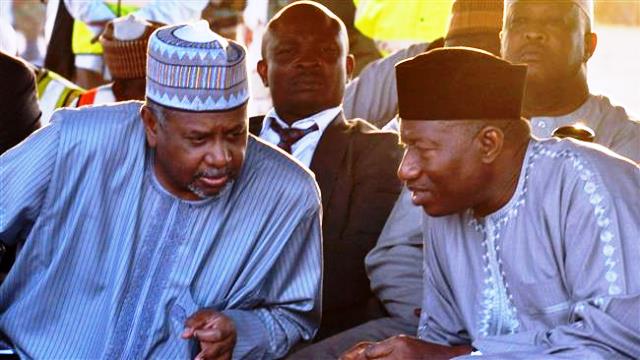 I acted based on Jonathan’s instruction – Dasuki





Nigeria: When Government Becomes Organized Crime, By Sa’adiyyah Adebisi Hassan
And now, the new gospel is “revenue generation.” Not wealth creation, not value addition, not human development just squeezing impoverished citizens of whatever crumbs are left for their survival. New taxes, higher tariffs, endless levies, all imposed on a population already crushed by hunger, unemployment and insecurity.
Let’s stop pretending: when the focus of governance is only to collect revenue without creating value, what you have is not government. What you have is an extortion racket. What you have is a gang of criminals wearing the cloak of legitimacy, backed by the law to rob citizens in broad daylight.
Governments exist to build, to create, to expand opportunity. Criminals exist to loot, to drain, to destroy. Nigeria’s tragedy is that its government has blurred the line so completely that you can no longer tell the difference.
Eight years wasted on cows instead of classrooms.
Millions of dollars wasted on a phantom airline instead of hospitals.
Citizens punished with taxes instead of empowered with jobs.
This is not mismanagement. It is systemic looting, packaged as governance.
When government stops being a platform for service and becomes a tool for legalized robbery, destruction is inevitable. No economy can survive when its rulers act like bandits. No society can thrive when leaders drain instead of deliver.
Nigeria is not short of resources. It is not short of talent. It is only short of honest leadership. Until that changes, every so-called “policy” will simply be a new scam in disguise.
So, call it what it is: not government, but organized crime with a constitution.