The main Nigerian opposition Peoples Democratic Party (PDP) will begin the sales of forms for various elective positions starting from tomorrow, March 17.
This was even as it has set up a 37-Member Committee on zoning controversy.
A statement this evening, March 16 said that presidential forms will go for N40 million while the Governorship goes for N21 million and Senate goes for N3.5 million.
The statement said that for the House of Representatives, the form would be sold at N2.5 million even as the form for House of Assembly goes for N600,000.
The statement said that the decision on the sales of the forms was contained in the party’s communique issued at the end its 95th National Executive Committee (NEC) meeting.
The party approved a 50% reduction in nomination fees for youths aged 25 to 30 years for various elective positions.
The party’s NEC also approved the establishment of a 37-member Zoning Committee to make recommendations for the zoning of various elective positions for the 2023 general elections.
President Muhammadu Buhari, who doubles as minster of Petroleum resources, has apologized to Nigerians over the prolonged fuel crisis that has caused them a lot of inconveniences.
The President reminded Nigerians that his government had, for seven years it has been in power, successfully averted such crisis in fuel supply and shortage of petroleum products.
“The administration knows the fuel shortage has placed a strain on Nigerian citizens and businesses, but relief is on the way. I especially apologize to all sections of society for this.
“The government is working round the clock to attend to this issue. An action plan agreed upon earlier this month is being implemented to address the scarcity. Working together with the Major Oil Marketers Association of Nigeria (MOMAN) and the Independent Petroleum Marketers Association of Nigeria (IPMAN), this plan is now bearing fruit. Sufficient fuel supply has returned to a handful of states, with the queues at stations falling. In the coming days, we expect this to be the case across the rest of the country.
“Looking to the longer term, funds are being targeted toward keeping fuel availability affordable for the country. The international energy markets have surged drastically in recent months, the government will however ensure that consumers are protected against these price spikes.”
President Buhari said that he has received information that some people who are not behaving properly at the depots and among owners of petrol stations and in this regard, he has directed the Ministry of Petroleum Resources, the Nigerian Midstream and Downstream Petroleum Regulatory Authority (NMDPRA), the NNPC and the entire security apparatus of the nation to take strong action against those responsible.
On the issue of electricity blackouts being experienced across the nation, President Buhari said: “the blackouts seen in the national grid are also being addressed.
“A dip in hydroelectric generation due to seasonal pressures has coincided with technical and supply problems at thermal stations. On this, the government is also working tirelessly to resolve the issues at the latter to guarantee sufficient power flows into the national grid.”
As part of emergency measures put in place following a meeting convened with key stakeholders to address the low power generation in the country, the main challenge was identified as being one of low gas power generation as a result of sabotage of gas pipelines leading to the shutdown of power plants coupled with ongoing routine maintenance on other gas power plants.
To recover over 1000MW, actions were agreed upon between the players in the Nigerian Electricity Supply Industry (NESI) and also NNPC. The actions targeted the National Integrated Power Project (NIPP) plants, (Niger Delta Power Holding Company (NDPHC) and power plants run under NNPC Joint Ventures, Agip and Shell (NAOC and SPDC) and progress on the key actions have already ensured the restoration to the grid of 375MW after the pipeline from “Okpai 1” was repaired.
To also ramp up the underutilised capacity of the NDPHC capacity, a USD 50 Million Gas Supply agreement is being finalized to secure the sustainability of up to 800MW of underutilized NIPP assets.
The President assured that government’s attention to these problems will bear fruits very soon.
The Minister of Power, Abubakar Aliyu, has said that lack of gas, the maintenance that some of the generators are undergoing have been the factors causing the current power collapse across the country.
“The more reason we are facing the situation now is as a result of the shortage of gas and some of the generators that have to go into maintenance.”
The minister, who briefed newsmen today, March 16 shortly after the Federal Executive Council (FEC) meeting at the Presidential villa, Abuja, said that he had summoned all the stakeholders’ meeting with a view to finding urgent solution to the problem.
“I challenged all of them; I said this is like a war situation; we need to find solutions. We need to come out with answers—quick ones, emergency solutions because the power on the grid has dropped due to those things that affected it— lack of gas, the maintenance that some of the generators are undergoing.”
Abubakar Aliyu emphasized that the drop in the supply as a result of the collapse of the grid has triggered some responses, adding that some have started to trip down and caused the whole system to go down.
“We had, the day before yesterday, recovered it. We are on top of it. We have recovered it now. The grid is back. We are trying to get more megawatts to push on to the grid through the aforementioned meeting.
Abubakar Aliyu said that committees have been set up, all geared towards getting more mega watts to put on the grid as basically, stressing that there is need to have gas contract between generating companies and gas supplies.
He said that all the variables were being looked into and some solutions have been proffered which would come into fruition soon.
“We have capacity of 8,000 mega watts – the one on the grid, embedded and captive. If you combine all of them, what is happening now is as a result of all these problems that we are encountering and we are on top of it. Very soon, we will come out of it.’’
The minister said that his ministry had received an approval of N5 billion from FEC for compensation to project affected persons in the expansion of the Lagos/Ogun line with six sub-stations.
The All Progressives Congress (APC) caucus in the House of Representatives have collectively endorsed the party’s National Leader, Asíwájú Bola Tinubu for the 2023 presidential election.
The endorsement followed the visit today, March 16, by Tinubu to the National Assembly to address the APC caucus in the Senate and House of Representatives in continuation of his engagement and consultations with critical stakeholders on his 2023 aspiration.
House Leader, Alhassan Doguwa, who led the lawmakers in the endorsement, spoke of Asiwaju’s track record as Senator and governor, as a democrat helping to build and strengthen Nigeria’s democracy, and as a party loyalist who did more than any other to create and sustain the APC.
He said that the APC leader has all it takes to aspire to the presidency and has physical and mental capacity to run the affairs of the country.
Doguwa then put the question to his colleagues, asking whether it was their wish to endorse Tinubu for the 2023 race to which they all answered in the affirmative without any dissenting voice.
Earlier, while addressing them, the APC leader described the National Assembly as a vital arm of government that had made important contributions to the unity and stability of the country as well as sustenance of its democracy as the most direct representatives of the individual constituencies at the Federal level.
The APC leader said that he was in the National Assembly to seek the lawmakers’ counsel, collaboration and support for his ambition.
Tinubu told the legislators that he had informed President Buhari of his aspiration, adding that he wanted to step into the president’s shoes without stepping on his toes.
House of Representatives Speaker Femi Gbajabiamila expressed surprise that many of those claiming to be in the race are sitting at home and not interfacing with Nigerians.
“I don’t think it’s good that Nigerians are still waiting six weeks to the primaries to know those in the race. It’s not fair on Nigerians,” he said.
He described Tinubu as one man who had indicated he would not take Nigerians for granted and would consult widely and talk to anyone who cared to listen.
The National Bureau of Statistics (NBS) has said that Kogi State is leading the other 35 States of Nigeria, and the Federal Capital Territory (FCT) in food inflation with 21.04 per cent, even as it announced that Nigeria recorded an inflation rate of 15.70 per cent in February 2022.
The Statistician-General of the Federation, Simon Harry, who spoke at a news conference to announce foreign trade statistics for fourth-quarter 2021 and Consumer Price Index (CPI) for February 2022, said that the Nigeria’s inflation is a 0.10 per cent increase from the 15.60 per cent recorded in January 2022.
“The nation recorded an inflation rate of 15.70 per cent in February 2022 on a year-on-year basis, which is 0.10 per cent points higher than the 15.60 per cent recorded in January 2022.
“On a month-on-month basis, the Headline index increased by 1.63 per cent in February 2022. This was 0.16 per cent points higher than the rate recorded in January 2022,” he said.
Harry said that the composite food index rose by 17.11 per cent, recording a decrease of 4.68 per cent points in February 2022, compared to 21.79 per cent recorded in February 2021.
He said that rise in the food index was caused by increases in prices of bread and cereals, food products such as potatoes, yam and other tubers, oils and fats and fruits.
On a state-wise basis, Harry said that food inflation on a year-on-year basis was highest in Kogi with 21.04 per cent, followed by Enugu with 20.31 per cent and Kwara 20.03 per cent. He said that Sokoto had the lowest with 13.89 per cent in February.
The statistician-general said: “all items less farm produce” or Core inflation, which excludes the prices of volatile agricultural produce, increased by 14.01 per cent in February.
He said that this was higher than the 12.38 per cent recorded in February 2021.
According to him, on a month-on-month basis, the core sub-index increased by 1.33 per cent in February 2022.
This, according to him, is higher when compared to 1.25 per cent recorded in January 2022.
The statistician-general said the urban inflation rate increased by 16.25 per cent (year-on-year) in February 2022 from 17.92 per cent recorded in February 2021.
Former Nigerian Vice-President, Atiku Abubakar has formally declared his intention to run for the 2023 Presidency, warning that the Peoples Democratic Party (PDP) under which he wants to run cannot survive another eight years as opposition party.
Atiku, who also warned against zoning the presidential ticket, added: “I am making this call because I’m afraid that if we do not win in 2023, it means we will be in opposition again for the next eight years.
“By the next eight years, I don’t know how many of us will be left in politics and it may even ultimately lead to the death of the party because people gravitate, particularly in developing countries like Nigeria.”
Atiku, who was the PDP Presidential candidate in 2019, made the declaration to stage a come-back in 2023 at a meeting with members of the party’s Board of Trustees (BoT) in Abuja today, March 15. He asked the party elders to work with him in the quest to secure the PDP presidential ticket.
He claimed that former President Olusegun Obasanjo’s administration, under which he served as Vice President, remains Nigeria’s best since the country returned to democratic rule in 1999.
“The PDP government in which I served as Vice President from 1999 to 2007 is the best since Nigeria returned to democratic rule 23 years ago. Many of you were part of the success story of that government. No administration since then has made as much achievement as our administration.
“All these are based on facts. I challenge everybody to take any aspect of our growth whether it is economy, whether it is healthcare, whether it is agriculture, whether it is education, the landmark achievements we made in 1999 to 2007 have not been matched by any subsequent administration.”
The All Progressives Congress (APC) has commenced the sale of forms for various offices ahead of its national convention slated on March 26. For all the positions, from chairmanship down to the least, the party reduces the for women and people with disability by 50 percent.
The National Leader of the APC Caretaker/Extraordinary Convention Planning Committee, Ismail Ahmed, said today, March 15 while giving details of the guidelines and timetable for the party’s national convention at the Eagle Square, Abuja: “The party’s leadership has agreed to sell the forms for the national chairmanship position for N20 million, National Secretary and Deputy National Chairman South and North will go for N10 million
“The forms for all other National Working Committee (NWC) positions will be sold for N5 million.
”The forms for other National Executive Committee (NEC) positions will be sold for N1 million.”
“Also forms for other positions at the zonal level, with the exception of the National Vice Chairman which is also a member of the NWC, is available for N500,000.”
Vice President Yemi Osinbajo has identified lack of political will and commitment as the factors that have been militating against the development of agriculture in Nigeria.
Professor Osinbajo, who looked back at the glorious past said:“the truth of the matter is that the difference between then and now is the political will. There is no question at all that there is far more information today than there was then but someone has to have the will to do it.”
Addressing, today, March 15, members of a delegation from the Development Agenda for Western Nigeria (DAWN) Commission, who was on a courtesy visit to the Presidential Villa, Abuja, insisted that what is required to boost resource mobilisation are hardwork and dedication of all stakeholders in the sector.
Professor Osinbajo stresses that agriculture can be the solution to a lot of the nation’s Internally Generated Revenue (IGR) and a lot of the resource needs.
“There is no question at all, that any part of Nigeria, if there is sufficient dedication and hard work, can feed the entire country. There are smaller countries not up to the size of one State in Nigeria that are producing enough and exporting produce to other parts of the world.”
Osinbajo, who also acknowledged the importance of private sector collaboration in transforming agriculture, however, stressed the need for stakeholders to focus on research and development.
He said that the progress made by some countries of the world, especially in the area of commercial farming have been hinged on research.
Earlier, the Director-General of DAWN, Mr. Seye Oyeleye, said that the commission had developed blueprints for the development of the health and education sectors in the six States of the South-West.
He cited the revitalization of cocoa production and the framework for sustainable agricultural transformation in the region, among achievements recorded by the commission in the nine years of its establishment
An Anambra State High Court, in Awka, presided over by Justice Arinze Akabua, has sentenced a former Treasurer with the Anambra State Ministry of Finance, Innocent Ezeonwuka, to 11 years imprisonment for defrauding pensioners of N66.5 million. Onwuka, who was a Sub-Treasurer with the Ministry, was accused by the Independent Corrupt Practices and Other Related Offences Commission (ICPC) of diverting monies meant for the payment of gratuities to retired civil servants under Aguata Sub-Treasury, Anambra State. The Commission, in a three-count charge, averred that the convict abused his office by conferring corrupt advantage on himself when he embezzled N66,520,564.62 meant for paying gratuities of the retired staff of the Aguata Sub-Treasury. Counsel to ICPC, Enosa Omoghibo, told the court that the convict committed the offence between June 2009 and June 2011 when he diverted the entire N66.5 million released by the state government for payment of gratuity to retirees. The court heard that the former Treasurer was posted to Aguata Treasury office within the period and in defiance to the lawful directives issued to him by the then Permanent Secretary of the Ministry of Finance to pay gratuities of retired civil servants under the Aguata Sub Treasury, diverted the monies released to other purposes thereby leaving the affected beneficiaries in want and penury. Justice Akabua, at the conclusion of the trial, found Ezeonwuka guilty on all three counts and therefore sentenced him to five years imprisonment on counts one and two, and one year imprisonment on count three. The sentences will run concurrently, the court ruled.
Report reaching us at Greenbarge Reporters online newspaper has shown that no fewer than 1,121, 123 candidates have registered seeking for admission into Nigerian universities through the Unified Tertiary Matriculation Examination UTME).
According to the Head of Media and Protocol of the Joint Admissions and Matriculation Board (JAMB), Dr. Fabian Benjamin in the JAMB’s Weekly Bulletin today, March 14, the registration exercise for the UTME and Direct Entry (DE), which commenced on February19, would close on March 26, with no extension.
JAMB said that it has paid N600 million cumulative amount derived from the regulated N700 service charges of the registration exercise to accredited Computer Based Tests (CBT) centres.
“JAMB had so far remitted over N600 million service charges to respective centres, in line with the cashless policy of the board, which represents the total number of candidates, multiplied by N700.
“This payment, however, excludes JAMB-owned CBT centres.
“N104,899,300 was paid in the first week of registration; N251,730,500 in the second week of registration and N332,150,700 was paid for last week’s registration.
“Cumulatively, more than N600 million had been paid to the CBT centres as centre charges.”
According to JAMB, the new policy of paying directly to CBT owners have reduced the sharp practices associated with warehousing candidates by tying them to non – performing centres.
The board said that it has also helped the proprietors of CBT centres to have a global picture of the total amount being generated by their respective centres.
It said that the cashless policy was introduced to curb the excesses of some fraudulent CBT centres that would want to take advantage of hapless candidates.
We use cookies on our website to give you the most relevant experience by remembering your preferences and repeat visits. By clicking “Accept”, you consent to the use of ALL the cookies.
This website uses cookies to improve your experience while you navigate through the website. Out of these, the cookies that are categorized as necessary are stored on your browser as they are essential for the working of basic functionalities of the website. We also use third-party cookies that help us analyze and understand how you use this website. These cookies will be stored in your browser only with your consent. You also have the option to opt-out of these cookies. But opting out of some of these cookies may affect your browsing experience.
Necessary cookies are absolutely essential for the website to function properly. This category only includes cookies that ensures basic functionalities and security features of the website. These cookies do not store any personal information.
Any cookies that may not be particularly necessary for the website to function and is used specifically to collect user personal data via analytics, ads, other embedded contents are termed as non-necessary cookies. It is mandatory to procure user consent prior to running these cookies on your website.



 The main Nigerian opposition Peoples Democratic Party (PDP) will begin the sales of forms for various elective positions starting from tomorrow, March 17.
 President Muhammadu Buhari, who doubles as minster of Petroleum resources, has apologized to Nigerians over the prolonged fuel crisis that has caused them a lot of inconveniences.
 The Minister of Power, Abubakar Aliyu, has said that lack of gas, the maintenance that some of the generators are undergoing have been the factors causing the current power collapse across the country.
 The National Bureau of Statistics (NBS) has said that Kogi State is leading the other 35 States of Nigeria, and the Federal Capital Territory (FCT) in food inflation with 21.04 per cent, even as it announced that Nigeria recorded an inflation rate of 15.70 per cent in February 2022.
 The All Progressives Congress (APC) has commenced the sale of forms for various offices ahead of its national convention slated on March 26. For all the positions, from chairmanship down to the least, the party reduces the for women and people with disability by 50 percent.
 Vice President Yemi Osinbajo has identified lack of political will and commitment as the factors that have been militating against the development of agriculture in Nigeria.
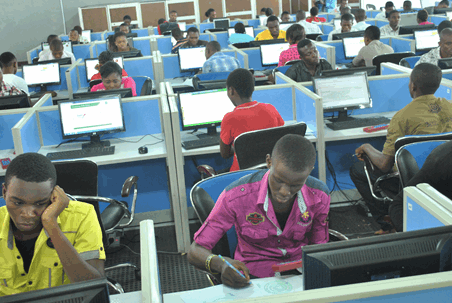 Report reaching us at Greenbarge Reporters online newspaper has shown that no fewer than 1,121, 123 candidates have registered seeking for admission into Nigerian universities through the Unified Tertiary Matriculation Examination UTME).