

NCC Rallies Stakeholders To Connect Rural Communities To Networks

The Nigerian Communications Commission (NCC) has gone into collaboration with other stakeholders, including the Association for Progressive Communications
towards connecting rural communities to networks.
A statement today, June 11, by the acting Head of NCC’s Public Affairs, Mrs. Nnenna Ukoha said that the Commission hosted a two-day workshop in Abuja from June 3 to 4 to explore policy framework for community networks connection.
She said that the outcome of the workshop would bridge the digital divide and accelerate socio-economic development in Nigeria’s underserved and unserved communities.
The statement said that the workshop was attended by regulators, community leaders, technical experts and potential foreign investors, among others, to examine policy and regulatory barriers, explore innovative funding mechanisms, ensure sustainable renewable solutions and strengthen collaboration with stakeholders.
The statement quoted the Executive Vice Chairman of NCC, Dr. Aminu Maida, as having said that the workshop is an opportunity for the stakeholders to harness their expertise, insights and experiences to address the critical challenges such as affordable devices, access, licensing, spectrum allocation, infrastructure development, sustainability and institutional monitoring.
Dr. Maida, who was represented by the Executive Commissioner, Technical Services, NCC at the event, Abraham Oshadami, said that the workshop demonstrates the Commission’s commitment to advancing digital inclusion, particularly in underserved and unserved areas.
“At NCC, we recognize the transformative potential of community center networks in achieving this important goal.”
The NCC boss assured of the Commission’s commitment to the journey, adding that the workshop would be used as a catalyst for meaningful change.
He said that the expertise, perspectives and commitments will shape the future where every Nigerian, regardless of his or her status, will have meaningful access to opportunities from digital connectivity.
This was even as the Co-manager of the Association for Progressive Communications’ Local Network (LocNet) initiative, Kathleen Diga, said that the collaboration was to tackle identified hindrances to digital inclusion. “This is a space where we can be open and exchange ideas of possibilities, opportunities that will remain in realizing values of a diversified ecosystem.
“I believe this workshop presents a moment in time that we can explore the bottom-up approach in local communities, small social enterprises, corporative among others, which have the ability to fill some of the digital gaps that remain unfilled.”
She emphasized the need to recognize that community centre connectivity exists and that they can grow throughout the global south, which, she said, are a “strategic response to digital exclusion.”
The workshop featured presentations from the NCC, the Association for Progressive Communications and other institutional stakeholders such as the Rural Electrification Agency (REA) and the Central Bank of Nigeria (CBN) all geared towards exploring a joint policy framework to address rural digital divide.
The Association for Progressive Communications is a 35-year-old international network member-based organisation encouraging digital inclusion in the unserved communities, particularly with communities in the global south and the workshop, through its LocNet initiative aimed at crafting an enabling inclusive regulatory framework for community networks in Nigeria.


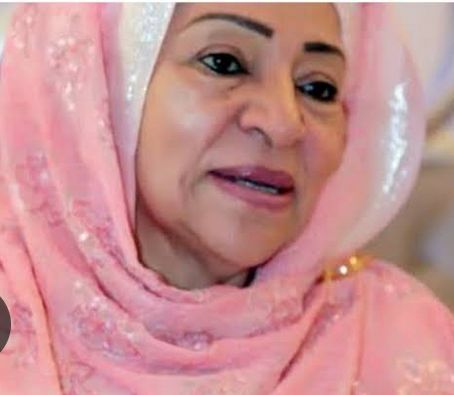 …Mrs Maryam Abacha
 …Soneye is second from right




Why Many Saudi Men Don’t Marry More Than One Wife, By Yusuf Ozi-Usman
The title of this piece can be regarded as a question, as in why many Saudi Arabian men don’t marry more than one wife? Or an enlightening one for those who have no idea why this is so.
On the point of question, I have always wondered why the citizens of the country from where Islam sprouted kind of distanced themselves from polygamy, which is one of the essential ingredients of the religion.
To start with, the Holy Qur’an, chapter 4 verse 3 states unequivocally thus: “…Marry women of your choice, two or three or four; but if you fear that you will not deal justly, then (marry) only one…” Take note that the verse starts with two wives, then moves to three, then to four and ends with one on the basis of “if you fear…”
Even Prophet Muhammad (May the Peace of Allah be with him), whose footsteps Muslims are supposed to follow (Hadith) had many wives; a sign to ideal Muslims to do as he did.
And out of worry and curiosity, I went to the Artificial Intelligence (AI) and asked the same question, and on the point of enlightenment, the following points came out:
Marriage in Saudi Arabia is expensive, including dowries (mahr), housing, and other expenses.
Supporting multiple households is financially burdensome, especially with rising living costs.
The government has reduced subsidies, and many Saudis now live on fixed or moderate incomes.
Saudi Arabia doesn’t ban polygyny, but regulations now require men to declare and justify their intent to marry another wife. Men should prove their financial ability and equitable treatment.
This makes the process more bureaucratic and scrutinized than before.
Modern Saudi women are more educated and financially independent. Many are strongly opposed to polygyny and would not accept being a second wife.
Divorce is more common when men pursue another wife, discouraging the practice.
Managing multiple emotional relationships is difficult. Men fear family conflict, jealousy, and disruption of existing stable households.
It can negatively impact children and family dynamics.
While polygyny still exists in rural areas and among older generations, it is relatively rare in urban centers like Riyadh and Jeddah.
Surveys and data from Saudi Arabia and other Gulf states suggest that fewer than 10% of married men have more than one wife.
Of course, although Islam allows polygyny, it does not command it, and the conditions for doing it justly are strict.
Therefore, in modern Saudi society, economic hardship, social resistance, legal oversight, changing values amongst others, have all contributed to monogamy being the norm, especially among younger generations.
Despite these AI narrations, and even because of such narrations, one is still left with a feeling as to why over jealousy amongst women should be part of the reasons for the largely monogamous life in Saudi Arabia, and why should economic hardship be the basis for men to distance themselves from polygamy?
As a matter of fact, I remember a highly educated middle aged Saudi Arabian, who told me when I was in that country for hajj in 2015 that he had the desire to marry more than one wife but could not because of the high cost of marriage. He said a man would have to build a mansion for the would-be wife, buy different colours of gold and others for her before the marriage.
According to him, if the same man wants to marry another wife, he would have to do the same thing: build a house and others for her. That is to say that one would have to build house in different place for each wife.
He also talked about over jealousy of the Saudi women and prohibitive conditions and regulations of the government.
Indeed, it still doesn’t make religious sense to me that negative indices, including even the government regulations would be placed in the ways of one of the highly recommended religious acts, that was freely practiced by the beloved Prophet.
We cannot pretend by redesigning what Allah ordained and practiced by His prophet, just for our own convenience. The danger being created by such act is the breeding of female children who will grow up to find it difficult to marry in future. Though out of 34.6 million population of Saudi Arabia today, females account for about 14 million, there is growing possibility that number of females will subsequently level up, and eventually outnumber the males.
I still feel that Saudi Arabia is not playing its proper role in this regard, being the citadel and foundation of Islamic religion. To it should the rest of the Islamic world look up for ideal Islamic life and living. But…