

Buhari Seeks National Assembly’s Approval Of N2.557 Trillion To Fund Fuel Subsidy
 President Muhammadu Buhari has written to the National Assembly, seeking approval of a supplementary budget which contains N2.557 trillion meant to provide for subsidy on petroleum products from June to December 2022. President Buhari wrote both to the President of the Senate, Senator Ahmad Lawan and Speaker, House of Representatives, Femi Gbajabiamila. The letters were read during plenary by Lawan and Gbajabiamila respectively.
The amount approved for subsidy on Petroleum products from January to June was N443 billion and with the present request, the total amount stands at N3 trillion. Buhari has also written to the Senate, seeking for a review of the Finance Act 2021.
In the letters, President Buhari said that it is imperative to remove all capital projects that were replicated in the 2022 Appropriation Act, just as he disclosed that 139 out of the 254 projects in the budget totaling N13.24 billion has been identified for deletion.
He requested the Lawmakers to roll back some of the N887.99 billion of projects earlier inserted in the budget by the National Assembly to accommodate these amendments.
President Buhari further requested the National Assembly to amend the Appropriation Act to provide for Capital Expenditures in the sum of N106,161,499,052 billion Naira and N43,870,592,044 billion Naira for Recurrent Expenditures.
He also requested that an additional provision for N2.557 trillion Naira be appropriated by the National Assembly to fund the petrol subsidy in the 2022 Budget Framework which was revised to provide fully for PMS subsidy. President Buhari underscored the need to reinstate four capital projects totalling N1.4 billion in the Executive proposal for the Federal Ministry of Water Resources; and N22.0 billion cut from the provision for the Sinking Fund to retire mature loans needed to meet government’s obligations under already Issued Bonds.
The letter titled: “Submission of the 2022 Appropriation Amendment Proposal read:
“As I indicated at the signing of the 2022 Appropriation Act, I forward herewith the Proposals for amendment of the 2022 Appropriation Act (as detailed in Schedules I-V), for the kind consideration and approval by the Senate. Let me seize this opportunity to once again express my deep gratitude to the leadership and members of the Senate for the expeditious consideration and passage of the 2022 Appropriation Bill as well as the enabling 2021 Finance Bill.
It has become necessary to present this amendment proposal considering the impacts of the recent suspension of the Petroleum Motor Spirit (PMS) subsidy removal and the adverse implications that some changes made by the National. Assembly in the 2022 Appropriation Act could have for the successful implementation of the budget.
It is important to restore the provisions made for various key capital projects in the 2022 Executive Proposal (see details in Schedule l) that were cut by the National Assembly. This is to ensure that critical ongoing projects that are cardinal to this administration, and those nearing completion, do not suffer a setback due to reduced funding. It is equally important to reinstate the N25.81 billion cut from the provision for the Power Sector Reform Programme in order to meet the Federal Government’s commitment under the financing plan agreed with the World Bank.
In addition, it is necessary to reinstate the four (4) capital projects totaling N1.42 billion in the Executive Proposal for the Federal Ministry of Water Resources that were removed in the 2022 Appropriation Act. Furthermore, there is critical and urgent need to restore the N3 billion cut from the provision made for payment of mostly long outstanding Local Contractors’ Debts and Other Liabilities as part of our strategy to reflate the economy and spur growth (see Schedule I). You will agree with me that the inclusion of National Assembly’s expenditures in the Executive Budget negates the principles of separation of Powers and financial autonomy of the Legislature. It is therefore necessary to transfer the National Assembly’s expenditures totalling N16.59 billion in the Service Wide Vote to National Assembly Statutory Transfer provision (see Schedule l).
It is also imperative to reinstate the N22.0 billion cut from the provision for Sinking Fund to Retire Mature Loans to ensure that government can meet its obligations under already issued bonds as and when they mature.
The cuts made from provisions for the recurrent spending of Nigeria’s Foreign Missions, which are already constrained, are capable of causing serious embarrassment to the country as they mostly relate to office and residential rentals.
Similarly, the reductions in provisions for allowances payable to personnel of the Nigerian Navy and Police Formations and Commands could create serious issues for government. It is therefore imperative that these provisions be restored as proposed (see Schedule II).
It is also absolutely necessary to remove all capital project is that replicated in the 2022 Appropriation Act; 139 out of the 254 such projects totalling N13.24 billion have been identified to be deleted from the budget. Some significant and non-mandate projects were introduced in the budgets of the Ministry of Transportation, Office of the Secretary to the Government of the Federation and Office of the Head of Civil Service of the Federation (see Schedule III).
There are several other projects that have been included by the National Assembly in the budgets of agencies that are outside their mandate areas.
The Ministry of Finance, Budget and National Planning has been directed to work with your relevant Committees to comprehensively identify and realign all such misplaced projects. It is also necessary to restore the titles/descriptions of 32 projects in the Appropriation Act to the titles contained in the Executive Proposal for the Ministry of Water Resources (see Schedule IV) in furtherance of our efforts to complete and put to use critical agenda projects.
The Appropriation Amendment request is for a total sum of N106,161,499,052 (One hundred and six billion, one hundred and sixty-one million, four hundred and ninety-nine thousand, and fifty-two Naira only) for Capital Expenditures and N43,870,592,044 (Forty-three billion, eight hundred and seventy million, five hundred and ninety-two thousand, and forty-four Naira only) for Recurrent Expenditures. I therefore request the National Assembly to make the above amendments without increasing the budget deficit. I urge you to roll back some of the N887.99 billion of projects earlier inserted in the budget by the National Assembly to accommodate these amendments. However, following the suspension of the PMS subsidy removal, the 2022 Budget Framework has been revised to fully provide for PMS subsidy (see Schedule V).
An additional provision of N2.557 trillion will be required to fund the petrol subsidy in 2022. Consequently, the Federation Account (Main Pool) revenue for the three tiers of government is projected to decline by N2.00 trillion, while FGN’s share from the Account is projected to reduce by N1.05 trillion.
Therefore, the amount available to fund the FGN Budget is projected to decline by N969.09 billion.
Aggregate expenditure is projected to increase by N45.85 billion, due to additional domestic debt service provision of N102.5 billion net of the reductions in Statutory Transfers by N56.67 billion, as follows: NDDC, by N12.61 billion from N102.78 billion to N90.18 billion; NEDC, by N5.90 bilion from N48.08 billion to N42.18 billion; UBEC, by N19.08 billion from N112.29 billion to N93.21 billion; Basic Health Care Fund, byN 9.54 billion from N56.14 billion to N46.60 billion; and NASENI, by N9.54 billion from N56.14 billion to N46.60 billion.
Total budget deficit is projected to increase by N1.01 trillion to N7.40 trillion, representing 4.01% of GDP. The incremental deficit will be financed by new borrowings from the domestic market. Equally, it is imperative that Clause 10 of the 2022 Appropriation Act which stipulates that the Economic and Financial Crimes Commission (EFCC) and the Nigerian Financial Intelligence Unit (NFIU) are authorised to charge and defray from all money standing in credit to the units as revenues, penalties or sanctions at 10% for technical setup and operational cost at the units in this financial year be repealed.
This clause is in conflict with the Act establishing these Agencies, as well as some other laws and financial regulations of the government. These are neither Revenue Generating Agencies nor Regulatory Bodies that generate revenue or charge penalty fees. They are fully funded (Personnel, Overhead and Capital) by Government through Budgetary provisions. The Fiscal Responsibility Act 2007, as well as the Finance Act 2021, require these Agencies to remit fully any recovered funds to the Consolidated Revenue Fund (CRF). This clause may lay a dangerous precedence, and spark clamours for similar treatment by other anti-corruption agencies.
Also, the Clause 11 which stipulates that “Notwithstanding the provisions of any other law in force, Nigerian Embassies and Missions are authorised to expend funds allocated to them under the Capital components without having to seek approval of the Ministry of Foreign Affairs should likewise be repealed. It too is inconsistent with extant Financial Regulations and the Public Procurement Act, which set thresholds for approving officers and Parastatal/Ministerial Tenders Boards for awards of Contracts for the procurement of goods and Services. This also amounts to an intrusion of the Legislature into what is an executive function.
Given the urgency of the request for amendments, I seek the cooperation of the National Assembly for expeditious legislative action on the 2022 Appropriation Amendment Proposal in order to sustain the gains of an early passage of the budget. Please accept, Distinguished Senate President, the assurances of my highest consideration.”
 Kogi State Governor, Alhaji Yahaya Bello has signed the implementation of the N30,000 new national minimum wage for public service workers in the State.
 The Nigerian Institute of Electrical and Electronic Engineers (NIEEE) has thumbed up for the leadership of the Nigerian Communications Commission (NCC) for the deployment of 5G in Nigeria.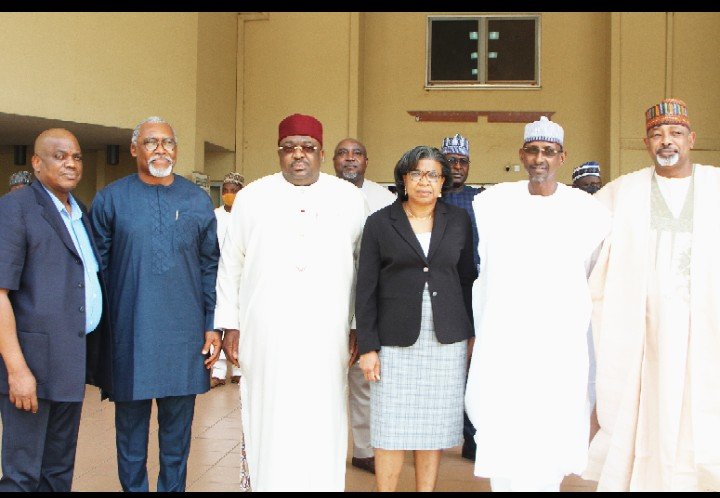
 University teachers under the auspices of the Academic Staff Union of Universities (ASUU) have began a 30-day “comprehensive and total” strike.
 The Nigeria Police Force has thrown more lights on the activities of members of the international narcotic cartel for which the embattled Abba Kyari, a suspended Deputy Commissioner of Police, has just been arrested and being detained.



Supreme Court And Executive Order 10: Matters Arising, Bye Ruben Abati
Many commentators have so far tried to be diplomatic in their response to the ruling, but from the outcome as reported, it is not difficult to see that what the Supreme Court has done is to take a technical view of the matter and offer a strict interpretation of the Constitution, the powers of the President, the relationship between the states, and the limits of the Federal Government in the exercise of its powers as spelled out in the 1999 Constitution. Did the President of Nigeria actually act ultra vires? Justice Mohammed Dattijo, delivering the lead judgment declared that “This country is still a Federation and the 1999 Constitution it operates is a federal one. The Constitution provides a clear delineation of powers between the state and the Federal Government. The President has overstepped the limit of his constitutional powers by issuing the Executive Order 10. The country is run on the basis of the rule of law.” Okay. The law is what the judge says it is. The powers of the various tiers of government are defined in Sections 4, 5, and 6 of the 1999 Constitution pursuant to the doctrine of the separation of powers. Executive powers are vested in the President in Sections 5, 130, 132, 148(1), 151 such that in general, the President of Nigeria is one of the most powerful executives in the world invested literally with the status of a constitutional monarch. In Section 130 (2), he is actually described as “the \Head of State, the Chief Executive of the Federation and Commander-in-chief of the Federation.” The strong effect of the ruling by the Supreme Court in A.G. Abia and 35 ors vs. AG Federation is that there are limits to these powers, nonetheless.
By seeking to enforce and extend Section 121(3) of the 1999 Constitution, the President, in other words, encroaches on the right of state governments to receive money from the Federation Account on behalf of the state judiciary and legislature and transmit their share to them. Thus, the Federal Executive overreaches itself when it assumes it has the powers to strengthen Section 121(3) through what amounts to additional legislation. It is the duty of the legislative arm of government to make or amend laws under Section 6. EO 10 further amounts to an interpretation of the law by the Federal Government and that Executive arm of government acting as adjudicator. The powers in that regard belong to the judiciary under Section 6. So, while the EO 10 would have protected the judiciary against the rascality of state Governors riding roughshod over the judiciary and the legislature at the sub-national level, and the judiciary would have been a beneficiary of the order, their Lordships looked beyond benefit to the judiciary and took a strictly purist and technocratic view of the law. It would be wrong to assume that the judiciary has ruled against itself. If the Federal Government is allowed to overreach itself and the President permitted to usurp the functions of the legislature and the judiciary, that would be a prescription for anarchy and an endorsement of dictatorship.
The lead judgment emphasizes the rule of law, separation of powers, the limits of powers and the federal principle. I would like to see the state legislatures begin to perform their oversight functions, to call over-bearing Governors to order. The judgment has also been described as victory for the Governors. It is most ironic that these same Governors are benefiting from a principle they themselves do not respect, an emphasis on the rule of law they have no regard for. In various states, Nigerian Governors are worse than tyrants. They seek to control judges, bribe them, humiliate them and violate their independence and integrity. It will be recalled that in one state, Cross Rivers State to be specific, magistrates not too long ago – January 2021- carried placards and organized protests because their salaries had not been paid for 24 months and nothing had been done to provide them good working conditions. State Governors also intervene unnecessarily in the appointment of judges, and seek to compromise them. As for the State legislatures, state Governors preside over them remotely. They behave like messiahs with the control of everything else. State legislatures in Nigeria are in any case pathetic. The members behave like the Governors’ houseboys, especially when the Governor’s party has the majority in the House. I argue that although the 36 State Governors may have secured partial victory in the matter of EO 10 with the Federal Government, but they lack the right to claim any moral high ground.
The judex may never at any time go to court to sue the state Executive arm of government, that would be strange but the abuse of privilege by state Governors actually got so bad, that in 2015, the Judicial Staff Union of Nigeria (JUSUN) went on strike for two weeks. In 2020, they shut down the courts for 64 days. State Governments hurriedly signed a Memorandum of Action (MoA), the National Judicial Council also made an appeal before the strike was suspended. JUSUN asked for financial autonomy for the judiciary. The body insisted on compliance with the Constitutional provision which places the budgets of state judiciary as a first line charge on the Constitution. They have a point.. I would also like to see the state legislatures begin to perform their oversight functions, to call over-bearing Governors to order.
What the Governors do to Local governments is even worse. They rely on the powers of control conferred on the state government under Section 7 to render local councils totally ineffective. Governors decide on whether elections would hold at that level of government or not, and when they frustrate due process they appoint sole administrators or caretaker committees. They hide under the State-Local Government Joint Account and the associated committees to steal money meant for local councils. They get away with blue murder because nobody challenges them.
To put the matter in perspective, the Federal Government in 2019 introduced Executive Order 10 to correct the wrong being committed by the State Governors. It also introduced through the Nigeria Financial Investigation Unit (NFIU) a set of guidelines to ensure that state Governors would no longer withdraw monies meant for local council operations from the Joint Account (Section 162 (8)). Daylight robbery of local council resources is one of the reasons the local level of government is virtually dead. The big obstacle against the attempt by the Federal Government to enforce the fiscal autonomy of the local councils was again, the law. This is relatable to the minority judgment by Justice Uwani Abba-Aji who maintained that the EO 10 was in order “because of the hanky-panky and subterfuge played by state Governors against the independence and financial autonomy of state judiciary…This is not unconstitutional.” There has been a tendency to play down this minority view.
On Sunday as anchor of ThisDay Live: The Sunday Talk Show, I had tried to bring up the matter with one of my guests, the legendary Chief Robert Clarke, SAN. Chief Clark had admonished me not to even mention the judge’s name not to talk of offering a summary of his position. But Justice Abba-Aji enjoys the support of Professor Itse Sagay, SAN, who deserves to be quoted at some length: “I just read the judgment” he said. “I was out of the country. I just want to say broadly that I agree with Justice Abba-Aji, the minority judgment. The reason is that the constitution makes it clear that the legislative and judicial branches of state government are to get specific sums of money from what goes to the state. And if the state governors are not making them to have it, all that the executive order has done is to facilitate the implementation of the Constitution. And that is what executive orders are supposed to do. So, the Federal Government was right and I agree with the minority judgment entirely.” What are we dealing with here: form vs substance, the law as it is vs. the law as it ought to be? What is the minority opinion based upon? Was Justice Abba-Aji offering an opinion rather than a strict construction of the law as it is? But whatever it is, the Supreme Court is the apex Court of the land, and the majority decision carries the day, more so as it is focused on the very substance of EO 10.
The Nigerian President is empowered to give orders, and in this regard, there can be a recourse to Section 315(2) of the 1999 Constitution, but this particular section states clearly that the President can only act “in conformity with the provisions of this Constitution”, certainly not in breach of it. The Buhari administration has adopted Executive Orders, the first administration to do so in Nigeria in a manner that looks like a copy-cat imitation of the American Donald Trump’s Presidency. Within the first five months of his assumption of office in 2017, Trump had signed 37 EOs! But even in the US, Executive orders are administrative handmaidens to facilitate the execution of policies within the Executive arm of government, commands to Ministries, Departments and Agencies (MDAs) as instruments of management or to prepare a framework for proposals to the legislature, but certainly not an attempt by the Executive to usurp legislative and judicial functions. To date, the Buhari administration has proclaimed more than 10 Executive Orders. A close scrutiny may reveal that most of them would pass the test. These would include EO 1: on the promotion of transparency and efficiency in the Business Environment; EO 2: On Submission of Annual Budgetary Estimates by all Statutory and non-Statutory Agencies, including Incorporated Companies wholly owned by the Federal Government of Nigeria; EO 3: Support for Local Content in Public Procurement by the Federal Government; EO 4: On the Voluntary Assets and Income Declaration Scheme (VAIDS); EO 5: to promote local content in public procurement with science, engineering and technology components, and to prohibit the Ministry of Interior from issuing visas to foreign nationals whose skills are available in Nigeria; EO 6: on assets connected with corruption and other related offences; EO 7: On Road Infrastructure Development and Refurbishment Investment Tax Credit Scheme; EO 8: On Voluntary Offshore Assets Regulatory Scheme, EO 9: On Companies Income Tax. The problem with EO 10 as appropriately pointed out by the Supreme Court is its breach of constitutional provisions.
It seems to me therefore that Executive Orders are not necessarily in themselves bad; they are good only to the extent that they are in conformity with the basic law, that is the Constitution. Every affirmation of the supremacy of the rule of law is a good sign, but all parties concerned, including the apex court must be seen to be consistent accordingly, and prepared to embark on judicial activism, beyond narrow technicality, for public good, when required to do so. The ruling under review thus throws up more questions than answers: how do we truly ensure the independence of the co-equal parts of government? How do we prevent cynical elements from violating the laws of the land because it is expedient to do so? There are many Nigerians who believe that the 1999 Constitution is the biggest problem of Nigeria and that the Constitution needs to be replaced with a people’s Constitution forged and agreed upon under a democratic dispensation. They also think that for as long as Nigeria is unable to find the political will and the right political leaders to promote unity and national loyalty, so long would the lawmakers and the judex continue to talk about the rule of law in vacuo. In that sense, the Supreme Court ruling under review has not solved any problem. It is instead, a strong reminder, of the inchoateness of the Nigerian essence.