The World Bank has blacklisted 18 Nigerian individuals and firms for engaging in corrupt practices, fraud and collusive practices in its 2021 fiscal year.
A list of debarred individuals and firms was presented in a new annual report titled: World Bank Group Sanctions System FY21.”
The debarments were made by the World Bank Sanctions Board, World Bank Chief Suspension and Debarment Officer and the African Development Bank.
The debarments made by AfDB were recognised by World Bank, making the affected firms to be barred under cross-debarment policy.
Based on the World Bank Sanctions Board’s decision, Mr. Elie Abou Ghazaleh and Mr. Fadi Abou Ghazaleh, alongside their firm, Abou Ghazaleh Contracting Nigeria Limited, were debarred for six months for collusive practices.
Based on the decision of the World Bank Chief Suspension and Debarment Officer, a Nigerian firm, Swansea Tools Resources, was debarred for fraudulent practices for two years and 10 months.
Referred to under Sanctions Case No 651, it was disclosed that the firm misrepresented its past experience in its bid for a road maintenance contract.
The report read in part: “The SDO determined that the respondent, a Nigerian firm, engaged in a fraudulent practice by misrepresenting its past experience in its bid for a road maintenance contract under a state employment and expenditure project in Nigeria. The SDO imposed on the respondent a debarment with conditional release for a minimum period of two years and 10 months. As a mitigating factor, the SDO considered the respondent’s limited cooperation with investigators, noting that the respondent produced documents and agreed to be interviewed but did not accept responsibility for the misconduct.”
Another Nigerian firm, Juckon Construction and Allied Services Nigeria Limited, was debarred for corrupt practices for three years. Referred to under Sanctions Case No 649, it was disclosed that the firm made improper payment to a public official.
The report read: “The SDO determined that the respondent, a Nigerian firm, engaged in a corrupt practice by making an improper payment to a public official in connection with the award and/or execution of two waste management and refuse collection contracts under a state employment and expenditure project in Nigeria. The SDO imposed on the respondent a debarment with conditional release for a minimum period of four years.”
A Nigerian, Ms. Okafor Glory, was debarred for fraudulent practices for four years, while the firm involved, Unique Concept Enterprises, was debarred for five years for same reason.
Another Nigerian firm, Asbeco Nigeria Limited, was debarred for five years for corrupt practices.
The matter which involved Ms. Glory and the firm, Unique Concept Enterprises, was presented under Sanctions Case No 691.
It read in part: “The SDO determined that the respondents, a Nigerian firm and a Nigerian citizen, engaged in fraudulent practices by submitting false documents in connection with two refuse collection and disposal contracts under a state employment and expenditure project in Nigeria. In particular, the SDO found that: (i) the corporate respondent submitted a falsified income tax clearance certificate in its bids for the contracts; and (ii) both respondents submitted a falsified advance payment guarantee in connection with the execution of one of the contracts.
“The SDO imposed on the corporate respondent a debarment with conditional release for a minimum period of five years. On the individual respondent, the SDO imposed a debarment with conditional release for a minimum period of four years. As aggravating factors, the SDO considered that (i) the corporate respondent engaged in a repeated pattern of misconduct, and (ii) the individual respondent was the managing director of the corporate respondent.”
The matter which involved Asbeco Nigeria was presented under Sanctions Case No 675.
It read in part: “The SDO determined that the respondent, a Nigerian firm, engaged in corrupt practices in connection with an erosion control contract under an erosion and watershed management project in Nigeria. Specifically, the SDO found that the respondent (i) made a payment of N2m (approximately $12,000) to the project’s engineer to influence his actions in connection with the procurement and/or execution of the contract, and (ii) made a facilitation payment of N50,000 (approximately $160) to the project’s cashier to influence her actions in connection with the execution of the same contract.
“The SDO imposed on the respondent a debarment with conditional release for a minimum period of five years. In determining this sanction, the SDO considered as aggravating factors the respondent’s (i) engagement in a repeated pattern of corrupt activity and (ii) interference with INT’s investigation, noting in particular that the respondent engaged in acts intended to materially impede the exercise of the Bank’s contractual audit rights.”
Based on the World Bank’s Sanctions Board Decision, A.G. Vision Construction Nigeria Limited, was debarred for fraudulent practices and collusive practices for four years and six months.
Not included in the report is a recent debarment of a Nigerian consultant, Mr Salihu Tijani, who is a consultant for the National Social Safety Nets Project, a project designed to ensure that cash is transfer to poor and vulnerable households in Nigeria.
Tijani was barred for 38 months for engaging in corrupt practices.
Aside from the firms mentioned so far, there are some firms that were debarred by other multilateral organisations under cross-debarment, which makes them debarred by the World Bank.
Sangtech International Services Limited, Sangar & Associates (Nigeria) Limited, Mashad Integrated And Investment Co Limited, and Medniza Global Merchants Limited were debarred by the AfDB two years under cross-debarment recognised by the World Bank.
ALG Global Concept Nigeria Limited, Abuharaira Labaran Gero, Qualitrends Global Solutions Nigeria Limited, and Maxicare Company Nigeria Limited were debarred by the AfDB for three years under cross-debarment recognised by the World Bank.
In his opening message in the report, the World Bank Group’s David Malpass, stated that the bank had granted over $157bn to assist developing countries, as he emphasised the need for integrity and transparency standards in public finance.
“Since the beginning of the global pandemic, the World Bank Group has deployed more than $157bn in critical assistance to developing countries. The crisis has required us to be rapid and innovative in mobilising this historic support.
“Yet, for these resources to have the needed development impact on the hundreds of millions of people who live in extreme poverty, we must ensure that resources are used efficiently, effectively, and for their intended purposes. And that means remaining vigilant to the scourge of corruption and ensuring that we promote the highest integrity and transparency standards in public finance,” he said.
He further highlighted some of the consequences of corruption, which he said could be devastating.
“The negative impacts of corruption on lives and livelihoods are well known. Corruption diverts scarce development dollars from the people who need them most and corrodes the systems and services that are integral for reducing extreme poverty.
“Entrenched corruption also comes with greater economic costs for countries, as it distorts public expenditures and leads to inefficient allocations of financing away from productive investments toward rent-seeking activities. And corruption increases the costs of doing business and deters foreign investors from entering new markets.
“As the world moves toward recovering from the pandemic’s damaging impacts, these costs can also restrict the private sector, which plays an important role in revitalizing economic growth and development in our client countries,” he added.thanks
The Central Bank of Nigeria (CBN) has kick-started the digital currency, known as Central Bank Digital Currency (CBDC) with N500 million, to be operated by 33 banks in the country.
The apex bank’s Governor, Godwin Emefiele, who spoke today, October 24 when President Muhammadu Buhari formally launched the digital currency at the Presidential villa in Abuja, confirmed that 33 banks have been fully integrated into the platform.
Emefiele said that N200 million has been issued to financial institutions and that 2,000 customers and 120 merchants have successfully registered on the eNaira platform.
“Customers who download the eNaira Speed Wallet App will be able to perform the following: onboard and create their wallet; fund their eNaira wallet from their bank account; transfer eNaira from their wallet to another wallet and make payment for purchases at registered merchant locations.”
Emefiele assured that the CBN would continue to refine and upgrade the eNaira.
Nigerians without BVN can access the eNaira. The digital currency can also be accessed without the internet using USSD.
Emefiele said that the eNaira will be deployed for the “onboarding of revenue collection agencies to increase and simplify collections and the creation of sector-specific tokens to support the Federal Government’s social programmes and distribution of targeted welfare schemes in a bid to lift millions out of poverty by 2025.
The CBN Governor explained that eNaira is Nigeria’s CBDC and it is the digital equivalent of the physical Naira.
”As the tagline simply encapsulates, the eNaira is the same Naira with far more possibilities. The eNaira – like the physical Naira – is a legal tender in Nigeria and a liability of the CBN. The eNaira and Naira will have the same value and will always be exchanged at 1 naira to 1 eNaira,” he said.
Emefiele added that the CBN has given careful consideration to the entire payments and financial architecture and has designed the eNaira to complement and strengthen these ecosystems and has implemented secure safeguards and policies to maintain the integrity of the financial system.
He pledged that there would be strict adherence to the anti-money laundering and combating the financing of terrorism (AML/CFT) standards in order to preserve the integrity and stability of Nigeria’s payment system.
According to Emefiele, since the eNaira platform went live, there has been overwhelming interest and encouraging response from Nigerians and other parties across the world with over 2.5 million daily visits to the website.
He listed the following milestones:
”33 banks are fully integrated and live on the platform, 500 million has been successfully minted by the Bank, N200 million has been issued to financial institutions, over 2,000 customers have been onboarded and over 120 merchants have successfully registered on the eNaira platform.”
The CBN governor also used the occasion to commend President Buhari for making history, yet again, with the launch of the eNaira – the first in Africa and one of the earliest around the world.
He also dispelled fears on the nation’s foreign reserves, saying the reserves are strong and getting stronger by the day.
”Mr. President, as you make ground breaking reforms, there have been continuing debate on the true value of the Naira. Rather than worry today on the direction of the exchange rate, let us take a step back and analyze how we got here in the first place.
”Please recall that since the advent of the International Monetary Fund (IMF) led Structural Adjustment Programme (SAP) in 1986, and the introduction of the Second Tier Foreign Exchange (SFEM) market, the Naira has been on a one-way free fall from parity to the US Dollar in 1984 to over N410/USD today.
”Some 35 years later, we have not been able to achieve the many promises and objectives of that programme.
”Instead, what we have seen is widespread import dependency, which has wiped out most of our production and manufacturing bases and exported all our jobs in the process.
”What has happened to the massive textile factories across our nation such that we import almost all cotton products when we are rich in cotton?
”What has happened to our vehicle assembly plants across the nation such that we import most vehicles and have become a massive dumping ground for dying second-hand vehicles?
”What has happened to our rubber plantations through which we made the best tyres and rubber products in the world? What has happened to our groundnut pyramids? What has happened to our Cocoa farms? What has happened to our palm oil mills?
”Under your leadership, Mr. President, we must stop this decline for good! We must return to massive homemade production; we must get our people working again. We must create the economic environment for massive domestic production and significant non-oil exports.
”As custodians of your national reserves, let me first assure you that there is no cause for alarm. Our FX reserves are strong and indeed getting stronger by the day, crossing the 40 billion USD mark, and is one of the highest in Africa – and growing.
”But we cannot fritter our reserves away on cheap imports and currency speculators. We must return to an employment-led growth anchored on productivity and rewarding producers of local goods, services, innovation and new technologies.
”If you consume cheap imports and export our jobs, we will make you pay dearly; but if you produce locally – with little or no foreign inputs beyond machinery, we will support you, and the markets will reward you abundantly,” he said.
Launching the platform, President Buhari said that the introduction of the eNaira would enable the government to send direct payments to citizens eligible for specific welfare programmes as well as foster cross border trade.
President Buhari said that alongside digital innovations, CBDCs can foster economic growth through better economic activities, increase remittances, improve financial inclusion and make monetary policy more effective.
”Let me note that aside from the global trend to create Digital Currencies, we believe that there are Nigeria-specific benefits that cut across different sectors of, and concerns of the economy.
”The use of CBDCs can help move many more people and businesses from the informal into the formal sector, thereby increasing the tax base of the country.”
The President said with the launch of eNaira, Nigeria has become the first country in Africa, and one of the first in the world to introduce a Digital Currency to her citizens.
He commended the Governor of the Central Bank, Godwin Emefiele, his deputies and the entire team of staff who worked tirelessly to make the launch of Africa’s first digital currency a reality.
The President, who assured Nigerians of the safety and scalability of the CBDC system, said the journey to create a digital currency for Nigeria began sometime in 2017.
”Work intensified over the past several months with several brainstorming exercises, deployment of technical partners and advisers, collaboration with the Ministries of Communication and Digital Economy and its sister agencies like the Nigerian Communications Commission (NCC), integration of banking software across the country and painstaking tests to ensure the robustness, safety and scalability of the CBDC System.”
The President also used the occasion of the unveiling of the eNaira to painstakingly explain to Nigerians why he approved the use of the digital currency.
”In recent times, the use of physical cash in conducting business and making payments has been on the decline. This trend has been exacerbated by the onset of the COVID-19 pandemic and the resurgence of a new Digital Economy.
”Alongside these developments, businesses, households, and other economic agents have sought for new means of making payments in the new circumstances.
”The absence of a swift and effective solution to these requirements, as well as fears that Central Banks’ actions sometimes lead to hyperinflation created the space for non-government entities to establish new forms of “private currencies” that seemed to have gained popularity and acceptance across the world, including here in Nigeria.
”In response to these developments, an overwhelming majority of Central Banks across the world have started to consider issuing digital currencies in order to cater for businesses and households seeking faster, safer, easier and cheaper means of payments.
”A handful of countries including China, Bahamas, and Cambodia have already issued their own CBDCs.
”A 2021 survey of Central Banks around the world by the Bank for International Settlements (BIS) found that almost 90 per cent are actively researching the potential for CBDCs, 60 percent were experimenting with the technology and 14 per cent were deploying pilot projects.
”Needless to add, close monitoring and close supervision will be necessary in the early stages of implementation to study the effect of eNaira on the economy as a whole.
”It is on the basis of this that the Central Bank of Nigeria (CBN) sought and received my approval to explore issuing Nigeria’s own Central Bank Digital Currency, named the eNaira.”
The President said that his approval was also underpinned by the fact that the CBN has been a leading innovator ‘‘in the form of money they produce, and in the payment services they deploy for efficient transactions.’’
He noted that Nigeria’s apex bank has invested heavily in creating a Payment System that is ranked in the top ten in the world and certainly the best in Africa.
”This payment system now provides high‐value and time‐critical payment services to financial institutions, and ultimately serves as the backbone for every electronic payment in Nigeria.
”They have also supported several private‐sector initiatives to improve the existing payments landscape, and in turn, have created some of the world’s leading payment service providers today.’’
President Xi Jinping and other leaders of China at the Communist Congress
In a groundbreaking effort to explore the internal dynamics of, perhaps, the world’s largest political party, the Communist Party of China (CPC), a renowned African scholar on China studies, Charles Onunaiju revealed the rare historical-cum philosophical insights into the Party and the secret behind its phenomenal rise on the world stage.
At an event to mark the centenary of the founding of the Communist Party of China last July, the General Secretary of the party, which is also the President of the People’s Republic of China, Xi Jinping unequivocally stated that “the founding of a communist party in China was an epoch-making event, which profoundly changed the course of Chinese history in modern times; transformed the future of the Chinese people and nation, and altered the landscape of world development.”
The 255-page book: “A Century of the Communist Party of China: Why Africa should engage its experience,” chronicled the arduous journey of the China Communist Party and the mystery behind its success in eliminating extreme poverty amongst the 1.4 billion Chinese people, a feat that has sparked global debates.
The book
The author is able to rigorously examine the nexus between the party’s success and the role of Marxism-Leninism theory with its core fundamentals of dialectical-historical materialism as an instrument of scientific interrogation of the country’s existential reality and how the party’s leadership, from generation to generation, has consistently innovated and updated the theory in line with the emerging trends. Such analysis has made the book not only unique but a compelling treasure for Africa and other developing countries to explore.
The seven-chapter book, which is the first of its kind in recent time, offers deep perspectives from the continent about the Communist Party of China, and the need to apply theoretical interrogation to unravel the history and socio-cultural forces of any society. It no doubt, opens a new bank of ideas, particularly for African nations whose exposure and political orientation are largely shaped by the colonial legacies.
As a firm believer in China-Africa cooperation, the author dedicates a chapter in the book to explore the productive relationship between the two partners that has so far changed the landscape of the continent, especially within the last two decades. In the chapter, he advocates more experience-sharing between China and Africa, especially in the areas of party building, organization, and governance, even as he reflects on the weak nature of African states, occasioned by the negation of the continent’s historical process while continuously nurturing the colonial legacies that ensure that the continent remains at the “periphery of the metropolitan imperialist.”
The author regrets the deficit of thorough interrogation of our existential realities that should have provided opportunities to evolve home-grown socio-political frameworks that can address our peculiar challenges of infrastructure, of poverty, of poor leadership, of corruption, and of course, dearth of reasoning.
The book advises the African continent to turn its weakness into an advantage, by drawing inspiration from the formation of China’s Communist Party which quickly “took advantage of the industrial backwardness of the country and its lack of sizeable proletariat, and proceeded to build a formidable and reliable army of peasantry and with steady revolutionary devolution and integrity, mobilize the national and petty bourgeoise…to embark on socialist construction.”
It is pertinent to highlight a few key points which I considered as takeaways from the book, and hope it will help the readers to know the exact focus of the work, ahead of obtaining their copies.
First, the lifting of about 800 million people out of absolute poverty within the span of 40 years, culminating in the elimination of extreme poverty among the 1.4 billion Chinese people, shows that poverty is neither destiny nor fate to quietly live with, but a social scourge that can be eliminated with requisite political will and the right leadership.
It also shows that poverty elimination is not a humanitarian work, but a responsibility bequeathed by leader to leader. The book is clear that “before the final conquest of poverty in China, over 3 million public sector officials were dispatched from all nooks and crannies of the country to combat the scourge on the frontline.”
It pontificates the fact that any vision of human progress without proper theoretical examination or guide to understand and deconstruct the internal contradictions is susceptible to failure or destined to produce poor results. This is particularly evident in the over three decades of adoption of liberal competitive multi-party democracy in many African states with periodic elections that had consistently yielded nothing significant. Instead, what have been coming out are poverty, unending social disorder, violent conflicts and swirling crimes.
It reveals that the concept of “democracy” is best defined or practiced by the individual country’s historical and social fabric, not by any universal standard or model.
The book also uncovers that the Chinese political model cannot be mechanically replicated anywhere in the world, but can serve as a useful guide for any nation that is ready to evolve a homegrown political system.
That China had gone through similar or worse challenges African nations have gone through or are still going through.
China had experienced the combined oppression of foreign capitalist and domestic feudal forces, and of late, corrupt party officials, which the current leader, Xi Jinping has vigorously fought and purged. The country had witnessed what Xi described as “innumerable hardships.”
The myth of China’s so-called miracle is by no means extraordinary, but came about as a result of a common resolve and continuous toil of its people with the party’s leadership at its core of extracting the facts from the truth.
As a matter of fact, while the book is not exhaustive of the party’s one-hundred year’s history, as acknowledged by the author, the work, no doubt, laid bare in a concise manner, the major events that shaped the party’s trajectories and, ultimately the country’s destiny. From its formative stage and liberation movement to the transformation era and, to its latest vision of shared prosperity for humanity, the material encompasses numerous important lessons that can provide a leeway for Africa to address the challenges of continent, and Nigeria in particular.
Of course, a short piece of this nature cannot sufficiently review all the vital points skillfully and succinctly put forth in this well-researched and in-depth exercise, but this is just an attempt to provide a glimpse of what to expect by readers.
As a matter of fact, the book is rich, handy, profound and is rendered in a lucid language.
I humbly recommend this book, particularly to African policymakers, political leaders, scholars, students, journalists and many other categories of people that are seeking for knowledge. The book should be made available in all Libraries of Nigerian universities.
I congratulate and commend the author for vigorously exerting himself in expanding the frontier of knowledge in Africa and beyond.
The Economist is correct: Nigeria faces four key threats to the stability and prosperity of the nation – namely: ISWAP/Boko Haram terrorism in the North-East; kidnapping and crime in the North-West; herder-farmer disputes in the central belt; and the delusions of IPOB terrorists in the South-East.
The Economist is also accurate to state that they have come to a head under President Buhari and the All Progressives Congress, (APC) administration. Yet they do so, because for so long, under previous administrations, whether military or democratic, tough decisions have been ducked, and challenges never fully met – with the effect of abetting these dangers and allowing them all to fester and grow. Today, all four threats are being fought concurrently and it is only this President’s administration which has finally had the will and determination to confront them.
The Buhari administration has sought to push back terrorism which has been a threat for more than two decades since the first emergence of Boko Haram. It is only the Buhari administration that has now sought to intervene against the kidnapping and banditry that has been a simmering threat for far longer. It is only this President’s government which has taken on IPOB, the violent terrorist group which bombs police stations and offices of security agencies, while also threatening those who break their Monday-sit-ins whilst claiming the mantle of forebears who half a century ago fought a civil war. And it is only the Buhari leadership which has sought – ever, in over one hundred years – to identify the root causes of the herder-farmer clashes and find durable solutions.
The forms may have altered, and the threats posed by each may have waxed and waned, but what has been constant is that administration after administration since independence – whether military or democratic – none sought to fully address these threats to Nigeria as President Buhari’s government does now.
Today, the military is engaged in almost all the states of Nigeria because the President has insisted upon addressing these decade-after-decade-long issues during his time in office.
In the North, Boko Haram members – many of whom now fight under the breakaway banner of Islamic State’s West Africa Province (ISWAP) – have been pushed back. At the start of the President’s tenure, Boko Haram was launching attacks across the majority of the country – including in southern states and Lagos. Today they are cornered and confined along with their ISWAP compatriots in our country’s outermost fringes of the border, unable to spread further.
In the South-East, IPOB – which the Economist rightly describes as “delusional” – the arrest and present trial of the terrorist leader of the group is the beginning of its demise. The President’s administration is redoubling efforts to have IPOB rightfully designated as a terrorist group by our allies outside of Nigeria – an act which will collapse their ability to transact gains from crime and extortion in foreign currencies. It is important to remind the Economist and the global media that this group’s aggression and widespread presence on social media does not reflect their public support, for which they have none: all elected governors, all elected politicians and all elected state assemblies in the South-East – which IPOB claim to be part of their fantasy kingdom – reject them completely.
The only government of Nigeria which has ever sought a solution to the centuries-old herder-farmer disputes of the central belt is President Buhari’s administration. The Federal ranches programme, launched shortly after the President’s re-election is the first of its kind – and it is working: during the last 12 months clashes have significantly reduced. The government now calls on State governors to have the imagination to join forces with the Federal administration and expand this programme by making available state lands for those interested, now that its effectiveness has been demonstrated.
The Economist opinionated and reported on banditry and kidnapping in the North-West. While this has been simmering for generations, it is the newest of the organized threats Nigeria faces to her stability. But this too the Economist inaccurately described: “bandits” who have the resources and technology to shoot down a military fighter jet are not bandits at all – but rather highly organised crime syndicates with huge resources and weaponry.
Yet they are essentially no different to Boko Haram in this regard who are now cornered. It will take time, but the President is unwavering in his determination to collapse this challenge to public order.
The Economist is correct: Nigeria faces multiple threats. They confluence now not because of this government; but on the contrary, it is this government which is addressing them concurrently, and simultaneously – when no other prior administration sought to adequately address even a single one. That is the difference between what has gone before and what we have now. It is why the President and his party were re-elected with’ an increased majority in national elections two years ago.
Garba Shehu is Senior Special Assistant to the president on media and publicity
Chairman of the Presidential Advisory Committee Against Corruption (PACAC), Professor Itse Sagay (SAN), has advised Kogi State Governor, Alhaji Yahaya Bello to wait till 2031 if he wants to aspire for the Presidency of Nigeria.
According to Sagay, the ruling All Progressives Congress (APC) would not need a young man like Yahaya Bello as its presidential candidate in 2023.
Speaking with DAILY INDEPENDENT today, October 24, Professor Sagay insisted that the party must field a Southerner as candidate in the 2023 election, even as he told Yahaya Bello that the only highest position he can aspire for in 2023 is Vice- Presidency.
Professor Sagay, who is also chieftain of the APC said that the claim by the governor that Nigeria needs a youth as president does not apply to him as there are abundance of young people in the Southern part of the country.
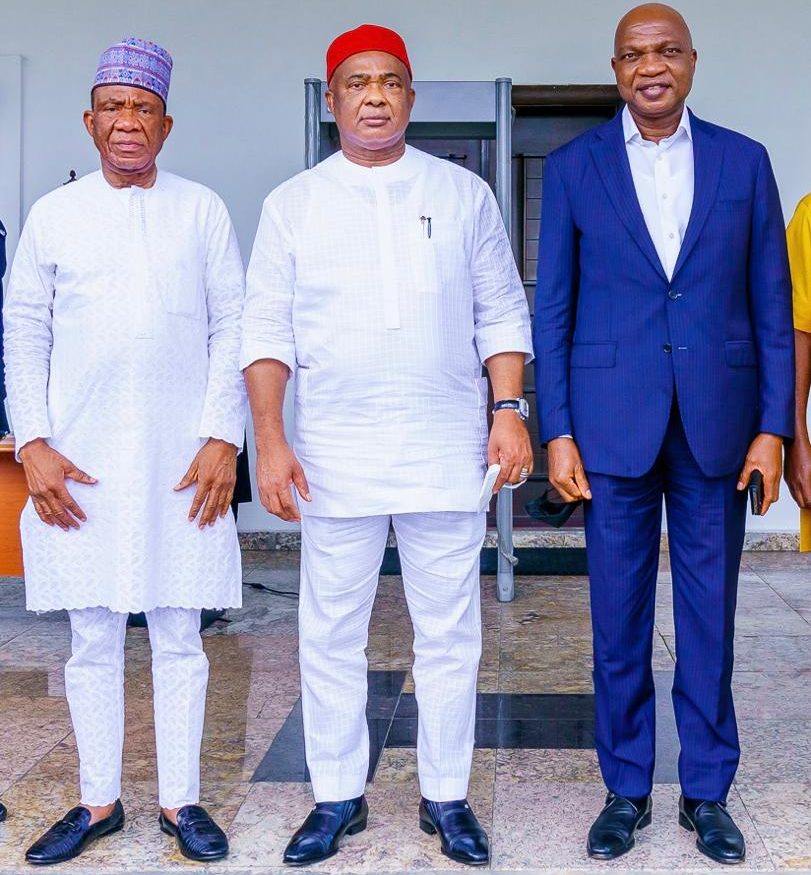
Governor Hope Uzodinma of Imo State (in the middle) poses with the industrial shakers in the State: Mr. Osagie Okunbor, Managing Director of Shell (right), and Chief (Dr.) Leemom Ikpea, Executive Chairman of Lee Engineering and Construction Company (left), shortly after a security meeting the governor had with them yesterday, October 23 in Owerri, the State capital.
The Nigerian Minister of Women Affairs, Mrs. Pauline Tallen has vowed that her ministry, working in conjunction with others, will work hard to put a stop to practices that jeopardize the health of female children and impugn on the dignity of female gender in the country.
She complained that despite advancement in technology and extant laws, Nigeria still remain one of the few countries in the world with high rate of Female Genital Mutilation (FGM) cases.
She said that such harmful practice persists in spite of a number of reforms and laws to curb the trend.
The Minister, who spoke on the sidelines of various activities to commemorate the 2021 International Day of the girls child in Abuja, Nigeria, further decried the general, increasing cases of Sexual and Gender Based Violence (SGBV) against women and girls in spite of the domestication of extant laws in the country.
Paulline Tallen said: “although government has undertaken a number of health reforms, including laws against harmful traditional practices, many cultural and religious practices still put the health of women in doldrums.
“I wish to state that the ministry is committed to abolishing all traditional practices that endanger the health and dignity of girls and womanhood in Nigeria and in this regard, will work more with the Ministry of Health.”
She said that violence and harmful practices endanger the lives of women and girls, hence the need for all states of the federation to domesticate laws and implement them to serve as deterrent and eliminate it in totality.
According to her, in spite of government and partners’ positive interventions, high and community level advocacy, capacity building of circumcisers, including provision of alternate income for circumcisers, the practice of FGM still persists.
She, therefore, urged stakeholders to support girls and women and ensure the implementation of all enacted policies/laws on ending SGBV and harmful practices.
In an interview too, the Founder of Hope for Second Chance Foundation (HOSEC), an NGO, Mrs. Ibukunoluwa Otesile said that the culture of silence by survivors and their families impedes success in eliminating SGBV and harmful practices in the country.
“The culture of silence is one of the things that has continued to endanger violence against women and children in Nigeria. The culture makes it difficult for the tools that the government has put in place to actually work. If people refuse to speak out against it when it happens, there is nothing government can do about it.
“It goes beyond just having the instruments and the laws; we as a people must criminalise every form of violence against women, girls and children, particularly sexual violence so that we don’t have situations where they will say we will go and settle in the family.
“It is not something that should be settled, it is a crime against the state and it should be attended to as such.”
On her part, Amarachi Chukwu, the Assistant Programme Officer, International Federation of Women Lawyers (FIDA), said the establishment of special courts to handle GBV cases would help to expedite prosecution of cases and ensure survivors got justice, which would serve as deterrent to others.
She added that “the more such cases are delayed, the more traumatised the survivor becomes. But as soon as the survivor gets justice, they get better.” Source: NAN.
The UN General Assembly, in its resolution 62/16 of December 18, 2007, designated October 15 as International Day of Rural Women to recognise and celebrate the achievements and struggles of the female gender toward improving their lives, their families’ and communities.
The day is annually celebrated around the globe to bring to the fore, the critical roles and contributions of rural women, including indigenous women, and has “Rural Women Cultivating Good Food for All” as its theme for 2021.
The invaluable contributions of rural women to development in many countries of the world cannot be over-emphasised.
The contributions are seen in the crucial roles they play in sustaining rural households, accounting for a substantial proportion of the agriculture labour force, including informal work, and perform the bulk of unpaid care and domestic work.
In most African countries including Nigeria, even when rural women farmers are productive and enterprising as their male counterparts, they are less able to access land, credit, agricultural inputs, markets, and high-value agrifood chains and obtain lower prices for their crops.
Structural barriers and discriminatory social norms have also continued to constrain women’s decision-making power and political participation in rural households and communities, hence, women and girls in rural areas lack equal access to resources and assets.
The female gender also lack equal access to public services, such as education and healthcare, including water and sanitation, while much of their labour remains invisible and unpaid, even as their workloads become increasingly heavy due to the out-migration of men.
Globally, with few exceptions, every gender and development indicator for which data are available reveals that rural women fare worse than rural men and urban women, and that they disproportionately experience poverty, exclusion and the effects of climate change.
On what rural African women and girls can gain from the commemoration of the international rural women day, the African Union Commission (AUC) Department of Agriculture Rural Development, Sustainable Environment and Blue Economy (DARBE), organised a virtual meeting on Oct. 15 to celebrate women, where participants agreed that rural women constitute one-fourth of the world’s population.
The African Union also agreed that rural women play critical roles in national economies of most African countries as they engage in crop production, livestock care, fetch fuel and water for families, predominantly labour providers in agri-businesses and agro-industries, and as such, they should be recognised and be included in decision-making processes at all levels of governance and in rural settings.
The union says economic empowerment of rural women is key, and that if given equal access to productive resources, agriculture yields will rise and will substantially reduce hunger in Africa.
Some of the objectives of the virtual meeting are: to share lessons and experiences for enhancing land rights that can promote women’s contribution to building sustainable food systems, increase awareness on the need to enhance agricultural mechanisation for women “so as to retire the hoe to museum”, as well as recommend practical and operable solutions to challenges facing rural women in food systems and agricultural trade.
On its part, UN Women highlighted the roles played by rural women and girls in sustaining communities, societies and nations.
The body noted that the International Day of Rural Women offers renewed opportunity to commit to different ways of organising the world to the recent UN Food System Summit so that rural women benefit equally from their productivity, with good food enjoyed by all.
In Nigeria, late Maryam Babangida, wife of former President Ibrahim Babangida, deepened the quest for improved living conditions for rural women and girls through the launch of the Better Life Programme for the (African) Rural Woman in 1987.
Prior to the launch, Babangida held consultations with stakeholders such as the Directorate for Food and Rural Infrastructure and women organisations about economic and social constraints affecting rural women after visiting Igbologun and Ilado-Odo villages in Lagos in 1986, where she found out that the villages had no clean water and power distribution infrastructure and decided that actions should be directed toward rural development.
In 1987, a workshop on the role of rural women in development was held in Abuja, which led to the establishment of the Better Life for Rural Women programme, conceived to have direct impact on the lives of rural women, described as the most sidelined, poorest and therefore the most vulnerable in African nations.
The objectives of the programme were to reduce maternal and child mortality by increasing basic healthcare facilities for women, provide income generating opportunities in agriculture and cottage industries, to integrate rural women into national development plans and develop education training for women.
However, the programme did not go far and had to stop due to change in government in the country.
Maryam Babangida also established the National Commission for Women in Nigeria and the Maryam Babangida National Centre for Women Development in Abuja.
She left indelible footprints on the sands of time and a legacy of inestimable value.
Meanwhile, on the occasion of the 2021 International Day of Rural Women, the Federal Government poured encomiums on Maryam Babangida, Founder of the Better Life for Rural Women programme at the launch of “Her Majesty”, a 15-minute film designed to chronicle and amplify the struggles, challenges and contributions of the Nigerian rural woman.
The Minister of Women Affairs, Dame Pauline Tallen, who eulogised the late Babangida for her efforts toward assisting rural women to get better lives, noted that the 15-minute film was to honour women who played significant roles in economic development through food production, building agriculture and rural development.
As women from all walks of life converged on Abuja on Oct. 15 to mark the rural women day and launch of the film, Tallen also commended Hajiya Aisha Babangida, the daughter to Maryam Babangida and Chairperson, Better Life Programme for the African Rural Women, for putting together the initiative aimed at promoting the welfare and rights of rural women.
She lamented that the problems of rural women were compounded by the outbreak of the COVID-19 pandemic, noting that “it is no gainsaying, that rural women are the key agents for development. They play catalytic roles toward achieving transformational economic, environmental and social changes required for sustainable development.
“Rural women and girls ensure food production and form a large proportion in agricultural workforce, yet they face persistent cultural and structural constraints that prevent them from enjoying their human rights and hamper efforts to improve their lives as well as others around them.”
She said that the ministry had in the last one year collaborated with relevant organisations to provide relief assistance including food and hygiene materials (washable face mask, detergent, bathing soap, sanitizer etc.) to about 3,060 households/vulnerable women and girls worst affected by the COVID-19 in the six-geo-political zones and the FCT.
The ministry is also implementing the second phase of Presidential National Cooking Gas Project Cylinders distribution and Economic tree planting project in additional 15 states to reduce deforestation, drudgery and health hazards among rural women, she added.
She assured the readiness of the ministry to continue to give necessary push and support policies and programmes that would uplift the status of rural women.
Tallen also called on public-spirited individuals and organisations to support digital technology, improved and better amenities for rural women with a view to reducing poverty and enhance their status.
She urged affluent women to assist fellow women, especially those in rural areas, to have better lives.
On her part, Aisha Babangida called for synergy among humanitarian Non-Governmental Organisations to harmonise operations to make the desired impacts on the lives of the underprivileged rural women.
The goal, she said, was to create awareness of the crucial roles women play in the society in ensuring food and nutrition security, eradicating poverty and most especially improving the well-being of rural women and girls.
In a remark, the Director-General, National Centre for Women Development (NCWD), Asabe Vilita-Bashir, lamented the increase in hunger, malnutrition and food insecurity mostly affecting women.
According to her, climate change and insecurity, banditry, farmer/herdsmen clashes, compounded by the COVID-19 pandemic has further worsen the situation of food security in Nigeria and rural women are the ones most affected.
She said “the NCWD has continued to uphold the tenets of its initiator to advance issues and concerns of rural women and ensure food security for women. The centre promotes the livelihood and wellbeing of rural women through its Women Development Centres Activation Project at the 774 local government areas of the federation.”
In conclusion, there are many things government can do to help rural women and girls to enjoy better lives, as other citizens and NGOs also offer assistance to uplift their status.
Countries can support rural households, especially women and girls, to cope with high food prices by putting in place or expanding food assistance and social safety net programmes that take into consideration men and women’s different roles and responsibilities within households and the different behaviours they adopt in times of crisis.
Through food assistance schemes, governments can provide households with food rations to compensate for lacking food supplies. This includes giving households food stamps or vouchers that people can exchange for food, implementing school feeding programmes where meals are given to children in school, and food-for-work programmes where people are given food rations in exchange for work on public projects like building roads.
Social safety net programmes also work, except that they provide households with cash to buy food and other necessities instead of food rations. These programmes include cash transfers where governments give periodic payments to households, and public work programmes, similar to food-for-work programmes, except that they compensate people in cash.
Food assistance programmes are advantageous for rural women who are traditionally responsible for obtaining food and ensuring good nutrition for the family. These programmes may reduce women’s need to take on additional work to earn more income to buy food and, in some cases, increase their decision-making power in the household.
School feeding schemes are also helpful because they motivate parents to keep children in school in times of crises, ensuring that they receive the nutrients they need and maintaining their chances at better opportunities later in life. These schemes are particularly important for girls, who tend to be pulled out of school before boys.
Cash transfers are also instrumental in supporting women, especially when the transfer is directed to them, and public work programmes that are designed to include them have many beneficial effects, including improving access to credit since their participation in the programme is often viewed as a guarantee of repayment.
By building programmes that take into consideration rural women and men’s differentiated needs and resources, governments can better strengthen rural communities’ resilience and ability to cope with high food prices and food price sparks in the long run, reducing the burden on rural women and girls, which at the end, will help them to do other things toward achieving their desires in life. International Day of Rural Women and its benefits to Nigerian rural women and girls. (NANFeature)
Afghanistan is no stranger to invasion and occupation as it’s not so recent history has clearly shown. Paradoxically it is also no stranger to purging out invaders as shown in its not-too-distant history. Perhaps this explains why it has been dubbed the graveyard of the ‘West’. For a country and people that have witnessed the rise and exit of global empires, from British colonialism through to the era of Soviet or Russian Invasion and climaxed by the farce on war on terror by the United States, little wander at the scenes of sweet-bitter episodes on the streets of Afghanistan at the exit and withdrawal of the self-acclaimed world policeman.
The multiplicity of views from our highly opinionated society from where we are being inundated with perspectives on who the victim is in the scheme of things in Afghanistan, has thrown up more answers than there are questions. This merry-go-round has created a worldview whereby those who are being decimated and subjugated are now tagged oppressors while the real culprits are on the loose.
But then again, do I know as much as I think I do? Am I also culpable of my libel of an opinionated world? Are there really more answers than there are questions in the scheme of things in Afghanistan? Is there really a winner in the Afghan war?
There are multiple of variables with which to address the above posers and one of them is from an age long quote in journalism that “he who follows the money always uncovers the path it leads. Following the money, whether in the stock or capital market, government dealings or even in a war” has proven time and time again to be revealing. So, to give flavour to our discussion, let’s take an economy or perhaps business class trip into Afghanistan.
Following the money into Afghanistan has shown that about 2.26 trillion dollars is what the US was alleged to have spent in Afghanistan, this is about 300 million dollars a day. While successive US administrations keep paying lip service to transparency in its dealings with tax payers’ monies, it is yet to be known, where the money went! It is an obvious fact the ordinary Afghans have little or zero knowledge as to the skirmishes and sophistry of how these monies exchange hands. Clearly so, as an average Afghan survives on less than 2 dollars a day, while his life and livelihood is being plunged, plundered and devastated while the money turns around back into the US economy. How? one might ask! Through the schisms of defence companies and contracts of course! The reality of the matter is that the US basically outsourced the Afghan war, while they, quote and unquote funded it, the work on the ground was being orchestrated by crony private companies, companies that dealt with the entire military circle from supply of vehicles, ammunition, and everything from the bandages to the bullets. Remember the indictment on Hilary Clinton on monies spent in defence and other contracts in Iraq and Afghanistan, under her Vice Chairperson-ship at the Council for Foreign Relations? Talk about a revolving door!
The ordeal being recounted by John Perkins in his memoire; The confessions of an Economic Hitman come to mind here, while the United States was funding the war in Afghanistan, the money never really left the US, it was used to pay US companies in US to plunder Afghanistan. The beauty with keeping records is; when the time comes the culprits will be faced with the receipt of their actions and inactions, because where men will not speak records will.
Let’s then present numbers to support the above claims. The top 5 military contractors in the Afghan war are; Lockheed Martins, Raytheon, General Dynamics, Boeing and Northrop Grumman, a very quick google search will do the trick. The numbers are also quite astonishing as these companies got over 2 trillion approved by the US congress from 2001 until the US withdrawal. These were monies spent in propaganda and show of US military might in Iraq, Afghanistan, Syria, Yemen – through the back door, backdoor name withheld – and other needless war campaigns that ended in futility, leaving some to conclude that the US soldiers lost the Afghan War, but most to conclude that the US businessmen and elites, not so much. Because right after 9/11military stocks in the US saw an unprecedented surge of almost over 1000 percent. Could this support the claims that the war lingered on and seemed almost frozen, because a forever war equals a forever profit? Again, we are just asking questions and seeking answers!
While the US elites and its Pentagon cronies keep telling the world they flooded Afghanistan with US armies, the reality is that they actually flooded the Afghan space with US mercenaries, US technology and US killing machines. Let’s present another receipt; remember when Julian Assange made the statement that ‘the goal isn’t to subjugate Afghanistan, but rather to use Afghanistan to clean American taxpayers’ money clearly being laundered by the American elite structure and back into their hands’? Well, that never evaded the memory of some of us.
SIGAR, the body setup by the US to ‘reconstruct’ Afghanistan in 2018 published a report that over 50 billion US dollars had gone missing, how? I guess we will have to follow the money to find out. But one thing is for sure, billions of dollars, flouted around without scrutiny, without oversight and without recourse to the Afghan people, because they gained nothing from it. However, the withdrawal of the US and the return of the Taliban as the legitimate government in Afghanistan signals the dawn of a new era, one that regardless of all criticism has come to stay and must be reckoned with. What seem apparent in the debate and rancour of whether a Taliban rule is ideal for a 21st century Afghanistan is that an independent sovereign entity is now be governed by its own people, good or bad. The outrage on the so-called infringement on women right by the so called woke community is the text book definition of hypocrisy, particularly coming from the same people who looted, robbed and rapped the Afghan people and their economy and bleed it dry.
First it was the British colonizers and when they left, the Afghan people and the world applauded and screamed freedom! Then it was the Russians – under the guise of a monster they created that left 61.8 percent of Afghanistan’s hooked on opium. A matter to be discussed on another date – Again when they withdrew the Afghans screamed freedom! Now that it is the turn of the US why does the world expect a reverse? This smoke screen isn’t going to hold for too long. If it is one thing I am certain about and further proven by this long and almost frozen invasion, it is that history has and will always be on the side of the oppressed. But then again who is the oppressed in this case? And who really did win the Afghan war?
Nigerians from the South-West zone have decried the rising cost of food items and cooking gas, calling on the Federal Government to swiftly intervene and address the situation.
Speaking in separate interviews with the News Agency of Nigeria (NAN) in Kwara, Osun, Oyo and Ogun, they complained that the cost of food items and cooking gas had soared beyond the reach of the masses.
In their contributions, they, however, offered the likely solutions to the situation, which they described as disturbing.
Dr. Olufemi Oladunni, the Executive Director, Agriculture and Rural Management Training Institute (ARMTI), urged Nigerians to embark on farming as a way of checkmating the high cost of food items.
Oladunni advised the government to encourage more Nigerians to go into farming by subsidising agricultural inputs and ensure that only qualitative and standard inputs were available in the markets for farmers to buy.
He said that ARMTI had been engaging in the training of youths in various areas of agribusiness to make them, not only self-employed, but employers of labour.
According to him, beneficiaries also enjoyed starter packs, valued at N200,000, to enable them to start their own businesses.
Oladunni, calling for improved security situation, said that many farmers had been displaced and unable to go to their farms due to the challenge of insecurity in the country.
Also, Prof. Olubunmi Omotesho of the Department of Agricultural Economics and Farm Management, University of Ilorin, urged government to put in place machinery to ensure that small scale farmers have access to agricultural resources, markets, land, finance, infrastructure and technologies.
Explaining that approach to economic development must be modern, focussed and in tune with global trends, he called for social security schemes for farmers and agricultural product protection policies.
“There should also be provision of credit facilities to small scale farmers and incentives for agricultural financial institutions among others,” Omotesho said.
Commenting, Mrs Bolanle Bamidele, decried the rising cost of foodstuffs and cooking gas, saying that it had kept reducing their profit margin.
Bamidele, who sells beans and noodles, told NAN that a cooking gas of 3kg, formerly sold at N1,000, is now N1,950 at 650 per kg.
According to her, both beans and noodles, in addition to the ingredients used in preparing them, have become too expensive.
”Since I was born, I have never bought beans at the price we are buying now. The prices of noodles, groundnut oil and pepper are nothing to write home about, either.
”I just pray that everything gets better, because we are just selling now to keep body and soul together, not that it is profitable again,” Bamidele said.
Another food seller, who simply identified herself as Mummy Semilanu, said that her customers had reduced greatly.
“They have been complaining of not getting enough food served with their hard-earned money,” she said.
Also, an Ilorin-based legal practitioner, Mr Abdul Gegele, advised the three tiers of government to check the inflation by venturing more into agricultural produce.
According to him, insecurity is an hindrance to the national economic development, which had contributed to high prices of foodstuffs.
A house wife, Hajia Khadijat Jimoh, said she learnt that increment in Value Added Tax (VAT) and government tariffs had contributed to the increase in prices of foodstuffs, gas, building materials and other items.
Jimoh also identified ritual killings, banditry, kidnapping and clashes between farmers and herders as other factors that contributed to the high cost of food items.
“Farmers no longer go to farm; they are scared of being killed,” she said.
In his reactions, Alhaji Sulaimon Araokanmi, the Chairman, All Farmers Association of Nigeria (AFAN) in Osun, blamed the high cost of food prices to disrupted farming brought about by inadequate rainfall in 2020.
According to him, the little planting done by farmers in 2020 is what is providing the little foodstuffs in the market, except for crops planted early this year.
Araokanmi said that the 2020 draught, with the disruption of farming in the Northern region of the country, caused by insurgency and banditry, resulted in food shortage, as currently being experienced.
He said that naturally, food insufficiency always resulted in food scarcity, which would affect the prices of foodstuffs in the market.
Araokanmi, however, said that with constant rainfall being experienced in 2021, there should be food sufficiency and surplus next year, with the hope of reduction in price.
The chairman of the association implored the government to provide farmers with grants, funds, modified planting seeds, seedlings and chemicals to boost the nation’s food production.
Also, Mrs Muyibat Egbedele, a housewife, decried the outrageous prices of food items, saying that most of the food items had increased by 100 per cent.
Egbedele added that the annoying aspect was that the locally produced food items were also following the trend.
“It is even difficult to quote the prices of food items when going for shopping, as prices keep increasing everyday.
“Most increment in prices are artificial, because most food sellers keep attributing the increment to foreign exchange, even, when their commodity is locally produced,” she said.
Muyibat, then called on the Federal Government to address the rising prices of food items for the sake of the masses.
Similarly, consumers of cooking gas in Osogbo decried the increasing cost of the commodity in the state and the country at large.
One of the retailers,
Mr Oladayo Oluwasegun, blamed the gas depots for the high cost of the commodity.
Oluwasegun said, “A 6kg cooking gas is now between N3,600 and N3,800, while 12kg sells for N7,600.”
A housewife, Mrs Iyabo Korede, said she had resorted to the use of charcoal due to the high price of cooking gas.
“It is out of the reach of my family to buy a 12kg gas, which was being sold for N3,800 before but now cost N7,500,” Korede said.
In Ibadan, Mr Akeem Emiola, a leader at Bodija Market, identified insecurity and bad road network as major reasons behind the continuous increase in prices of foodstuffs.
Emiola said that insecurity, with the fear of what would befall farmers in their farms, like kidnapping, banditry and herders/farmers clash, stopped many farmers from going to their farmlands.
“Government should first tackle the issue of security across the country, as this will enable farmers to intensify on the production of food and smooth movement of farm produce and foodstuffs from the rural areas to urban centres.
“Road maintenance and rehabilitation should follow. This is because heavy duty vehicles are used in transporting foodstuffs.
“Most roads are not in good condition, as articulated vehicles were spending days on the roads; some even broke down and get repaired on the road before foodstuffs can reach their destinations.
“These and more are parts of the reasons foodstuffs are too expensive,” Emiola said.
Confirming that a bag of yam flour has jumped from N100,000 to N140,000, Mrs Mojoyin Akinade, a yam flour trader, attributed this to the shortage of yam due to low harvest as part of the climate change and insecurity on farms.
Akinade said, “Farmers, after sowing seeds, left their farms, leaving herders with their cows to destroy everything on the farms.”
A gas retailer, Mrs Nkem Joseph, urged the Federal Government to regulate the price of cooking gas or subsidise it to alleviate the sufferings of the masses.
Joseph said the price hike was becoming unbearable for the masses, as sales had dropped with low profit margin.
“Almost every home in the urban areas use gas for both home and industrial purposes. With the hike, the money to refill a 6kg cylinder is now N3,500 instead of N2,000.
“By this, the consumer is left to fill his or her cylinder halfway,” Joseph said.
Commenting, a housewife, Mrs Juliana Adewale, said that government should intervene in the matter.
“This is how those in charge of Kerosene pushed the masses to the wall, before we eventually embraced the use of gas.
“If gas is now untouchable like Kerosene, we will be left to use charcoal and firewood, which has negative effects on the climate, occasioned by indiscriminate trees felling,” Adewale said.
Meanwhile, some housewives in Ibadan have expressed their grouse over the sudden change of their husbands’ attitude toward them as a result of the rising cost of foodstuffs in the market.
NAN reports that prices of foodstuffs in the markets have skyrocketed in the last few months in Oyo State and Nigeria in general.
For instance, a bag of foreign rice now cost between N27,000 and N28,000, while that of local rice cost N23,000.
Narrating her experience, Mrs Alimat Abdulkadir, said her husband, nowadays, quarrelled at home anytime she demanded money for foodstuffs.
Abdulkadir, who said her husband had been adequately performing his responsibilities before now, said that high cost of foodstuffs in the markets was responsible for his change of attitude.
“He would shout and quarrel with me anytime I ask for money for foodstuffs.
“He always complain of spending all his earnings in buying foodstuffs and because of that, he is not always happy whenever I request for money for foodstuffs,” she said.
Abdulkadir, therefore, called on the government to address the situation in order to save her marriage.
Another housewife, Mrs Janet Odeyale, said her husband now skip morning or night meal so that the little food in the house could be enough for the children.
“As a result of the hike in price, he has warned me to always cook little food in the house. If I go contrary to this, he will quarrel with me,” Odeyale said.
Complaining that her husband’s salary was no longer sufficient for them, she called on the government to urgently find a lasting solution to increase in prices of foodstuffs in Nigeria.
“Every kobo now goes into buying foodstuffs,” she said.
An Economist, Dr John Filani, also the Managing Director, Jalis Associates, said the rising cost of foodstuffs and cooking gas, if not addressed, would eventually compound the economic hardship facing many Nigerians.
Filani said some youths that ventured into gas businesses had started parking up due to the rising cost of cooking gas.
The economist said it would be disastrous, if such huge number of youths returned to the unemployment market.
Also, Mr Seyi Olakanmi, the Chairman, Gas Retailers Vendors Association in Egbeda Local Government area of Oyo State, decried the indiscriminate hike in the price of cooking gas.
Olakanmi said that with the situation daily becoming unbearable for most Nigerians, his members were currently experiencing low patronage.
Meanwhile, Mrs Abibat Lasisi, the Chairperson of Foodstuffs Association, Adegbayi Market, expressed sadness over what she described as a pathetic situation.
Lasisi called on both the State and Federal Governments to urgently address the food crises, saying that some of her members had closed shops due to low sales.
Cross section of housewives in Ibadan said they had opted for charcoal as another means of cooking due to hike in the price of cooking gas.
Mrs Olayemi Adeoye said she could no longer afford cooking beans with gas.
“I have opted for charcoal and firewood as alternatives to gas, because it is presently cheaper than using gas, though, health wise, it is not the best,” she said.
Another housewife, Mrs Oladunni Stephen, said that due to the rising cost of foodstuffs and cooking gas, the standard of living of many had dropped.
Stephen, therefore, implored the government to subsidise the price of gas just as petroleum.
In his reactions, a crop farmer, Mr Tayo Ojekemi, said that government needed to identify and direct their assistance packages to the real farmers and not those he called, office farmers.
“The government prefers to give loans and grants to biro or office farmers.
“Most times, the funds meant for farming are diverted to other things that are irrelevant to farming.
“When farmers are not adequately supported financially to produce enough food, there is no way the price of the little ones produced will not increase, because of the high cost of production.
“We will continue to experience more increase unless the government intervenes by giving loan/grant to real farmers and providing large land for farmers to increase food production,” he said.
Another farmer, Mr David Ogundele, said COVID-19 outbreak that caused total lockdown in 2020, thereby, leading to limited food production by farmers, contributed to the high cost.
“Other causes include lack of funds or inadequate financial assistance from the government, land topography, especially in the Southern part where we have thick forest, which does not give room for farm expansion because of the monetary involvement.
“Inadequate supply of farm inputs such as fertilsers, improved seeds and farm equipment affected us.
“Also, some farm products get wasted on the farm during harvesting and even after, since there’s no where to keep them because of lack of storage facilities.
“Also, lack of social amenities, roads, electricity, drinkable water and bad network, all contributed,” he said.
According to him, the effect of the increase can cause hunger, sickness, deaths, folding of some companies, which will in turn increase the level of unemployment and poverty in the society.
“The causes can be addressed, if everyone does his own part perfectly and adequately; let the government play its part while farmers do theirs,” he said.
Similarly, a tomato farmer, Mr Adetunji Ajani, said disturbances caused by Boko Haram, COVID-19 and banditry negatively affected farming, farmers and food production.
A consumer, Mr Isaac Olusola, said the cost of every commodity in Nigeria was on the rise.
“The inflation rate is beyond 100 per cent. Imagine how the cost of rice, beans garri, gas, electricity and bread had risen, this calls for concerns.
“The government should take drastic and impactful measures to arrest this situation. 12kg cooking gas that we used to buy around N3, 500 is now sold for N6, 200,” he said.
Also, Alhaji Ibilola Kushimo, Chairman, All Farmers Association of Nigeria (AFAN), Ogun Chapter, attributed the situation to the challenge of insecurity in the country.
Kushimo said that many farmers had abandoned their farms as a result of the herders/farmers’ clashes in some parts of the country, thereby, bringing productivity to a low level.
“The few farmers that are trying to farm cannot produce enough for the nation, that is why the little they produced are becoming very expensive,” he said.
Kushimo also tied the development to the increased transportation cost, a cost farmers often factor into their cost of production.
Commenting, Alhaja Riskatu Subir, a market leader at Lafenwa market in Abeokuta, complained that the price increase was becoming frustrating for traders and customers.
“Almost all the prices of food commodities have increased. Traders cannot stock their shops anymore, because these items are increasing on a daily basis and they are not financially capable to buy and stock anymore.”
Subir, who noted that the situation started in the wake of the COVID-19 pandemic, said it had persisted without redress.
Mr Akeem Bello, a civil servant, complained that his salary could no longer feed him and his family, because of the rising cost of food items.
Bello added that the situation had continued to force many families into hunger, noting, “an average Nigerian, who could afford to feed three times in a day, is now struggling to feed twice or less because of the rising cost of food items.”
A consumer of the Liquified Petroleum Gas (LPG), otherwise known as cooking gas, Adenike Adeoti, said: “I want government to help us the masses.
“We are used to cooking with gas, but with the soaring price of the commodity, it is better we return to stove. We can not spend all our income on purchasing gas.”
The Secretary, Liquified Petroleum Gas Retailers, Mr Samuel Obasanjo, ascribed the increasing price of cooking gas to the cost of transportation, its high demand and the unstable exchange rate.
Obasanjo appealed to the government to consider a review of the policy on LPG.
“People are now getting used to gas, because it is easy and quick to cook with.
“So, it is the duty of the government to do the needful in ensuring that it is made available in large quantity to force the price down,” he said.
We use cookies on our website to give you the most relevant experience by remembering your preferences and repeat visits. By clicking “Accept”, you consent to the use of ALL the cookies.
This website uses cookies to improve your experience while you navigate through the website. Out of these, the cookies that are categorized as necessary are stored on your browser as they are essential for the working of basic functionalities of the website. We also use third-party cookies that help us analyze and understand how you use this website. These cookies will be stored in your browser only with your consent. You also have the option to opt-out of these cookies. But opting out of some of these cookies may affect your browsing experience.
Necessary cookies are absolutely essential for the website to function properly. This category only includes cookies that ensures basic functionalities and security features of the website. These cookies do not store any personal information.
Any cookies that may not be particularly necessary for the website to function and is used specifically to collect user personal data via analytics, ads, other embedded contents are termed as non-necessary cookies. It is mandatory to procure user consent prior to running these cookies on your website.


 The World Bank has blacklisted 18 Nigerian individuals and firms for engaging in corrupt practices, fraud and collusive practices in its 2021 fiscal year.
 The Central Bank of Nigeria (CBN) has kick-started the digital currency, known as Central Bank Digital Currency (CBDC) with N500 million, to be operated by 33 banks in the country.



 Afghanistan is no stranger to invasion and occupation as it’s not so recent history has clearly shown. Paradoxically it is also no stranger to purging out invaders as shown in its not-too-distant history. Perhaps this explains why it has been dubbed the graveyard of the ‘West’. For a country and people that have witnessed the rise and exit of global empires, from British colonialism through to the era of Soviet or Russian Invasion and climaxed by the farce on war on terror by the United States, little wander at the scenes of sweet-bitter episodes on the streets of Afghanistan at the exit and withdrawal of the self-acclaimed world policeman.
  Nigerians from the South-West zone have decried the rising cost of food items and cooking gas, calling on the Federal Government to swiftly intervene and address the situation.

Book Review: Chinese Century Communist Party, Lessons For Africa, By Deen Adavize
In a groundbreaking effort to explore the internal dynamics of, perhaps, the world’s largest political party, the Communist Party of China (CPC), a renowned African scholar on China studies, Charles Onunaiju revealed the rare historical-cum philosophical insights into the Party and the secret behind its phenomenal rise on the world stage.
At an event to mark the centenary of the founding of the Communist Party of China last July, the General Secretary of the party, which is also the President of the People’s Republic of China, Xi Jinping unequivocally stated that “the founding of a communist party in China was an epoch-making event, which profoundly changed the course of Chinese history in modern times; transformed the future of the Chinese people and nation, and altered the landscape of world development.”
The 255-page book: “A Century of the Communist Party of China: Why Africa should engage its experience,” chronicled the arduous journey of the China Communist Party and the mystery behind its success in eliminating extreme poverty amongst the 1.4 billion Chinese people, a feat that has sparked global debates.
The author is able to rigorously examine the nexus between the party’s success and the role of Marxism-Leninism theory with its core fundamentals of dialectical-historical materialism as an instrument of scientific interrogation of the country’s existential reality and how the party’s leadership, from generation to generation, has consistently innovated and updated the theory in line with the emerging trends. Such analysis has made the book not only unique but a compelling treasure for Africa and other developing countries to explore.
The seven-chapter book, which is the first of its kind in recent time, offers deep perspectives from the continent about the Communist Party of China, and the need to apply theoretical interrogation to unravel the history and socio-cultural forces of any society. It no doubt, opens a new bank of ideas, particularly for African nations whose exposure and political orientation are largely shaped by the colonial legacies.
As a firm believer in China-Africa cooperation, the author dedicates a chapter in the book to explore the productive relationship between the two partners that has so far changed the landscape of the continent, especially within the last two decades. In the chapter, he advocates more experience-sharing between China and Africa, especially in the areas of party building, organization, and governance, even as he reflects on the weak nature of African states, occasioned by the negation of the continent’s historical process while continuously nurturing the colonial legacies that ensure that the continent remains at the “periphery of the metropolitan imperialist.”
The author regrets the deficit of thorough interrogation of our existential realities that should have provided opportunities to evolve home-grown socio-political frameworks that can address our peculiar challenges of infrastructure, of poverty, of poor leadership, of corruption, and of course, dearth of reasoning.
The book advises the African continent to turn its weakness into an advantage, by drawing inspiration from the formation of China’s Communist Party which quickly “took advantage of the industrial backwardness of the country and its lack of sizeable proletariat, and proceeded to build a formidable and reliable army of peasantry and with steady revolutionary devolution and integrity, mobilize the national and petty bourgeoise…to embark on socialist construction.”
It is pertinent to highlight a few key points which I considered as takeaways from the book, and hope it will help the readers to know the exact focus of the work, ahead of obtaining their copies.
First, the lifting of about 800 million people out of absolute poverty within the span of 40 years, culminating in the elimination of extreme poverty among the 1.4 billion Chinese people, shows that poverty is neither destiny nor fate to quietly live with, but a social scourge that can be eliminated with requisite political will and the right leadership.
It also shows that poverty elimination is not a humanitarian work, but a responsibility bequeathed by leader to leader. The book is clear that “before the final conquest of poverty in China, over 3 million public sector officials were dispatched from all nooks and crannies of the country to combat the scourge on the frontline.”
It pontificates the fact that any vision of human progress without proper theoretical examination or guide to understand and deconstruct the internal contradictions is susceptible to failure or destined to produce poor results. This is particularly evident in the over three decades of adoption of liberal competitive multi-party democracy in many African states with periodic elections that had consistently yielded nothing significant. Instead, what have been coming out are poverty, unending social disorder, violent conflicts and swirling crimes.
It reveals that the concept of “democracy” is best defined or practiced by the individual country’s historical and social fabric, not by any universal standard or model.
The book also uncovers that the Chinese political model cannot be mechanically replicated anywhere in the world, but can serve as a useful guide for any nation that is ready to evolve a homegrown political system.
That China had gone through similar or worse challenges African nations have gone through or are still going through.
China had experienced the combined oppression of foreign capitalist and domestic feudal forces, and of late, corrupt party officials, which the current leader, Xi Jinping has vigorously fought and purged. The country had witnessed what Xi described as “innumerable hardships.”
The myth of China’s so-called miracle is by no means extraordinary, but came about as a result of a common resolve and continuous toil of its people with the party’s leadership at its core of extracting the facts from the truth.
As a matter of fact, while the book is not exhaustive of the party’s one-hundred year’s history, as acknowledged by the author, the work, no doubt, laid bare in a concise manner, the major events that shaped the party’s trajectories and, ultimately the country’s destiny. From its formative stage and liberation movement to the transformation era and, to its latest vision of shared prosperity for humanity, the material encompasses numerous important lessons that can provide a leeway for Africa to address the challenges of continent, and Nigeria in particular.
Of course, a short piece of this nature cannot sufficiently review all the vital points skillfully and succinctly put forth in this well-researched and in-depth exercise, but this is just an attempt to provide a glimpse of what to expect by readers.
As a matter of fact, the book is rich, handy, profound and is rendered in a lucid language.
I humbly recommend this book, particularly to African policymakers, political leaders, scholars, students, journalists and many other categories of people that are seeking for knowledge. The book should be made available in all Libraries of Nigerian universities.
I congratulate and commend the author for vigorously exerting himself in expanding the frontier of knowledge in Africa and beyond.