
Home Blog Page 603

My Late Father Made Me Who I Am, FCT Senator Says As He Receives Minister
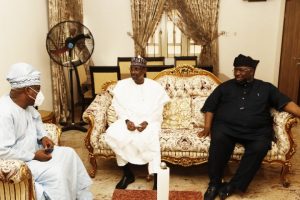
Senator Philip Aduda, representing the Federal Capital Territory (FCT) in the National Assembly, has given credit to his father, Rt. Rev. Tanimu Samari Aduda who died today, October, 20, on the success he has achieved in life.
The Senator, who received the Minister of the FCT, Malam Muhammad Musa Bello that led his team on condolence visit, described his father as a wonderful disciplinarian who put his children on the path of righteousness and was responsible largely for their successes in life.
Senator Philip Aduda expressed appreciation to the Minister who was one of the early callers to the family compound, saying that the visit meant a lot to his family.
“The FCT Minister is the father of the FCT, the Governor of the FCT and the one in charge of the FCT. So, his visit means a lot to all of us and for him to have visited us has made us to be excited because we, as a family in the FCT, we take each other as one. So, we are indeed very grateful and very happy to have received him.”
Malam Muhammad Musa Bello, who was accompanied by the FCTA Permanent Secretary, Olusade Adesola, said that the Aduda family name is an institution in the FCT due to the efforts of the late parents of the Senator.
“Your family is now an institution in the FCT through the efforts of your parents of blessed memory. Your mother was always known and of course your father as well. Many of the people know the name without even knowing the face.”
The Minister expressed his appreciation to Senator Aduda who he said had remained a brother to him since his appointment as FCT Minister.
He prayed for the repose of the soul of the deceased and pledged the participation of the Administration in the funeral of the late clergyman.
The late Rev. Aduda was the Anglican Bishop of the Gwagwalada Dioceses.
Take Responsibility, Join Politics, Osinbajo Challenges Nigerian Youth

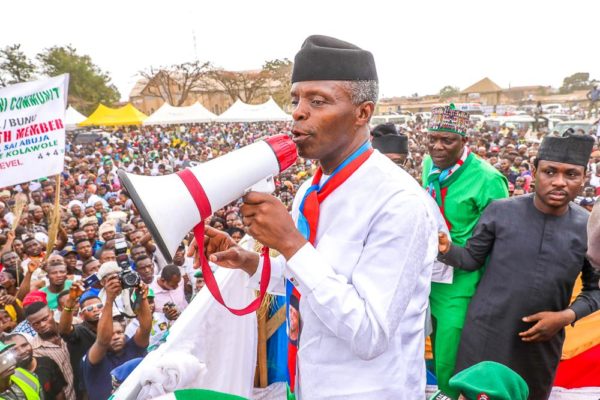
 file photo: Osinbajo speaks at a rally in Kabba, Kogi state,2019

Vice President Yemi Osinbajo has challenged the Nigerian youth to join politics which he said is the way to transform the society.

“The way to transform society is largely dependent on the actions and decisions of those who occupy public offices.”
Professor Osinbajo, who spoke today, October 20 at a virtual forum where he interacted with Nigerian Fellows of the Mandela Washington Fellowship for Young African Leaders, told the youth: “you need to go the extra length if you are not already involved.”

According to him, while a lot can be achieved in civil society, government still holds the ace in terms of capacity and resources to bring social goods to the largest numbers.

“Besides, being deciders instead of pressure groups at the table in policy formulation are hugely different positions. The consummation of our great ideas to transform our societies ultimately will depend on “those politicians” as we sometimes derisively describe them.
“African nations and especially our country, cannot afford to have its best minds and most committed social activists remain only in the civil space. No, we simply can’t afford it, you have to get involved in politics. You have to be in the position to make the difference on the scale that is required.
“Of course, there are many who will not be involved in politics but those that are inclined should, and there will be many challenges even in the winning or getting heard in politics. But I want to say to you that it should be an objective that you should set for yourselves, to get involved at whatever level of politics so that you can make the difference on the scale that is required.”

Professor Osinbajo described the efforts of young African innovators as “Africa’s most exciting story – the story of a present and future that could be steered by our continent’s incredibly talented and optimistic young men and women.”

He commended the innovation and creativity of the fellows, adding: “within any generation, only a few wholeheartedly take on that challenge – the challenge of building a society. ‘Most believe that the task is for someone else and that such endeavors cannot pay the bills.”

He recalled his days in civil society engagements and later in politics as Lagos State Attorney-General, saying: “it took public office for me to be able to get the scale of change that is required to make a difference.
“Without public office, I would have remained a pressure group activist: I would have done some nice things, but I wouldn’t have been able to make the changes that my country required.
“I was once where you were. I was part of several civil society groups at the time. I joined the first civil society group when I was 24, I was teaching at the time. I also co-founded the anti-corruption group, Integrity, and then Convention on Business Integrity (which is still existing today and they function out of Abuja and Lagos).
“I was chair of the Legal Research and Development Centre, where we worked on civil rights issues and legal defense for the poor. We did a couple of legal defence initiatives, we got funding from donors and tried to do the best we could.
“If I count the numbers that we did all the years it will be around maybe a hundred or so. We achieved some good, but compared to the scale of the problem, it was really a little.
“But in 1999 came politics, and I was appointed Attorney General of Lagos. With that platform, we took on corruption in the Lagos judiciary and set a model. We reviewed the issues of corruption in the Lagos Judiciary and how to address it. From remuneration to discipline and we were able to put in place an anti-corruption framework that has lasted several years.
“The reason why I make this point is that other States after what we did in Lagos copied that very example. So, many States improved remuneration and a wide variety of things.
“The second thing we did in Lagos at the time is that we established the Citizens Rights Department. For the first time in the history of our country, a department was established in the Ministry of Justice for the rights of citizens.
“That was important because the Ministry of Justice is not just a ministry of law and order, it is a Ministry of Justice for the people. And that department had what was called the Office of the Public Defender, and that was a concept we borrowed from some US States and we were able to do legal defence, government provided the funding, for thousands of Lagosians.
“But the more interesting part of that story is that almost every state in Nigeria adopted the Citizens’ Rights Department, adopted the Office of the Public Defender. Now, go back to when I was an activist working in the Legal Research and Development Centre, where we tried to do some work on legal defence. We did a few but certainly couldn’t achieve the scale that we achieved when we were in public service.”
Responding to concerns about the International English Language Testing System (IELTS) test, the Vice President said relevant government ministries and agencies would work on making things easier for Nigerians.
“As an English-speaking country, we should be beneficiaries of some concession as opposed to being forced every two years to take the same test especially if you have passed it once before.”
The Fellowship is the flagship program of the U.S. Government’s Young African Leaders Initiative (YALI). Since 2014, nearly 5,100 young leaders from every country in Sub-Saharan Africa have participated in the Fellowship.
Besides the Fellows of the Mandela Washington Fellowship, other participants at the meeting were the United States of America’s Ambassador to Nigeria, Amb. Mary Beth Leonard and the Special Adviser to the President on Social Investments, Mrs. Maryam Uwais, among others.


Agric Minister Laments Decline In Extension System For Years, Begins Training

Minister of Agriculture and Rural Development, Dr. Muhammad Mahmood has lamented what he called, the decline in extension programme over the years.

This is even as his ministry has embarked on the training of the agricultural extension agents, beginning in Plateau State with 40 extension agents.

The Minister, who spoke today, October 20 in Jos, the Plateau State capital, at the opening of the 3-day training of the extension agents, said that agric extension had asserted its importance in rural and semi-urban development, food and job supply for the fast growing population, especially in emerging economies such as Nigeria.

“Over the years, the fortunes of the agricultural extension system has declined mainly due to decreased funding, policy changes, reduced manpower and lack of interest of young people in agricultural entrepreneurship.

“This situation has affected food production, exposing the country to the dangers of unemployment, youth restiveness and economic instability.

“This training is one of the several strategies planned by the FMARD to halt the drift in the agricultural extension system with aim of pursuing the revitalization agenda of the Nigerian economy by the Federal Government.”

The minister was represented by Michael Adegboye, an Assistant Director in the ministry.

This was even as the Director in the Federal Department of Agricultural Extension, FMARD, Frank Kudla

said that the factors causing the decline in the national agricultural extension delivery system included the decreasing number of extension agents caused by retirements, deaths and non-replacements.

Kudla, who was represented by David Anyam, an Agric Officer, said that youth unwillingness to embrace agricultural entrepreneurship, poor capacity of existing extension agents to deliver due to lack or low quality of training, and the general poor funding of the sub-sector were other factors.

“This training is designed to empower participants with skills in the use of extension delivery methodologies and tools, as well as the best global practices in agricultural value chains, as chosen by your state.

“The training also provides you with necessary logistics and reference manuals in tune with emerging technologies, innovations and practices in the sub-sector.

“The resource persons have been carefully selected from agricultural research institutions, universities, colleges of agriculture and the Agricultural Development Programme (ADP) itself, and few private sector partners.”

The State Commissioner for Agriculture and Rural Development, Dr. Ezekiel Finangwai, said that the training would impact positively on the development and encouragement of agriculture in Plateau.

“Our farmers are eager, they are prepared and they have farm equipment and inputs that are necessary.

“But without them having the knowledge on the utilisation of the modern equipment, they may not make good use of them.

“This training is very important because of the fact that agriculture is not static, it is dynamic, and there are innovations.”

The commissioner commended the Federal Ministry of Agriculture and Rural Development (FMARD) for organising the training programme, saying that the initiative would boost yields and operations in agriculture.

Forty agric extension agents from Plateau will be trained at the programme.

Source: NAN.


Don Lists 8 Benefits For Nigeria To Subscribe To Zero Hunger Initiative

President of the National Complementary and Alternative Medical Association (NACAMA),

Professor Peter Katchy, has listed eight reasons why Nigerian government should subscribe to the World Food Programme’s (WFP) zero hunger initiative.

Professor Katchy, in a chat with the News Agency of Nigeria (NAN) in Enugu today, October 19, said that one of the reasons is that subscribing to zero hunger initiative could save the lives of 3.1 million children every year, especially children in sub-Sahara Africa, which Nigeria falls into.

“Second: well-nourished and well-fed mothers have healthier babies with stronger immune systems as they totally commit to exclusive breastfeeding of their babies.

“Third, adopting zero hunger initiative will certainly end child malnutrition and increase a developing country’s Gross Domestic Product (GDP), such as Nigeria, by 16.5 per cent.

“Fourth, a dollar invested in hunger prevention, through the zero hunger initiative, could return between $15 and $139 in benefits.

“Fifth, proper nutrition and availability of a balanced diet early in life could mean 46 per cent more in lifetime earnings.

“Sixth, eliminating iron deficiency in a population could boost work place productivity by 20 per cent.

“Seventh, eliminating nutrition-related child mortality, through the zero hunger initiative, could increase a work force by 9.4 per cent.

“Eighth, zero hunger can help build a safer and more prosperous world for everyone.”

Prof. Katchy lamented the dwindling investments in agriculture in developing countries, especially those in sub-Sahara Africa, including Nigeria.

He also decried the negative impact of climate change on food production and other agricultural practices worldwide.

The don challenged scientists and international organizations on inventing climate resistant crops and climate-smart agricultural practices that could mitigate against climate change worldwide.

“The costs of hunger and malnutrition fall heavily on the most vulnerable as 60 per cent of the hungry in the world are women, while four in every 10 children in poor countries are malnourished, damaging their bodies and brains as well as retarding their growth.”

The Zero Hunger Initiative is embedded in the Sustainable Development Goal (SDG) 2, which emphasises end to hunger, achieving food security, improving nutrition and promoting sustainable agriculture, all priorities for the WFP.

Source: NAN.

700,000 South Sudanese Hit By Worst Floods In Decades – UN Agency

The United Nations Refugee Agency (UNHCR) on Tuesday said it was alarmed by the humanitarian impact of the worst flooding in decades in South Sudan, as it affected more than 700,000 people across the country.
Stéphane Dujarric, spokesman for the UN Secretary-General, disclosed this at a news conference at the  UN headquarters in New York, saying that the UNHCR is working to help the victims of the floods.

Dujarric said the UN humanitarian agency is working with the government and partners to help the most affected people – by providing food, emergency shelter, hygiene items and solar lanterns.

“In Upper Nile state alone, UNHCR teams met around 1,000 people who had walked for seven days to reach Malakal town,’’ he said.

The spokesman said some of these people had not eaten in days, noting that women were deeply worried about the health of their children, with the increased risk of infections from deadly water-borne diseases.

“UNHCR said that while the effects of the climate emergency are being felt on every continent and in every region, its impacts are profoundly felt in East Africa.

“Communities, which are already struggling, are facing unprecedented floods and storms, unpredictable rainfall, and distress under hotter and drier conditions as their basic needs and rights to water, food, livelihoods, land, and a healthy environment are hit hard,’’ he said.

On Ethiopia, Dujarric said the humanitarian colleagues reported that the situation in Mekelle, in Tigray as at Tuesday was calm, but tense.

He said local health workers had reported that three children were killed and one person injured in an airstrike on the outskirts of Mekelle on Monday.

“A second airstrike in Mekelle town later in the day reportedly injured nine people and damaged houses and a nearby hotel.

“Our humanitarian colleagues are alarmed at the intensification of the conflict and once again remind all parties to the conflict of their obligations under international humanitarian law to protect civilians and civilian infrastructure.

“We also call for unrestricted and sustained humanitarian access to all people in need.’’

Giving an update on COVID-19, Dujarric said a UN team led by acting Resident Coordinator Dirk Wagener, had continued to help authorities respond to the pandemic in Papau New Guinea.

“Our team has provided health supplies and supported the vaccination campaign, following a recent rise in the number of cases. The number of new cases this week has doubled compared to last week.

“Around 10 per cent of the target population has received one dose of a COVID-19 vaccine, while just 5.7 per cent of the target population is fully vaccinated.

“The World Health Organisation (WHO) and UNICEF are working closely with the government to increase the number of people who are vaccinated. They are also working to combat misinformation surrounding the vaccine.”

Source: NAN.

Nigeria Is Now Global player In Agriculture, Minister Shehuri Claims

The Minister of State for Agriculture and Rural Development, Mustapha Shehuri, has declared that Nigeria is now a global player in agriculture.

According to him, Nigeria ranks second as world producer of Sorghum, just after the United States of America, fifth as a global producer of Palm oil and Cocoa, while the Gross Domestic Product (GDP) contribution by the agricultural sector in Nigeria skyrocketed.

A statement today, October 19 in Abuja by the Chief Information Officer in the ministry of Agriculture, Ezreaja Ikemefuna, quoted  the minister as saying at a virtual high-level panel discussion on Friday, to round off activities to celebrate the 2021 World Food Day that in 2019, Nigeria recorded successes as follows: Sesame Seeds oil: N77.04 billion, Cocoa: N66.73 billion, Cashew Nuts: N45.6 billion, Frozen Shrimps and Prawns: N7.46 billion, Ginger: N3.34 billion, Processed & Semi Processed Agro Food: N1.84 billion and Cotton: N609.33 million.

“The potential in this strategic sector is enormous and there is enthusiasm and political will to return the agricultural sector as the highest contributor to the National Gross Domestic Product by the year 2025.”

Shehuri stressed that the ministry is strongly committed to meeting domestic food requirements, exporting at qualitative levels and creating a favorable business environment that would make agribusiness thrive.

”There is a deliberate strategic approach to job creation, conserving foreign exchange and attaining national food security,” he said.

The minister pointed out that the seed sub-sector supply chain was being repositioned to ensure that farmers had access to quality seeds to improve yields.

“The National Agricultural Seed Council (NASC), under my watch, has been directed to interface with key seed industry stakeholders to ensure that Early Generation Seeds (EGS) are structured, to ensure uninterrupted supply of certified seeds.

”There is also an on-going awareness campaign by the Council on the importance of using improved seeds to boost production,” he said.

The minister added that the administrative bottlenecks that had previously hindered farmers’ easy access to fertilizer had been addressed, while the partnership with the Government of Brazil to pilot the establishment of 117 mechanisation centers across the country was on- going.

”When these centers are completed and made operational, farmers will be able to buy mechanisation services for a fee, with relative ease, and without the need to own expensive equipment for farm operations,” he said.

‘’Nigeria’s agriculture has done well under this administration in areas such as, being the world leading producer of yams with 18.3 million MT, world leader in the production of Cassava that has steadily risen to 70 million MT.”

Source: NAN.

160 Indigent Women In Niger Get FG, Agency’s Livelihood Support

The Federal Government and the International Fund for Agricultural Development Programme (IFAD) assisted Value Chain Development Programme (VCDP) have jointly distributed livelihood support to 160 indigent women in Niger State.
Dr. Mathew Ahmed, the State Programme Coordinator (SPC)  IFAD-VCDP, made this known while inaugurating the exercise in Mokwa Local Government Area of the state.
Dr. Ahmed said that the programme, under the VCDP Additional Financing (AF), would ensure balanced diets for the families of the vulnerable women, thereby uplifting their living standard.
“The IFAD-VCDP called for AF to be able to reduce malnutrition among children by 15 per cent.
“The VCDP AF is to support the vulnerable among women, such as widows, the physically challenged and the financially handicapped, to be able to provide balanced diets to their families, thereby uplifting their living standard.
“This year we are supporting 20 women from each of the benefiting eight Local Government Areas of Bida, Borgu, Katcha, Kontagora, Mokwa, Shiroro and Wushishi, making a total of 160 beneficiaries,” he said.
He explained that ten out of every benefiting 20 would get one local cock, one local hen and N10,000 to multiply the birds.
While the other ten would be given horticultural crops including two suckers of plantains, two suckers of bananas, five seedlings of moringa plants, five seeds of fluted pumpkin seeds, two seedlings of citrus and N5,400 to improve the farm.
The Coordinator said that the project had committed N2 million to support the women, adding that the VCDP had also developed a monitoring mechanism, with its extension agents, to check and advise the beneficiaries on weekly basis.
He said that when the project’s finances improves in 2022, it would target a different set of 50 vulnerable women from each of the eight local government areas, to also benefit from the livelihood support.
Also speaking, Alhaji Yahaya Sheti, the local government council Chairman urged the beneficiaries to utilise the livelihood support items for the successful implementation of the programme.
Sheti, who assured of the council’s support for the programme, lauded the VCDP for the gesture.
Similarly, Mr Ndagi Isah, Director of Agriculture in the Council, said that the programme was a platform for the women to venture into agri-business to support their families.
Mrs Moses Grace, one of the beneficiaries, who expressed happiness for the support, assured that the items would be utilised to ensure continuity of the intervention programme.
Earlier, Mr Lawal Mohammed, Agricultural Production Officer, VCDP, in the state, encouraged the beneficiaries to always seek the assistance of the extension staff, when necessary, in order to succeed.
Source: NAN.

Don Lists 8 Benefits For Nigeria To Subscribe To Zero Hunger Initiative

President of the National Complementary and Alternative Medical Association (NACAMA), Professor Peter Katchy, has listed eight reasons why Nigerian government should subscribe to the World Food Programme’s (WFP) zero hunger initiative.

Professor Katchy, in a chat with the News Agency of Nigeria (NAN) in Enugu today, October 19, said that one of the reasons is that subscribing to zero hunger initiative could save the lives of 3.1 million children every year, especially children in sub-Sahara Africa, which Nigeria falls into.

“Second: well-nourished and well-fed mothers have healthier babies with stronger immune systems as they totally commit to exclusive breastfeeding of their babies.

“Third, adopting zero hunger initiative will certainly end child malnutrition and increase a developing country’s Gross Domestic Product (GDP), such as Nigeria, by 16.5 per cent.

“Fourth, a dollar invested in hunger prevention, through the zero hunger initiative, could return between $15 and $139 in benefits.

“Fifth, proper nutrition and availability of a balanced diet early in life could mean 46 per cent more in lifetime earnings.

“Sixth, eliminating iron deficiency in a population could boost work place productivity by 20 per cent.

“Seventh, eliminating nutrition-related child mortality, through the zero hunger initiative, could increase a work force by 9.4 per cent.

“Eighth, zero hunger can help build a safer and more prosperous world for everyone.”

Prof. Katchy lamented the dwindling investments in agriculture in developing countries, especially those in sub-Sahara Africa, including Nigeria.

He also decried the negative impact of climate change on food production and other agricultural practices worldwide.

The don challenged scientists and international organizations on inventing climate resistant crops and climate-smart agricultural practices that could mitigate against climate change worldwide.

“The costs of hunger and malnutrition fall heavily on the most vulnerable as 60 per cent of the hungry in the world are women, while four in every 10 children in poor countries are malnourished, damaging their bodies and brains as well as retarding their growth.”

The Zero Hunger Initiative is embedded in the Sustainable Development Goal (SDG) 2, which emphasises end to hunger, achieving food security, improving nutrition and promoting sustainable agriculture, all priorities for the WFP.

Source: NAN.

It’s Dangerous To Link Your NIN To Another Person’s SIM, NCC Warns

The Nigerian Communications Commission (NCC) has strongly warned telecoms consumers to beware of the danger in linking or sharing their National Identification Number (NIN) to, or link with another person’s Subscriber Identity Module (SIM) cards, no matter how close the person is to them.


The Commission gave the warning during its third run Telecom Consumer Town Hall on Radio (TCTHR) programme, broadcast live on Human Rights Radio, 101.1 FM in Abuja recently. The event was hosted on the platform of ‘NCC Digital Signature on Radio’.

The NCC Digital Signature on Radio is the flagship radio programme of the Commission created to educate the general public on the mandates of the Commission and for sharing salient, consumer-centric and up-to-date information on how NCC is delivering on its mandates.

Speaking during the radio programme focused on ‘the Benefits of NIN-SIM Integration’, NCC’s Director, Consumer Affairs Bureau, Efosa Idehen, said “On no account should a telecom consumer, however circumstanced, allow another person to register a SIM with another person’s NIN.”

Idehen said compliance with this advice will protect the true owner of the NIN from any liabilities or negative consequences arising from the use of other person’s SIM.

“If the person, whose SIM is linked to your line use his own SIM to commit crimes or any form of atrocities, it is easy to be traced to you and then, you will be dealt with because the SIM is linked to your NIN,” he said.

During the phone-in segment of the radio programme, which lasted two hours, consumers within Nigeria and in the diaspora, especially from the United Kingdom (UK), Russia and neighbouring countries like Ghana, among others, were able to call and get clarifications on concerns they had regarding the ongoing NIN-SIM integration in Nigeria.

Discussions largely focused on educating consumers on NIN and its purpose, process of obtaining NIN, why consumers are being asked to submit their NIN to their Mobile Network Service Providers, the benefits of NIN-SIM linkage, relationship between NIN and Bank Verification Number (BVN) registration, the step-by-step approach to linking NIN to SIM, and the role and uses of Unstructured Supplementary Service Data (USSD) *346# in the NIN-SIM integration activities.

Efosa was joined in the studio by NCC’s Director, Public Affairs, Dr. Ikechukwu Adinde, who was represented by an Assistant Director in the department, Dr. Omoniyi Ibietan; and a Deputy Director, Projects Department of NCC, Mrs. Nnenna Ukoha, who jointly educated consumers on the various aspects of NIN-SIM integration exercise.

Other panelists include NCC’s Head, Consumer Information and Education, Mistura Aruna; Head, Corporate Communication,  National Identity Management Commission (NIMC), Kayode Adegoke, as well as representatives of mobile operators, including MTN, Airtel, Globacom, and 9Mobile.

During the radio programme, telecoms consumers were reminded repeatedly of the October 31, 2021 deadline for NIN-SIM integration. The Federal Government had extended the deadline earlier giving for the completion of the NIN-SIM linkage to 31st October 2021.

The two-hour discussion programme, which was also livestreamed on the social media, recorded broader participation than its forerunners due to a combination of the regular radio listenership with viewership on Human Rights Radio’s social media assets. Thus, it achieved NCC’s objective of using a mass medium to expand its reach to telecom consumers to enhance their protection through information sharing, and education in order to improve the quality of consumer experience with telecom services in Nigeria.


New Attah Igala Emerges, He’s Mathew Opaluwa Oguche

A new Attah Igala (King of Igala kingdom) has been named by the Kogi State Government. He is Matthew Opaluwa Oguche.

He succeeds Dr. Michael Ameh Oboni II who passed on in August last year.

The Kogi State Commissioner of Local Government and Chieftaincy Affairs, Barrister Salami Ozigi, announced the appointment of the new Attag Igalah at the end of the State Executive Council meeting, presided over by the State Governor, Yahaya Bello, yesterday, October 18.

The appointment of Opaluwa, according to Ozigi, followed due process.

Opaluwa was born into the family of the late Chief Opaluwa Oguche Akpa.

The prince is the ninth of 16 surviving children and the fourth of the six males of the late Chief Opaluwa Oguche of the Aju Ameacho ruling dynasty of Igala kingdom.

The new Attah Igala-designate started his early education at St Boniface Primary School, Idah and proceeded to St Peter’s College, Idah where he obtained his West African School Certificate (WASC) in 1980.

He attended  School of Basic Studies, Ugbokolo, in Benue state, in 1981 and proceeded to Ahmadu Bello University, Zaria in the same year where he obtained  Bachelors of Science (B. Sc.) Degree in Business Administration in 1986.

He returned to the same school for his Masters (MBA) degree in Business Administration in 1997.

Before his appointment, he had worked at Independent National Electoral Commission (INEC) in 1988 as administrative officer and rose through the ranks to become Deputy Director.

He had served in many Local Government Areas of Kogi, Kaduna and Federal Capital Territory as Electoral Officer and in Katsina state, he was in charge of the Research and Documentation Unit of the Electoral body.

Advertisement ADVERTORIAL
WP2Social Auto Publish Powered By : XYZScripts.com