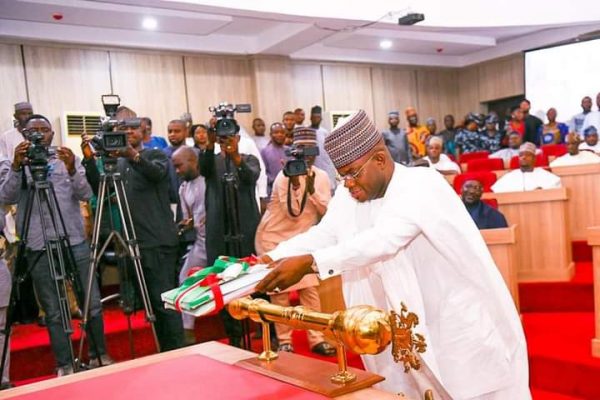
The Governor of Kogi State, Alhaji Yahaya Bello has presented to the State House of Assembly, a total sum of N145,896,072,913 as the budget proposal for the year 2022.
The governor admitted that funding budget had always had its headache, vowing to employ traditional and other means to be aggressive in revenue drive.
“It is one thing to craft a beautiful budget, it is entirely a different kettle of fish to find the funds to give it life and effect. On our part as the Executive Arm, we will continue to explore traditional and extraordinary avenues for improved revenues, simultaneously strengthen our award-winning anti-corruption measures and relentlessly cut down on waste of all resources.”
He told the lawmakers today, October 28 that the total budget outlay of N145,896,072,913 is divided into Recurrent Expenditure of N90,151,291,251 representing 61.79% and Capital Expenditure of N55,744,781,662 representing 38.21%. The governor’s budget speech is reproduced hereunder:
Protocols
The Right Honourable Speaker and Honourable Members of this Great House, I am honoured to stand before you today in pursuit of our joint mandate to run an efficient and effective Government for the people of Kogi State. Accountability and open governance start with timely and transparent showcase of Government income, proposed expenditure plan and levels of performance. In pursuit of that objective we are here to present the 2022 draft Budget for your usual frank review and approval.
This is, for me, also an opportune moment to appreciate this great House for her excellent grasp of the principles of separation of powers and the interplay of checks and balances between the 3 Arms of the same Government – as constantly displayed in her partnership with the Executive and Judicial Arms in Kogi State. The maturity of this House and her members shines forth in the absence of contrived conflicts and engineered misunderstandings in the Executive-Legislature relationship in Kogi State.
Even when the available finances have not met expectations this wonderful House has had no problem participating with us in self-denial and the foregoing of some official privileges. This has enhanced the enabling environment, allowing our Administration to focus on the big issues of service to the people. These are the bonds we must all continue to work together to strengthen, and most importantly, build on as we work to deliver the greatest good to the greatest number of our people.
We are well aware of the tough challenges presently confronting, not just our state, but Nigeria as a nation. The COVID-19 pandemic has yet to relax its painful grip on the collective jugular of the nations of the world. The socioeconomic ravages of the disease is showing no signs of significant abatement. At a point in 2020, our biggest revenue source, crude oil, came to a scary low of $17 per barrel, against a Budget assumption of $65 per barrel. This squeezed our income, increased inflation, heightened the cost of living, worsened unemployment and insecurity and added fuel to different agitations. Along with the rest of the globe, Nigeria (and Kogi State with her), feels the disruptions and setbacks reverberating at all critical points along the governance value chain.
It was against this dismal background that we dared to present, and you had the courage to pass, our budget for the outgoing fiscal year 2021 tagged BUDGET OF ACCELERATED RECOVERY. Our optimism at the time came from deploying a homegrown and constantly evolving synergy between science and common-sense, and medicine and governance, which we had adopted in response to the pandemic from inception. Initially, our determination was simply to stop Covid-19 from turning into the humanitarian crisis it was predicted to become by global and domestic regulators, at least not in Kogi State. As time went on and we saw the coronavirus disease decimating citizens of even first world nations while their governments looked on helplessly, it became clear to us that we just could not afford to have it enter our State much less run amok among our people and economy.
I am delighted to say, as you well know, that we successfully prevented the disease from taking root here and simultaneously eliminated the worst of the socioeconomic disruptions associated with it, particularly from restrictions, lockdowns and fear-driven wastage of scarce financial resources. Our methods drew anger, mockery or both at the beginning, depending on who you asked, but we have since been vindicated. Our success was only possible by the resilience of our people and the Vote of Confidence they passed on us as a Government by trusting our judgment and following our lead. Collectively, it represented a defiant refusal to collapse in the face of the severe storms which buffeted us.
On the 23rd of October, 2021 we completed work on the 55km Anyigba – Ejule – Umomi – Ugwolawo – Ajaka – Idah road in the Eastern Senatorial District. It joins the Ganaja Flyover and Interchange, the Lokoja, Okene and Kabba Township Roads, the Reference Hospital in Okene, District hospitals in Badoko and Gegu, the Prince Abubakar Audu University Teaching Hospital, Anyigba and ultramodern clinical complex at Isanlu, along with many other roads and projects across all sectors in the 3 Senatorial zones, to bear eloquent testimony that 2021 was indeed a watershed year for infrastructural development in Kogi State. It is also proof of our ability to confront difficult times and situations with foresight and courage.
In line with our New Direction Agenda, our administration remains committed to probity and accountability in the utilization of the State’s scarce resources. This has made it possible to stretch a lean purse to accommodate massive outputs. As a Government, we are constantly challenging what we are doing with a view to doing them better. No doubt, our best still lies in our ability to harness the high quality human capital with which we are so abundantly blessed. This is why in the year under review we assembled some of our best minds into the Kogi State Economic Council (KOSEC) to help us think outside the box and harvest ideas that will propel the State to further greatness.
It is clear from the foregoing that the overarching objective of a good government budget is not the percentage of its implementation which is often subject to the vagaries of factors external to its intent, purpose and application. A good budget is defined by how deep it taps into the existential realities of its target polity and by the tangible changes it is able to make in the life of the people during its lifespan.
It is on this premise that we have named our 2022 draft Budget the BUDGET OF ACCELERATED RESULTS. This Budget is designed to achieve important macroeconomic goals while ensuring effective delivery of good governance as a public service. It will focus on results rather than activity, benefits to the people rather than amounts expended. The 2022 Budget of Accelerated Results has inbuilt mechanisms to enhance implementation. The budget performance is premised on fair and equitable distribution of available resources amongst our diverse constituencies. We have made sure that it is set up to minimize extra-budgetary expenditure and assist compliance with best budgetary practices. Its objectives and principles are in tandem with the prescriptions of the Medium Term Expenditure Framework (MTEF) as well as the Fiscal Strategy Paper (FSP) approved by this Honourable House.
In line with our electoral promises to do more, we will continue to implement the New Direction Blueprint by focused interventions in the expanded thematic areas, to wit, Education, Health, Infrastructure & Utilities, Youth Empowerment and Employment Creation, Civil Service & Pension Reforms, Security, Agriculture, Human Capital Development as well as Cooperation and Integration. As has become customary with our budgets in this Administration, the principal aims of the 2022 Budget of Accelerated Results are wealth creation, poverty reduction, employment generation, conflict resolution, peace-building and to enshrine fairness, transparency and accountability in the governance of the State.
I pledge to an honest, realistic and sustained implementation of the Year 2022 Budget as usual. In order to keep this undertaking and to avoid derailment by any means, we have factored into this Budget policies, outcomes and targets consistent with those Sustainable Development Goals (SDGs) identified in our Blueprint Documents as most urgently needed by the larger spectrum of our populace. These are in turn targeted at specific milestones for reduction of poverty across the Multidimensional Poverty Index (MPI) in our State.
Topmost on our list of good governance initiatives is to widen and accelerate the provision of basic amenities for the masses. Many have of course been completed and released for use by the people in both rural and urban areas over the last 6 years. Many others are currently under construction and we have made plans to complete them on schedule. Many more will be commenced and completed before this tenure is over.
It is one thing to craft a beautiful budget, it is entirely a different kettle of fish to find the funds to give it life and effect. On our part as the Executive Arm, we will continue to explore traditional and extraordinary avenues for improved revenues, simultaneously strengthen our award-winning anti-corruption measures and relentlessly cut down on waste of all resources. In 2021 we secured critical recognition as an Oil Producing State which should begin to add more money to our coffers as soon as production commences on our reserves. 2022 is the year we start pushing for that.
At the last State Executive Council Meeting, we also adopted several resolutions to increase our earnings from solid minerals. I am hopeful that by the time we bring the 2023 budget before you, 13% derivation from crude oil produced on our land would have increased our revenue streams, alongside more returns on investments in solid minerals. We have also keyed fully into the Economy Recovery and Growth Plan (ERGP) of the Federal Government to ensure economic stability and quick measurable results.
Mr. Speaker, permit me to say that government earns its reputation from the goodwill and support it enjoys from the governed. Such goodwill and support derive essentially from the benefits the people enjoy from the policies of government that answer to the dynamics of our challenging economy. I am aware that this government has done plenty to prove to our people that she is interested in enhancing those benefits. Thus, I call for your usual prompt cooperation in ratifying this budget so that the policies, programmes and projects contained in this Budget Proposal can be implemented for those we govern.
The Right Honourable Speaker, Honourable members and Distinguished Ladies and Gentlemen, before I give the details of the 2022 Budget Proposal, I wish to review the performance of the year 2021 Budget and the modest achievements we made in the outgoing year.
HIGHLIGHTS OF YEAR 2021 BUDGET PERFORMANCE.
The total Budget package for year 2021 is N160,560,230,602 for both Recurrent and Capital Expenditures. The recurrent revenue approved for year 2021 was N99,328,575,430 out of which N52,784,265,642.49 was collected as at the end of August, 2021 representing 53.14% performance. The approved capital receipts for 2021 was N61,231,655,172 from which the sum of N5,007,984,851 was realized representing 8.18% performance as at the end of August, 2021.
A total sum of N88,084,883,742 was approved for recurrent expenditure in the year 2021. However, only N42,074,469,978 was spent as at 30th August, 2021 representing 47.77% performance.
The approved capital expenditure for 2021 was N72,475,346,860 out of which the sum of N17,318,807,596 was expended representing 23.90% performance as at the end August, 2021.
Some of the on-going projects embarked upon during the year under review are:
Construction of Reference Hospital, Okene.
Construction of CT and MRI Block at Reference Hospital, Okene.
Construction of perimeter fencing at Reference Hospital, Okene.
Construction of Oxygen Plant at Reference Hospital Okene.
Procurement and installation of Medical/Clinical/Surgical/Laboratory Equipment at Reference Hospital Okene.
Renovation and Remodelling of many old Hospitals.
Construction of Modern General Hospital Gegu-Beki, Koton-Karfe LGA.
Construction of Modern General Hospital Badoko, Ajaokuta LGA.
Comprehensive renovation and remodelling of Kogi State Specialist Hospital, Lokoja.
Construction of New Ultra-Modern Clinical Complex in Prince Abubakar Audu University Teaching Hospital.
Full accreditation of 24 programs presented for accreditation at Prince Abubakar Audu University.
Construction of 15km Okene Township Roads.
Rehabilitation of 14km Kabba Township Roads.
Construction/Rehabilitation of Lokoja Township Roads/Ganaja Flyover and Interchange.
Asphalt overlay of new Market/Murtala Muhammed/Barrack/Kabba Junction (Dual carriage way 4.7km).
On-going Construction of Idah-Ugwolawo-Ejule-Anyigba Road (55.5km).
Construction of Ultra-Modern Civic Centre, Lokoja.
Maintenance of Government Quarters/Offices across the state (police Squadron Unit, Oro).
Renovation of Government Lodge across the State.
Renovation of Ohinohi’s Palace, Okene.
Construction of GYB Model Science Secondary School, Okene.
Construction of GYB Model Science Secondary School, Adankolo, Lokoja.
Remodelling of Girls Unity Secondary School Oboroke.
Remodelling of Community Secondary School Ajiyolo-Ojaji.
Reclamation Channelization Erosion Project in Agassa.
Remediation, Channelization and Erosion works at Adumu Road, Ogugu
Channelization, Reclamation and Bioremediation works in Ogane-Aji;
Construction and Bioremediation work at Greater Lokoja Waterworks in Lokoja.
Construction and Bioremediation work at Ozuri, to mention just a few.
Mr. Speaker, Honourable members, as you can imagine, our moderate performance was adversely affected by the current economic situation in the country which negatively affected our financial expectations from various sources. In the light of the above, the year 2022 draft Budget has been crafted to enhance Internally Generated Revenue (IGR), aggressively pursue the implementation of the newly approved 13% derivation as oil producing State for the State, secure repayment of debt owed us by the Federal Government, provide a more conducive environment for our development partners across the world to contribute to the State economy, especially by prompt payment of our counterpart funding obligations, mobilize private sector investment to the State, encourage Public-Private-Partnerships and most importantly, block all leakage in our revenue purse.
BUDGET OF ACCELERATED RESULT
Mr. Speaker, Honourable Members, the 2022-2024 Multi-Year Budget is presumed on Zero-Based Budgeting principles and is tailored towards actualizing the Development Plan. The key targets in this budget, from a fiscal perspective, are:
Ensuring the actualization of the development priorities of the government as articulated in the State Development Plan and respective Sector Implementation Plans (SIPs).
Maintaining a favourable proportion of Capital to Recurrent Expenditure.
Completing all on-going projects and adding new projects in areas of critical need.
Expanding revenue generation so as to reduce over dependence on federation allocation.
Maintaining a sustainable debt position thereby reducing our State Domestic Debt profile.
Providing a conducive environment for investors and Donor Agencies to operate in the State.
Enhancing greater transparency, accountability and proper public expenditure management.
BUDGET POLICY STATEMENT
The fiscal strategy of Government is anchored on the on-going Public Financial Management Reform (PFM). Over the period 2022-2024 the State Government fiscal policy will aim to:
Improve the efficiency and effectiveness of spending.
Gain greater control of the wage bill.
Direct capital expenditure to critical infrastructure in Roads, Housing, Education and Health in addition to equally important thematic areas such as Job creation, Youth Engagement, infrastructure and utilities and public sector and pension reforms.
Boosting revenue receipts by identifying and blocking revenue leakages alongside a deliberate programme of gradual fiscal consolidation directed at achieving a level of public spending consistent with macroeconomic stability and sustainable debt.
HUMAN POPULATION GROWTH – KOGI LEADS THE WORLD
In the year 2021, as Kogi under our oversight consolidated on her status as the safest state in the country we have tracked an inward flow of human beings and investments into all parts of the state, but especially into the Lokoja Capital City territory. There are the identifiable reasons for this rapid growth which include:
Massive investments in security of lives and properties have proved irresistible to citizens seeking safe haven for their lives and businesses.
Massive investments in our education sector has sponsored corresponding growth in student populations across Kogi State. This is especially true of our regular and uninterruptible (by the grace of God Almighty) tertiary education calendar, wholesale and sustained infrastructural renaissance in Kogi State Polytechnic and other tertiary institutions, elimination of cultism and other fear factors from our campuses, removal of end-stage academic uncertainty for scholars by the accreditation of dozens of courses in our state university and the full accreditation of our nursing school at Obangede.
Still on education, the icing on the cake for us in the year 2021 is, of course, the establishment of a whole university, the Confluence University of Science and Technology (CUSTECH) at Osara, practically from scratch. We made sure this brand new school went from concept to confirmation to construction to curriculum activities under one year. It was designed and built to provide first-grade training in Science, Technology, Engineering and Mathematics (STEM) disciplines for our teeming youth. Our plans for the institutions in 2022 Budget will greatly move it forward towards our aim of ensuring that it quickly becomes comparable to any similar school anywhere on the globe by leveraging ICT and artificial intelligence (AI).
Our vast natural endowments in arable land, waterways, solid minerals, crude oil and human capital have caught the eyes of more and more people who moved in to settle and make a life among us. In fact, for a while during the pendency of the 2021 budget we led the entire country in the inflow of foreign direct investment. This phenomenon was also not unconnected with our firm and innovative stances against the novel coronavirus disease.
Finally, this inflow of new residents and businesses into our state is also sponsored in the main by our huge strides as an administration in the provision of infrastructure and utilities across previously forgotten rural areas along with urban renewal of Lokoja and other cities, particularly the traditional headquarters of our 3 senatorial districts and other principal towns.
We are not just tooting our own horn or blowing hot air when we speak about this rapid growth of our state under the last 6 years of my New Direction Administration. Precious confirmation of this also came recently from no less a quarter than the United Nations which reported in 2021 that Lokoja is the fastest-growing city on Earth. According to the Wall Street Journal which expanded on the UN findings, the population of Lokoja metropolis will grow 78% in the next decade, quicker than every other sizable town in the world. QED.
BUDGET OBJECTIVES AND TARGETS
The growth statistics in the preceding paragraph should rightly make us proud. Our city, Lokoja, has stagnated for over a century since it became the birthplace of modern Nigeria in 1914 and was then left behind as other cities advanced in the new nation. This neglect has gone on for far too long and I am not just content to be superintending this New Rising but also too determined to make hay while the sun shines. This refers primarily to the sacred responsibility on me to put in place the structures on which this unprecedented growth can be accelerated, sustained and harnessed over the next few decades. As I start heading towards the halfway mark in my second term the need to avoid wasting the demographic dividends just outlined has given me reason to be even more careful about scrutinizing the vision and mission readiness of those within my succession plan.
We have tried to think large and outside the box with this Budget and our lofty aspirations have found expression in the objectives and targets below. The specific fiscal objective is effective allocation of scarce resources to identified critical programmes and projects, with the following as major targets:
To improve the quality of education at all levels and make it accessible to all citizens in order to produce the articulate and skilled manpower which we need to sustain economic growth and physical transformation of the State.
To improve access to quality and free-to-affordable healthcare leading to improvement in efficiency of the healthcare delivery system.
To ensure food security and generate as high a proportion of the GDP as possible from agriculture.
To exploit the full potential of our economy and expand trade and commerce in the State.
To ensure that products from our agricultural and industrial activities have access to markets locally and internationally.
To ensure gainful employment of youths and create opportunities for the development of their talents.
To promote social and economic development through culture and tourism.
To establish the necessary framework for a robust mining and Solid minerals sector, and to brand Kogi State as the foremost solid minerals mining destination.
To improve the road network in urban and rural areas through construction of new roads and bridges and rehabilitation of existing ones.
To improve the quantity, quality and access to safe water for domestic, commercial and industrial uses as well as improve sanitation and hygiene practices among the citizens.
To ensure sustainable use of the environment and continuous management of environmental challenges such as pollution, degradation of lands, forests and other natural resources and gully erosion.
To facilitate the social and economic development of the State by ensuring responsible access to lands for agricultural, residential, commercial and industrial uses to all citizens and investors.
To improve the quantity of decent housing and facilitate the creation of viable urban communities in the state.
To further clarify on our targets for the health sector referenced in No.2 above, let the House note that in addition to all I have reported in this speech about our turnaround efforts in building and upgrading health facilities across the state, this Administration also set up the Kogi State Health Insurance Agency and Scheme in 2021. Like I noted just this week (Monday, 25th) at the House of Lords in the British Parliament where I was represented for a Keynote Address by Honourable Bello Balogun, the Majority Leader of this Assembly, our Health Insurance Scheme will make sure that ‘for the cost of treating one bout of malaria out of potentially dozens in a year, a family can now have year-long healthcare coverage in Kogi State. It only remains to appeal to Mr. Speaker and the honourable members to join us as evangelists of good health to their constituents by encouraging them to sign up for this life-saving health insurance. You can also sponsor some of them for about N12,000 a year per beneficiary. We must again thank this honourable House for passing the enabling laws for this insurance scheme with the customary speed that she never fails to exhibit when it comes to pro-people matters.
Mr. Speaker, let me undertake again on behalf of this administration that we will strive to complete every single project we have started in all of our 21 Local Government Areas, and to pay the contractors who are working for us. In the same vein, we will continue to cut down the cost of governance and ensure that our people remain the ultimate beneficiaries of all public resources.
SUMMARY OF THE 2022 DRAFT REVENUE AND EXPENDITURE ESTIMATES
The summary of the draft 2022 Revenue and Expenditure Estimates is as follows:
The proposed 2022 Budget has an estimated outlay of N145,896,072,913. This total budget outlay of N145,896,072,913 is divided into Recurrent Expenditure of N90,151,291,251 representing 61.79% and Capital Expenditure of N55,744,781,662 representing 38.21%. This is represented in the table below:
Expenditure Item
Allocation
%
Recurrent Expenditure
N90,151,291,251
61.79%
Capital Expenditure
N55,744,781,662
38.21%
Total
N145,896,072,913
100%
Also the total Budget expenditure outlay is given in the following sectors:
Code
Sectors
Allocation
%
01
Administration
N50,233,230,518
34.43
02
Economic
N41,926,235,949
28.74
03
Law and Justice
N4,720,893,239
3.24
05
Social
N49,015,713,207
33.60
Total
N145,896,072,913
100.00
THE TOTAL BUDGET PACKAGE
The total Budget package for year 2022 is N145,896,072,913 as against N160,560,230,602 Revised Budget for year 2021. This represents a decrease of N14,664,157,689 or 9.13% when compared with the 2021 Revised Budget.
Mr. Speaker Sir, Honourable Members, Distinguished Guests, Ladies and Gentlemen, I now present to you the year 2022 Draft Budget for your consideration and approval.
The Honourable House is invited to Note that:
We have budgeted a total estimated recurrent revenue of N96,792,006,352 consisting of N23,266,375,259 from internal sources, N49,586,957,264 as State’s share from the Federation Account, N19,667,974,999 revenues from Value Added Tax (VAT), N100,000,000 from Excess crude, 1,000,000,000 from exchange difference, N500,000,000 as refund from Federal Government, N1,000,000,000 from Non-Oil Revenue, N200,000,000 from Forex Equalisation, N120,698,829 from Excess Bank charges, N350,000,000 from Budget Augmentation, N500,000,000 from Solid Minerals and N500,000,000 from Ecological Fund.
Recurrent Revenue for the year 2020 stands at N96,792,006,352. Out of the above figure, the estimated personnel cost for the period is N45,119,725,532 whereas N45,031,565,719 is Overhead Costs, thereby giving N90,151,291,251 as a total recurrent expenditure for the year 2022.
From the foregoing, we have a total estimated Transfer Surplus of N6,640,715,100 as Capital Development Fund.
The estimated Capital Receipt is N49,104,066,562 comprising Capital receipts analysis by economic, Aids and Grants. However, if the Transfer Surplus of N6,640,715,100 is added to this amount, we shall have N55,744,781,662 as fund available for capital development projects.
Total estimated capital expenditure, therefore, stands at N55,744,781,662.
In summary, our total estimated revenue (i.e. recurrent revenue and capital receipts) stands at N145,896,072,913 for the year 2022, making total estimated expenditure (i,e Recurrent and Capital) stands at N145,896,072,913 for the year 2022 making our 2022 Budget a balanced budget.
Mr. Speaker Sir, Honourable Members, Distinguished Guests, Ladies and Gentlemen, it is now my pleasure to formally present to you the 2022 Draft Budget for your deliberation and approval.
I conclude with profound gratitude to the Almighty God, appreciation for our people, and special mention of security personnel across all the law enforcement agencies, for standing together to minimize the incidences of insecurity for us.
Let us all do more, wherever we find ourselves per time, to keep our State and people safe.
God Bless Kogi State.
God Bless the Federal Republic of Nigeria.
Thank you all.
YAHAYA BELLO
Governor of Kogi State.