Those Who Made It In Life Owe Society 3 Type Of Taxes – Osinbajo
Vice President Yemi Osinbajo has reminded people who made it to leadership positions in all fields of human endeavours in life that they owe the society three type of taxes.
The first one, he said, is income taxes, which is personal income tax, “and if you own a company, company, or corporation tax.”
The second tax, Professor Osinbajo said, is a social tax, which is another name for philanthropy: “the obligation of the wealthy to give back to society.”
And the third is a civic tax: “the obligation of the successful to write their stories, to share the histories of the phenomena they have become, in order to instruct, to admonish and to inspire the present and the future.”
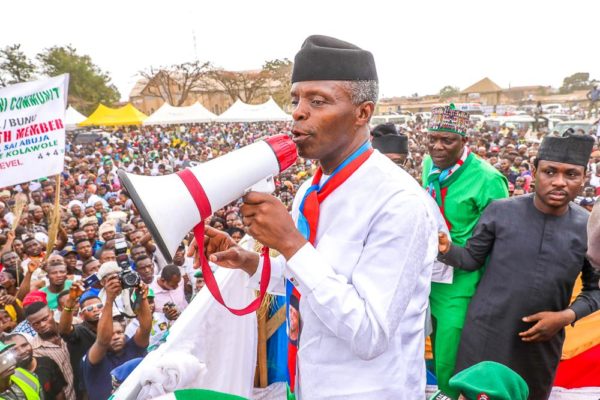
The Vice President spoke today, September 17, in Lagos, at the presentation of the biography of the General Superintendent of the Deeper Christian Life Ministry, Pastor W. F. Kumuyi, jointly written by Banji Ojewale, Segun Babatope, Emeka Ezeze and Tunde Opeibi
The Vice President added the fourth tax which he called “the Pentecost Tax,” which he said is for successful preachers of the gospel.
“But for the successful preacher of the gospel of Jesus Christ, there is the fourth tax, this is the Pentecost Tax. The obligation of men and women since the day of Pentecost, the day described in Acts 2 when the Holy Spirit empowered the disciples to preach the gospel, to tell the story of their missionary journeys. The miracles, signs, and wonders that God has wrought on that journey, the deprivations, the fastings, and the persecutions. The victories and failures, the mountains and the valleys.”
According to Osinbajo: “this is a huge responsibility. But the saints before us discharged that responsibility so we are the beneficiaries of the Acts of the Apostles, the stories of the men and women who carried the gospel first to Jerusalem, Judea, and Samaria and to the ends of the earth.
“Their stories have encouraged generations of Christians since, their recorded experiences may seem to make them stars, but they are meant to instruct us in adherence to sound doctrine, to rebuke us and instruct us unto righteousness.”
Prof Osinbajo said that the book: “Kumuyi – the Defender of the Faith,” is the continuation of the baton handed down over to our generation since the day of Pentecost.
He also described the book represents the work of discharging the Pentecostal tax obligation of Pastor Kumuyi.
“The book tells the story of the incredible work of the Holy Spirit in his life and Ministry. How by His grace, he not only preached and continues to preach holiness to a whole generation, but lived and lives it himself daily.”

Names of top shots currently in the opposition Peoples Democratic Party (PDP), including serving governors, who are warming up to cross over to the ruling All Progressives Congress (APC) have been unveiled.
Zamfara State Governor, Alhaji Mutawalle has ruled out the possibility of going on with dialogue with bandits and other criminal elements tormenting the State.
First Lady of Nigeria, Aisha Muhammadu Buhari has called on Nigerian girls to embrace football as a career path.
Chieftain of the opposition Peoples Democratic Party (PDP), Chief Femi Fani Kayode has returned to the ruling All Progressives Congress (APC), with a vow to join in putting to shame, local and foreign elements that are out to disintegrate Nigeria by way of war.
President Muhammadu Buhari has sought for the full support of the world football ruling body, FIFA, to further develop football game for the betterment of the country.
The Nigeria Naira has hit an all-time low of N562 per dollar in the unofficial market, known as black market, even as dealers lament that the currency may plunge to N600/dollar soon.
2023: The North Must Let Go, By Dan Agbese
The season is virtually upon us. The politicians are sharpening their knives for 2023. The sound is becoming jarringly louder. Prayer warriors are being pressed into service just like the eyes and the ears of the gods. It is always good to seek the assurances and the support of God and the gods in the battle for political power in our country. It is a battle no one takes lightly.
But the fate of our country in 2023 is not in the hands of God and the gods. It is in the hands of those who play god, to wit, the party moguls whose bounden duty it is to dispense favours to godsons and god-daughters, even at the expense of peace, unity, a sense of belonging and cohesion in our badly fractured republic. It is our duty as fellow citizens not to allow them to be trapped in their faux pas only for us to blame God and the gods at the end of the day.
This is the time for the rest of us to put our views across on what should be done to set our country back on the path of oneness. Politics, as the wag said, is too serious to be left to politicians. 2023 presents us with some peculiar but critical challenges, not the least of which is that the crass mismanagement of our diversities under the current dispensation has widened our traditional fault lines and opened some other fissures. This is the time to recognise them, appreciate them and factor them into the permutations for the locus of power at the centre in 2023.
The two major political parties, APC and PDP, are beset with internal problems and wrangling. They have fractured national executive committees and both are engaged in patching things up by constituting reconciliation committees to appease their members who feel aggrieved by the endemic problem of our political parties: the absence of internal democracy. The committees will reconcile them and thus help to staunch the toing and froing from one party to another and back again that instantly changes the fortunes of political parties and their members. These movements are merely an opportunistic exploration of accommodation in a rival political with seemingly greener grass under its feet. Its deleterious effect is the inability of the political parties to build themselves into steady and strong parties able to drive, through their policies and programmes, our national development. Weak and unsteady political parties are afflictions on our democracy.
The first order of business for the political parties is the choice of a national chairman in each case. This is no ordinary choice. It is critical to the political parties because everything else rides on the section of the country that produces the national chairman of each party. In their tradition, the section that produces the national chairman cannot produce the party’s presidential candidate – all thing being equal, of course.
The real question is not who but which section of the country, north and south should produce the next president in 2023. The fortunes or the misfortunes of each party will depend on its answer to the question. Perhaps, we should lend them a helping hand in the absence of a guiding principle through which the locus of power at the centre is determined at the regular election intervals. In 1983, NPN mooted the idea of a rotational presidency between the north and the south. Its purpose was to ensure that politics being a game of numbers, number alone would militate against equity, fairness and justice. Its new formula was to be put to the test in 1987. It never was because after four years, the generals returned from the political Siberia to service their political fortunes.
This was later renamed power shift. Different semantics, same primary purpose. It was the rallying cry by the south in Babangida’s transition to civil rule programme; the argument being that the north appeared bent on domiciling the presidency to the permanent disadvantage of the south, given the number of northerners who had held the levers of power since independence. It was no way to build the nation and unite the people. It was time, the south strenuously argued, for power to shift from the north to the south to make the latter an equal partner in the Nigeria project. That would be the right way to build the nation and unite the people.
Quite a bit of water has passed through the River Niger to the creeks. Power shifted to the south in 1999 and 2011. Still, 2023 presents the country with the same unsettled issue and challenges. The late head of state, General Sani Abacha, introduced the geo-political zoning system as the basis for managing our ethno-political and other interests. It is the formula for sharing or allocating elective and appointive political offices at the centre. It has virtually become an important tradition in both the management and mismanagement of our diversities. Can we use this as the basis for inclusive governments in which every part has a chance to both hold and milk the cow?
It still rankles those who, while recognising zoning as necessary in other cases, appear allergic to using it as the basis for choosing a party’s presidential candidate on the grounds that it would be a cynical abbreviation of individual political ambition. I think we are dealing with some sophistry here. Political parties are constitutional creations by tradition and that is why you find neither APC nor PDP in the constitution. By constitutional tradition they are the platforms on which people seek elective political offices. More importantly, political parties determine independent ways and means of managing power and growing the national economy without recourse to the national constitution. Each political party has its own constitution by which it runs its affairs. That zoning is not in the constitution does not prevent a political party from using it as a basis for determining the locus of political power at the centre provided it is satisfied that it makes for equity, fairness and justice and does not offend the letter and the spirit of the supreme law of the land.
It is the constitutional right of a political party to find ways and means of managing the affairs of a nation. That which it chooses to do does not become unconstitutional by reason of its not being in the constitution. Sophistry is a red herring across the path of serious and rational thinking on managing our nation and its myriads of diversities in a manner that makes Nigeria our Nigeria all of the time, not some of the time.
The south sees the north and its so-called greed for power as the nation’s main problem. In the next few months as the debate on the locus of power at the centre heats up, copious evidence would be provided to show that the north has used its sheer number to dominate power in the country since independence to the discomfiture of the south. This evidence cannot be rationally contested. So long as the south feels marginalised by the north, so long will our country continue to be a patch work of ethno-religious interests masquerading as government of the people; so long as the south feels that it is not an equal partner with the north in the Nigeria project, so long will our country remain an atomistic nation in perpetual conflict with itself; and so long as our political leaders are given to the luxury of paying lip service to equity, justice and fairness sans a commitment to those ideals, so long will the simple formula for building a nation and uniting the people elude us.
Let us quit pretending about this. Buhari’s successor will inherit a fractured republic and a divided people. It behoves our political leaders to appreciate this and take steps now that will de-fracture the republic and unite the people and make our country peaceful. It is time for the north to recognise that it has a moral duty to share and share power equally with the south. Political power is not essentially about merit. It is about what is right for a country at a particular point in time. There are potentially great leaders in every part of the country. To recruit them, we must ventilate the system and end power hoarding.
To move forward, we must take two urgent steps. The first is to accept and formalise power rotation or power shift between the north and the south and cast it in marble. Let us ride on what happened in 2019. APC and PDP zoned the presidency to the north. Two northerners slugged it out. We can do the same in 2023. Power must shift to the south and the two political parties must choose their presidential candidates from there and let them slug it out as to who wears the presidential sash.
The second step is to accept the zoning arrangement as a means of perfecting the power shift. It is not enough to broadly rotate power between the north and the south; power must also rotate among the zones in the north and the south so that no zone dominates and leaves other zones in the cold.We can emerge from the current crucibles as an enviable republic and a united people. But we must set aside sentiments and face the challenge of nation building with the courage to use political power as an instrument for the good of the nation and its people. I am not naïve enough to believe that this would be easy but I believe we have enough patriotic Nigerians who wish to see our nation pull itself up from the murk of its failed promises, shed its toga of a potentially great country and put on the new toga as a great nation. Then we can to ourselves what President Barack Obama said to his fellow Americans: yes, we can. Yes, we can unite the people and build a great nation.
Email: ochima495@gmail.com