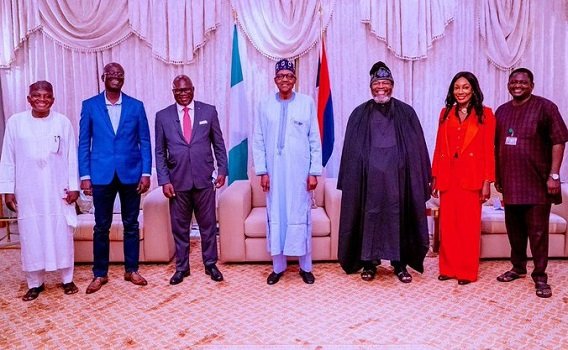
 I have been privileged to interview quite a number of world leaders in the course of my journalism career. These include President Olusegun Obasanjo, President Ketumile Masire of Botswana, President Umaru Musa Yar’Adua, Commonwealth Secretary General Shridath Ramphal, UN Secretary General Kofi Annan etc..not to talk of holding the microphone across the world in the presence of countless Presidents in my then capacity as President Goodluck Jonathan’s spokesperson. But no other encounter held as much memory and nostalgic feelings for me as my return to the Aso Rock Presidential Villa on Wednesday, June 9 to interview Nigerian incumbent President Muhammadu Buhari.
It was my first return, not to the Villa itself, but to the President’s Residence since President Jonathan was driven out of that environment on May 29, 2015. As I walked from the parking lot in the Residence as we call it, I took in the familiar surroundings. I recalled I used to walk along the same paths, on a daily basis, as frequently as duty demanded. One day, we all followed our principal out of the Main Gate. How transient power can be. A sense of home and exile is definitely imprinted on the pavestones in the corridors of power. Today, you can pound it as if you were the mason who arranged the interlocking stones. Tomorrow, you could be exiled by circumstances from the same space, and your brief sojourn, with the effluxion of time, becomes a distant, fading memory.
As I stepped on every stone leading to the Residence, my mind travelled to the past. I felt as if I was in a trance. I was soon woken up by the words of welcome of the security men at the entrance. I was surprised some of the boys from the past were still on duty. Past the security check-point is the Red Carpet, the outer reception of the Residence. I walked in and sank into a seat. Red Carpet! This was where President Jonathan held his early morning devotions, with members of his family and some aides who were always in the Villa for early morning worship. The Christian devotion usually started around 6 am, by which time, in those days, the President would have shown up at the Red Carpet to start the day with prayers. Christian Presidents in Nigeria usually appoint a Chaplain for the church in the Villa. His job includes overseeing this early morning devotion. The red carpet was also where we, members of the President’s Main Body – Special Adviser Media, Chief Physician, SCOP, CSO, ADC, Chief Detail, PA, often sat if the President was sitting in the main living room, attending to a guest and we needed space to chat and relax. I saw some members of President Buhari’s Main Body last week also sitting in that same Red Carpet, as we waited. It was like old times. I was in the Villa with Prince Nduka Obaigbena, Chairman of the Arise/ThisDay Media Group, owners of ThisDay newspaper and Arise TV, along with Olusegun Adeniyi, former Presidential spokesperson during the Yar’Ádua administration, now Chairman of the ThisDay Newspaper Editorial Board, and Ms Tundun Abiola, lawyer, daughter of the late Chief MKO Abiola, winner of the 1993 June 12 Presidential election and Arise TV anchor, to interview President Buhari.
The interview was aired on Thursday, June 10 during The Morning Show on Arise TV and has been repeated in other bulletins on the station since then. This is one media interview that has generated more commentary than any other in the past five years in Nigeria. Quotes have been taken from it. It has been curated to the last detail. It has been reproduced on virtually every channel, local and international. Essays have been written on it and every part of it dimensioned for analysis. This particular media interview has thus exerted an elephantine impact on the public imagination with each viewer or commentator slicing off his or her own share of the meaty conversation. Others have described it as an exclusive and a scoop.
On Friday, June 11, another interview with President Buhari was aired by the government-owned Nigeria Television Authority (NTA) but that has been treated as an anti-climax, an afterthought and a veritable evidence of the lack of trust in government and its institutions. Nonetheless, the excitement that has been demonstrated over the Buhari interview(s) owes in part to the status of public perception about the President’s unwillingness to communicate directly with the people who elected him into power in 2015 and 2019. For the better part of his six years in power, President Buhari has engaged more with Nigerians through third parties, spokespersons and press statements. Other Presidents before him appeared regularly on Presidential Media Chats during which they responded to the people’s concerns. Not this President. In six years, he has not granted one Presidential media chat. Other Presidents gave one on one interviews to media houses, or even stand-up interviews with reporters. This President has been unusually reticent and absent. On the few occasions that he has spoken to the press, he did so with foreign journalists, a counter-productive move that merely infuriated Nigerian stakeholders. As his spokespersons churned out press releases and statements clarifying previous releases, in the face of rising wave of insecurity, violence and confusion in the land, Nigerians demanded that they would rather have the man they voted for speak to them.
The absence of the President’s personal voice eventually resulted in conspiracy theories which flourished unabated. Opposition elements argued that Nigeria no longer had a President but a Presidency that had been taken over by a cabal. They argued that the elected President died a while ago and had been replaced by a body clone called Jibrin from Sudan. For effect, they added that even the First Lady was aware of this and hence, her trenchant criticisms of the government and her husband’s aides. Commentators like Farooq Kperogi, claiming insider knowledge of Aso Villa and its actors, in seductive prose, told Nigerians many tales about how their President had succumbed to a combination of dementia and senility and government had been taken over by unscrupulous persons who call the shots in the President’s name. The big lesson in retrospect is that when a President distances himself from the people, and refuses to engage them as we see leaders in other parts do, he unwittingly encourages conspiracy theories about a vacuum in power and the politics of absence and/or indifference at the highest levels.
Whoever advised President Buhari to grant media interviews last week and also address the nation on Saturday, June 12, did him a big favour. The intensity of media appearance was a good move, even if it came rather late. Nigerians may disagree with some of the things the President said in his media outings, but many of the myths constructed around him have been exploded, and that must be helpful to his administration. The man that our team sat with and interviewed didn’t sound like a Jibrin from Sudan. He was alert, alive, informed, confident, relaxed, witty and capable of disarming humour. He was not the invalid or the senile old man that his critics say he is. He didn’t sound weak either. As the interview progressed, he had another function that he needed to attend, and we didn’t leave the Villa until about 11 pm. Less than 12 hours later, the same man, the following day was in Lagos to commission rail, maritime, and security projects. His submission to a media conversation is also a form of protection for his spokespersons. Many have accused Garba Shehu, Femi Adesina and Alhaji Lai Mohammed of speaking for themselves, and not for the President, but we have all seen a President, speaking for himself, whose views do not contradict what his aides have been telling us. Our interview with him also proved the point that there is no doubting the fact that President Muhammadu Buhari is effectively in charge. He knows what is going on. And he showed no hesitation in restating some of his reported views and taking ownership of them despite the controversial nature of those views. Every President has his or her own style but deliberately playing possum should not be part of that style. President Buhari should speak more often to Nigerians. He should sit down at Presidential media chats. Nigeria is not a feudal system where the aristocrat treats the people with disdain. In a democracy, the man of power is accountable to the people who expect their leaders to continually justify why they must be in power and office.
The reactions to our interview have been mixed, I guess, understandably. The problem with being a journalist however, is that everyone claims to know the job better than the man in the arena, more so because Nigeria is afflicted by a yet undeclared pandemic that I have since labelled opinionitis. We must get a vaccine for that. Nigeria is the only country I know where everybody is a universal expert on every subject, including the mating habits of porcupines and the nightlife of witches and wizards. People wake up in the morning with ready-made opinions even about news that they have not read or seen, and they are ready to go town with all the energy they woke up with. With due respect, I think our team asked serious and relevant questions, which brought out Buhari, the man, the person, the persona and the leader. But Nigerians still raise questions. I have been told for example that when the President said he would keep the question about what his government intends to do about Twitter to his heart, we should have followed up with an attack. Fine. The President spoke his mind. But were we supposed to rip out his heart from his chest to find out what he was keeping there? His answer was revealing enough. When he spoke about the neighbouring Republic of Niger, he focussed more on the economic advantages of engaging Niger, on government to government, business to business and people to people basis, but the only word his critics heard was that he referred to having cousins in that country. Were we expected to turn into his media advisers at that point? I do not intend to defend our work. But the conversation and debate that have been generated by the Arise TV interview is enough proof that this was a useful, impactful, and path-finding contribution to public conversation. What we did was not a celebrity showcase, but serious journalism.
The ground-breaking nature of that interview must be further situated within the context of the different reactions to it along the North-South Nigerian divide. It must be noted that the feedback from the North has been overwhelmingly positive. From the South, majorly negative. The President referred to IPOB, the Indigenous People of Biafra, as a “dot in a circle”. He proceeded to talk about how IPOB, he meant Igbos, are in every part of the country and how they will not be allowed to exit. He repeated the point that if they try to do so, government will speak to them in the language they will understand. The police and the military will be sent after them. Southerners including the Yoruba Afenifere group are angry about this. But the Hausa/Fulani are happy that the President spoke firmly. It didn’t matter to them that he also added in that interview that bandits in the North will also be spoken to in “the language that they will understand.”
When asked what he will do after retirement, whether he will set up a Presidential Library or not, the President did not refer to any library, he said he will return to his farm in Katsina and tend the cows in his farm. In that breath, the President identified with every cattle owner in the country. Southern commentators think he should set up a library, but the man made it clear he would rather attend to cows. He would later talk about grazing routes that need to be reinstated in line with a First Republic Gazette. Southern Nigerians have been up in arms because of that statement. They are quoting the ruling of Justice Adewale Thompson in Suit AB/26/66 of April 1969 in the Abeokuta Division of the High Court in which the learned Justice described the grazing of cows as “repugnant to natural justice, equity and good conscience”. That ruling has not yet been set aside 52 years after. They also quote Sections 1 and 2 of the Land Use Act which vests ownership of land in the states, which means that in 2021, the President is not in a position to enforce a 1960s gazette on open grazing, more so as states of the South and the Middle Belt have imposed a ban on open grazing in their jurisdictions. Many Northerners think Southerners are talking nonsense, and are just being intolerant.
When asked about zoning and succession within his party, the President made the point that determining the future of the party is the responsibility of the party not his, and that it is not something that anyone can sit in Lagos and decide. This turned out to be the most salacious part of the Arise TV interview. Southern commentators have stretched that comment to its point of elasticity and attached a name to it: that of Asiwaju Bola Ahmed Tinubu. The Presidency has had to issue a statement to debunk the auto-suggestions. Southern Nigerians are not impressed. They see this, and the President’s laboured justification of his nepotism in appointments as a confirmation of the fault lines in his government. Northerners don’t see any issue here. Similarly, there have been, in the course of the weekend, equally partisan, ethnic responses to the President’s claims about creating 10.5 million jobs in 2 years and the sectional spectacle of June 12 protests and celebration. What came across to Buhari’s opponents is the persona of a President with a military mind-set, an ethnic champion who is still fighting the civil war, and who cares little about public opinion.
The Buhari interview has further revealed how divided we are as a nation, and the crisis of social cohesion that we face. Nigeria is more divided today than at any other time in our history. And certainly, the President’s responses reinforce this conclusion because his main constituencies and supporters see nothing fundamentally wrong with his media statements in the last few days. With his responses, Buhari chose his audience tactically. People should stop saying he did not understand the questions. He did, and he made his point. And I insist: that was a very good interview, and an opportunity for the entire country.




 The Aliko Dangote Foundation (ADF) has doled out the sum of N4.2 billion as part of its unconditional Micro Grant Programme for empowering women in the rural areas across the country.

 Minister of State for Petroleum Resources, Chief Timipre Sylva has said that the coming on stream of the Nigeria Natural Liquefy Gas (NLNG) has helped to cut down gas flaring from 65 percent to a mere 12 percent in the last decade.


Ancient Sultan’s Predictions About Likely Collapse Of His Caliphate
The metaphorical accuracy and symbiotic perspective of this historic presentation by Abbas Ibn Mohammed goes beyond a merely coincidental or ordinary fictitious storyline, from an ancient allegorical folktale, dramatising a voyeuristic interpretation of an imaginary plot, or, perhaps, could it be part of nature’s profoundly visionary and telepathically secret signs of coded language about the ominous future of the decaying Sokoto caliphate, under a decadent siege syndrome of an externally brainwashed and spiritually conscienceless generation of compromised heir?
Well, whatever may be the thematic thrusts, motives and contemprenous motivations of the many reasons of the unpalatable tragedies seemingly popping up their ugly heads, in a serially bizarre but rapidly suicidal succession in the contemporary domains of the Danfodian ancient Sokoto Caliphate at the moment, Abbas Ibn Mohmmed’s Graphic Analysis of Sheikh Usman Danfodio’s Past Dream Of a collapsing Caliphate, under a fictionally demobilized moral characterized tagged: “The 18th Sultan” is beyond simplistic, or ordinary accidental coincidences!
I believe that all serious and concerned Members of the Muslim Ummah within and outside Nigeria Will applaud Abbas Mohammed, for his timely response to the deadly virus that seems to be the undetected but ultimately organic killer disease that might be the cause of Islamic Disunity in Nigeria,which had been overshadowed by apparent indifference of hitherto , unperturbed engagements by virtually all Muslim Stakeholders!
I think, instead of indulging in ostrich-nagging debates and rancorous harangues about the visible threats of Sheik Usman Danfodio’s Ancient Promination which beastial reality is exposed by the incidental Political Solidarity between the Mala- Buni’s Northern Pro OBJ El-Rufai Cliques, Against the South-West Muslims, who have been discriminated and subdued by their own so called Yoruba elites,on the basis of religious beliefs, despite the undeniable facts and substative merits of the established historical testimony, that, without Muslim Support, “The Awoism which most of the Self-Serving and power mongering bigots from the South-west adlib to gain recognition and access to national political state, would have been in vain without Yoruba Muslim politicians, serving as (his, Pa Awolowo’s) indispensable pillars of unbendable support!
However, in conclusion, all I can say for now, to the Northern traitors and pro El-Rufai APC sponsored mobsters, is to refer them to the eloquent testimonies of Sheikh Usman Danfodio’s voyeoristic incitement.