Home Blog Page 709

Unknown Assailants Stab Driver To Death In Abuja, Collect His Phone

A commercial driver in his early 30, Shuaibu Ishaq was yesterday, February 8, stabbed to death by unidentified men along Airport road, Gosa in the Federal Capital Territory ( FCT), Abuja.
Information reaching us at Greenbarge Reporters said that Shuaibu parked his car by the roadside to urinate at about 6.30pm when his attackers appeared from behind and stabbed him on the side with knife.
It was learnt that the attackers simply removed his hand held phone and disappeared, leaving him in the pool of his blood.
Shuaibu was said to have managed to drive himself in the car to a nearby police station, and that he gave up the ghost while the police officers were rushing him to a hospital.
Police in Lugbe, the Abuja Municipal Council Area (AMAC) confirmed the incidence and said that investigation is ongoing to track the killers.
Meanwhile, the remains of the deceased, who lost his only son a fortnight ago, have been buried today, February 9 according to Islamic rites.

Fani-Kayode Dazzles Them With Grammar, Dodges Question Whether He’s Joined APC

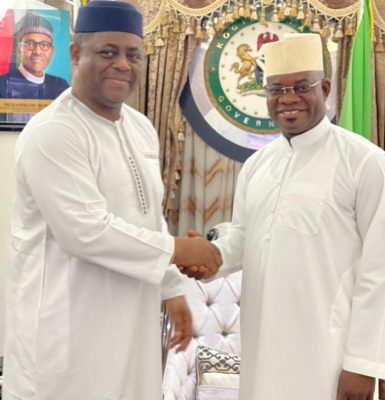
Former Nigerian aviation minister and a staunch member of the opposition Peoples Democratic Party (PDP), Femi Fani-Kayode has failed to specifically admit that he had crossed over to the ruling All Progressives Congress ( APC) following his meeting, on Sunday, with Kogi State Governor, Yahaya Bello and chairman of APC caretaker/extra-ordinary convention planning committee Mai Mala Buni in Abuja. He also met with Senator Smart Adeyemi.

In a statement today, February 9, posted to Facebook, Fani-Kayode said that the meeting was based on the “state of the nation, pressing national issues, party politics and the way forward.

“Despite the obvious benefits and wisdom in this noble initiative it amazes me that some people should feel that it is wrong for me to sit with other leaders in the country to discuss issues which touch and concern the national cohesion, future and stability of our country.”

Fani-Kayode stressed that Nigerians must come together at this point in the nation’s history.

“I can and will never compromise or jettison my core fundamental principles for any reason and I stand firmly on my honestly held opinion that we need to enthrone equity, justice and fairness in this country for it to survive.

“I also believe in restructuring the country and in a vigorous and effective fight against terrorism. The fact that I am in talks with leaders from a cross-section of political parties, including the ruling party, does not in any way derogate from this and does not mean that I will ever change those views.”

Private Company, BUA Procures 1Million Doses Of Covid-19 Vaccine, Delivered Soon

Photo by Science News

BUA, a private company has announced that it has paid for one million doses of AstraZeneca COVID-19 vaccines for Nigeria through the AFREXIM Vaccine programme in partnership with CACOVID.

These doses of the vaccine which is expected to be delivered by next week, will be the first delivery of Vaccines to Nigeria since the COVID-19 vaccines became available.

According to BUA, the vaccines will be distributed free to Nigerians at no cost.

Speaking on the development, Philanthropist and Founder of BUA, Abdul Samad Rabiu said: “BUA decided to secure these 1million vaccines by paying the full amount for the vaccines today because these vaccines became available only last week through AFREXIM.

“We expect the vaccines to be delivered within the next 14 days and hope priority will be given to our frontline workers who have committed their lives to managing the pandemic.”

He said that BUA is committing to purchase five million doses for Nigeria as soon as they become available through this same arrangement.

He thanked the President of the Afrexim Bank, Dr. Benedict Oramah for making the purchase possible and the Nigerian Central Bank Governor, Godwin Emefiele, for coordinating the process through the CACOVID Private Sector partnership.

Nurses In Ondo Protest As Relatives Of Dead Patient Beat Up Some Of Them

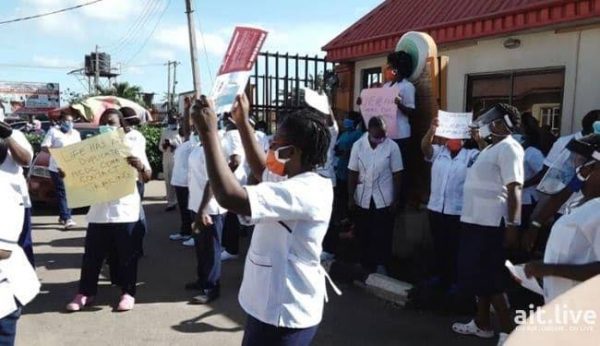
Nurses working at the the Federal Medical Centre in Owo, Ondo State have staged a peaceful protest over physical attacks on some of their colleagues by the children of a deceased patient in the hospital.

Reports reaching us at the Greenbarge Reporters said that all the nurses at the hospital abandoned their jobs today, February 8, vowing not to resume work until there is full assurance of the safety of their lives.

It was gathered that yesterday, February 7, three Nurses were attacked at the hospital by the relatives of a deceased patient who was brought into the hospital’s emergency ward in a critical condition.

Narrating the incident, the Chairman of nurses at the hospital, Francis Ajibola, said that the patient in question was brought too late and that after the nurses and doctors tried all they could do to place the patient on oxygen at around 4 am and he died because the situation had become so critical, and had affected his respiratory system.

Ajibola said that the death of the patient provoked his children who pounced on the nurses on duty, inflicting serious bodily injuries on them. The nurses are presently receiving treatment at the hospital.

According to him, the nurses were not embarking on strike but have withdrawn their services until the management of the hospital provides adequate security for them while on duty.

The Chief Medical Director of the hospital, Dr  Liasu Ahmed, confirmed the incident, saying that a detailed investigation into it has commenced.

Liasu assured that the workers of the hospital will be well protected to forestall a reoccurrence of such an unfortunate incident.

He, however, said that the hospital is still open and has not been shut down, contrary to news being spread by some individuals.

My Govt Is At War With Bandits, Any Of Them Arrested Will Be Killed – Gov El-Rufai

Gov El- Rufai | Photo by Thecable

Kaduna State Governor, Malam Nasir El-Rufai, has made it clear that his government is at war with bandits and that any of them arrested in the state would be killed.

El-Rufai, who spoke today, February 8 in an interview with the BBC Hausa service in Kaduna, said that bandits kill ‘mercilessly’ because they don’t believe in religion.

“My administration is at war with the bandits and so we cannot negotiate. Eliminating them is the only solution to banditry,” El-Rufai said.

“I never believed that a Fulani herdsman who ventured into banditry and is collecting millions of Naira as ransom will repent. I spoke to Dr Gumi, who is my friend; I explained that the majority of these bandits don’t believe in the religion. That is why they kill mercilessly.

“Anybody who thinks a Fulani herdsman that was used to only getting N100,000 in a year, after selling a cow, but now is getting millions through kidnapping for ransom will stop is only wasting his time.”

Tanker Explodes In Abuja, Kills 11

A petrol tanker which exploded in Gawu community in Abaji Area Council, Abuja has killed no fewer than 11 people, including three children, a housewife, Halima Mohammed Yusuf, chairman of the vigilante of Gawu, Adamu Ibrahim.

Others are Dantala Usman, Umar Aliyu, Mohammed Hamza, Hassan Usman, Gambo Hamisu and Sani Abdulmutalib.

Gawu community shares boundary with new-Gawu in Suleja, Niger state.

A resident of the community, Usman Yakubu, said that the incident happened around 11:23 am today, February 8, when a petrol laden tanker was trying to avoid a head-on collision with a ‘Dangote’ trailer.

He said: “the tanker was coming from Lapai axis heading to Izom, after dodging a pothole, which he suddenly veered off the road and crashed, spilling the content on by the road side.”

According to him, some natives of the community after noticing the petrol was pouring out of the fallen tanker rushed to the scene with buckets and jerry-cans to scoop fuel.

“It was while scooping the fuel from the fallen tanker, when it suddenly exploded and killed three Almajiri boys and eight others including a woman who came to the scene to chase the boys away from the scene”

The Chief of Gawu, Alhaji Yusuf Ibrahim, confirmed the incident and said that it happened when some natives of the community went to scoop fuel from the fallen tanker, adding: “unfortunately, we also lost one woman who went to chase the boys away from the tanker explosion.”

The chief said the dead bodies have been buried according to Islamic rites.

The FCT sector commander of the Federal Road Safety Commission (FRSC), who also confirmed the incident, said: “22 people were involved in the incident, while ten people were burnt to death and ten others, eight male adults and two female adults sustained various degrees of burns.”

He said that the burnt victims were rescued by the unit command of the FRSC and taken to Federal Medical Centre at new Gawu in Niger state, even as he attributed the incident to over-speeding and loss of concentration.

The FRSC sector commander said that families of the burnt victims, who visited the scene after fire took the corpses for burial.

Source: Daily Trust

Legal Team Of Police Boss Set To Slam Libel Suit On SaharaReporters

IGP, Mohammed Abubakar Adamu
Legal team of the Inspector General of Police, Mohammed Adamu is set to engage in legal battle with SaharaReporters online newspaper over an alleges N2 Billion service tenure extension Scam.
In a statement today, February 8, the Force spokesman, Frank Mba confirmed that the Inspector General has directed his legal team to commence legal actions against the online publisher.
In the statement, Frank Mba said that the Police High Command regarded  SaharaReporters’ story, dated February 07, 2021, alleging that the police boss paid over 2 Billion Naira for the tenure extension as untrue, unfounded, defamatory and libellous.
“The Force wishes to state categorically that the extension of service of the IGP was strictly the prerogative of the President and was never paid for as maliciously reported in the publication.
“The insinuations also by Sahara Reporters that the IGP did not “celebrate” his extension smacks of ignorance and a pathetic misplacement of priority. The extension does not call for merry-making or celebration but a time for more work, rededication to duty and selfless service to the nation.”
The police boss called on Nigerians to disregard and discountenance the publication by SaharaReporters as evidently untrue and unfounded, adding that he is undistracted even as the Force remains motivated and committed to delivering on its mandate, especially the task of neutralizing current and emerging internal security threats.
He assured the nation of an unwavering commitment by the Force under his leadership, to improved service delivery, safety and security of the citizenry.

Bi-Courtney Aviation Services Announces Importation Of $500,000 X-Ray Machines

Dr. Wale Babalakin
Dr. Wale Babalakin

The Dr. Wale Babalakin’s Bi-Courtney Aviation Services (BASL) operated MMA2,Lagos,  has announced the importation of a sizeable number of X-ray machines to the tune of about US $500,000

to enhance and accelerate the screening of passengers and cargoes.

In a statement today, February 7, Mikail Mumuni, Group Corporate Affairs Manager of BASL, said that the company is embarking on a massive upgrading of its X-ray machine and air conditioning systems for passengers safety, security and comfort.

Mumuni said that “massive resources are also being deployed to upgrade our air conditioning system for the comfort of passengers as we always treat our customers as Kings and Queens.”

The BASL Spokesman said that the ongoing upgrading of the facilities is part of the company’s determination to continue to give Nigeria the best Airport Terminal that is comparable to those available in the developed economies.

“To satisfy our customers, we had to buy 50% of the money required for the importation of the X-ray machines from the parallel market as the Central Bank of Nigeria (CBN) was only able to allocate 50% to us.  This, when added to the amount spent on the air conditioners, is a huge investment on our part, especially at this pandemic period when businesses are at low ebb and considering the fact that BASL is not a beneficiary of the Federal Government’s COVID-19 Palliatives to the aviation sector.”

Bi-Courtney Limited was granted a concession by the Federal Government of Nigeria (FGN) to design, build and operate MMA2. The company is required to under the concession agreement to transfer MMA2 to the FGN after 36 years of operation. MMA2 was constructed and completed within the schedule, a rare feat in Nigeria’s aviation industry and the terminal has been adjudged the best in the country by both the private and public stakeholders.

All Nigerian Banks Have Since Forbidden Cryptocurrencies Transaction – CBN

The Central Bank of Nigeria (CBN) has said that it had not placed any new restrictions on cryptocurrencies in the country.

The apex bank said that all banks in the country had earlier been forbidden, through CBN’s circular dated January 12, 2017, not to use, hold, trade and or transact in cryptocurrencies.

In a statement today, February 7, the bank’s spokesman, Osita Nwanisobi said that the apex bank’s position was reiterated in another CBN Press Release dated February 27, 2018.

Full text of the statement is reproduced here:

The attention of the Central Bank of Nigeria (CBN) has been drawn to various comments and reactions following our recent reminder to Deposit Money Banks (DMBs) to desist from transacting in / and with entities dealing in cryptocurrencies.

Most of these reactions reveal that there appears to be a need to provide further justifications about our position, especially to the general public. For those who are not conversant with the universe of cryptocurrencies, it is important to state that Cryptocurrencies are digital or virtual currencies issued by largely anonymous entities and secured by cryptography.

Cryptography is a method of encrypting and hiding codes that prevent oversight, accountability, and regulation. While there are a number of cryptocurrencies now in circulation, Bitcoin was the first to be introduced in 2009, and now accounts for about 68 percent of all cryptocurrencies.

As regards our recent policy pronouncement, it is important to clarify that the CBN circular of February 5, 2021 did not place any new restrictions on cryptocurrencies, given that all banks in the country had earlier been forbidden, through CBN’s circular dated January 12, 2017, not to use, hold, trade and/or transact in cryptocurrencies . Indeed, this position was reiterated in another CBN Press Release dated February 27, 2018.

It is also important to note that the CBN’s position on cryptocurrencies is not an outlier as many countries, central banks, international financial institutions, and distinguished investors and economists have also warned against its use. They have all made similar pronouncements based of the significant risks that transacting in cryptocurrencies portend-risk of loss of investments, money laundering, terrorism financing, illicit fund flows and criminal activities. China, Canada, Taiwan, Indonesia, Algeria, Egypt, Morocco, Bolivia, Kyrgyzstan, Ecuador, Saudi Arabia, Jordan, Iran, Bangladesh, Nepal and Cambodia have all placed certain level of restrictions on financial institutions facilitating cryptocurrency transactions.

2In China, for example, cryptocurrencies are completely banned and all exchanges closed as well. Banks and other financial institutions are not allowed by law to transact or deal with cryptocurrencies. China’s Central Bank, called the Peoples Bank of China (PBoC) has provided several directives ruling out the use of these currencies.

The PBOC views cryptocurrencies as illegal because they are not issued by any recognized monetary institution and do not hold any legal status that can make them equivalent to money.

Hence banks and all stakeholders are strongly advised against their use as a currency.Even famed investor Warren Buffett has called cryptocurrencies “rat poison squared,” a “mirage,” and a “gambling device.” Mr. Buffett believes it is a “gambling device” given that they are mostly valuable because the person buying it does so,not as a means of payment; but in the hope they can sell it for even more than what they paid at some point.

During an online forum hosted by the Davos-based World Economic Forumfewweeksago, Andrew Bailey, the Governor of the Bank of England, highlighted the extreme price volatility of cryptocurrencies as one of the biggest flaws and explained that this flaw makes it impossible for them to be used as a lasting means of payment.

“Have we landed on what I would call the design, governance and arrangements for what I might call a lasting digital currency? No, I don’t think we’re there yet, honestly. I don’t think cryptocurrencies as originally formulated are it,” he said.It is not surprising he would take that position because, Bitcoin, the best-known cryptocurrency, hit a record high of $42,000 per unit on January 8, 2021, and sank as low as $28,800 about two weeks later. This is far greater volatility than is found with normal currencies.

Let us now turn to some of the justifications for CBN’s recent policy reminder. A perfunctory reflection on the definition of cryptocurrencies can already reveal several problems.

First, in light of the fact that they are issued by unregulated and unlicensed entities, their use in Nigeria goes against the key mandatesof the CBN, as enshrined in the CBN Act (2007),as the issuer of legal tender in Nigeria.

In effect, the use of cryptocurrencies in Nigeria are adirect contravention of existing law. It is also important to highlight that there is a critical difference between a Central Bank issued Digital Currency and cryptocurrencies. As the names imply, while Central Banks can issue Digital Currencies, cryptocurrencies are issued by unknown and unregulated entities.

Second, the very name and nature of “cryptocurrencies” suggeststhat its patrons and users value anonymity, obscurity, and concealment. The question that one may need to ask therefore is, why any entity would disguise its transactions if they were legal.

It is on the basis of this opacity that cryptocurrencies have become well-suited for conducting many illegal activities including money laundering, terrorism financing, purchase of small arms and light weapons, and tax evasion.

Indeed, many banks and investors who place a high value on reputation have been turned off from cryptocurrencies because of the damaging effects of the widespread use of cryptocurrencies for illegal activities. In fact, the role of cryptocurrencies in the purchase of hard and illegal drugs on the darknet website called “Silk Road” is well known.

They have also been recent reports that cryptocurrencies have been used tofinance terror plots, further damaging its image as a legitimate means of exchange.

More also, repeated and recent evidence now suggests that some cryptocurrencies have become more widely used as speculative assets rather than as means of payment, thus explaining the significant volatility and variability in their prices.

Because the total number of Bitcoins that would ever be issued is fixed (only 21 million will ever be created), new issuances are predetermined at a gradually decelerating pace.

This limited supply has created a perverse incentive that encourages users tostockpile them in the hope that their prices rise. Unfortunately, with a conglomeration of desperate, disparate, and unregulated actors comes unprecedented price volatility that have threatened many sophisticated financial systems.

In fact, the price of ether, one of the largest cryptocurrencies in the world, fell from US$320 to US$0.10 in June 2017.

The price of Bitcoins has also suffered similar volatilities. Given that unlike Fiat Money which accompanied by full faith and comfort of a country or Central Bank, cryptocurrencies do not have any intrinsic value and do not generate returns by themselves.

When one buys a stock, say of a conglomerate in the Nigeria Stock Exchange, its price reflects the activity and production of that conglomerate and the value people place on their goods and/or services.

This price may rise as the conglomerate produces better goods/services and probably gains greater market share. The reverse would be true if the conglomerate does not innovate to improve the quality of its goods/services. In other words, the price of that stock reflects market fundamentals.

In contrast, cryptocurrencies do not have fundamentals and would never have fundamentals. Investors only buy in the hope that its use and acceptability will rise, thereby pushing up its demand

4and price. But since new versions of cryptocurrencies come on stream with new mathematical models, an infinite supply may someday crash the price to zero.

At this juncture, the CBN would like to assert that our actions are not in any way, shape or form inimical to the development of FinTech or a technology-driven payment system. To the contrary, the Nigerian payment system has evolved significantly over the last decade, leapfrogging many of its counterparts in emerging, frontier and advanced economies propelled by reforms driven by the CBN.

This is evident from the variety of participants, products, channels, cutting-edge technology in the payments system. It is also validated by the astronomical growth of volume/value of transactions and the fact that Nigeria is an investment destination of choice for international financial technology companies because of CBN’s policies that have created an enabling investment environment in the payments system. These developments in the payments and settlements space has helped to grow the financial system, improving financial inclusion, the quality and convenience of financial services and has also created millions of direct and indirect jobs for teeming youth population.

The innovations in Nigeria’s payment system were catalyzed by regulatory reforms driven by the CBN which entailed the issuance of a raft of guidelines and regulations on Operations of Electronic Payments Channels in Nigeria; Transaction Switching; Card Issuance and Usage, Licensing of payment service providers; Mobile Money Services, Electronic Payments of Salaries, Pensions, Suppliers and Taxes, Licensing Super Agents in Nigeria; and use of USSD for Financial Services in Nigeria, Super Agents and Agent Banking Operations and Payment Service Banks to mention a few.

The robust regulatory framework put in place by the Bank opened up the payment system to innovation with several new players across in the following licensing categories-Payment Terminal Service Providers (PTSPs), Payment Solution Service Providers (PSSPs), Mobile Money Operators (MMOs), Payment Terminal Application Developers (PTSAs), Switches, Super Agents, Agents and Payment Service Banks (PSBs) This has created both direct and indirect jobs for Nigeria’s youth population.

Several other initiatives are being implemented to further support FinTech development and creation of jobs. These include regulatory sandbox and open banking principles that the Bank recently implemented.

The recent regulatory directive became necessary to protect the financial system and the generality of Nigerians (including the youth population) from the risks inherent in crypto assets transactions, which have escalated in recent times, with dire consequences for the integrity of the financial system and financial stability. Due to the fact that cryptocurrencies are largely speculative, anonymous and untraceable they are increasingly being used for money laundering, terrorism financing and other criminal activities.

Small retail and unsophisticated investors also face high probability of loss due to the high volatility of the investments in recent times.

In light of these realities and analyses, the CBN has no comfort in cryptocurrencies at this time and will continue to do all within its regulatory powers to educate Nigerians to desist from its use and protect our financial system from activities of fraudsters and speculators.

Police Battle Kidnappers, Other Criminals In Abuja, Nab 6 Kidnappers, Rescue Victims

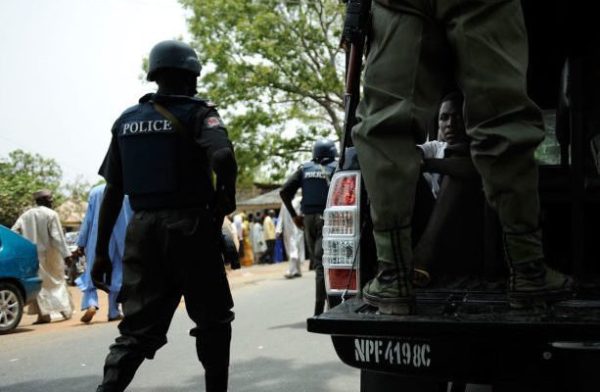
Men and officers of the Federal Capital Territory (FCT) Abuja Police Command have launched an anti-kidnapping operation, leading to the arrest of six suspected kidnappers along Apo axis.

A statement by the Command’s public relations officer, ASP Yusuf Mariam, said that the suspects had earlier abducted three persons and were subsequently arrested by the officers who were on routine patrol as they were attempting to relocate one of their victims.

The names of the suspects were given as 26 year old Frank Ozor, 19 year old Nweke Uches, 25 years old Chester Uzor, 27 year old Chukwu Bethrand, 25 year old Chukwu Samuel and 26 year Kelechi Ngene all males.

The Command said that it had deployed covert and overt crime-fighting strategies to strengthen security across the Federal Capital, especially areas with cumbersome terrain.

“In addition, the Command has launched a strategic counter-kidnapping operation to checkmate the emerging security concerns. The Command is working closely with sister security agencies, key stakeholders and community leaders to rid the FCT of criminal elements.”
While advising residents to remain calm and law-abiding, the Command enjoined them to report any suspicious persons or activities around their vicinity at the nearest Police Division or report the same through any of the FCT Police Command Control numbers: 08032003913, 08061581938, 07057337653, and 08028940883.

Advertisement ADVERTORIAL
WP2Social Auto Publish Powered By : XYZScripts.com