Home Blog Page 777

US Imposes Visa Ban On Un-Named Kogi, Bayelsa Politicians Over 2019 Elections

US Embassy in Abuja

The United States of America has imposed visa ban on politicians, whose names it did not disclose, for allegedly undermining the conducts of the November 2019 governorship elections in Kogi and Bayelsa States.

The spokesperson for the Department of State, Morgan Ortagus, in a statement today, September 14, said: “in July 2019, we announced the imposition of visa restrictions on Nigerians who undermined the February and March 2019 elections.

“Today, the Secretary of State is imposing additional visa restrictions on individuals for their actions surrounding the November 2019 Kogi and Bayelsa State elections and in the run up to the September and October 2020 Edo and Ondo State elections..”

The statement added that these individuals “operated with impunity at the expense of the Nigerian people and have undermined democratic principles.”

It said that the ban is in furtherance of its commitment to strengthening democracy in Nigeria.

Go Back To Work, Minister Appeals To Striking Health Workers

Nigeria’s Minister of Health, Osagie Ehanire

Nigeria’s Health Minister, Ehanire Osagie, has appealed to the Joint Health Sector Unions (JOHESU) to suspend its nationwide strike.

“Nigeria needs the service of all our health workers to control the spread of COVID-19. Issues around allowances are multi-sectoral and have always been saved with negotiations no matter how long it took.”

Dr. Ehanire who spoke today, September 14 at the briefing of the Presidential Task Force on COVID-19 in Abuja, called on the striking health workers to return to work and start negotiating, citing the Coronavirus pandemic.

“I use this opportunity to appeal to JOHESU to suspend their industrial action and go into negotiation.

“The position of the Ministry of Health is that strikes by healthcare workers jeopardise the lives of citizens, especially at such times of global health emergencies as now.

The health workers commenced a nationwide strike on midnight of September 13 after claiming that the government failed to pay allowances for services rendered during the COVID-19 pandemic and other welfare packages earlier agreed upon.

Kainji Dam Overflows Its Banks, Threatens Some States With Flooding, Blackout

The Kainji Dam in Niger State of Nigeria is said to have burst at Kainji Hydroelectric, threatening some states with flooding and blackout.

Reports said that the embankments of the dam, one of Nigeria’s hydro-power stations, had caved in after the opening of the four spillway gates to free surplus water, caused by heavy rains.

The management of the dam, Mainstream Energy Solution Limited, was believed to have opened the points but discovered that the dam was impounding more water than it should.

An official of the company said: “we opened the 4 spillway gates because of the water pressure. Now, it is hitting the embarkment and will continue to expand if not reinforced. The embarkment is falling, rocks are falling into the water.”

The dam, which produces hydroelectric power, is located in New Bussa town in Borgu Local Government Area of Niger State.

Authorities and the firm have shut down the hydro-power station for repairs. This will take about 760MW of electricity off the national grid.

Abdulrasaq Jakada, a top official of the Emir of Borgu’s palace said the monarch has been informed of the development.

Source: THISDAY

Oshiomhole Thought I Was Going To Be Subservient To Him – Gov Obaseki

The Edo State Governor, Godwin Obaseki has said that he fell out politically with his predecessor, Adams Oshiomhole because he wanted to turn him into slave.

In a series of tweets, Obaseki, who is running for re-election on the platform of the Peoples Democratic Party (PDP) in the September 19 election wrote: “I supported @A Oshiomhole when he ran for office. I developed his plan as governor. When he was done, he felt I can continue this plan.

“So, I ran for office; he had an ulterior motive and felt I was going to be subservient. He didn’t know I was going to be this independent-minded.

“The @OfficialPDPNig gave me umbrella when I weathered my political storm and I am grateful to the leadership of the party for their large heart.

Lockdown: Federal Govt Moves To Assist Newspaper Houses Overcome Financial Hiccups

Nigeria’s Federal Government has announced moves to assist newspaper houses to overcome some financial issues they face in the wake of the coronavirus pandemic lockdown.

Minister of Information and Culture, Alhaji Lai Mohammed, who made this known to newsmen today, September 14, after a private audience with President Muhammadu Buhari at the presidential villa, Abuja, said that so far, government had done a few things to intervene in the broadcast subsector of the industry.

He added that government is waiting for the the Newspapers Proprietors Association of Nigeria (NPAN) to come forward with a submission on how government could help.

“Government has done a lot the media, especially the broadcast industry, during this pandemic. The first thing we did was to give a waiver of two months payment of license fees to all broadcast houses, between May and July, after which we gave an amnesty as 60% discount or debt forgiveness, for all broadcast houses, except the Pay TVs, and also slashed by 30% the licensing fees because of the COVID-19.

“I also met with the Newspapers Proprietors Association of Nigeria, we met virtually and I’m still waiting for them to come and make their submissions.

“Definitely, the government is willing to look into the hardships and the challenges the media is facing and within our means to see how best we can intervene. I’m still waiting for the NPAN to come back to us to see what we can do to ameliorate the situation.”

The Minister said that the federal government is serious about developing the entire creative industry, especially because of the huge job opportunity in it, adding that President Buhari is particularly interested in the industry.

“This government is putting a lot of emphasis and promoting the creative industry, which is tourism, which is hospitality industry, which is the music industry, which is the film industry, which is publishing, which is broadcasting.

“We’ll continue to support this industry and have the Mr President’s support. He was quite excited about the portrait because he’s able to see what kind of jobs can be created through this cultural festivals.”

Fuel Subsidy Removal: The Needless Furore, By Maryam I. Shettima

President Muhammadu Buhari is in the eye of the storm recently for bravely realizing the inevitable expungement of the fuel subsidy in Nigeria: brave due to the extreme furore and knee jerk reaction by some gullible and credulous Nigerians, who are convinced that this decision is most inhumane and anti masses. Yet, conflictingly, deep within their minds, they are secretly relieved in knowing that the removal is an absolute necessity. Also, they are not unaware of the fact that, Nigerian masses are neither directly nor indirectly benefiting from the obsolete policy. Thirdly, put them in the same position and the same condition, they would not be any different.

The term subsidy means a sum of money granted by the state or a public body to help an industry or business keep the price of a commodity or services low. For decades, Nigeria had a policy to subsidise petroleum product, especially on PMS, which is one of the most consumed petroleum products in the country. This, over the years, has become a thorn in the flesh of our National Economy, due to blatant abuse and corruption by many beneficiaries as would be outlined later. Experts in the field consequently argued that Nigeria can actually do better by removing the subsidy regime in petroleum, and instead, putting the money to use by developing other sectors with emphasis on health-care, infrastructure and agriculture.

For the past two decades, after democratic governments took over from the military in 1999; this topic has been a major bone of contention. The three past Nigerian leaders had a long and onerous battle with Nigerians, in an attempt to convince the Nigerian masses that subsidy is merely an exploitative and self-serving mechanism some unpatriotic elites use, to deprive the nation of its hard earned resources. This battle proved to be a hopeless one….almost!

Why does any attempt by the government to right the wrongs of subsidy hit a brick wall? Did the subsidy regime truly help in providing enough gasoline to our vehicles and industries? Who are the major beneficiaries of the subsidy idea and Why are they averse to the policy being abolished? Most importantly, what are the benefits Nigerians stand to gain in the eventuality of its removal? These are some of the questions, that are begging to be explored on this topic.

Going back to memory lane, in 1999 the price of petrol in Nigeria was N11 per litre, by 2015, despite the subsidy, the price had skyrocketed to N145 per litre, an increase of over 15 times the initial 1999 rate! Coupled with that, the incessant scarcity of petroleum in a country that parades itself as the sixth largest petroleum exporter all these years, is awfully disturbing and beyond shameful.

In reaction to this quagmire, experts like Malam Sanusi Lamido Sanusi: former Nigerian Central Bank Governor, and former Emir of Kano argued, that the subsidies on petroleum products succeeded in making Nigeria the only oil exporting country that does not enjoy the benefits of increase in the price of crude oil in the international market. According to him; firstly, he reasoned we needed to fix the price of petroleum products ourselves, but then, we do not refine these products! How can you fix the price of a product that you do not produce? We produce crude oil but regrettably the price we fix is for refined products. Thus, suffice it to say….we are fixing the price of what we never produced, as a result, we end up paying enormously for NOTHING. The money meant to improve other more deserving sectors, now is monopolised by a few individuals, consequently deepening the fissures of poverty in the country. This plunged us in a bleak situation whereby while the rich are getting richer; the poor actually keep getting poorer.

Malam Sanusi Lamido is not alone in this argument, Former Minister of Finance; Dr Ngozi Okonjo Iweala also in a nine paged document, presented to the Federal Executive Council in 2011, similarly leaned toward the same direction of thought, as carried by Vanguard Newspaper of 25th December 2011:

“During that briefing to ministers, Okonjo-Iweala, in a document, titled, BRIEF ON FUEL SUBSIDY, (by) Dr. Ngozi Okonjo-Iweala, the coordinating Minister for the Economy / Honourable Minister of Finance explained the key facts about subsidy, what fuel subsidy is all about, deregulation of the downstream sector  benefits for deregulation), why the subsidy was going to be removed, pointing out that it was a major fiscal and financial “BURDEN” on the nation, those who benefit from the subsidy as well as the relationship between subsidy and the Federal Government of Nigeria’s budget, among other things.”

From her point of argument, the former minister laboriously, and convincingly, pointed to the fact that, the benefit of subsidy’s removal far outweighs its stay. The policy is nothing but waste of resources and a huge needless economic scam in the name of making the products cheaper for the masses. On the final analysis, if government budgeted N10 for subsidy the masses only get a meagre fraction of Kobo out of it, while some subsidy elites are smiling to the bank with the rest. This systematic siphonage of our common wealth by a few subsidy elites can be clearly seen, if we are to consider the 2018 NEITI report alone, which stated that Nigeria spent about N722.3 billion on fuel subsidy! In healthcare, this amount can build 6 world class standard hospitals each in one of the six geopolitical zones of Nigeria. The money also if carefully invested on energy sector, can provide our country with over 2000megawatts! This can give a tremendous boost to power generation and lead to massive industrialization, which would in turn provide employment opportunity for millions of “qualified” yet jobless youths in the country. In the area of Agriculture, the money can guaranty food security in Nigeria, and improve farming and other agro allied products in the country.

Interestingly, this same amount of money could also build Ten Dams with modern irrigation facilities, which would also improve agro business in Nigeria, and launch Nigeria in the league of major exporters of Agricultural products for the inexhaustible foreign consumption.

It is both curiously perplexing then, how some politicians who maximally exploited subsidy removal as the cardinal principle of their campaign, now turn back to be its major adversaries! The former Vice President Atiku Abubakar and the PDP Presidential candidate in the 2019 elections happens to be one of these. He was quoted recently, attacking President Buhari’s decision on the removal and argued thus on his Twitter handle:

“Federal Government finally withdraws the fuel subsidy and price fixing bazaar that had been rife with corruption and stalling investment. This is something patriots have been calling for and for which I was demonised.”

Even the Chief political adversary of PMB, from the above statement, believes the policy is corruption permeated, which every patriotic Nigerian must fight to a standstill. Subsidy removal will at least have two major advantages, killing one major form of corruption and also encouraging investors to put their money in the sector. These at the end of the day, will witness more refineries built in Nigeria, provide job opportunities for our teeming unemployed youths, and would translate to a source of income for more projects development, in transportation , healthcare , housing, and many more sectors.

Dr Rabiu Musa Kwankwaso, a two time governor in Kano State and former Minister of Defence also kicked against the President’s unpopular decision on subsidy. However, if we are good students of history we could remember vividly how in 2011, during fuel subsidy removal’s nationwide protest, the same governor ordered for the shooting of the protesters in Kano. According to him, the idea is ill-timed and inhumane, but like the Chairman of Nigerians in diaspora acknowledged, much as the idea is painful, coupled with Corona Virus pandemic and a slump in the global economy, still agreed the decision is unavoidably necessary. As far as the oppositions are concerned the only right time for the removal is when they are in power, as long as as they are out of it, no time will ever be right!

As far as “WE” are concerned, it is a welcome idea, Nigerians need more focus on developing projects, they have no or limited luxury of enjoying as a result of subsidy regime, the wise and far-sightedly man, took the painful decision, not to further the harsh economic conditions Nigerians are in, but to alleviate their suffering, fight corruption, improve, lay out and solidly set the stage for more infrastructures, and a solid foundation for National Economic growth. There is no way we can stop fuel smuggling across our boarders with the current pricing system. The subsidy removal will bring more investment in the sector, government will get more income for projects implementation, and in the long run, prosperity and progress will reign!

Maryam I Shettima is an Abuja based social media activist, and the CEO of #webelieve! movement.


Polaris Bank Dedicates Account For Women Empowerment 

Polaris Bank has dedicated a special account known as Polaris Pearl account to equip women entrepreneurs with the requisite knowledge, skills, and support to run their businesses profitably.
The Bank announced that following from its interaction with women across the country, it has discovered that most of them are unable to access finance to either stabilize or scale their businesses mainly because of a lack of awareness on how to leverage bank funding to drive and sustain profit. 
It noted that this finding is contrary to the popularly, but erroneously held view that unavailability of finance is the main challenge facing the average business woman.
Speaking on the benefits of the Polaris Pearl Account, the Bank’s Group Head, Products and Market Development, Mrs. Adebimpe Ihekuna, explained that lack of proper guidance on access to opportunities is also a major hindrance to women in their entrepreneurial ventures. 
“We have carefully designed Polaris Pearl Account for women or groups of women entrepreneurs who initiate, organize, and operate a business enterprise to fulfill an existing need for the purpose of making profit.”
She said that with Polaris Pearl, Women Entrepreneurs do not only have access to collateral-free loans but are also regularly supported in understanding vital aspects of business development such as business training, business tips and positioning for new opportunities. We also support them with requisite skills on emerging local and global trends that may impact their businesses.
She said that many women entrepreneurs who have embraced the Polaris Pearl product have so far enjoyed numerous incentives such as business name registration, health check, business plan development, and a host of other value-adding benefits.
On the value proposition of the Polaris Pearl, the Bank’s Acting Managing Director/CEO, Innocent Ike, said that Polaris Bank is a member of the United Nations Environment Programme Finance Initiative (UNEP FI) and hence a critical stakeholder in the global conversation about gender inclusion and women empowerment especially in enhancing their access to finance and business opportunities.
He explained that the empowerment of Nigerian women constitutes one of the six pillars of Polaris Bank’s corporate citizenship and Sustainability focus.
Polaris Pearl account can be opened through the Bank’s account opening portal at https://accounts.polarisbanklimited.com/opening/ or visit any of our SurePadi agents in your neighbourhood, as well as any Polaris Bank branch closer to you.

Joint Health Workers Union Commence Nationwide Strike Tomorrow

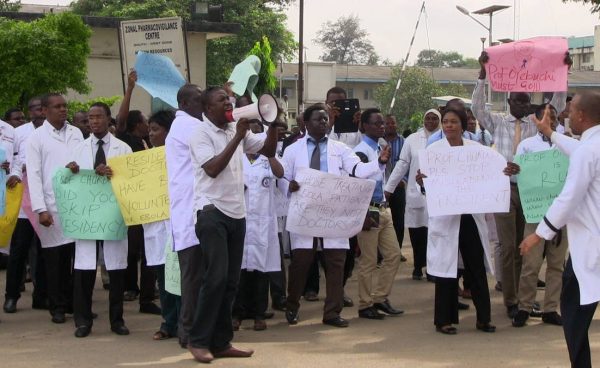
File photo of protesting health workers

The Joint Health Sector Unions (JOEHSU) and Assembly of Health Care Professionals (AHCP) under the auspices of JOHESU have said that their members will commence a nationwide strike by early hours of tomorrow, September 14 to press the federal government to meet their demands.

Those who signed the JOHESU’s strike notice are President of the Medical & Health Workers’ Union of Nigeria (MHWUN), Biobelemoye Joy Josiah and the Secretary General, Silas Adamu; President of the National Association of Nigeria Nurses and Midwives (NANNM), A. Adeniji and General Secretary, A. Shettima; President of the Senior Staff Association of Universities Teaching Hospitals, Research Institutes And Associated Institutions (SSAUTHRIAI), A. B. Akintola and General Secretary, Ezekiel Popoola; President of the Nigerian Union of Allied Health Professionals (NUAP), O. Ogbonna, and General Secretary, Martin Egbanubi; National President of the Non-Academic Staff Union of Educational & Associated Institutions (NASU), Hassan Makolo and General Secretary, Comrade Peter Adeyemi.

The leadership of JOHESU had written to the federal government at the weekend, through the Ministry of Labour and Employment to inform the authorities of the decision of members to proceed with their planned strike.

The federal government and JOHESU had earlier signed a Memorandum of Understanding (MoU) last Thursday on measures to resolve their grievances. In the MoU, signed between the government team and JOHESU, both sides agreed on modalities to sort out issues before the next meeting scheduled for September 15.

The MoU reads: “In view of this understanding, JOHESU will consult with her members with a view to reporting back on Saturday, 12th September, 2020. The meeting adjourns to 15th of October, 2020 to enable Federal Ministry of Health to carry out the assignments.

“Following the 15 days’ ultimatum given by JOHESU to commence an industrial action by midnight of Sunday September 13th, 2020, the Minister of Labour & Employment convened a conciliation meeting on Thursday, 10th September, 2020 with the leadership of JOHESU and relevant government stakeholders to address the issues.”

However, in the letter titled: “Notice of 15-day Ultimatum/outcome of JOHESU Expanded NEC Meeting,” it said: “You would recall that at the end of the meeting held in your office on Thursday, 10th September, 2020, JOHESU demanded that the outcome of the meeting between JOHESU and the federal government be reported back to our expanded NEC meeting and give a feedback to the federal government within 48 hours.

“In the light of the above, the meeting of our expanded NEC was held today, Saturday, 12th September, 2020. And at the end of the meeting, which was held both physically and virtually, it was unanimously agreed that since nothing concrete was achieved at the said meeting with the federal government, that the strike notice is still germane and alive.

“Therefore, the 15-day ultimatum still subsists and with effect from midnight of Sunday, 13th September, 2020, our members shall withdraw their services due to federal government’s inability to meet their demands.”

The union had complained that many of its members were either omitted or short paid in the implementation of Special Hazard and Inducement Allowance as agreed in the MoU of 21st April, 2020.

According to JOHESU, some of their members were paid 10 per cent of their consolidated basic salary instead of 50 per cent in the MoU of April 2020, while others were omitted in the categories of those to benefit from the Special Covid-19 Hazard and Inducement allowance.

JOHESU added that in spite of several engagements with the Federal Ministry of Health, the anomalies are yet to be corrected as at Thursday, September 10, 2020.

The meeting agreed that the Federal Ministry of Health should issue a circular to the Chief Medical Directors (CMDs) of the various health institutions by Friday, 11th September, 2020, and the CMDs should be requested to forward the list of members affected by the shortfall to the Federal Ministry of Health by Monday 14th of September, 2020.

JOHESU was also asked to mobilize their members in the local chapters of the tertiary health institutions to ensure that the CMDs forward the list of their members to the Federal Ministry of Health to facilitate the payment.

On the issue of medical personnel in the educational sector that were not captured in the first tranche of payments, the meeting noted that the omission was not peculiar to JOHESU members alone.

The minister informed them that he would consult with the relevant ministers on how to address the issue as clinics/hospitals under Federal Ministries of Education, Justice & Defence are all equally affected.

JOHESU made a request that all health workers who hitherto were being paid N5,000 as hazard allowance should be the beneficiaries of the 50 per cent of their consolidated basic salary as Special COVID-19 Hazard and inducement allowance, irrespective of whether they are or non-core medical professionals.

The ministry explained that the MoU of April 2020 in 1(d) was explicit on this.

However, the meeting agreed that the list of this category of workers should be compiled by the Federal Ministry of Health and the attendant financial implication should be computed by the office of the Accountant General of the Federation (AcGF) to see if the request can be accommodated within the available funds because they were not in the original classification for 50 per cent.

“Adjustment of Consolidated Health Salary Structure (CONHESS) as was done with Consolidated Medical Salary Structure (CONMESS) since 2014: The meeting noted that this matter had been earlier referred to the National Industrial Court of Nigeria (NICN) and is one of the issues that cannot be resolved by consensus at the ADR.”

Source: THISDAY.

Landslide Renders 3,000 Families Homeless In Imo, State Govt. Helpless

Landslide which occurred last week at Okohia Akwakuma in Owerri North Council Area has rendered no fewer than 3,000 families homeless, even as the State government said that the calamity is beyond its capacity to resolve.

State Commissioner for Environment, Dr. Iyke Njoku, who spoke on the issue, said that already the affected families have been asked to leave their residences immediately to avoid further calamity.

“We have asked them to temporary find a place to stay and we have asked the Federal Government to urgently come to the aid of the families and state government.

“It is a very big landslide which has affected many homes and houses.”

Njoku lamented that the situation is beyond the state government, considering the parlous economic state, even as he said that Imo has over 300 erosion sites.

“So we are calling on the Federal Government, ecological fund office and International donor agency to come to our aid to save the state from submerging.”

He said that the state government has promised to send some palliatives to the displaced persons, even as there is report of exodus of landlords and tenants from the affected areas.

Source: The Nation.

Obasanjo, Atiku, PDP Cannot Point Way Forward For Nigeria To Buhari – APC

The All Progressives Congress (APC) has said that the Peoples Democratic Party (PDP), former President Olusegun Obasanjo and former Vice President Atiku Abubakar have no moral justification to point a way forward for Nigeria for President Muhammadu Buhari to follow because they failed to do so when they had the chance.


The APC asked former President Olusegun Obasanjo to tell Nigerians why they were yet to get a steady power supply despite claims by his administration that it spent $16 billion on the power sector.

In a statement today, September 13 by its Deputy National Publicity Secretary, Yekini Nabena, in Abuja, APC said: “it is baffling that the same political actors that midwife and institutionalized the national rot, corruption, impunity and eroding of our value systems are the same characters posing as voices on the way forward in our national life. How ironic!

“Former President Olusegun Obasanjo could start with telling us where the electricity is despite $16 billion he spent on the power sector. Obasanjo’s deputy, Alh. Atiku Abubakar should account for the privatization exercise under his watch which saw national assets sold off to friends and cronies with no benefit to the country. Successive Peoples Democratic Party administrations can also start by accounting for the trillions stolen from our national coffers in the guise of a fraudulent fuel subsidy regime.

“While it is well within the rights of these political actors to write skewed letters, spew empty, hypocritical, tongue-in-cheek, and two-faced economic magic models in line with their Dubai meeting strategies, this administration is walking the talk with verifiable projects and people-centred interventions that is uplifting Nigerians.

“These political actors probably only listen to their own voices because Nigerians have long stopped taking them seriously as they simply lack the antecedents and moral credentials to guide Nigeria and Nigerians to the path of prosperity and progress.

“Instead of the “do or die” lingo Obasanjo and the PDP introduced to our electioneering, votes are beginning to count as our elections improve steadily. Their abandoned projects which constituted drainpipes on national resources are being completed by this administration.

“The brazen culture of impunity and corruption which they institutionalized is being replaced by strong and accountable systems. The culture of roundtripping and the rested subsidy regime in the petroleum sector has been replaced by a deregulated and accountable petroleum pricing template. Instead of plotting how to sell national assets, particularly the NNPC to friends, this administration is reforming public sector operations to ensure optimised service delivery.

“We are gradually eating what we grow. Our national emergency health response has earned global accolades and recognition as displayed by our COVID-19 response. Our defence capacity to respond and contain emerging security challenges is now tested and proven. How did Nigeria achieve this? A strong, people-centred and focussed leadership which the President Muhammadu Buhari-led APC administration provides.”

The APC stressed that the recent deregulation of the petroleum sector will save Nigeria as much as one trillion naira ($2.6 billion) according to the Petroleum Minister of State Timipre Sylva.

It added that Nigerians should trust that the freed-up cash will be accounted for and be judiciously invested to develop other critical areas such as infrastructure, health care, education among others.

Advertisement ADVERTORIAL
WP2Social Auto Publish Powered By : XYZScripts.com