Ex Minister of Trade and Investment, Olusegun Aganga, has said that Nigeria has everything going in its favour to become a great nation.
In a lecture he delivered yesterday. August 1, at EY Alumni, Aganga said: “Nigeria is a country with so much promise, blessed with abundant human and natural resources. A country with about 84m hectares of land, where almost everything can be grown; a nation with more than 44 solid minerals in commercial quantity, a top 10 oil and gas producer in the world, has a demography that is the envy of the world and more. “The fundamentals are strong. We have everything to become a great nation and to have a strong and well-diversified economy.
“The time to take that bold step and put Nigeria on the path of economic diversification is now.”
The full text of the lecture, titles:
THE SOVEREIGN WEALTH FUND AND THE URGENCY FOR ECONOMIC DIVERSIFICATION, is reproduced here:
First, I must thank the EY Alumni and the organising committee for asking me to speak at this inaugural event. I have declined to speak at many events since I left government. However, this was an opportunity I couldn’t miss because of my relationship with EY Lagos and EY London for more than two decades. In addition, the main issues at hand are of particular interest to me, given my involvement in the establishment of the Nigerian Sovereign Investment Authority and the urgency of the issue of economic diversification in the realization of our true potential as a Nation. I must confess that my greatest challenge was to condense these germane and interrelated issues into a 35- minute speech. I promise to try my best.
IS THE NIGERIAN ECONOMY DIVERSIFIED?
The composition of our total output seems to suggest a diversified and well-balanced economy. The size of our economy in 2019 was N146 Trillion (about US$448 billion). Oil and gas accounted for only 10 percent and non-oil contributed 90 percent. If we further disaggregate the non-oil output, agriculture had a share of 20 percent, industry-21 percent; and Services-49 percent. On the face of it, this looks like a well-diversified economy.
But the picture is very different when we actually look at other metrics. I will focus on the composition of revenue and exports, size and quality of revenue, and other dimensions of economic development that tend to align with a more-diversified economy.
Sources of revenue for Government and foreign exchange: We rely mainly on one source – oil and gas! Revenue from oil accounts for over 70 percent of our total revenue and over 85 percent of exports. Meanwhile, for other resource rich countries like Indonesia, oil and gas only accounts for less than 35 percent of their export earnings while the remaining 65 percent is from a wide range of products and commodities.
Size and quality of revenue: The size of the revenue is relatively small as already identified by the IMF (reported at about 8 percent of GDP in 2019 but expected to decline to around 5 percent in 2020), and the quality poor because of the volatility of oil prices. The fiscal deficit in the recently revised 2020 budget stood at N4.97 trillion, reflecting largely the sharp decline in oil prices due to reduced global activities associated with COVID-19.
Size of economy: Indeed, our country is the largest economy in Africa. Indonesia, which in many ways is similar to Nigeria in terms of population and natural resources, has more than twice the size of our economy, with a nominal GDP of $1.12 billion. Nigeria’s per capita GDP of $2,386.90 constitutes about 32 percent of that of South Africa. It is clear to me that we have considerable scope to grow our economy and at the same time ensure that greater segments of the population participate in the growth process.
Delivers Inclusive Economic Growth? – The high level of poverty and unemployment is a pointer to the fact that there are fundamental issues to be addressed. According to the 2019 poverty and inequality report, released by the National Bureau of Statistics recently, 82.9 million (40.1 percent) Nigerians are poor. That is the entire size of the population of South Africa and Ghana put together. The poverty world clock actually claims that the number of the absolute poor in Nigeria is closer to 102.million, the highest in the world. Nigeria’s unemployment rate of over 23.1 per cent deserves policy attention. The unemployment situation is expected to worsen as a result of the COVID-19 pandemic.
THE ECONOMY WE NEED
So, what do we need? We need a much bigger economy that is diversified in terms of domestic revenue generation and export earnings. Such an economy is better equipped to withstand internal and external shocks and compete in the global arena.
The key message here is that being a resource rich country does not make you a rich nation, but it is what you do with the resources that makes you rich, very rich or remain poor.
WHY HAS IT ELUDED US?
Despite the talk of economic diversification over the decades, we have not been able to diversify our economy due to a combination of factors. But I will highlight 4 critical factors:
– Lack of CONTINUITY: in policies, plans and commitment to economic diversification and quality of governance.
– Poor implementation: we are long on plans but short on implementation/execution as they hedge fund manager would say.
– Breakdown of our national values system
– Lack of adequate investment and development of our greatest asset – our people. I will explain later
SO, WHAT DO WE NEED TO DO?
Of course, there are a number of things we need to do to address these issues, but I will limit myself to 4 critical points:
i. We need an integrated national economic long and medium-term plan and an effective framework for delivery, monitoring and reporting. A plan that will be implemented overtime. The norm is to have a 20-25- year plan that is reviewed every 5 years. Remember Singapore’s economy was transformed over a 30-year period and the Auto policy in South Africa was first developed in 1960 and the same plan has been developed and reviewed every 5 years. What is more important is to have in place an effective monitoring and evaluation process to periodically review this framework. The ERGP is a good start.
ii. Build a strong industrial and services sector based on areas of competitive and comparative advantage. The plan to do this is already there. It is called the Nigeria Industrial Revolution Plan (NIRP), and was launched in 2014.
History shows that no country has ever become rich by exporting raw materials without also having an industrial sector, and in modern terms, an advanced services sector. The more a country specializes in the production of raw materials only, the poorer it becomes… Industry multiplies National wealth !
Nigeria has all that is required to become the China of Africa “Africa’s factory” and even more. In 1980, China was the 7th largest economy with a GDP of only $305.45bn, less than Nigeria’s GDP today, while the US then was $2.86 trillion. Chinaaveraged 10% annual growth for many years and now has the largest economy in the world with a GDP, in PPP terms, of $ 25.27 trillion.
In today’s world, you can only be a great nation, if you have a great economy. And you can only have a great economy, if you have a great Industrial sector to diversify the economy and sources of revenue… and if you also have a vibrant MSME sector to create jobs and provide linkages.
iii. MSME
MSMEs are the bedrock for Nigeria’s industrialization and inclusive economic development. All over the world, MSMEs are the primary drivers of employment. In China and Brazil, MSMEs employ 75% and 70% of the workforce respectfully. The last survey, conducted by NBS and SMEDAN in 2017, identified 41.6m MSMEs employing 86.3% of our workforce, accounting for 49.78% of our GDP and 7.64% of our exports.
Again, we already have a comprehensive plan called NEDEP (National Enterprise Development Plan), which can be updated and implemented as part of the long-term plan. It covers the entire ecosystem of the sector nationwide, working closely with SMEDAN, ITF, BOI, the State and local Governments and the private sector, under the supervision of the National MSME Council. There should also be state MSME Councils.
iv. CRITICAL ENABLERS
The drivers of competitiveness, viz; The needed investment, a friendly business environment, infrastructure and standards are already addressed in the NIRP. But I want to talk about other critical enablers for economic diversification and National development, which are often not properly identified and linked to economic diversification and development.
National Values System – History has shown that the most successful companies and countries in the world have some core values, which have become part of their culture. It is the foundation on which their success is built. It is PEOPLE who make the laws, develop the diversification plan and policies; it is the people who enforce and monitor the law and implement the policies and plans. So, if the values of integrity, hard work, patriotism, industry, spirituality, compassion, fight against greed, corruption and lust for power are not embedded in our culture and do not form the foundation on which our economic diversification program is built, we are bound to fail woefully, as a people and as a nation. We must seek unity, based on our shared values.
They were part and parcel of our culture in the 60s, 70s, and early 80s, when we had a stronger economy and currency.
In fact, building a value-based society is not new to us. In the days of our Fathers, Grand Fathers and our Founding Fathers, our families and communities, were based on strong values. Those values reflected on the quality of leadership, teachers and teaching, religious leaders, schools/educational system etc. Those were the days when individuals were recognized, based on their values and contributions to the community, and not on their wealth; the days when your wealth meant nothing unless the community knew the source and considered it credible; the days when children were taught that all that glitters is not gold and thou shall not bring shame to the name of the family and community; the days when exchange rate was N1 to £1 or even less; the days when it was almost a crime to tell lies in school and our Universities ranked as some of the best in the world. And yes, there was a time when farmers left their produce like yam, plantain, by the roadside with the price tag, and travellers stopped by the roadside, took what they wanted and left the exact amount on a piece of cloth or newspaper by the yam or plantain, without anyone looking or watching! The only unfortunate thing is that anyone under the age of 45 years today may not have experienced this era or would have very little recollection of this era.
I am not just talking about a campaign but I am talking about a deliberate, well thought out strategy that is rigorously implemented over a number of years and that will involve everyone, starting from primary schools. It may need an amendment tothe constitution asit was done in Singapore, where an act was enacted, plans and policies were developed and implemented.
If we get this right, we will create a new disciplined society of Nigerians who are ready to serve and put country first (not personal interest first), ready to implement the economic diversification plan to the best of their ability and for the general good of the society.
II. Civil Service Reform – The civil service is the backbone of any government. It was not by accident that the civil service was one of the first institutions Lee Kuan Yew focused on in Singapore. He forged a system of meritocratic, highly effective and non-corrupt government and civil service. The reward system recognised hard work, performance and integrity. We need to make our civil service smaller, invest in their training and pay them more to attract and retain the best talent. Today, it is bloated, civil servants are paid less than a living wage and they are ill equipped.
III. Economic Institutions and Agencies – Government agencies are the implementing arm of government and are therefore critical to any diversification plan. Some have drifted from their mandate and others are just ineffective. At a minimum, we should aim to:
a) appoint technocrats who are competent and have a reputation to defend to the Boards and management of these Agencies. The dividend of democracy is good governance for all, not appointments of politicians or friends to jobs that will compromise the quality of governance.
b) Agree on KPIs and review their performance every 4 years. Federal Character is also a good policy, which is poorly implemented. It should mean appointing the most competent and suitable person from that state or geopolitical zone for that particular job, not just anybody from the zone.
IV. Drastically Improve Quality of Spending and Investment– This is about getting value for taxpayers’ monies spent or invested. Always remember that it is your money and therefore you should have a say on how it is spent and hold the person spending your money on your behalf accountable. We need to eliminate all manner of waste, misappropriation and leakages, including uncompleted projects. We all appear to agree that there is a need to reduce the size of Government and cut the cost of Governance. We just cannot afford the type and size of Government we have today. Our economy can not support it. It is time to cut our cloth to our size. Unfortunately, we will remain a poor nation if we do nothing about it. We need strong political will, boldness, wisdom and courage to get this done.
V. Investing in Our Most Important Asset – We need to Invest in our most important and biggest asset – our people, starting with the Reform of the Health and Educational System to make our education more relevant to the economy. We need schools with particular focus on character formation, technical skills acquisition, educational excellence and spiritual insight.
Germany and Brazil have implemented this successfully. Other countries, including Pakistan, also produce annual or bi-annual skills gap survey/reports to support their training requirements.
We have too many young people, including graduates, who are unemployable
VI. Population Control – Our demography and quantity advantage are completely useless and become a threat (social problem) when productivity is low. Most (in particular the youth) are unemployed and do not have enough disposable income to become important consumers of goods produced locally. In fact, many nations with rapid population growth have low standards of living.
Do you know that every year, we add roughly 6 million people to our population? This is about the size of countries like Congo, Namibia, Liberia, Mauritania and the Gambia. In 1960, the population of the UK was 52 million while that of Nigeria was 46 million. By 2015, UK’s population was 62 million while Nigeria’s was 185 million and by 2070, Nigeria will be 550 million while the UK will be only 80 million!
Our population is growing faster than the economy and that only means one thing. Poverty, more poverty and more poverty; with social unrest as a possible end result. We can do something about it now. Let’s start with mass education campaigns highlighting the dangers of uncontrolled population growth and then back that up with policies at the right time. We must prioritise strategies to turn our quantity advantage to productive advantage.
VII. RESTRUCTURING
There has been so much said about the need to restructure. So, I will be very brief here. I will only say that there is definitely a need for restructuring to achieve our accelerated economic diversification and developmental goals.
History will be favourable to any government that addresses these CRITICAL enablers well. In fact, that government would have written its name in gold and future generations will forever cherish their actions.
NOW TO THE ROLE OF SOVEREIGN FUND IN ECONOMIC DIVERSIFICATION – CASE STUDY
Now, let us examine the role of SWF in economic diversification.
Sovereign wealth funds have a
prominent role in the global financial system. Their number has swelled over three decades, with sovereign investors in more than 50 countries, and combined assets under management (AUM) exceeding $8 trillion. The largest funds are held by resource rich countries and East Asian economies. Sovereign wealth funds in several countries have economic diversification as a primary mandate in addition to providing an additional buffer against commodity risk.
Contrary to what most people say or think, the NSIA is not just a savings and stabilization vehicle but it was also meant to be a tool for economic diversification and development. As part of the effort to develop and diversify the economy, it was expected to serve as a catalyst for attracting additional local and foreign investments. The NSIA
has the ability to invest in developmental projects; its subsidiaries or affiliates can issue bonds, or other debt instrument, borrow or raise finance from outside sources.
I will use some examples to illustrate the role the NSIA can play in diversifying the Nigerian economy:
• Mubadala Development Company is a highly successful global telecom company and a subsidiary of the UAE SWF. Its primary objective is to generate strong returns by investing in areas that will benefit the community, develop and diversify the economy of the UAE.
Through its investments, Mubadala
supports the UAE’s economic-diversification plan in different sectors. To promote tourism,
Mubadala invested inhotels and museums, and in Formula One racing with the Abu Dhabi Grand Prix. To advance its healthcare,
Mubadala partnered with and brought the Cleveland Clinic to Abu Dhabi. In education,
the company has attracted prestigious international universities such as
New York University to UAE.
The Fund also invests in the energy sector, healthcare, telecom, utilities, and in education, to produce the best minds and skills to drive the economy.
SABIC, was set up in Saudi Arabia and is recognised as the World’s 2nd largest diversified chemical company. A market leader in the production of methanol, polycarbonate, polyethylene, polypropylene, glycols, fertilisers and it exports granular urea.
SABIC has a slightly different structure in that it is owned and funded directly by the Saudi Arabia Oil Company from oil revenues but the concept/goals are very similar to those of the SWF or a subsidiary of SWF. The mandate is simple – pioneer and drive gas industrialisation in Saudi Arabia, adding value to gas produced. I visited SABIC in 2013 and here is what I found out:
o SABIC was started in 1976 with a $1.8 billion investment, and at the time I met them in 2014, they had a total asset base of $90 billion, employed about 35,000 people and generated $50 billion in revenue. They had 60 plants worldwide, 18 innovation centers, which at the time developed 150 new products annually and owned 8,000 global patents. It also had SABIC academy, which trained all SABIC staff as well as hosted classes for university students.
o In this case, Saudi Arabia had a long-term industrialisation plan and used SABIC, funded from oil revenues to pioneer and drive gas industrialisation. After a number of successful years, SABIC expanded their activities to steel manufacturing, focusing on export market as local demand was not enough.
The SWFs in Saudi Arabia and their partners are invested in some of the Industrial zones in 35 industrial cities and in the technology zones. In total, investments in these cities exceed $133 billion and they employ about 528,000 people.
Nigeria tried implementing this model many years ago with Eleme Petroleum but failed and then sold it to Indorama. Do you know what happened when Indorama bought it? They turned it around and Sales and profit increased over 30 times. It has remained a highly successful company
• However, we tried a different model with the NLNG, which has worked very well so far, but NLNG is only mandated to produce and sell gas at the moment. A well supported NSIA can achieve the same remarkable success as SABIC in Ogindigbe oil and gas FTZ if given the opportunity.
• Kazanah fund in Malaysia. Khazanah Nasional Berhad is the sovereign wealth fund of the Government of Malaysia. Khazanah’s commercial objective is to grow financial assets and diversify revenue sources for the Nation. In the first 10 years from the time they began operations in 1994, Khazanah managed the Government’s commercial assets as well as invested in strategic economic diversification projects like Economic zones, FTZs, industrial parks and local industries, Infrastructure and high-technology sectors, healthcare and airlines. It was only in 2004 that it was allowed to seek opportunities in new economic sectors and geographies. When I met the CEO for the first time in 2012 in Abuja, he told me that the Treasury had received multiples of the initial $1bn capital invested.
TEMASEK Holdings Limited
Temasek is one of Singapore’s two SWFs, along with the Government Investment Corporation (GIC). It was founded in 1974, and today, it has assets of about $375bn. Remember the population of Singapore is only about 5.8m, compared to Nigeria with a population of over 200m, endowed with natural resources and with it’s SWF that has assets of only $1.7bn. After independence in 1965, Singapore lacked capital, infrastructure and job opportunities (almost like where we are today). They then decided to embark on an aggressive industrialisation and economic development program since they had no natural resources. Temasek was one of the vehicles set up to help achieve their industrialisation plan. They have now transformed into a global investor…
RAINY DAYS
I recall when we were setting up the NSIA in 2011, some of the Governors who opposed it then said there was no need to save for the rainy day because their state was already flooded. This was when oil prices were around $100 pb and there was no Coronavirus. I wonder what they would say today? Well, I would say, the rainy days we talked about in 2011 are now here with us and many fully funded SWFs have been helping their economies to recover from the effects of COVID-19. Sovereign Wealth Funds are investing more at home, a trend set to accelerate in the wake of the economic carnage wrought by COVID-19.
Turkey’s fund has injected 21 billion lira ($3.1 billion) into three state banks and Temasek supported a $1.5 billion rights issue by SembCorp Marine and are also facilitating the accelerated production of a vaccine to curtail the spread of the virus.
On 23 June 2020, a consortium of the world’s leading infrastructure and sovereign wealth funds signed an agreement worth $20.7 billion (Dh76bn) to invest in Abu Dhabi’s natural gas pipelines infrastructure. The NSIA can be a catalyst for such critical and strategic investment in Nigeria.
There have been withdrawals from the Nigerian and Norwegian funds to help their governments deal with the economic impact of the virus. If only the Government had implemented the law strictly and fully invested in the SWF, they would have had more to withdraw at this critical time.
Final word on the SWF
There are a few trends I would like to highlight from the above examples:
• SWFs are generally funded from oil revenues or excess foreign reserves and do have a mandate to play a role in the diversification of the economy.
• Well supported and funded SWFs overtime return multiples of capital invested and are self sustaining.
• They are generally more successful in developing and delivering economic infrastructure projects because there is no bureaucracy, they apply private sector skills and discipline to implementation and project management and are able to attract some of the best partners and investors.
• They tend to invest and transform local economies first before emerging as global investors.
• It is easier for SWFs to attract local and foreign investment and partners if the fund has a strong governance structure, is transparent, and if appointments of management and board members are based on merit and competence. Luckily, the NSIA ranks highly as one of the best in terms of transparency and governance structure. In fact, it won an award in its second year.
• They tend to manage existing assets of the Government. We do have so many assets held by different MDAs that are not actively managed. I am not even sure we have a comprehensive list. This is a role that can be delegated to the SWF.
The NSIA has the structure, mandate and legal instrument to play the same role as these SWFs. It only needs a stronger political will from the Government and the full implementation of the law to deliver fully on its mandate.
WHY IS IT URGENT TODAY?
The combined impact of COVID-19, imminent commencement of AFCTA, high level of unemployment and poverty, pre-pandemic; fall in oil price, high level of debt and uncontrolled population growth means that, more than ever, the time to be bold and take decisive action to diversify the economy and empower the NSIA to play its critical role is NOW.
YOU ALSO HAVE A ROLE TO PLAY
I cannot end this without a word or two for this uniquely talented group. You are all leaders with brilliant minds, diverse backgrounds in a profession that is not only noble but that is also described as the passport or gateway to success in the private and public sectors. I am sure you understand why accountancy is described in that way. The courses and exams you take prepare you to excel and be whatever you want to be in the private and public sectors. You are well positioned to play a number of roles as leaders e.g. become a Think Tank and issue thought leadership papers, review our budgeting process and allocation of resources annually to help improve the quality of spending. You can apply the principles of sources and application of funds to the loans to help educate Nigerians and advise Governments on debt management , help strengthen our institutions, including the implementing agencies. You can help embed our core values in the society, look into how the office of the Accountant General and Auditor General can be more effective and play a vital role in transforming our nation. You are all leaders individually, and collectively, you form a formidable group of leaders. Remember you can play a role as a non-political, unbiased group and make a difference, whether or not you are in Government, for the sake of your children, grandchildren and our great country.
7. CONCLUSION: THE FUTURE REMAINS BRIGHT
The good news is that, as a country, we are not starting from the scratch. We did it in the 70s and early 80s and we can do it again and do it even better this time. We have made tremendous progress in some areas. I will give you some examples:
• There was a time when we spent a large proportion of our foreign earnings on the importation of cement but today, more than US$9 billion has been invested In the Cement sector and they support more than 1.6 million jobs. In 2013, Nigeria became a net exporter of cement for the first time in our history. Thanks to companies like BUA, Dangote, Lafarge, Flour Mills and others
• Dangote Petrochemical and refineries is a game changer. I was a big advocate for it when I was in Government and I remain an advocate because I know the impact it would have on our economy. When completed next year, it will have the largest single-train refinery in the world. It will not only help to produce what we consume, but it will also export its products as well.
• Yes, we no longer have Bata but we have Lee in Kano producing some of the best shoes for export and local markets.
• By Q2 next year, Thor through its Segilola project, will be producing and exporting gold in commercial quantity in Osun State.
• Flourmills is leading the sugarcane to sugar production in Sunti, Niger State. If/when the policy is fully implemented, four other Northern states (Kwara, Nasarawa, Jigawa and Adamawa) will benefit from this.
• Proforce in Ode Remo is producing and exporting armoured vehicles for the military, whilst the likes of Innoson in Nnewi, PAN in Kaduna, and others are championing local assembly of cars.
• Coleman Cables based in Arepo, Ogun State, has grown to become Africa’s second largest Electrical and Telecommunications wire and cables manufacturing company
• CAM and Wempco PLC are leading the efforts in Steel manufacturing locally
• Nigeria was one of, if not the largest importer of rice, but today, we are the 13th largest producer of rice in the world and the largest in Africa. We should be able to export rice soon.
• And only last month, Cross Rivers State Commissioned the first cocoa integrated processing factory in Nigeria.
• The Nigeria Economic Sustainability Plan 2020 is a good start and will yield tangible results if well implemented.
• This is just to mention a few
We are a blessed nation. Nigeria is a country with so much promise, blessed with abundant human and natural resources. A country with about 84m hectares of land, where almost everything can be grown; a nation with more than 44 solid minerals in commercial quantity, a top 10 oil and gas producer in the world, has a demography that is the envy of the world and more. The fundamentals are strong. We have everything to become a great nation and to have a strong and well-diversified economy. The time to take that bold step and put Nigeria on the path of economic diversification is now. But we cannot leave it to the Government alone. As EY Alumni and leaders, you are uniquely placed to play a role in national development. Be part of that force that will transform our country and make the Nigerian dream come true. It may be delayed but Nigeria will fulfil its divine plan.
The future is bright!!
God bless you and God bless our great country Nigeria.



 Former governor of Niger State, Dr. Muazu Babangida Aliyu has thrown his support to Mamman Daura, President Muhammadu Buhari, who asked that Nigeria should reconsider its dogmatic belief in zoning, especially in the 2023 general elections.

 Nigeria is the collective heritage of about 200 million people of diverse ethnic backgrounds and tongues. There are over 250 ethnic nationalities spread across the country. Nigeria does not belong only to the Igbo, the Hausa and the Yoruba. Unfortunately, these three so-called ‘’major ethnic groups’’ have defined the political and economic actualities of the country since independence.
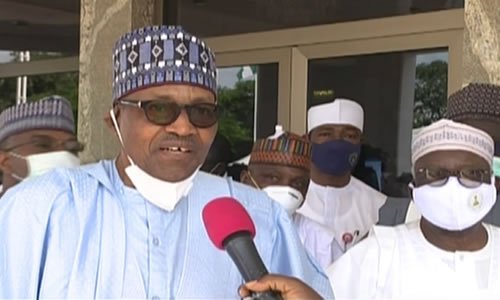 President Muhammadu Buhari has expressed disgust over the escalating security situation in both the Northwest and North Central of the country.



Professional Support For Use Of Hydroxychloroquine To Treat Coronavirus, By David Adonri