over N156 billion higher than its corresponding Q1, 2019 collection of N1,046,889,787,060.27.
This figure translates to 15 percent increase over the previous year’s first quarter collection.
A statement today, April 16, by the Director of Communications and Liaison Department of the FIRS, Dr. Abdullahi Ismaila Ahmad, said that the 15 percent increase in Q1, 2020 is a first in the FIRS first quarter collection history since its inception in colonial times.
“This is attributed to widespread policy reforms and institutional re-organisation initiated by the Executive Chairman, Mr. Muhammad Nami, since assuming office in December, 2019.
“Traditionally, Q1 collection results have been notoriously low as a result of limited economic activities within the period, which business analysts trace to the festive hangover of the New Year celebrations, delay in budget presentation which was a New Year ritual in the country for decades under the Military, limited clarity about government policy directions after the budget had been presented and consumer spending caution and limited liquidity following lavish festivities of preceding December month and January 1 New Year celebrations.”
The statement said that the historic final performance results for Q1, 2020 are all the more remarkable as the period coincided with two adverse global developments on individuals, businesses and nations – a global fall in the price of crude oil price, which is Nigeria’s foremost cash cow and a shutdown of the global economic system by coronavirus pandemic.
It emphasized that the Q1,2020 performance result shows an astronomical increase in collection trends.
“Capital Gains Tax (CGT) recorded 568% increase to N643,935,849.06, from N96,408,740.90.
“Gas Income Tax rose by 420% from N2,977,345,332.31 in Q1,2019 to N15,489,264,736.92 in Q1,2020. Even Petroleum Income Tax (PPT) increased by 9%.
“Other taxes such as Companies Income Tax (CIT) increased by 152% – N102,610,369,777.73 in Q1, 2020 compared to N40,696,980,658.52 for the Q1, 2019; NITDEF rose by 522% – Q1, 2020 N691,206,855.85 to N111,037,797.16 for the Q1, 2019 and Stamp Duty increased by 40% from N3,386,648,663.85 in Q1, 2019 to N4,750,893,578.48 in Q1, 2020. Value Added Tax (VAT) increased by 27% at the Customs Level and 13% at the Non-Import Level.”
The statement said that the passage of Finance Act 2019 led to a drop in Withholding Tax rate from 5% to 2.5% in some sectors.
It said that the Act also tinkered with Pre-operational levy (levy paid by taxpayerstoobtain TCC), thereby resulting in a 5% collection in Q1, 2020, a drop from 7% in Q1, 2019.
“With the full take-over of PAYE and PIT in the FCT by FCT-IRS, the FIRS lost all FCT collection, which led to the fall in both Pay As You Earned (PAYE) and Personal Income Tax (PIT) for Q1, 2020.
Without a doubt, this commendable performance is a direct result of the blockage of leakages and other wide-ranging reforms launched by the Executive Chairman, Mr. Muhammad Nami towards repositioning the Service for efficient service delivery.”
The spokesman recalled that since taking the mantle of leadership at the FIRS, Nami has instituted a regime of policy reforms anchored on deployment of Information Communication Technology (ICT) to block tax leaks.
The statement said that various other measures were taken to motivate members of staff to positively change their attitude to work, adding that some of such measures are the restoration of their functions which were previously outsourced to Consultants, the introduction of Authority to Incur Expenditure (A.I.E) and the commencement of implementation of a new organizational structure, which opened up the opportunity for eligible staff to be promoted, leading to round pegs being put in round holes for efficient service delivery.
The Executive Chairman commended members of staff at the FIRS for buying into the reforms at the Service and their hard work, which led in no small measure to the impressive Q1 2020 results.
Nami, according to the statement, advised the staff to work even harder in the new quarter, saying that he, the FIRS Board and the nation expect a brighter outlook in revenue collections as on-going reforms and deployment of more ICT platforms take root in Q2 2020, against the backdrop of current economic and operational challenges.




 Chairman and Chief Executive Officer of the National Hajj Commission of Nigeria (NAHCON), Alhaji Zikrullah Kunle Hassan, has raised the hope of Muslims that want to perform the 2020 pilgrimage in Makkah and Madinah but are scared that coronavirus pandemic might push the Saudi Arabian authorities to cancel it.
 The Federal Inland Revenue Service (FIRS) is believed to have performed wonder for the first quarter of 2020, by generating a total sum of N1,203,310,372,900.34 which is

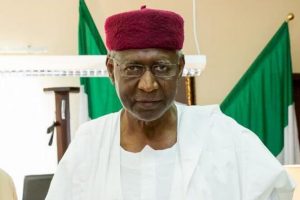
The Man, Abba Kyari, From Cradle
Born in 1938, a Kanuri from Borno, not much is known about his early life. In 1980, he graduated with a bachelor’s degree in sociology from the University of Warwick, and also received a bachelor’s degree in law from the University of Cambridge.
In 1983, he was called to the Nigerian Bar after attending the Nigerian Law School.
In 1984, he obtained a master’s degree in law from the University of Cambridge. He later attended the International Institute for Management Development in Lausanne, Switzerland and participated in the Program for Management Development at the Harvard Business School, in 1992 and 1994, respectively.
Kyari was married to the sister-in-law of Ibrahim Tahir and had four children.
Kyari worked for the law firm Fani-Kayode and Sowemimo for some time after his return to Nigeria.
From 1988 to 1990, he was Editor with the New Africa Holdings Limited Kaduna.
In 1990, he served as a Commissioner for Forestry and Animal Resources in Borno State.
From 1990 to 1995, Kyari was the secretary to the board of African International Bank Limited, a subsidiary of Bank of Credit and Commerce International.
Kyari was an executive director in charge of management services at the United Bank for Africa, and was later appointed the chief executive officer. In 2002, he was appointed a board director of Unilever Nigeria, and later served on the board of Exxon Mobil Nigeria.
In August 2015, Kyari was appointed Chief of Staff to President Muhammadu Buhari.
Kyari was an influential figure within the Buhari administration. During the administration’s first term, he worked mainly behind the scenes to implement the president’s agenda. In 2019 with Buhari’s re-election for a second term, he ordered his cabinet to channel all requests through Kyari’s office. Further enhancing his influence within government circles, and being labelled as the de facto head of government.
In 2017, following a leaked memo, Kyari became embroiled in a public argument with the Head of Civil Service, who was later removed from office and arrested. In 2020, in another leaked memo, Babagana Monguno the National Security Adviser accused Kyari of meddling in matters of national security.
Kyari died in a Lagos hospital on 17 April 2020, after testing positive for COVID-19.
Source: Wikipedia.