Kogi State Governor, Ahmed Usman Ododo, has adopted orphans and indigent students in the state, expressing his commitment to their welfare and education. The governor, who flagged-off a body called “Governor Ododo Orphan Students Care (GOOS-Care)” initiative, organized today, January 25, by the Kogi State Forum of Local Government Special Assistants in Lokoja, emphasized his belief that no child in the state should feel abandoned or forgotten as a result of death or financial condition of their parents or guardians. “You are not orphans as far as we have God Almighty,” the governor said, advising the benefiting students to believe in themselves and avoid tendencies to succumb to emotional setbacks. Governor Ododo, who commended the Forum of Local Government Special Assistants for their proactive efforts, described the initiative as a testament to the success of his administration’s policy to take governance to the grassroots. “What you are doing here today shows we never made any mistake in our decisions because this government is for the people.” The Governor emphasized that his administration is focused on collective responsibility in governance, stressing that leaders should prioritize service to the people at all times. Ododo assured the forum of LSAs of his commitment to addressing issues related to outstanding appointments within the ranks of grassroots supporters of the government. He enjoined members of the forum and benefiting students to remain steadfast, emphasizing that their efforts today would shape a brighter tomorrow. “What we are doing now may not be fully appreciated today, but its value will be evident in the future.” This was even as the Auditor General for Local Government in Kogi State, Yakubu Siyaka Adabenege lauded the efforts of the forum in bridging the gap between the government and the people at the grassroots. He charged the beneficiaries to take the advantage of the programme and make use of the resources provided for them wisely, stressing the need to sustain the programme in order to enhance education and grassroots engagement, describing the initiative as critical tools for fostering collective progress and lasting impact in the state. Earlier, the Chairman of the forum, Jafar Kamarudeen, expressed profound gratitude to Governor for his visionary leadership and commitment to uplifting lives He assured the governor that the programme would be sustained to benefit orphans in the state.
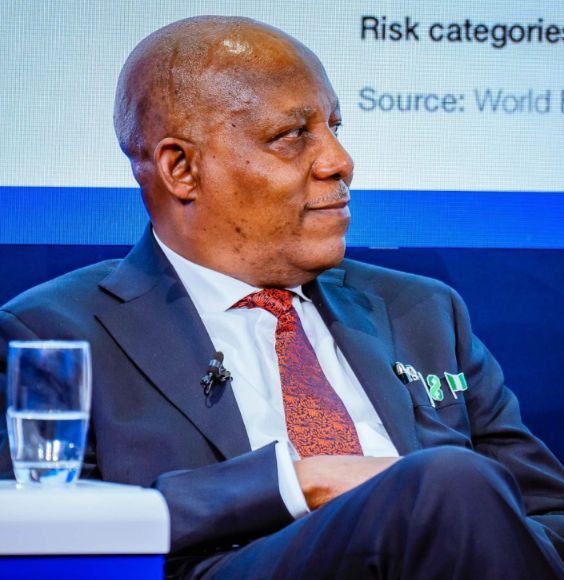
Nigeria’s Vice President, Kashim Shettima, has advised Africa to look inward for solutions to its challenges, instead of relying heavily on foreign assistance. He said: “I don’t believe in aid; I believe in partnership. I would rather carry my poverty with dignity and deal with people, nations, and companies on a pedestal of equality, not in a master-servant relationship. I didn’t come with a begging bowl.” Shettima spoke today, January 23, at the Financial Times Global Risk Roundtable at the ongoing 2025 World Economic Forum in Davos, Switzerland. The Vice President acknowledged the impact of global crises, including conflicts in Ukraine, the Middle East, and Sudan, on supply chains, humanitarian challenges, and peace. He called for multilateral collaboration, stressing that the interconnected nature of global challenges requires collective solutions. “There is an incestuous relationship between economy and ecology in the African continent. But hope springs eternal in the hearts of men. As members of the same human family, we can find solutions to our challenges,” Shettima added. He, however, expressed optimism about the country’s potential to lead Africa’s growth through investments in education, innovation in agriculture, and empowerment of its youth. Shettima noted the importance of harnessing the potential of African youths, who he described as the drivers of global change. “The word for crisis in Chinese is ‘Wei Ji’. Wei stands for danger, while Ji stands for opportunity. “Yes, we have challenges, but those challenges are pregnant with opportunities to re-engineer our society and build back better.” He reiterated Nigeria’s commitment to embracing innovation and empowerment, particularly through education, gender-focused initiatives, and smart agriculture, to propel its economy into the fourth post-industrial revolution.
Minister of the Federal Capital Territory (FCT) has disclosed that the Kuje township reconstruction which contract was awarded to Arab Contractor sometimes ago was not done. The minister, who would not say when the contract was awarded to Arab Contractors, simply said that it was awarded by previous administration. “That road was awarded by the previous administration at the cost of about N59 billion to Arab contractors.” Wike spoke today, January 23, when he officially commissioned the newly reconstructed five kilometer asphalt carriageway from Garage Junction to LEA Secretariat in Kuje Area Council of the FCT. He said that President Bola Tinubu directed that whatever needed to be done should be done to complete the road, adding that the contractor was called back. The Minister reiterated the commitment of the Renewed Hope Agenda to improve infrastructure and enhance the quality of life for residents. He highlighted the importance of the road project, saying that it would significantly improve connectivity within Kuje and enhance its overall development. The Minister assured that the long-awaited completion of the FCT Highway 105 from Airport Road to Kuje, a project initiated by the previous administration, was also nearing its homestretch. He recalled a previous engagement with stakeholders in Kuje, where the traditional ruler had also requested the dualisation of the road, saying that President Tinubu equally gave a directive to ensure the completion of the project. “Today, as we drove coming here, you can see that very soon, you don’t need to leave Kuje to go to the city centre to live. By the time that road is completed, this will be a different town altogether.” The Minister announced that the government has approved the provision of a road project from Kuje to Pegi, a crucial step in improving regional connectivity. Wike assured that the necessary budgetary provisions would be made to ensure construction of this project. On the issue of water supply, the Minister said that President Tinubu had approved a N50 billion budget to provide water to satellite towns, including Kuje. He said that it would address the critical water needs of the community,. The Minister made it clear that the Renewed Hope Agenda is not about party politics but about improving the lives of all Nigerians, even as he called on the community to continue to support the government in its efforts to deliver on its promises. He stressed the importance of communication and collaboration between the government and the people, adding: “It is only in this administration of the President, Tinubu, that you can have the opportunity, that government can sit down with you and ask you questions and say, what do you want? And you say you want this. And government goes ahead to do it.” The Minister also expressed gratitude to the National Assembly for their unwavering support in the development of the FCT, adding that it has enabled the FCT to achieve a remarkable 90% implementation rate for all budgeted projects. “We cannot thank you enough, because anything Mr. President has brought to you as regards the FCT, you have never hesitated. You have always given approval.” Wike also commended the construction company, Gilmor, for the high quality work, even as he praised their corporate social responsibility initiatives and encouraged other companies to follow Gilmor’s example. “I want urge other companies, remove a small percentage of your profit, contribute to the development of the community where you are working. It will not make you to be poor. Rather it will make us to give you more jobs because you care for our people.”
Minister of the Federal Capital Territory (FCT), Nyeson Wike has said that the administration of President Ahmed Tinubu has earmarked over 300billion naira in one year, towards the development of Area Councils of the FCT. Speaking at the commissioning of the Paikon Kore – Ibwa road in Gwagwalada Area Council yesterday, January 22, Wike said that out of the amount, over N50 billion was for the development of Gwagwalada Area Council, which includes the renovation of Paikon Kore Ibwa road, the reconstruction of the Aguma palace road, renovation of 5 secondary schools and the building of two police divisions. The Minister expressed President Tinubu’s commitment to the development of not only the city but the satellite towns and has directed him to provide for the people of the Area Councils whatever they need. He said that the President believes that governance is about seeking the peoples buy-in in every project that is for their well being. “For this road, the President has committed N8.5b. If you are asking what the President has done for the people of Gwagwalada Area Council, put it on record now. In Aguma Palace road, Mr President has committed N22b and that road will be commissioned in May this year. “As I speak to you, we are renovating five secondary schools in Gwagwalada. One is the school for the Gifted. Two, Government Secondary School Gwagwalada. Three, GSS Anagada. Four, GSS Tugan Maje. Five, GSS Giri. For these, N16.5b. “I have not calculated the two police divisions that we are building in Gwagwalada as we speak now, in order to enhance the security of this area. If you add the total value of what the President has committed to Gwagwalada alone, you are talking about over N50b, for one area council. If you now add the six area councils taking that Gwagwalada is the least, you will see that in a year, the President has committed to the development of satellite towns, not less than N300b. “It is important for people to have this record because, you see people will go out and say they are only developing the city, nothing is happening in the Area Councils.” Minister Wike promised to build the Ibwa bridge as requested by the leadership of the Area Council, describing the bridge as very important to the community. The Minister said that the cost will be included in the FCT’s 2025 statutory budget. In their separate goodwill messages, the Vice Chairman Senate Committee on FCT Area Councils and Ancillary Matters, Senator Joel Thomas and the Chairman, House of Representative committees on FCT Area Councils and Ancillary Matters, Fred Agbede, commended the FCT Minister and Minister of State for their dedication to the growth of the FCT, adding that the National Assembly is happy with their performance. Both lawmakers pledged their support for the FCTA and enjoined residents to continue to support the administration for more dividends of democracy. In her address, the FCT Minister of State, Dr. Mariya Mahmoud described the 9km Paikon Kore-Ibwa road as not just a road network but a symbol of progress, connectivity, and economic growth for the community. She thanked President Bola Ahmed Tinubu and the National Assembly for their support for the FCTA and the FCT Minister for prioritizing the project and ensuring its successful completion.
Reports indicate that notorious bandit leader, Bello Turji has fled to the Maradun Local Government Area (LGA) of Zamfara State, narrowly escaping the ongoing military offensive against bandit groups in Northwest Nigeria. Local sources said that Turji’s loyalists were sighted moving on motorcycles late Sunday evening and early Monday morning, reportedly transporting wounded gang members. The fleeing bandits were seen traversing through the areas of Galadi, Damaga, Rudunu, and Danbenchi before heading towards Garsa/Kadanya in the Bayan Ruwa axis. There are also indications that bandits are regrouping in Rudunu, Bankamawa, and Farfaru, all located within the Faru District, which is known for its armed criminal activities. The Bayan Ruwa axis has emerged as a strategic route for terrorists in Zamfara, where the Nigerian Air Force (NAF) conducted airstrikes on terrorist hideouts in August 2024. Further intelligence suggests that some of Turji’s foot soldiers may have taken refuge in Garsa/Kadanya, reportedly under the protection of Jummo Smally, a former rival who has now allied with Turji. The motives behind this unexpected alliance, however, remain unclear. When reached for comment, a defence intelligence source confirmed Turji’s flight to the Maradun area but emphasized that security forces are closely monitoring their movements before launching an attack. The source underscored the importance of caution to prevent civilian casualties, as Turji may be traveling with women, children, or captives. “Yes, Turji and a few of his lieutenants managed to evade our bombardment. We have observed occasional movements of these individuals, accompanied by vulnerable groups such as women, children, and the elderly, who may also include kidnapped victims. “We are meticulously tracking their movements to assess the identities of those accompanying them, in order to minimize the risk of collateral damage. “I can assure you, however, that their days are numbered; they have no safe haven left to threaten the peace of the affected communities.” Source: By PRNigeria.
Ismailia Isah, Special Adviser on Media to Governor Ahmed Usman Ododo of Kogi State has confirmed that Federal Government has already approved the establishment of an International Airport in the state. The governor’s spokesman, who was answering questions on Classic FM 94.3 Abuja, as part of Media Engagements ahead of the first one year in office of the Governor, did not specify where the airport would be sited. According to him, work on the International Airport will soon commence, adding that a Memorandum of Understanding (MoU) has been signed with NEXIM Bank for development of processing facilities for agricultural products for export of and local industries among others. Ismaila Isah said that the Governor, as the State’s Chief Marketing Officer, is working hard to engage relevant Federal Agencies and the International Community as well as investors in the private sector for collaboration that will ensure that the resources of Kogi are used for the development of the State. According to him, the Governor has been reaching out to illustrious sons and daughters of the state on the need to invest in the state, pointing out that the discussions are already yielding positive results. He said that with efforts of Governor Ododo, the establishment of an Industrial Park with the status of Free Trade Zone in the State is already in the pipeline. The Governor’s Spokesman said that prices of food items are now crashing in the state compared to the past, explaining that crop processing facilities have been provided as the government has been encouraging farming by buying directly from farmers. On security of lives and property, the Special Adviser said that a lot has been invested in the security sector which has produced positive results. He said that apart from the purchase of gadgets as well as hundreds of vehicles and motorcycles for hunters, vigilantes and conventional security agencies, the government is also in constant touch with neighbouring states in a bid to take the fight against crimes and criminality to hideouts of criminals in and around the state. Ismailia Isah said that Governor Ododo had since released over N600 million for the payment of WAEC fees, restructured the Bursary Programme for indigent students in tertiary institutions, free education from primary to secondary schools in public schools among others. He said that one unique achievement of the present administration in the state is the completion of projects inherited from the immediate past administration of Governor Yahaya Bello as a deliberate effort to avoid the scourge of project abandonment in the state. Such projects according to him, are the nine kilometer GYB Junction-Zango-Zone eight round about road and 5.5 kilometer Crusher-Zone 8 round about road which has been completed and awaiting commissioning.
“We were initially discouraged not to come to Yobe state, citing insecurity but, we insisted on coming and are impressed with the peace and security (we found), and the government’s commitment to the project.” This was the verdict of Mr. Javed khan, Senior Agriculture Specialist at the Islamic Development Bank. He spoke when he led a team from the Bank on assessment tour of the state to see for itself the documents developed and the preparations on ground for the project. He was on a courtesy visit to Governor Mai Mala Buni at the government House in Damaturu, the State capital. He expressed satisfaction with the preparedness of the state government to partner the bank for the proposed agricultural project. Javed Khan stressed that the commitment of the state government to meeting its obligations is quite impressive and encouraging. Javed Khan said that the team was convinced with government’s committment to the project. “We are working towards a target in the next three months for the state to obtain approval from the bank for the project. “The working synergy between our team and your team suggests that we will achieve our target within the stipulated time frame.” This was as Governor Buni commended the Bank for not listening to the enemies of progress of the state. “l am glad you did not listen to them, some of whom have never been anywhere close to Yobe state but giving stories about what they don’t know. “You are now here and you have seen things for yourselves and can tell the story better. We are ready for this partnership using agriculture to drive the economy of our state and the people. “All the 17 local government areas in the state are now accessible and the people can access their farms and make this proposed project successful.” The Governor explained the importance of agriculture to the people, saying: “this project would guarantee food security and economic prosperity in our post insurgency recovery programme. “The resilience exhibited by our people in embracing agriculture being their major preoccupation to rebuild their lives after the protracted insecurity is very encouraging and need to be supported.” Governor Buni made clear that with proposed partnership with the bank, agricultural development in the state will attain a huge success.
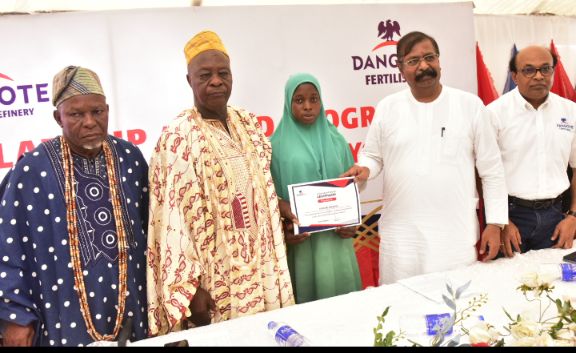
Dangote Petroleum Refinery & Petrochemicals, in partnership with Dangote Fertilisers Limited, have awarded scholarships to 473 students from 10 secondary schools and 7 tertiary institutions to the Idotun Community Junior High School, a suburb of Lekki, Lagos. The company also donated 804 tables and chairs to secondary schools in their host communities of Ibeju-Lekki. At the venue of the donations, students, parents, teachers, and community leaders expressed their joy. The donations of educational materials; textbooks and notebooks, were part of the 5th Edition of the Dangote Scholarship Award Programme. The Group Vice President of Oil & Gas at Dangote Industries Limited, Devakumar Edwin, said that the event symbolised a shared vision, a partnership between Dangote Industries and the host communities, designed to build a foundation for sustained growth. He said that the donation was the one that is rooted in education, innovation and opportunity. He said that the initiative is not merely a celebration of achievements but a reaffirmation of the group’s commitment to nurturing potential, empowering communities, and shaping a brighter future for the leaders of tomorrow. “Education, as we all know, is the passport to the future. At Dangote, we believe that education is not just a privilege but a right that every child deserves. This belief has fueled our dedication to supporting students and schools in our host communities since the year 2019 when we launched the Scholarship Award Programme as a key pillar of our Community Development Plan, with year-on-year progress.” Praising the students for their academic dedication, which he acknowledged has resulted in remarkable growth over the years, Edwin highlighted the impressive year-on-year progress—from 56 students in 2019 to 450 beneficiaries in 2024. He said that the company is deeply inspired by their determination and is confident that the resources provided will empower them to realise their dreams. He noted that the decision to donate the 804 tables and chairs to schools was part of the company’s broader commitment to enhancing the learning environment. This gesture, he emphasised, is a testament to the company’s dedication to ensuring that every child has access to a conducive environment for learning, where they can grow, dream, and thrive. “To the scholars here today, you are at the heart of our initiatives. Your dreams, aspirations, and hard work inspire us to continue making a difference. “As you embark on your academic journeys, remember that the support you receive today is a seed sown in fertile ground. Nurture it with dedication, perseverance, and a spirit of excellence, and it will yield remarkable fruits in your future. “I would like to extend my heartfelt gratitude to our community leaders, dedicated school administrators who work tirelessly to ensure the success of these initiatives. “Your partnership and support are invaluable, and we are honored to work alongside you in empowering the next generation.” The Managing Director of Dangote Industries Free Zone Development Company (DIFZDC), Olayinka Akande, advised the beneficiaries to uphold excellence, which he identified as one of the core values of Dangote Industries Limited. Emphasising the importance of dedication and diligence, he encouraged the students to aim high, saying that with such attributes, some of them could rise to become governors, ministers, captains of industry, or even the next ‘Edwin’ in the future. The Head of Social Performance at Dangote Petroleum & Petrochemicals, Ogunleye Mojisola, said that the education intervention is one of the four pillars of the Community Development Plan, which was jointly designed with the community. Ogunleye expressed gratitude to the management for consistently providing the necessary resources to sustain the programme. “The increase in the number of beneficiaries each year is a clear indication that the initiative is fulfilling its purpose, motivating students to study hard and achieve academic excellence.” The Aro of Lekki Kingdom, Chief Adewale Salami, who represented the Oni of Lekki, conveyed his appreciation for the intervention, affirming that the company is helping to shape the future of the community. He also expressed the kingdom’s continued support for Dangote Industries Limited. The Chairman of the Lekki Coastal Area Development Association, Alhaji Wasiu Ayeola, praised the founder and Chief Executive of Dangote Industries Limited, Aliko Dangote, for transforming what was once a hunting ground of rabbits and lizards into a multibillion-dollar investment that benefits not only the local community and Lagos but also Nigeria and the world. He emphasised that education is the most effective way to shape the future of the community. Several beneficiaries, including Atibere Peter from Lagos State University, Dauda Omolara from Community Senior High School, Magbon Segun, and Ganiu Ayomide from Community Senior High School, Akodo, among others, expressed their heartfelt gratitude. They said that the scholarship and support would motivate them to study harder and alleviate the financial burden on their parents and guardians.
Kogi State Governor, Ahmed Usman Ododo has pleaded with the management of the National Space Research and Development Agency (NASRDA) to complement his administration’s efforts at combating insecurity, improving agriculture and food security, fastracking land reforms. He also talked about development in other critical sectors using existing space technology and innovative capabilities of the agency. Governor Ododo spoke during a meeting with the Director General of NASRDA, Dr. Mathew Olumide Adepoju yesterday, January 20. The Governor, who was in the company of some senior officials of the government, assured that the state government is committed to ensuring partnership with NASRDA to improve the state’s Geographic Information System to facilitate land reforms, promote agriculture and food sufficiency, security of lives and property and other critical sectors of the state’s economy. Acknowledging the state of technology and innovative endowment available at NASRDA, Governor Ododo called on the leadership of the agency to ensure collaboration with the state government by providing needed assistance to enhance development in the areas already enumerated in the Memorandum of Understanding between the agency and the state government, signed late last year in Lokoja in critical sectors. The Director General of NASRDA, Dr. Mathew Olumide Adepoju commended Governor Ododo for the level of infrastructural development and other achievements recorded within one year of his administration. He thanked the Governor for adopting space technology as a way of combating insecurity and promoting development in different sectors of the state’s economy, assuring that the partnership between NASRDA and the Kogi state government will be sustained in the interest of the country and the people of Kogi state.
The Yobe State Audit Service Board has organised a two-day capacity building workshop on fiscal transparency and accountability for Auditors aimed at promoting good governance and service delivery in the state. The workshop, organised for Auditors from offices of the Auditors General for State and Local Governments, began today with the Head of Civil Service, Hamidu M. Alhaji announcing that the workshop is aimed at equipping Auditors of the State and Local Governments with the necessary skills and knowledge to meet the challenges of modern auditing. “This workshop is a clear testimony on Governor Buni’s commitment for transparency and accountability, recognizing the vital roles of Auditors in carrying out their duties.” The Head of Service said that auditing is a key aspect of ensuring transparency, stressing the need for auditors to enforce accountability in public expenditure, thereby fostering trust between the government and citizens. He commended state Governor, Mai Mala Buni for his unwavering support towards the development of human capital asset in the state through continuous training and development of both local, national and international conferences and workshops. He called on the participants to be attentive, deligent and make meaningful contribution towards achieving the goal of the workshop and the knowledge to be translated into their work. Earlier, the Chairman of the State Audit Service Board, Alhaji Goje Modu Balube said that the workshop was organised at a critical time when the need for transparency and accountability is paramount, to ensure that public funds are effectively managed and that government programs align with the needs of the people. He commended Governor Mai Mala Buni for his support to the State Audit Service Board especially in the organization of the workshop, to improve transparency and accountability according to global best practices.
We use cookies on our website to give you the most relevant experience by remembering your preferences and repeat visits. By clicking “Accept”, you consent to the use of ALL the cookies.
This website uses cookies to improve your experience while you navigate through the website. Out of these, the cookies that are categorized as necessary are stored on your browser as they are essential for the working of basic functionalities of the website. We also use third-party cookies that help us analyze and understand how you use this website. These cookies will be stored in your browser only with your consent. You also have the option to opt-out of these cookies. But opting out of some of these cookies may affect your browsing experience.
Necessary cookies are absolutely essential for the website to function properly. This category only includes cookies that ensures basic functionalities and security features of the website. These cookies do not store any personal information.
Any cookies that may not be particularly necessary for the website to function and is used specifically to collect user personal data via analytics, ads, other embedded contents are termed as non-necessary cookies. It is mandatory to procure user consent prior to running these cookies on your website.