The United States of America has formally declared support for the controversial hate speech Bill currently going through processes in the National Assembly.
A political officer in US Embassy, Jerry Howard, who made his country’s position known today, December 3 in Abuja, described the Hate Speech bill as an “impressive” piece of legislation needed to address issues of discrimination, hostility and violence in Nigeria.
At a meeting with the Deputy Chief Whip of the Senate and sponsor of the Hate Speech bill, Senator Aliyu Sabi Abdullahi, at the National Assembly, the US official said that his visit was intended to engage the sponsor of the Hate Speech bill and to seek an understanding into the proposed legislation under consideration by the Senate.
Howard described the response of the media as “misleading” and “hysterical” of the contents of the bill and what it actually seeks to achieve.
He advised the sponsor of the bill to engage and educate Non-Governmental Organizations and Civil Society Organizations in the country on its proposed contents so as to muster support for the bill.
Speaking on the decision of the US Embassy to engage the National Assembly on the Hate Speech bill, Howard said: “we want Nigeria to succeed and we think a prerequisite for Nigeria’s success is successful democracy.
“For democracy to succeed, the people must have a house, the people must have a place where their representatives can argue and complain, come up with new ideas and come up with solutions to guide the executive branch and lead the country forward.”
He commended the lawmaker for the level of work and research carried out on the bill.
“I’m very impressed with the research you’ve done on the bill. The media has had a field day with this, really.
“You’ve thought it through. I was depending on the media for my education, and it was very misleading. You’ve done your research and it is very interesting.
“But you have a difficult job selling this to the NGOs, CSOs. You need to talk to them. You’ll need to talk to Civil Society Organizations, you need to educate them. You’ve educated me,” Howard said after Senator Abdullahi explained the contents of the bill.
Earlier, the sponsor of the bill said that part of the reasons why violence takes place is attributable to discriminatory practices.
“It is discrimination that creates the socio-political imbalance that you see leading to a group feeling shortchanged and marginalised.
“Discrimination is also another very serious matter why I sponsored the bill. This bill basically is about preventing discrimination, and prohibiting people who incite violence.”
Abdullahi said that the bill has the backing of Section 45 of the 1999 Constitution of the Federal Republic of Nigeria as amended, explaining that the Section states: “Nothing in Sections 37, 38, 39, 40 and 41 of this Constitution shall invalidate any law that is reasonably justifiable in a democratic society; in the interest of defence, public safety, public order, public morality or public health; or for the purpose of protecting the rights and freedom or other persons.”
On measures in place to ensure that the bill is not abused by politicians, Senator Sabi explained that “an Independent Commission shall be constituted and whose membership will be restricted to persons without any history of promoting ethnic or religious causes, or anyone with political affiliations.”
He added that the passage of the Bill by the National Assembly into law will address all forms of discrimination, hostility and violence which are on the rise in the country.
Commissioner for Finance in Imo State, Professor Uche Uwaleke has insisted that borrowing is not bad if it is utilised to develop infrastructures and other projects that are beneficial to the people. Professor Uwaleke, who spoke at the opening of a two-day seminar by the Central Bank of Nigeria (CBN) in Owerri, Imo State capital, for Finance Correspondents and Business Editors of media organizations across Nigeria, noted that the biggest economy in the world today, the United States of America, is also the biggest borrowers. “Coming back home, the biggest economy in Nigeria is Lagos State but it is also the biggest borrower,” the commissioner said. He stressed that no country in the world is free of borrowing, even as he said that he preferred foreign loans with room for concession to local ones. Professor Uwaleke commended the CBN for moving fast to quench the fire of recession and for continually organizing fora to equip journalist with the ways the economy is moving. “CBN played a leading role in getting Nigeria out of the recession through several interventional measures. I commend the apex bank and urge it to continue with its intervention engagement to get the country moving.”
President Muhammadu Buhari has appointed Zikrullah Olakunle from Osun State as new chairman, Chief Executive Officer of the National Hajj Commission of Nigeria (NAHCON). Zikrullah succeeds Barrister Abdullahi Mukhtar, who had served out his two term tenure.
President Buhari, today, December 3, transmitted a letter to the Senate for the confirmation of the appointment of Zikrullah and other members of the Commission’s board.
In the letter. Buhari wrote: “Pursuant to Section 3 (2) of the National Hajj Commission of Nigeria (NAHCON) Act 2006, I am pleased to forward for confirmation by the senate the underlisted names of the nominees for the position of Chairman and members of the National Hajj Commission.”
Others whose names were contained in the letter as Executive Commissioners include Abdullahi Magaji Hardawa from Bauchi State as Operation Inspection and Licensing, Nura Hassan Yakasai Policy from Kano State as Personnel Management and Finance and Sheikh Momoh Suleman Imonikhe from Edo State as Planning, Research, Statistics Information and Library.
Part-time members are Mrs Halimat Jibril, Niger State, Abbas Jato, Borno State, Garba Umar, Sokoto State; Ibrahim Ogbonnah Amah, Ebonyi State, Sadiq Oniyesaneyene Musa, Delta State and Mrs. Akintunde Basirat Olayinka, Ogun State. Representatives of Ministries, Department and Agencies are Shehu Dogo, Ministry of Aviation, Nura Abba Rimi, Ministry of Foreign Affairs, Rabi Bello Isa, Ministry of Finance, Budget and National Planning, Zainab Ujudud Sheriff, Ministry of Health, Aminu Bako Yarima, Nigeria Immigration Service and Ibrahim Ishaq Nuhu from Central Bank of Nigeria.
It was gathered that names of the representatives of the Jamaatul Nasril Islam and the Nigerian Supreme Council for Islamic Affairs will be sent to the Senate after ongoing consultations are concluded. President Buhari urged the Senate for expeditious considerations and confirmation of the nominees.
The Central Bank of Nigeria (CBN), has made it clear that not only the closure of the nation’s borders but will take any other measures to correct the mistakes that led to last year’s recession. Speaking today, December 3 at a two-day seminar organised by the CBN for Finance Correspondents and business editors in Owerri, the capital of Imo State, the apex bank Director of Corporate Communications, Isaac Okorafor blamed Nigerians of forgetting so soon, factor that led to the near collapse of the the economy in the recent past. He said that the CBN will not sit down and watch the same mistakes that created a situation of confusion in the economy, adding that there is no way the bank would allow foreign goods to come and drive away local goods.
“Our economy cannot grow if we allow all manner of products to be brought from other countries nearby and far to flood our markets. The CBN will continue to drive policies, whatever it takes to grow the economy.” Okorafor, who argued that borders are not closed but “protected” stressed that Nigeria had no apology for the action, even as the Owerri branch Controller of CBN in Imo State, Mrs. Georgina Nwankwo appealed to the media to improve on the reportage of the nation’s economy. She commended CBN for creating a platform for the continued capacity development of the media practitioners to be able to professionally report the economic activities. The seminar which is being attended by the economic media practitioners from across the country, has as it’s theme: “Galvanizing Development Finance And Monetary Policy For Growth” and has as resource persons the CBN top managers as well as foremost labour leader, Malam Issa Aremu.
Members of the Nigerian National Assembly, and by extension lawmakers across the country, have been under scrutiny lately with regard to their engagements with citizen-voters whose interest they are expected to represent in parliament. Two issues: constituency projects and constituency offices. President Muhammadu Buhari brought the issue of constituency projects to public attention when at an event organized by the Independent Corrupt Practices and Other Related Offences Commission (ICPC), in November, he lamented that there is very little evidence or benefit to the grassroots of the One Trillion Naira that had been earmarked for constituency projects in the last 10 years. This is the main finding of a tracking report on Constituency Projects conducted by the ICPC, the anti-corruption agency which has further announced that the North East is the most affected region where constituency projects were not carried out, or abandoned either due to Boko Haram insurgency or the negligence of the lawmakers from the area. ICPC is launching a probe. The second issue is that of constituency offices. In its lead story of Monday, December 2, 2019, The Punch newspaperfocused at length on the issue of constituency offices: “Five months after inauguration: Senators yet to set up constituency offices – Lawmakers shun constituents. People seek assistance for social events – Senators,” the paper declares. I intend to deal with this latter issue first and subsequently return to the matter of constituency projects.
Lawmakers are expected to have constituency offices in the same manner in which they open campaign offices during the election season. A constituency office is a contact address for keeping in touch with the public, a place where the lawmaker can be contacted by his constituents to engage and relate with him, submit petitions for his attention and action, obtain feedback from him about his work in the legislature and draw his attention to community priorities or basically seek help from him or her. Every state in Nigeria has a state of Assembly with members representing local governments. There are 109 members in the Senate, located in the Federal Capital Territory and 360 seats in the House of Representatives. Every lawmaker represents a constituency, they link national and state politics to the grassroots, reinforcing the notion that politics is essentially local and people-centred. In most jurisdictions, constituency offices are funded by parliament or the executive, and the lawmaker gets a constituency allowance to maintain a properly staffed office. Usually, the legislative calendar is also structured in such a way that lawmakers are given enough time within a year to enable them return to base to interact with the people they represent.
The investigative story in The Punch, earlier referenced, reveals what many Nigerians have always observed since the return to civilian rule in 1999: that is the alienation between parliamentarians and the people, and the urgent need for parliamentary strengthening within the context of citizen relations and wider local, political and sociological forces. The Punch reveals that most law makers in the Senate, five months after the 2019 general elections, do not have any office in their constituencies. The same can be said for other lawmakers. Those who probably have offices are in the minority. This is the Nigerian way. Politicians tend to remember the people only during election seasons. In order to get the people’s votes, in those places where the people are still allowed to make their own choice unfettered, the political office seeker needs to be seen to be popular with the people, he or she must have followers and supporters. A politician seeking a position cannot close the doors to either his office or home: he must maintain an open door policy. Many of the visitors to his home or campaign office may even be members of the opposition parties. He is obliged to welcome them and find ways to encourage them to switch their loyalty to him and his party. In the home of a Nigerian politician, food and drinks during the campaign season must not be in short supply. People will eat and drink and collect transport fare, even if they live within the neighborhood. The politician needs them. They too need him. They serve one purpose in particular: apart from keeping the campaign machinery going; they also help to keep hope alive. They will never tell the politician that he would lose the election or that he is unpopular. They will oxygenate him with so much hope, he would begin to see visions of overwhelming victory. Of what use is a Nigerian politician if nobody visits?
But this relationship often changes shape and colour immediately after the elections have been won and lost. The politician who loses election shuts his doors and withdraws into his shell to go count his losses in the privacy of his space. The supporters also instinctively withdraw, leaving behind only a core group of close associates. The crowd would eventually thin out: the same supporters who predicted victory would quietly move on to support the winner of the election. Politicians are pragmatists: even if they are die-hard party members, you can legitimately expect some of them to jump ship. But the major point in The Punch lead story is how politicians having secured victory at the polls tend to abandon the people. They become inaccessible. They lock their gates, now manned by fierce-looking security guards or able-bodied men or both. The same man who used to buy roasted corn by the road side and personally serve the political crowd food, suddenly hides inside bullet proof vehicles, and siren-blaring convoy. He is now “Your Excellency.” If he is a Governor, he moves into Government House which is a no-go-area for ordinary people. If he is a Member of the House of Assembly, he becomes “Honourable” and he leaves the neighborhood for Legislative Quarters, in a secluded part of the state capital. Don’t expect to see him coming around to play football with his age mates as he used to before he rode on the people’s back to the Assembly. If he is elected as a member of the National Assembly, he would rather hide in Abuja. He may open a constituency office, but you’d never find him there. The poor boy or girl who occasionally keeps the place open to create an impression, has a ready answer: “Honourable is in Abuja!” “Senator is not around.”
Thus, the objective of representation/accountability, citizen engagement and feedback, is defeated. The Punch in its story interviewed a number of Senators. While one or two affirm that they run constituency offices, the overall impression is that this is not the case generally. And why? We are told that some lawmakers stay away from their constituencies for security reasons. Lawmakers from the North West and the North East run away from their constituencies either because of Boko Haram insurgency or the fear of being attacked. One Northern lawmaker was once stripped naked and given the beating of his life by his constituents. Lawmakers from the East are afraid of kidnappers… But generally, lawmakers complain about the pressure they face whenever they have any encounter with their constituents or other members of society. It is as if nobody is interested in their main assignment of defending the people’s interests and making laws for good governance while also acting as a check on the Executive arm of government. The people are just interested in financial help: they want the lawmaker to help pay hospital bills, feed their families, get jobs for their children, sponsor a wedding, attend a funeral and make a generous contribution towards every expense. Community groups, religious bodies, market women associations, the council of church elders, the association of herbalists and spiritual masters…they all seek financial help from the elected representative. Many are unable to bear the pressure. They simply run away, or go into hiding. They hide in Abuja or the state capital. Nigerian politics, before or after the election, is so money-driven, a weak politician may be tempted to resort to armed robbery in order to live up to expectations. The crisis is complicated by the lack of opportunities for the people, and the widespread epidemic of poverty in the land. The country lacks a social security system. Politicians and their political parties have no poverty reduction strategies. Nonetheless, no politician should run away from the people because they seek help from him or her. Constituency work is part of the lawmaker’s mandate. To build a positive reputation, he must connect with citizens and other politicians.
What often happens in this regard, is that as another election cycle approaches and the politician needs the people again to achieve his ambition, he suddenly rediscovers them. He goes back home bearing cash and other gifts. Each politician has his or her style: they could distribute cash, clothing materials, phone sets, grinding machines, generators, motorcycles and tricycles, bags of rice, kegs of ground oil. Food is prepared. A musician is invited to entertain the people. But the politician makes sure the photographs of the items to be distributed are carefully taken and the event itself is video-taped. Journalists are invited to cover the event of course. The politician grants interviews professing his love for “my people.” Usually, the money that is spent on publicity and self-promotion is more than the actual amount spent on the people. It is also common these days to have anyone in power set up a Foundation. One lawmaker bought two electric poles and dug a borehole for his community. Another one built a latrine. Both men advertised the events in newspapers and on national television!
These politicians would later turn around to boast that they have provided constituency projects in their communities. They are rewarded with chieftaincy titles, the Knighthood of Forgotten Saints, or some other decorations. But what is a constituency project? Do National Assembly members fund constituency projects from their own pockets? If they do, so why would the allocation for Constituency Projects be a matter of contention between the Executive and the Legislature during every budget preparation and consideration process? If constituency projects are budgeted for in Nigeria, is the Fund handed over to each lawmaker as is the case in some other African countries? Since President Buhari and the ICPC brought up the matter of constituency projects in the last month, members of the National Assembly have been having a meltdown trying to defend themselves. Femi Gbajabiamila, Speaker of the House of Representatives in response to the allegation that Constituency Projects have swallowed over a Trillion Naira, responded that only N500 billion was released. So, who and who got the N500 billion? Where are the projects? Who are the contractors? Other lawmakers have told us that their only connection with constituency projects is to help identify priority and useful projects in their constituencies. They insist that the projects are implemented by the Executive through Ministries, Departments and Agencies (MDAs) and if anybody is to be held accountable it should be these MDAs. This same position was repeated by Senator Ali Ndume, (Borno South –APC), Chairman of the Senate Committee on Army, in response to the ICPC claim that the worst abuse of constituency projects is in the North East where Ndume hails from. My gut feeling is that we certainly do not know enough about these constituency projects. There is something we need to know that nobody is telling us. At least not yet. For example, are there members of the National Assembly who also double as contractors to the MDAs for the execution of constituency projects?
Senator Ali Ndume says he is proposing a bill for the establishment of a Commission to track constituency projects. I disagree. Monitoring and evaluation of constituency projects is important, but Nigeria does not need a whole Commission to do that. The first step would be for the National Assembly to have a proper data base on constituency projects: which project is being done and where? Who is the lawmaker behind it and which constituency, MDA or contractor is involved? The relevant Committees of the National Assembly should also monitor the projects and the disbursements, and every detail should be made public, particularly for the benefit of the constituents who are the direct beneficiaries. Perhaps when the constituents are properly informed about these projects, they will have every reason to ask questions. For now, politicians throw money at their constituents whenever they can, while accountability is shoved aside. The political parties also have no structure or means for monitoring the performance or the commitment of their members in public positions. That too, must change. Every politician in public office must open a constituency office and make himself or herself available to the people. A new typology of role playing for Nigerian politicians and a strategic pattern of behavior aligning district behavior with national responsibilities in general is what we need.
Ogun State government has threatened to shut houses without toilet facilities and get the landlords arrested to face the full weight of the law.
The decision of the state government came in the wake of cholera outbreak which hit Abule-Otun, Lafenwa, Kuto and Idi-Aba areas of Abeokuta, the State capital and reportedly claimed five lives.
The Permanent Secretary in the Ministry of Health, Dr Adesanya Ayinde said that the State Governor, Prince Dapo Abiodun’s directive to that effect would become operational this week. He said that the governor is of the opinion that open defecation in the 21st century is unacceptable given the danger it is capable of unleashing on human lives, such as cholera and other infections.
Dr Ayinde said that government will soon send workers out to inspect round the length and breadth of the state and that anyone found flouting the order will face the wrath of the law.
“Government will soon send its workers to inspect houses across the state. Any house owner who fails to provide toilet in his house will be made to face the consequences.”
The Permanent Secretary highlighted the efforts made by the present administration in the State to contain the epidemic, saying that government had swung into action on confirming an index case by commencing a thorough investigation in the suspected areas and visiting the health facilities in the communities for search in case of any active complaints.
Dr. Ayinde said that out of the five deaths reported in the news, only one was taken to a government health facility, pointing out that contact tracing helped the officials to get information on the other four victims.
“Away from insinuations from some quarters, not only cholera causes vomiting and diarrhoea but the index case was confirmed by a laboratory test.
“Our action is to see that we disseminate correct information to different places. We have our Information Communication Education (IEC) materials across the state, including the rural areas.”
Dr Ayinde said that the State Hospital, Ijaiye, Abeokuta, has been identified as referral centre for treatment and that cholera alert has been sent to all health facilities in the state in case of any suspected patient.
He said that the administration has decided to fumigate the affected areas through the Ministries of Health and Agriculture respectively to get rid of any form of infectious diseases.
The Permanent Secretary said that health workers are on the field for continuous surveillance, adding that efforts have been set in motion to sensitise the public on safe drinking, hand washing as well as personal and environmental hygiene.
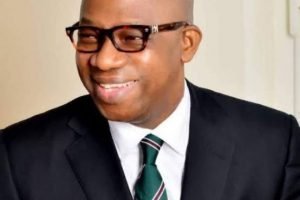
The Governor of the Central Bank of Nigeria (CBN), Godwin Emefiele, has given a hint of the move to establish a Bankers’ Charitable Endowment Fund, as part of the apex bank’s priorities for 2020.
Godwin Emefiele, in a keynote address titled: “Strong Sustainable growth for the Nigerian Economy” delivered at the 54th Annual Bankers’ Dinner organized by the Chartered Institute of Bankers of Nigeria (CIBN) in Lagos yesterday, November 29, explained that the establishment of a Bankers’ Charitable Endowment Fund will fund a major charitable initiative every year starting in 2020.
According to him, the Bankers’ Charitable Endowment will directly fund strategic social programmes in states and local communities across Nigeria. He expressed the hope that the Fund would spur a trend across other industries and sectors to collaborate and work together to better the lives of all Nigerians.
He said that in spite of the positive growth the economy experienced, growth had remained slow due to “some structural constraints” in the economy.
According to him, the pace of growth, given Nigeria’s growing population, exposed the economy to shocks, such as changes in the oil price, and sentiments in the global financial markets.
He said that plans by the CBN to support the economic recovery and enable stronger growth for the country’s Gross Domestic Product (GDP), would continue, adding that the bank’s current tight stance, particularly in view of rising inflation expectations would be sustained.
“Though we will act to appropriately adjust the policy rate in line with unfolding conditions and outlooks, the CBN will continue to ensure that the policy interest rate is delicately set to balance the objectives of price stability with output stabilization.”
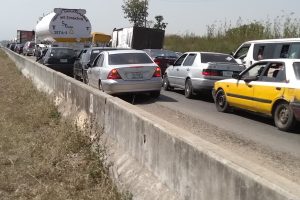
Traffic came to a standstill today, November 30 between Giri and Zuba in the Nigeria’s Federal Capital Territory as a result of diversion created by officers of the Federal Road Safety Corps (FRSC).
Our correspondent who was trapped in the holdup reported that the officers had blocked the other lane of the highway for some youths that were practicing skirting, running on the coater, wearing shoes with tyres.
He said that the vehicles, including loaded trailers, luxury buses and others that were diverted to the other lane subsequently created confusion with vehicles coming in opposite direction.
According to our reporter, the officers who caused the confusion subsequently disappeared from the scene with the resultant holdup that built-up between Yangoji and Zuba, a distance of about two kilometers.
It was gathered that other FRSC officers later joined in reversing the situation by redirecting vehicles to their rightful lane, as the youths practicing skirting also abandoned the practice.
Our reporters said that vehicles, most of which were on long journey to Kano, Sokoto and other Northern states were in the traffic logjam for over four hours, beginning from past 11.00 in the morning.
When contacted, some FRSC offers trying to correct the traffic confusion preferred to remain silent, saying they were not authorized to speak to press.
The Managing Director of Famzhi Interbiz Limited, Hajiya Mariam Suleiman has debunked insinuation that the company is a ponzi.
According to her, while ponzi is a method of collecting money from some people to pay other people, Famzhi Interbiz operates on shearing the profits from production and manufacturing.
Hajiya Mariam, who spoke to over 10,000 investors at the 2019 Annual Conference at the headquarters of the company in Kubwa, Abuja today, November 30, said that the company, which has been registered with Security and Exchange Commission (SEC), is into estate business, farming and animal husbandry, microfinance business and water production and manufacturing as well as other businesses.
She said that there are 150 people on the employment of the company, adding that since it started operation four years ago with few investors, thousands of Nigerians have joined even as it operates strictly within the law of the land.
Hajiya Mariam said that the company’s board of directors are looking into new business opportunities, with more people investing in it, even as she promised to formally declare the company’s statement of account next year after consultation with the directors.
She appealed to the investors, who turned up in their thousands, to be patient with the management over the expected changes in the way the company dispense their income.
“All such changes will be corrected in November 2020, when the company goes Plc. My appeal to the investors is to imbibe the spirit of patience. Everything will be alright in the end.”
Some groups, including students of the University of Abuja and Ebira Vabe Association honoured Hajiya Mariam for her honesty, humanitarian services and devotion to the happiness of fellow human beings.
‘’APC is a party we hurriedly put together….President Buhari gave character to the party. He brought his integrity to bear on the party and made it what it is in the northern part of the country where the masses saw him as a true leader and we all rode on that to achieve victory. But after the credibility of Buhari, there seems to be no alternative in the same manner that will drive the party to a 2023 victory. If we are not careful, APC might go with Buhari in 2023 and that will be very unfortunate. ‘’ Senator Rochas Okorocha
Of the deluge of comments that followed the victory of President Buhari in the 2015 elections, it was Adamu Adamu the current minister of Education, then a columnist with the Daily Trust who offered a more nuanced perspective. He reasoned that Buhari’s victory was the preferred alternative to the social upheaval that the country was hurtling inexorably to under the rudderless leadership of President Goodluck Jonathan of the People’s Democratic Party (PDP)
Now four years into the administration and counting, considering the promises and expectations that accompanied President Buhari’s ascendancy, it should worry us that Senator Okorocha a top figure in this administration should sound this alarm about the ruling party. For what is likely to happen to the APC and indeed the country after President Buhari must have served his second term in 2023 is without doubt the trillion naira question on the mind of not just every political figure but across the spectrum of life in the country as well.
That there is a general feeling of anti-climax slowly giving way to fatalistic resignation as a result of the unresolved and unfulfilled expectations of Nigerians of the Buhari administration is palpably unmistakeable.
Nigerians are yet to see the promised improvements in their lives as dividends for voting Buhari and the APC. And at the level of politics, president Buhari’s failure to strengthen the ‘’ hurriedly put together’’ APC has led to a feeling of uncertainty among the rank and file about what the future holds for the party once he goes. Many APC members across the country are thus convinced that owing to the several fissures within its ranks the party may likely implode once president Buhari goes.
In this regard, the most telling of all the issues raging within the APC has to do with the succession question. There is afoot, a quiet but vicious struggle going on currently on who will succeed president Buhari among the grandees in the party. One of those frequently mentioned is Governor Nasir El-Rufai of Kaduna state. But a Kaduna-based veteran politician thinks differently. ‘’That one? He is not only an accidental civil servant as he himself admitted; he is also an accidental politician. Where will he be today politically were it not for Buhari’’? the man who pleaded not to be named because his house will be demolished, asked rhetorically.
Many within the APC and outside it believe that Senator Rabiu Musa Kwankwaso, had remained in the APC, stood a greater chance of succeeding president Buhari both as party leader and president.
Then there is party leader Asiwaju Bola Tinubu. It is believed by many within APC that he stands the greatest chance to succeed president Buhari should the party decide to zone the presidency to the south. But again as zoning is one of the several issues raging within the APC currently which threatens to derail it Tinubu work is cut out for him. I am reliably informed that in anticipation of this, the Asiwaju is quietly but assiduously working on forming an alternative political platform to actualise his political ambitions.
Although the APC has made some gains in recent electoral contests, the great question still remains whether the party can find within it a leader that can hold its constituent parts together once Buhari exits in 2023. The overwhelming majority of its northern members especially in the party’s core support area of the northwest do not want to countenance a southern presidential candidate let alone support one. They are likely to set up and support a new political party or vote a northern candidate on another political platform. The party’s supporters in the south feel its time one of its own is supported to clinch the presidential ticket and be voted for in 2023 and would settle for nothing less.
All these point are flashpoints with a potential to lead to a major implosion of the APC in the near future. President Buhari despite his massive following may not be able to prevent it because the rifts within the party are spurred principally in anticipation of his departure. Whatever influence he wields in the party will come up against emerging realities in the APC and the country and these will be driven by other significant actors in the polity.
In 2015 president Buhari was the major beneficiary of a shift in political realities which favoured a change from President Goodluck Jonathan and PDP. Similarly by 2023 other issues will emerge to render his influence largely academic having spent his allotted time to make his mark in the annals of Nigerian political history.
If his departure precipitates what Adamu Adamu wrote about in 2015 and Senator Okorocha warned about so eloquently in 2019, it will be the ocassion for the emergence of another fit for purpose leader just as president Buhari in 2015.
We use cookies on our website to give you the most relevant experience by remembering your preferences and repeat visits. By clicking “Accept”, you consent to the use of ALL the cookies.
This website uses cookies to improve your experience while you navigate through the website. Out of these, the cookies that are categorized as necessary are stored on your browser as they are essential for the working of basic functionalities of the website. We also use third-party cookies that help us analyze and understand how you use this website. These cookies will be stored in your browser only with your consent. You also have the option to opt-out of these cookies. But opting out of some of these cookies may affect your browsing experience.
Necessary cookies are absolutely essential for the website to function properly. This category only includes cookies that ensures basic functionalities and security features of the website. These cookies do not store any personal information.
Any cookies that may not be particularly necessary for the website to function and is used specifically to collect user personal data via analytics, ads, other embedded contents are termed as non-necessary cookies. It is mandatory to procure user consent prior to running these cookies on your website.


 The United States of America has formally declared support for the controversial hate speech Bill currently going through processes in the National Assembly.
 Commissioner for Finance in Imo State, Professor Uche Uwaleke has insisted that borrowing is not bad if it is utilised to develop infrastructures and other projects that are beneficial to the people.
 President Muhammadu Buhari has appointed Zikrullah Olakunle from Osun State as new chairman, Chief Executive Officer of the National Hajj Commission of Nigeria (NAHCON). Zikrullah succeeds Barrister Abdullahi Mukhtar, who had served out his two term tenure.

 The Governor of the Central Bank of Nigeria (CBN), Godwin Emefiele, has given a hint of the move to establish a Bankers’ Charitable Endowment Fund, as part of the apex bank’s priorities for 2020.