President Muhammadu Buhari has expressed sadness over the death of his classmate, Dr. Tukur Abdullahi, a Kaduna based medical doctor, who died at the National Hospital, Abuja.
The President, who confessed the death of his classmate was devastating to him, described the deceased as an “epitome of kindness, warmth and care which he brought into medical practice
“As one of those who schooled with the deceased, I was always delighted to be associated with the gentleman, who was so nice,” President Buhari said.
“The late Dr Tukur was not only a gentleman, but also a compassionate and dedicated professional who chose medicine out of his sheer passion to serve humanity.
“I am deeply touched by the demise of Dr Tukur, one of the finest medical doctors you can ever meet. May Allah bless his gentle soul, and reward his good deeds with paradise.
“May God comfort his family and give them the fortitude to overcome this irreparable loss.’’
President said Dr. Tukur, who established and operated Jinya Specialist Hospital,’’.
President Buhari condoled with Dr. Tukur’s family, Katsina Emirate, government and people of Katsina State over the sad loss.
Late Dr. Tukur owned and operated Jinya Specialist Hospital.
President Muhammadu Buhari has narrated how Nigeria lost an estimated US$157.5 billion to illicit financial flows between 2003 and 2012.
He spoke in New York, at the High-Level National Side-Event, organized by the African Union Development Agency and New Partnership for Africa’s Development (AUDA-NEPAD) and the Economic and Financial Crimes Commission (EFCC), on the margins of the 74th United Nations General Assembly, under the theme: “Promotion of International Cooperation to Combat Illicit Financial Flows and Strengthen Good Practices on Assets Recovery and Return to Foster Sustainable Development.”
The Nigerian leader, who quoted from the 2014 Global Financial Integrity Report, said that such massive loss of assets resulted in dearth of resources to fund public services or to alleviate poverty in the country.
According to him, “This is why, as Africans, we have no choice but to break the back of corruption.”
Acknowledging lack of sufficient capital and corruption as impediments to socio-economic development of the continent, the President emphatically restated his administration’s anti-corruption campaign:
“That is why our government has made it a war we intend to win. We will give all it takes to ensure there is no hiding place for purveyors of corrupt practices who are truly enemies of the people.”
Buhari stressed the need to strengthen good practices on asset recovery and return, adding: “in the last five years, our government has made significant progress to curb corruption,” adding: “We have recovered millions of dollars stolen from our country.”
He said that there are still a lot of other funds that are stuck in foreign bank accounts due to international laws, different jurisdictions and justice systems that make it difficult for repatriation.
The President described Illicit Financial Flows as “illegal movement of funds from one country to another.
He cited tax avoidance as another form of illicit financial flow, quoting the Tax Justice Network and the International Monetary Fund to have estimated over US$200 billion per year as being lost by developing countries when multinational enterprises do not pay taxes in the countries where they made the profit.
“This amount is significantly higher than the annual development aid received by these countries which are estimated to be about US$143 billiob.”
President Buhari commended the organisers of the meeting designed to finding pragmatic ways to promote international cooperation to combat illicit financial flows and strengthen good practices on asset recovery and return, as an arm of sustainable development policies in Africa. He also lauded their shared commitment to root out corruption from our continent.
“I am motivated by the belief that, if we join hands, we can bequeath to our children an Africa that is not defined by corruption.”
President Muhammadu Buhari of Nigeria, representing power and Bill Gates, Aliko Dangote, representing wealth, met today, September 26 in New York, the United States of America on the sideline of the ongoing United Nations General Assembly (UNGA).
Buhari explains ro Bill Gates how he manages Nigeria’s economy.
Former Director in the Department of Information in the Federal Capital Territory Administration (FCTA), Alhaji Ibrahim Biu has vouched for the competence of the minister of State for Foreign Affairs, Ambassador Zubairu Dada.
Reacting in a statement today, September 26 to the appointment of Zubairu Dada by President Muhammadu Buhari, the veteran journalist who also worked as editor with defunct New Nigerian Newspapers, said that the minister is a versatile administrator and technocrat who have served meritoriously in various public services in the past.
“Ambassador Zubariu Dada is an experienced civil servant who rose to the post of Permanent Secretary in Niger State before he was nominated by the federal government as Ambassador.”
Ibrahim Biu is sure that with his wealth of knowledge about the public service, the minister would not disappoint the President, even as he cautioned the minister that people would expect much from him as he assumed duty.
The British Prime Minister, Boris Johnson has said that the country’s Supreme Court was wrong to have issued an order for the return of members of the parliament to work after he suspended them a fortnight ago.
“I think the court was wrong to pronounce on what is essentially a political question at a time of great national controversy.”
Boris Johnson was reacting to the London Supreme Court ruling yesterday, September 24 that the suspension of the legislature was not lawful and amounted to a severe blow to Britain’s democracy and ordered that members of Parliament should return to work immediately.
But today, September 25, when parliamentarians regrouped in Westminster to plot their tactics again, the Prime Minister refused to give an inch of ground.
The Prime Minister had asked Queen Elizabeth II to suspend the Parliament for five weeks earlier this month even as his critics argued that such move was an attempt to thwart them in their efforts to restrain him.
The Prime Minister challenged his political opponents to trigger an election as soon as they like, adding: “this Parliament must either stand aside and let this government get Brexit done or bring a vote of confidence and finally face a day of reckoning with the voters,” Johnson told a noisy House of Commons today.
Britain is due to leave the bloc of 28 countries on October 31, and Boris Johnson has vowed to complete the split on time, even if that means doing so without an agreement to soften the impact.
Most members of Parliament disagree with this approach and have passed a law aimed at stopping the premier forcing the U.K. out of the bloc without a deal. But Johnson insists he will go ahead anyway and expects to fight for his strategy in court yet again next month.
Federal Government has given a go ahead to TetFund to intervene by constructing Facilities of Education and Environment in the University of Abuja at a cost of N1. 8 billion.
The Minister of state for education, Emeka Nwajiuba, who briefed news men at the end of the Federal Executive Council (FEC) meeting today, September 25, said that the approval came after presenting a memorandum in that respect.
“A key component of the memorandum was the award of contract at the sum of N950 million for the construction of the faculty of environment and another was also approved for he sum of N908 million for the award to build the faculty of education in the University.”
The minister said that the project is a special intervention, adding: “we have to act to give effect to them so that they can proceed with the delivery.”
President Buhari participates at Programme of 2019 UN Climate Change Summit at UN General Assembly in New York on 23rd Sep 2019 | State House
On Monday September 23, 2019, President Muhammadu Buhari participated alongside other world leaders at the United Nations Climate Action Summit 2019.
Since then, we have seen conversations on Twitter doing what Twitter allows many people to spend a lot of their time on: getting things horribly wrong and/or focusing on the wrong things, while completely missing the real/meaningful/actual message.
And so, this is a backgrounder/explainer, focusing on Nigeria’s commitment to climate action, under the Buhari Administration.
The Climate Action Summit was convened by UN Secretary-General Antonio Guterres, to provide an opportunity for world leaders to, “come to New York on 23 September with concrete, realistic plans to enhance their nationally determined contributions by 2020, in line with reducing greenhouse gas emissions by 45 per cent over the next decade, and to net zero emissions by 2050.”
The theme of President Buhari’s panel was, “Towards a Resilient Future” — with the rider: “Announcement of plans to mainstream climate risk in decision making.”
So, note that the goal of the panel was to elicit ‘announcements’ from the panelists on behalf of their respective countries: Fiji, Nigeria, Netherlands, the Bank of England, etc. In other words, panelists were billed to deliver remarks announcing their country/organisation plans to build a resilient, climate-sensitive future.
To address the theme of the event, President Buhari chose to deliver prepared remarks.
And the moderator’s question, was, in keeping with the theme: “President Buhari, Nigeria has a very young population; perhaps you might highlight what a pathway for a resilient future looks like?”
The President did exactly that, in his prepared remarks, over the next few minutes, highlighting what a“resilient future” will look like in Nigeria — by focusing on the administration’s policies (the ones already being implemented, like the Green Bonds, and the ones set for implementation, like the new tree-planting campaign, and the energy mix target).
His prepared remarks were wholly in alignment with the theme of the Panel event, and the question he was asked.
Keep in mind that as panels often work, the moderator’s question was meant to invite/usher him to take the stage, and share his remarks. As a panelist it was up to him to choose to respond ex tempore, or to go the ‘prepared remarks way.’
He chose the prepared remarks way. And most importantly, he touched on the issues re: mainstreaming climate action for the future and for the young people of Nigeria.
The only story here, for all serious minded people, is what he said, and what it means for the future and for the young people of Nigeria. His remarks read in parts:
“I share the sentiment expressed by the Secretary-General that the world is on the verge of climate catastrophe. Undeniably, Climate Change is a human-induced phenomenon.
“In the water sector, Nigeria will issue a Green Bond for irrigation and construct multi-purpose dams for power, irrigation and water supply. We will strengthen solid and liquid waste management systems to attract more private sector investors.
“We will mobilize Nigerian youths towards planting 25 million trees to enhance Nigeria’s carbon sink.
“Specifically, Nigeria is progressively working to realize 30 percent energy efficiency and renewable energy mix by 2030.
“Furthermore, the Federal Government has commenced the implementation of the Hydrocarbon Pollution Remediation Programme in Ogoniland, to recover the carbon sink potential of the mangrove ecosystem of the one thousand square kilometers (1,000 KM2) polluted site in the affected area.
“Finally, permit me to add that the forty million citizens in the Lake Chad area expect this Summit to take into consideration their concerns. They anticipate that the outcomes of this meeting would include solutions to address the Climate Change impact in the Lake Chad area.”
We believe that the important things for young people of Nigeria to do now should be around holding the government to account on these ‘announcement’ and promises, and ensuring they are fulfilled and delivered in a timely manner.
One of the most exciting should be the tree-planting campaign. Ethiopia recently set a world record on that account — perhaps Nigeria’s young people might even be able to pressure the Government into scaling up the ambitions of our own planned tree-planting campaign.
Therefore the online hysteria is completely unnecessary.
Vice President Yemi Osinbajo has declared legal war with two Nigerians: Timi Frank and Katch Ononuju over what he called malicious news that have been featured in social and conventional media in recent time.
He made it clear that he is ready to waive his constitutional immunity to enable the most robust adjudication of several baseless allegations, insinuation and falsehoods against his person and office.
Professor Osinbajo made this declaration in a tweet he personally authored this afternoon.
Below is the full text of his tweet:
“In the past few days, a spate of reckless and malicious falsehoods have been peddled in the media against me by a group of malicious individuals.
“The defamatory and misleading assertions invented by this clique had mostly been making the social media rounds anonymously.
“I have today instructed the commencement of legal action against two individuals, one Timi Frank and another Katch Ononuju, who have put their names to these odious falsehoods.
“I will waive my constitutional immunity to enable the most robust adjudication of these claims of libel and malicious falsehood.”
The United Bank for Africa (UBA) Plc has expressed its determination to make the 2019 Lagos International Trade Fair, starting on November 1, an avenue for networking, trade and investment bound even as it assured small and medium enterprises (SMEs) that the Fair would bring far-reaching benefits that will transform their businesses to the next level.
UBA’s Head of Group Consumer Retail Business, Jude Anele, who gave this assurance yesterday, September 24, at a press conference to officially herald the Trade Fair as well as unveil sponsors of the trade fair, said that the bank has put in place various service offerings to guarantee that this year’s fair provides a veritable platform to catalyse businesses to new highs. He explained that the 33rd edition of Lagos International Trade Fair scheduled to commence on November 1 is expected to provide an avenue for networking, trade, and investment bound to boost business activities in Africa’s largest economy and by extension, Africa.
While ensuring that SMEs maximise their presence at the fair, Mr Anele explained that UBA would provide uninterrupted banking services during the two-week event, and also provide advisory services to the small and medium entrepreneurs, fundamental to achieving their business goals.
“Worthy of mention is that merchants and entrepreneurs from other African countries and abroad would be able to conduct their transactions seamlessly without currency exchange hassles, using the extensive reach of UBA as a pan African bank with presence in key commercial capitals in the world.
“We have realised that critical to the success of SMEs in Africa is not necessarily access to finance, but their understanding of business and accounting mechanisms, process and procedures critical to their growth and existence especially on e-commerce, tax management, and bookkeeping and access to funding, and these are issues which we are trying to address.”
Speaking on the ease of payment during the event,t, especially with African companies from outside Nigeria, Anele said that UBA has successfully put in place solutions that would see ease of payment within Africa. UBA will be deploying state-of-art Point of Terminals (POS) configured towards ensuring merchants receive immediate values in currencies of their choice,” he said. The bank further said that it has reached an agreement with the organisers of the fair to give 20% discount to its small and medium business customers who register to showcase their products and services at the fair.A key activity at this year’s fair is the Africa Special Day, to be organised by UBA to promote Intra-African Trade.
Also speaking, the chairman, Trade Promotion Board, Gabriel Idahosa promised that the 33rd edition of West Africa’s flagship fair would bring utmost value to entrepreneurs and businesses in Nigeria and beyond as he acknowledged the massive support being provided by corporate organisations such as UBA.
“The LCCI and UBA have partnered to give exciting services to visitors and exhibitors at the fair. UBA is a foremost Pan African financial institution operating in 20 African countries, the United Kingdom and the USA and France, thus offering unique services to the delight of visitors and exhibitors during the are available with over 2,000 exhibitors from 16 African countries.
President Muhammadu Buhari has described an attempted coup plot against the authorities in Ghana as part of the corruption fighting back even as he said coups are now old fashioned.
A statement by a presidential spokesman, Garba Shehu Yoda, September 25 quoted the President as saying: “Nigeria and Ghana are leading partners in ECOWAS, and Transparency International, and Afrobarometer’s Africa Index 2019 attested that both countries have recorded exceptional advances in fighting corruption. When you take on powerful and corrupt vested interests successfully, sometimes they seek to push back. As the saying goes, ‘if you fight corruption, corruption will fight back’.
“The only acceptable form of governance in our region in this 21st century is through democratic elections. It is the only way to install – and the only way to change – an administration. The days of coups and government without votes are over.
“All Africans hold the nation of Ghana in the highest esteem as the first post-colonial country to gain independence, and the first African country to hold multi-party elections by universal suffrage. Ghana is the first, true African democracy.
“We in Nigeria hold out – as always – our hands in support and friendship to our brothers and sisters in Ghana.”
We use cookies on our website to give you the most relevant experience by remembering your preferences and repeat visits. By clicking “Accept”, you consent to the use of ALL the cookies.
This website uses cookies to improve your experience while you navigate through the website. Out of these, the cookies that are categorized as necessary are stored on your browser as they are essential for the working of basic functionalities of the website. We also use third-party cookies that help us analyze and understand how you use this website. These cookies will be stored in your browser only with your consent. You also have the option to opt-out of these cookies. But opting out of some of these cookies may affect your browsing experience.
Necessary cookies are absolutely essential for the website to function properly. This category only includes cookies that ensures basic functionalities and security features of the website. These cookies do not store any personal information.
Any cookies that may not be particularly necessary for the website to function and is used specifically to collect user personal data via analytics, ads, other embedded contents are termed as non-necessary cookies. It is mandatory to procure user consent prior to running these cookies on your website.


 President Muhammadu Buhari has expressed sadness over the death of his classmate, Dr. Tukur Abdullahi, a Kaduna based medical doctor, who died at the National Hospital, Abuja.
 President Muhammadu Buhari has narrated how Nigeria lost an estimated US$157.5 billion to illicit financial flows between 2003 and 2012.
 President Muhammadu Buhari of Nigeria, representing power and Bill Gates, Aliko Dangote, representing wealth, met today, September 26 in New York, the United States of America on the sideline of the ongoing United Nations General Assembly (UNGA).
 Former Director in the Department of Information in the Federal Capital Territory Administration (FCTA), Alhaji Ibrahim Biu has vouched for the competence of the minister of State for Foreign Affairs, Ambassador Zubairu Dada.
 The British Prime Minister, Boris Johnson has said that the country’s Supreme Court was wrong to have issued an order for the return of members of the parliament to work after he suspended them a fortnight ago.

 The United Bank for Africa (UBA) Plc has expressed its determination to make the 2019 Lagos International Trade Fair, starting on November 1, an avenue for networking, trade and investment bound even as it assured small and medium enterprises (SMEs) that the Fair would bring far-reaching benefits that will transform their businesses to the next level.
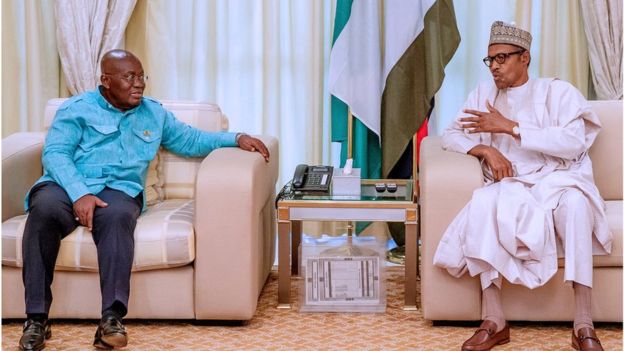 President Muhammadu Buhari has described an attempted coup plot against the authorities in Ghana as part of the corruption fighting back even as he said coups are now old fashioned.

Buhari’s Speed At UNGA And Online Hysteria, By Femi Adesina
On Monday September 23, 2019, President Muhammadu Buhari participated alongside other world leaders at the United Nations Climate Action Summit 2019.
Since then, we have seen conversations on Twitter doing what Twitter allows many people to spend a lot of their time on: getting things horribly wrong and/or focusing on the wrong things, while completely missing the real/meaningful/actual message.
And so, this is a backgrounder/explainer, focusing on Nigeria’s commitment to climate action, under the Buhari Administration.
The Climate Action Summit was convened by UN Secretary-General Antonio Guterres, to provide an opportunity for world leaders to, “come to New York on 23 September with concrete, realistic plans to enhance their nationally determined contributions by 2020, in line with reducing greenhouse gas emissions by 45 per cent over the next decade, and to net zero emissions by 2050.”
So, note that the goal of the panel was to elicit ‘announcements’ from the panelists on behalf of their respective countries: Fiji, Nigeria, Netherlands, the Bank of England, etc. In other words, panelists were billed to deliver remarks announcing their country/organisation plans to build a resilient, climate-sensitive future.
To address the theme of the event, President Buhari chose to deliver prepared remarks.
And the moderator’s question, was, in keeping with the theme: “President Buhari, Nigeria has a very young population; perhaps you might highlight what a pathway for a resilient future looks like?”
The President did exactly that, in his prepared remarks, over the next few minutes, highlighting what a “resilient future” will look like in Nigeria — by focusing on the administration’s policies (the ones already being implemented, like the Green Bonds, and the ones set for implementation, like the new tree-planting campaign, and the energy mix target).
His prepared remarks were wholly in alignment with the theme of the Panel event, and the question he was asked.
Keep in mind that as panels often work, the moderator’s question was meant to invite/usher him to take the stage, and share his remarks. As a panelist it was up to him to choose to respond ex tempore, or to go the ‘prepared remarks way.’
He chose the prepared remarks way. And most importantly, he touched on the issues re: mainstreaming climate action for the future and for the young people of Nigeria.
The only story here, for all serious minded people, is what he said, and what it means for the future and for the young people of Nigeria. His remarks read in parts:
“I share the sentiment expressed by the Secretary-General that the world is on the verge of climate catastrophe. Undeniably, Climate Change is a human-induced phenomenon.
“In the water sector, Nigeria will issue a Green Bond for irrigation and construct multi-purpose dams for power, irrigation and water supply. We will strengthen solid and liquid waste management systems to attract more private sector investors.
“We will mobilize Nigerian youths towards planting 25 million trees to enhance Nigeria’s carbon sink.
“Specifically, Nigeria is progressively working to realize 30 percent energy efficiency and renewable energy mix by 2030.
“Furthermore, the Federal Government has commenced the implementation of the Hydrocarbon Pollution Remediation Programme in Ogoniland, to recover the carbon sink potential of the mangrove ecosystem of the one thousand square kilometers (1,000 KM2) polluted site in the affected area.
“Finally, permit me to add that the forty million citizens in the Lake Chad area expect this Summit to take into consideration their concerns. They anticipate that the outcomes of this meeting would include solutions to address the Climate Change impact in the Lake Chad area.”
We believe that the important things for young people of Nigeria to do now should be around holding the government to account on these ‘announcement’ and promises, and ensuring they are fulfilled and delivered in a timely manner.
One of the most exciting should be the tree-planting campaign. Ethiopia recently set a world record on that account — perhaps Nigeria’s young people might even be able to pressure the Government into scaling up the ambitions of our own planned tree-planting campaign.
Therefore the online hysteria is completely unnecessary.