

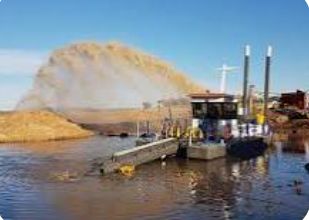

The story of the Lower River Niger dredging contract began long before the administration of President Umaru Musa Yar’Adua. Since the colonial era, there had been repeated proposals to dredge the River Niger and make it navigable throughout the year for commercial shipping.
The objective was to create a reliable inland water transport corridor linking the coastal city of Warri to Baro in Niger State, thereby reducing pressure on road transport and stimulating economic activity across riverine communities.
However, successive governments discussed the project without fully implementing it.
When Yar’Adua became president, he revived the long-abandoned plan. In December 2008, his administration approved a contract worth about N34.8 billion for the dredging of the Lower River Niger.
The project covered approximately 572 kilometres from Warri to Baro and was divided into several lots handled by different contractors.
The official flag-off took place in Lokoja on 10 September 2009, with a projected completion period of three years. The project included capital dredging, maintenance dredging, installation of navigational aids, river training works, and community development initiatives along the river corridor.
Following Yar’Adua’s death in May 2010, his successor, President Goodluck Jonathan, continued the project. Jonathan’s administration presented the dredging programme as part of its transportation and infrastructure agenda. During the execution of the project, the contract cost was revised upward.
In November 2011, the Federal Executive Council approved an additional N8.5 billion, raising the total project value to roughly N43.3 billion. Government officials argued that the increase was necessary because of inflation, rising operational costs, and the need to address continuous silting of the river channel.
Officials of the National Inland Waterways Authority (NIWA) reported that major dredging works had been completed and that maintenance dredging was underway. The government stated that navigational aids had been installed and that sections of the river were already being used by commercial operators.
The dredging project was divided into five lots, and was awarded to four contractors, with one contractor handling two lots. The contractors and their assigned sections were awarded to Bifurcation of the Nun, Fung Tai Engineering Company Nigeria Limited,
Dredging International Services Nigeria Limited, Van Oord Nigeria Limited,
William Lloyds Technical Company Limited
The five lots covered about 572 km of the river from Warri to Baro. A few notable details emerged during implementation:
Van Oord Nigeria Limited received the largest share of the work, handling both Lots 3 and 4, which together covered 226 km of the river.
William Lloyds Technical Company Limited was responsible for the crucial Baro section (Lot 5), and government officials later said that it had completed the capital dredging and part of the maintenance dredging.
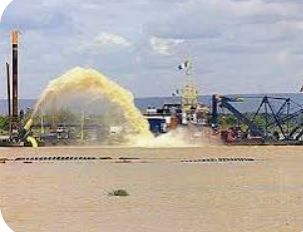
However, the project soon became controversial. Critics argued that despite the billions spent, the expected economic transformation did not materialize.
Questions were raised about the actual extent and effectiveness of the dredging. Many communities along the river complained that they had not experienced the promised benefits, while some observers noted that commercial navigation on the route remained limited.
The project’s critics alleged that parts of the work were either incomplete or failed to deliver the anticipated results.
These concerns eventually attracted legislative scrutiny. In 2017, the Nigerian House of Representatives ordered an investigation into aspects of the Lower River Niger dredging project.
The Lawmakers examined allegations that some contract sections were either not fully executed or had been abandoned after partial completion. Questions were also raised regarding specific dredging lots and associated river port projects.
In effect, therefore, the Lower River Niger dredging contract was one of the most ambitious inland water transport projects undertaken by the Nigerian government. It was initiated and launched under President Yar’Adua, expanded and funded further under President Jonathan, and officially declared completed by Jonathan’s administration. Yet, despite the substantial public expenditure, the project remains a subject of debate because of continuing questions about its economic impact, operational success, and value for money.


Yusuf Ozi-Usman