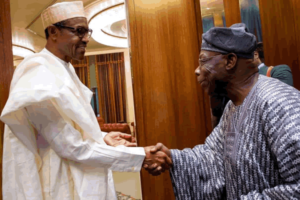
Chief Olusegun Obasanjo and President Muhammadu Buhari
President Muhammadu Buhari has congratulated former President Olusegun Obasanjo as he clocks 82 years on earth, saying that he is a passionate and great patriot who deserves accolades for his immeasurable contributions to our democracy and national unity.
In a statement, President Buhari said that aside from his political differences with Obasanjo, “I still hold him in the highest esteem because his contributions to the development of the country overshadow those differences.
“Chief Obasanjo gave a good account of himself and inspired his juniors with his wit and other leadership skills.”
“Nigeria’s successful transition to democratic rule in October 1979 was one of Obasanjo’s remarkable contributions to national development.
“As he celebrates his 82nd Birthday Anniversary, I wish Chief Obasanjo more good health, knowledge and wisdom in the service of Nigeria and humanity.”
Human rights lawyer, Femi Falana (SAN) has acknowledged the constitutional right of the Presidential candidate of the opposition Peoples Democratic Party (PDP) in the February 23 election, Alhaji Atiku Abubakar, to challenge the result of the election in court but that he will have what he called “insurmountable legal obstacles” to face.
In a statement today, Tuesday in Lagos, Falana said: “the frustration of election petitioners has been compounded by several judicial authorities, with some decisions holding that an election cannot be questioned on grounds of corrupt practices.”
He said that judicial authorities had upheld many elections despite the fact that the polls were marred by malfeasance, citing an example where a petitioner is required to prove that there is substantial non-compliance and that the non-compliance has substantially affected the results of the election.
“In Yussuf vs Obasanjo, it was held that an election cannot be questioned on grounds of corrupt practices.
“In Falae vs Obasanjo it was held that it has to be proved that financial inducement was authorised by the winner of an election.
“In Buhari vs Obasanjo it was held that the onus of proving electoral malpractice rests on the petitioner.
“Several fraudulent elections have been upheld under the doctrine of substantial compliance.
“In several cases, winners of fraudulent elections that were annulled were allowed to take part in rerun elections ordered by the courts.”
The Senior Advocate of Nigeria insisted that despite all such discouraging factors, the former Vice-President should not be blackmailed not to take the legal step over his election loss.
He recalled that President Muhammadu Buhari who was declared the winner of the February 23 election had challenged his losses in court in the successive presidential elections of 2003, 2007 and 2011.
He also noted that many All Progressives Congress (APC) members who lost the just-concluded National Assembly elections had announced plans to challenge the return of their opponents by the Independent National Electoral Commission.
“The campaign that Alhaji Atiku Abubakar should not seek redress is totally uncalled for.
“Aggrieved by the general elections of 2003, 2007 and 2011 conducted by INEC, Candidate Muhammadu Buhari sought redress in court.
“The chairman of the APC, Adams Oshiomole, and other APC leaders have had cause to claim their mandate through the court.
“Even some APC members who lost the just-concluded National Assembly elections have announced plans to challenge the return of their opponents by INEC.
“Therefore, Alhaji Atiku Abubakar should not be blackmailed or begged by any group of people not to challenge the presidential election held in the country on February 23, 2019.
“Regrettably, however, the failure of the PDP and APC-led Federal Government to reform the electoral process has created insurmountable legal obstacles for election petitioners.”
Former President Olusegun Obasanjo has vowed to continue to criticize President Muhammadu Buhari until he begins to do what he (Obasanjo) want.
“I believe that Africa has no alternative to democracy, good governance and development, growth and progress of our economy. We have none and if that is not happening in any country, those who keep quiet about it are accomplices to the crime.
“You see, in a democracy, you criticize a policy of government because it is not a family affair. Even if it is my brother that is there and he is not doing what I think he should do, he must be criticised. That is what democracy is all about: criticisms; saying the other side.
“So, you might also ask your boss to leave his boss alone or do what is right that his boss wants him to do.” says he will continue to criticize President Muhammadu Buhari.”
Obasanjo spoke today, Tuesday in Abeokuta, capital of Ogun State, at a a public lecture, titled ‘Colonialism, Apartheid, Freedom and South Africa Rising’, delivered by Prince Mangosuthu Buthelezi (MP), President of the Inkatha Freedom Party (IFP) in South Africa
The former Nigerian leader, who was obviously responding to the plea by the Alake of Egbaland, Oba Adedotun Gbadebo, that he (Obasanjo) should reduce his criticism of Buhari, his boss, said that he would not stop as he was also Buhari’s boss.
Oba Gbadebo had said: “You all know that I was an officer under General Buhari so each time Obasanjo criticises my boss, I always stand to say my senior, please leave the President alone! At 82, Baba is still fighting on, please fight less and be a consultant to everybody.”
However, in response, Obasanjo told the traditional ruler to advise Buhari to govern the country right, adding that the onus is on Buhari to prove that he is doing well.
“If I say anybody in government in Nigeria or any government for that matter is not doing well, let that government prove that he is doing well. So, Kabiyesi, your boss, Buhari; there is nothing personal between me and him. Just as he is your boss, I am also his boss with due respect.
“The point is that I have been in that position longer than any Nigerian could ever be there. That is the truth because if any Nigerian comes in now and have two terms, he will not have almost four (4) years of military rule.
“I have been there longer than any Nigerian will ever be there. So, when I say something, I know what I am talking about. So, Kabiyesi, anytime you say ‘leave my boss alone’, I agree, he is your boss, but I am also his boss.”
Governor of the Central Bank of Nigeria (CBN), Godwim Emefiele has recounted the reason why the apex bank had to take measures to drive Nigeria’s economy away from only oil sector.
“The over 60 percent drop in crude oil prices we witnessed between 2015–2016 and its attendant effects on economic growth, inflation and our external reserves, provided further impetus on the need for the CBN to support measures that will drive productivity in critical sectors of the economy, while also weaning our economy from its dependence on imported goods.”
Emefiele, who spoke today, Tuesday in Abuja, at the Textile Stakeholders meeting, recalled that when he assumed office in 2014, he made it clear that his focus would be on building a Central Bank that would devote its energies on building a financial system that would serve the growth and development of Nigeria.
The speech goes thus:
In addition to a focus on key macroeconomic concerns such as moderating inflation and maintaining exchange rate stability, we also feel that the Central Bank of Nigeria must play a more constructive role in supporting Nigeria’s economic development particularly in the Agric and Manufacturing sectors, given the constraints faced
by rural farmers, SMES and Manufacturing companies. Our reason for adopting this posture rest on the believe that, addressing impediments to their growth, will not only strengthen economic growth, but will also enable the creation of more jobs and foster a more inclusive society.
The over 60 percent drop in crude oil prices we witnessed between 2015 – 2016 and its attendant effects on economic growth, inflation and our external reserves, provided further impetus on the need for the CBN to support measures that will drive productivity in critical sectors of the economy, while also weaning our economy from its dependence on imported goods.
Following a series of steps embarked upon by the CBN which include, a tighter monetary policy regime beginning in 2016; the establishment of the
Investors and Exporters Window in April 2017; restriction of access to forex for 41 items that could be produced in Nigeria; and the deployment of our agricultural intervention programs to support improved cultivation of particular agricultural items such as rice, tomatoes and fish, the Nigerian economy has made considerable progress.
After five quarters of uninterrupted GDP contraction (beginning from 1st Quarter of 2016), the economy exited from the recession during the second quarter of 2017. The recovery has been sustained for seven consecutive quarters.
The pace of quarterly GDP growth has improved from .5 percent in the second quarter of 2017 to 2.38 percent in the fourth quarter of 2018. Our FX reserves today stand at above $43billion, up from $23 billion in October 2016 and inflation has dropped from its peak of 18.17% in January 2017 to 11.3 percent in February 2019. Following a successful general elections, our Foreign Investor friends have began to show interest in Nigeria again, given their confidence of a stable business environment. Noticeable declines have been recorded in our monthly food import bill which declined from US$665.4 million in January 2015 to US$160.4 million as at October 2018; a cumulative fall of 75.9 percent and an implied savings of over US$21 billion on food imports alone over that period.
A lot of progress has been made, but at the same time more needs to be done in order to ensure that we build an inclusive economy that supports domestic production of goods and services, while offering job opportunities to teeming Nigerians.
This is the only option that we have, if we are to insulate our economy from volatility in the crude oil market and in the global financial markets. In order to achieve this goal, the CBN together with other critical stakeholders recently identified key commodities and products such as textiles and palm oil that have the ability to support the creation of hundreds of thousands of jobs in our economy.
As you are aware, in the 1970’s and early 1980’s, Nigeria was home to Africa’s largest textile industry, with over 180 textile mills in operations, which employed close to over 450,000 people. By today, if we had nurtured and encouraged the textile industry, that sector will be employing millions. The textile industry at that time, was the largest employer of labour in Nigeria after the public sector, contributing over 25% of the workforce in the manufacturing sector. This industry was supported by the production of cotton by 600,000 local farmers across 30 of Nigeria’s 36 states. This sector supported the clothing needs of the Nigerian populace, as our markets were filled
with locally produced textiles from companies such as United Textiles in Kaduna, Supertex Limited, Afprint, International Textile Industry (I.T.I), Texlon, Aba Textiles, Asaba Textile Mills Ltd, Enpee and Aswani Mills amongst several others.
It’s no secret that the past 20 years have been very difficult for many textile firms. They have faced rising operating cost and weak sales due to high energy cost, smuggling of textile goods, and poor access to finance.
Many of them have had to lay off employees. Today, most of the factories mentioned have all stopped operations, as only 25 textile factories are
operating today at below 20 percent of their production capacities, and the workforce in Nigeria’s textile industry stands at less than 20,000 people. In addition, the cotton growing sector has gone dead, thereby depriving thousands of small holder farmers the opportunity to earn a living. Furthermore, a large proportion of our clothing materials are imported from China and countries in Europe. At this stage, we intervened to redirect our focus to the important role the textile industry played in our country. They did more than produce cottons and textiles, they helped in sustaining the vitality of the neighborhoods in which they operated.
With the death of these industries, came a rise in unemployment, insecurity and other negative social vices.
Today, Nigeria currently spends above $4 billion annually on imported textiles and ready-made clothing. With a projected population of over 180 million Nigerians, the needs of the domestic market are huge and varied, with immense prospects, not only for job creation, but also for growth of the domestic textile industries. One quick example that highlights the potential of this local market, includes the need to support provision of uniforms and clothing apparels for school students, military and paramilitary officers as well as workers in the industrial sector.
In addition, when we consider the amount spent on outfits for religious and social events such as weddings, naming and funeral ceremonies on a weekly basis, the potential market size is well over $10bn annually.
Ladies and gentlemen, we are here to change this narrative today. I believe that if the CBN along with other critical stakeholders are able to address some of the challenges facing this key industry, given the high domestic demand for textiles, we will be able to create jobs for our economy, while increasing production of textiles in Nigeria.
The issues we will be discussing today are critical to everyone with an interest in the success of our nation’s textile industry and by extension our economy as a whole.
As a result, I would urge stakeholders here today to think carefully about how, in the current economic environment, our nation can best provide operators in the textile industry with the support they need to revive their factories and expand job opportunities.
On our part, we have decided to implement a few steps which we believe will support the revival of the textile sectors. These steps include;
Financial support to Textile manufacturers with the provision of funds at single digits rate, to refit, retool and upgrade their factories in order to produce high quality textile materials for the local and export market
Effective immediately, the CBN hereby place the access to FX for all forms of textile materials on the FX restriction list. Accordingly, all FX dealers in Nigeria are to desist from granting any importer of textile material access to FX in the Nigerian Foreign exchange market. In addition, we shall adopt a range of other Strategies that will make it difficult for recalcitrant smugglers to operate banking business in Nigeria. The details of those strategies will be unfolded in due course.
We shall, initially support the importation of cotton lint for use in textile factories, with a caveat that such importers shall begin sourcing all their cotton needs locally beginning from year 2020.
As part of its Anchor Borrowers Program, the CBN will support local growers of cotton to enable them meet the needs of the textile industries in Nigeria. The CBN shall also support efforts to source high yield cotton seedlings so as to ensure the yields from our cotton farmers meet global benchmarks.
As regards provision of stable electricity, the CBN shall support the creation textile production centers in certain designated
areas in Nigeria where access to electricity shall be guaranteed. In 2016, the CBN began discussions with the Kano and Kaduna State Governments to establish textile industrial areas in a bid to guarantee stable electricity in those industrial areas. We would intensify efforts with these governments and others that may show keen interest to see to the quick actualization of such programs.
We believe that these measures will discourage smuggling, resuscitate this critical industry, and support your efforts at creating jobs for Nigerians.
More leaders across the world have sent congratulatory messages to President Muhammadu Buhari on his victory at the February 23 Presidential election in the country.
The President Milos Zeman of Czech Republic, in his congratulatory message, wished the Nigerian President every success in his second term in office for the well-being and prosperity of the Nigerian people.
“I highly value the diversity of cooperation and longstanding friendly relations between the Czech Republic and the Federal Republic of Nigeria. I am looking forward to working with Your Excellency in the years ahead to further develop mutual cooperation to the benefit of the people of both our countries.”
President Buhari also received congratulatory messages from Shaikh Khalifa Bin Zayed Al Nahyan, the President of United Arab Emirates (UAE), Shaikh Mohammed Bin Rashid Al Maktoum, Vice President and Prime Minister of UAE and Shaikh Mohammed bin Zayed Al Nahyan, Crown Prince of Abu Dhabi and Deputy Supreme Commander of the UAE’s Armed Forces.
Atiku Abubakar, Nigeria’s one time second citizen and candidate of the People’s Democratic Party (PDP) in the just concluded Presidential election, again failed to secure the first spot – on his fourth attempt.
His first shot at the top job was on the platform of the Social Democratic Party in 1992. He came third in the presidential primaries, behind Babagana Kingibe and Moshood Abiola. Atiku, whose regular loss at the polls has earned him the title ‘veteran contestant’ and ‘serial loser’ was defeated by incumbent President Muhammadu Buhari of the All Progressives Congress (APC) in the 2019 presidential election. The loss dashed Atiku’s hopes of realizing his 27 year ambition.
Against the predictions of notables like Dele Momodu and prominent institutions such as Williams and Associates, and The Economist, the writer foretold Atiku’s defeat and it came to pass. Buhari garnered 15,191,847 votes, to conquer Atiku who scored 11,262,978 votes. Why did Atiku lose?
Atiku has not been arraigned or convicted by any court, but the weighty corruption allegations against him has destroyed his reputation and diminished peoples trust in him. The corruption burden largely made him lose the election, having contested against Buhari who is widely adjudged honest. Atiku’s vow to privatize the inefficient Nigerian National Petroleum Corporation (NNPC) was largely construed as a ploy to enrich cronies, like he allegedly did when he, as Vice President, supervised the privatization of national assets. Atiku’s outburst made the moguls profiting from NNPC’s ineptness work hard for Buhari’s reelection.
Atiku’s focal campaign promise of restructuring the country was widely interpreted as an anti-North agenda by his people. Although the policy amplified his popularity in the less voting populated regions in the South, it incredibly diminished his popularity in the major voting populated North. Atiku also failed to win the minds of voters during campaign. He underutilized the opportunity of using the rallies to draw people’s attention to Buhari’s shortcomings and how he would address them, if elected. Atiku’s campaign was not informative and revealing as expected from an opposition candidate. The PDP stalwarts preoccupied themselves with calumny, ideas bereft, non-issues based campaigns, exchanging insults with Buhari’s men.
Atiku is popular, but his popularity and acceptance is incomparable to that of Buhari. The PDP’s unimpressive performance in the North handed Buhari and APC an easy win. Atiku lost his polling unit and majority of the key northern states by a wide margin. One thing’s for certain, the election must have enlightened Atiku that the mammoth crowd at the rallies are not votaries; they are fun-seekers any candidate desirous of electoral victory must not rely on.
Power is a transient, temporary phenomenon. Atiku, a once very powerful time is now reduced. The ex-Vice President was sometimes ago the ‘commandant’ of the northern political elites. He called the shot. The power blocs sung his song and danced to his beat. He was so powerful to the extent that he almost dethroned his former boss, ex-President Olusegun Obasanjo. It is broadly whispered that Obasanjo allegedly kowtow before Atiku allowed the northern power blocs support their reelection as president and vice in 2003. Today, most of the power blocs under Atiku’s control then have switched allegiance to Buhari. They worked against Atiku, fervidly criticized him, and made him lose the 2019 presidential election.
Most of the notables that worked against Atiku were either discovered or groomed during the Obasanjo-Atiku presidency. Garba Shehu, the Senior Special Assistant, Media and Publicity to Buhari was Atiku’s former media adviser. He fed from Atiku’s purse for over a decade. Shehu was one of the trusted aides Atiku donated to Buhari’s team when the latter won the APC presidential ticket in 2015. Before then, Shehu’s vivaciousness to the emergence of an Atiku presidency had no equal. The reverse is the case now. The same voice Shehu praise Atiku with is the one he is using to demean him now.
During the presidential election campaign, Shehu severally and unapologetically disparaged Atiku in order to convince the Aso Rock cabal that he is not a mole. Shehu’s loyalty shift and pivotal role in the destruction of the Atiku project he once lived for is a lesson to everyone that: like life, human loyalty is temporal and everyone has a price.
Shehu is not the only one. The former Governor of Lagos State and national leader of the APC, Bola Tinubu was once in Atiku’s camp. Both have a time-honored relationship. The amity between them made Atiku work against the interest of his party, the PDP, in 2003, despite being the Vice President at the time. He softened pedals to ensure the political machineries that enthroned PDP in the Southwest states did not capture Lagos. Both men later teamed up to strategize on how to rule Nigeria in 2007. Tinubu allowed Atiku contest for President on the platform of the defunct Action Congress, a party he singly controlled.
The former Lagos Governor apparently backed Atiku with the hope that the latter would hand over power to him after his tenure, but he lost the election. Tinubu still has his eyes on the nation’s top job. His political enmity with Atiku rests on the calculation that the APC is his shortest and strongest link to being President.
Tinubu has a lot to learn from Atiku. The first of such lesson is: power is transient. The political godsons Tinubu has today may also turn against him tomorrow and hinder him from getting his most desired. The powers he has today, he will in due time have them no more. His boys would either switch allegiance or oust him. No man has reigned forever; Tinubu’s political dynasty would sooner or later be ruined by one of his disciples. The handwriting on the wall is clear, but has concealed meaning like that of Daniel 5:25. Only the gifted can see and understand it.
President Buhari’s Ministers of Labour and Agriculture, Chris Ngige and Audu Ogbeh, were once Atiku’s faithful. They teamed up to frustrate Obasanjo’s third term agenda. During difficult times, Atiku supported Ogbeh, particularly when Obasanjo allegedly forced him to resign as the PDP National Chairman. But in the just concluded election, Ogbeh worked against Atiku in favor of his principal, Buhari. The pioneer Chairman of the Economic and Financial Crimes Commission (EFCC), Nuhu Ribadu, is also one of Atiku’s erstwhile beneficiaries that worked against his win. Atiku championed Ribadu’s appointment as EFCC Chairman, a position that ushered him into limelight.
The former FCT Minister and incumbent governor of Kaduna State, Mallam Nasir El-Rufai, was once Atiku’s henchman. Atiku was instrumental to his appointment and political development. He secured him an appointment as the Director General of the Bureau of Public Enterprises and later a Minister. El-Rufai likes to prove his loyalty through show offs. He would, at the time, do anything for Atiku. He hurriedly kneels to greet him at every given opportunity. No one thought the day would come when El-Rufai would work against Atiku.
But lo and behold, Atiku lost El-Rufai’s loyalty when he needed it most. Things took a turn for the worse when Atiku’s vice presidential tenure ended and he lost his presidential bid in 2007. El-Rufai faithfulness would have provided Atiku the much needed succumb when he fell on hard times and was struggling for political survival. But El-rufai was nowhere to be found; he had made new contacts and moved on. He is today’s Atiku prominent critic. His unparalleled dedication to Buhari’s reelection made Atiku lose the presidential poll in Kaduna State.
Don’t be deceived by people’s flattery and worship; they may be the first to throw you stones when you fall on hard times. Once you lose that success, beauty, money, fame or power that is attracting people to you, almost everyone will desert and disappoint you when it matters most. They will quickly find a replacement or pally with whoever is occupying your position. They would forget about you before sunset! You would not only be forgotten, most of the people you fed and clothed will vilify you and dine with your enemy. Senate President Bukola Saraki would be the best person to speak on this in a few months. That aside, how many beneficiaries of Abiola’s kind heartedness are standing by his family now?
Take a quiet time and look inwards, the power you have may be that which is commanding people’s loyalty. Lose the power, go broke, or contract a deadly disease and you’ll see peoples natural behavior. If Atiku had won the APC ticket and emerged president in 2015, the likes of Shehu and El-Rufai would have remained in his team, screaming they love him more than God. Do these persons love Buhari or they just love his power? Where were they when Buhari was losing election serially? Would those shouting ‘sai baba’ now stand by him when the chips are down? One could only hope that Buhari is not only celebrating his victory, but preparing to take Nigeria to the next level, and not drowning in the praise singings of his supporters and handlers.
It must not be left unsaid that Atiku himself is unrighteous. His disloyalty made him fall out with his former boss, ex-President Olusegun Obasanjo. Buhari is his self-inflicted, well deserved nemesis. Atiku immensely sponsored the campaign of the Buhari he’s struggling to defeat now in 2015. His insatiable thirst for power made him play a lead role in pulling PDP down 2015, despite being one of her greatest beneficiaries. He should be grateful that the party was kind enough to offer him her presidential ticket, which many people thinks he doesn’t deserve. He is a serial defector that only stays with any party that is ready to offer him ticket. His desperation for power is dwindling his electoral value and he may never achieve his dream of becoming Nigeria’s President.
While going ahead to challenge his lose at the tribunal, someone should remind Atiku that the seeming politically motivated suspension of Chief Justice Walter Onnoghen is not for nothing. Buhari too should be reminded that power is transient. That he has it today doesn’t mean it’s his forever. He should be conscious of his place in history and treat others the way he would like to be treated when power change hands.
*Omoshola Deji is a political and public affairs analyst. He wrote in via moshdeji@yahoo.com
President Muhammadu Buhari has asked traditional rulers in the country to join hand with his government of “Next Level” to wage war against criminal activities in their domains.
The President, who spoke today, Tuesday when he received members of the National Council of Traditional Rulers led, by the Sultan of Sokoto, Alhaji Muhammad Sa’ad Abubakar III, at the Presidential Villa, Abuja, said that involving the royal fathers in the fight against crimes had become necessary in view of the deep knowledge of their localities.
“You know all the families who harbour criminals and you know those who produce respectable individuals. You know the weaknesses of our society. We need your support to consolidate our achievements.”
President Buhari listed several significant efforts by his administration aimed at enhancing national security while emphasising the overall need for stability in the country.
“What we need now is your support. No government can serve creditably without your support. We will always count on your support,” he told the traditional rulers.
The President also welcomed the royal fathers to his “second and final term, at the end of which I will, God willing, go to Daura and settle down.”
The Sultan of Sokoto and Co-Chairman of the Council, told President Buhari that the body “on behalf of all the Traditional Rulers in Nigeria, is here to congratulate you on your re-election as the President of the Federal Republic of Nigeria.”
The Sultan advised all Nigerians to accept the election result as the will of God, even as he assured the President of the traditional rulers’ continued unflinching support in his laudable projects, “particularly your government’s cardinal objectives of fighting corruption, containing insecurity, generally sanitizing the governance machinery, entrenching discipline, hard work and peaceful co-existence amongst the citizenry.”
The Co-Chairman of the Council and Ooni of Ife, Oba Adeyeye Ogunwusi Ojaja II, assured President Buhari that the members would work very closely with his administration to fight criminal activities.
The Ooni advised the re-elected Nigerian leader to be a President for the whole nation and father to all citizens.
Twelve presidential candidates in the February 23 election have advised the defeated Presidential candidate of the Peoples Democratic Party (PDP), Atiku Abubakar to put Nigeria above primordial sentiment at this crucial time by respecting the verdict of the citizens.
The Presidential candidates, in a statement today, Monday congratulating President Muhammadu Buhari, the candidate of the ruling All Progressives Congress (APC), for his electoral victory.
The group, acting under the aegis of Forum of Presidential Candidates and Political Parties for Good Governance, said at a news conference in Abuja, that the victory for Buhari was deserved.
“We are indeed not oblivious of the fact that only one candidate will emerge as president. Now that the candidate of the APC, President Buhari has been re-elected, we have no qualms accepting his victory.
”Permit this opportunity to congratulate President Buhari on his well-deserved victory at the polls,” the group’s chairman, Shittu Kabir, said.
The Forum noted that the pattern of voting, the large turn-out and country-wide endorsement of Buhari attested to the fact that Nigerians are pleased with him, his style of leadership and performance in the last three and half years.
Shittu Kabir, who is a member of Advanced Peoples Democratic Alliance (APDA), called on Atiku and the PDP not to contest Buhari’s victory in court.
”We urge the candidate of the Peoples Democratic Party, Alhaji Atiku Abubakar, to disregard the advice of those asking him to challenge the outcome of the election in court.
”To borrow the popular adage in Africa, two litigants cannot resolve their differences in court and return to the same house as brothers. President Buhari and Alhaji Abubakar are brothers.
”We strongly urge Alhaji Abubakar to drop the legal option in expressing his grievances. This is consistent with the counsel of many well-meaning Nigerians, including Chief Olisa Agbakoba and General Ibrahim Babangida.
”We also believe that the former Vice President has made a mark among Nigerians of means who have positively impacted their communities.
”We think he has a lot more to contribute to developing humanity and promoting peace and progress in our nation, even without holding any political office.
”At his age, he should now avoid any action and utterances capable of fanning the embers of discord, disagreement and violent conduct. Nigeria is greater than any personal or class interest.” The Forum’s chairman called on Buhari to include everyone in his government, including those who did not vote for him.
He said with the right investment environment, the government had put measures in place to attract investment into Nigeria in the next three years.
He pledged the group’s “continuous support and cooperation to the government and look forward to collaborating in areas of mutual interest in the task of the nation-building’’.
Shittu Kabir commended Independent National Electoral Commission (INEC) for conducting a credible, free and fair election, in spite of obvious lapses bothering on human error and isolated cases of thuggery and intolerance.
He charged the commission to improve on its operational logistics in Saturday’s elections and ensure that all Nigerians would be able to exercise their mandate without hindrance.
“The same advice goes to all security agencies, especially security personnel directly involved in election-related duties.”
The twelve presidential candidates of other political parties had before the poll, endorsed Buhari, according to a statement by presidential spokesman, Femi Adesina.
The candidates included Advanced Peoples Democratic Alliance’s Shittu Kabiru, Independent Democrats’ Edozie Madu, Danjuma Mohammed of Movement for Restoration and Defence of Democracy, Mamman Naptali of Allied Peoples Movement and Save Nigeria Party’s Ahmed Buhari.
They said they decided to support Buhari because of advances made in security, economy, fighting corruption, infrastructure development and agricultural revolution.
The National Publicity Secretary of the ruling All Progressives Congress (APC), Malam Lanre Issa-Onilu has said that the National Working Committee (NCW) of the party has recommended to the National Executive Council (NEC) for the expulsion of governors Rochas Okorocha of Imo State and Ibikule Amosun of Ogun State.
The National Working Committee of the party had, after a meeting presided over by the National Chairman, Adams Oshiomhole, in Abuja on Friday, announced their suspension of the two governors and others for alleged anti-party activities.The two others that were suspended are the Minister of Niger Delta Affairs, Usani Usani and the Director General of Voice of Nigeria, Osita Okechukwu.
The suspended members had variously claimed that the party had yet to write to inform them of their suspension from the party.
But the APC spokesman said that writing those who were suspended was not a precondition for their suspension, adding: “we don’t have a timeline to write them, the important thing is that they are suspended. It (writing) is not a precondition.”
He said that the party’s NEC meeting would hold bery soon but that there is no date yet.
“The time for NEC meeting has not been fixed. The party will have to agree on the time before the notice of meeting is sent out.”
Article 25(B) of the APC constitution states: “The NEC shall meet every quarter and or at any time decided by the National Chairman or at the request made in writing by at least two-third of the members of the NEC provided that not less than 14 days notice is given for the meeting to be summoned.
(ii) Without prejudice to Article 25(B)(i) of the constitution, the NWC may summon an emergency NEC meeting at any time, provided that at least seven days notice of the meeting shall be given to all those entitled to attend.
Business mogul and owner of Dangote Group of Companies, Alhaji Aliko Dangote, has predicted that there are better ahead for business community after the 2019 general elections which are ongoing in Nigeria.
“I think for the business community, things are going to continue to grow in terms of trajectory. When I say it; I mean there are quite a lot of things that are happening in Nigeria.
“We didn’t really bother whether election period or not, we have been investing heavily in the country and we would continue to invest. I think we would have better days ahead.”
Dangote spoke today, Monday on a Channels TV programme.
Dangote was recently declared as one of the top 70 billionaires in the world.
We use cookies on our website to give you the most relevant experience by remembering your preferences and repeat visits. By clicking “Accept”, you consent to the use of ALL the cookies.
This website uses cookies to improve your experience while you navigate through the website. Out of these, the cookies that are categorized as necessary are stored on your browser as they are essential for the working of basic functionalities of the website. We also use third-party cookies that help us analyze and understand how you use this website. These cookies will be stored in your browser only with your consent. You also have the option to opt-out of these cookies. But opting out of some of these cookies may affect your browsing experience.
Necessary cookies are absolutely essential for the website to function properly. This category only includes cookies that ensures basic functionalities and security features of the website. These cookies do not store any personal information.
Any cookies that may not be particularly necessary for the website to function and is used specifically to collect user personal data via analytics, ads, other embedded contents are termed as non-necessary cookies. It is mandatory to procure user consent prior to running these cookies on your website.


 Human rights lawyer, Femi Falana (SAN) has acknowledged the constitutional right of the Presidential candidate of the opposition Peoples Democratic Party (PDP) in the February 23 election, Alhaji Atiku Abubakar, to challenge the result of the election in court but that he will have what he called “insurmountable legal obstacles” to face.


 Twelve presidential candidates in the February 23 election have advised the defeated Presidential candidate of the Peoples Democratic Party (PDP), Atiku Abubakar to put Nigeria above primordial sentiment at this crucial time by respecting the verdict of the citizens.
 The National Publicity Secretary of the ruling All Progressives Congress (APC), Malam Lanre Issa-Onilu has said that the National Working Committee (NCW) of the party has recommended to the National Executive Council (NEC) for the expulsion of governors Rochas Okorocha of Imo State and Ibikule Amosun of Ogun State.


2019 Atiku’s Defeat Foretold, By Omoshola Deji
His first shot at the top job was on the platform of the Social Democratic Party in 1992. He came third in the presidential primaries, behind Babagana Kingibe and Moshood Abiola. Atiku, whose regular loss at the polls has earned him the title ‘veteran contestant’ and ‘serial loser’ was defeated by incumbent President Muhammadu Buhari of the All Progressives Congress (APC) in the 2019 presidential election. The loss dashed Atiku’s hopes of realizing his 27 year ambition.
Against the predictions of notables like Dele Momodu and prominent institutions such as Williams and Associates, and The Economist, the writer foretold Atiku’s defeat and it came to pass. Buhari garnered 15,191,847 votes, to conquer Atiku who scored 11,262,978 votes. Why did Atiku lose?
Atiku has not been arraigned or convicted by any court, but the weighty corruption allegations against him has destroyed his reputation and diminished peoples trust in him. The corruption burden largely made him lose the election, having contested against Buhari who is widely adjudged honest. Atiku’s vow to privatize the inefficient Nigerian National Petroleum Corporation (NNPC) was largely construed as a ploy to enrich cronies, like he allegedly did when he, as Vice President, supervised the privatization of national assets. Atiku’s outburst made the moguls profiting from NNPC’s ineptness work hard for Buhari’s reelection.
Atiku’s focal campaign promise of restructuring the country was widely interpreted as an anti-North agenda by his people. Although the policy amplified his popularity in the less voting populated regions in the South, it incredibly diminished his popularity in the major voting populated North. Atiku also failed to win the minds of voters during campaign. He underutilized the opportunity of using the rallies to draw people’s attention to Buhari’s shortcomings and how he would address them, if elected. Atiku’s campaign was not informative and revealing as expected from an opposition candidate. The PDP stalwarts preoccupied themselves with calumny, ideas bereft, non-issues based campaigns, exchanging insults with Buhari’s men.
Atiku is popular, but his popularity and acceptance is incomparable to that of Buhari. The PDP’s unimpressive performance in the North handed Buhari and APC an easy win. Atiku lost his polling unit and majority of the key northern states by a wide margin. One thing’s for certain, the election must have enlightened Atiku that the mammoth crowd at the rallies are not votaries; they are fun-seekers any candidate desirous of electoral victory must not rely on.
Power is a transient, temporary phenomenon. Atiku, a once very powerful time is now reduced. The ex-Vice President was sometimes ago the ‘commandant’ of the northern political elites. He called the shot. The power blocs sung his song and danced to his beat. He was so powerful to the extent that he almost dethroned his former boss, ex-President Olusegun Obasanjo. It is broadly whispered that Obasanjo allegedly kowtow before Atiku allowed the northern power blocs support their reelection as president and vice in 2003. Today, most of the power blocs under Atiku’s control then have switched allegiance to Buhari. They worked against Atiku, fervidly criticized him, and made him lose the 2019 presidential election.
Most of the notables that worked against Atiku were either discovered or groomed during the Obasanjo-Atiku presidency. Garba Shehu, the Senior Special Assistant, Media and Publicity to Buhari was Atiku’s former media adviser. He fed from Atiku’s purse for over a decade. Shehu was one of the trusted aides Atiku donated to Buhari’s team when the latter won the APC presidential ticket in 2015. Before then, Shehu’s vivaciousness to the emergence of an Atiku presidency had no equal. The reverse is the case now. The same voice Shehu praise Atiku with is the one he is using to demean him now.
During the presidential election campaign, Shehu severally and unapologetically disparaged Atiku in order to convince the Aso Rock cabal that he is not a mole. Shehu’s loyalty shift and pivotal role in the destruction of the Atiku project he once lived for is a lesson to everyone that: like life, human loyalty is temporal and everyone has a price.
Shehu is not the only one. The former Governor of Lagos State and national leader of the APC, Bola Tinubu was once in Atiku’s camp. Both have a time-honored relationship. The amity between them made Atiku work against the interest of his party, the PDP, in 2003, despite being the Vice President at the time. He softened pedals to ensure the political machineries that enthroned PDP in the Southwest states did not capture Lagos. Both men later teamed up to strategize on how to rule Nigeria in 2007. Tinubu allowed Atiku contest for President on the platform of the defunct Action Congress, a party he singly controlled.
The former Lagos Governor apparently backed Atiku with the hope that the latter would hand over power to him after his tenure, but he lost the election. Tinubu still has his eyes on the nation’s top job. His political enmity with Atiku rests on the calculation that the APC is his shortest and strongest link to being President.
Tinubu has a lot to learn from Atiku. The first of such lesson is: power is transient. The political godsons Tinubu has today may also turn against him tomorrow and hinder him from getting his most desired. The powers he has today, he will in due time have them no more. His boys would either switch allegiance or oust him. No man has reigned forever; Tinubu’s political dynasty would sooner or later be ruined by one of his disciples. The handwriting on the wall is clear, but has concealed meaning like that of Daniel 5:25. Only the gifted can see and understand it.
President Buhari’s Ministers of Labour and Agriculture, Chris Ngige and Audu Ogbeh, were once Atiku’s faithful. They teamed up to frustrate Obasanjo’s third term agenda. During difficult times, Atiku supported Ogbeh, particularly when Obasanjo allegedly forced him to resign as the PDP National Chairman. But in the just concluded election, Ogbeh worked against Atiku in favor of his principal, Buhari. The pioneer Chairman of the Economic and Financial Crimes Commission (EFCC), Nuhu Ribadu, is also one of Atiku’s erstwhile beneficiaries that worked against his win. Atiku championed Ribadu’s appointment as EFCC Chairman, a position that ushered him into limelight.
The former FCT Minister and incumbent governor of Kaduna State, Mallam Nasir El-Rufai, was once Atiku’s henchman. Atiku was instrumental to his appointment and political development. He secured him an appointment as the Director General of the Bureau of Public Enterprises and later a Minister. El-Rufai likes to prove his loyalty through show offs. He would, at the time, do anything for Atiku. He hurriedly kneels to greet him at every given opportunity. No one thought the day would come when El-Rufai would work against Atiku.
But lo and behold, Atiku lost El-Rufai’s loyalty when he needed it most. Things took a turn for the worse when Atiku’s vice presidential tenure ended and he lost his presidential bid in 2007. El-Rufai faithfulness would have provided Atiku the much needed succumb when he fell on hard times and was struggling for political survival. But El-rufai was nowhere to be found; he had made new contacts and moved on. He is today’s Atiku prominent critic. His unparalleled dedication to Buhari’s reelection made Atiku lose the presidential poll in Kaduna State.
Don’t be deceived by people’s flattery and worship; they may be the first to throw you stones when you fall on hard times. Once you lose that success, beauty, money, fame or power that is attracting people to you, almost everyone will desert and disappoint you when it matters most. They will quickly find a replacement or pally with whoever is occupying your position. They would forget about you before sunset! You would not only be forgotten, most of the people you fed and clothed will vilify you and dine with your enemy. Senate President Bukola Saraki would be the best person to speak on this in a few months. That aside, how many beneficiaries of Abiola’s kind heartedness are standing by his family now?
Take a quiet time and look inwards, the power you have may be that which is commanding people’s loyalty. Lose the power, go broke, or contract a deadly disease and you’ll see peoples natural behavior. If Atiku had won the APC ticket and emerged president in 2015, the likes of Shehu and El-Rufai would have remained in his team, screaming they love him more than God. Do these persons love Buhari or they just love his power? Where were they when Buhari was losing election serially? Would those shouting ‘sai baba’ now stand by him when the chips are down? One could only hope that Buhari is not only celebrating his victory, but preparing to take Nigeria to the next level, and not drowning in the praise singings of his supporters and handlers.
It must not be left unsaid that Atiku himself is unrighteous. His disloyalty made him fall out with his former boss, ex-President Olusegun Obasanjo. Buhari is his self-inflicted, well deserved nemesis. Atiku immensely sponsored the campaign of the Buhari he’s struggling to defeat now in 2015. His insatiable thirst for power made him play a lead role in pulling PDP down 2015, despite being one of her greatest beneficiaries. He should be grateful that the party was kind enough to offer him her presidential ticket, which many people thinks he doesn’t deserve. He is a serial defector that only stays with any party that is ready to offer him ticket. His desperation for power is dwindling his electoral value and he may never achieve his dream of becoming Nigeria’s President.
While going ahead to challenge his lose at the tribunal, someone should remind Atiku that the seeming politically motivated suspension of Chief Justice Walter Onnoghen is not for nothing. Buhari too should be reminded that power is transient. That he has it today doesn’t mean it’s his forever. He should be conscious of his place in history and treat others the way he would like to be treated when power change hands.
*Omoshola Deji is a political and public affairs analyst. He wrote in via moshdeji@yahoo.com