Early in 1988 I was persuaded to try my luck with farming by my friend and colleague, now late Abu Tapidi. His father in-law lived around Ngurore, a village in the precincts of Yola, the Adamawa State capital. Through him we rented a large parcel of land which we shared with other friends who also invested in the enterprise.
We cleared the land then waited for the rains. When they came, we ploughed and then planted maize seedlings. At the appropriate time we applied fertilizers and watched happily as our farms developed. Then came a most disturbing report from our farm supervisor that some Fulani herdsmen had invaded the farm with their cattle and caused extensive damage.
After an inspection of the damaged farm, we followed the advice of the farm supervisor and reported the problem to the Ardo, the local leader of the Fulani herdsmen in the neighborhood. As it turned out, it was a most wise move. If we had gone to the police, they would have demanded bribes. The Fulani herdsmen themselves avoided having encounters with the police for the same reason – bribery.
It was a good decision to have engaged a local farm supervisor because he was on hand when the herdsmen invaded the farms and he could positively identify the group. After our report to the Ardo, a meeting was arranged with the herdsmen and we tabled our complaints. The herdsmen were full of regrets for the damage they caused us and then went into discussions, switching off from Hausa, which I understand to the Fulfulde language, which I don’t.
After what looked like an endless discussion, they switched back to Hausa. We were told the herd that had caused the damage on our farms had been identified and that the owner would be responsible for compensating us for the damage. We were then told to quantify our damage into Naira and Kobo which wedid. Another round of endless haggling ensued at the end of which a solution was worked out. The owner of the rampaging cattle had agreed to pay for our losses but he had no cash. We were to wait for the next market day at Ngurore for him to sell one cow and then pay us. We agreed and left.
As we drove back to Yola, I asked Abu Tapidi about the man who was to settle our losses. All through the negotiations, I noticed that he was angry, wore a melancholic look on his face and argued endlessly. It was then that I knew what his predicament was. First, he agreed that we suffered losses and needed to be compensated. But he was not convinced that it was his cattle which were herded by a young lad of between nine to twelve years that had caused the damage. Most of the negotiations at our meeting with the herdsmen and their Ardo was done in Hausa. Unfortunately, the man did not speak the Hausa language and all that transpired during the negotiations had to be translated to him in Fulfulde. He believed there was a conspiracy against him by his fellow Fulani herdsmen who could speak Hausa to criminalize and shortchange him. From what Abu Tapidi who spoke a smattering of Fulfulde could understand, the man felt there was a gang up against him because of his inability to speak Hausa.
It was a pathetic situation. But he kept his word. His failure to do so would have led to more losses on his part. The Ardo had ruled based on the evidence of his fellow herdsmen that he was guilty. If he refused to honor the gentleman’s agreement, he would have been dragged to the police where he would most likely be detained, pay bribes and suffer more losses than just one cow. It was on that day that I saw for the first time what the loss of one cow means to a Fulani herdsman. The pain on his face was just beyond description.
Last week as I visited Yola to condole with the family of my friend, brother and most reliable comrade,Abdulahi No Sweat, memories of this incidence and many others swept through my mind. I could not just believe how Adamawa and Nigeria has changed for the worst within such a short period in our life time. Problems between herdsmen and sedentary farmers of today cannot be resolved the way we did it in Ngurore in 1988. There has been a lot of bloodshed and loss of life and property in Adamawa, just like in her sister state of Taraba. Benue, Nassarawa, Plateau and Kaduna statesare burning because problems between herdsmen and sedentary farmers defy solutions.
At the home of Abdullahi No Sweat, his widowed wife Inna – a fine Fulani lady – whose marriage to No Sweat saw me playing a significant role in 1988, who speaks perfect Tiv language and who spent her honeymoon in my remote Tiv village was heartbroken to see me. Still, she managed to crack some jokes after the shock of our meeting me was over.
I devoted a whole day of my stay in Yola determined to see old friends. I saw many, mostly my Fulani friends. By evening, I was at the home of Professor Jibril Aminu a Fulani and old school mate of Abdulahi No Sweat at the Adamawa Provincial School in Yola way back in the 50’s. We broke his fast together with a three-course meal at his Jimeta home. I have done that with him and No Sweat on several occasions in the past at his house in theAso Rock Villa neighborhood.
As we discussed what to do to assist the young family our mutual friend No Sweat left behind, the fact of our common humanity as Tiv and Fulani began to dawn on me. It also dawned on me how governments’ incompetence and failure to appreciate and solve problems in an objective way could lead to wastage of human life, property and finally failure of state.
Senegal defeated Poland in their opening Group H game with a 2-1 victory at the Spartak Stadium, recording the first win by an African team at the ongoing World Cup. M’Baye Niang’s strike secured victory on the hour, after a 37th-minute own goal handed Senegal the half-time lead. Both teams seemed nervous at the start in Senegal’s first World Cup match since 2002 and Poland’s first since 1996. In a first half of few chances Senegal took control when outshot Poland 5-2 while the Poles had a slight possession edge. Senegal took the lead when Mbaye Niang went around Lukasz Piszczek on the flank following a restart and centred to Sadio Mané. The Senegal midfielder passed to Idrissa Gueye, who sent a right-foot shot from the arc toward Wojciech Szczesny’s far post. But the Poland defender Thiago Cionek, near the penalty spot, lifted his right leg and deflected the ball past a wrong-footed Szczesny. Niang then struck on the hour. From the centre of the pitch Grzegorz Krychowiak tried to loft a 50-yard pass back to his goalkeeper but the ball dropped woefully short. Niang beat Szczesny to the ball and shot into an empty net. Krychowiak pulled a goal back, but it was not enough for Poland. The teams next play on Sunday, when Senegal face Japan and Poland take on Colombia.
Industry and Commerce delegation from Germany has rated Nigeria as one of the promising markets for foreign investors.
Members of the delegation, led by Ulrich Konstantin Rieger, Head of Division, Internationalization Department Africa, Bavarian Ministry of Economic Affairs, alongside the German Ambassador to Nigeria, Bernhard Schlagheck paid a visit on Vice President Yemi Osinbajo today, Tuesday, at the Presidential Villa, Abuja. The leader of the delegation and German Ambassador acknowledged that the economic policy initiatives of the Muhammadu Buhari administration have improved Nigeria’s rating as a more investor-friendly destination. “After difficult years, Nigeria is facing an upward trend; the investment climate seems to be improving. For foreign companies, Nigeria is one of the most promising markets in Africa,” Rieger added. this was even as Vice President Osinbajo stressed that the Buhari administration is continually working very hard to create an environment that makes it much easier for businesses to thrive in Nigeria and is looking at ways to solve infrastructure and economic issues. “A few weeks ago, we completed the Focus Labs which was a way by which we thought we could crack some of the difficult problems concerning investors coming into Nigeria. There were a wide range of investors in power, oil and gas, various sectors. They had one issue or the other with their investments, and we had over a 6-week period, we worked through each of those problems with government agencies in attendance. “It was a very innovative experience, because we had all government agencies in the same room with investors who had issues, and we ensured that the investors were able to get some results from the Focus Labs. We intend to take that approach in resolving many of the other issues that have been outlined. I think Minister of Industry mentioned that in relation to Nigerian Investment Promotion Council’s approach in solving some of these problems. “I just want to say that Nigeria is set for business, and fortunately, you have NIPC – Yewande Sadiku will be talking to you in greater detail about some of the issues around investment and all that. A lot of the physical issues and concerns around interest rates, we are working on it now that inflation has declined steadily in the past 18 months, we are certainly going to have to look at how to substantially reduce interest rates to make it easier for businesses to take credit. We are in a very good place, especially with the physical situation improving very considerably, to make some important changes. We are hoping the Central Bank will be able to do so in a very short time. Nigeria is a place to look at for innovation and technology, we have so many young people there, and we think that might be an interesting opportunity as well.” [myad]
There has been nothing in recent memory like the build-up to Nigeria’s first match at the on-going 2018 FIFA World Cup tournament in Russia. Football is Nigeria’s greatest unifier: when it is football, our compatriots drop all ethnic, religious and ideological differences and profess the missing faith and ideology of one Nigeria.
They have expressed similar solidarity over whose jollof is sweeter in the competition between Ghanaian jollof, Senegalese jollof and Nigerian jollof – the way Nigerians defend our national cuisine, you would think we are a nation of gourmets, but nothing compares to the magic of football and its connection with nationalism. When it comes to football, Nigeria is the home of passion, zeal and boundary-less excitement. This is intriguing so to speak in the same nation where politics is combustible and a comment about another person’s faith or religion, or ethnicity or a mere disagreement between a Hausa-Fulani and a Yoruba at Mile 12 market, or between a pastoralist and a farmer in the Middle Belt could result in bloodbath, even at a football-viewing centre. The only explanation we have for this is that Nigeria is a complex country, full of paradoxes, and clearly, only Nigerians understand their country.
Nonetheless, the disappointing performance of the Super Eagles in their first match at the on-going 2018 World Cup tournament has nothing to do with paradox or complexity, it was a display of sheer absent-mindedness. In the build-up to the 2018 FIFA World Cup, Nigeria was the darling of the entire world. The news was that we had the best set of jerseys and kits in the world. Despite the shoulder-rubbing aspiration of Egypt, Croatia and one other country like that, the Nigerian jerseys designed by Nike became the aso ebi of the World Cup – a nice combination of colour, mood, shade and tint. The jerseys sold out a few minutes after being made available on the Nike website. Before you knew it, everybody that is somebody or simply pro-Nigerian started wearing the jersey, across the world. If the World Cup were to be won by the beauty of the garment, Nigerians would have seized the trophy even before the tournament began.
There was even a quarrel over the attires: there must be like four different types, but the one eventually designed by a local tailor made as much wave as the Nike ones and one guy went on twitter to protest that there was a Nigerian conspiracy against the Warri guy who designed the local aso ebi. At that point, the ethnic element came in, but Nigerians didn’t dwell on that. They quickly recognized @gt_stitches and asked the Super Eagles to show the world what they have.
Beautiful Nollywood girls and professional local slay queens pushed their frontal and back-end assets in our faces proclaiming Up-Nigeria. Some even exposed nice, succulent, tempting flesh, to reassure the Super Eagles that the women of Nigeria were behind them. Some celebrities joined the craze, including a few pot-bellied, and white-hair-in-the-nose actors wearing the Super Eagles jersey. The international media spotted the story – BBC, CNN, Al-Jazeera etc and adopted the Super Eagles as the best-dressed team in the World Cup and we all went wa-ah–oh. They even interviewed Russians watching our Nigerian football fans, dancing round the streets of Russia, singing, jolloficating, and energetically pounding the streets. “The Nigerians just won’t stop singing and dancing”!
The excitement was so much that even the President of Brazil endorsed Nigeria as a key team at the World Cup. The Irish, not having a team at the World Cup, ignored England and said they were supporting Nigeria. It was clear to me, doing a structuralist and semiotic reading of this that Nigeria is a country in desperate need of good news. I didn’t attempt a Marxist reading- the Russians themselves having killed Karl Marx after his death. The World Cup is not about the struggle of the masses, or equity or justice. It is war, even if at the end of the day the gifted are separated from the waka-pass and a dictatorship of the former is established. Every qualifying team joins the war to defend its country, its brand, national ego and corporate brand. Very sad. Very bad. So frustrating, therefore: The Super Eagles messed us up on Saturday, June 16. Many Nigerians were disappointed with their performance. It was Nigeria’s 6thWorld Cup appearance. The boys may have worn the most fashionable clothes, but they failed to realize that the World Cup is not a Dolce and Gabana show where Wizkid and Naomi Campell can exchange boy and woman banters or that the garment does not make the Monk. Every World Cup match is a macho game, a game of thrones, with too much at stake – personal brands, national brands, and the ego and emotions of nations. Our team lacked energy, drive and creativity. Alex Iwobi, the leading light from the qualifiers was anonymous on the left wing. Victor Moses was the man every Nigerian thought would make some difference. The fella was busy showboating all over the pitch on Saturday, falling up and down like a yoyo, kicking the ball like a headless chicken. Ighalo was left isolated with no secondary support.
Troost-Ekong certainly does not know that the World Cup field is not a night-club. He should be told to stop holding and embracing the opponent in the penalty yard. A football match is not a ballet where people cling to each other and do the pirouette. Mikel Obi should try and help his country. Cristiano Ronaldo had a big tax evasion matter on his head, but he still stood up for his country. Diego Costa: he proved himself for Spain. Lionel Messi may have lost the penalty: I blame the coach – never ask Messi to take the penalty, he would mess it up- but he worked hard for Argentina.
With an own goal and a silly penalty give-away in the match against Croatia, we have all now become a nation of football coaches. Young Nigerians who claim to understand football, even if their only claim to that is the Aba-made Super Eagles jersey they bought in Lagos Traffic, or at Yaba bend-down market, are now telling Gernot Rohr what combination he must adopt in subsequent matches. Many amateur coaches have recommended the 4-4-2 combination but I think Nigeria probably stands a chance of doing better in this World Cup if all the arm-chair coaches on social media can be blocked and all the fine girls with corruption-laden body parts can be banned from sending Direct Messages to the Super Eagles. Also, the boys must not visit Mikel Obi’s in-laws until the end of the tournament. They must stay away from Russian hospitality and Vodka. Nigeria as a country needs to concentrate on the task at hand. Switzerland was able to hold Brazil down to a 1-1 draw because they focused on the job. The same was the case in the Portugal-Spain match. Marcus, the pig had predicted that Spain would beat Portugal. But that didn’t happen. In the dying minutes, Ronaldo made it a hat-rick and cancelled Diego Costa’s brace. We need people like that in the Super Eagles. Portugal obviously did not rely on the pig.
It is indeed a crying shame that Nigerians are relying on fashion and animals for their World Cup 2018 fortune. Just before our first match against Croatia on Saturday, we were told that the Football Association Chairman in Russia had issued a statement forbidding Super Eagles fans from bringing live chickens to the stadiums. Apparently the Super Eagles Fans’ Club Association had asked for permission to bring live chickens to the match venues- chickens are said to be symbols of the Fans’ association. I don’t know whether or not the Russians were being polite, but they said No. I have tried to put myself in their shoes. Having heard all those stories about snakes that steal millions of money in Nigeria, who in his right senses in the world today, will allow Nigerians to bring a live chicken to a competitive football match? What if any of the chickens, the sprightly, springy ones broke loose, jumped onto the field of play and caused some havoc in the course of a peregrination across the stadium? There is also the additional threat of bird flu, being spread inadvertently through contact or air-borne pollination. But may be it was not even the chickens that posed the greatest danger, it was probably Marcus the pig- the prophesying-animal that reportedly told the whole world that the Super Eagles would make it to the semi-finals of the 2018 World Cup.
Nigerians generally, including the Super Eagles are very superstitious. But we all need to be told that the World Cup is not about chickens and pigs. Some Nigerians were so dependent on the pig’s prediction that when they were disappointed at the end, they slaughtered and barbecued Marcus – representations of it – literally, and figuratively, on social media for its treachery. May they be reminded that the same pig probably predicted that Spain will beat Portugal in their first encounter. But Portugal had Ronaldo who proved to be brighter than the pig and in the dying minutes, he changed the game. And that takes us to where we are going: the Super Eagles must stop relying on predictions, or pigs or chickens and play football. The on-going World Cup tournament is already springing surprises and living up to the hype. Mexico trashed Germany the defending Champions. Switzerland held Brazil with their individually and collectively talented squad to a draw. Portugal and Spain played as if they were at war. Iceland, a first-time participant at the World Cup, put up a great showing, 1-1, against Argentina, a team mentioned as one of the favourites to win the tournament. This particular match recorded specular saves by the Iceland goalkeeper, including a Lionel Messi penalty kick. Magical moments like this indicate determination and the desire to win. Hannes Halldorsson, Iceland’s goalkeeper, is a film-maker away from football- he would never have guessed he would produce a film-like performance at the World Cup and also be named Man of the Match.
On Friday, June 22, the Super Eagles will again be on the field – against Iceland. If there is ever a must-win match to keep a nation’s hope alive, that must be it. The Super Eagles must not play like pigs or chickens. We expect them to play like champions. Just before the World Cup began, Javier Mascherano, an Argentine player commented on how the great thing about Nigeria is that we are a disorganized team, and that our disorganization disorganizes other teams. Masherano was proven right in our match against Croatia. That is disheartening.
As a country that has football ingrained into its identity, we expect a lot more even if, to be honest, there is an obvious lack of high-end talent representing the national team. Many of our own who can make a difference are, sadly and unfortunately, representing other national teams at this World Cup. Manuel Obafemi Akanji, born to a Nigerian father, has just helped Switzerland to secure a draw against Brazil. Dele Alli, another Nigerian is in the English national team. So I ask: are we expecting too much from the Super Eagles? Are we putting too much pressure on them to perform? I don’t think so. Romelu Lukaku, a star of the Belgian team and Manchester United, is from a family that had no access to Cable TV. His family was poor. He is now making a second-time appearance in the World Cup finals. He has scored 2 goals in this World Cup to help secure a 3-0 victory for Belgium over Panama. Gabriel Jesus of Brazil used to paint streets; today he is one of the leading stars for Brazil at the World Cup. What Nigerians want from the Super Eagles at this World Cup is good performance, a display of ability and seriousness, and a successful defence of the Nigerian brand.
Developing football? Whatever happens at the end of the day in Russia, we have to learn to develop Nigeria’s football sector and the entire sports sector – the management, the leadership recruitment, the diversification and strategic intensification – to demonstrate to the world that we are a serious-minded nation. Super Eagles – a severely depressed nation in search of good news waits on you.
President Muhammadu Buhari has directed the Minister of Education, Mallam Adamu Adamu, to lead a Federal Government delegation immediately to Bauchi State to assess the extent of material and human losses in the wake of the windstorm which destroyed an estimated 1,505 houses mainly in the state capital.
No fewer than eight persons have been confirmed dead while 120 others have reportedly sustained various degrees of injury. Azare, another major town was struck by a major fire disaster that destroyed the market in the town a few days after.
The Director General of National Emergency Management Agency (NEMA), Engineer Mustapha Yunusa Maihaja is part of the Presidential delegation, even as before now, NEMA has started mobilizing relief items from its warehouses located in Damaturu and Yola for onward distribution to those displaced by the windstorm. The aid materials are expected to reach Bauchi today, Tuesday evening while assessment is being conducted on the fire incident in Azare.
President Buhari had yesterday, Monday, extended his deepest sympathies to the victims and families of devastating windstorm and the fire incidents.
Former Vice President of Nigeria, Atiku Abubakar has confessed that his former boss, President Olusegun Obasanjo punished him and his people because of the misunderstanding the two of them had even as he was limited by the nation’s constitution to do what he would have liked to do.
Atiku regretted that apart from constitutional constraints, which limited his powers as Vice President, the politics and political intrigues of that era also harmed the larger interest of the people of his home State, Adamawa, as some of its share of federal infrastructure including roads were deliberately discontinued on account of some political differences among several key players.
The former Vice President dropped these hints today, Tuesday, while answering reporters’ questions on his arrival at the Port Harcourt International Airport in continuation of his consultations to Bayelsa and Rivers States for his 2019 presidential bid.
He complained that the road that should have been constructed to link Mambilla in Taraba State and thereby making it the shortest cut to Mambilla were delayed and later truncated by his boss, Obasanjo, on the altar of politics.
Atiku said that allegations that funds meant for road projects in the state were diverted to build the American University of Nigeria (AUN) in Yola was unfair to him, saying: “it shows lack of understanding of how government runs on the part of the people making such allegations. Government does not run on such pedestrian level, it is a process.”
He complained that as Vice President, he did not have the powers to initiate and execute projects of his own choice, but to engage the process, adding that it is on record that he creditably discharged tasks assigned to him as Vice President.
The PDP presidential hopeful said that the administration of Obasanjo in which he served as Vice President awarded contracts for the Mayo Belwa-Jada-Ganye-Tongo and Yola-Mubi-Maiduguri roads in Adamawa State in its first term.
He explained that all the money used for setting up the first development university in Africa came from private sources.
“To set the records straight, no public funds were involved in all my investments in several sectors that have continued to provide jobs and enhance educational and socio-economic well being of Nigerians. I have always been contented with what God has given to me in all its ramifications and I thank Him for using me to better the lot of the people”.
“Without being immodest, I was a successful businessman before going into politics and subsequently becoming the Vice President by Allah’s Grace. I was not desperate to be in government in order to make money but to serve the people in my own little way and contribute my quota to its overall development.”
Atiku said that he had turned out to be the most investigated Vice President in Nigeria, and challenged “anybody with evidence linking public funds to the AUN or any of his private investment to come forward to prove that.”
He lamented that some people do not appreciate individuals who create wealth by their personal initiative and resourcefulness but rather hold contrary views with the stigma of such possessing ill gotten wealth.
He said that it is wrong to assume that one cannot succeed without stealing public funds, adding that it is well documented that he (Atiku) had made a success of his businesses before he was tapped as Vice President.
“If money was my motivation for seeking elective office, I would not have joined the presidential race at any point in time in my political career. My ability to make money through my businesses was established long before I was chosen as Vice President.”
He stressed that passion for service, and the desire to bring efficiency in the management of government affairs are the main reasons he wants to run for President.
He however affirmed that better days are ahead not only for Adamawa State but for all of Nigeria when he gets the mandate of Nigerians to serve as President in 2019.
The Nigerian Minister of Defence, Mansur Dan Ali has said the federal government is aware of the recruitment and training of ISIS fighters on the Nigerian soil but that the issue will top the agenda of the Meeting of the Ministers of Defence of the Community of Sahel Saharan States (CEN-SAD) beginning in Abuja tomorrow, June 20.
Addressing news men on the forthcoming Meeting at the Ministry of Defence in Abuja, the Minister said that the issue of recruitment and training of ISIS fighters on Nigerian soil “is on the table. It is on top of the agenda of the Meeting of the Ministers of Defence of the Sahel Region and it will be discussed elaborately with a view to find lasting solutions to it.
“Such Movements of ISIS members into Nigeria are illegal and the Meeting of the Ministers is aware of it and we are trying to curtail this illegal movement.”
Represented by the Permanent Secretary Ministry of Defence, Hajiya Saratu Batagarawa, the minister said that the regional meeting would take strategic decisions on the problems of Boko Haram and its allies, kidnappings and killings by bandits in the Northwest as well as the clashes between Fulani herders and farmers in the Northcentral states of Nigeria.
“These issues are the basis for forming this regional organization to enhance intelligence sharing among member countries, to checkmate trans-border and cross border crimes and banditry.
“The idea is that crimes have no border and it is incumbent on all member countries to take a holistic approach to arrive at common solutions to the challenge”
He said that it is not true that the agreement on the protection of Lake Chad Basin by some countries is being threatened by the fact that some of the countries are reneging on their promises, insisting that the agreement is not only intact by also the resolve to defeat terror in the basin.
According to the minister the 7th Meeting of Ministers of Defence of the Community of Sahel-Saharan States (CEN/ SAD) would take place in Abuja, Nigeria from 20th -22nd June, 20l 8.
Dan Ali explained that the sub-Regional Organization established in Tripoli, Libya, on 4th February, 1998, following a summit of Heads of States of Libya, Niger, Mali, Sudan and Chad would among others promote amongst member-states cooperation in the field of defence ond security, as well as tackle the thorny issues of insecurity across the sub-Region
He added that the all-African member-States of the Community have since increased in number to 28, while members states are committed to establishing “a sub-Regional Economic Union integrating investment in the fields of Agriculture, Industry and Energy, as well as Social and Cultural sectors”.
“At the national level, it is gratifying that the gains accruing from Nigeria’s campaign against terror and insurgency are being consolidated in so many fronts. The Operation Safe Corridor Programme of Nigeria, for instance, is worth emulating by other CENSAD member-States. The Operation is aimed at addressing the suffering of the people of the North East and fast-tracking the peace process. lt is supposed to de-radicalize, rehabilitate and reintegrate surrendered insurgents.
“There is also the Counter Terrorism Centre at Nigeria’s Office of the National Security Adviser to tackle the root causes of radicalization and proffer appropriate solutions. The Center also helps in countering radical ideologies of fundamentalist groups in Nigeria.
“In addition, the Presidential Committee on the North East initiative (PCNl) serves as the primary national strategy, as well as coordination and advisory body for all humanitarian interventions and developmental efforts in the North East of Nigeria. The PCNI is also designed to oversee all remedial programmes aimed at addressing the Crisis in the North East since 2009.”
The Nigeria Football Federation (NFF) has offered to pay the players full benefits of the Super Eagles players if they qualify for the knockout stage. This is a way to motivate the players to put behind them their loss to Croatia at the opening match in group D, in the ongoing FIFA World Cup in Russia.
The First Vice-President of the NFF, Seyi Akinwunmi, confirmed that the essence of the full group stage benefit to the team is to ginger the players to give their best in the two remaining matches.
“Once they qualify for the Round of 16, they will get their full benefits as if they didn’t lose any match. This is one of the ways we believe we can motivate the players to go all out in the remaining two matches against Iceland and Argentina,” Akinwunmi who also doubles as Lagos FA chairman said.
Eagles’ players are scheduled to leave their camp base in Essentuki on Thursday morning for Volgograd where they will play Iceland in their second Group D match.
Nigeria lost her opening match 2-0 to Luka Modric inspired Croatia on Saturday in Kaliningrad but have another opportunity to stay alive in the competition if they are able to get a win against Iceland that forced Argentina to a one-all draw.
“Our players are focused on the match with Iceland. They have reviewed the loss to Croatia and done all that is necessary to earn all three points against Iceland on Friday. We are really looking forward to positive result come Friday in Volgograd,” stressed Akinwunmi who also revealed that the NFF was solidly behind Coach Gernot Rohr despite pressure from a section of Nigerians condemning his tactics against Croatia.
He insisted that no query or ultimatum has been issued to the German gaffer as a result of the loss last Saturday.
“It amazes me that people have easily forgotten that this same coach was hailed for qualifying Nigeria for the World Cup with a match to spare. How come he has suddenly become a bad coach?”
On the face-off between some Super Eagles players and a section of Nigerians on the social media, Akinwunmi said that the coaching crew had waded into the matter and steps were being taken to avoid a repetition.
While refusing to be dragged into NFF election campaigns embarked upon by a section of the football stakeholders here in Russia, the NFF first vice-president said the main focus of every patriotic Nigerian now is how Super Eagles will do well at this tournament.
“We are not in Russia for any NFF campaign or election matter. We are here solely to ensure that the Super Eagles make all of us proud. That should be the focus of all of us,” he noted.
Akinwunmi suggested that henceforth it will be necessary for the NFF elections to be moved away from the World Cup year to avoid the kind of distractions associated with it.
“People just want to create problems where they don’t exist. Because we are used to hearing crisis in the NFF whenever it is an election year, they are busy spreading what does not exist in this board. We all (NFF board members) here watched some of the matches together and even had breakfast together this morning. I wonder where such rumours of crisis is coming from,” concludes the NFF chief who was accompanied to the briefing by Chairman of NFF’s Media Committee, Suleiman Yahaya-Kwande, Chairperson of the female league and board member, Aisha Falode and Director of Communications, Ademola Olajire.”
The Nigerian Government is virtually angry with a certain un-named neighbouring country which it accused of economic sabotage even as it makes move to shut its land border between it and said country in a few days time.
the Minister of Agriculture and Rural Development, Chief Audu Ogbeh, who, today, Monday, spoke with youths in a leadership clinic under the auspices of Guardians of the Nation International (GOTNI) in Abuja, accused the neighbouring country of smuggling foreign rice into Nigeria.
Audu Ogbeh lamented that the said neighbouring country is bent on destroying the economy of Nigeria and discouraging local production of rice, hence the need to shut down the border.
“Our other problem is smuggling. As we speak, a neighbor of ours is importing more rice than China is importing. They do not eat parboiled rice, they eat white rice, they use their ports to try and damage our economy. I am telling you now because in a few days, you will hear the border has been shut, we are going to shut it to protect you and protect our economy.
“You will start seeing all sorts of negative things on the internet. Let me tell you why we need to shut the border. I grow rice; I was the first Nigerian to mill rice free of stones. If you plant rice in certain parcels of land, some poisonous materials gets into the rice.
“There are three kinds of water in their natural state; there is fresh water from the river, salt water from the sea, blackish water.
“If you go to the Delta in many countries, in South East Asia where they grow the rice, if you plant rice in the same place like four to six years continuously, the quantum of arsenic begins to increase and arsenic causes cancer and that is what they are dumping for us.
“Some people say they prefer Thai rice because they are very sophisticated, but welcome to poison.”
Audu Ogbeh said that the Federal Government, in two years, reduced rice importation by 95 per cent and increased the number of rice farmers from five million to 30 million.
The minister said that states like Anambra, Ebonyi, Kebbi, Kano, Jigawa are doing well in rice production.
“We just have to handwork you to prosperity otherwise, this country will not grow. My wish for you is to have a better time that we had.”
The President of GOTNI, Dr. Linus Okorie, commended the minister for sharing prosperity experiences with the youth.
Okorie noted that the leadership clinic was organised by GOTNI to expose young people to practical leadership principle for life success.
According to him, GOTNI is committed to changing the narratives of poor leadership in Nigeria by consciously developing the capacities of generational leaders.
“A lot of young people are asking questions, seeking answers to their questions, wish that they have an experienced person who will hold them by the hands and show them the way to achieve success.
“There are a few people that are readily available to do this; a lot of them are making decisions everyday on the basis of their limited exposure.
“If Nigeria must make progress, if we must consciously build the next generation of leaders then, we must expose these young people to experienced leaders that have gone ahead for a conscious transfer of knowledge and experiences.”
Some of the youths who spoke at the meeting called for continuous mentorship from leaders, access to finance and low interest rates to assist them in businesses.
GOTNI is a non-profit youth leadership capital development organisation with a passion to nurture various categories of young people under 40 years of age, into transformational leaders.
England, today, Monday, defeated another African team, Tunisia, by two goals to one, in their opening Group G match, played at the Volgograd Arena, Volgograd, Russia in the ongoing 2018 World Cup tournament.
Harry Kane gave England the lead in the 11th minute, knocking home a rebound after Tunisia goalkeeper Mouez Hassen kept out an initial effort.
Ferjani Sassi equalized for Tunisia from the spot in the 35th minute, despite Jordan Pickford guessing the right way in a failed attempt to protect the Three Lion’s lone-goal lead.
The game appeared to be poised for a 1-1 draw until Kane again popped up in added time to nod home from close range and break Tunisian hearts.
Like Egypt, Morocco and Nigeria, Tunisia must now avoid defeat in their next game, against Belgium on Saturday, to avoid being one of the first sides to be knocked out of the group.
Belgium, meanwhile, obliterated minnows Panama in the first Group G encounter played earlier.
Africa’s hopes of a first-match win now rest solely on Senegal, who face Poland at the Spartak Stadium Moscow on Thursday.
We use cookies on our website to give you the most relevant experience by remembering your preferences and repeat visits. By clicking “Accept”, you consent to the use of ALL the cookies.
This website uses cookies to improve your experience while you navigate through the website. Out of these, the cookies that are categorized as necessary are stored on your browser as they are essential for the working of basic functionalities of the website. We also use third-party cookies that help us analyze and understand how you use this website. These cookies will be stored in your browser only with your consent. You also have the option to opt-out of these cookies. But opting out of some of these cookies may affect your browsing experience.
Necessary cookies are absolutely essential for the website to function properly. This category only includes cookies that ensures basic functionalities and security features of the website. These cookies do not store any personal information.
Any cookies that may not be particularly necessary for the website to function and is used specifically to collect user personal data via analytics, ads, other embedded contents are termed as non-necessary cookies. It is mandatory to procure user consent prior to running these cookies on your website.



 Early in 1988 I was persuaded to try my luck with farming by my friend and colleague, now late Abu Tapidi. His father in-law lived around Ngurore, a village in the precincts of Yola, the Adamawa State capital. Through him we rented a large parcel of land which we shared with other friends who also invested in the enterprise.
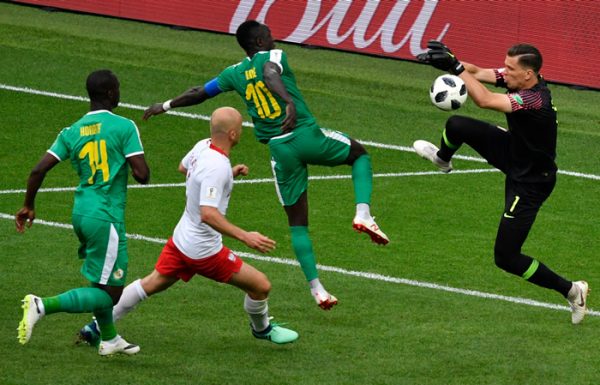 Senegal defeated Poland in their opening Group H game with a 2-1 victory at the Spartak Stadium, recording the first win by an African team at the ongoing World Cup.
 There has been nothing in recent memory like the build-up to Nigeria’s first match at the on-going 2018 FIFA World Cup tournament in Russia. Football is Nigeria’s greatest unifier: when it is football, our compatriots drop all ethnic, religious and ideological differences and profess the missing faith and ideology of one Nigeria.


 The Nigeria Football Federation (NFF) has offered to pay the players full benefits of the Super Eagles players if they qualify for the knockout stage. This is a way to motivate the players to put behind them their loss to Croatia at the opening match in group D, in the ongoing FIFA World Cup in Russia.
 England, today,
