President Muhammadu Buhari has described as vile, evil and satanic the killing of worshippers and two priests at a Catholic church in Ukpor-Mbalom community in Gwer East Local Government Area of Benue State.
“This latest assault on innocent persons is particularly despicable. Violating a place of worship, killing priests and worshippers is not only vile, evil and satanic, it is clearly calculated to stoke up religious conflict and plunge our communities into endless bloodletting.”
The President, in a statement by his spokesman, Femi Adesina made it clear that the country will not bow to the machinations of evildoers.
He extended his condolences to the government and people of Benue State, the Mbalom community, and the Bishop, priests and members of the St Ignatius’ Catholic Church, whose premises was the unfortunate venue of the heinous killings by gunmen.
President Buhari vowed that the assailants would be hunted down and made to pay for the sacrilege committed.
Pupils of the Local Education Authority (LEA) of the Government Primary School, Life Camp, in Abuja, today, Tuesday, took Vice President Yemi Osinbajo to task, asking him questions on many issues, some of which are personal.
Professor Osinbajo was in the school to witness an event marking the 2018 International Book and Copyright day on Monday.
After the Vice President had finished reading excerpts from a short biography of Nigeria’s first President, the late Dr. Nnamdi Azikiwe to the pupils, they began to fire the questions thus:
Q: Sir, you are a very busy man. How do you create time for your wife and children?
Vice President: Let me say first that my children are quite grown up. I have two children who are already out of the university and are working. One of them just got married about a month ago, the other is already working; so they are very busy themselves. My last son is still in school. So as much as possible, whenever they are home, I try and find time about two hours just to talk to them and when they are home, we pray in the morning. After prayer we get a chance also to talk to each other. Also, my wife is around, so I spend quite a bit of time with her anyway because we both live in Abuja. We live in Aguda House, where we see each other practically all the time.
But I must say that it’s very difficult because I travel a lot to different parts of the country, and so I’m not usually home, I’m not usually in Abuja. That’s one of the reasons why there are tenures for the President or Vice President; four years, eight years maximum. So you can’t do this kind of work for the rest of your life because it’s very difficult.
Q: How did you become Vice President?
Vice President: Let me quickly take you through the process. My party, which is the All Progressives Congress, the APC, nominated the president, President Muhammadu Buhari, as the presidential candidate in 2014, and the President, in consultation with the party, then decided to appoint me as running mate. So I was appointed as the running mate. Now the running mate means if the party wins, I become the vice president. Before then I was teaching law at the University of Lagos and practicing law in the courts all over Nigeria. So I was a lawyer and a law teacher before I was appointed as the running mate to President Buhari. On March 28th, the election was held and on the 31st, the result of the election was announced. We won the election. That’s how I became the Vice President.
Q: What is the role of government?
Vice President: Government’s role, and in some cases also, the private sector, is to provide the necessary amenities. Let me give you another example of that. A school such as this is a government school, so it means the government has provided an amenity in this locality. Also, the Federal Capital Territory (FCT), which is the arm of government, provides schools, hospitals from taxpayers’ money. So your parents, other people who are working or who are in business, pay taxes. Aside from taxes, Government also get revenue from natural resources that we sell. So from taxes, from proceeds of oil, other things that are sold from exports and for the business that is done, government provides some money and that money is used to build hospital, roads and so on.
But we also get the private sector, private people, and individuals, to provide amenities. So you have some private schools and private hospitals. We encourage private people also to provide amenities because government can’t provide everything. Government simply doesn’t have enough money to provide all the amenities that we need.
Q: What are your duties as the Vice President of Nigeria?
Vice President: As the Vice President of Nigeria, I assist the President of Nigeria in carrying out his responsibilities, and those responsibilities are very big indeed. The President has responsibility to about 200 million Nigerians and all Nigerians expect him to provide leadership, in some cases amenities. They expect him to be a firm leader, and because we are so many and we are in different places, it’s a very major responsibility. So I assist him in carrying out those responsibilities. I’m here, for example, talking to you, children in LEA School, as part of my responsibilities of encouraging and working with young people to make that young people aspire to achieve great things, so that they also get the chance to be good Nigerians, to be as active and contribute to the country. So that is what I do as Vice President.
Q: Sir, tell us a bit about your childhood days.
Vice President: When I was small, sometimes I was naughty when I was in school and my mom will spank me. And sometimes when I’m very, very good, she will buy me biscuits and sweets and tell me how very, very good I’ve been. So if you are naughty in school you might get spanked.
When I was very little and I was in school, we reported bullies to the teachers. We made sure that we reported them t and the teachers would punish them for bullying. We also ensured that we told our parents too because bullying is a very bad thing; it is unfair, it is unjust and no should be treated unjustly.
Q: What does Government do to help the poor?
Vice President: There are things we do to help the poor. One of the ways by which we help the poor, is that we give them one million of the poorest people in Nigeria N5,000 a month. So far we’ve done about 300,000 of such. Along with the World Bank, which is our partner in this project; we identify the poorest households and we give them N5,000 a month. Now there are many poor people, so we can’t do enough because even with one million, and we want to increase that number.
The other thing we do we also is to give micro credit loans, which is a small loan to small traders so that they can expand their businesses, pay their children school fees and do more for themselves and for their children. So we try to work hard and provide for the poor. But government alone cannot do it because government does not have all of the money. So we also encourage the private sector to contribute; the big companies also contribute to what we are doing; they also give some money towards helping the poor. Government try to put all that money and help as many as it can so that people are empowered and can fend for themselves to take care of their families.
Professor Osinbajo then advised them to shun corruption which has killed the economy of the country.
He said, “Corruption is stealing the money that belongs to all of us; that belong to young children and adults. This is the money that was supposed to use to build roads, to build school, to build hospital, to build airports and if some people steal that money, we should arrest them and put on trial, send them to jail so that everybody else will learn a lesson.
“Nigerian glory, first of all, is that we are very, very brilliant people, so we have brilliant doctors, brilliant engineers, pilots and also very brilliant sports men and entertainers, and so many very brilliant people. So one of the way that our country get one of her lost story how have you work, so if you make sure that you as a Nigerian child do your best in school and become something great then we will truly gain our lost story. So every one of us have a duty to make sure that we work hard, do the best we can, honesty and forthrightly and our country will be truly great.”
National chairman of the All Progressives Congress (APC), Chief John Odigie-Oyegun has said that the date for the national convention of the party was fixed to May 14 because of the Muslim Fasting that is likely to begin within that week.
The chairman, who spoke while inaugurating the 68-member Convention Committee in Abuja yesterday, reminded members of the committee that they were undertaking what he called a “tough and heavy task,” even as he advised them to produce a free, fair and credible convention.
“I have no doubt that this one, given the controversies that have preceded it will also be a most watched convention. So, you have the task of producing a convention that is free, fair and provide a level playing field for anybody who wants to aspire to any position.
“At the end of this exercise, I want to see a reunited APC under whatever leadership your exercise brings up. We have a tough election ahead of us and we must prime ourselves for that election.”
The Chairman of the National Convention Committee, Governor Mohammed Badaru Abubakar of Jigawa State, reiterated the resolution of the last National Executive Committee (NEC) meeting that the current zoning arrangements for party positions be retained.
He said that the details on the list of delegates for the National Convention would be provided after the congresses scheduled to commence on May 2, 2018.
On whether the committee would give any room for consensus and affirmation apart from casting of ballots, Governor Badaru said, “It depends on the situation. Our constitution allows consensus. You are all aware. If there is consensus, we will do it. But we will still cast votes to affirm the consensus that we have done.”
Governor Badaru said that the committee would not fail the party. “We will do all it takes to come out stronger and united out of that convention” he said.
“God is with us and God will continue to support us because of our clear vision, our good heart and our love for the people of Nigeria. We all know that our leader has no business in running this government except for the care of our people.
“Most of us you see in APC are in the party today to serve our people. Our mission in APC is to rescue the country from near collapse we saw around 2014 and 2015.
“With that heart and with mind, we believe that God will support us, help us to come out stronger and re-dedicate ourselves to the service of humanity and our people. Mr Chairman, be rest assured that with the people you see here you can go and sleep. I am very sure that we will come out stronger, united and there will be transparency and accountability.
The inauguration was attended by key stakeholders in the APC, including governors Jibrilla Bindow (Adamawa), Ibrahim Gaidam (Yobe), Simon Lalong (Plateau), Rochas Okorocha (Imo), former governors Danjuma Goje (Gombe), Sani Yerima (Zamfara), Sen. Ken Nnamani, Alhaji Abubakar Kawu Baraje; Mrs. Paulin Tallen, and Sen. Ovie Omo-Agege among others.
Senator Dino Melaye, representing Kogi State West Senatorial Area, today, Tuesday, April 24, jumped off a moving police vehicle conveying him to Lokoja, the Kogi State capital, to face possible criminal charge. He ended up being wheeled unconsciously to an Abuja hospital for emergency medical attention. [[myad]
File photo: Prof. Wole Soyinka | Credit: PIUS UTOMI EKPEI/AFP/Getty Images)
Nobel laureate, Professor Wole Soyinka has cautioned Nigerians to be careful with the former President Olusegun Obasanjo and former military President, retired General Ibrahim Babangida who have been pretending to be “messiahs” over their posturing on national issues.
Soyinka, who spoke at the posthumous 80th birthday of late Gani Fawehim (SAN), insisted that Nigeria is in danger when politicians like Obasanjo, who “supervised the sacking of democratic governments” in Oyo and Anambra states pretend to be messiahs.
“All I want to say in connection with the title of today is just one word: vigilance. There is no question whatsoever that democracy is in danger.
“And so I find it ironic that those who’ve proved themselves the enemies of democracy who’ve really taken, they’ve really committed acts, not just negligence, but actually inaugurated certain policies which contributed to our being at this point again are once again coming out and positioning themselves as saviours, as messiahs, as the sole possible rescue mission that this nation can even dream of, a nation of nearly 200 million people.”
Under Obasanjo’s presidency, Dr. Chris Ngige was abducted by armed policemen and forced to sign a resignation letter at gunpoint in July 2003, and in January 2006, his administration.
“I find it very strange, and I find it even stranger because at the beginning of this movement towards ‘rescue mission’, there were one or two organisations that came out under different names and they had people in them whom I considered worth following, worth encouraging, worth encouraging others to study closely and even consider following.
“The next thing I knew, these movements were being hijacked by the very people who laid the foundation, an ironic word by the way, for the collapse of the democratic edifice.”
Soyinka said he turned one of the groups down when it approached him. He said: “The next thing we know, they are forming coalitions and I was invited by one of the rescue missions to address them and I telephoned them and I asked the question, ‘wait a minute, which one are you? Are you the original people I saw or is there a faction or is there now a fatherly umbrella under which everybody is moving?’
“And I told them; don’t even come near me, if you’ve signed up on one of those who are the enemies of democracy in this nation.
“Those who inaugurated so-called constitutional amendment programmes, total charades, to assist them to continue to run, which has been scuttled by the direction known as tenure elongation, third term, etcetera for which the entire national treasury was almost bankrupted.”
“And suddenly, here they are they are forming coalitions all over the place, once again, confusing people. Who are the genuine leaders, who are those that we can trust? The answer to that is very simple: look at their track records. That’s all”.
Soyinka advised Nigerians not to allow themselves “to plunge into a zone of amnesia, in which you conveniently forget unpleasant realities. “We’ve had presidents in this nation, some of whom inaugurated a never-ending democratic process, which landed us eventually under the most brutal dictators that this nation has ever known.”
Under Babangida, who was in office between 1985 and 1993, his transition programme was the longest ever in the country’s history. On several occasion, he promised to hand over to a democratically elected government but failed to do so.
In June 1993, he annulled the presidential election won by the late Bashorun MKO Abiola. He was forced to “step aside” in August 1993.
Babangida handed over to the Ernest Shonekan-led Interim National Government (ING), which was sacked by the late Gen. Sani Abacha, who tried to perpetuate himself in office before his sudden death.
Soyinka was not done: “We had others also who actually supervised sacking of ‘democratic government’; I’m speaking of Anambra, I’m speaking of Oyo State. A governor was kidnapped under their watch with their complicity; in another instance, thugs actually entered the House of Assembly, sacked the legislators and installed their own candidates; under the same watch.
“And they call themselves the God-designated watchmen over the fortunes of this nation? And suddenly, here they are and I see Nigerians flocking to them and asking them once again to lead.
“Mind you, they’ve said very clearly if it becomes a political party count me out o, but paths are already being beaten to their doors, control by subrogation.”
The National Chairman of the All Progressives Congress (APC), Chief John Odigie-Oyegun may be on his way back to the saddle as the some APC leaders from North-East, North-West and North-Central have already endorsed him.
In a statement in Dutse by the chairman of APC United Front, Alhaji Ibrahim Musa, the leaders praised Oyegun for unifying the ruling party, fostering collaboration and encouraging engagements that neither diminishes others moral worth.
According to the leaders: “the incumbent, Chief Oyegun will be reelected for the second time. Party faithful and their leaders in the north are certain of Oyegun’s victory. A change of leadership is not on the cards. There is no surprise in the air. The dynamic national chairman is sure to win.”
They called on the APC National leader and former governor of Lagos State, Senator Bola Ahmed Tinubu and other APC leaders in the South-West to back Oyegun’s candidacy, saying: “we need to avoid deadlock. The result of the APC chairmanship election won’t surprise anyone.”
They said that the APC under Oyegun’s leadership has been existing as a united political group.
“APC is not a loose coalition of personal and sectional factions,” they said even as they hailed Oyegun for his flexible position on political issues, reconciliation of feuding political groups and his commitment to a greater Nigeria.
Specifically, they eulogized Oyegun for bringing unparalleled brilliance and unbridled patriotism to the chairmanship job.
“Oyegun is a stabilizing factor in Nigerian politics. His success in the convention will be based on his performance, popularity and honesty. Other aspirants do not pose serious danger to Oyegun. They have nothing to offer” the leaders said.
They commended South-East and South-South APC leaders for supporting Oyegun.
“We don’t want a southern gang up against the north. We don’t want to be plunged into darkness. Oyegun, a role model and an icon, is held in reverence and affection by the vast majority of Nigerians.
“He believes in the course that seeks to prime humanity to loftier heights” the leaders added.
A strong indication of both the quality and failure of politics in Nigeria, as the people look forward to the next general elections in 2019, is the manner in which virtually “every” Nigerian believes that he or she is good enough to be President of Nigeria. This may speak to a deepening of political consciousness, but it is also a reflection of the people’s anxiety and frustration about how the office and position of the President of Nigeria seems to have been mishandled and demystified. The process of that demystification has taken different shapes and tones since the return to civilian rule in 1999, but now everything seems to have gone so bad, far beyond expectation. My mechanic couldn’t have phrased this national dilemma better. He came to see me the other day, full of excitement.
“Oga, it’s you I have come to see oh.” Typical Nigerian manner of speaking: you are right in front of me, and yet you still consider it necessary to announce your presence. Anyhow, I nodded affirmatively, already working out a response to a likely solicitation for money. It is school resumption time, and it is usual for people to go soliciting for help to pay children’s school fees in a country where basic education is so unaffordable.
“Oga, I have come to inform you that I am thinking of running for President.” I thought the guy was talking about the Presidency of the Mechanics Village Association. So, I brightened up. No, he meant President of Nigeria. I removed my eyeglasses and dropped my pen.
“President of Nigeria? How? Look, have you been drinking?”
“Oga, you know I am a Christian. I don’t drink. I am serious oh. I have been thinking about it for a while. I can do a better job. The way these people are running Nigeria, some of us have good ideas about what can be done. If we leave this Nigeria to these politicians, they will finish all of us. Anybody that likes this country should get involved.”
I paid attention to him.
“Oga, look at me, I can do it. We can do it. I have worked it out. By the grace of God, I will be the next President of Nigeria.”
I had known this mechanic for a while, but I never suspected he had very tall ambitions. I had not yet given him my honest opinion; he had already conscripted me. “We can do it.” We? Every Nigerian politician is an optimist, and the most optimistic are often the ones who don’t even stand a chance at the polls.
I pretended to be interested all the same; so he continued with his campaign.
“Oga, you know me. Am I a lazy man? No. I am not.” When people insist on answering their own questions the best you can do in the circumstance is to listen.
“What this country needs now is a mechanic, somebody who can take a look at a vehicle that is having problems, and fix it. We mechanics do that every day. When they bring a car to you, first you diagnose. What is wrong with the car? Why is it not functioning well, and then you go straight to the problem and fix it. Why can’t people fix Nigeria? If we mechanics were to behave like politicians, this whole country will be littered with broken down vehicles. In the hands of these politicians, Nigeria is broken. E be like say Nigeria don knock engine sef. I am the man who will fix that engine.”
“But nobody will give you any chance. Everybody will laugh and think you are joking.”
“I am not joking, Oga. What does it take to be President? I have done my homework. The only thing they are asking for is a WAEC certificate. I have my certificate ready and I can produce it to prove that I completed secondary school.”
“How many credits?”, I asked, trying to humour him.
“INEC does not ask for five credits. Even F9 parallel sef can be President of Nigeria. No be Nigeria?”
“But you don’t have the resources. You’d need a lot of money.”
“Oga, it is not about money. And if it is money, God will provide. Our Pastor in our church has been praying for me and God is speaking to us. When I become President, I will declare free education, free health and there will no lazy youth in Nigeria again!”
“Why don’t you start at a lower level. may be local government chairman, gain some experience.”
“Ha. Oga, Experience has shown that in Nigerian politics you don’t need experience. Who has experience helped? All those former Governors in the National Assembly, what kind of experience do they have? In fact, let me just say a lot of them go there to sleep and collect free money, travel free. I have seen their pictures. They go there to sleep. When some thugs stormed the place to steal the Mace, not one of them could stand up and protect the Mace. Lazy Senators. Only a woman, a sergeant at arms was courageous enough to challenge the Mace thieves. When I am President, nobody will dare steal the Mace. It won’t happen.”
I felt like telling him that there has been too much drama over the significance of the Mace in our legislatures. It is at best a ceremonial symbol. For a session of the legislature to be valid under the 1999 Constitution what is required is a quorum as defined under Section 54, but of course the kind of criminal conduct that was put up at the Senate, last week, is condemnable and should be investigated and all authors of that act of impunity must be sanctioned accordingly. I didn’t say anything to him along these lines, rather I was more impressed by his passion, his determination to save Nigeria and arrest the drift. I was also struck by the fact that he is not the only Nigerian with such passion. There have been many of his kind, now active on social media, promoting a vision of Nigeria and insisting that they would be better materials for 2019.
The number of these aspiring Presidents keeps increasing everyday and while I consider some of their posters a bit curious and the candidates a bit unusual, taken together, the shared anxiety about the Presidency and who is best fit to lead Nigeria beyond 2019 says a lot about public expectations. There are online, video-tapes of a certain Aunty Monica, for example. She is based in Europe and she wants to come home to be President, to bring investment and tourism to the country, and she says she has “ideas in her head.” I have also seen such banners as “Vote Iya Bayo for president, Aunti Ramota for Vice President”, and “PFANN: A new refreshing wind blowing over the nation. Get ready. Elishama 2019.”
The names of a popular Fuji musician, Wasiu Alabi Pasuma, and that of the legendary footballer, Kanu Nwankwo have also been mentioned as potential Presidents of Nigeria. Neither Pasuma nor Kanu has confirmed their interest in the job. But the social media is the forum where many ideas are hatched, and many of such ideas also die on social media, but what is said about public reality should not be ignored. Nigerians want what is now referred to as the #realchange. They are disappointed. They are angry. There is also a growing resentment to the repeated claim by the ruling All Progressives Congress (APC) and President Buhari’s handlers that there is no alternative to Buhari. In a most recent article, Garba Shehu, a Presidential spokesperson asks what he considers “an important question” – “who do you have that is better?. Then he answers it himself; “…certainly there is no face (other than Buhari) that can be called the President of Nigeria.” Garba Shehu even scoffs at the Coalition Movement that started a protest against the two leading political parties in Nigeria – APC and PDP, and asked for a one-term Buhari Presidency. He says “a so-called Third Force has failed to gain political traction since its birth.”
My mechanic, Aunty Monica, Iya Bayo, Aunti Ramota, and Elishama – these are ordinary Nigerians- certainly disagree that only one man’s face is good for the Nigerian Presidency. They in fact believe that they will do a much better job. But perhaps the more significant development is the emergence of new faces on the political scene who are also keenly interested in rescuing Nigeria and whose declared starting point is the Presidency. I once described them as products of the Trudeau-Macron effect. Justin Trudeau, 46, became Prime Minister of Canada in 2015. Emmanuel Macron, 39 assumed office as President of France in 2017. There is also the current Chancellor of Austria, Sebastian Kurz – he is the youngest President in the world. He is 31. An emerging group of Nigerian political leaders falls into this category: they are challenging current political orthodoxies; they are educated, they are internationally exposed, they can think out of the box and above all, they are united in their resolve that President Muhammadu Buhari is replaceable in 2019. They equally pose a challenge to the traditional political elite, which so far is yet to make up its mind about presidential candidates or alternative platforms for the 2019 Presidential and general elections. The usual tendency is to dismiss them as “noise makers and attention seekers”, but they probably constitute the real “Third Force” that will produce the traction that the Presidency is yet to see.
One newspaper has identified up to about 24 of these emerging “game changers”. There is Bukunyi Olateru-Olagbegi, 27 who has registered a political party – the Modern Democratic Party (MDP). He is not running for President but the MDP could become a useful platform for youth mobilization and conscientization.
There is also Omoyele Sowore, 47, former students’ union leader, civil rights activist and founder of Sahara Reporters, an online newspaper. For the past month or so, Sowore has been on the campaign trail, addressing students and civil society groups. He has also appeared on radio and television. His main message is that Nigerian youth should “take back Nigeria” from those who have destroyed it. He has in particular been very critical of the Buhari government. “I can run Nigeria better than Buhari in my sleep”, he says. When a serving Minister, Adebayo Shittu told Sowore to go and start as a councilor, during a radio programme, Sowore held his ground. Kingsley Moghalu, 55, former Deputy Governor of the Central Bank of Nigeria (CBN), an author and a scholar, has also declared his interest in the Nigerian Presidency. He is offering Nigeria, “bold and decisive leadership …something different … by a capable, experienced technocrat.” Like Sowore, Moghalu means business.
You also have Fela Durotoye, 47, a Presidential aspirant on the platform of the Alliance for New Nigeria (ANN). Durotoye wants to rebuild Nigeria through visionary and inspirational leadership. Alistair Soyode is the founder of BEN TV in the United Kingdom. For years, he has been reporting Nigerian stories to the world and to Africans in diaspora. Like Sowore, he has also decided to become directly involved in Nigerian politics. Other emerging aspirants include Professor Funmilayo Adesanya-Davies, 55 who says “power must go to women and the youth”; Sam Nwanti, an international detective, and a member of the Labour party, who wants to “fight crime and corruption”. Others include US-based Omololu Omotosho, Lewis Omike, a filmmaker and photographer, Dr. Thomas-Wilson Ikubese, 47, of the National Conscience Party, and 35-year old Adamu Garba II.
The temptation is to dismiss this category of aspirants as Minister Shittu has done, in part because they do not preach the message of religion, ethnicity and money, and they do not seem to have any Godfathers who can offer them existing structures in exchange for conditions of service.
Many of them may even throw in the towel before the actual race begins. The old brigade of Nigerian politics is not in a hurry to retire, change tactics or yield space. People don’t become Presidents in Nigeria by merely pasting posters and social media messages or through sheer idealism. IN 2011, Dele Momodu, 51 at the time, tried to run for President. He has many stories to tell. The Trudeau-Macron effect in our politics may still take a few more years. But it would be wrong to ignore what the new faces represent: a more deep-seated yearning for change among the youth and the middle class, and at least two of them: Sowore and Durotoye are already exercising much influence among the Nigerian youth, not just on social media but also across the educational institutions and the streets.
On April 16th 1911, Mr. Carl Zimmermann, a South African Dutchman mounted a horse at Wukari with four boxes. His destination was Takum – all in Taraba State. On the second day of his journey, 17th April 1911 and halfway to Takum, he came to a big village and decided to stop.
The founder of the village was Saaitu Deekpe, Chief of the Shitile clan of the Tiv tribe. He was not at hand to receive the horseman because he was busy attending to other urgent matters of his chiefdom. The horseman sent word through an interpreter for the chief to come and join those who were at hand so that he would tell them about ‘Aondo’ – the Tiv word for God which many Tiv people also answer as their name.
“What has Aondo done again?” asked the chief thinking the man wanted to complain about one of his recalcitrant subjects who answered the name Aondo. “I am too busy now to hear this complain about Aondo. Make the white man comfortable and maybe tomorrow I will hear what he has to tell me about Aondo.”
This was a pleasant surprise to the horseman.He had read the accounts of Dr Baikie who embarked on an adventure of the Benue river with Ajayi Crowther in 1854. Baikie had written that the Tiv are an unfortunate tribe that are against everybody and everybody is against them. He went further to conclude that “their rude minds are incapable of comprehending anything beyond war and raping.”
Other accounts he had read from colonial literature about the Tiv people were equally unpleasant and out of tone with the hospitality extended to him at Saaiutu. British colonial administration had up to that time declared the whole of Tivland as unsafe for Christian missionary work. Lord Lugard in his official dispatches described the Tiv people as “ignorant savages and very intractable people who enjoy lawless murders and looting.”
These negative opinions, expressed by people who were in a position to recommend bringing Christianity to the Tiv people were responsible for the delayed arrival of Christianity in Tivland.
There were however a few people who were inspired by the spirit Christ to bring Christianity to Tiv land. Notable among them were Dr Hermann Karl Wildhem Kumm, a German who studied Arabic in the University of Cairo in Egypt and Hausa in Tripoli Libya. He was instrumental to the formation of the Sudan United Mission in the United Kingdom in 1904. In 1907 he travelled to South Africa where they held meetings and in collaboration with Rev George Botha, a young theological graduate and another young man, Mr V H Hosking of the Wesley Church embarked on the arduous task which would bring Christianity to the Tiv people.
Still, given the negative publicity given about the Tiv people by early writers who came in contact with them, the man on the horseback was surprised with the hospitality granted him by Chief Saaitu Deekpe on 17th April 1911. Not only did the Chief allow him stay without molestation or an attack of the poisoned arrow for which the Tiv people were famous, he sent word round and invited his subjects to come and welcome his new guest.
If Mr Zimmermann was surprised, those who knew Chief Saaitu intimately were not. One of his most respected wives, Mrs Kwaghembe Sai (nee Burya) who witnessed the historic event on April 17th 1911 told this writer that the man Chief Saaitu was an enigma.
“He used to boast that he is a man with a coat of many colors: That from his house there will emerge poor men and rich men; good men and bad men; kind people and cruel people; honest men and thieves; small men and giants etc. His decision to welcome the queer man who looked like a sprite, the type that were being hunted and killed with poisoned arrows all over Tiv land and accommodate him in his compound did not come to us as surprise at all. It was in his character,” she told me before her death in 1975.
The surprised horseman took immediate advantage of the unexpected hospitality. He opened the first box and brought out a copy of the Holy Bible and read from John 3; 16. He preached and sang to the assembled crowd. The people were perplexed and started calling “Ortese” meaning the teacher. It was from this first box that Christianity and western educarion took root and has today become the dominant religion of the Tiv people. Chief Saaitu’s son Akighirga (Akiga) was the first Tiv man to be baptized and to profess that Christ was his savior. His other son, Ishoribo-Rev J E I Sai became the first Tivman to be ordained a Priest.This box also contained other books which brought literacy to the Tiv people. Chief Saaitu’s son Akiga was the first Tiv man to be literate and his grandson, Ezekiel Akiga became the first Tivman to get a University degree. Today the Tiv are one of the most educated ethnic groups in northern Nigeria.
Among the people who came to see the strange horseman were people suffering different kinds of ailments. Some had malaria, some had sores and ulcers all over their bodies, others were coughing endlessly. The second box was opened in which an assortment of medicines and the horseman was proceeded to administer these to all the sick people who came. Amazingly they were healed and healthcare became a powerful weapon to induce the sick who in the process of receiving treatment for their ailments also received the word of Christ.
On the second day, the horseman opened the third box. This one contained a hammer and other carpentry and building implements. With these, he erected a structure of his own and thus introduced the Tiv people for the first time to the art of modern architecture.
Soon, the horseman opened his other box, the fourth one. This one contained seeds of fruit trees and vegetables, namely mango, citrus (oranges), grape, avocado, guava, cashew etc. He planted the first mango trees in Tivland which are still standing in Saaitu’s village. The rapid spread of tree crop farming in Tivland came out of this box.
Today Benue is the leading producer of mangos and citrus in Nigeria. The United Nations Development Program (UNDP) estimates that there are 22 million mango trees in Benue equivalent of 220, 000 hectares – all from one of the four boxes with the horseman.
Thus, the horseman, Carl Zimmermann, who arrived Saaitu village on 17th April 1911 with his four boxes brought with him a revolution that has changed the course of Tiv history.
Chinese investment company, Tongyi Group has donated five million naira to the government of Benue State as part of its contribution towards the alleviation of the sufferings of Internally Displaced Persons (IDPs) in the state.
The Project Manager of the company, Mr. Vincent Yaun and Assistant Manager of its Makurdi Branch, Mr. Badmus Saka Owolabi both of who represented the Chairman, made the donation when they visited the Benue State Emergency Management Agency (BSEMA) in Makurdi.
The Chinese investment company said that it had come to identify with the predicament of the people of Benue state.
The chairman of the company expressed concern that some children have turned to orphans while women had become widows even as they are displaced from their homes, even as he commiserated with the families of those victims who lost their lives during the series of attacks in recent time.
The company promised to continue to render support to IDPs in the state noting that the challenge of taking care of the IDPs is enormous. “This donation is meant to cushion the suffering of the displaced persons in this trying period,” the chairman added.
In his response, the Executive Secretary, Benue State Emergency Management Agency, Emmanuel Shior who received the cheque on behalf of Governor Samuel Ortom, commended Tongyi Group for the kind gesture which he said reflects the concern of the Chairman of Tongyi Group for the people of Benue state.
He thanked the company for being mindful of the plight of IDPs in Benue State, adding that the donation has come at a time when the needs of IDPs are on the rise.
“The donation is timely as the numbers of IDPs keep increasing by the day because of the consistent attacks.”
PDP Chairman Uche Secondus and Minister of Information, Alhaji Lai Muhammed
The Rivers State High Court sitting in Port Harcourt has issued an order restraining the federal government, Minister of Information and Culture, Lai Mohammed, and Vintage Press Limited (publishers of The Nation Newspapers) from further publishing the name of the National Chairman of the Peoples Democratic Party (PDP), Prince Uche Secondus, in the list of looters. Secondus had instituted a N1.5 billion suit against Lai Mohammed, the federal government and Vintage Press in Suit No. Suit PHC/1013/2018 as damages for alleged defamation as his name was listed as a looter in the list published by the minister of information and culture for allegedly collecting N200 million on February 19, 2015 from the office of then National Security Adviser.
In the suit, Secondus among other reliefs asked the court to order the defendants to retract the publications in as many media houses as they published the list and pay N1.5 billion as damages. As the matter came up Monday at the state High Court 1, the trial judge and Chief Judge of Rivers State, Justice Adama Iyayi-Lamikanra, granted one of the two prayers sought by the counsel to Secondus, Emeka Etiaba (SAN), and restrained the defendants from further publication of the name of the PDP National Chairman in the list of looters pending the determination of the matter before the court.
The judge also ordered that hearing notice be served on the defendants as neither the defendants nor their counsel were present in court and adjourned the case to May 28. Secondus, had through his counsel, sought an interlocutory injunction retraining the defendants from further publication of his name as a looter and secondly restraining them from publication of any other list. While the court granted the first, it refused the second on grounds that it was “at large”. Addressing journalists shortly after the proceedings, the plaintiff’s counsel, Etiaba, who led Emeka Okpoko (SAN) and others, said Secondus instituted the matter in court because the defendants included him in the list of looters, accusing him of collecting N200 million on February 19, 2015 when they (the defendants) knew that he never collected any such money. He expressed satisfaction with the order issued by the court and said at the end of the matter, Nigerians would know that the federal government and its agents lied. “The judge has granted a restraining order. We moved our motion seeking interlocutory injunction to restrain the defendants from further publishing the libellous materials. Prayer one was granted but prayer two was not granted because the honourable court felt it was at large. But we are very satisfied with prayer one which effectively put a halt to further libel,” he said. He said the defendants were not in court perhaps because they knew that there was no truth in what they published. He said: “There is no truth in what they published, so I can understand why they are not in court. But by the time the restraining order comes, may be they will take us more seriously. But we have told Nigerians that this is one case of executive recklessness which comes up once in a while but we hope at the end of the day to prove to Nigerians that this is nothing but a gimmick, a ploy to destroy the PDP and its leadership because of the 2019 elections coming up.”
On why the suit was filed at a state High Court, Etiaba said: “It is a matter for the state High Court. It is a matter that relates to libel and the state High Court has absolute jurisdiction to try the matter. That is actually the main claim in the suit; that he was defamed and the state High Court has jurisdiction. And the Rivers State High Court, especially Port Harcourt, where we are, is the best suited for the matter because the publication was made all around the world and Nigeria, but specifically in Port Harcourt where it was read by people who complained and confronted him (Secondus). So where the publication was made and we are relying on is in Port Harcourt and that is why we are here.”
On the progress of the matter, Etiaba said: “The matter has been adjourned to May 28. On that day, we believe we will go into the merit of the case. The court also ordered that we serve them hearing notice and that we will do just as we served them the court processes. We will serve them vide the newspapers and deposit same at the office of the attorney general of the federation.”
We use cookies on our website to give you the most relevant experience by remembering your preferences and repeat visits. By clicking “Accept”, you consent to the use of ALL the cookies.
This website uses cookies to improve your experience while you navigate through the website. Out of these, the cookies that are categorized as necessary are stored on your browser as they are essential for the working of basic functionalities of the website. We also use third-party cookies that help us analyze and understand how you use this website. These cookies will be stored in your browser only with your consent. You also have the option to opt-out of these cookies. But opting out of some of these cookies may affect your browsing experience.
Necessary cookies are absolutely essential for the website to function properly. This category only includes cookies that ensures basic functionalities and security features of the website. These cookies do not store any personal information.
Any cookies that may not be particularly necessary for the website to function and is used specifically to collect user personal data via analytics, ads, other embedded contents are termed as non-necessary cookies. It is mandatory to procure user consent prior to running these cookies on your website.



 National chairman of the All Progressives Congress (APC), Chief John Odigie-Oyegun has said that the date for the national convention of the party was fixed to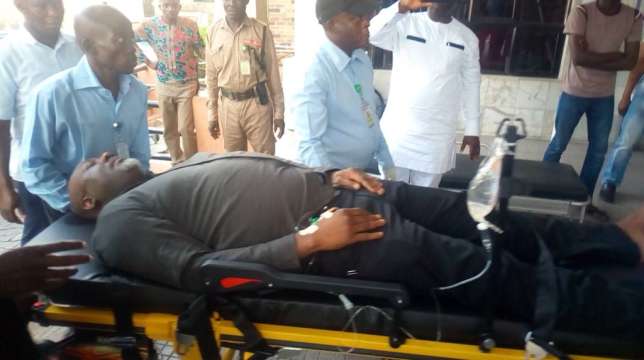


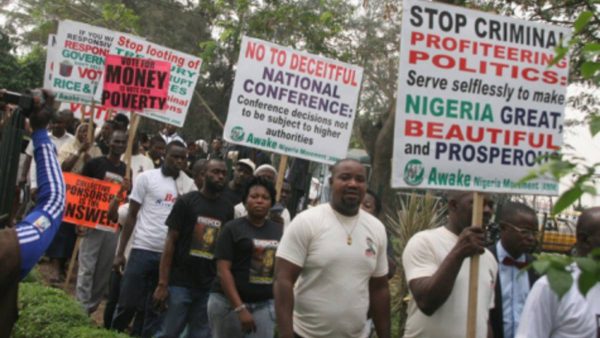 A strong indication of both the quality and failure of politics in Nigeria, as the people look forward to the next general elections in 2019, is the manner in which virtually “every” Nigerian believes that he or she is good enough to be President of Nigeria. This may speak to a deepening of political consciousness, but it is also a reflection of the people’s anxiety and frustration about how the office and position of the President of Nigeria seems to have been mishandled and demystified. The process of that demystification has taken different shapes and tones since the return to civilian rule in 1999, but now everything seems to have gone so bad, far beyond expectation. My mechanic couldn’t have phrased this national dilemma better. He came to see me the other day, full of excitement.
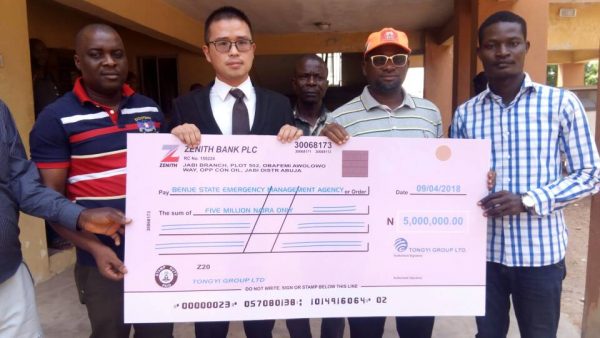 Chinese investment company, Tongyi Group has donated five million naira to the government of Benue State as part of its contribution towards the alleviation of the sufferings of Internally Displaced Persons (IDPs) in the state.

