Police arrested Senator Ovie Omo Agege over the invasion of the Senate Chamber by some hoodlums who ran away with the Mace, the symbol of authority. Senator Omo Agege, who allegedly led the hoodlums is being made to return the Mace within 24 hours.
The Senate has asked the security to arrest suspended Senator Ovie Omo-Agege and some hoodlums he allegedly led into the Senate plenary to seize the Mace which is the symbol of authority of the Upper Legislative Chamber. “This action is an act of treason, as it is an attempt to overthrow a branch of the Federal Government of Nigeria by force, and it must be treated as such. All Security agencies must stand on the side of due process and immediately mobilize their personnel to retrieve the mace and apprehend the mastermind and the perpetrators of this act.” In a statement by the Senate spokesman, Senator Aliyu Sabi Abdullahi, the Upper Chamber of the National Assembly stressed that this action is also an affront on the legislature, and the Leadership of the House. It said that the Senate is now in an Executive session even as promised that an updated statement will be released immediately after the closed door session.
The International Monetary Fund (IMF) has hailed the rapid growth of the Nigeria’s economy, predicting that it would hit 2.1 percent growth towards the end of this year. The Fund however, projected a slow down to 1.9 percent growth next year, in its latest World Economic Outlook (WEO) Report launched in Washington DC, United States where the annual World Bank/IMF Spring Meetings are ongoing. The IMF advised oil-dependent economies, including Nigeria’s to intensify economic diversification as the global body foresees the crash of crude oil prices in the near future. “Some low-income countries like Mozambique and Nigeria have experienced financial stress or deteriorating loan quality in recent years as growth has moderated and corporate balance sheets have weakened. “Further deterioration in loan quality would impair credit intermediation and ability of the banking sector to support growth, which would raise the risk of cost recapitalisation and severely burden the already strained public finances.’’ The IMF Director of Research, Mr Maurice Obstfeld at a news conference yesterday, said that global economy would grow by 3.9 per cent in 2018. Obstfeld said the forecast was borne out of the continued strong performance in the Euro area, Japan, China and the United States. “Despite the good near-term news, longer-term prospects are more sobering. Advanced economies are far facing aging population, falling rates of labour force and low productivity growth. “Emerging and developing economies present a diverse picture. Many of these countries need to diversify their economies to boost future growth and resilience,’’ he said. According to Obstfeld, global financial conditions remained loose, despite the approach of higher monetary policy interest rates and enabling a further buildup of asset-market vulnerabilities. He said the recent escalating tension over trade (United States vs China) presented a growing risk for global financial stability. “The prospect of trade restrictions and counter-restrictions threatens to undermine confidence and derail global growth prematurely. “While some governments are pursuing substantial economic reforms, trade disputes risk diverting others from the constructive steps they would need to take now to improve and secure growth prospects,’’ he said. The IMF encouraged each national government to advance growth by resolving issues of climate change, infectious diseases, cyber-security, corporate taxation and corruption, among others. The global financial body said “each national government can do much on its own to promote stronger, more resilient and more inclusive growth,” saying global interdependence will only continue to grow; and that “unless countries face it in a spirit of collaboration- not conflict – the world economy cannot prosper.
The House of Representative has commenced a process towards stopping the electricity Distribution Companies (DisCos) from cheating consumers through billing for the electricity they never consumed. A bill seeking to amend the Electicity Power Reform Act, sponsored by the House of Representatives Majority Leader, Femi Gbajabiamila and others, has scaled second reading on the floor of the Green Chamber. If passed, every electricity consumer must be provided with a prepaid meter, thus ending the regime of paying for power not consumed. The lawmakers also proposed to criminalise non-provision of prepaid meter after application and illegal disconnection of consumer’s light among others with a fine of N500, 000, or six-month jail term. Failure to carry out the provision of the proposed law was to attract a six-month jail term, a fine of N1 million, or both. The development followed the second reading of a bill where Section 67, sub-Section 1 of the Principal Act among others was amended. Leading the debate on the general principles of the bill, Gbajabiamila said that feedback from Nigerians showed deliberate extortion of consumers by the DisCos. On the need to back the prohibition of estimated billing by law, the House Leader pointed out the difference between regulation and law. He said: “The Electricity Regulatory body can direct that all consumers be provided with prepaid meters immediately and by the stroke of a pen, can also direct that the prepaid meter no longer be provided for one reason or another. So, if this is backed by law, such can no longer happen.” Other lawmakers took turn to relive their experiences in the hands of Discos officials on estimated bills. Speaker Yakubu Dogara said that he had to disconnect his house in Bauchi that was not occupied but receiving N80, 000 monthly on estimated bill. Deputy Majority Chief Whip, Pally Iriase described estimated bill as a serious financial oppression, adding that the sale of the National asset was faulty from the beginning. Saying that the arbitrariness of the billing is real, Iriase regretted that “the people who were handed our commonwealth for nothing and making millions out of it could not add any value to it. “These are the same people who don’t want to install the meters even after the consumers have paid for the meter, they kept on giving excuses.” Muhammad Monguno (APC, Borno) wonder why estimated bill was alien to Nigeria’s less-developed neighbours like Chad and Sudan and others that Nigeria supplies power to. Mrs. Nkeiruka Onyejeocha (PDP, Abia) regretted that corruption has eaten deep into the system. She described as unacceptable a situation whereby an entire community in parts of Southeast gets one prepaid meter while the bill, running into hundreds of thousands are shared by individuals within the community. “Billing on one prepaid meter by the entire community is always causing problems every time”, she added. Sergius Ogun (PDP, Delta) lamented that the N215 billion intervention fund given to the sector, and by extension to the DisCos, has yielded no result. The Principal Act was amended by creating new Sections 68 to 72 as Section 68 (1), estimated billing methodology is hereby prohibited in Nigeria. Below are the provisions: Section 68 (2): Every electricity consumer in Nigeria shall apply to the electricity distribution company carrying out business within his jurisdiction for a pre-paid meter and such consumer shall pay the regulated fee for pre-paid meter to be installed in his premises and the electricity distribution company shall within 30 days of receiving the application and payment install the pre-paid meter applied for in the premises of the consumer. Section 68(3): Customers who elect to buy their pre-paid meters through Credit Advancement Metering Implementation must state it in their applications and such customers must be metered within 30 days of the receipt of their applications. Section 68(4): All electricity charges or billings to the premises of every consumer shall be based strictly on pre-paid metering and no consumer shall be made to pay any bill without a pre-paid meter first being installed at the premises of the consumer. Section 68(5): If a customer is not metered within 30 days after application has been duly made, the relevant electricity distribution company is prohibited from refusing to connect the customer or disconnect the customer in the event that the customer has been connected or estimate his bills Section 69: Upon connection, the electricity distribution company serving the Consumer must inform the customer in writing on the nature of the meter installed, tariff methodology and all other services available to the customer. Section 70: In giving effect to the provisions of this Act, the National Electricity Regulatory Commission as the regulatory body must ensure that all licensed distribution companies comply with the provisions of this Act. Section 71: All cases of illegal disconnection, refusal of the relevant distribution company to connect a customer after application, un-metering within 30 (thirty) days of a customer applying for a pre-paid meter and estimated billing shall attract both civil and criminal liability. Any officer found guilty shall be liable to a fine of N500, 000, or imprisonment for a term of 6 months or to both such fine and imprisonment as the Court may deem fit. Section 94 sub-Section (2)of the Principal Act is amended by creating a new sub-section (4) as follows: Any person who performs any act or does anything or refuses, fails and/or neglected to carry out his lawful duties with intention to contravene or frustrate the Implementation of Sections 68 and71 of this Act is said to have committed an offence; and upon conviction shall be liable to 6 (six) months imprisonment or a fine of N1,000,000 or to both such fine and imprisonment without prejudice to the right of the Commission to cancel or suspend any license under this Act. The bill scaled second reading after it was unanimously passed in a voice vote.
Former Minister of Finance, Ngozi Okonjo-Iweala, has revealed that former President Goodluck Jonathan single-highhandedly called to congratulate Muhammadu Buhari before the conclusion of the 2015 Presidential election without consulting the Peoples Democratic Party (PDP) on which platform he contested the election or federal cabinet members.
In a book she wrote which will soon go public, Okonjo-Iweala said that while members of the federal cabinet who were with President Jonathan were arguing whether to accept the result of the election or not, she leaned towards the president and asked him to concede before the results were completely collated and announced.
She said that Jonathan listened to her whispered words and then spoke loudly in response to the hearing of everyone in the room: “It is done. A few minutes ago, I called to congratulate President-elect Buhari.”
Okonjo-Iweala recalled that on that day, March 31, 2015, when, unknown to all present at the presidential residence in Aso Villa, Jonathan had already contacted Buhari, while various high-level government officials and the Peoples Democratic Party (PDP) bigwigs were discussing whether or not he should concede.
The book is titled: ‘Fighting Corruption is Dangerous: The Story Behind the Headlines.’
Okonjo-Iweala described it as “a personal account of an important aspect of my work in government – fighting corruption” unwraps her experiences while serving in the Jonathan government. [myad]
The Chairman of the Social Democratic Party (SDP), Chief Olu Falae, has acknowledged that President Muhammadu Buhari remains his friend, recalling his support for him (Buhari) during the 2011 polls.
“President Buhari is my friend and I remember how I supported him and raised his hands at Adamasingba Stadium in Ibadan, Oyo State where I asked people to vote for him because he said he would restructure Nigeria.”
Falae, who spoke to news men shortly after a closed door meeting with former President Olusegun Obasanjo at the Olusegun Obasanjo Presidential Library (OOPL), however expressed his displeasure over his administration’s failure to restructure Nigeria and to deliver on his campaign promises.
Falae did not support Buhari’s presidential ambition in 2015 as his Social Democratic Party supported Goodluck Jonathan and the Peoples Democratic Party. The SDP received N100 million from the PDP as logistics fund for the support.
Minister of the Federal Capital Territory (FCT), Malam Muhammad Musa Bello, has given assurance that the Industrial Park phase 2 at Idu in Abuja will soon be ready for the use of local and foreign investors.
The minister, who gave the assurance today, Tuesday, at the FCT Day of the Economic Recovery and Growth Plan (ERGP) Focus Labs at the Abuja Sheraton Hotel, stressed that his government is determined to ensure early completion of the Industrial Park as part of efforts towards the restoration of the Nigerian Economy and to make it globally competitive.
The minister said that it is with such determination that has led to the setting up of a team that had so far held direct talks with investors for the purpose of addressing inter-agency problems that can slow down investment in the Territory.
The team comprised the Permanent Secretary, Christian Chinyeaka Ohaa, Executive Secretary FCDA, Engr. Umar Gambo Jibrin, Chief of Staff, Bashir Maibornu and other relevant top functionaries.
Top among the investors in the team is Zeberced, a Turkish investment giant that is presently constructing the second phase of the Idu Industrial Park. The 245-hectare Park is expected to provide over 170 industrial plots of land for various categories of investors from manufacturing to retail marketing as well as create thousands of jobs.
During the discussions the uncompleted access road to the Park was identified as a major hindrance to prospective investors.
The minister and the minister of State for Budget and National Planning, Zainab Ahmed, agreed to work together to mobilise funds for the completion of the road.
The collaboration and understanding achieved between Zeberced and the two ministers also paved way for the resolution of issues concerning other investors who made presentations at the Lab.
Major investors in World Health Organization (WHO) certified Pharmaceutical manufacturing, Liquefied Petroleum Gas and footwear manufacturing, who all sought for land allocation to set up their industries, were all linked up with the industrial park developer for location of their businesses.
The FCT minister also directed the Abuja Investment Company to facilitate all the linkages and ensure that investors who have also expressed interest in the Abuja Technology Village (ATV) were also provided with necessary support and guidance.
The ERGP Focus Labs being organised by the Ministry of Budget and National Planning aims at achieving three cardinal goals namely: restore growth in the economy to a positive path and sustain it to, at least, 7% by 2020; invest in the Nigerian people and improve their living standards as well as build an economy that is globally competitive.
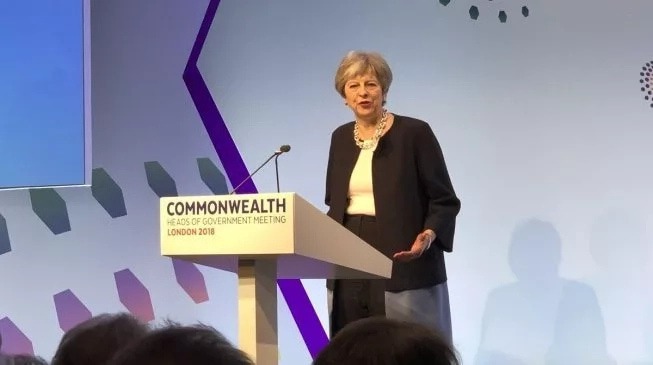
British Prime Minister Theresa May, has encouraged members of the Commonwealth of Nations to revoke what she called “outdated legislations” banning same-sex marriage. The Prime Minister, who spoke today, Tuesday at the Commonwealth Heads of Government Meeting (CHOGM), said that no one should make any law persecuting or discriminating against another person on account of who the person chooses to love, even as she pledged to support countries that are ready to revoke its anti-same sex law. She said that the world had moved from what it used to be in over 50 years ago, when people were dictated to, saying that nowadays, young persons design their own lifestyles and run their life affairs as they deem fit. Theresa May recalled that the last commonwealth meeting resolved to float an organisation to promote the interests of gays, lesbians, and transgenders, adding that three of such countries which had made such laws recently revoked their laws and advised others to emulate them. “Recent years have brought welcome progress. The three nations that have most recently decriminalised same-sex relationships are all Commonwealth members, and since the heads of government last met the Commonwealth has agreed to accredit its first organisation for lesbian, gay, bisexual and transgender people. “Yet there remains much to do. Nobody should face persecution or discrimination because of who they are or who they love. And the UK stands ready to support any Commonwealth member wanting to reform outdated legislation that makes such discrimination possible. “Because the world has changed. When, in 1953, the newly-crowned Queen Elizabeth set off on a tour of the Commonwealth, she travelled by air, sea and land on a journey that took more than five months. Today, many members of the Youth Forum have only ever known a time in which they can instantly converse with one another regardless of where in the world they live. “Unlike previous generations, today’s young people don’t need an organisation like the Commonwealth to connect them. They can build their own bridges, forge their own links, mastermind and run their own campaigns. “If the Commonwealth is to endure in such a world, we must demonstrate our relevance and purpose anew. We must show what the Commonwealth is capable of. And this summit can be the moment where that change begins to happen,” she said. May also stated that her country was investing £44 million for the purpose of improving the abilities of member-nations to independently curb any menace of natural disasters in their countries. Disclosing that 90 per cent of members are affected by the scourge of malaria, May also said the disease kills no fewer than 445,000 persons every year, pointing out that talks on legacies for children would remain a mirage if a disease which kills a child every two minutes is not decisively tackled. Against this background, she said the United Kingdom remained committed to the promise it made two years ago that it would yearly spend £500 million to fight the scourge of malaria among member-nations in five years. “We are only meeting in London this week because of the devastation wrought on Vanuatu by Cyclone Pam in 2015. The impact of other recent extreme weather events in the Caribbean and Pacific have underlined the vulnerability of smaller states across the Commonwealth. “So I am proud to say that the UK, long a supporter of such nations, is investing a further £44 million to help improve members’ ability to prepare for and deal with natural disasters of all kinds. It is an issue Prime Minister Holness and I have already spoken about this morning. “But extreme weather is not the only threat our people face from nature. Today, some 90 per cent of Commonwealth citizens live in countries where malaria is endemic. Worldwide, the disease kills 445,000 people every year, many in the Commonwealth and most of them children. Malaria has a serious impact on the economies of countries it affects. The human cost is incalculable. “We cannot talk to the young people of the world, talk about securing a legacy for our children and grandchildren, without tackling a disease that, worldwide, kills one of them every two minutes. That is why, this week, I will be calling on my fellow leaders to commit to halving malaria across the Commonwealth by 2023. “It is an ambitious goal, but one that is firmly within our reach. Since the Commonwealth Heads of Government last met, Sri Lanka has been declared malaria-free. Malaysia is on-course to eliminate the disease by 2020. And, since the year 2000, global malaria deaths have been cut by more than 60 per cent – the result of a concerted effort by governments, civil society groups, and individuals alike. “Bill, you and Melinda deserve particular praise for all the work you have done in the fight against this terrible disease. Your philanthropy has saved countless lives, and your tireless campaigning has kept the issue firmly on the global agenda, including at tomorrow’s Malaria Summit. “The UK remains committed to its five-year pledge, made in 2016, to spend half a billion pounds a year tackling malaria. Over the next two years £100 million of that will be match-funded by partners in the private sector. I know other Commonwealth nations are also among the biggest funders of this global effort,” May stated.
His Lordship Justice Binta Nyako at the Federal High Court sitting in the Federal Capital Territory last Friday, gave an instructive, landmark judgment in the matter between Mohammed Bello Adoke and the Attorney General of the Federation on the extent of Presidential powers.
I had addressed this particular subject in a previous essay titled “Obasanjo and the extent of presidential powers” (January 29, 2018) when President Obasanjo argued forcefully that President Muhammadu Buhari must be prepared to accept responsibility for the failings and failures of his government and stop blaming previous governments or political leaders. What Justice Binta Nyako has done in the suit titled FHC/ABJ/94/446/2017 re: Mohammed Adoke vs Attorney General of the Federation is to give a judicial stamp to the theoretical views expressed in that earlier essay and even an earlier one preceding it. I could not previously comment on the details of such matters before the court, in order not to run foul of the rules of contempt, ex facie curia, but it seems to me that Justice Binta Nyako with her ruling affirming the extent of presidential powers has enriched our jurisprudence. Except there is any earlier precedence under the 1999 Constitution, this must be taken as alocus classicus, and how it plays out in our jurisprudence should be of both theoretical and practical interest.
Further, Justice Binta Nyako has upheld the potency of Section 5 of the Constitution, which vests the powers of the President of Nigeria under the 1999 Constitution, in his person and not in institutions. The meaning here is clarified in Section 148 which allows the President to delegate his authority. Justice Binta Nyako ruled that where the President’s delegated authority is carried out lawfully and with consequent approvals, the person exercising that delegated authority is free of any liability. This is a technical point of law, which further establishes a trite point about the relationship between an agent and a principal. In this matter, Mohammed Bello Adoke is the agent and President Goodluck Jonathan and the Federal Government of Nigeria (of which Jonathan was Head of State and Head of Government) exercising powers granted under the Constitution, are the disclosed principals.
Nyako’s ruling is important in part, also, because following the displacement in 2015 of the then ruling Peoples Democratic Party (PDP) by the All Progressives Congress (APC), the new power brokers at the centre simply adopted the notion that anybody close to Jonathan must be corrupt. Even where and when they have plausible reasons for investigation, or prosecution, their partisan, accusatorial, selective, and vindictive approach has ruined what could otherwise have been a worthy governance issue. Making the fight against corruption look like an attempt to destroy Jonathan by all means has in the last one year backfired. Justice Nyako’s ruling of course has nothing to do with politics: it is about what the law says.
In the other matter of Colonel Sambo Dasuki, Jonathan’s National Security Adviser (NSA), for example, and in similar other matters involving President Jonathan’s agents, the defendant(s) simply need(s) to prove that he or she acted in line with the directives and approvals of the President and that would be the end of the matter. I should also add that members of the Buhari administration may in the future find themselves quoting this same Nyako ruling, except it is upturned, as the main cover available to them for lawfully carrying out Presidential directives. It is useful always when the Constitution is tested. It should therefore be seen as a good development that Section 5 of our 1999 Constitution is now being tested, given the enormous powers at the disposal of the Nigerian President and his agents.
Mohammed Bello Adoke wherever he may be, must be happy with the outcome of this case that he instituted on the extent of presidential powers. I know him – we served in the same government – and I know he has been on self-imposed exile, away from the unhealthy political environment imposed by the ruling APC. Adoke has also been the target of all kinds of charges, obviously the effect of the attempt by the ruling APC to denigrate some of the shining stars in the Jonathan government. Adoke was definitely a shining star, one of the many who were in the Jonathan government: men and women who not only boasted of first-rate education, but who were internationally regarded for their talents and accomplishments. At the risk of sounding like someone who was involved, and probably making a passionate assessment, I will like to throw up a point: that in the last 35 years or so, President Ibrahim Babangida, President Olusegun Obasanjo and President Goodluck Jonathan recruited into the Federal Government at all levels some of the best and the brightest that Nigeria has ever offered. What each one of these three political leaders did or achieved with the talents at their disposal, however, or the quality of their individual efforts, is something we can debate.
Back to Adoke: whatever the state may be afflicting him with today, I can attest that he was an asset to the Jonathan government and an asset to the Nigerian state itself. The substantive issue before Justice Binta Nyako was the Constitutional interpretation of Sections 5(1), 147, 148 and 150 of the 1999 Constitution but underlying it is the matter of OPL 245 or what is more popularly known as the Malabu Oil deal, and Attorney-General Mohammed Bello Adoke’s role. The Malabu oil deal is a case that spans the life-time of five successive governments – from Abacha to Abdusalami to Obasanjo to Yar’Adua to Jonathan but only the last phase of it is the subject of the Buhari government’s interest. What is the role of previous governments and Presidents and their agents?
In many press releases, Mohammed Bello Adoke who was Jonathan’s Attorney-General insisted that he acted based on Presidential directives and that he did no wrong and that if anything, he helped Nigeria to retrieve money and save litigation costs. It is noteworthy that some currently serving public officials are trying to pay something even higher for that same transaction that has since been paid for, completed and closed. Nigeria owes Kemi Adeosun, the current Minister of Finance, a debt of gratitude for blocking that curious attempt to obtain from the Nigerian Government under false pretence, and M.B. Adoke for acting in accordance with the law as affirmed by Justice Binta Nyako’s court.
Nyako’s court gave declaratory orders, which I hope the Federal Government will respect. Should the contrary be the case, the present Attorney-General, Abubakar Malami, whose office is already in danger of being accused of persecution of political opponents, has the option of testing the Constitution further. It will be clearly within his prerogative to do so and a plus for our jurisprudence. But let him note this: the position of the Attorney-General of the Federation and Minister of Justice is a constitutional position, perhaps the only Ministerial position that is so expressly recognized. This is probably the same reason why everyone who occupies that position must be concerned about his or her legacy. Her- yes- Nigeria is yet to appoint a female Attorney-General of the Federation and Minister of Justice but it should happen someday in the future. What will be Malami’s legacy as Attorney General of the Federation and Minister of Justice?
I mentioned earlier that I worked with Mohammed Bello Adoke. He was a very influential man in the Jonathan government. He was so involved that he even occasionally wrote drafts of presidential speeches, and I had to warn him to focus on the law and not dabble into the work of night-soil men. His usual defence was that he was only concerned about matters of the law, and he needed to be sure that his principal, his favourite name for President Jonathan, did not violate the Constitution. He distanced himself from politics, because in his view, an Attorney-General of the Federation must be non-partisan. “I am a Constitutional purist”, he always said and “my job is to ensure that the President acts in accordance with the laws of Nigeria.” President Jonathan had many officers like that who would insist on their professionalism, and their understanding of rules, best practices, and standards. Their story, individually and collectively, will be told.
In Adoke’s case, the fact that he is now on self-imposed exile, and his political persecution, draw attention away from his outstanding achievements as Attorney General and Minister of Justice. It was under his watch that the Freedom of Information Law was passed in 2011, and the Administration of Criminal Justice Act in 2015 – two laws that are now being used to prosecute cases against the same government and the same persons that made them! Mohammed Adoke was leader of the Nigerian delegation to the Nigeria-Cameroon Boundary Commission and leader of the same delegation to the follow-up committee on the UN implementation of the Green Tree Agreement that brought the ICJ judgment on the Bakassi peninsula to a peaceful resolution. He also presided over the reform of the Evidence Act, 2011, and the Terrorism Prevention Act of 2011, and its 2013 amendment. He was elected during this period as a member of the International Law Commission- a United Nations body of selected 34 experts across the world.
President Jonathan, given his respect for the law and due process, regularly sought Adoke’s counsel. Adoke’s tongue is sweet-coated but when it comes to matters of the law, he removes the sugar and says it as it is. President Jonathan respected him for that. When the Federal Executive Council decided to impose a state of emergency in parts of the North East, in the wake of the Chibok girls’ crisis, and there were complaints about the failure of the Governors in that part of the country, there was a demand that the Governors should be removed. Adoke put his feet down. He said a state of emergency could be declared but it would be unconstitutional to displace the political authorities. Some other lawyers in the Cabinet, holding other portfolios insisted that President Olusegun Obasanjo, during his tenure, declared a state of emergency in two states and removed the Governors. Adoke argued that Obasanjo was wrong and that such precedents could not stand. He won the argument. The Governors in the North East kept their seats, but a state of emergency was declared.
When Nyesom Wike was to be sworn in as Governor of Rivers state, there was no Chief Judge of Rivers State in office. Adoke had to argue that a Chief Judge from a neighbouring state could do the job. And that was what happened. When Adams Oshiomhole as Governor of Edo State wanted to sign death penalty warrants for condemned persons in his state, Mr. Adoke had to remind Edo State that the Nigerian Government was on a self-imposed moratorium on the death penalty. This brought him in conflict with the then Edo State Governor. He held his ground. Oshiomhole signed the warrants anyway. Adoke understood the powers of his office and he hid under the purity of the law to exercise those powers.
But for all that he has done for Nigeria, it is unfortunate that the only thing many know about him is OPL 245. That is just the way it is in our country. We destroy, persecute and humiliate our best talents, for nothing other than political reasons. But the judiciary is gradually finding its voice and standing up in the defence of the law and the rights of persons (see Reuben Abati, “Judges, the law and our democracy”, ThisDay, back-page, February 20, 2018). The ruling by His Lordship Justice Binta Nyako is the latest in this regard. Whatever the colour of the party in power, the judiciary remains the last hope of the common man, the aggrieved and the victim of persecution. In a country where noise is more important than reason, where allegations are packaged as truth, and villains behave like victims, the judiciary should always seek to remain the voice of reason, truth, justice, equity and good conscience – against all odds.
The national leader of the ruling All Progressives Congress (APC), Asiwaju Bola Ahmed Tinubu has said that Nigeria is now going through an era in which the bad is in contention with the good.
“Our nation resides in a period of historic transition. We struggle to give birth to a better Nigeria. This also means we struggle to eject the malpractices of the past. That which is good contests against that which is not.
“This contest has a high moral content and it is here that we turn to Aminu Kano for inspiration. For it is here that Aminu Kano set the path we must follow.”
Asiwaju Tinubu, who was Lagos State governor, spoke today, Tuesday, at the 35th annual Aminu Kano Memorial symposium, themed: “Democratic Governance and the Imperatives of Party Ideology and Supremacy.”
He stressed that Aminu Kano, who he described as ‘great man’ could have lived an easy life by exploiting for selfish objectives all the opportunities opened to a man of his great abilities and social station.
“Instead, he devoted himself to the welfare of the people. He took the harder path because it was the true and correct one. As Aminu Kano did, we must do!”
Tinubu insisted that the spirit of “this great man must guide more than our deliberations here today. That spirit must direct our political intercourse and actions.
“If we do so, we shall come to the realization that Democratic Governance is more than going through the motions of mimicking certain processes and functions that have been deemed to connote democracy.
“We must come to a better understanding of the moral and social principles that underlie these processes and functions. The existence of parties and of elections does not of itself mean democracy is present. For form without substance is but an empty box, a hollow gift, not worth the giving.
“Democratic governance must not only stick to proper form, it must bear proper fruits.
It must work for the betterment of the people and give them the chance to realize the best of their individual and collective aspirations in an atmosphere of peace, justice, and fair enterprise.”
The APC leader noted that this is what sets apart the current administration from prior governments of that other party, adding that the APC government may, at times be, imperfect in fulfilling the spirit of Aminu Kano “but we are far from the PDP, which has perfected the malign craft of giving selfish ambition primacy over the public good.”
He said that the Buhari government has spent inordinate time cleaning the rot and plugging the holes in the corrupt system the others had institutionalized as their strategic policy and national direction.
Tinubu added that the APC has been working to steer the national ship from this awful direction “in order that we may bring the people and their welfare into safe harbor.
“Had the billions of dollars and trillions of naira that were stolen by past governments been used for the people, the nation would have been able to acquire the infrastructure and implement the programs that bring greater development and economic justice to all.
“Instead, the select few ate more than their bellies could contain. Distorting the cause of justice and hijacking the means of national welfare, they wildly enriched themselves and left the average Nigerian to dine on the passing wind.
“Due to the drop in oil prices, this administration has had less money than those, which preceded it. However, it has done more with less.
“The government has launched school feeding and stipend programs for the poorest among us. These programs have enabled millions to eat at least one solid meal a day and for countless children to attend to their education instead of allowing the world to pass them by at an early age.
“The programs have also increased local economic activity by boosting consumer demand. These things were done with the welfare of the people in mind.
“When someone can do for you in three years what another did not even try in sixteen, any person with an open eye can see the difference between giver and taker, between friend and thief.
“Of course, more needs to be done. I envision a time of even bolder action that modernises national infrastructure, implements an industrial plan that revives the textile sector and builds new industries, agricultural reform that provides farmers minimum incomes and greater access to credit, mortgage reform that opens the door to affordable housing for millions of families, pension reform that insulates our aged from poverty and an expansion of the school feeding into every state and local government.
“With regard to Party Ideology and Supremacy, let me state that ideology and principle must hold supremacy over supremacy. I think Mallam Aminu Kano would have said the same thing in this regard.
“Calling for party supremacy by and for its own sake is nothing but an invitation for people to install and then perpetuate themselves in positions of authority in the party. They will arrogate power so that they come to dictate to the rest of the party instead of serving the collective will of party members.
“Recent events in our party confirm this observation. Party discipline is vital but even more vital is adherence to humane and democratic ideals and principles.
“With such principles, a party exercises internal democracy, which better enables it to govern democratically.
“Without such adherence, a party becomes a vehicle to lord over its members instead of a tool to empower its members to realize good and beneficial aims.
“We must always remember that the political party is meant to serve the people and not the people to serve the party.”
We use cookies on our website to give you the most relevant experience by remembering your preferences and repeat visits. By clicking “Accept”, you consent to the use of ALL the cookies.
This website uses cookies to improve your experience while you navigate through the website. Out of these, the cookies that are categorized as necessary are stored on your browser as they are essential for the working of basic functionalities of the website. We also use third-party cookies that help us analyze and understand how you use this website. These cookies will be stored in your browser only with your consent. You also have the option to opt-out of these cookies. But opting out of some of these cookies may affect your browsing experience.
Necessary cookies are absolutely essential for the website to function properly. This category only includes cookies that ensures basic functionalities and security features of the website. These cookies do not store any personal information.
Any cookies that may not be particularly necessary for the website to function and is used specifically to collect user personal data via analytics, ads, other embedded contents are termed as non-necessary cookies. It is mandatory to procure user consent prior to running these cookies on your website.


 Police arrested Senator Ovie Omo Agege over the invasion of the Senate Chamber by some hoodlums who ran away with the Mace, the symbol of authority. Senator Omo Agege, who allegedly led the hoodlums is being made to return the Mace within 24 hours.
 The Senate has asked the security to arrest suspended Senator Ovie Omo-Agege and some hoodlums he allegedly led into the Senate plenary to seize the Mace which is the symbol of authority of the Upper Legislative Chamber.
 The International Monetary Fund (IMF) has hailed the rapid growth of the Nigeria’s economy, predicting that it would hit 2.1 percent growth towards the end of this year.
 The House of Representative has commenced a process towards stopping the electricity Distribution Companies (DisCos) from cheating consumers through billing for the electricity they never consumed.