The Federal Government has made a move to establish a new university for the Nigerian Army in Biu, Borno State.
Th move was approved today by the Federal Executive Council (FEC) at its meeting, wth Vice President Yemi Osinbajo presiding.
The Minister of Education, Adamu Adamu had presented a memo to the FEC on the University.
The Chief of Army Staff, Lieutenant General Tukur Buratai had earlier in March, announced that the Nigerian Army will upgrade the Institute of Technology and Environmental Studies to a full-fledged University of Technology and Environmental Studies. [myad]
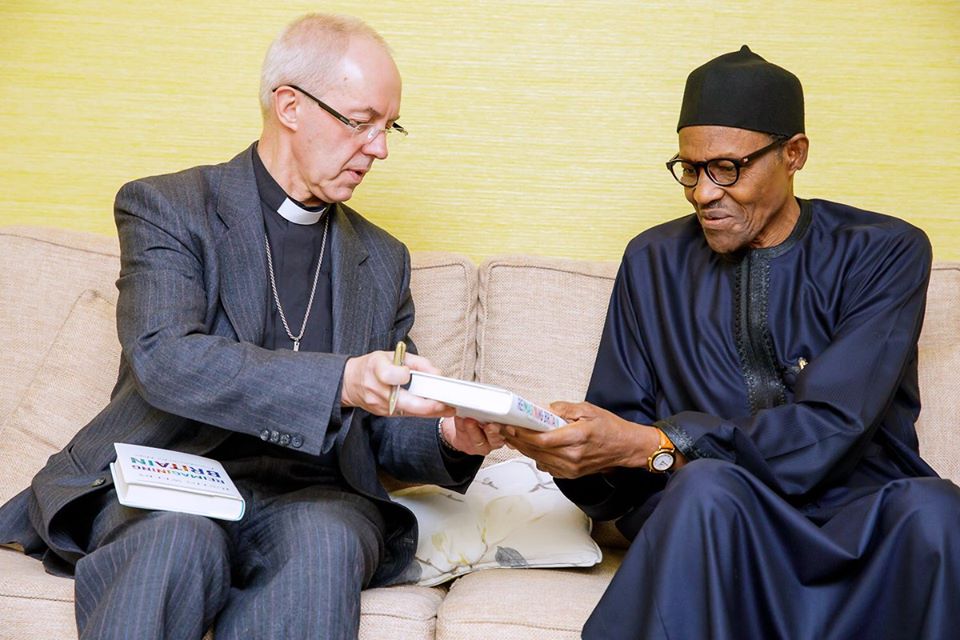
President Muhammadu Buhari receiving a gift from Archbishop of Canterbury, Archbishop Justin Welby at the Abuja House in London
The Archbishop of Canterbury, His Grace Justin Welby, has assured President Muhammadu Buhari in London that he has his best wishes on his move to contest the 2019 Presidential election for his second term in office.
The Archbishop, who visited the President today, Wednesday in London, said: “you have my best wishes on your recent decision. I read your declaration speech. We are neutral as a church, but we will pray for you. Great statesmen are those who run for the good of their country. We will be praying for you.”
Grace Justin Welby, who presented President Buhari with a copy of his recent book: ‘Reimagining Britain. Foundations for Hope,’ confessed that it is always a delight for him to see President Buhari, “whom I have tremendous respect for.”
Responding, President Buhari said that he declared his intention to run for another term in office on Monday, April 9, during the National Executive Committee (NEC) meeting of the All Progressives Congress (APC) to put the rest agitations in many quarters for him to go for second term.
“I declared before leaving home because Nigerians were talking too much about whether I would run or not. So, I felt I should break the ice. We have many things to focus on, like security, agriculture, economy, anti-corruption, and many others. We needed to concentrate on them, and politics should not be a distraction. The majority of Nigerians appreciate what we are doing, and that is why I am re-contesting.”
The President recounted some successes of the administration to his guest, with whom he has built a deep friendship in recent times, and was quite particular about strides in agriculture.
“We have cut the importation of rice by about 90%, saving billions of dollars in the process. People who rushed into petrol money have now gone back to agriculture. Even professionals have gone back to the land. Nigeria should be able to feed itself comfortably soon. I am so pleased.”
The President stressed the need for continuous education of the people on the issue of war against insurgency, adding that such education would free them from religious manipulation.
He emphasized that there is no true religion that advocates the hurting or killing of the innocent even as he said that the problem of farmers/herdsmen clashes predated his government.
“It has always been there, but now made worse by the influx of armed gunmen from the Sahel region into different parts of the West African sub-region. These gunmen were trained and armed by Muammar Gadaffi of Libya. When he was killed, the gunmen escaped with their arms. We encountered some of them fighting with Boko Haram. Herdsmen that we used to know carried only sticks and maybe a cutlass to clear the way, but these ones now carry sophisticated weapons. The problem is not religious, but sociological and economic. But we are working on solutions.”
President Buhari blamed “irresponsible politics” for the farmers/herders’ crisis, even as he assured that enduring solutions would be found, and justice done to all concerned.
On Leah Sharibu, the schoolgirl from Dapchi still being held by insurgents, reportedly because she refused to renounce her Christian faith, the President said: “we are managing the matter quietly. Making noise would not help. We are collecting as much intelligence as possible, working with the Red Cross and other international organizations. There are too many fraudulent people around, who claim they can do this and that. We won’t deal with them. That was how we got the Dapchi girls back, and the Chibok girls.”
A negligible number of Nigerians in Diaspora, who are supposed to be a bundle of enlightened species, residing in civilized country, today, Tuesday, gathered in front of Nigerian Embassy building in London protesting what is clearly about democracy back in Nigeria.
They rented the air with a chorus ‘Buhari must go’ for reasons which only Nigerians in Nigeria can handle by voting him out come 2019. The protesters complained about the farmers/herdsmen clashes in Nigeria, cost of food stuffs in Nigerian markets, scarcity or high cost of petroleum products amongst others.
Of course, people in Nigeria are aware of such complains, and many have explained that most of such challenges were inherited by the government of President Buhari. Even if it is his government that created and festered the problems, today’s civilization still does not make the London protesters civilized set of people in modern world.
As a matter of fact, President Buhari is not known to have violated Nigerian constitution and or his party’s constitution by declaring to contest the 2019 Presidential election to complete his second term in office. Indeed, those who are protesting in foreign land against the President are the ones that should check their consciences, as to whether where they are protesting is the right place and for that matter, the reason for their protest is genuine.
It is only in those dark days of the world that none civilized members of the local society would carry out such an action and could be excused for their ignorance.
For, if Buhari and his government are not doing well or have even run down the country in all facets, it is only the electorates, in a democracy being practiced, back in Nigeria that can send him packing through their votes, just like it was done to Dr. Goodluck Jonathan in 2015, and is being done to some other African leaders in the recent past.
By staging a protest in London, asking Buhari to go, those Nigerians in Diaspora have come out to show that they are mercenaries or hired political thugs to embarrass the President who has done no more harm to Nigeria than those before him; those past leaders were allowed to breathe well, even when some of them sought to elongate their tenures beyond either the constitutional requirement or human expectations.
And more importantly, they are disgracing Nigeria in the foreign land; the foreign land whose citizens know and understand how best to kick out bad leaders without making noise about it. Or are they saying that by merely asking Buhari to ‘go’ he would return to Nigeria early this week and leave government…so that their corrupt sponsors would return to pounce on the treasury of the nation and resume the ‘business as usual?’
Honestly, I never knew there are these kinds of cheap Nigerians living in such highly respected country. They are too cheap, dirty, uncivilized, archaic, downright silly and apparently sell-outs.
I just finished reading a syndicated story in some online news portals of April 9, 2018 with the headline: “Abacha Loot: Adeosun blocks $17m dubious payment to Malami’s lawyers.”
From the headline, the objective of the report was clear: to assert that the payment of $17 million to the lawyers that the Attorney General of the Federation and Minister of Justice, Mr. Abubakar Malami (SAN), engaged as consultants to complete the process of repatriation of the $321 million Abacha loot confiscated by the Swiss government, was tantamount to re-looting the loot.
According to the report, the Minister of Finance, Kemi Adeosun, has refused to approve the payment. In addition, she was reported to have written “a strong-worded letter to President Muhammadu Buhari to raise objections to the payment following revelations on the suspected sleaze.” These are just claims. But in as much as the veracity of the claims and the report is rebuttable, I think it is important that the Ministry of Finance and the office of the Attorney General of the Federation and Minister of Justice should quickly come clean on the issue in the interest of the public and the nation.
One cannot take the claim in the report that the payment is dubious hook-line-and sinker as the evangelical truth until the Nigerian Government says so. Therefore, this may just be an imprudent campaign of calumny to discredit the Minister of Justice and Attorney General of the Federation, Mr. Malami (SAN), lawyers that were engaged in the repatriation of the fund and the entire process itself. Interestingly, the report in another area referred to what it called “suspected sleaze”. Again, what that means is that the writer is not sure yet that the transaction was sleazy or he was probably trying to play safe.
Noticeably, the pieces of information contained in the report are not entirely new. A greater part has been a rehash in the past few weeks of a syndication in some sections of the media, possibly, in furtherance of some ends. What, however, appears new is the reported claim that the Swiss lawyer, Enrico Monfrini, who started the process of tracing, confiscation and repatriation of the looted funds since 1999, that he did not ask the Nigerian government for additional fees to complete the process of repatriating the $321 million.
Whereas, his alleged request for a fresh 20 percent professional fees on the money and his refusal to accept five percent that the Nigerian government was ready to pay, was the reason Malami engaged the services of two Nigerian lawyers, Mr. Oladipo Okpeseyi (SAN) and Temitope Adebayo to complete the process of the repatriation of the remaining $321 million from Switzerland; Monfrini’s purported response in the report that he did not make any such request must be subjected to further confirmation and interrogation.
What could be deduced from the purported Monfrini’s statement is that he had been paid his fees by the federal government. If he had been paid his fee, why did he not complete the process? Consider his purported e-mail response to an enquiry: “I never had the audacity to claim for additional fees. This figure of 20% is simply invented. I didn’t reject any proposal made by Mr. Malami since my fees were already paid a long time before Mr. Malami’s appointment as attorney general….
“The repatriation of the $321 million was not completed by me. It’s a matter which is normally dealt between governments and which doesn’t entail the engagement of lawyers. I have no idea of the whereabouts of these $321 million. I know that they have been restituted to Nigeria by the Swiss government a few months ago. On the other hand, I don’t know why it took about three years for the two governments to agree that said restitution should be monitored by World Bank since this concept was created by me some 15 years ago.”
A careful deconstruction of Monfrini’s statements brings out some salient points, to wit: one, that Malami did not make any proposal to him; two, that the repatriation of the $321 million was not completed by him; three, that it is a matter which is normally dealt with between governments and which does not entail the engagement of lawyers; and fourth, that he did not know why it took about three years for the two governments to agree that the said restitution should be monitored by World Bank.
Now, to rebut Monfrini’s claim, it behoves Malami to provide documents evidencing offer and counter offer. This is the time to go beyond Monfrini’s words. That will clear the fog on that aspect. If according to Monfrini, the repatriation of the $321 million was not completed by him, it means he did not complete the transaction for which he had been paid. Why did he keep mute when he realized that his assignment had been determined unceremoniously? That questions Monfrini’s integrity. He should have taken steps to advert the attention of the Swiss government, Nigerian government and the World Bank to the development to safeguard due process.
So from Monfrini’s admittance that he did not complete the process, it could be inferred that some other persons completed the process. From an earlier article I read on this issue, it was clear that the team of legal consultants led by Dipo Okpeseyi (SAN) helped to complete the process. They reportedly provided the services that conduced to the proposition and vetting of additional documents to the MoU listing the social safety net projects that the repatriated fund would be spent on under the monitoring of the World Bank. And this perhaps answers Monfrini’s poser as to why it took about three years for the Swiss and Nigerian governments to agree that the said restitution should be monitored by the World Bank. The World Bank, as reported, did not sanction the first set of proposed projects.
Clearly Monfrini was not on top of the process. If he was, he would have collaborated properly with the former Attorney General of the Federation and Minister of Justice, Mr. Mohammed Bello Adoke with whom he enjoyed a cordial working relationship to vet the MoU to accord with the proposed projects that the World Bank actually believed would be in the interest of the country and her citizens. The Swiss government and World Bank’s interest is the judicious use of the repatriated fund.
Working in concert with Malami on the final process, Okpeseyi (SAN) had reportedly ensured that the needful was done and the proposed projects accorded with the provisions of the MoU. This is what legal guidance and tying up of loose ends in the Swiss legal jurisdiction entailed. The Nigerian government was convinced it needed the services of legal consultants. That was the reason Malami engaged Okpeseyi and co. They had offered services on an agreed payment term, which I believe the Nigerian government should keep to. That cannot amount to re-looting the Abacha loot. It is payment for services rendered.
There is also nothing curious about engaging Okpeseyi and Adebayo who happened to be Muhammadu Buhari’s lawyers in the 2011 presidential election petition that terminated at the Supreme Court. Buhari was then the candidate of Congress for Progressive Change (CPC) while Malami was the party’s Legal Adviser. The innuendo of pecuniary interest as insinuated in the report is rebuttable. Maybe the reporter expected Malami to engage the lawyers that represented the former President Goodluck Jonathan who was the candidate of the Peoples Democratic Party (PDP). That would be stupidly patronizing and empowering the enemies.
In rounding off, I propose that the Federal Government should quickly wade into the issues arising to ensure that nothing was amiss in the process of repatriating the $321 million Abacha loot from Switzerland. And if there is any mischief, the federal government has the capacity to cure such in the national interest.
·Ayelabowo, a public affairs analyst, contributed this piece from Ibadan.
“Who is OBJ? OBJ is not God. IBB is not God. Obasanjo was President here; he wanted a third term and he didn’t get it.”
These were the reactions of Nigeria’s Minister of Communications, Barrister Adebayo Shittu, when he spoke to News Agency of Nigeria on the declaration by President Muhammadu Buhari yesterday, Monday, to run for second term as President of the country in the 2019 election.
Adebayo Shittu said that since the former Nigerian leaders “are not God, there should be no apprehension. I want to assure Nigerians that by the grace of God, Mohammadu Buhari will become president the second time.” he said that what President Buhari did yesterday, Monday, “we had done that much back on his behalf; that is the Muhammadu Buhari/Osinbajo Dynamic Support Group. “So what he did yesterday was just a follow-up to what we had done about three months ago. “The president has distinguished himself as his achievement in three years had surpassed what the Peoples Democratic Party (PDP) for Nigeria in 15 years. “For instance in the area of job creation for youths, no government has ever in one day employed 200, 000 graduates. It has never happened but under Buhari N-Power it happened. “Through this, he has provided jobs for 200, 000 families spread across the length and breadth of Nigeria. “Government is still processing the employment of 300, 000 more graduates to make it 500, 000, this has never happened. “In the areas of transport, works and housing, the last budget of the PDP government was less than N20 billion and most of these monies were stolen; diverted to private pockets. “In 2017 alone, the Buhari government spent N255 billion on those subject matters; transport, works and housing. So how do you compare? “Today, government is also building new roads across the South East states with 100 million dollars SUKUK loan; non-interest loan from Islamic Development Bank. “For the first time, government is building new railway from Lagos to Kano, from Kano to Maiduguri, from Maiduguri to Calabar and from Calabar to Lagos. So the records are there.”
File photo: Members of IPOB during a protest in Anambra
The Indigenous People of Biafra (IPOB) has said that the decision of President Muhammadu Buhari to run for a second term in office is welcome vowing to realize the Biafran Republic they have been agitating for before he completes his se second tenure.
In a statement today, Tuesday, the group said: “IPOB worldwide view the decision of the bearer and custodians of the name Muhammadu Buhari to seek re-election in 2019 as a welcome development. We have always maintained that the rebirth of Biafra will happen under Buhari or under whoever is answering to his name.”
“No doubt we have lost a lot of people under the brutality of this terror APC regime, we also have many innocent citizens in prison and detention facilities across Nigeria with countless miscarriages of justice in their law courts but we remain undeterred, focused and determined.
“Like Israelites in Egypt, Jews in Europe and Germany, blacks in apartheid South Africa, no amount of tribulation will stop us from emerging victorious as a free people at the end of this process.”
The statement, signed by the publicity secretary of IPOB, Emma Powerful, the group said: “the second coming of Buhari portends goodwill for freedom lovers because God wants to fulfill his divine purpose in the life of Biafrans in 2019 as foretold by its leader, Nnamdi Kanu many years ago.
IPOB said that its leader had earlier prophesied that Biafra would be realized under Buhari, and since the tenure of the president was already winding down, his re-election bid would be a welcome development.
“We urge our brethren in the Middle Belt and Western Nigeria not to give up or capitulate in this our collective quest to free our people from the shackles of caliphate domination and creeping Islamisation.
“At IPOB, we are continuing the intensification of our global campaign to peacefully bring the existence of this disastrous colonial experiment called Nigeria to an end, in order that millions of innocent lives may be saved.
“We are advising Biafrans and other ethnic nationalities in Nigeria seeking to be free from this contraption created by Fredrick Luggard the British mercenary, to remain mentally strong and resolute for what is about to come will test our collective resolve.”
“IPOB will not relent in its pursuit for total liberation of all territories presently under Arewa feudal Islamic bondage regardless of the human and material cost. The continued existence of this disastrous APC Government led by Major General Muhammadu Buhari and his Fulani cabal, is our passport to freedom.”
Chief of Nigerian Army Staff, Lieutenant General Tukur Yusuf Buratai has threatened to henceforth hold commanders responsible for lapses that have become very noticeable in recent times during the operations of troops in war against insurgents and other criminals in the country.
The army chief, who spoke at the First Quarter Conference in Abuja, stressed that the need to review the conduct of Nigerian Army operations across the country “in view of lapses recently observed among commanders.
“Some of the lapses observed can be partly attributed to indecisiveness when faced with obvious challenges. Hence, the attitude of commanders in the field must change, especially towards decision making and taking appropriate action in line with the Rules of Engagements.
“In this regard, issues of murder, arson and other serious crimes perpetrated by ethnic and local militias, criminals and miscreants must be dealt with decisively. Commanders would be held responsible for any lapses arising from their actions or inaction.
“I have directed the CTOP (A) to set up a high powered team to review all our operations especially where lapses have been observed in order to bring to book all those involved in such cases.”
He recalled that very recently, concerns have been raised by individuals and groups alike about the actions carried out by some units and formations in the course of operations which he said led to very strong comments and criticisms against the Nigerian Army.
“Some of the strongest comments have come from key citizens in Taraba State. In this regard, I have set up a panel to investigate some of the allegations that have been made, particularly with regards to operations in Taraba State. The panel was tasked to ascertain the veracity of the statements made and the true situation of things in the State. Nonetheless, we must put in more effort to improve our relations with civilians and the citizenry at large through better narratives and media operations. General Buratai insisted that army would continue to chart progressive paths towards tackling the security challenges confronting the nation, adding that he had already instructed that attention must be given to ongoing operations in various parts of the country to ensure that security threats are dealt with decisively. According to him, in this era of political and social transformation, the army would remain steadfast in carrying out its constitutional roles as well as providing aid to civil authority, saying that his vision for the Nigerian Army, which is “To Have a Professionally Responsive Nigerian Army in the Discharge of its Constitutional Roles” is geared towards ensuring a safer environment for development and socio-economic activities to thrive in the country.
“We must ensure that we conduct ourselves professionally and respond adequately to threats against our nation in accordance with our constitutional roles. He recalled the successes achieved by troops in the ongoing operations, particularly Op LAFIYA DOLE, even as he urged the troops to replicate the same by working with other services and security agencies to deal decisively with other security challenges such as farmers-herdsmen clashes, armed banditry, cattle rustling, kidnapping, pipeline vandalism, militant activities among other violent crimes. He reminded them that the unity and integrity of Nigeria lies on the military and the Nigerian Army in particular, saying that any act inimical to the unity and integrity of this country by personnel of the army will be decisively dealt with.
“The NA must remain apolitical and professionally responsive in the discharge of its constitutional roles. GOCs and Field Commanders at all levels are, therefore, warned that anyone that runs foul of his professional ethics will be appropriately dealt with. You are all enjoined to continue to remind officers and soldiers under command to remain non-partisan and be guided by the stipulated code of conduct and rules of engagement in the discharge of their duties particularly in the coming 2019 General Elections. Furthermore, NA personnel in any capacity who receives any form of inducement from politicians, public or private entities, knowingly or unknowingly will be severely punished. Both the giver and taker of such inducement will be investigated and appropriately sanctioned. “I have directed for a Special Standing Court Martial to be set up in preparation for the coming 2019 elections. I must warn that any NA personnel found hobnobbing with politicians or being partisan will be investigated and sent to the Special Standing Court Martial. I must state clearly that any officer or soldier who wishes to be sympathetic to a political, religious or ethnic group should voluntarily retire from the NA. Furthermore, all are reminded on the ban on any form of worship outside the barracks except those permitted for wedding and other social functions. Therefore, officers and soldiers must restrain themselves from any act of political, religious or ethnic patronisation as these would attract severe consequences. The fate of the 38 officers who were retired is still fresh in our memories. “I am quite aware of the logistics constraints affecting the sustainability of our operations across the country particularly Op LAFIYA DOLE. I want to assure you that a robust and comprehensive procurement plan is in place in the Year 2018 Budget. However, the effective implementation of the procurement plan is subject to budget releases. I, therefore, want to emphasize that personal clothing, protective gears, additional equipment/platforms, accommodation, welfare and other logistics provisions would be my top priority in the procurement plan this year. “In line with the Federal Government’s drive to boost local content and patronage, the NA is collaborating with indigenous companies in the local production of vehicles, weapon and equipment spares as well as combat materiel. The companies include Innoson Vehicle Motors, Proforce Nigeria Limited and Nigerian Machine Tools amongst others. This is aimed at boosting local production and enhancing our growing military industrial complex.”
Bauchi State Police Command has said that its men and officers have killed three armed robbers in one fell swoop after a gun battle that lasted some minutes.
A statement by the Command’s spokesman, DSP Kamal Datti Abubakar said that the operation was carried out by combined team of Inspector General of Police Monitoring Unit in conjunction with a renowned hunter, Alhaji Ali Kwara, acting on credible intelligence.
The statement said that the security operatives trailed the suspects to Maladunba forest in Misau local government area as they were planning to attack unsuspecting members of the public.
It said that on sighting the team, the suspects engaged them on fierce shoot out which lasted for some minutes, adding that as a result, the three suspected armed robbers sustained fatal injuries and were taken to General Hospital Misau where a medical Doctor certified them dead. The statement listed items recovered from the suspects to include three AK47 riffles,. One locally made fabricated double barrel gun, two hundred and ten live ammunition of 7.62mm caliber, six cartridges of double barrel gun, three empty magazines of AK47 riffle, one Golf 3 wagon operational vehicle, silver in colour with registration number AH 471 GWA, one cutlass, two pairs of Police uniform and the sum of sixteen thousand nine hundred naira. The police said that the case is under investigation even as it also announced the recovery of 83 prohibited/illegal firearms and 702 live ammunition from suspected criminals and persons that voluntarily surrendered their firearms to the Command. They include 30 AK47 rifles, one AK49 riffle, 20 fabricated guns, five single barrel guns, two double guns, four pumps action guns, one K2 riffle, 20 pistols, 702 live ammunition and 70 cartridges. The Bauchi police Command called on individuals and groups who are yet to surrender Prohibited/Illegal firearms in their possession to take advantage of the extension of ultimatum approved by the IGP and surrender such firearms to it.
“The Command equally calls on the general public to avail the Police with useful information on persons in possession of firearms or where such firearms are kept or any information that will assist the Command in the fight against crime.”
The United States Senate Judiciary and Commerce Committees have embarked on enquiries against Facebook Chief Executive Officer (CEO) and co-founder Mark Zuckerberg over the Facebook’s (FB) role in the latest Cambridge Analytica scandal, Russian activity in the 2016 U.S. presidential election and users’ data and privacy in general.
Zuckerberg is also scheduled to appear before the U.S. House Energy and Commerce Committees tomorrow, Wednesday to discuss to answer queries on the same issue. A senior senator from Florida, Sen. Bill Nelson, said before the Facebook chief executive: “if you and other social media companies don’t get your act together, none of us are going to have privacy anymore.” Zuckerberg had initially stuck closely to his prepared remarks, which were released Monday, saying: “just recently, we’ve seen the #metoo movement and the March for Our Lives, organized, at least in part, on Facebook. After Hurricane Harvey, people raised more than $20 million for relief.”
In the prepared speech, Zuckerberg went on: “and more than 70 million small businesses now use Facebook to grow and create jobs. But it’s clear now that we didn’t do enough to prevent these tools from being used for harm as well. That goes for fake news, foreign interference in elections, and hate speech, as well as developers and data privacy. We didn’t take a broad enough view of our responsibility, and that was a big mistake. It was my mistake, and I’m sorry. I started Facebook, I run it, and I’m responsible for what happens here.” During the Senate Judiciary and Commerce Committees’ back-and-forth with Facebook’s chief executive, Zuckerberg emphasized his goal of informing users about the different ways in which in their data could be used.
He also discussed the challenges of balancing being explicit with privacy policies with making those same policies simple and accessible enough for users to understand. Zuckerberg also discussed how much Facebook has evolved since he started the social network from his Havard dorm room in 2004. Back then, when Facebook was an exclusive, college-only social network, policing content was a matter of having Facebook users flag content to be taken down. Flash-forward 14 years, however, and Zuckerberg emphasized such methods simply aren’t enough. “What I think we’ve learned now … is that we need to take a proactive broader role,” Zuckerberg explained. We need to take a more proactive role in policing the ecosystem and making sure members of the community are using the ecosystem in a way that is healthy.” To wit, Zuckerberg explained that some of the measures Facebook is taking to thwart future activity from bad actors. The social network is using artificial intelligence, for instance, to identify classes of bad activity and flag it to Facebook, and by the end of 2018, Facebook will employ over 20,000 people focused on security and reviewing content. Zuckerberg’s two-day appearance follows a number of media appearances and press calls where he apologized and admitted mistakes in the Cambridge Analytica scandal, which involved the improper release of personal information of as many as 87 million users to the political consultant. The admission contrasts his previous response to the manipulation of Facebook’s platform for political purposes during the 2016 elections. At that time, Zuckerberg denied that Facebook was helping to deliver “fake news.” Now that Zuckerberg is addressing that there is a problem and even outlined steps that Facebook is taking to protect user data, the company may be able to make it through this rough patch. On Monday, Facebook also announced that it would be notifying users via their news feed if their data was compromised in the Cambridge Analytica scandal. But as of last night, according to one report, there was no sign of any users receiving such a notification. This morning, Yahoo Finance noticed via Twitter that people were beginning to receive the notice. And hours before the hearing, Facebook unveiled a “data abuse” bounty program to reward people who report app developers that abuse data. Facebook shares, which are off about 10% from its high, were trading up around 2% this morning.
Nigerian Federal Government has confirmed that it has received 322.51 million dollars from the Swiss Government as part of looted funds recovered from former Head of State, late General Sani Abacha.
In a statement today, Tuesday, the Special Adviser on Media and Communications to the Minister of Finance, Oluyinka Akintunde said that there is no controversy surrounding the recovery of stolen funds by the former head of state from the Swiss Government.
“The minister wishes to dissociate herself and the Federal Ministry of Finance from recent reports on the Abacha refunds.
“The minister had at no time written any letter to the President or any member of the Federal Executive Council (FEC) on the payment of lawyers for the Abacha recovery.
“She also refutes the flawed reports of controversy surrounding the Abacha recovery.
“We wish to state that the sum of 322,515,931.83 dollars was received into a Special Account in the Central Bank of Nigeria (CBN) on Dec. 18, 2017 from the Swiss Government.
“For the avoidance of doubt, there is no controversy concerning the recovery of the Abacha monies from the Swiss Government.”
Akintunde said that the minister of Finance, Mrs. Kemi Adeosun, faulted a recent report that she objected to the payment of 16.9 million dollars to two lawyers who recovered the Abacha funds.
We use cookies on our website to give you the most relevant experience by remembering your preferences and repeat visits. By clicking “Accept”, you consent to the use of ALL the cookies.
This website uses cookies to improve your experience while you navigate through the website. Out of these, the cookies that are categorized as necessary are stored on your browser as they are essential for the working of basic functionalities of the website. We also use third-party cookies that help us analyze and understand how you use this website. These cookies will be stored in your browser only with your consent. You also have the option to opt-out of these cookies. But opting out of some of these cookies may affect your browsing experience.
Necessary cookies are absolutely essential for the website to function properly. This category only includes cookies that ensures basic functionalities and security features of the website. These cookies do not store any personal information.
Any cookies that may not be particularly necessary for the website to function and is used specifically to collect user personal data via analytics, ads, other embedded contents are termed as non-necessary cookies. It is mandatory to procure user consent prior to running these cookies on your website.





 Chief of Nigerian Army Staff, Lieutenant General Tukur Yusuf Buratai has threatened to henceforth hold commanders responsible for lapses that have become very noticeable in recent times during the operations of troops in war against insurgents and other criminals in the country.
 Bauchi State Police Command has said that its men and officers have killed three armed robbers in one fell swoop after a gun battle that lasted some minutes.



Matters Arising From Abacha Loot, By Femi Ayelabowo
From the headline, the objective of the report was clear: to assert that the payment of $17 million to the lawyers that the Attorney General of the Federation and Minister of Justice, Mr. Abubakar Malami (SAN), engaged as consultants to complete the process of repatriation of the $321 million Abacha loot confiscated by the Swiss government, was tantamount to re-looting the loot.
According to the report, the Minister of Finance, Kemi Adeosun, has refused to approve the payment. In addition, she was reported to have written “a strong-worded letter to President Muhammadu Buhari to raise objections to the payment following revelations on the suspected sleaze.” These are just claims. But in as much as the veracity of the claims and the report is rebuttable, I think it is important that the Ministry of Finance and the office of the Attorney General of the Federation and Minister of Justice should quickly come clean on the issue in the interest of the public and the nation.
One cannot take the claim in the report that the payment is dubious hook-line-and sinker as the evangelical truth until the Nigerian Government says so. Therefore, this may just be an imprudent campaign of calumny to discredit the Minister of Justice and Attorney General of the Federation, Mr. Malami (SAN), lawyers that were engaged in the repatriation of the fund and the entire process itself. Interestingly, the report in another area referred to what it called “suspected sleaze”. Again, what that means is that the writer is not sure yet that the transaction was sleazy or he was probably trying to play safe.
Noticeably, the pieces of information contained in the report are not entirely new. A greater part has been a rehash in the past few weeks of a syndication in some sections of the media, possibly, in furtherance of some ends. What, however, appears new is the reported claim that the Swiss lawyer, Enrico Monfrini, who started the process of tracing, confiscation and repatriation of the looted funds since 1999, that he did not ask the Nigerian government for additional fees to complete the process of repatriating the $321 million.
Whereas, his alleged request for a fresh 20 percent professional fees on the money and his refusal to accept five percent that the Nigerian government was ready to pay, was the reason Malami engaged the services of two Nigerian lawyers, Mr. Oladipo Okpeseyi (SAN) and Temitope Adebayo to complete the process of the repatriation of the remaining $321 million from Switzerland; Monfrini’s purported response in the report that he did not make any such request must be subjected to further confirmation and interrogation.
What could be deduced from the purported Monfrini’s statement is that he had been paid his fees by the federal government. If he had been paid his fee, why did he not complete the process? Consider his purported e-mail response to an enquiry: “I never had the audacity to claim for additional fees. This figure of 20% is simply invented. I didn’t reject any proposal made by Mr. Malami since my fees were already paid a long time before Mr. Malami’s appointment as attorney general….
“The repatriation of the $321 million was not completed by me. It’s a matter which is normally dealt between governments and which doesn’t entail the engagement of lawyers. I have no idea of the whereabouts of these $321 million. I know that they have been restituted to Nigeria by the Swiss government a few months ago. On the other hand, I don’t know why it took about three years for the two governments to agree that said restitution should be monitored by World Bank since this concept was created by me some 15 years ago.”
A careful deconstruction of Monfrini’s statements brings out some salient points, to wit: one, that Malami did not make any proposal to him; two, that the repatriation of the $321 million was not completed by him; three, that it is a matter which is normally dealt with between governments and which does not entail the engagement of lawyers; and fourth, that he did not know why it took about three years for the two governments to agree that the said restitution should be monitored by World Bank.
Now, to rebut Monfrini’s claim, it behoves Malami to provide documents evidencing offer and counter offer. This is the time to go beyond Monfrini’s words. That will clear the fog on that aspect. If according to Monfrini, the repatriation of the $321 million was not completed by him, it means he did not complete the transaction for which he had been paid. Why did he keep mute when he realized that his assignment had been determined unceremoniously? That questions Monfrini’s integrity. He should have taken steps to advert the attention of the Swiss government, Nigerian government and the World Bank to the development to safeguard due process.
So from Monfrini’s admittance that he did not complete the process, it could be inferred that some other persons completed the process. From an earlier article I read on this issue, it was clear that the team of legal consultants led by Dipo Okpeseyi (SAN) helped to complete the process. They reportedly provided the services that conduced to the proposition and vetting of additional documents to the MoU listing the social safety net projects that the repatriated fund would be spent on under the monitoring of the World Bank. And this perhaps answers Monfrini’s poser as to why it took about three years for the Swiss and Nigerian governments to agree that the said restitution should be monitored by the World Bank. The World Bank, as reported, did not sanction the first set of proposed projects.
Clearly Monfrini was not on top of the process. If he was, he would have collaborated properly with the former Attorney General of the Federation and Minister of Justice, Mr. Mohammed Bello Adoke with whom he enjoyed a cordial working relationship to vet the MoU to accord with the proposed projects that the World Bank actually believed would be in the interest of the country and her citizens. The Swiss government and World Bank’s interest is the judicious use of the repatriated fund.
Working in concert with Malami on the final process, Okpeseyi (SAN) had reportedly ensured that the needful was done and the proposed projects accorded with the provisions of the MoU. This is what legal guidance and tying up of loose ends in the Swiss legal jurisdiction entailed. The Nigerian government was convinced it needed the services of legal consultants. That was the reason Malami engaged Okpeseyi and co. They had offered services on an agreed payment term, which I believe the Nigerian government should keep to. That cannot amount to re-looting the Abacha loot. It is payment for services rendered.
There is also nothing curious about engaging Okpeseyi and Adebayo who happened to be Muhammadu Buhari’s lawyers in the 2011 presidential election petition that terminated at the Supreme Court. Buhari was then the candidate of Congress for Progressive Change (CPC) while Malami was the party’s Legal Adviser. The innuendo of pecuniary interest as insinuated in the report is rebuttable. Maybe the reporter expected Malami to engage the lawyers that represented the former President Goodluck Jonathan who was the candidate of the Peoples Democratic Party (PDP). That would be stupidly patronizing and empowering the enemies.
In rounding off, I propose that the Federal Government should quickly wade into the issues arising to ensure that nothing was amiss in the process of repatriating the $321 million Abacha loot from Switzerland. And if there is any mischief, the federal government has the capacity to cure such in the national interest.
· Ayelabowo, a public affairs analyst, contributed this piece from Ibadan.