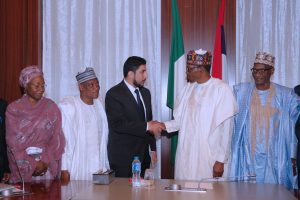
President Muhammadu Buhari has expressed gratitude to the Saudi Arabian Government for providing material assistance to the Internally Displaced Persons (IDPs), especially in the Northeast, worth $10 million.
The President, who received in audience, a delegation from King Salman of Saudi Arabia at the Presidential Villa, Abuja today, Thursday, particularly thanked King Salman Aid and Relief Centre and the Saudi Development Fund for the relief materials.
Buhari said that Nigerians in the areas affected by Boko Haram insurgency are in the best position to provide correct assessments of the changes that have taken place since he assumed office in 2015.
He said that his administration is mindful of the three-pronged promises made to Nigerians before the 2015 elections, assuring that he remained undeterred and focused on securing the lives and properties of all Nigerians.
“From the very time we came until now, we have been able to do our best, and we remain focused on delivering on our promises.”
President Buhari told the Saudi Arabian delegation that the priority of his administration had so far been on securing the country, buoying the economy and curbing corruption so that Nigerians would start benefiting from the rich natural and human resources of the country.
In his remarks, the Minister of Defence, Mohammed Dan-Ali said the delegation from Saudi Arabia had already visited the Ministry of Defence, Defence Headquarters and taken a tour of IDP camps in Maiduguri as part of their schedule.
The Leader of the Saudi Arabian delegation from King Salman, Nasser Bin Mutlaq, said the visit and the donation of materials was an extension of the good relations both countries had shared over the years.
“We are directed to offer materials and food for the displaced persons in the North East worth 10 million dollars. We have had a field visit to the places and seen the humanitarian situation ourselves.” [myad]
The Senate has begun an investigation into the alleged plot by some members to impeach its President, Dr. Bukola Saraki and his Deputy, Ike Ekweremadu, as well as other leaders of the Senate.
Raising the alarm through a point of order at the plenary yesterday, Wednesday, Senator Obinna Ogba (PDP, Ebonyi-Central) alleged that the group of aggrieved senators was also mobilizing civil society and trade groups to protest against Saraki’s leadership.
Ekweremadu, who presided over the plenary, referred the matter to the Senate Committee on Ethics, Privileges and Public Petitions.
A Pastor and general overseer of Salvation Army Church located in Mbiri community of Ika North-East Local Government Area of Delta State, Rev. Ignatius Ogboi has been arrested by police for being the leader of kidnapping and gunrunning gang in the state.
The pastor, who also owns a pharmaceutical and provision shop at Umunede, was paraded to news men today, Wednesday, by the Delta State Police Command.
The state’s police spokesman, DSP Andrew Aniamaka, who said that the pastor and other suspected kidnappers were still being detained and may be charged to court within a week.
The police had stormed the house of the clergyman with a search warrant and recovered a loaded English Made Double Barrel Gun, three thousand eight hundred and seventy one live cartridges, some prohibited drugs, four million naira cash, three hundred dollars, some amount of fake naira in different denominations and others.
While parading the suspect, the Commissioner of Police, Delta State Command, Muhammad Mustafa said that the Reverend had been the leader of a Syndicate group who specializes in sponsoring kidnapping and armed robbery operations within Agbor, Umunede and environs.
The Police boss, who disclosed that the case is still being investigated, said that the monies recovered were part of ransoms collected from kidnap victims.
Meanwhile, the suspect, Rev. Ignatius Ogboi while being interrogated by the Press, confirmed being into gun running and sale of ammunition without license.
He said he wanted to donate the guns and ammunition to the Vigilante outfit in the Area before he was arrested. [myad]
Senator Shehu Sani, representing Kaduna Central Senatorial District in the National Assembly has virtually turned the heat on his colleagues, querying the over N750,000 monthly consolidated salary and allowances as well as another N13.5 million monthly as running cost for each Senator.
In a statement today, Wednesday, the maverick Senator kicked against payment of allowances, saying that Senators should be paid just salaries.
The statement reads: “I think what we can say is that the running cost of a senator is N13.5 million every month. Though no specific instruction on what the fund should be used for, lawmakers must provide receipts to back up their expenses from the running costs.
“The running cost is in addition to funds earmarked for each senator for constituency projects.
“But what I am saying is that money (N13.5 million per month) must be receipted for what you do with it. But what you are given to go and spend without any accountability is N750,000.00. “The constituency project itself is given on a zonal basis and almost every Senator will go with a constituency fund of about N200 million, but it is not the cash that is given to you. You will be told that you have N200 million with an agency of government for which you will now submit projects equivalent to that amount. And it is that agency of government that will go and do those projects for you.
“Now, the corruption comes when the projects are not done and the money is taken. But right now, it is difficult to do that because NGOs and transparency groups have come into it.
“They track every allocation made to you and where they are being used. So, it’s becoming difficult for what used to happen in the past to happen now. But I can tell you that I would love a situation where we do away with running costs, constituency projects and leaves senators and members of House of Reps with salaries.
“And also, the public should be informed that nobody should come to any senator’s house asking for any kobo. That also would be helpful. There are issues that we need to understand. First, I don’t believe that members of the National or even state assemblies should be involved in carrying out what is called constituency projects”.
“When people are elected into the National Assembly, they should just be involved in law making, raising motions, bills and also performing oversight functions. But we live in a society where people cannot differentiate between the legislators and the executive. “When the people come to you, they want you to build roads, dig boreholes, build hospitals, schools, give money, pay school fees for them. Now, if we have a society in which people will stop asking legislators to do those things, then there is no need (for the allowances) But funny enough, if you are very active in the National Assembly in making laws and you don’t embark on projects in your constituency, you cannot in any way be appreciated by the people you are there to serve because the electorates in United States are different from the electorates in the United States and Africa.
“We live in an underdeveloped society with a lot of poverty, misery and wants. What people want is for you to address those basic fundamental issues that affects their lives. If we can be done with that, it would be okay. Now, you are talking of bogus salaries and bogus allowances – there are three steps you need to consider the first has to do with the fact when you represent the people, expectations arose from your immediate and the larger constituencies. But I agree with you that the salaries and allowances of lawmakers should not be discreet, but what is discreet about it when you can write to Resource and Fiscal Mobilization Commission to get everything about what a senator earns? The only money you are not expected to account for is your salary and the salary of a senator is about N750, 000.00 per month. The other one, the running cost of office must be accounted for. You must provide a receipt for every expense you make.” [myad]
“If he (Governor Yahaya Bello of Kogi State) doesn’t stop, there is no how he will come back in 2019. Never! No, he will not. God will show him that he is a God of justice and this is a message to all those people who have caused all kinds of problem in Nigeria at different levels.”
The deputy Senate President, Chief Ike Ekeweremadu, made these remarks today, Wednesday, while commenting on a motion sponsored by Ahmed Ogembe, senator representing Kogi central during plenary. Senator Ogembe had, in a motion, alleged that Governor Yahaya Bello sponsored thugs to disrupt an empowerment programme he organized for members of his constituency.
Ekweremadu said that such incident indicated that efforts must be made to protect Nigeria’s democracy, warning that the road which governor Yahaya Bello is “travelling will not lead him anywhere.”
According to the deputy senate President, “you will recall that sometime last year when they wanted to recall Dino, I advised the governor that they are wasting the resources of that state; that it is mission impossible.
“They took three pages in the newspaper abusing me. Are we still hearing the recall today? Money has been wasted. Money that would have been used to pay salaries of people in Kogi state was used to mobilize people to recall senator Dino, yet those people have not been paid and Dino is still here.
“So today, I am advising the governor again, that road he is travelling will not lead him to anywhere. Ultimately, these people he is seeing here will be back here and he will leave office.”
Ekweremadu said that the problem in Nigeria is that “our democracy is receding. Who says army cannot take over? Let us not joke with our democracy; that is the issue.
“The house of a senator was destroyed in Kaduna state; we are talking about Kwankwaso who was stopped from going to his state where he ruled for eight years. In Kaduna, Shehu Sani cannot organize a meeting and we are about a democracy? The international community needs to know this because they helped us install democracy.” [myad]
Federal High Court in Abuja has today, Wednesday, sentenced Charles Okah to life imprisonment for his role in the 2010 Independence Day bombing in Abuja.
He was sentenced alongside Obi Nwabueze, his co-accused for the crime.
The elder brother of Charles, Henry Okah had been sentenced for a similar crime in South Africa, where he is based.
In a 4 hour, 30 minutes judgment, Justice Kolawole, found the defendants guilty as charged for being responsible for March 15, 2010, bomb blast which claimed one life in Warri, Delta State and the October 1st, 2010 bomb blast near Eagle Square in Abuja which claimed several lives.
The judge noted that the second defendant, Obi Nwabueze, particularly made himself available to run illegal errands for Henry Okah who provided N1.2 million used to purchase five fairly used cars deployed for the Warri blast while Charles Okah, provided the sum of N2m used for the purchase of the four cars deployed for the Independence Day blast in Abuja.
The court had earlier sentenced a third defendant, Edmund Ebiware, also to life imprisonment on July 27, 2017, for his role also in the Abuja bomb blast. [myad]
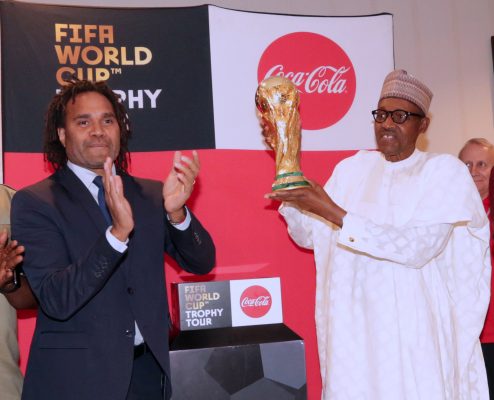
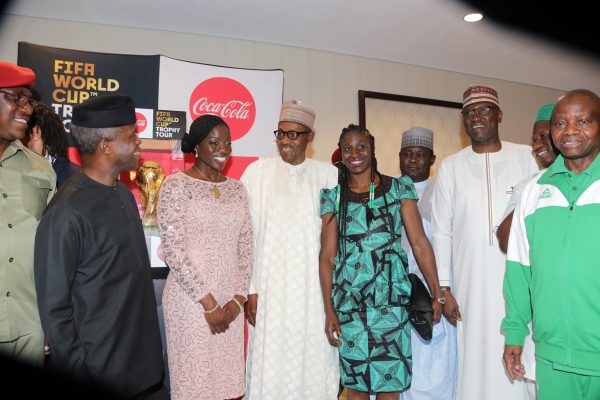
President Muhammadu Buhari, today, Wednesday, March 7, formally receives FIFA World Cup, presented to him by Fifa Legend, Christian Karembeu, at the Aso Rock Presidential Villa, Abuja, ahead of the 2018 World Cup football tournament in Russia, for which Nigeria had qualified.
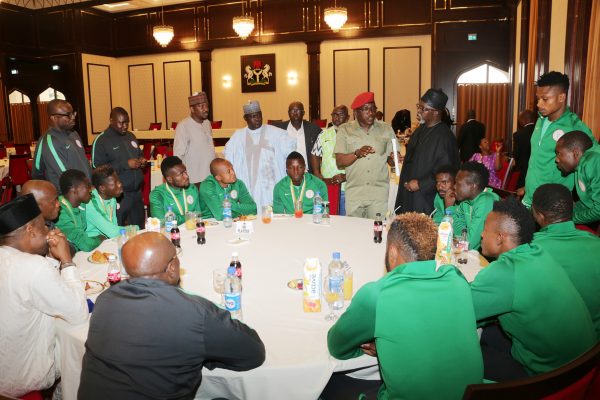
Nigerian Minister of Youth and Sports Development, Barrister Solomon Dalung, chats with members of the Chan Super Eagles ahead of the 2018 Football World Cup, during an audience with President Muhammadu Buhari at the Aso Rock Presidential Villa, Abuja, today, March 7.
Secretary to the Government of the Federation (SGF) Mr. Boss Mustapha (third from right); President Muhammadu Buhari (middle), flanked by the Foreign Based Nigerian’s Bobsleigh Winter Olympic Team, Ms. Seun Adigun (Bobsled Driver), Simidele Adeagbo and Vice President Yemi Osibanjo, during an audience with President Buhari at the Aso Rock Presidential Villa, Abuja, ahead of the 2018 World Cup. Photo by Sunday Aghaeze. [myad]
Governor Yahaya Bello of Kogi is obviously angery with hoodlums that launched attacks on some political leaders in Okene, Adavi and Okehi local government areas and has directed the arrest of the suspects. In a statement in Lokoja yesterday, Tuesday, signed by his Chief Press Secretary, Mrs Petra Akinti–Onyegbule, the governor vowed to ensure that the perpetrators faced justice. “The governor has since directed the relevant security agencies to ensure a thorough investigation into the allegations and bring the perpetrators and their sponsors to justice. “This is irrespective of political parties or personalities involved.” According to her, the governor has raised a high-powered delegation, led by his Special Adviser on Local Government and Chieftaincy Affairs, Mr. Sadiq Ohere, to visit the victims to express government’s condolences to them. “This is in pursuance of lasting peace and tranquillity in the land, and to reassure them of his commitment to ensuring the safety of lives and property of every resident of Kogi State,” Akinti-Onyegbule added. She said that the special adviser had since commenced visits to the homes of those affected, including members of the Peoples Democratic Party (PDP) who were allegedly attacked, to give them support. “This government will not condone any form of crime or violence in any part of the state, the government is responsible for the security of lives and property of all residents of Kogi, irrespective of political affiliation,” he said. He said that perpetrating violence in the name of political support and thuggery was alien to the All Progressives Congress (APC) and the culture of the people of the state. The governor stated further that his administration would not condone any act of violence or attack against innocent and law abiding citizens. He refuted allegations that the APC masterminded the violence and advised the PDP to stop playing to the gallery. He assured the PDP and other political parties in the state that his government would never indulge in political violence, urging them to stop playing politics with security. Bello appealed to people to embrace peace, unity, love for one another while going about their normal businesses without fear. Violence erupted in Okene on March 3 during an empowerment programme sponsored by Senator Ahmed Ogembe. It however escalated to Okehi and Adavi local government areas on Sunday during which hoodlums unleashed mayhem on political rivals in the areas. [myad]
The baton of leadership of the Independent Corrupt Practices and Other Related Offences Commission (ICPC) has been handed over to the Secretary to the Commission, Dr. Musa Usman Abubakar.
In a brief ceremony which was witnessed by the heads of departments and other senior management staff, the former acting Chairman of the Commission and two-term Board Member, Alhaji Bako Abdullahi, said that he was handing over to the Secretary as his tenure as a member had come to an end.
He expressed his gratitude to the government for having been given the opportunity to serve both as a member and an acting Chairman on two different occasions.
Alhaji Abdullahi commended the management and staff of the Commission for the support he had received from them, saying that it was tremendous. He therefore urged them to extend the same level of support to the Secretary.
The out-gone acting Chairman also advised ICPC staff to intensify their efforts in eradicating corruption in Nigeria.
He challenged the staff not to let the recent Transparency International’s rating of the country dampen their enthusiasm, but should see it as a shot in the arm for a renewed drive by the Commission to combat the evil that corruption represents.
In his own response after receiving the handing-over documents, the Secretary eulogized the out-gone Chairman, saying that the task of running a strategic organization like ICPC is a onerous one, and that having worked directly with Alhaji Abdullahi, he could attest to the awesome responsibility it entails and how diligently the out-gone Chairman had discharged his duties.
Dr. Abubakar therefore solicited for staff cooperation, saying that it such support is needed if he is to succeed in carrying the heavy burden being placed on his shoulders even as he promised to put in his best in order to make the Commission better in all ramifications.
Meanwhile, a new Chairman and members nominated by the Federal Government for ICPC are currently awaiting confirmation by the Senate as stipulated in the Corrupt Practices and Other Related Offences Act 2000.
It is expected that until their confirmation, the Secretary, Dr. Abubakar, will oversee the affairs of the Commission. [myad]
With few days left to his swearing-in for a second term in office, Anambra State Governor, Chief Willie Obiano, has sacked all political appointees and heads of Ministries, Departments and Agencies (MDAs) who are not civil servants.
A letter with reference ANS/SSG/HANDOVER/201, signed by the Secretary to the State Government (SSG), Professor Solo Chukwudebelu titled: “Submission of handover notes by political appointees and non-civil servant heads of MDAs in the state,” gave the affected persons up to March 16, 2018 to complete the exercise.
The letter reads: “His Excellency, Chief (Dr) Willie Obiano, Governor of Anambra State, has directed that all political appointees and non-civil servant heads of MDAs in the state submit their handover notes/reports on or before Friday 16`” March, 2018 to the Permanent Secretary of their respective MDAs, or to the most senior civil servant there in the absence of a Permanent Secretary.
“All SSAs/SAs are to submit their handover notes/reports to the Permanent Secretary, Office of the SSG. A copy of the handover note/report must be submitted to the Secretary to the State Government on or before Friday, 16th March 2018.
“Further to the above, political appointees and non-civil servant heads of MDAs and SSAs/SAs under reference, are to also handover any government project/utility vehicles in their custody to the Permanent Secretary, Office of the Secretary to the State Government on or before Friday, 16th March 2018.
“The contents of this letter are for your attention and necessary actions, as I assure you of my high regards.”
Obiano, who was re-elected for the second tenure on November 18 last year, in his move for another fresh start, has already set up a committee, headed by Chief Ifeanyi Ibezim, to oversee the inauguration of his second tenure in office. [myad]
We use cookies on our website to give you the most relevant experience by remembering your preferences and repeat visits. By clicking “Accept”, you consent to the use of ALL the cookies.
This website uses cookies to improve your experience while you navigate through the website. Out of these, the cookies that are categorized as necessary are stored on your browser as they are essential for the working of basic functionalities of the website. We also use third-party cookies that help us analyze and understand how you use this website. These cookies will be stored in your browser only with your consent. You also have the option to opt-out of these cookies. But opting out of some of these cookies may affect your browsing experience.
Necessary cookies are absolutely essential for the website to function properly. This category only includes cookies that ensures basic functionalities and security features of the website. These cookies do not store any personal information.
Any cookies that may not be particularly necessary for the website to function and is used specifically to collect user personal data via analytics, ads, other embedded contents are termed as non-necessary cookies. It is mandatory to procure user consent prior to running these cookies on your website.