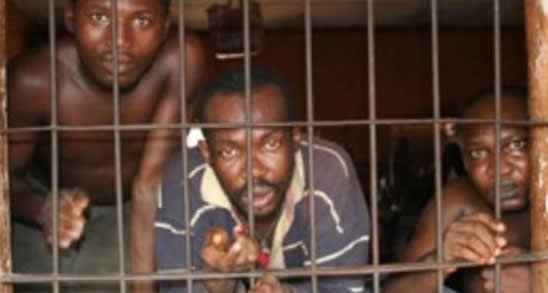
File photo: Some previously arrested suspected Boko haram members
No fewer than 167 members of Boko Haram, who were reported to be fleeing from the war zone in the Northeast have been captured around Lake Chad Island by the Nigerian soldiers operating Lafiya Dole. A statement by the Deputy Director Public Relations in the Theatre Command Operation, Lafiya Dole, Colonel Onyema Nwachukwu, said that several other insurgents were killed. The statement said that the success achieved in clearing the insurgents came on the heels of intensified offensive launched against them in their enclaves in the Islands around the Lake Chad region. “The offensive, which commenced about two weeks ago with coordinated air and artillery bombardments on Boko Haram enclaves while ground troops moved in to clear the areas, is yielding positive results, as several insurgents have been killed and 167 insurgents who were fleeing from the offensive have been captured by troops.” The statement said that soldiers also extricated and profiled 67 women and 173 children who revealed during profiling exercise that they are family members of insurgents who fled, following the offensive. It said that arrangement is ongoing to hand them over to IDP camp authorities after preliminary investigations are concluded. The statement said that soldiers, have, in the past two months, sustained the precursor operations and have conducted long-range fighting patrols and ambushes seeking out and clearing Boko Haram’s hideouts in Saada and Juwei in the fringes of Northern Borno. “During the operations, troops intercepted and arrested 53 fleeing insurgents who have been profiled and are currently helping with investigations. “Fifteen insurgents have also willingly abandoned the insurgent group, describing it as a futile struggle and have surrendered to troops of Operation Lafiya Dole within the period.”[myad]
The Controller General of the Service, Nigerian Prison Service (NPS), Jaafaru Ahmed has revealed that 72,384 Nigerians are currently languishing in various prisons across the country. Jaafaru, who spoke at the quarterly meeting of the Penal Reform Media Network (PERMNET) in Lagos at the weekend, said that 66 percent of those being held in prisons are on awaiting trial as at December 15 this year. The NPS boss, who was represented by the spokesperson of the Service, Francis Enobore, said: “as at December 15, 2017, the current population of prisoners in Nigeria is 72,384 with 48,527 of them were awaiting trial inmates. The awaiting trial inmates, therefore, constitute about 66 percent of the prison population.” Jaafar, who commended the intervention of various stakeholders in the decongestion of the prison, called for more collaboration of relevant agencies of government towards addressing the plight of awaiting trial inmates. “There is a need for more collaboration among the three arms of the criminal justice system to enhance synergy so that anybody brought to prison as awaiting trial, the case will be determined as quickly as possible. The other arms have to do their part so that there would be quick dispensation of justice.” He also commended Prisoners’ Rehabilitation and Welfare Action (PRAWA) for spearheading the campaigns towards the decongestion of prison facilities through advocacy campaigns and consultative meetings. Also speaking at the occasion, the Chief Executive Officer of PRAWA, Dr. Uju Agomoh listed some factors militating against the decongestion of the prison. “To address the plight of awaiting trial inmates, the stakeholders should address the seeming lack of speedy trial, overuse of imprisonment by the courts, abuse of arrest powers and bail conditions by the police and inadequate prison structures.” The quarterly meeting which was hosted by PRAWA, concluded that prison facilities should be mandated to only accept persons into detention for whom there is a legal warrant authorizing imprisonment and to also speed up the trial process so that detainees spend less time in pre-trial detention. The meeting further canvasses for issues relating to adaptation of criminal procedure codes so that judges rather than prosecutors make the decision about pre-trial detention. Permnet is a network of Journalists and Media Experts aimed at Creating Awareness, advocating for implementation and replication of good prison and correctional practices in Nigeria. The network is a major output of the fourth component of the Prison Reform Project. Meanwhile, prisoners in Lagos State held a mini product exhibition at an end of the year party put together by the State Command in collaboration with the Rotary Club of Ikoyi in Ikoyi Prison, Lagos. Several products, including beads of different shapes, flower vases, clothes shoes and furniture were displayed to the admiration of visitors at the exhibition. The State Prison Controller, Tunde Ladipo appealed to well-meaning Nigerians to support the clarion call of Mr. President and encourage prison decongestion in whatever manner possible as this remains the only way to create suitable environment for proper inmate reformation and rehabilitation.[myad]
Former Vice President and chieftain of the Peoples Democratic Party (PDP), Atiku Abubakar, has advocated the creation of more employment as a solution to incessant migration of Nigerian youths to other countries, with all the dangers involved. He also recommended what he called ‘inclusive government’ that does not engender crisis which he said will stem the ill-fated migration of Nigerians. Atiku Abubakar made the recommendation today, Sunday, to mark the United Nations International Migrants Day. The PDP chieftain said, in a statement by his media office in Abuja, that the major driver of migration, which at times are ill-fated like in the case of Libya, is the search of better life and opportunity. Atiku laments the current situation in the country where three million jobs, according to the NBS, are being lost annually in the last two years, adding that such situation had complicated the already bad unemployment. “Millions of our youths have been rendered jobless and, with no prospects of opportunities, they are compelled to take the suicidal flight. Atiku, who holds the traditional title of Waziri Adamawa, advised governments at all levels to create the enabling environment that will attract and sustain investments that will create jobs for the army of unemployed. “The chances of a young person with a job and opportunity at home taken a suicidal flight in search of a better life will become an exception and not the rule.” He emphasised that migration is caused by poverty and insecurity in the original countries of the migrants, stressing that governments in Africa, including Nigeria to create an environment conducive for economic progress and employment generation. According to Atiku, a fair and inclusive government would spread available opportunity to all citizens and encourage those with entrepreneurial inclination to start businesses and factories to absorb the teeming population of the unemployed, thus making unbridled migration unnecessary. The former Vice President, however, appealed that “migrants should be treated with decency because they are humans, in apparent reference to the harrowing experience and stereotype which migrants are being subjected to all over the World over. He said that migrants do not usually choose to migrate if it were not unpleasant social, economic and political conditions in many countries that forcefully uproot them and turn them into such condition. These are the people, he said, that are seeking new homes, security, employment and a better future. Atiku called on all stakeholders to find ways of dealing squarely and in a humane manner, with the challenges thrown up by the reality of migration in the contemporary World, even as he regretted that one of the worst forms of maltreatment, which a migrant can experience, is the large-scale enslavement of young and helpless Nigerian and African migrants in Libya which recently drew global attention.[myad]
The management of Dangote Group has not hidden its fight with BUA company over limestone mining in a boundary town of Oguda/Ubo in Okene Kogi State, saying that BUA is stealing its Mining Lease No. 2541 through illegal mining resource. The Executive Director of Dangote Group, Mr. Devakumar Edwin, who spoke on the matter, expressed sadness with what he called ‘media war,’ that has been instigated by BUA against his company on a matter that is already pending before the Federal High Court, Benin Division Edwin said: “Dangote Group validly acquired its interest and mining title in the disputed Mining Lease No. 2541 from AICO Ado Ibrahim & Company Ltd sometime in 2014. AICO itself had applied to the Mining Cadastre Office and Ministry of Mines and Steel Development for the said Mining Lease No. 2541 located in a boundary town of Oguda/Ubo in Okene Kogi State in 2007. The Ministry in exercise of its power under the Nigerian Minerals and Mining Act, 2007 granted and issued to AICO ML. No. 2541 for the renewable period of 25 years effective from 1st February 2008 and to expire on 31 January, 2033. Thus AICO by virtue of the said grant, became vested with the legal title over ML. No. 2541. In 2014, the Dangote Group approached AICO and indicated interest in acquiring AICO’s stake in ML No. 2541. In 2014, AICO in exercise of its right under the Mining Act, applied to the Ministry for the transfer of its title in the ML No. 2541 to Dangote Group. AICO and Dangote Group equally paid all the transfer and statutory fees demanded by the Ministry.” He further explained that:” By a letter dated 05 February 2016, the Ministry wrote to the Managing Director of the Dangote Group to convey the approval of the Ministry for the Transfer/Assignment of ML No. 2541 from AICO to Dangote Group with effect from 03 February 2016. Following the successful transfer of ML. NO. 2541 to Dangote Group, the Group became the holder of the Mining Lease No. 2541.” He said that even BUA, in its process in Court, acknowledged that these illegal mining leases which it claimed were granted in 1997 were temporary mining leases. Edwin recalled that the then Minister for Solid Minerals under Olusegun Obasanjo’s regime, Dr Oby Ezekwesili sometime in 2006 waded into the dispute and invited the managements of Edo Cement Company Limited and AICO Ado Ibrahim & Company Limited for a meeting and that in the course of the meeting the then Minister again queried the legality of Mining Lease Nos 18912 and 18913 and the power of the Governor of Edo State to grant such mining leases. “At the end of the Meeting, the Minister declared the Edo Cement’s Mining Leases Nos. 18912 and 18913 illegal and declared the mining site open for interested investors. Given that AICO’s then existing Mining Lease No. 17825 was yet to be renewed even though application for renewal was pending, AICO in 2007 (under the Mining Act, 2007) applied for the fresh Mining Lease No. 2541 and the Ministry granted it in 2008 without any objection from Edo Cement Company” Edwin said AICO, who sold the right to Dangote, continued its mining operations in the Mining Lease No. 2541 undisturbed until BUA Group acquired Edo Cement Company Limited and resuscitated the dispute again. Edwin further revealed that it was the attempt by BUA to encroach on AICO’s mining title in Mining Lease No. 2541 that prompted AICO to write to the Ministry in 2015 complaining of BUA’s encroachment. He said: “The Ministry after investigation in the same 2015 by the letter dated 21 January 2015 wrote to the Chairman of BUA Group directing BUA to stop mining within the ML. No. 2541. It was this same letter from the Ministry that prompted BUA to file a Suit at the Federal High Court Benin in 2016.” Edwin said: “It is therefore appalling that BUA Group in the midst of these overwhelming facts will still want the public to believe that Dangote Group is after its business when in actual fact BUA has been the one mining illegally in Dangote Mining Lease and attacking its officials without any justification… The crocodile tears being shed by BUA in its cry for help and open letter to the President is most laughable and a total distraction from BUA’s continuous illegal activities within Dangote’s ML 2541 aimed at depleting and exhausting the limestone reserves in order to sabotage Dangote Group’s legitimate investment.”[myad]
After making a slow start, the Nigerian energy landscape is set for a major change with the award of a USD 2,809,522,548.36 gas pipeline contract approved by the Federal Executive Council as proposed by the Ministry of Petroleum Resources. The ministry is under the direct supervision of President Muhammadu Buhari. Dr. Ibe Kachikwu, the Minister of State who made the presentation to the cabinet announced that the project is for the construction of a 40 inches pipeline across 614 kilometers from Ajaokuta to Abuja-Kaduna-Kano. This should mark an important landmark in the implementation of the first phase of the Nigerian Gas Master Plan, NGMP approved in2018. A second contract approved under this massive, blockbuster investment is for the engineering,verification,procurement and construction of a 40 inches 30 kilometers Odidi to Warri gas pipeline expansion project. This one is to transport additional gas supply from upstream producers to various demand points at the cost of N7.7 billion and USD56 million. The projects, which can rightly be termed as being among of the President’s pet projects is owed, in part to his vision and momentum back in his days as the federal commissioner for Petroleum Resources. That time, Colonel Buhari led think-tanks to plan the country’s gas future and initiated the contracts for the laying of a massive network of petroleum pipelines, linking the length and breadth of the country and laid the foundation for the construction of three refineries, Warri, the second Port Harcourt refinery and the one in Kaduna in a bold move to augment the the supply and distribution of petroleum products in the country. That was the golden period of the country’s petroleum industry when domestic refining not only met the requirements of home consumption but also produced excess 150,000 barrels of refined products for export. The bold step taken by the President on Wednesday seeks the integration of the Eastern and Northern parts of Nigeria, which had suffered past neglect into the gas economy. Gas pipeline infrastructure had been concentrated in the coastal areas and the North and the East had been left largely untouched by the industrial revolution that has come with the gas pipeline network. It is therefore not surprising that the western part of the country is having more economic activity. The All Progressives Congress, APC which had campaigned on the issue of inclusive growth holds the view that the achievement of a balanced and equitable national development can only come with a balanced growth of the states and the regions. The party manifesto had identified the development of natural gas transportation infrastructure as a key project in this regard. These contracts for pipelines and LNG terminals to be set up at various points will therefore expand opportunities for balanced national development to counter the backwardness and geographical disadvantages of the North and the East. In line with the country’s rapid growth in energy demand, the connection of the south and the north should serve as a boost to the nation’s energy security. The increased energy transportation networks will be a shot in the arm for the struggling manufacturing industry which suffers arising from the acute crisis in the energy sector. It will cater to the needs of cement and fertilizer plants; power plants, transportation systems and even household consumers thereby increasing gas share in the country’s energy consumption mix. Gas which is classified as clean energy will, in addition to the promise of energy security, provide efficient fuel for power generation and reduce air pollution leading to improved quality of life. The Trans-Nigeria Gas Pipeline (TNGP), the East-North network starts from Qua Ibeo Terminal, QIT to Cawthorne Channel in Rivers traversing Obigbo-Umuahia-Enugu-Ajaokuta and now Ajaokuta-Abuja-Kaduna-Kano is likely to be completed in 2019. The extension of this network to the East and the North is potentially the precursor of the Trans-African pipeline that will cross the Sahara enroute Europe. Nigeria’s eyes have for many years been fixed on the European Gas consumer markets. The contractor financing arrangement has been adopted and the project sponsor, the Nigerian National Petroleum Corporation, NNPC and the Federal Government are expected to reach common terms with the contractors on how they will be repaid over a 15-year period. Although the loan repayment is expected from revenue accruing to from both existing and the expanding pipeline network, the NNPC and the Federal Government are expected to meet financial gaps and guarantee return on net investment. The Buhari administration came into office at a time when Nigeria faced a crisis of inadequate and crumbling Infrastructure and has, as a matter of priority embarked on a number of positive interventions to ease the infrastructure crunch. The administration has been raising short term and long-term funding for road projects, railway and power projects. The President is strongly optimistic that all these infrastructure projects will increase the scope of economic activities and contribute to the overall economic growth and development of the country. This is the Change. *Garba Shehu is Senior Special Assistant to President Buhari on Media and Publicity Abuja. [myad]
“Whoever is trying to use my name to support or promote Atiku’s political exploits is attracting God’s wrath to himself or herself.
“Those who are impersonating my names wickedly and politically must be careful. People must fear God and respect His anointed.
“For now, I have never spoken neither for nor against Atiku. God has shown me nothing about him.”
These were the words of the Spiritual Director of the Adoration Ministry, Enugu, Reverend Father Ejike Mbaka against the background of the statement attributed to him that he had endorsed former Nigerian Vice President, Alhaji Atiku Abubakar for the 2019 Presidential Election.
The revered priest expressed shock over such attribution, saying: “I read the report about my support for Atiku with bitterness in my heart as I can see how wicked and evil some people could be. Neither in the public nor in the secret have I said what the reporter claimed.”
He asked: “When? Where? With whom? and under what platform did the mendacious and wicked reporter hear or see me talk about Atiku?”
Rev. Mbaka said that if those behind the report failed to do the needful: “I will take action against such vulturous and satanic character assassins who have been working hard to destroy my reputation or make me a false prophet.
“I am busy with the work of God and I am now in a deeper contemplative encounter with the Awesome God.
“My concerns now are the healings, deliverances, blessings, breakthroughs etc of my people. I don’t talk carelessly. I speak when God has given me a word. For now, God has not revealed anything about Atiku Abubakar.”
The immediate past President of Nigeria, Dr. Goodluck Jonathan, has acknowledged that President Muhammadu Buhari is a statesman who has earned for himself, a special place in the history of Nigeria.
In a message to congratulate Buhari as he turned 75 today, Sunday, Dr. Jonathan said: “Your Excellency, you are a statesman whose place in history as Nigeria’s leader, at different epochs in our nation’s development journey, is guaranteed.” [myad]
Governor Ayodele Fayose has sent a congratulatory message to President Muhammadu Buhari on his 75th birthday wherein he wished him a long and healthy life.
“This is to congratulate Mr. President as he clocks 75. I want to thank God for his life and pray for good health in the service of our nation and that he continues to age with grace. I wish him the best. He represents us all and we owe him prayers and cooperation where necessary, just as we also need to criticize him too where necessary,” he said. [myad]
Let me begin by telling a story. On June 1, 2015, the day I resumed work as adviser on media to President Muhammadu Buhari, he had admonished me: “Adesina, always tell me the truth. That is what I want from you. In this type of position I have found myself, it is very easy not to be told the truth. People will just tell you what they think you want to hear. But from you, I want the truth. As a General, I may argue, but please argue with me. Tell me the truth always.”
Based on that blank cheque I’d been given, I went to the residence one evening last year to see the President. That was the time there was deafening talk of hunger from different parts of the country. I wanted to be sure that the talk was not being filtered from the President. Of course, I know him as somebody who reads newspapers religiously, and wherever we are in the face of the world, he asks for media highlights from Nigeria. So, he would not be unaware of what Nigerians were going through. But I still wanted to raise it with him.
“Mr President, there is hunger in the land, and people are complaining. I know government is doing its best, but I just want you to be aware,” I said.
Mr President responded: “I know, I know. I am aware of what people are going through. I have people in my own constituency back home, and I know the messages they send to me. But it is a passing phase. Our country was vandalized, and we found ourselves in this problem. But now that we are here, we will do our best. We will bring change to this country, and we are already seeing it in agriculture. This period of hunger will pass.”
It was prophetic. The season of hunger will pass, and is indeed passing. Anyone that is honest will admit that things are looking up in Nigeria. The ravening clouds shall no longer be victorious. They shall not long possess the sky.
I went away with one conviction from that night’s meeting: the poor matter very much to this President. He is not the type that people would tell they had no bread to eat, and he would tell them to eat cake instead. This is a friend of the talakawas, a man who loves ordinary people, and who wants their station in life to be improved. And those people know it. That is why they gravitate towards him, and repose so much confidence in him. He is their hero. Our hero.
President Buhari turns 75 years today. But some six months back, how many could confidently say this day would come for the ramrod straight man from Daura? How many believed the President would come out of the severe medical challenge that had confronted him? It all began as a routine vacation cum medical checkup in January, and few days after, the rumour mill was on overdrive. The challenge lasted till August, before the President returned home finally, and since then, he has been looking better by the day. Each time you now see him, there is a fresher glow, and you cannot but give glory to God on his behalf.
But why was President Buhari kept alive, so much so that he is turning 75 today? Why did he pass through the sea of infirmity, and he was not swept away? Why did he pass through inferno, and the fire did not kindle against him? Big question. I don’t have the answer, but I can hazard some guesses, based on divine principles.
Rigobert Song. Remember him? Song was the Cameroonian defender who played many years for the Indomitable Lions. He appeared at eight African Nations Cup tournaments, five as captain, and stood between Nigeria and victory many times. He became an idol, venerated by his countrymen and women. He retired to become a coach.
Then late last year, Song was not on song again on the soccer pitch. He had a near death experience on October 20. He went down with brain aneurysm, and was in coma for two days. Doctors battled to save his life, and he was eventually evacuated to France.
While the travails lasted, the social media was abuzz with news of Song’s passage. As someone who had followed his career over the years, I felt very sad. But this is the season of fake news. Song was not dead, he miraculously rallied back. He narrated his experience, which I found instructive, considering what our President also passed through:
“I did not know what was happening to me…I did not even know I was fighting between life and death…All these people, they put God in trouble. Because everyone in this situation, they were praying-this is what I keep in my mind-God would have been in trouble. Everyone was praying, asking, ‘God, please don’t do that, don’t take Rigobert.’ I say thank you everybody for making me come back.”
What song was Song singing? One of thanksgiving. Cameroonians who loved him bombarded God with prayers, ‘Please, don’t take Rigobert now.’ And God heard. He showed mercy.
That is the same reason President Buhari is alive today. Nigerians bombarded Heaven with prayers. With supplications, intercessions, pleas for mercy. Muslims prayed in mosques. Christians prayed in churches. President Alpha Conde of Guinea declared 24 hours prayer for his Nigerian counterpart. Prayers were going on everywhere, both at home, and in the Diaspora. I can imagine God telling Himself: ‘I must answer these prayers. These petitions are too many. I must answer.’
And God had mercy, a fact attested to by President Buhari himself. He said his return was a miracle, which only God could have done.
Why did God keep our President alive? The Holy Books answer:
“Blessed is he that considers the poor;
God will deliver him in the day of evil.
God will preserve him, and keep him alive,
And he will be blessed upon the earth;
And deliver him not unto the will of his enemies,
And raise him up from sickness.” (Psalm 41:1-3).
And this one in Surah At-Tawbah 9:128:
“There has certainly come to you a Messenger from among yourselves. Grievous to him is what you suffer, for he is concerned over you and to the believers he is kind and merciful.”
President Buhari is concerned about Nigerians, particularly the helpless, the ordinary people, and he has dedicated his life to serving them. And when he was near unto death, those ordinary people besieged Heaven with prayers. That Christian hymn says “dearer to God are the prayers of the poor.” And God truly answered.
There is power in goodwill, we have seen it work. It worked for Rigobert Song, and it has worked for our President. Have a heart for men, particularly for the poor, the lowly, and the downtrodden. And see God rise on your behalf.
Consider Tabitha (Dorcas in Greek), who lived at Joppa. She was full of good works, always doing good, and helping the poor. One day, she took ill, and died. Peter, one of the apostles of Jesus, was invited. He came, prayed, and said: “Tabitha, arise!” And the woman came back to life. That is what is possible, when you have a heart for the poor.
In his New Year message last year, President Buhari told the country: “Living in the State House has not alienated me from your daily sufferings. These challenges are only temporary, we are working to make things better.”
When news came a couple of months ago that Nigeria had exited from recession, what did the President say? “Until coming out of recession translates into meaningful improvement in peoples’ lives, our work cannot be said to be done.”
In another broadcast, the President had stated: “All my adult life, I have always earned a salary and I know what it is like when your salary is simply not enough.”
That is the man we follow, and serve. Millions would today follow him into battle blindfolded. Millions upon millions would vote him again and again, if he throws his hat into the ring. Happy birthday, Mr President. You have shown us how to care for the lowly and the poor, how to bear them in our hearts at all times, and how such pleases God, and brings mercy our way. Thank you for coming this way, thank you for offering yourself for service.
.Adesina is Special Adviser on Media and Publicity to President Muhammadu Buhari. [myad]
A popular musician-turned-activist, Chukwuemeka Charles Oputa, popularly known as Charly Boy, has described Pentecostal Pastors in Nigeria, as 419. He said that their preaching is solely based on systematic fraud. Charly Boy, who is convener of OurMumuDonDo movement, said, on his Instagram account, comdemned pastors for preaching only for money. The AreaFada, who shared a photos of himself with a Buddhist monk, said the system practiced by the preachers is fraud and deception. “Pentecostalism na modern-day commercial enterprise garnished in the cloak of religion with deception and exploitation as its foundation. “Their goal na the complete monetisation of peoples ignorance. It remains the only legally and politically accepted movement completely based upon systematic fraud, deception and cheating. “Fck the con men of God, dem crooked theology is all for the Naira. Na so AreaFada Talk,” Charly Boy wrote. [myad]
We use cookies on our website to give you the most relevant experience by remembering your preferences and repeat visits. By clicking “Accept”, you consent to the use of ALL the cookies.
This website uses cookies to improve your experience while you navigate through the website. Out of these, the cookies that are categorized as necessary are stored on your browser as they are essential for the working of basic functionalities of the website. We also use third-party cookies that help us analyze and understand how you use this website. These cookies will be stored in your browser only with your consent. You also have the option to opt-out of these cookies. But opting out of some of these cookies may affect your browsing experience.
Necessary cookies are absolutely essential for the website to function properly. This category only includes cookies that ensures basic functionalities and security features of the website. These cookies do not store any personal information.
Any cookies that may not be particularly necessary for the website to function and is used specifically to collect user personal data via analytics, ads, other embedded contents are termed as non-necessary cookies. It is mandatory to procure user consent prior to running these cookies on your website.