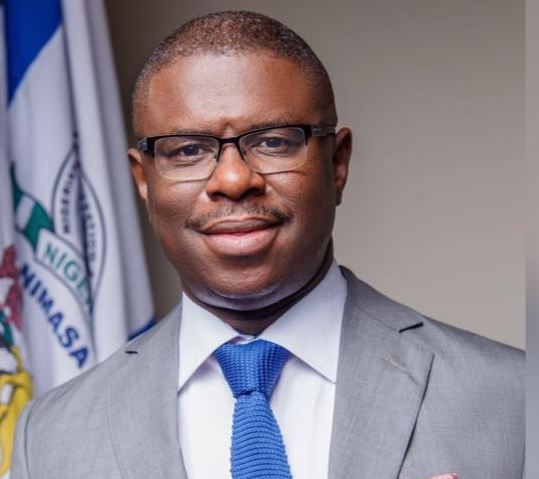
The Director General of the Nigerian Maritime Administration and Safety Agency (NIMASA) Dr. Dakuku Peterside has promised that the Agency is working with Stakeholders and the global maritime community to ensure that the menace of piracy is stamped out in the Gulf of Guinea in order to allow for free flow of trade in the region. The Director General, who spoke on the sideline of the G7++ group summit held in Lagos, said that the fact that the Italian government decided to hold the meeting in Lagos Nigeria, which is the first time outside Europe, shows that they believe in the country’s efforts to fight piracy and other criminal activities in the Nigeria and in the Gulf of Guinea. He said that since Nigeria has been given the leadership role to curtail criminal activities in the region, the Agency would continue to collaborate with the relevant authorities, both locally and internationally to put an end to the issues surrounding piracy in the region. Dr. Peterside said that NIMASA is tackling piracy from four broad approaches namely; Legal framework through an anti-piracy bill, which will soon be passed to law, thereby making Nigeria the first country in the whole of Africa to formulate such policy. Others are acquisition of military hardware, through partnership with an Israeli firm, which will enhance our response capabilities to criminal activities, enhancing our intelligence gathering system and regional integration and collaboration through working with other African countries. “No piracy begins and ends in one jurisdiction; when there is a hot pursuit, they shift to another region, and on our part, we are determined to give them a hot chase through our partnership and other collaboration with other countries in the region.” The G7++ Friends of Gulf of Guinea Group is headed by the Italian government and is poised to ensure sustainable interest in the promotion of peace, security and development in the Gulf of Guinea.[myad]
There was a veiled agreement among stakeholders at a recent gathering in Lagos, that the governments in Nigeria at all levels are shirking the traditional but universal responsibility of provision of economic and infrastructural succor to the citizenry which the instrumentality of participatory democracy and election of leaders confer on them. The passionate plea for government-private sector collaboration for sustainable development underscores this assertion, thus eliciting this jigsaw: If it has been said that government has no business in business, what business does the private sector has helping government to do its business of providing quality governance to the populace? Essentially, participants at a recent one-day international conference were unanimous that 2030 sustainable agenda has partnership and collaboration at its centre. It was clearly stated that the scale and ambition of this agenda calls for smart partnerships, collaborations, ecosystem thinking, co-creation and alignment of various intervention efforts by the public and private sectors and civil society. The conference which had as a theme; Partnership for sustainable development and innovation, was jointly organized by the First Bank sustainability centre and Lagos Business School, Lekki, Lagos. The event was among other goals aimed at finding an ‘urgent need for creative and innovative thinking by all strata of the society-public and private sector and civil society-to promoting sustained and inclusive economic growth, social development and environmental protection’. Different speakers present at the event brought to the fore the reality of infrastructural deficit facing the country and government’s helplessness in this regard hence the clarion plea: “Government partnership with the private sector is needed for the provision of infrastructure for sustainable development”. After listening to different speakers present at the event, it has dawned on me that this must be trying moment for our nation especially when it was muted that bridging the infrastructural deficit which will form a major indicator for determining the success or otherwise of the agenda will require a whopping sum of 2.3 trillion US Dollars. That obviously got me thinking as it reminded me also that we are in a nation that is characterized by policy inconsistency and lacking in committed leadership Still ruminating on this whole thought of sustainability as discussed, I had the opportunity of driving through Anthony Cardinal Olubunmi Okojie ‘way, in Ikoyi. A Street that houses the now abandoned federal secretariat. Casting a glance at the complex, the question that readily flooded my mind; If we draw on this federal secretariat building as a key performance indicator to appraising the government effort to bridge the infrastructural deficit in Nigeria as explained at the conference, can Nigeria achieve this 2030 sustainability agenda? Indeed, critical minds will not take the federal government seriously in its bid to attain the 2030 sustainable agenda or consider the corruption fight as orchestrated after looking at this abandoned edifice, as this is worse than corruption. Adding context, this issue raised is not the primary concern of this piece but apparently will point at the bigger frame of obstacles that may prevent us as a nation from achieving the said 2030 sustainable agenda. Again, the sorry state of the onetime edifice also reminds me of our penchant for project abandonment which may likely blur this vision and damage the goal as envisioned by the United Nations. Synoptically, I must acknowledge the fact that I am aware of the transaction gone sour and the inherent friction created between the federal government and the parties involved. Also noteworthy is the federal government elusive search for a truce. But while this search is ongoing, the complex is telling our sorry story to the world. So using the above scenario as a dashboard to correcting our leadership challenge which is gravitating towards becoming a culture, it would be important for us as a nation to openly admit and adopt both structural and managerial changes if achieving this agenda is at the centre of our goal. This to my mind will necessitate our leaders welcoming approaches that impose more leadership discipline than conventional, and creating government institutions that are less extractive but more innovative in operation. This shift in action is important as ‘we cannot solve our socio-economic challenges with the same thinking we used when we created it’. And this time is auspicious for our government to bring a change in leadership paradigm by switching over to a leadership style that is capable of making successful decision built on a higher quality of information while dropping the age long mentality which presents execution as more important than idea incubation. This leadership fence mending becomes crucial as it is considered by many that if Nigeria fails to get it right, Africa as a continent will in turn not get it right. Correspondingly also, if Africa as a continent fails, it means the 2030 sustainable development agenda as planned will be considered a failure the world over. This position underscores the consciousness and industry that is expected from Nigeria as a nation and supports my belief that government rather than the private sector should provide the needed drive of this agenda.
And so, Uche Secondus, despite the hue and cry about heavy monetisation of the process and alleged plan by governors under the influence of Nyesom Wike of Rivers state to hijack the party leadership, still ended up being the national chair of the Peoples Democratic Party (PDP). For a vast majority of PDP members who crave a new leadership identity for the party, who believe in freshness of ideas and the infusion of new blood in the national executive committee (NEC) after the very recent saga that unraveled about the leadership following the defeat of the party in the 2015 presidential election, Secondus does not represent that sort of political revivalism. He was a member of the old guard and was, therefore, not qualified to become national chair of a PDP in serious need of new direction and gravitas. His antecedents were not in pari material with the new ethos of freshness on which the new leadership of the party should run. He was acting national chair of the controversial national working committee (NWC) that tried to help itself with party fund when the party was down and out post 2015 general election. Besides, against the alleged bazaar into which the then leadership turned the nomination process, it becomes difficult to contemplate and locate a force of resurgence in Secondus’ individuality. But, unfortunately, Wike and his colleagues harboured and nurtured a different agenda that sustained Secondus’ candidature. They wanted him in the absence of anyone else that suited their pre-determined political values and elitist fancies, and stopped at nothing to foist him on the party in furtherance of such parochial considerations. Though, to be fair to Wike, he did not single-handed railroad Secondus into the leadership of the party. He did so in concert with the other governors on the party platform, especially those in the southern part. There are arguments out there to justify the emergence of Secondus from South-south zone despite the notorious fact that the party had agreed that the position of national chair be ceded to the Southwest zone. That was settled at the botched national conventions sponsored and hosted in Port-Harcourt by Wike. Even during the non-elective unity convention in Abuja said to have been sponsored by Governor Ifeanyi Okowa of Delta state, nothing presented itself to threaten that consideration. But in a manner that smacks of political shenanigans, the Southwest has been dealt a fatal blow. Bode George’s very profound reactions have surmised the depth and pains of the betrayal inflicted on the Yoruba race and its stock in the PDP. The truth is that it was not that the zone did not have good candidates. The problem was that the absence of reinforcing political correctness that should have seen a PDP-controlled state in the southwest producing the national chair conspired with other secret desires to deny the zone the prized position. That was what worked against candidates from Lagos, Ogun and Oyo states. There were no candidates from Ondo and Osun. Professor Tunde Adeniran from Ekiti, who could have emerged, in that circumstance, as a consensus candidate, did not have the most critical home support. Governor Fayose had never been on the same page with him and it was inconceivable how he was going to break through that wall of opposition to emerge as national chair. The argument was that the party chairman should come from a state controlled by the party in order for the occupier of the position to operate effectively with the support and cover of the state governor. A national chair from an APC-controlled state would have been a disaster as the home state would become unfriendly and the national chair would be exposed to the vagaries of political assaults and attacks from the APC governor of the state. The interest of the Southeast is to produce the vice presidential candidate and therefore, it did not care a hoot about producing the national chair. This encouraged an ambitious Wike to move in with his proposition to hold down the position in the South-south; and because the other PDP governors in the oil-rich zone were not interested in presenting any candidate, he was left to cover the entire field. But I had expected that Wike to present a fresh candidate from his state like Elder Felix Obuah instead of an old wine in a new wine skin. However, beyond Wike’s enthronement of Secondus and the motivation behind it, those who know Secondus speak of his experience as a party administrator par excellence. They say that having been Rivers state chair of the PDP for eight years from 1999 to 2007 and having earned for himself the moniker of “Total Chairman” before he moved to the NEC of the party, it becomes pretty difficult to discountenance him in the choice of someone for the position. There are also talks about solid friendship, trust and reliability that exist between him and Wike. But all those pale into insignificance in the definition of a bigger picture for the party in terms of public confidence in the PDP and the leadership that drives it, especially now that the party presents the most viable alternative platform around which support can be galvanised for a referendum against the ruling APC. Can Secondus’ leadership feed that kind of public sentimentalism? Except the leadership works as a team, Secondus may find it difficult to define his individuality given the peculiarity of his antecedents and the conditions that produced him as national chair. Regardless of the petulance of Secondus’ choice, the new PDP NEC is robust and will benefit from the moral force of perhaps one or two persons. If there is any great thing that has happened to reinforce the credibility of the NEC and save it from any scintilla of public odium on account of Secondus’ past engagements in the old national working committee (NWC) of the PDP, it is the election of Senator Umaru Ibrahim Tsauri from Katsina state as national secretary of the party. What is the reason for my position? Rewind to 2006. There was an attempt by the Olusegun Obasanjo administration to amend the constitution to make a third term (tenure elongation) possible for him. Members of the National Assembly were bribed with N50 million each. As a journalist covering politics and senate, I gathered authoritatively that Tsauri was one senator who rejected the offer. It was even learnt that that when some powerful persons in government heard, they reasoned that what money could not do, plenty money could do. They increased the package and he still rejected it. He was reprimanded for being stubborn. This speaks volume about his moral force, his capacity to shun filthy lucre, and his predilection for good behaviour, prudence, honesty, accountability and financial discipline. I am excited that right in the NEC is a watchdog whose character, attitude and disposition to issue of integrity should put the entire NEC of the PDP on its toes. The last I heard of Tsauri was in 2007 after he exited the 5th senate. I read about him recently when he began his campaign for the position of national secretary. He was reported to have promised that PDP would be rebranded towards 2019, the year that Buhari would fall in Katsina. I believe him. Methink that Tsauri is an epitome of every good thing, including courage and conviction. With him in the NEC, the PDP leadership will be guided or, if need be, forced to do the right things, always, and Secondus and whatever antics he and his promoters plan to deploy will become secondary. I expect checkmates. If there are one or two others like him, then the PDP is secured.
Governor Akinwunmi Ambode of Lagos State has presented the 2018 budget proposal of N1.046 trillion to the state House of Assembly. The budget, tagged: “Budget of Progress and Development” represents a 28.67 per cent increase over the 2017 budget of N812 billion. The News Agency of Nigeria (NAN) reports that the 2018 budget, whicfh the governor presented today, Monday, has a Capital Expenditure of N699 billion and a Recurrent Expenditure of N347billion. The capital to recurrent ratio of the budget stood at 67:33. “The budget will be used to consolidate on infrastructure, education, transportation/traffic management, security and health, with an added emphasis on mandatory capacity building for civil servants, all teachers in public secondary/primary schools, officers in the health service sector and women and youth empowerment,” Ambode said. He said that the estimate of total revenue for year 2018 was N897.423 billion, of which N720.123 billion would be generated internally. According to him,a total of N148.699billion will be sourced through deficit financing within the state’s medium term expenditure framework. He said that in 2018, economic affairs would continue to dominate and get the largest allocation of the budget, adding that there was a lot to be achieved in the coming year. According to Ambode, as at November 2017, the 11-month period revenue performed at N448.396 billion at 76 per cent compared to full year’s performances in 2016 of N449.609 billion at 83 per cent and N399.382 billion at 82 per cent for 2015. “Suffice it to say that the overall budget performance stood at 74 per cent as at November 2017 and it is projected to close at 80 per cent by the end of the year 2017. “The state average contribution to the National Gross Domestic Product (GDP) from 2015-2017 remains strong at about 30 per cent,” he said. Giving highlights of the sectoral allocation for 2018 budget estimate, Ambode said that General Public Services got an allocation of N171.623 billion while Public Order and Safety got N46.612 billion. He said that N473.866 billion was allocated to Economic Affairs while Environmental Protection got N54.582 billion. Also, N59.904 billion and N92.676 billion were allocated to Housing and Community Amenities and Health respectively. Recreation, Culture and Religion got an allocation of N12.511 billion, while Education and Social Protection got allocations of N126.302billion and N8.042 billion respectively. “I want to sincerely thank all Lagosians, our leaders, statesmen and citizens for their superlative support thus far, most especially our tax payers throughout Year 2017. “It is our resolve in 2018 to strive and complete all ongoing projects in order to meet their specified completion period and embark on new strategic projects. “We intend to improve on our IGR in the face of the dwindling accruable revenue allocation from the Federal Government, sustain our vision on wealth creation and poverty alleviation. “It is our desire to maintain the tempo of continuous construction, rehabilitation, upgrading and maintenance of network of roads throughout the length and breadth of the state, including those within the boundaries of Lagos and Ogun States. “With the favourable weather conditions prevailing now, this year’s local government roads, totaling 181, will be commenced as contractors will be mobilised immediately. “We have made provisions for continuous gridlock resolution, junction improvement, construction of more laybys and advancement of signalisation that will improve traffic congestion, especially along the Lekki-Epe corridor. “Other key projects that we have provided for include, the Agege Pen Cinema flyover, alternative routes through Oke-Ira in Eti-Osa to Epe-Lekki expressway, among others. He said that the government would consolidate on the Lagos bus reform project with the introduction of high and medium capacity buses, construction and completion of bus depots at Oshodi, Anthony, Yaba and many many more. In the area of job creation, Ambode said an ICT Focus Incubator Centre would be constructed in Yaba, while the development of Imota and Igbonla Light Industrial Park, as well as the provision of additional small scale industrial estate at Shala, would commence. “The State Employment Trust Fund will disburse more funds to Lagosians to support business and stimulate the economy. “From feedback of Lagosians, more emphasis will be placed on the successes already recorded by the Employment Trust Fund to get more of our unemployed youths into gainful employment. “The process leading to the movement of Mile 12 market to Imota which commenced in 2016 has reached an advanced stage and we will complete the infrastructure in the new location in good time to pave way for relocation next year. “We will vigorously pursue our planned direct intervention in the power value chain toward generating 3,000MW Embedded Power Programme; a 3-year plan to achieving 24/7 power supply for the state. “The challenge of inadequate power supply must be resolved for our economy to perform optimally and we believe the provision of this essential utility can no longer be left in the hands of the Federal Government alone to solve. We must complement each other for the overall development of our nation. “We will continue to rekindle our efforts in the area of Tourism, Sports, Arts and Culture by ensuring that our objective of making the state the tourism, sporting and entertainment hub of our nation is conscientiously pursued. “We are mindful of the housing needs of the citizens; that is why we are poised on completing all on-going housing projects, especially those at Gbagada, Igbogbo, Iponri, Igando, Omole Phase I, Sangotedo and Ajara-Badagry for delivery to our subscribers under the Rent-to-Own policy of this administration. “This budget has something for everyone, young and old, man or woman, including the physically challenged in line with our vision of making Lagos work for all. “We shall also make massive investments in the area of Healthcare, Health Insurance, Education, Food Security and General Public Service,” Ambode said. In his address, Mr Mudashiru Obasa, the Speaker of the House commended Ambode for infrastructural and economic development. “This budget proposal marks another basic point of reference in the progressing radical transformation and change that we have been witnessing in Lagos State since the inception of this administration. ”Today, with the remarkable support of this House, we are all witnesses to the jobs done so far as regards infrastructural renewal and wealth creation. “The completion and commissioning of Abule-Egba and Ajah state-of-the-art flyovers, as well as the ongoing Pen Cinema flyover among other completed and ongoing infrastructural projects numerous to mention, are pointers to the success story of Mr. Akinwumi Ambode. According to him, the feats cannot have been realised without the legislative concurrence and support of the House of Assembly. “With the feat achieved by Gov. Ambode merely two years in office, there is no doubting the responsiveness and readiness of this noble House to continue to support the state through passage of people-oriented and development-focused legislation. “We are poised to cooperate with the Executive to develop an economy that is sustainable, smart and knowledge-based, and whose commitment to law and order is unequivocal. “There is no gainsaying the fact that the Y2018 Budget is aimed at continuous infrastructural development to bridge infrastructural gap; transport, security and environmental reforms. “The budget is also aimed at capacity building for all civil and public servants, teachers and health workers; completion of housing estates; commencement of health insurance scheme among others. “However, this House will not rest on its oars in scrutinizing this Budget to deliver on its promises in meeting the aspirations of the people. “As usual, we are duty bound to painstakingly look at the nitty-gritty of the budget for the purpose of transforming same for the benefit of all Lagosians,” he said. Obasa assured that the House, through effective oversight, would ensure that the Year 2018 budget delivers on its promises to stimulate the economy of the state by focusing on infrastructure development. The speaker, who commended tax-payers, urged those who had been evading tax to adjust.[myad]
Acting Chairman of the Economic and Financial Crime Commission (EFCC), Ibrahim Magu, has vowed to shoot down corruption before it kills Nigeria. He stressed that he will never give up in making sure that corruption is completely eradicated in Nigeria, adding: “the days of impunity are gone.” Ibrahim Magu spoke today, Monday, after the operatives of the Commission and that of other agencies of the government had staged a nation-wide walk as part of activities to mark the 2017 International Anti-Corruption Day celebration. The walk held simultaneously in all the cities where the EFCC has offices, and it featured stakeholders such as the Public Compliant Commission, Nigeria Police, Independence Corrupt Practices and Other Related Offences Commission (ICPC); Nigeria Security and Civil Defence Corps (NSCDC); organized Labour, Ministry of Justice, staff of the Office of the Auditor-General for the Federation, youth organizations, civil society organizations and African Centre for Media and Information Literacy (AFRIML). In Abuja, the walk which took-off from the EFCC Head Office, Wuse 2, Abuja en route Unity Fountain to Area 11 junction, has as its theme: “United Against Corruption for Development Peace and Security.” The participants moved amidst singing and dancing, with placards and banners with inscriptions such as “Say No To Corruption,” “Corruption Kills,” Corruption, Our Greatest Enemy,” “Kill Corruption Now,” “Do not be silent, blow the whistle to fight corruption,” and “Let us make Nigeria Great Again.” They also had Red Cards boldly inscribed on their ‘T Shirts,” to symbolically send corruption out of Nigeria. The EFCC boss commended the participants for the trek and stressed the need for unity in fighting corruption. According to him, Nigerians had for long borne the pangs of corruption which he said, had led to diversion and conversion of public funds into private pockets and accounts. “It is high time Nigerians are united against corruption for sustainable development, peace and security. “Our country has witnessed a torrent of the adverse effects of corruption and we need to kill the monster of corruption before it kills our country.”[myad]
Managing Director of Shell Nigeria Exploration and production Company Ltd (SNEPCo), Bayo Ojulari
The Petroleum Technologies Association of Nigeria (PETAN) has honoured Shell companies in Nigeria with the Aret Adams Award for Excellence. The award is in recognition of their “outstanding contributions to the development of local content in the Nigerian oil and gas industry.” PETAN, comprising 89 indigenous companies in the upstream sector of the oil and gas industry, announced the recognition at the 2017 award night in Lagos, the 3rd corporate laurel to be won by Shell from the organisation. Shell had won PETAN’s Local Content Operator of the Year awards in 2013 and 2015. Speaking at the awards ceremony, PETAN President, Bank-Anthony Okoroafor acknowledged the leadership role of Shell Companies in Nigeria in local content development and said the award was well deserved. “Indigenous companies look to leveraging growth opportunities in the industry.” The Managing Director of Shell Nigeria Exploration and production Company Ltd (SNEPCo), Bayo Ojulari who represented Shell companies in Nigeria thanked PETAN for the recognition. He said: “at Shell, we see local content as a critical business enabler, not just a regulatory requirement, and that is why we took cogent steps to encourage community and Nigerian contractors even before the Nigerian Oil and Gas Industry Content Development Act was enacted in 2010. “Today, these steps have matured as contracts and funding and other capacity building initiatives as well as highly rewarding collaborative engagements with Nigerian oil and gas professionals in Scotland and suppliers in China. “We are pleased that the milestones have been recognised by PETAN and other organisations.” The Lagos event also featured awards to other intentional oil companies and Nigerian service providers. Shell Companies in Nigeria awarded 94 percent of their total number of contracts to Nigerian companies in 2016, with the total value amounting to $0.74 billion. Meanwhile, 110 persons have completed the Shell/PETAN Internship Programme designed to support efforts towards tackling the shortage of competent manpower in some critical disciplines in the oil and gas industry, with emphasis on geology and engineering. Speaking at the graduation of the third batch of the programme in Port Harcourt, Managing Director of The Shell Petroleum Development Company of Nigeria Limited (SPDC) and Country Chair, Shell Companies in Nigeria, Osagie Okunbor, said the collaboration with PETAN was targeted at fresh graduates on an annual basis. “This is achieved through exposure to rich technical on-the-job work experience, designed to equip the participants with practical industry experience and to position them more favourably for employment after the 12-month internship.” The Managing Director, who was represented by the General Manager, External Relations, Igo Weli, announced the commencement of the fourth batch of the programme. The Shell/PETAN Internship Programme commenced in 2014 and about 50 percent of the 110 beneficiaries from the first to third batches have been employed by some PETAN member companies.[myad]
Founder of Faith Revival Apostolic Church, Lagos, Pastor Paul Adenuga has joined in the controversies that have continued to trail collection of tithes in Churches which he said should be accounted for to make them meaningful.
In a statement today, Sunday, Pastor Adenuga stressed that there will always be crises over tithing if pastors continue to use the money to acquire personal properties even as he said that the controversy over the issue of tithes is unnecessary.
“It is happening now because some of the big-time servants of God have betrayed the gospel and their calling. They now recruit antichrists to work in God’s vineyard. In their bid to make sure that they are known all over the world, many Nigerian servants of God now target influential people, particularly bank chiefs and top public servants to recruit as pastors. These are the people that are now introducing negative doctrines that are alien to the body of Christ.
“They spend tithes to set up businesses and establish schools for the purpose of making money. Instead of using tithes to pay good salaries to their full-time pastors, they recruit part-time rich pastors who won’t bother them about salaries since they are already comfortable.”
Pastor Adenuga said that people don’t have problems paying tithes in accordance with God’s directive in the Bible book of Malachi but that they are annoyed that the present-day pastors are no longer using the money for evangelism.
“They are spending tithes to build universities that children of the payers won’t be able to attend because of high school fees.”
He exonerated himself from the madness, saying that to the glory of God, he had been in the ministry for over 28 years and had, as at now do not a personal property, challenging anyone who disputed the fact to investigate.
“I also have detailed accounts of how we spend all money being paid by members. The Bible says we should bring all the tithes to the storehouse, but the people are protesting today because pastors are no longer using the tithes for the purpose they are meant for. It is for the welfare of pastors and the needy, not for acquiring properties, exotic vehicles and private jets.”
He insisted that Church members should be in the habit of holding their pastors accountable on the issue of tithes. [myad]
Active mobile voice subscriptions on the MTN, 9mobile, Airtel and Globacom networks is said to have crashed from 154.7 million in January to 140.4 million in October, 2017. This means that 4.3 million active network users have been lost within 10 months.
According to statistics from the Nigerian Communications Commission on the subscribers under the GSM category, although Airtel and Globacom gained 422,925 and 190,031 new subscribers between January and October, respectively, MTN and 9mobile lost 11,528,125 and 3,400,894 subscribers, accordingly.
The statistics revealed that 9mobile started the year with 20,521,952 active subscribers and by October, it had 17,121,058 subscribers remaining on its network, representing 12.2 per cent market share.
It said that MTN’s subscriber figures dropped from 62,248,827 network users in January to 50,720,702 subscribers in October, representing 36.14 per cent market share.
The NCC statistics also showed that as a result of the reduction in the two operators’ subscriber base from January to October 2017, MTN, Nigeria’s largest telecommunications company by subscriber base, and 9mobile lost about N27.32bn potential voice revenue within the 10-month period under review.
It said that MTN Nigeria’s estimated revenue from voice calls dropped by N21.1bn based on the industry’s N1,830 Average Revenue Per User while 9mobile lost N6.22bn during the period.
MTN, in its quarterly report, had attributed the poor performance of the group’s subscriber base, which declined marginally by 0.7 per cent quarter-on-quarter to 230.2 million to lower reported subscribers in Nigeria and the disconnection of about 750, 000 subscribers in Uganda as a result of regulatory SIM registration requirements. [myad]
A Palestinian was said to have stabbed an Israeli security guard today, Sunday at the entrance to Jerusalem’s bustling central bus station, seriously wounding him in the first attack in the volatile city since President Donald Trump recognized it as Israel’s capital.
In Beirut, scores of Lebanese and Palestinian demonstrators clashed with security forces outside the heavily guarded U.S. Embassy over the recognition, while Arab foreign ministers meeting in Cairo demanded that the United States rescind Trump’s decision, calling it a “grave” development.
The violence came amid days of unrest sparked by Trump’s dramatic announcement Wednesday. The Palestinians staged three “days of rage,” with clashes breaking out in flashpoints around the West Bank, east Jerusalem and the Gaza Strip.
It was not immediately clear whether the bus station attack was motivated by Trump’s move, which upended decades of U.S. foreign policy and drew swift criticism from around the world, including U.S. allies in Europe and the Middle East.
Israeli police said the attacker was a 24-year-old Palestinian from the West Bank city of Nablus. Israeli media identified him as Yassin Abu al-Qarah, who posted on his Facebook page in recent days about Jerusalem, writing “our blood is devoted” to the holy city. Comments on his profile called him a hero for allegedly carrying out the Jerusalem attack.
Police spokesman, Micky Rosenfeld said the guard sustained a serious wound to his upper body and the attacker was apprehended.
Israel’s Channel 10 TV news broadcast security camera video showing the attacker removing his jacket near the security gate and then thrusting what looked like a knife into the guard’s chest before fleeing.
Trump’s announcement raised fears about a new wave of violence. Four Palestinians were killed in Gaza in Israeli airstrikes following rocket fire from there and in clashes along the border. In the West Bank, there were dozens of injuries, but no deaths.
Palestinian youths clashed Sunday in the West Bank city of Bethlehem, hurling stones toward Israeli soldiers, who fired back with rubber bullets and tear gas.
There have been more than two years of intermittent attacks in which Palestinians have killed more than 50 Israelis, two visiting Americans and a British tourist in stabbings, shootings and car-rammings. Israeli forces have killed more than 260 Palestinians in that time, mostly attackers.
The status of Jerusalem is at the core of the Israeli-Palestinian conflict, and Trump’s move was widely perceived as siding with Israel. Even small crises over Jerusalem and the status of the holy sites in its Old City have brought deadly bloodshed in the past. Trump’s announcement was denounced by critics who suggested he had needlessly stirred more conflict in an already volatile region. Israel captured the eastern sector of the city in the 1967 Mideast war, along with the West Bank and Gaza, territories the Palestinians claim for their future state.
Lebanese security forces broke up the protest outside the U.S. Embassy after demonstrators pelted them with stones. The group gathered hundreds of meters (yards) outside the embassy to reject the move by Trump. After a rowdy start, the protest drew several hundred people and became more peaceful, with demonstrators chanting and singing.
The clashes resumed in the afternoon, with security forces chasing protesters, arresting a handful of them and lobbing tear gas. Lebanon is home to 450,000 Palestinian refugees, nearly 10 percent of the population.
In a resolution long on rhetoric but short on concrete actions, Arab foreign ministers demanded the recognition decision be rescinded and also called for the U.N. Security Council to adopt a resolution condemning Trump’s decision. They acknowledged that Washington would most likely veto it.
If the U.S. vetoes the resolution, the Arabs would seek a similar resolution in the U.N. General Assembly, Palestinian Foreign Minister Riyad Al-Maliki told a pre-dawn news conference in Cairo.
A two-page resolution adopted by the emergency meeting, which began Saturday night, did not include any punitive actions against the U.S., such as a call for a boycott of American products or changes to ties with Washington.
Nikki Haley, the U.S. ambassador to the U.N., defended Trump’s move Sunday, despite the opposition and violence it sparked.
“For those who want to say this is a bad idea, I’ll tell you: Ask us five or 10 years from now if you still think it’s a bad idea. Because I really do think this is going to move the ball in the peace process,” she told CNN’s “State of the Union.”
Trump’s move was embraced in Israel as a long overdue acknowledgement of Israel’s seat of parliament and government and the historic capital of the Jewish people dating back 3,000 years. Upon departing for a diplomatic visit to Paris and Brussels, Prime Minister Benjamin Netanyahu said he was prepared to respond to critics.
“While I respect Europe, I am not prepared to accept a double standard from it. I hear voices from there condemning President Trump’s historic statement but I have not heard condemnations of the rockets fired at Israel or the terrible incitement against it,” he said. “I am not prepared to accept this hypocrisy, and as usual at this important forum I will present Israel’s truth without fear and with head held high.”
Israeli Defense Minister Avigdor Lieberman, who heads the nationalist Yisrael Beiteinu party, called for a boycott of Arab businesses in an area where residents took part in violent protests of the U.S. recognition.
Lieberman said the Arabs of Wadi Ara in northern Israel were “not part of us” and that Jewish Israelis should no longer visit their villages and buy their products. Hundreds of Arab citizens of Israel protested Saturday along a major highway in northern Israel, where dozens of masked rioters hurled stones at buses and police vehicles. Three Israelis were wounded and several vehicles were damaged.
Lieberman has long called for Wadi Ara to be included in his proposed swap of lands and populations as part of a peace agreement with the Palestinians. The residents, like many of Israel’s Arab minority, sympathize with the Palestinians of the West Bank and often openly identify with them. But they are also Israeli citizens who largely reject the notion of becoming part of a future Palestinian state.
The comments sparked criticism of racism and collective punishment toward a community of which only a small minority were violent. It also raised questions about how Israel could aggressively oppose international boycott campaigns against it while one of its most senior ministers called for one against its own citizens. [myad]
President Muhammadu Buhari, today, Sunday, December 10, took time off to visit his farm in his country home, Daura in Katsina State. He left for Daura shortly after his official visit to Kano middle of last week. [myad]
We use cookies on our website to give you the most relevant experience by remembering your preferences and repeat visits. By clicking “Accept”, you consent to the use of ALL the cookies.
This website uses cookies to improve your experience while you navigate through the website. Out of these, the cookies that are categorized as necessary are stored on your browser as they are essential for the working of basic functionalities of the website. We also use third-party cookies that help us analyze and understand how you use this website. These cookies will be stored in your browser only with your consent. You also have the option to opt-out of these cookies. But opting out of some of these cookies may affect your browsing experience.
Necessary cookies are absolutely essential for the website to function properly. This category only includes cookies that ensures basic functionalities and security features of the website. These cookies do not store any personal information.
Any cookies that may not be particularly necessary for the website to function and is used specifically to collect user personal data via analytics, ads, other embedded contents are termed as non-necessary cookies. It is mandatory to procure user consent prior to running these cookies on your website.



 Governor Akinwunmi Ambode of Lagos State has presented the 2018 budget proposal of N1.046 trillion to the state House of Assembly.





Baggage Of 2030 Sustainable Agenda. By Jerome- Mario Utomi
There was a veiled agreement among stakeholders at a recent gathering in Lagos, that the governments in Nigeria at all levels are shirking the traditional but universal responsibility of provision of economic and infrastructural succor to the citizenry which the instrumentality of participatory democracy and election of leaders confer on them.
The passionate plea for government-private sector collaboration for sustainable development underscores this assertion, thus eliciting this jigsaw: If it has been said that government has no business in business, what business does the private sector has helping government to do its business of providing quality governance to the populace?
Essentially, participants at a recent one-day international conference were unanimous that 2030 sustainable agenda has partnership and collaboration at its centre. It was clearly stated that the scale and ambition of this agenda calls for smart partnerships, collaborations, ecosystem thinking, co-creation and alignment of various intervention efforts by the public and private sectors and civil society. The conference which had as a theme; Partnership for sustainable development and innovation, was jointly organized by the First Bank sustainability centre and Lagos Business School, Lekki, Lagos.
The event was among other goals aimed at finding an ‘urgent need for creative and innovative thinking by all strata of the society-public and private sector and civil society-to promoting sustained and inclusive economic growth, social development and environmental protection’.
Different speakers present at the event brought to the fore the reality of infrastructural deficit facing the country and government’s helplessness in this regard hence the clarion plea: “Government partnership with the private sector is needed for the provision of infrastructure for sustainable development”. After listening to different speakers present at the event, it has dawned on me that this must be trying moment for our nation especially when it was muted that bridging the infrastructural deficit which will form a major indicator for determining the success or otherwise of the agenda will require a whopping sum of 2.3 trillion US Dollars. That obviously got me thinking as it reminded me also that we are in a nation that is characterized by policy inconsistency and lacking in committed leadership
Still ruminating on this whole thought of sustainability as discussed, I had the opportunity of driving through Anthony Cardinal Olubunmi Okojie ‘way, in Ikoyi. A Street that houses the now abandoned federal secretariat. Casting a glance at the complex, the question that readily flooded my mind; If we draw on this federal secretariat building as a key performance indicator to appraising the government effort to bridge the infrastructural deficit in Nigeria as explained at the conference, can Nigeria achieve this 2030 sustainability agenda?
Indeed, critical minds will not take the federal government seriously in its bid to attain the 2030 sustainable agenda or consider the corruption fight as orchestrated after looking at this abandoned edifice, as this is worse than corruption.
Adding context, this issue raised is not the primary concern of this piece but apparently will point at the bigger frame of obstacles that may prevent us as a nation from achieving the said 2030 sustainable agenda. Again, the sorry state of the onetime edifice also reminds me of our penchant for project abandonment which may likely blur this vision and damage the goal as envisioned by the United Nations.
Synoptically, I must acknowledge the fact that I am aware of the transaction gone sour and the inherent friction created between the federal government and the parties involved. Also noteworthy is the federal government elusive search for a truce. But while this search is ongoing, the complex is telling our sorry story to the world.
So using the above scenario as a dashboard to correcting our leadership challenge which is gravitating towards becoming a culture, it would be important for us as a nation to openly admit and adopt both structural and managerial changes if achieving this agenda is at the centre of our goal. This to my mind will necessitate our leaders welcoming approaches that impose more leadership discipline than conventional, and creating government institutions that are less extractive but more innovative in operation.
This shift in action is important as ‘we cannot solve our socio-economic challenges with the same thinking we used when we created it’. And this time is auspicious for our government to bring a change in leadership paradigm by switching over to a leadership style that is capable of making successful decision built on a higher quality of information while dropping the age long mentality which presents execution as more important than idea incubation.
This leadership fence mending becomes crucial as it is considered by many that if Nigeria fails to get it right, Africa as a continent will in turn not get it right. Correspondingly also, if Africa as a continent fails, it means the 2030 sustainable development agenda as planned will be considered a failure the world over. This position underscores the consciousness and industry that is expected from Nigeria as a nation and supports my belief that government rather than the private sector should provide the needed drive of this agenda.