The First Executive Chairman of the Economic and Financial Crimes Commission(EFCC), Nuhu Ribadu has said several money laundering cases happen in Nigeria with the active connivance of banks’ insiders. Ribadu, in a keynote address at the Book Launch in Abuja on “Improving Anti-Money Laundering Compliance: Self-protecting Theory and Money Laundering Reporting Officers,” said that the banking system is prone to abuse by corrupt elements. “Our banking system is prone to abuse by corrupt elements. As investigations reveal every now and then, almost no case of corruption occurs without the involvement of banks and bankers.” Ribadu said that the development is not because the country is lacking in laws and regulations, but because Nigeria is lacking in issues with compliance and enforcement. “We have them in abundance. Even the EFCC Act, for example, amply tackles these issues, we also have the Money Laundering (Prohibition) Act, 2011, the CBN AML/CFT Regulation, 2009 (as amended), among others. “As is often said, Nigeria is not lacking in laws but the issue is with the compliance and enforcement. It is the same with AML issues. Despite the best efforts of the anticorruption agencies, some audacious and unpatriotic elements still find room to abuse the system, despite the possible consequence.” He advised banks to identify the risk of money laundering in relation to products, services and customers and assess such risks at every stage, adding that such risks should also be managed whether high, medium or low- risk profiling through reporting, due diligence and monitoring. He advised the Board and management of banks to cooperate with law enforcement agencies and regulators, not only by the word of mouth but in letter and spirit. Earlier, the chairman of the occasion and Governor of Central Bank of Nigeria(CBN), Godwin Emefiele who bought copies of the books for banks and universities in Nigeria said trends in the flow of illicit financial transactions need to be curtailed, adding that dirty money flows are proceeds of corruption and crime which must be combatted. He said that as for the banks of which he superintends, there have been great efforts to support anti-money laundering policies and actions and the development will continue to tackle the menace. Reviewing the book, former Director General of the Inter-Governmental Action Group against Money Laundering in West Africa (GIABA), Professor Abdullahi Shehu said that the book provides recommendations on how to improve the effectiveness and efficiency of Anti-Money Laundering Law compliance by introducing the theory, framework and approach for dealing with the concerns of Money Laundering Reporting Officers within the banking industry. The book is authored by Dr. Abdullahi Usman Bello of the Abdulbel Consulting.[myad]
The Court of Appeal, Abuja Division has over-ruled the Code of Conduct Tribunal (CCB) which discharged and acquitted the Senate President, Dr. Bukola Sararki on an 18 count charge bordering false asset declaration. Justice Tinuade Akomolafe-Wilson in the 70-page unanimous judgment today, Tuesday, dismissed 15 out of the 18 counts charges, describing the dismissed charges as incompetent in the face of the law. The federal government had filed an appeal against the decision of the CCB for discharging and acquitting the senate president on the 18 count charge in a ruling on no case submission delivered in June this year. The court said that Senator Saraki should make some explanations on the three counts only. The judge held that on counts 4,5 and 6 bothering on the purchase of house 17 A and B at McDonald Street, Ikoyi Lagos by the Senate president, the prosecution was able to establish a prima facie case against Saraki. The Appeal court held that the prosecution had established the were discrepancies in the claims on the asset declaration forms as to how the two houses in Ikoyi were acquired. The Appeal Court held that the senate president needs to provide explanations to the discrepancies established by the prosecution that the properties he claimed were bought from sales of rice and sugar in his asset declaration form were bought from loans acquired from a commercial bank. The court concluded that credible evidence was led by the prosecution on counts 4,5,6 to warrant the defendant to be called upon to defend himself on how he acquired the properties disclosed in the three counts. Justice Akomolafe-Wilson said that from the totality of the evidence adduced at the tribunal, it was proved beyond reasonable doubt that the 15 counts knocked off were based on hearsay evidence that have no probate value. The court further held that the information supplied in the report used to prepare the charge by the federal government against Saraki did not link Saraki directly with the charges as required by law. The Appeal court held that the federal government erroneously came to the conclusion that the onus to prove the 15 charges was on Saraki whereas it is an established fact that the party that alleges must be the one to prove beyond reasonable doubt. The court faulted the federal government on the claim that Saraki collected salaries and emoluments from Kwara State government after he had left office as the executive governor of the state adding that it was a big surprise that no single witness was invited from Kwara State to prove the allegation. The court did not take kindly to the prosecution’s allegation that Saraki operated foreign account while he was in office as a state governor but called no witness to establish the allegation in line with section 37 of the Evidence Act. On the count 15, the court held that the allegation was substantially based on hearsay that does not drive value from merit adding that in a criminal trial, evidence base on hearsay is inadmissible in law. “On this point, the federal government failed in the allegation of operation of foreign account by the defendant as no foreign bank account was linked to the defendant while also no direct evidence was obtained from Kwara State government to establish the allegation of payment of salaries to Saraki after he had left.” The appeal court further held that the 48 documents tendered by the federal government and admitted by the tribunal were not from the appropriate sources that were supposed to tender them before they could be admitted in line with provisions of the law. Having established prima facie case against Saraki in respect of counts 4,5 and 6 which bothered on the properties at McDonald Street, Ikoyi – Lagos, the court said that the tribunal should conduct trial so as to arrive at a just conclusion on the 3 charges instead of dismissing them at a no case submission stage. “In conclusion, we find no merit in 15 out of 18 count charges brought against the defendant by the complainant and we hereby uphold the decision of the tribunal delivered in June this year on the finding. “On the remaining three, it is hereby ordered that counts 4,5 and 6 be remitted to the tribunal for retrial to enable the defendant offer explanations where necessary.” The federal government had on September 11, 2015 filed 13 count charges on false assets declaration against Saraki and later amended the charge and increased the counts to 18. During the trial, 4 witnesses were called and 48 documents were tendered by government to establish the case of false assets declaration against Saraki. However, at the close of the prosecution’s case, Saraki made a no case submission to the effect that he was not linked directly with any of the charges and that the charges were based on hearsay. The tribunal headed by Danladi Yakubu Umar in his ruling on the no case submission delivered in June this year, upheld Saraki’s claim that the charges were based on hearsay and discharged and acquitted him from the trial. The federal government felt dissatisfied with the decision of the tribunal and approached the court of appeal with a prayer that the decision of the tribunal be set aside on the ground that there was a miscarriage of justice. Meanwhile, the Senate President has indicated his readiness to approach the Supreme Court to challenge the validity of the three count upheld by the court of appeal against him. His counsel, Paul Usoro SAN said that the judgment would be studied and that the apex court will be invited to adjudicate on the three charges with a view to get them nullified. Counsel to the federal government, Rotimi Jacobs SAN also said that the legal team of government will study the judgment and decide the next line of action.[myad]
The elective Convention of the Peoples Democratic Party (PDP) that took place at the Eagle Square in Abuja on Saturday, December 9, was a charade and an anti-climax. Everyone who had been a witness to the travails of the once-upon-a-time ruling party which lost power to the All Progressives Congress in 2015 – viz, the humiliation, the victimization of the party and its agents by the successor-government, the catastrophic seizure of the party by a certain Ali Modu Sheriff, the desertion of the party by opportunists seeking fresh foothold, protection, and relevance in the new ruling party, the pummeling of the party as a party of corruption by both the stupid and the knowledgeable- indeed nearly everyone who witnessed all this had expected that the party would use the opportunity of the Convention to renew itself and set the tone for a new beginning. The event of Saturday December 9 was truly meant to be the PDP’s new beginning but was it? No, it wasn’t. The election that took place was another night of the long knives. After the macheting, the ego slaying, the marching out, and the intrigues of Caesarian flavour, the PDP was left in a worse state than it had been. It was sad. It was disappointing. It was a big let down. The All Progressives Congress has been gloating, trying to score a cheap point out of the melodrama of this PDP Convention, but it does not lie in the mouth of the APC to put down the PDP Convention. The tragedy of Nigerian politics right now is that we do not yet have, 18 years after our return to democracy, a political party that represents the closest ideals of democracy. There are 50 political parties or so on the list of the Independent National Electoral Commission (INEC) but they are all special purpose vehicles, designed to put ambitious men and women who go by the title of professional politicians in the corridors of power and more precisely, in close proximity to Nigeria’s resources. These politicians are full of guile and bile; they would do whatever it takes to remain relevant, and once they gain power, they use it as they wish. More than two years after taking power, the APC has not been able to define what it had in mind when it campaigned on the platform of “change.” It has not been able to hold a Convention or form a Board of Trustees. Its leaders are divided, the government it has put in place is hobbled by inter-agency/intra-governmental rivalry and misunderstanding. It has proven to be no better, if not worse than the PDP it replaced. In the elections that have been held under the watch of the APC, be it in Ondo, Edo or Anambra, electoral integrity was a problem; whatever irregularities or chicanery may have been on display at the PDP convention are not alien to the APC or any other Nigerian political party. This is the big picture for informed consideration. But we rightly complain about the PDP, because we had thought that given the humiliation it has suffered since its exit from power, given also, the winner-takes-it-all and vindictive posture of the ruling APC, and given, if we may add, the obvious failure and refusal of the APC to impress the people with quality governance, the leaders of the PDP would do everything to project their party unto a higher pedestal and regain the confidence of the Nigerian people. On Saturday, December 9, they failed to do so. They ended up showing that they have learnt no lessons at all, and that they are perhaps incapable of learning. December 9 was the United Nations International Day Against Corruption. The label of corruption has been the worst stigma that the PDP has had to deal with in its short but eventful history. Rather than use the occasion of its Convention to market itself positively, the party delivered in broad daylight, a Convention that was a loud promotion of corruption, and a brazen mockery of the Buhari administration’s heavily conflicted campaign against corruption. Long before the voting began, the news had been abroad that a certain Governor, namely Nyesom Wike of Rivers State had been going about insisting that his candidate, Uche Secondus must be the next Chairman of the party. Secundus, in his own right, a tested politician, and a man of great ability, had also been quoted saying it was the turn and the right of the South-South to produce the next Chairman of the PDP, regardless of an advertised agreement that the party’s Chairmanship should be zoned to the South West. The main story was that Wike is the new financier of the party and that at the critical moment when the party was drowning and seeking survival, it was Wike who came to the rescue with financial oxygen. The PDP went to the Convention of December 9 amidst loud whispers about how the party was about to be hijacked by highest bidders. Delegates were reportedly informed that if they voted in a certain manner, they would get a sum of N500, 000, an amount that reportedly went up to $10, 000 per delegate. Nobody controverted the story even as one of the founding fathers of the party protested that the Convention should not be sold to the highest bidder. The suspicions and the whispers gained greater currency and verisimilitude, when just before the Convention, one of the Chairmanship aspirants, Chief Olabode George withdrew from the Chairmanship race. He accused Governor Wike of manipulating the process and of insulting the Yoruba race. Wike had reportedly appeared on television to tell the South West aspirants to forget their ambition because the Yoruba have never contributed much to the PDP. The witchcraft of ethnic marginalization and victimization is a convenient deus ex machina for aggrieved Nigerian politicians. Bode George dragged it out and railed in purplish prose: “Everywhere you look, the Yoruba people are now being brazenly insulted…The Peoples Democratic Party has now mangled and distorted its soul and spirit…There is no sanity or any sense of enlightened civility.” Events moved quickly as other South West aspirants withdrew from the race and announced Professor Tunde Adeniran as their consensus candidate. The only other South West candidate who remained in the race, Professor Taoheed Adedoja got zero vote at the end of the day. He too must have been so incensed he probably refused to vote for himself in protest! It was an interesting day. Still, before the voting began, a so-called Unity List showed up at the venue of the Convention. It was distributed to delegates and it soon found its way into social media. Envelopes of dollar notes were also allegedly distributed. When the voting began, all the names on the Unity List were listed first and strategically positioned and when the results were tallied, all the names on the Unity List won. Note this: before that announcement, Governor Ayo Fayose had appeared on AIT Television where he boasted arrogantly that whoever was not happy with the outcome of the elective Convention had no option but to accept the results. Other Governors also said they had reached a consensus to support Uche Secundus and the Unity List. The question is: what was the purpose of the Convention then? If the new leaders of the party had been selected, the main business of the December 9 Convention should have been a ratification of the Unity List and not a so-called election. Uche Secondus and his Unity team may be capable men and women, but the process that has produced them is greatly flawed. It was to all intents and purposes a kangaroo process about which questions of legitimacy may be rightfully raised. It is even more worrisome, that whereas there were 2, 115 registered delegates, the final vote count of 2, 297 exceeded that number. Were there ghosts at the Convention? Professor Tunde Adeniran who walked out of the Convention in protest got merely 230 votes. Raymond Aleogho Dokpesi and Gbenga Daniel, also Chairmanship aspirants, have congratulated Uche Secundus, but the party is at the moment in the throes of a silence of the graveyard. It is not a comfortable place for a political party to be. The Governors and their allies who have currently seized control of the PDP may have done greater damage to the PDP than the Ali Modu Sheriff faction that failed. In the days to come, nobody may defect from the PDP on account of this Convention, and no person may go to court to ask for the cancellation of its outcome but it is risky to alienate significant segments of the party as has been done. This omission and the triumph of a cash-for-position politics was one of the many factors that divided the party and robbed it of victory in the 2015 general elections. Wike, Fayose and their co-travellers are said to be the new PDP panjandrums. Governor Wike, Governor Fayose and the new boys on the block who have taken control of the PDP should moderate their triumphalism. They should remember the words of the sage who said that those whose palm kernels have been cracked for them by benevolent spirits should learn to be humble. They should ask the elders of the party to tell them some stories about the past. Governor Gbenga Daniel who was frog-jumped out of the race, and who was not even allowed to add a candidate to the Unity List was once a powerful PDP decision-maker. The same is the case for Donald Duke, Liyel Imoke, Obong Victor Attah, Sir Peter Odili, Sanimu Turaki, Abdullahi Adamu, Ahmed Muazu, Achike Udenwa, James Ibori, Lucky Igbinedion… but where are they all today? Governor Olusegun Mimiko, most recently of Ondo state, and some other yesterday men did not even bother to attend the December 9 Convention. Anyhow, my fear is that all the partners who contributed candidates to the Unity List and shared the positions among themselves are not working with any defined purpose other than their selfish interests. As they soon abandoned one another after endorsing the caretaker Chairmanship of Ali Modu Sheriff, they may again soon part ways when the differences in their motives swim to the surface. The victim will again be the party. This is indeed sad because the APC has performed so poorly in power there is no reason why it should beat the PDP in 2019. But if the PDP does not quickly put its fallen house in order, it will fall into its own grave. Since it lost power at the centre, Nigerians had looked up to the PDP to provide a robust opposition to the new ruling party. The party continues to fail woefully in this regard. The opposition to the Buhari administration has been majorly self-inflicted; it is not because of any creativity on the part of the PDP or any other political party. The opposition has come mainly from a disappointed electorate that was promised change but got stasis, promised prosperity but received penury, offered hope but handed despair, motion instead of movement, opaqueness in place of transparency. Bode George dismissed the PDP Convention as “brazen fraud and absolutely preconceived, monetized, mercantilist Convention.” Political party corruption is the stimulus for corruption in the larger society. The crisis of internal democracy within our political parties remains a major challenge in Nigerian democracy. If the PDP must survive, new Chairman Uche Secundus and his Unity team must address the crisis of legitimacy of their own becoming. They must ensure that the PDP does not go into the 2019 elections as a divided and incapacitated party. Secundus, now Nulli Secundus, should adopt a total approach by reaching out immediately to all aggrieved parties, and show that he is an independent umpire as the PDP begins the search for a Presidential standard bearer. He must disown the ethnic umbrella of his Chairmanship and project himself as an unbiased, open-minded party leader and as his own man. Whatever may have happened at the Convention, he can still keep the party whole and together, since in any case, Nigerian politicians are always ever so circumspect and cowardly in a situation like this – nobody may take the principled position of going to court to challenge the irregularities at the Convention. [myad]
Vice President Yemi Osinbajo, Monday, December 11, held a meeting the Emir of Kano, Muhammadu Sanusi II; the Lamido of Adamawa, Muhammadu Barkindo Aliyu Musdafa; elder statesman, Mallam Ahmed Joda; and other leaders of the Fulani communities.
Also at the meeting were Secretary to the Government of the Federation (SGF), Boss Mustapha, and the Minister of the Federal Capital Territory, Mohammed Musa Bello.
The meeting today, according to the Presidency, is first in the series of national consultations meetings with all relevant groups aimed at finding a lasting solution to the farmers-herders conflict in parts of the country.
A statement by the senior special assistant to Vice President Yemi Osinbajo on media and publicity, Laolu Akande, said that at the meeting, previous reports on the conflict were presented by the delegation and causes of the conflict were analysed.
It said that the meeting unequivocally condemned the acts of violence that has occurred, especially the killing of children and women, and highlighted the need for Law Enforcement and other Government Agencies to dutifully and objectively perform their Constitutional roles.
The statement quoted Vice President Osinbajo as assuring the delegation of the Federal Government’s resolve and commitment to the entrenchment of lasting peace in all communities across the country and the resolution of all legitimate grievances.
“There is nothing much more important now, in showing our leadership, beyond preventing tragedy and destruction of everything we have built as a nation. The entire Nigeria enterprise is bigger than other interests. The overall objective is ensuring that our nation is not enveloped by another crisis.
“We now have an opportunity to do something. We have the opportunity to resolve the issues and to build a nation where we and our children can live in peace.”
The statement said that following the Vice President’s visit to Adamawa State last week, several food items and relief materials have been distributed to all the affected communities in the State, including Shafaron, Kodomti, Tullum, Mzoruwe and Mararraban Bare in Numan Local Government Area. Others communities that have received relief materials are Dong, Lawaru and Kukumso in Demsa Local Government Area of the State.
It said that in the next series of meetings, the Vice President will meet with the Batta, Bachama and other groups from Adamawa State; while meetings with stakeholders from other conflict-affected States would follow. [myad]
A 37-year-old man, Kingsley Oriaku, has been arrested by the police for selling his one-year-old daughter, Nkechi, for N190, 000 to bury his mother-in-law.
It was gathered that the suspect also abducted and sold his neighbour’s seven-year-old kid for N120,000. Oriaku reportedly sold both kids at a fake Orphanage Home in Abia State.
He allegedly told his neighbour that he wanted to buy something for the child before fleeing with him.
Police said that the suspect admitted to the crime, claiming that he was confused and frustrated.
In his confessional statement, Oriaku said: “I know that what I did was not good but then I was confused and frustrated. My wife is the first and only daughter and when her mother died sometime in September my in-laws gave me an outrageous bill.
“Not knowing what to do, I took my daughter and handed her over to the owner of an orphanage home. I got to know her through one of my friends. She told me that she runs an orphanage and that she buys children who do not have parents.
“I remembered her when I had problem with raising money for my in-law’s burial.
“I later had problem with my wife when she found out that I left town with our child. She reported me to the police at Meiran. At the station, I admitted selling off our daughter. We later settled the matter between us.
“Two days later, I tricked my neighbour’s son, Gabriel with sweet, into following me out one evening. Immediately we left our house at Meiran, I headed to the motor park where I boarded a mid-night vehicle to Abia.
“I called the owner of the orphanage before I left Lagos with my neighbour’s son. We had agreed that she would pay me N190,000 but surprisingly when I got to Umuahia, Abia State, she said she can only pay me N120,000 for the boy.”
Lagos State Police Commissioner, Imohimi Edgal, said that it was a clear case of abduction and child theft, adding that the police followed a report of missing child filed by one Olabisi Yanga in October.[myad]
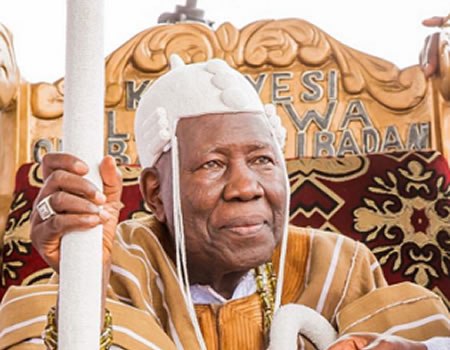
The Ibadan Council of Obas has issued a 21-day deposition notice to the Olubadan of Ibadanland, Oba Saliu Adetunji, accusing him of acts unbecoming of his office as the paramount ruler of the ancient town.
The traditional rulers led by Oba Lekan Balogun, the Otun Olubadan of Ibadanland, gave the notice on Monday at a press conference at the Mapo Hall, Ibadan.
Among the many allegations levelled against the monarch was taking actions on behalf of the council without inputs from members.
They also accused him of inciting the people against the state government, saying this was not representative of the relationship between the council and the government.
The Obas also queried the meetings of the Olubadan-in-Council, saying they were not conducted properly.
They further accused the Olubadan of allowing interests within and outside the palace to manipulate him to their own advantage.
Though the Obas said they were not keen on deposing the Olubadan, they said the council would recommend his removal from office to the governor if he failed to change.
Other members of the council who attended the conference were Oba Owolabi Olakulehin, Balogun of Ibadaland; Oba Abimbola Tajudeen Ajibola, Osi Balogun of Ibadanland and Oba Eddy Oyewole, Ashipa Olubadan of Ibadanland.
Others were Oba Lateef Gbadamosi Adebimpe, Ashipa Balogun of Ibadanland; Oba Amidu Ajibade, Ekarun Olubadan of Ibadanland and Oba Kola Adegbola, Ekarun Balogun of Ibadanland.
But when NAN contacted the spokesman for the monarch, Mr Adeola Oloko, he said he was yet to get the details of the development, promising to respond accordingly.
A 63-year-old doctor has appeared in court for allegedly having sex with his mentally challenged patients.
The prosecution told the southern German state of Bavaria today, Monday, that the doctor, who has not been identified under Germany’s strict privacy laws, exploited the trust of three of his mentally unstable patients to have sex with them, sometimes without treating the women.
The trained psychotherapist was said to have committed the acts either in his practice or in the women’s homes, the prosecution said, adding that he could face imprisonment of between three months and five years.
Prosecutors said in an earlier statement on the case that the doctor had regularly asked mentally ill patients to come for treatment between 2012 and 2015, usually in the late evening hours.
He is alleged to have told the women that sex was part of the therapy. Eventually, one of the women called the police.
The accused admitted the allegations in a statement made through his lawyer in February. Source: dpa/NAN.[myad]
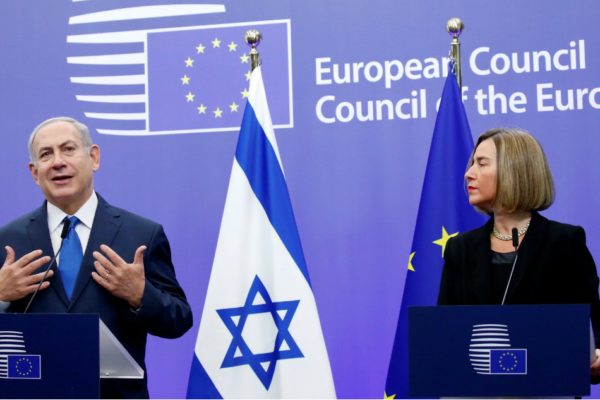
Israel’s Prime Minister Benjamin Netanyahu and European Union foreign policy chief Federica Mogherini brief the media at the European Council in Brussels, Belgium December 11, 2017
European Union (EU) foreign ministers has rejected Prime Minister Benjamin Netanyahu’s request to join the United State in recognizing Jerusalem as Israel’s capital.
Earlier, Netanyahu had asked the EU to ask allies to join the U.S. in Jerusalem move, but was met by a firm rebuff from EU foreign ministers who saw the move as a blow against the peace process.
Making his first ever visit to EU headquarters in Brussels, Netanyahu said President Donald Trump’s move made peace in the Middle East possible “because recognising reality is the substance of peace, the foundation of peace.”
President Trump announced on December 6 that the U.S. would recognise Jerusalem as Israel’s capital, breaking with decades of U.S. policy and international consensus that the ancient city’s status must be decided in Israeli-Palestinian talks.
Israel, which annexed East Jerusalem after capturing it in a 1967 war, considers the entire city to be its capital while Palestinians want East Jerusalem as the capital of a future independent state.
The Trump administration says it remains committed to the peace process and its decision does not affect Jerusalem’s future borders or status.
It said any credible future peace deal will place the Israeli capital in Jerusalem, and ditching old policies is needed to revive a peace process frozen since 2014.
Israel’s closest European allies have rejected that logic and say recognising Israel’s capital unilaterally risks inflaming violence and further wrecking the chance for peace.
After a breakfast meeting between Mr. Netanyahu and EU foreign ministers, Sweden’s top diplomat said no European at the closed-door meeting had voiced support for Mr. Trump’s decision, and no country was likely to follow the U.S. in announcing plans to move its embassy.
“I have a hard time seeing that any other country would do that and I don’t think any other EU country will do it,” Margot Wallstrom said today, Monday.[myad]
The Speaker of the House of Representative, Yakubu Dogara has said that the provision of section 143 of the 1999 constitution has made it impossible for any President of the country to be impeached.
Dogara, who made spoke today, Monday, in a lecture he delivered at the Nasarawa State University, Keffi (NSUK), third public lecture series tagged ‘depending democracy: the role of the legislature,’ the provision of section 143 of the constitution has made any Nigerian President the most powerful President in the world.
The Speaker explained that the provision of section 143 provides that after indicting the president of any illicit act, the chief judge of the federation who is an appointee of the president is saddled with the responsibility of setting up a 7 man committee to probe the president.
He said that since the chief judge is an appointee of the president, he is prone to intimidation by the president and would set up committee members who would dance to the tone of the president.
The speaker said that whatever decisions the 7 man committee comes up with, cannot be challenged in any court of competent jurisdiction.
Dogara said that in developed countries: “when they want to impeach the president, the lower house indicts the president while the upper house impeaches the president without referring it to any committee.
“During the 7th assembly one of my colleagues and I, sponsored a bill to amend that very section 143, but before I knew it, my colleague met me that he wants to withdraw from the bill.The day we were to vote on the bill, the then PDP chairman came and asked us to withdraw it because we wanted to use it to impeach the then President Goodluck Jonathan.”[myad]
The Court of Appeal in Lagos has told the Economic and Financial Crimes Commission (EFCC) that it has no powers to investigate and prosecute serving judicial officers for offences committed in the discharge of their duties.
The Judge gave the ruling today, Monday, in a case involving Justice Hydiazira Nganjiwa versus the Federal Government of Nigeria.
The court insisted that a judicial officer can only be investigated and prosecuted after being dismissed or retired by the National Judicial Council (NJC).
However, the Appeal Court said a serving judicial officer can be prosecuted for offences like murder, stealing etc., if such offences were committed outside the discharge of their official duties.
The Judge ruled that once a judicial officer commits an offence in the discharge of his duties, he must first be tried by the NJC and dismissed or retired before the EFCC can investigate or prosecute him.
The court anchored its decision on the principles of separation of powers between the three arms of government in the country.
In a lead judgment in an appeal No: CA/L/969C/2017, Justice Obaseki Adejumo, held that that the condition precedent to filing a charge against the accused judge was not fulfilled.
While allowing the appeal against a decision of the Lagos State High Court on the suspected judge, the superior court held that the NJC must first strip a judicial officer of his judicial standing before he could be charged with an offence allegedly committed in the discharge of his duties.
Based on that the Appeal Court held that the High Court of Lagos State lacked the jurisdiction to hear and determine the charge against the serving judicial officer.
It, therefore, set aside the ruling of the Lagos High Court and upheld the preliminary objection brought against the lower court.
The court also dismissed the charge brought against the embattled judge by the EFCC.[myad]
We use cookies on our website to give you the most relevant experience by remembering your preferences and repeat visits. By clicking “Accept”, you consent to the use of ALL the cookies.
This website uses cookies to improve your experience while you navigate through the website. Out of these, the cookies that are categorized as necessary are stored on your browser as they are essential for the working of basic functionalities of the website. We also use third-party cookies that help us analyze and understand how you use this website. These cookies will be stored in your browser only with your consent. You also have the option to opt-out of these cookies. But opting out of some of these cookies may affect your browsing experience.
Necessary cookies are absolutely essential for the website to function properly. This category only includes cookies that ensures basic functionalities and security features of the website. These cookies do not store any personal information.
Any cookies that may not be particularly necessary for the website to function and is used specifically to collect user personal data via analytics, ads, other embedded contents are termed as non-necessary cookies. It is mandatory to procure user consent prior to running these cookies on your website.



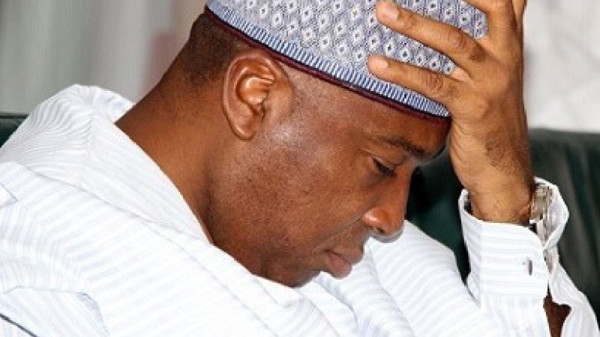 The Court of Appeal, Abuja Division has over-ruled the Code of Conduct Tribunal (CCB) which discharged and acquitted the Senate President, Dr. Bukola Sararki on an 18 count charge bordering false asset declaration.
 The elective Convention of the Peoples Democratic Party (PDP) that took place at the Eagle Square in Abuja on Saturday, December 9, was a charade and an anti-climax. Everyone who had been a witness to the travails of the once-upon-a-time ruling party which lost power to the All Progressives Congress in 2015 – viz, the humiliation, the victimization of the party and its agents by the successor-government, the catastrophic seizure of the party by a certain Ali Modu Sheriff, the desertion of the party by opportunists seeking fresh foothold, protection, and relevance in the new ruling party, the pummeling of the party as a party of corruption by both the stupid and the knowledgeable- indeed nearly everyone who witnessed all this had expected that the party would use the opportunity of the Convention to renew itself and set the tone for a new beginning. The event of Saturday December 9 was truly meant to be the PDP’s new beginning but was it? No, it wasn’t. The election that took place was another night of the long knives. After the macheting, the ego slaying, the marching out, and the intrigues of Caesarian flavour, the PDP was left in a worse state than it had been. It was sad. It was disappointing. It was a big let down.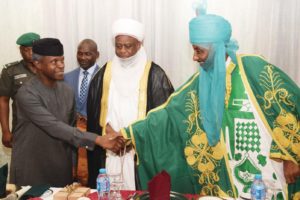



 The Court of Appeal in Lagos has told the Economic and Financial Crimes Commission (EFCC) that it has no powers to investigate and prosecute serving judicial officers for offences committed in the discharge of their duties.
