Home Blog Page 1424

Nigeria Requires N3 Billion To Execute 2018 World Cup Tournament – Sports Minister

Sports Minister, Barrister Solomon Dalung

Nigeria sports minister, Solomon Dalung has put an estimate of N3 Billion for the Super Eagles to successfully execute the 2018 World Cup competition in Russia.
“We have a conservative budget of about N3 billion but out of that N3 billion, FIFA is going to raise about N900 million, our sponsors and partners are also going to put about N600 million. Government will conservatively raise about N2 billion or N2.5 billion to compliment.”
The minister, who answered reporters’ questions at the Aso Villa, Abuja, said that his ministry intends to mobilize a very strong federal government delegation that will support the team because sports is also about number.
“The number of people you have on ground can also give support to the players and intimidate. So, we intend to go with at least a good size of the federal government delegation to give the team support.
“We intend to make it more inclusive so that Nigerians will participate in this particular victory which Nigeria is going to have.”
Dalung said that a number issues militating against performance of the Nigerian team in the past have been identified and will be addressed before the World Cup competition begins.
According to him, one of such challenges is the welfare of the players and the officiating team, adding that his ministry would set a new approach to the question of welfare.
“By March next year, we intend to start paying the players their allowances, camping allowances upfront. Now, that will go a long way to boost the morale of the players and confidence too. The new method of governance in football has taken the pattern of change. We will also ensure that there is unity within the football family.
“Because unity too is a key factor going by some of the reports we had in the past where poor performances were attributable to lack of unity between the family, the technical team,  the officials and the players.  This unity has to be promoted.
“Finally, we will also ensure that government makes funds available on time.  That has been why the budget for the competition has since been sent to the President for a special intervention so that government can make provision for some of the funds we need for training now before other things can come up.”  [myad]

President Buhari Commends Commander Of Guard Brigade For Discipline, Professionalism

President Muhammadu Buhari and wife of the Brigade Commander, Hajiya Amina Yusuf decorates the Commander, Guards Brigade from Brigade General to the Rank of Major General Musa S Yusuf at the State House in Abuja. PHOTO; SUNDAY AGHAEZE/State House.

President Muhammadu Buhari has commended the Commander of the Guards Brigade, Brigadier General Musa Yusuf, for demonstrating a high-level of discipline and professionalism in the discharge of his duties.
The President, who decorated Brigadier General Yusuf, who had just been promoted to the rank of Major-General, said that the senior officer displayed a high level of discipline during his two-year stint as Commander.
‘‘I congratulate the Brigade Commander for his achievements these past two years.
‘‘I never received any serious report of indiscipline in your formation that is in-charge of my security.
‘‘I hope you will get a command that will complement your experiences in the political headquarters.
‘‘I congratulate you very much for making it to this new rank at a very competitive time. I know there are so many Generals but when you go to the records you pick the best and place them at very strategic appointments.”
The President expressed confidence that Major General Yusuf will bring his experience in the field as a former Guards Brigade Commander to his next posting, as directed by the Defence headquarters.
Recounting his days as a military officer, President Buhari said officers earned the respect of their colleagues because of their intellectual disposition and experience in the field.
‘‘An officer is what he is when he gets into the field. Certainly, there was the need for intellectual officers but then what you do in the field is what earns you respect from those who are under you,”
In his remarks, Yusuf while reaffirming his “unalloyed loyalty and that of his troops to the President and Commander-in-Chief,” thanked President Buhari for the honour of decorating him with his new rank.
He conveyed the appreciation of his troops in Keffi, Nasarawa State and those at Gwagwalada, in the Federal Capital Territory to the President for the renovation works in the barracks.
“In Keffi, this is the first time in the last 25 years that 14 blocks of accommodation for soldiers are being renovated; he said adding that in Gwagwalada, the Chief of Army Staff approved funds for renovation works in the barracks to make it habitable.”
Born on November 6, 1966, Major General Yusuf had served as a member of Nigerian contingent to UN peacekeeping missions abroad including United Nations Mission in Eritrea-Ethiopia (UNMEE) and United Nations Mission in Sudan (UNAMID).

Libya: “No Brother In The Jungle,” By Reuben Abati 

Reuben Abati
Reuben Abati

Arab countries have a tradition of slavery dating back to centuries. This has persisted despite the existence of international conventions and legal frameworks classifying slavery as a crime against humanity. The current situation in Libya, involving slavery and human trafficking, has been brought to global attention because we now live in the age of communication where nothing good or bad can be hidden forever. But the situation is far worse than has been depicted. The Nigerians who have been brought back from Libya have told heart-rending stories of woe and misery: how they were sold into slavery by the Arabs and by their own Nigerian brothers and sisters, how they were subjected to all forms of indignity including rape, extortion, and torture, and how living in Libya is now the equivalent of a trip to hell. Quite a number of issues deserve closer interrogation to enable us appreciate the depth of this crisis.
The Libyan story today is a sorry advertisement for the abuse of NATO and the failure of the American foreign policy process. The multinational coalition that intervened in the Libyan civil war in 2011 and made the removal of Libyan strongman Muammar Ghadaffi its primary objective must by now be full of regrets. It is instructive that former US President Barack Obama has described the failure to think through the consequences of that intervention as the “worst mistake” of his Presidency. The character of that mistake lies in the fact that NATO and other forces despite the division among the global powers on the question of Libya, saw the internal crisis in Libya as an opportunity to deal with a man who had been labeled at various times as the “mad dog of the Middle East”, and who was gradually expressing “imperialist ambitions” – “the king of kings of Africa” with a pan-African vision. NATO’s intervention was an act of vendetta, an orchestrated punishment for a man who had been declared guilty of dictatorship. It was most convenient for the multinational coalition, with its eyes fixed on Libya’s oil, to support the rebels. The result is the mayhem that has overtaken Libya since the fall of Ghadaffi.
Under Ghadaffi’s watch, Libya was a stable, organized society. Following the bloodless coup that led to the flight into exile of King Idris 1 in 1969, the new leader, Muammar Ghadaffi, not only abolished the monarchy, he embarked on a mission of unifying the various clans under the umbrella of Libyan nationalism. He seized control of the country’s oil infrastructure from Western interests and redistributed wealth by creating a welfare system. The average Libyan had access to free housing, free medical care, and free education. The government provided infrastructure, and although Ghadaffi soon became a practical dictator, he managed to grow a sense of Libyan identity and unity.
Seeing himself as a pan-Africanist, he encouraged closer relations with other African nations. Many Africans from Egypt, Sudan, Nigeria and other African countries lived and worked in Libya, even if many of them took the menial jobs that an average Libyan would not touch – at that time. The country’s foreign reserve was about $200 billion. Its life expectancy and literacy rates were among the highest in Africa and the Arab world. The average Libyan enjoyed many opportunities except the freedom to be different or query the government and the Constitution. Those who removed and killed Ghadaffi didn’t realize how much of a potentially divided country Libya was, and the extent of Ghadaffi’s efforts in managing the centrifugal tendencies.
After Ghadaffi, Libya imploded. Anything is possible in Libya today because there is no responsible government in charge. People are resorting to self-help. Anybody that is armed exercises authority and does anything to make money. The welfare state has collapsed, criminality is widespread: kidnapping, slavery, violence, the economy is in shambles. Clannish and sectarian differences now predominate. The country is drifting. Most of the people are like prisoners, including those who are gainfully employed. In the absence of a government, the international community appears helpless. This is the setting for the chaos and the humanitarian crisis that has overtaken that country.
Libya remains nonetheless, a major transit point and exit route for many Africans seeking to escape illegally into Europe. Libya, a country whose land area is almost twice the size of Nigeria, has over 2,000 kilometres of Mediterranean coastline from the Egyptian border to the Tunisian border. Frustrated by the objective conditions in their own countries, in the form of crippling poverty, misgovernance, unemployment and the difficulty of getting a visa or being able to buy a ticket to Europe, many Africans, particularly West Africans opt for the cheaper, albeit illegal option of sneaking into Europe through the desert and across the Mediterranean sea, with Libya and Algeria as the most popular exit points. This has always been a risky venture, but the traffic continues to grow. It is also an organized criminal operation involving gangs at home, and along the route. Nigerians constitute the majority of these illegal migrants.
Organized by a criminal gang at home, they usually travel through Niger, which is a contiguous, ECOWAS country. In Niger, another gang of human traffickers, mostly Touaregs take over from their Nigerian partners to take the illegal migrants across the desert to Libya. Only about 60-70% eventually make it to Libya. Many die along the way because of the harsh desert conditions and they are buried in the sand. Those who eventually make it to Libya are not necessarily lucky. They may be kidnapped at the border by rampaging Arab militants, turned into slaves, and asked to contact their families back home to pay ransom. The men are beaten; the women are raped. The images that we have seen from Libyan slave camps are sad. Arab racism has been an issue and violence towards foreigners is not necessarily new in Libya, but it is getting worse because now the issue is not strictly racism but the people’s desperation for survival in a state that failed.
It is estimated that about 500, 000 – 700, 000 Nigerians are trapped in Libya. The Obasanjo government once had to repatriate over 17, 000 Nigerians from that country. In the light of recent developments, the Buhari government has also repatriated over 1, 000 Nigerians from Libya in 2017 alone, but there is no hope that all of them can be brought back home. Many will like to return home, but they don’t even have the means to transport themselves to the evacuation points. Those that are not enslaved are still hoping to make enough money to be able to cross to Europe. They wash cars, work as farm hands or as security guards, or prostitutes, and they get exposed to all the dangers imaginable. The few who manage to make the final journey to Europe are not always lucky either: they could perish in the sea like the 26 Nigerian girls who recently drowned while trying to cross into Italy.
The saddest part of it all is that Nigerians are also involved in the trafficking and dehumanization of their own compatriots. In a shocking account by one Sunday Anyaegbunam, a Libyan returnee, who left Nigeria in April 2017, with his wife, we are told that: “The Nigerians selling people in Libya are more wicked than many of the Arabs. I have never seen people so heartless as the Nigerians who bought and sold me. There are many of them in Agadez and Sabha, who are making so much money from selling their own people. But there are other West Africans doing the business too. When you approach them and say “please, my brother, help me.” They would tell you: “No brother in the jungle”. Libya is indeed now a jungle in the hands of armed militants, the Islamic State, tribal gangs, and an interim leadership authority. The jungle is a dangerous place: which is why it is surprising that more Nigerians would prefer to abandon their own country and go to the jungle.
About 70% of the Libyan returnees are reportedly from Edo State, and in general most of them are from Edo, Delta, Imo, Anambra and Rivers states. But this is not enough reason for this problem to be treated as Southern Nigerian or Christian. This should not be about North or South, or Christian vs Muslim. It is unacceptable for every Nigerian issue to be reduced to this kind of division, the same way some Nigerians tend to dismiss Boko Haram as a Northern problem. This is a crisis that affects all of us. It is embarrassing that Nigerians are deserting their own country and flocking to Europe in droves despite the risks of illegal migration. In the 70s, many Nigerians were proud and happy to live at home, but since the introduction of austerity measures in the 80s and the gradual collapse of the Nigerian economy, a new kind of economy has since developed around dangerous choices.
The consequences are not limited to the tales from Libya. There are Nigerians in jail or on the death row across the world, in China, Thailand and the Middle East. We need to have a strong policy in place to check illegal migration. Massive enlightenment campaigns should be organized to educate the populace about the associated dangers. There is an assignment here for the National Orientation Agency (NOA), a strategic agency, which has been relatively sleepy since 2015. Our youths should be told that there is no safe route to Europe through the desert or a boat ride.
Everybody should wake up – government, civil society, and all the people who have abdicated their responsibilities at the level of the family unit. The human trafficking gangs in the country especially in the identified major centres should be tracked, identified and sanctioned. Government should create a conducive environment for our youths to make a living at home. Government has a constitutional responsibility to empower all Nigerians and to guarantee their security and welfare. Nigeria should also engage the government of Niger. What can we do to prevent illegal migration through Niger? This has to be a joint responsibility between Nigeria and Niger. Although Chad is not in ECOWAS, quite a number of Nigerians also travel through that route. Joint border patrol and exchange of useful intelligence between Nigeria and her neighbors would be advisable.
The Federal Government of Nigeria and its agencies, the National Agency for the Prohibition of Trafficking in Persons (NAPTIP) and the National Emergency Management Agency (NEMA), the Ministry of Foreign Affairs, the Edo State Government and the International Organization on Migration, CNN, Pastor Temitope Joshua’s The Synagogue, Church of All Nations (SCOAN) and every other group or agency that has responded decently and responsibly to the plight of the Nigerians from Libya, and the evil of slavery in Libya, deserve to be commended. In spite of the deviousness of a minority who earn a living by dehumanizing their fellow human beings, it is enheartening to see that warm blood still flows in the heart of mankind. The Edo State government has put in place perhaps the most comprehensive rehabilitation programme for the Libya returnees: counseling, accommodation, vocational training, and take off grants after training.
These are worthy steps, but they are at best short-term. The long-term measures for all governments should be good governance, public enlightenment and concerted international action against slavery and all forms of cruelty and inhumanity. [myad]

Boko Haram Kid Victim Miraculously Walks Out Of Danger After Surgery In Dubai, Gets Scholarship

kid

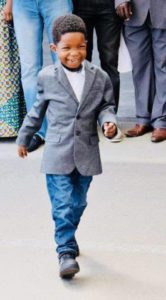
A six year old victim of Boko Haram attack in the famous Chibok village, Borno State, Ali Ahmadu has walked gallantly out of the worst danger, as he returned to Nigeria after undergoing a corrective surgery in Dubai, United Arab Emirates (UAE).
According to information reaching us, young Ali was flown to Dubai on September 10 this year under the guidance of GIPLC, a non governmental organisation that coordinated appeal for help to enable the young boy walk again.
It was gathered that as a result of the appeal, the Dickens Sanomi Foundation donated over N17 million for the Hospital fees as well as transportation and other services in Dubai.
Ali was said to have returned to Abuja aboard Ethiopian airline accompanied by his aunt and Mr. Nuhu Kwajafa, who is the coordinator of GIPLC. He was by the bedside of young Ali during the period of treatment and rehabilitation.
An official of the foundation who received Ali Ahmadu at the Nnamdi Azikiwe Airport, Goodluck Hayi in a brief address to news men, said that Dickens Sanomi foundation will be working with Ali’s Family through GIPLC to support his post surgery life “as we help him settle into Abuja, to grow as a child with love and care.
“I am authorized to announce that an Educational Scholarship will be provided for Ali, until he gets to University by the Taleveras Foundation.”
Hayi recalled that about three months ago, “we all witnessed at the same airport Ali Ahmadu being taken away on a wheel chair, today to the Glory of God we are here to receive Ali Ahmadu, walking handsomely into our arms.”
He said that what started as a painful Journey for little Ali after the Boko Haram attack in Chibok, four years ago that confined him to a wheel chair, has transformed into a Journey of hope, Love and care.
“Dickens Sanomi Foundation, is backed by the principle of Love and care, one that was practiced and preached by Late Assistant Inspector General of Police, Mr Dickens Sanomi, today we demonstrate these principles by being our neighbours keepers and teaching love by showing it.”
The coordinator of GIPLC, Nuhu Kwajafah who also spoke upon arrival from Dubai said that young Ali “suffered excruciating pains all over his body, brought upon him by the senseless marauders” when they invaded his village of Chibok in 2014.
Kwajafah said that Boko Haram terrorists“ crushed everything/everyone in their path,severely damaging his still forming vertebral column in the process but the hand of God preserved Ali, so we may give glory to His name.”
He added that since that incident, the little boy never accessed any form of orthodox medication.
“He was at the mercy of traditionalist, in highly unpredictable and perilous times. Obviously, during this period, access to education, nutrition, psychosocial tuning, water, sanitation or hygiene, was very limited, if not non-existent.
“He was immobile and fast detoriating, physically and mentally, from that period till the 1st quarter of this year,2017, when GIPLC(Global Initiative for peace, love and care) made contact with him.”
He said that the organisation facilitated the relevant examinations & digital/lab tests, for assessment and proper medical attention.
The results, he said, revealed that Ali couldn’t access the quality care required.
“After duly assessing the various options open to us, from all over the world, we resolved to take him to the UAE. After almost 6 hours of extremely delicate surgery, about a week in ICU and a month in recovery, Ali took his first steps into a brighter future.”
Kwajafah said that GIPLC is committed to Ali’s post surgery well being and have received confirmation from Dickens Sanomi Foundation to support his settling in the society, while the Taleveras Foundation will provide him an Educational scholarship as he settles in Abuja.
Kwajafah said that GIPLC is also organizing an end of year party for orphans and vulnerable children for over 3,000 children.
“This is our 5th Year and Ali Ahmadu will be Guest of Honour. This event has always been sponsored by Taleveras Foundation for the 5th year running.” [myad]

Even If Atiku Is Dreaming… By Yusuf Ozi-Usman

Alhaji Atiku Abubakar

When the former Nigeria Vice President, Atiku Abubakar announced his return to the Peoples Democratic Party (PDP) on Sunday, December 3rd, I didn’t know whether to laugh for his ingenuity and consistency in searching for platform to become President, or cry for his consistency in changing political party as he changes his caps.
Atiku is consistently creating credibility problem for himself and, by that, embarrassing his supporters across the country.
As a matter of fact, it is not his resignation from the All Progressives Congress (APC) a fortnight ago that is the issue here. If he had joined a political party other than the PDP, perhaps, he would have made some points even if they are not so clear to political analysts.
This was a man, who swore on March 10, 2015 that nothing would make him to return to the PDP, saying: “not even in my dream will I return to PDP.”
In a statement that day, December 10, 2015, reacting to reports in a section of the media of his purported return to the fold of the PDP, Atiku said that he would never leave APC for any reason.
“I remain irrevocably committed to the APC,” he swore, describing his purported return to the PDP or any other party as the handiwork of mischief makers focused on pitching him against other leaders of the then opposition APC.
Atiku said that for the avoidance of doubt, he was unequivocally committed to the unity of APC and that it would take more than the antics of mischief makers to break that bond.
“I have backed my words and commitment with my resources to ensure that I bring my influence and support to bear on our party’s march to victory at all levels in the general election. That should be enough to shut up mischief makers bent on derailing the APC’s success at the March 28 and April elections.”
I have quoted him extensively in order not to leave anyone searching for excuses to refute his words or he, referring to me, a neutral political observer cum commentator, as mischief maker.
The way Atiku is going about his ambition to lead this country in a more obsessive way, shows clearly how he either has lost the sense of the history or how his handlers have simply found a lucrative way of milking the enormous wealth he is in control of.
Talking about history, Atiku had once left the same PDP to align with the then Alliance for Democracy (AD) in his usual search for political platform to contest the Presidency, and when he could not make it, he returned to the PDP. In a build-up to the 2015 election, he also spare-headed the formation of New PDP, which later fuse into the grand alliance that snowballed into the APC. By the historical facts, one is not in doubt that Atiku has no permanent friend or more appropriately, confirmed political party, but a permanent interest of becoming the President of the country.
And talking about his handlers, it is obvious that they read him very well and are always on the look out for the best way of exploiting what looks like his weak point – vaulting ambition.
The handlers are always around to drum it to his ears that he is the best President Nigeria must have. Once he falls into that trap, they gather around him to make their millions. But the sad thing about it is that at the end of the day, the handlers hardly deliver, going by what happened in the past.
Atiku, this time, seems to have boxed himself into a tight political corner, because, some leaders in the PDP are obviously suspicious of him: they cannot trust him again. Some of them are already thinking that he is being planted in the party to cause confusion and make easy way for the APC Presidential candidate, likely to the President Muhammadu Buhari, to win the 2019 election.
The dilemma is that even the APC from where he had resigned, are feeling relieved of his act of breathing down their necks, wanting to be carried along in a way that he would be anointed as the next President.
In all honesty, even his avid supporters are confused and, like I said, embarrassed by what my grand son would say jumping-jumping.
Of course, my concern about Atiku’s resignation from the APC and his return to the PDP is not whether he will eventually become the PDP Presidential candidate, going forward, for, that is his absolute right. My concern is the way he has started his campaign, attacking persons and the party he was coming from.
What Nigerians want to be hearing from him, as a matter of priority, are things he will do differently to tackle the economy, corruption, security, food production, education, health, infrastructural development, Political stability, foreign affairs and myriad of other socio-economic challenges facing the country.
It never really makes any difference if he had never in his life visited America and whether President Buhari had never visited America. It doesn’t matter really if the APC and President Buhari have performed dismally in all the sectors of the nation’s life. What matters as far as he is the one talking, is how his Presidency will bring about an Eldorado.
And so, even if Atiku was dreaming, he couldn’t have sleep-walk into PDP, going by his promise. But, since he had walked back into the PDP which he roundly vilified a couple of years ago, he has to look fresh and productive even in the way he addresses the challenges facing the country. We have heard all that he has been saying about the APC and President Buhari from him, against PDP and ex-President Goodluck Jonathan, when he was crossing over to the APC in 2014.
He needs to CHANGE from the over-beaten track.[myad]

National Chairmanship Contest: PDP At Crossroads, By Sufuyan Ojeifo

For avid watchers of the nation’s political scene, the developments in the opposition party, the Peoples Democratic Party (PDP), over the election of substantive national chair and other officers, understandably, deserve more than a scant attention.  This is due, largely, to the fact that, as a leading opposition party in the country, the PDP is the alternative government-in-waiting.

However, for it to transmute and become government-in-power, it must muster the capacity to dislodge the ruling All Progressives Party (APC), otherwise, it will be the alternative government-in-waiting beyond 2019.  Capacity, in this sense, refers to human, financial, material and intellectual capacity.  Located in the vortex of this critical component is leadership ability to galvanise and mobilise party members along desired directions.

Therefore, a leadership that has the character and discipline to further the process of consensus-building within the party as well as construct and strengthen strategic linkages with other parties in the overall interest of the nation is imperative in the PDP quest for self-rediscovery, not a leadership with questionable antecedents or a leadership that is mollycoddled by some state governors to the extent of being rendered compromised from the outset of its administration of the party consequent upon anointment.

Having just been pulled back from the jaws of the lion via the verdict of the Supreme Court, after it had sustained scary injuries inflicted on it by some self-seeking members, it will be sad if PDP repeats the same mistake that plunged it into that celebrated hysteria.  Both members and non-members of the PDP were concerned that a party that had blossomed for about seventeen years with sixteen of those years in the saddle at the federal level, was headed for self-immolation.

The role of the duo of Rivers state governor, Nyesom Wike and his Ekiti state counterpart, Ayodele Fayose, in signing off the party to Senator Ali Modu Sherrif is still very fresh in the mind.  The battle that Sherrif took the party and its salvation army of leaders through before they could reclaim the party and prepare it for the national convention billed for this week’s Saturday in Abuja cannot be forgotten in a hurry.

Both Wike and Fayose admitted making a mistake that could have destroyed the party.  Having been given a second chance to restitute, one would have expected Wike, in particular, to be of good behaviour and act in ways that would conduce to peace, stability and growth of the party.  But developments in the party have clearly indicated Wike’s resolve to once more embark on a scary adventure that is capable of destabilising the party.

In his new preoccupation to assume control of the party structure, he has enlisted the support of the National Caretaker Committee chairman, Senator Makarfi, who is interested in the presidential ticket of the party.  In the spirit of quid pro quo, both party leaders are committed to the realisation of each other’s agenda.  For a promised support for his presidential aspiration by Wike, Makarfi has ensured that the micro-zoning of the position of national chair to the southwest zone is discountenanced and the contest thrown open to the entire southern region.  Curiously, it is only the national chair that is subjected to this political shenanigan.

Perhaps the move would have been popular if the choice of aspirant had been different from Uche Secondus, a crony of Wike, whose antecedents in the National Executive Committee of the PDP where he acted briefly as national chairman have arguably been questionable.  Perhaps, if Wike and his co-travelers in the fresh plot to destabilise the party have been pushing Chief Raymond Dokpesi, whose capacity and qualification for the post are not in doubt, it would have been a different ball game.  It would have been a case of undisputed merit against zoning.  But where is the merit in Wike’s Secondus?

It is sad that Wike could expend public funds belonging to Rivers people in pursuit of a laughable national leadership for the PDP.  This act has only exposed the governor as profoundly ridiculous and provincial.  Even if his plan is to test his popularity and financial might in the party, should he not have placed his bet on another person outside his Rivers state?

Dokpesi would have been the right person.  I cannot fault Dokpesi’s political connections, preeminence and administrative savoir-faire.  Even at that, those who crave the entrenchment of due diligence, respect for party supremacy and discipline would invest their solid support for the emergence of the substantive national chair from the southwest zone.

It is expected that those who are committed to the survival and progress of the PDP would ensure that the next national chair comes from the southwest.  If southwest does not get it, it would have lost out completely from the PDP power arrangement, which has already ceded presidential position to the north.  The south-south has just ended its occupation of the presidency in 2015 and should not talk about appropriating the national chair.  Besides, it is only the southwest that has not produced the national chair of the PDP since the formation of the party in 1998.

If it wants to stay together as a united party, the PDP must not allow any action or decision that would undermine its existence, progress and stability.  But, unfortunately, that is the trajectory that the party under the leadership of Makarfi seems to have taken.  Selfish political interests have once again reared their heads in a desperate bid to hijack the party machinery and control the soul of the party.  Such moves certainly always leave any party divided, weak and unable to effectively confront the “monstrosity” of the ruling party.

The contestation for different positions was structured, jurisdictionally circumscribed and settled. There should not have been any reason at all to throw open the position of the national chairman to the entire southern region, the way Makarfi has done on the prompting of Wike for his promised support for his presidential ambition.  And who would have thought that Makarfi would become so desperate as to fall for Wike’s overture?

Makarfi has surprisingly unraveled, thus losing a historic opportunity to show selfless leadership and firmness in dealing with a potential flashpoint in the party’s march to self-rediscovery.  The good thing is that there are men of honour in the party who would shun Wike’s messy porridge and do the right thing for conscience sake and for posterity. The survival of the PDP will certainly bear their imprimaturs.

Ojeifo contributed this piece from Abuja via ojwonderngr@yahoo.com   

 [myad]

I’m Demoralized By People Using Money To Buy PDP Chairmanship – IBB

General Ibrahim Badamasi Babangida (Rtd)

Former Nigeria Military President, General Ibrahim Badamasi Babangida, has described the sound bites of monetization of the process leading to the national convention of the Peoples Democratic Party (PDP) coming up next week, December 9th and 10th, aimed at producing the national chairman of the party, as utterly demoralizing and benumbing.

In a statement today, Sunday by his media aide, Prince Kassim Afegbua, General Babangida said that he is ‘frightened’ by the extent of the on-going attempts to determine who emerges PDP chairman  through the use of  money.

He said: “we must begin the process of interrogating processes that lead to outcomes and not just the outcomes. We must interrogate our leadership recruitment process and encourage our delegates to exercise the power of their thumbs in making their preferred choice among the candidates.

“Our party, the PDP, must re-invent and re-enact itself on account of her recent history of factions and fractures. The new leadership must, therefore, be one that enjoys the confidence of the majority stakeholders and members in order to have a seamless transition. To achieve this template, such a chairman must be the outcome of delegates’ election without manipulation and inducement. One would have thought that after the 2015 dismal outing, followed by months of leadership tussles, individuals would have put to rest their selfish and egocentric interest and pursue goals and objectives that bear true testimony to the ideals of the founding fathers; but the sound bites of monetization of the process are utterly demoralizing and benumbing.”

The former leader noted with regret that in the countdown to the Saturday 9th December, 2017 convention of the party, he as one of the founding fathers and stakeholders, would advise on the need for the stakeholders in the party to collectively assure Nigerians and members that they have learnt our bitter lessons.

“Following the defeat of the party in the 2015 election, it is incumbent upon us as leaders and stakeholders to use the opportunity of the convention to sober reflect on the challenges confronting us, identify our flaws and seek plausible ways to correct them in order to come out stronger in subsequent elections.

“An elective convention presents as it were, a rare opportunity and veritable platform to elect in a holistic manner a credible, tested, down-to-earth and truly urbane candidate with enough stamina, distinguished character and national acceptability who is driven by incurable optimism and passion for a united Nigeria. At this point of our political history as a party, we need a National Chairman who is driven by uncommon initiatives, creativity in ideas and a rich content of character to lead and stabilize the party in line with the laudable ideals of the founding fathers of the party. Such an individual must possess national recognition to be able to galvanize political opportunities and transform them into tangible outcomes in our democratic engagements.

“When we were conceptualizing the idea of the PDP at formation, we had in mind a party that offers platform for all Nigerians in their pursuit of legitimate political aspirations. The choice of her motto; POWER TO THE PEOPLE was in sync with our clear objective of recognizing the people as the repository of power. In any democratic engagement, the people decide the outcome of elections through popular and inclusive participation.

“The monetization of our electoral process is disturbingly eroding that power which should ordinarily reside in the people.

“In the last few days, I get frightened by the monetary consideration that is likely to dictate who emerges as the National Chairman of our great party rather than what the people truly want. The discussion is more on the side of heavy monetization of the process and ultimate “procurement” of the position of the Chairman by the highest bidder.

“This approach, in my humble view, defeats the whole essence of participation, free choice and voting which are the essential attributes of any democracy without inducement and outright manipulation.

“I wish to plead that we tread on the path of caution and common sense, conscious of our recent history of avoidable political crisis.

“At 76, and given the benefit of hindsight, my role both in context and content; is now more of advisory one to enhance any altruistic democratic process to elect credible leadership at various levels of representation.

“Rather than de-monetize the electoral process to provide ample room for more citizens’ participation, the idea of monetizing the process and trying to “procure” party positions defeats merit, offends good conscience and blurs fair play. At this critical stage of our political secretions, we need men of stature, discipline, character and commendable conduct to breathe fresh air into our party and not persons whose political relevance is the product of naira and kobo bargain across the counter.  We need a National Chairman that would not bend to the vagaries of individual selfish interest but one who is strong enough to apply the rule of law without fear or favour.

“Good name cannot be bought with gold or silver. Good name is the sum total of the individual’s conduct in his trajectory and his overall assessment through life’s enduring journey.

“On the strength of this, I wish to make a passionate appeal to our members, party leaders and the members of the Convention Committee to be fair and just to all, and allow the process to produce a National Chairman that would truly represent the conscience of the party. I do subscribe to the idea that consensus building, collective bargaining and constructive engagement are some of the ingredients that nurture any democratic process; such ingredients should be given enough room to flourish in order to birth credible and truly representative leadership.

 “It is my strong belief therefore that leaders of the party irrespective of their political interest would allow reason and level playing field to prevail in the overall interest of the party. I wish the party a successful and peaceful convention on Saturday 9th December, 2017. “[myad]

Nigeria Is Ready To Provide Leadership For Africa On Violence Extremism – Buhari

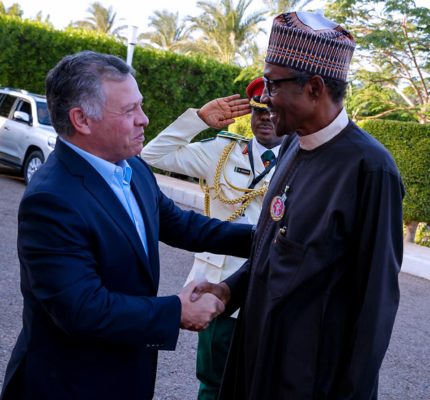
President Buhari holds Bilateral Meeting with King of Jorda

President Muhammadu Buhari has given assurance of the commitment of Nigeria to providing a leadership role in bringing together countries of the West African sub-region in collective security arrangement.

Speaking in Jordan at a security meeting hosted by King Abdullah II, President Buhari said that with what Nigeria had gone through, it was ready to share the experiences with a view to fashioning out comprehensive action plans in tackling the scourge of violent extremism in the region.

He called for a stronger and well-coordinated collaboration, saying that the joint regional collaboration under the auspices of the Multinational Joint Task Force, combined with the efforts of the Nigerian Armed Forces, had gone a long way to decimate the activities of extremists in the West African region.

President Buhari said that insurgents were able to attract members in their fold because of the insidious preaching of extremist clerics and called for an action plan to halt the trend. He also advised leaders, especially from the Muslim world to speak up against the hateful violence committed by deranged people in the name of Islam.

“All nations, irrespective of religion should partner effectively in implementing national, regional and global action plans to counter violent extremism.”

At the end of the meeting, participants resolved to come up with concrete action plans that would change the narrative of violent extremism in the West African sub-region at a follow-up meeting to be hosted by Nigeria.[myad]

Senator Makarfi Vows To Challenge Atiku At PDP Presidential Primary

Ahmed Makarfi, PDP National Chairman

The Chairman of the Peoples Democratic Party (PDP) Caretaker Committee, Senator Ahmed Makarfi, has made it clear that he will challenge former Vice President Atiku Abubakar, who just returned to the party and is likely to contest for the party’s ticket for 2019 election.

In an interview in the current edition of The Interview magazine, Makarfi said: “Atiku left before, he’s back just in time before the (party’s) Convention.”

In response to a question about his own interest, Makarfi said: “I have thought of it. By the time I leave as caretaker committee chairman on the 9th or 10th, there’ll still be ten months to the party primaries. By any law or the party’s guidelines, I’m not excluded.”

Makarfi said that the PDP is expecting a harvest of defections from the All Progressives Congress (APC), after Atiku’s move from the party to PDP.

“For some strategic reasons, I don’t expect a lot of people to move to the PDP now. People are in APC for different reasons. Wait for the time when everybody will be on his own, you will see the influx of people into the PDP.”

Makarfi, who came close to being the PDP’s presidential nominee in 2006, revealed for the first time how former President Olusegun Obasanjo schemed him out, even though an internal party assessment had returned him as the most favorable candidate.[myad]

Atiku Returns To PDP

Atiku Abubakar
Atiku Abubakar

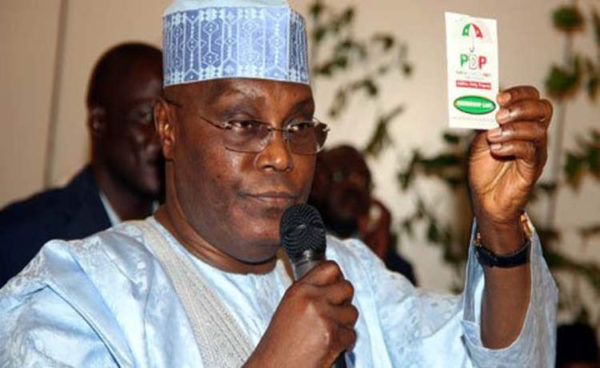
Former Vice President Atiku Abubakar has announced his formal return to the Peoples Democratic Party (PDP).

He did the switch in the format of the information age: by announcing it Live on Facebook on Sunday following what he called his consultations with party leaders and stakeholders from across the country.

Atiku was a member of the All Progressives Congress (APC) until last week when he announced his resignation. The PDP has a national convention scheduled for 9 December in Port Harcourt.

Atiku read a statement live on Facebook and photographs later distributed by his Media Office showing him fiddling with his smartphone as he responded to questions from his Facebook followers.

The live announcement had garnered just 24,000 views at about 5pm.

Atiku’s statement went thus:

“Hello, my name is Atiku Abubakar.

I am speaking to you today on Facebook Live as I want to reach as many of our young people as possible as I have an important announcement to make about the future of Nigeria.

As it is you, our youths, who represent the future of our nation.

I have found in my travels across the country that whenever I get into conversations with young people their number one concern is whether they will be able to get a job for without a job they have no means of sustaining themselves or begin a family.

And without the security of a job we cannot have security in our country.

So without jobs there is no future for you or for Nigeria.

And I also know as a parent that the older generation is also concerned about jobs for their children and, too often today, for themselves as well.

Creating jobs is something I know about as I have created over 50,000 direct jobs and 250,000 indirect jobs in my own State of Adamawa.

And I also know how the Government can help create the right environment for businesses to create jobs. When I was Vice President in 1999 I was responsible for liberalising the telecoms sector which enabled us to increase the number of people who could access a phone from less than 1 million then to over 100 million today.

This transformation resulted in the creation of hundreds of thousands of new jobs from the top-up card vendors you see on every street corner to the many new businesses that fed off the mobile phone revolution.

Some of you may know that I was elected Vice President under the banner of the PDP, which is the political party I had helped to found some ten years before.

And some of you may also know that I left the PDP four years ago when I believed it was no longer aligned to the principles of equity, democracy and social justice upon which we had founded it.

I joined the APC as I had hoped it would be the new force that would help improve life for our people and I was excited about the party’s manifesto to create 3 million new jobs a year.

The result has not been the change people had been promised or voted for, as in the last two years almost 3 million Nigerians have lost their jobs.

And today with a record 25% of people aged 18-25 unemployed I can see how difficult it is for our youths to find a job.

The key to creating jobs is a strong economy and that is what we are currently lacking.

So today I want to let you know that I am returning home to the PDP as the issues that led me to leave it have now been resolved and it is clear that the APC has let the Nigerian people, and especially our young people, down.

The declaration was followed by some questions posed online by several fans.

The first shot was how could deal with the problem of Nigerian youths when he is over 70 years old.

His response: I meet young people every day. I have children and grandchildren and most of my employees are youths. The key to knowing what young people want is to listen to them. I’m good at that. Sometimes when I am on the phone with my kids they ask me are you still there, because I just listen to them without interrupting. Young people are on social media and so I go there. They tell me that their number one challenge is jobs.

Terrorism, militancy, kidnapping, and other forms of exuberance they may lead to criminality are a symptom of the disease of joblessness.

Once you can get Nigeria working again and get Nigerians working again, youth restiveness will ease and gradually disappear,” he concluded.

Source: NAN.[myad]

Advertisement ADVERTORIAL
WP2Social Auto Publish Powered By : XYZScripts.com