Vice President Yemi Osinbajo has said that he is not in a position to know whether President Muhammadu Buhari will eventually sack the suspended Secretary to the Government of the Federation (SGF), Babachir David Lawal and Director General of the National Intelligent Agency (NIA), Mr. Ayo Oke. Professor Osinbajo, who spoke to news men shortly after submitting to the President, the report of fact-finding committee set up by the President to look into the cases of the two officers of the government, said when asked if heads would roll as a result of the report: “No, how can I tell you? If you want to know what is in the report, you have to wait; you really have to wait. Even when he was asked to give a brief of what is contained in the report, the Vice President retorted: “of course not. I mean this is a report which contains recommendations to the President. “It is a fact finding committee as you know and what our terms of reference were was to find out, based on the fact available to us and based on the interviews of witnesses of what transpired in those cases of the report one involving the SGF and the other the DG of NIA. We have now concluded that and we submitted a full report with recommendations to the President. “We cannot of course give you any kind of details because the President has to look at the report, study it and then make his own decisions based on that report.” Professor Osinbajo stressed that his committee did its work with fairness to all the parties involved and that the whole approach was to ensure that justice is done in all cases. “It is in the interest of the government and also the interest of the nation that things are done properly and that there is due process and that we are not unfair. You can be sure that we will do the right thing.”
Minister of the Federal Capital Territory (FCT), Malam Muhammad Musa Bello, has expressed dissatisfaction with the commercial relationship between Nigeria and Poland. The minister, who received in audience, organizers of the Polish-Nigeria Business and Investment Summit (PONBIS) in his office in Abuja. Muhammad Bello said that the commercial relationship has been so skeletal despite that the country is one of the fastest growing economies in Europe today. The Minister cited Poland’s proficiency in the construction and heavy steel industries. “I think this is the right time for you to come fully into Nigeria because the government is serious about encouraging trade between Nigeria and countries like yours. “I am therefore very happy that you are already liaising with the Nigerian Investment Promotion Council (NIPC), which is the right organization for you to deal with because they have the expertise.” He unveiled the various investment opportunities in the medical field, especially in equipment and medical diagnostic services even as he advised Poland to facilitate cultural exchanges between them and Nigeria. Other areas, the Minister mentioned include; educational exchanges between lecturers and students, saying: “you can encourage your scholars to come here on sabbatical leaves, maybe to undertake some aspects of their studies.” Muhammad Bello highlighted the attractiveness of Abuja as an investment destination. The leader of the delegation Dr. Piotr Uruski, a member of Polish Parliament had said that they were in FCT to invite the Administration to the First Polish-Nigeria Investment Summit scheduled in Poznan, Poland on the 25th and 26th of September this year. Dr. Uruski wanted the Minister to be around to address the Polish parliament as well as meet with the Poznan Marshall, (equivalent of a Governor in Nigeria) towards establishing mutual cooperation and trade promotion. The tour was facilitated by Dr. Okechukwu Nwafor, who is Director of Centre for Polish and African Affairs, Poznan University of Communication and Management.[myad]
Some Indian Muslim women protest the court ruling |AFP Photo/SAM PANTHAKY
India’s Supreme Court has outlawed Islamic mode of pronouncing divorce on women, in which a Muslim would say ‘Talaq’ – ‘divorce’ in Arabic – three times in quick succession.
India is one of the few countries where a Muslim man, by way of Qur’anic injunction, can divorce his wife by pronouncing the Talaq.
A 3-2 majority judgment by five-judges, ruled that the practice was unconstitutional, illegal and a violation of the right to equality.
Former attorney general Mukul Rohtagi, who represented the Indian government in court, welcomed the judgment.
“The constitution is the highest law. All laws, including personal laws, must abide by constitutional guarantees and constitutional freedoms, including the right to live with dignity.
“There is no manner of doubt that this judgement will go in showing whole world, that we are progressive nation and the constitution applies with equal force to all, including Muslim women, and they will also walk without fear, just like women of other communities.”
An Indian Muslim Women’s Movement group, one of the petitioners, Zakia Soman said: “we are very happy, we have won. We, the Muslim women, were till so far deprived of a law which is gender-just, which upholds our rights in marriage and in family.
“It is because of the domination and hegemony of patriarchal elements that Muslim women have suffered for the last 70 years. It is a historic day for us.
“But it doesn’t end here. A proper, longer battle for social reform, for women’s empowerment, awareness, education has to be taken up.”
The ruling Bharatiya Janata Party government backed petitioners in the landmark case, with Prime Minister Narendra Modi often speaking against the practice.
“It grants equality to Muslim women and is a powerful measure for women empowerment. It is historic judgment,” Modi said in a tweet.[myad]
Anambra State Governor, Willie Obiano has given a counter directive to the people of the state to confront the Indigenous People of Biafra (IPoB), over threat that it would disrupt the November 18 governorship election in the state.
He urged them to challenge any person or group that attempts to disrupt peace or cause chaos during the election. Obiano who spoke in Awka, the state capital observed that security reports available to him revealed that those behind the threat were from outside the state and wondered why such people should always come to Anambra to foment trouble.
He said the state has been declared very safe and assured that it would remain so before, during and after the election. Obiano urged the people not to be disturbed by election boycott threats, but to be prepared for such persons, should they attempt any such ill-advised intention to disrupt peace during the election.
“We cannot allow somebody from another state to invade our peaceful state and issue unwelcome directives to us. “We will not fold our hands and watch such an individual motor in people from Abia, Enugu and other places to disrupt order in our state. “Ignore the empty threats. Go about your lawful businesses and sleep with both eyes closed. I will keep watch over you with my two eyes open. I will let anyone who dares us know I am from Aguleri.”
The governor called on the people to take the threats as empty, saying that the majority of those at Nnamdi Kanu’s rally at Ekwulobia on Sunday were people from Abia, Enugu and other places, who should not be part of the election in the state.
Kanu had during a rally of IPoB members at Ekwulobia in Aguata local government area on Sunday, renewed his call on the people to boycott the forthcoming election in the state. [myad]
The Nigerian Association of Entrepreneurs in the United Kingdom has condemned those who criticized the nation-wide broadcast of President Muuhammadu Buhari on Monday, saying that such critics are ignorant and malicious,
Chairman of the group, Charles Sylvester said in a statement today, Tuesday, said: “for crying out loud, this is not a budget speech. The government is in continuum as the acting president was in charge in his absence.
“Delivering a long speech would have rendered the work of our capable Vice President as incompetent, which would have been disrespectful and the president is wise not to do just that.”
Charles Sylvester, who described Buhari speech as “a well-articulated and direct speech,” said that members of the group are happy that the President has energetically resumed duty and delivered a well-articulated speech which pointedly summarized the country’s situation, while been decisive in dealing with security threats and economic security.
“This will provide assurances to foreign investors who will be encouraged to do business in Nigeria.
“The large turnout of millions of Nigerians to welcome our president despite glaring challenges is a testament of how he is dearly loved and a phenomenon.
“We call on all Nigerians to continue to support the President and pray that God will grant him good health and the wisdom to lead Nigeria to attain greatness.” [myad]
The United Nations Children Education Fund (UNICEF) has expressed discomfort in the rise of Boko Haram recruited children suicide bombers from 19 last year to 83 this year, especially in the North Eastern of Nigeria.
In a statement today, Tuesday, the world body looking after the well being of children, also regretted that some of the children who have been released, rescued or escaped from Boko Haram or similar Islamist terrorist groups are being rejected by the communities.
The statement which was issued by the UNICEF spokesman, Marixie Mercado said: “there is an extraordinary level of tension obviously in these communities and… people are afraid of children who have been victimized in this absolutely appalling way,”
“There are instances of children being ostracized by their communities and worse. Terrible things are happening to children after already horrific things have happened to them.”
The statement said that in total, 55 attacks used girls, often younger than 15 years old, 27 used boys and one even used a baby strapped to a young girl to carry out a suicide bomb attack.
UNICEF described such terrorist attacks as an “atrocity,” stressing that the children involved are “victims, not perpetrators.
“There were two girls taught by Boko Haram to be suicide bombers … The girls confirmed that they were taught that their life was not worth living, that if they die detonating the bomb and killing a lot of people, then their lives will be profitable.”
So far, 1.7 million people have been displaced by the Islamist insurgency in the northeast of the country, 85 percent of whom come from Borno state, the main focus of such attacks.
The insurrection is now in its eighth year, having claimed the lives of more than 20,000 and forced more than 2 million people to flee their homes, reports Reuters. [myad]
The Nigerian navy has announced the release of the list of successful candidates in the aptitude test that was held nationwide on August 12, 2017.
The spokesperson of the Navy, Captain Suleman Dahun, in a statement today, Tuesday, directed the successful candidates to report at the Nigerian Navy Secondary School, Ojo, Navy Town, Lagos for the final selection interview from August 25 to September 14, 2017.
Captain Suleman asked the candidates to come along with the original copies of their credentials, sporting kits and writing materials for the exercise.
“Meanwhile, candidates are advised against patronizing online fraudsters who use fake Facebook accounts bearing names and pictures of serving senior naval officers to extort money from innocent candidates for the purpose of the recruitment exercise.”
Captain Dahun advised the candidates to check online at www.joinnigerianavy.com for scheduled dates for the final interview for each of the states in the country. [myad]
The Joint Admission and Matriculation Board (JAMB) has reduced the cut off mark for students seeking admission into universities to 120 while that for Polytechnics and Colleges of Education is pegged at 100and that of Innovative Enterprising Institutes is 110.
The decision was reached today, Tuesday, after a consultative meeting with Vice Chancelors (VCs) and other Heads of tertiary institutions in Nigeria..
The meeting resolved that no admission will be made by any institution without prior approval of JAMB, the academic institutions are at liberty to raise their cut off marks for admission above the minimum set by JAMB.
The admissions into public degree awarding institutions for the 2017 UTME examination will end on January 15, 2018 while for private institutions will on January 31, 2018.
The meeting also approved that the decisions on first choice candidates by universities which will end on October 15, 2017 and second choice candidates will end on December 15, 2017 after which the remaining students will be available in the market place for other institutions till the January 2018 closing dates.
The JAMB also introduced a Central Admission Processing System, CAPS which will be used to streamline admission processes among institutions and to address challenges associated with the former approach.
The Registrar of JAMB, Ishaq Oloyede, said advocated a dynamic educational policy as related to admissions.
“All over the world, there is agitation for dynamic educational policy,” he said.
“JAMB only admits for National Diploma, not Higher National Diploma; so why should we use the same requirement for ND and BSC, that is unreasonable parity.
“We should not be sentimental in fixing our cut off mark; we need not over-dramatise issue of cut off mark.”[myad]
The Federal, States and Local Governments have shared revenue of the sum of N467.852 billion for the month of July. While the federal government took N193.048 billion, states collected N130.691 billion while local governments got N98.014 billion.
Also nine oil producing states shared N31.591 billion, representing 13 percent derivation fund even as Federal Inland Revenue Service (FIRS) got N14.508 billion as refund.
A communiqué today, Tuesday, signed by Accountant General of the Federation, Ahmed Idris at the end of a meeting by members of the Account Allocation Committee (FAAC),, said that there was significant increase in export volume by1.2 million barrels and this resulted in increased revenue from export sales by $62 million…
“Despite the increases, there were issues of leaking flow lines, shut-ins and shut-downs at terminals for maintenance and the force majeure declared at Forcados Terminal since February, 2016 subsisted.
“There was a drastic fall in revenue from companies income tax due to the expiration of the deadline for filing returns.
“Oil royalty recorded a reasonable increase but revenue from import and excise duties increased significantly.”
Permanent Secretary in the Ministry of Finance, Dr. Isa Mahmoud Dutse explained that excess crude oil account stood at $2.3 billion while $ 0.068 billion was in the excess petroleum profit tax account.[myad]
Vice President Yemi Osinbajo has insisted that the Muhammadu Buhari government has spent major part of his two years in office rebuilding the nation’s economy that was battered over the years through various negative activities of the leaders and other stakeholders.
In an exclusive interview he granted the correspondent of CNN, Zain Asher at the Nigerian Bar Association (NBA) 2017 Annual General Conference in Lagos, today, Professor Osinbajo stressed that the single greatest achievement of the Buhari administration so far is setting the foundations for the economic recovery of the country.
“I think those foundations are important because first, we were dealing with a mono-economy, mono-export, mono everything practically. But more importantly we were also dealing with a system of public finance that was essentially opaque and if you like, a fair amount of corruption.”
The Vice President lamented that corruption so thrived that it was difficult to imagine how the economy survived, saying that what the government has been doing is rebuilding the economy “and we have laid what I believe is a very solid foundation in the rebuilding of the economy, especially the public finance system beginning of course with ensuring that we block all of the loopholes.”
The full transcript of the interview is hereby reproduced as recorded by the Vice President’s spokesman, Laolu Akande:
Achievements of the Buhari Administration:
I think the single greatest achievement of the administration so far is really setting the foundations for the economic recovery of the country. I think those foundations are important because first, we were dealing with a mono-economy, mono-export, mono everything practically. But more importantly we were also dealing with a system of public finance that was essentially opaque and if you like, a fair amount of corruption. Not even so much corruption in some cases, that it was difficult in some cases to even discover how it was the economy survived the extent of that corruption. So I think maybe the point is that we are rebuilding that economy and we have laid what I believe is a very solid foundation in the rebuilding of the economy, especially the public finance system beginning of course with ensuring that we block all of the loopholes.
We have continuous audits now, we have an efficiency unit that ensures there is efficiency in government expenditure, we have the TSA – the Treasury Single Account that ensures that we are able to monitor government spending and revenue closely, and we have modified the tax system so that it is more efficient.
We also have the Executive Orders, one looking at we are looking at transparency in government business, we are looking at annual budgets of small agencies, and another is Voluntary Assets Declaration and one on local content encouraging local content. I think really where we are is a situation where we have cleared the mess, cleared the debris and we are laying solid foundation for modernizing the economy.
Average Nigerians feeling the results:
Let me give you an example of what is going on. For example, look at agriculture. I mean, it is very clear that agriculture has taken a quantum leap and we are producing far in excess of where we were even just a year ago.
Referring to the Northern states, in most of the Northern states, agriculture has become a significant economic contributor, and what we are experiencing, for example, take rice production, we are experiencing, in this season, we are going to find almost a tripling of actual harvest in rice and you’re going to see that replicating itself.
In a lot of communities where agriculture has taken root, take Kebbi state, take Zamfara state, take Jigawa and several of the other states, you will find that prosperity is returning to those places. We recently opened the largest rice milling plant in Kebbi state a couple of weeks ago. Now that milling plant needs 50,000 farmers to satisfy it.
Already Kebbi state is struggling to be able to produce that number of farmers and there are several other areas where we are getting those kind of significant results; the rural areas, where you have the poorest communities. But what we are experiencing today is that those rural areas are coming up and they are doing so much better. As a matter of fact, this year, the vast majority of those who went on Hajj were farmers because they are earning significantly more.
So I think the common man would begin to see, because we are talking about real growth, we are talking about growth in jobs, and a lot of that is going to start with actual production dealing with agriculture first. We are hoping that the agro-processing would catch up. We’re hoping that resource manufacturing also would catch up, all of the resource manufacturing. We are hoping that even the innovation and technology-led manufacturing will also catch up. But all of these are, you know, we are at a point where I think we are taking off quite well and we will soon see significant improvement in the lives of people.
Getting Nigerian to export:
Well, let me say for agriculture, you know, and it is interesting that a lot of export is taking place in agriculture already. You’ll find that a lot of Nigerian grain moves to the North, out of the Niger, Mali, and those places, there is a lot of export going on, especially grain, loads and loads of trucks are moving on to the markets in those neighbourhoods. We are also experiencing a lot of exports into West Africa. What we need to do is more value added exports, which is really where a lot of the profit is going to lie and we are working on that. And part of what we are doing for the NEPC, that is the Export Promotion Council, and the NIPC, and several other of our agencies, is standardizing those products.
We’ve got quite a few investors, for instance, there are investors in vegetable and fruits, bananas, pineapples and all of that, who are already doing excellent packaging for export. But what you find, one of the things that you will discover is that, a Mexican investor in bananas and pineapples and he is in 11 states already. But what he was saying to us is, look, the local market is so large, so huge, that I don’t need to export at this point. Just satisfy the local market, it’s huge.
So I think we have a situation here where even our domestic market is large enough to create the kind of opportunities that other countries will salivate about. So, I think we are in a good place. We’re certainly behind the curve in terms of realising the potential in agriculture, the potential in agro-processing. But in the past year and a half, I think that more and more innovation and opportunities are arising, and more people are going into farming, and more and more investors are coming into farming. So we think we are in a very good place.
Mending the corruption reputation:
Absolutely. And I think you are right, especially the reputational issue of corruption. But there are quite a few things that we are trying to do. One of the critical things, and I think Mr. Nika Gilauri mentioned that, which is that, government ownership of business almost always encourages rent-seeking. So we need to get out of government ownership of most businesses, and that is one of the key things for us, that you need to do certainly much more private sector involvement. The more private sector involvement, the more efficient the system is, the more transparent the system becomes.
I think that is one of the critical issues that we are trying to deal with. I was saying that we have signed a few executive orders; the first is the Executive Order 001, which is really on transparency in government business.
Now, there is transparency in government business. We insist that there are timelines for delivery of government business. We are at the moment training a lot of our public servants in delivering efficiency in that respect and ensuring that timelines are better.
There is also what we call the one-government system, namely that if you need five different approvals from government and you get one of those approvals, it is up to the government to ensure that government agencies talk to each other rather than have you go from point to point to get those approvals.
That is the one-government system which we are working on now. Now that way, you’re able to reduce the interaction with agents, and agencies and all that, and you’re able to do almost a one self-centre for collecting all of the different investment approvals that you need.
Technology is also helping with respect to registration of companies. We now have an electronic platform in the Corporate Affairs Commission for the registration of companies. And we think that introduces less discretion, so the public servant does not have any discretion with business online there is less interaction with any human agent and all that.
That is also speeding up the entire process of registration of companies. But we think that the most important thing is that the more you introduce technology, you reduce the opportunities for rent-seeking, we privatize as much as possible, I think that that will help efficiency.
But the other thing also is that we must punish offenders. There must be consequences and this is really the point. Sometimes, you find yourself in a situation where, we are saying, look, we are charging so many people to court. The court system is relatively slow, so we need to build that institution, we need to build our court system, we need to build our trial process so that it is much faster.
I mean, fighting corruption is a multi-sectoral thing, you need the law enforcement institutions, you need the justice system, you need the prosecution, that is the executive, but we have to work. It is not one trying to just push. So we’ve got quite a few cases of people who are in court already; we’ve got quite a few public officers who have been put on trial.
Corruption convictions and the slow pace of it:
Convictions have been slow, very slow.
The institutional process is extremely slow. I was a prosecutor in Lagos and we have a situation where even the process of getting a case to court, investigative process, can be quite slow. Sometimes you find that policemen are transferred, those who are IPOs, Investigating Police Officers are sometimes transferred. Sometimes because the system allows appeals on a wide variety of issues, there are then challenges of various kinds that are dilatory delaying and all of that. So you find out that the system allows a lot of inefficiency and we really need to reform that system so that it will be efficient enough to try cases promptly and so that people see the consequences of corruption or consequences of wrongdoing.
Speeding up the judicial process:
Well, first, that whole process of reforming the system involves essentially three separate arms of government, which must come together, that is the executive, the legislature and the judiciary, the judiciary in particularly. Of course, you know also that the judiciary is independent. But what we try to do is to work with the judiciary.
I’ve had a series of conversation with the Chief Justice of Nigeria. As a matter of fact, just in the past few days, we also had a couple of conversation around establishing special offences courts, around trying to improve the performance of the judiciary and all of that. I think those conversations are important because that is one way of ensuring that we are all on the same page about improving efficiency. But it is also important that there is commitment on the part of our profession, the legal profession, to reform. These are some of the issues that we are trying to contend with, but certainly and the government is committed to it, we are doing our part and we think that it is important to work with the other arms of government, the legislature and the judiciary, and we are doing that.
Issue of better pay for workers:
It is a fantastic suggestion. But let me just say that we are in a bind of sorts, you know, because at the moment, we are spending 70 percent of revenues on remunerations essentially, by public sector remunerations and overheads, which leaves a paltry, less than 30 percent for our capital expenditure. So already we are spending a huge amount of money. What we need is a much more efficient civil service that is paid more. But in order to do such, we certainly need to increase revenue. Sometimes it is chicken and egg situations because, in order to increase revenues, we need to increase you know.
I think that what we are probably going to end up doing is what we have done with some of the parastatals; in other words, identifying certain government services that must be remunerated differently in order to be able to increase efficiency. One of those are some of the revenue generating agencies, for instance, the FIRS, Federal Inland Revenue Service. Improving remuneration, especially bonuses, would do a lot of good. That we saw happen in Lagos, with the Lagos Inland Revenue Service, where because there were bonuses, there was improvement in revenue and reform, people were able to do better, even in our judicial system. Because we paid better, we remunerated better, people were able to improve. But some of it has to be targeted, because you can’t have an overall increase in expenditure today of government expenditure, especially on remuneration, because that’s already skewed somewhat in favour of recurrent expenditure, which is the problem.
Getting Nigerians to pay their taxes:
What it is, is this. We have what we call the Voluntary Assets Declaration Scheme and what that says is in 90 days you come up with a self-assessment that tells us where all of these is at. How much are you earning, how much are you paying in taxes? Pay the difference.
We’ll forgive the penalties; we’ll forgive the past so long as you come up with this within the 90-day period.
Now, of course as you know, many countries, the UK is opening up a beneficial ownership scheme so that we will know in another few months what you own abroad, especially what you own in the UK and countries like that. So if you don’t do this within 90 days, then we will go ahead with criminal prosecution where necessary, because there are already criminal prosecution provisions in the tax laws. So the whole idea is that you have a 90-day amnesty, you have a 90-day period of grace. After that period, we are going to just go ahead and enforce the law.
Enforcing the new tax drive:
It is very straightforward. If we discover after the 90-day period that you’re hiding away some money or you have not declared those assets that you ought to have declared in order for us to know what your revenue is and all of that, then it’s simple, it is very straightforward. Evasion of tax under our law is criminal. There is civil liability and criminal liability. It is very straightforward. The only thing that can prevent possible prosecution is if we don’t discover it. The moment we discover it.
Okay, if you have assets in the United Kingdom, for instance, under the Beneficial Ownership Scheme in the UK now, we are going to know who owns what in the UK. So that is going to be made public; that will become public. Now, many wealthy Nigerians own assets in the UK and several other countries in the OECD are also opening up. So we are bound to know very soon what people own abroad in particular. What you own here is probably easier to discover. We will find out in due course. I think the most important thing is that we’ve set the framework and we’ve given a sensible period of grace. And already quite a few Nigerians are coming up and discussing the terms of their payment of whatever.
So already, you’re saying that wealthy Nigerians have come forward voluntarily to say that this is what I own:
Yes, we’ve got quite a few, we are expecting very many more, some of who are here in this audience.
So, while President Buhari has been away, you obviously have been praised a lot because you’ve implemented a lot of reforms. Now that the President is back, can we expect the same pace of those reforms to continue:
Yes. The President, of course as you know, is very committed to everything we’ve done. I mean, as much as it was possible, we worked together on most of these issues. And what we are doing essentially was executing a plan, the Economic Recovery and Growth Plan, and we intend to continue to execute it as efficiently as possible. So, I think we should expect double efforts as opposed to single effort now that the President is back. And I’m sure that you’re going to see very strong leadership.
ERGP and 2018 Budget:
First, it is reflected in the budget. As a matter of fact it is the basis of the budget. The plan is the basis of the 2017 budget and the 2018 budget. As a matter of fact, it would be the basis for our budgets from 2017 to 2019. The plan itself is meant to go on to 2020. So, now every aspect of it is reflected in the plan. Our focus is on agriculture; our focus is on power, infrastructure, especially railways, roads, and all of that, and ensuring that we send more than ever before on capital. For instance, we spent about N1.3 trillion on capital, which is the largest ever spent on capital in this country, and we intend to increase the capital spent year on year. That’s part of the Economic Recovery and Growth Plan. Part of it is also is the power sector reform where we are hoping that we’ll be able to do both off grid and on grid power and improve power supply, because that obviously is one of the most basic needs for the infrastructure take-off and for the take-off of several sectors. So, the Economic Recovery and Growth Plan is really the basis of the budget, and we expect to see results going forward.
Overall, do you think Nigeria has truly, and I want you to answer this from your heart, not as a politician, do you think Nigeria has actually learnt its lessons from the oil prices:
Well, I think a lot has to do first with discipline and the way that government approaches its business. I think that we have shown that we can be disciplined and we’ve shown even in the execution of our plan that we are disciplined about it and that we are serious about it.
I think also the fact that this particular oil shock led to a recession and to grave economic consequences is a lesson that would be much more difficult to forget than in the past. I think also is the resurgence of the non-oil sector is several ways is also evident of the fact that we are not going to, we can’t go back the same way.
And there is also evidence all over the world that oil is gradually losing relevance. So we are not going to have much of a choice, if you see what I mean. In the next 10, 15 years or so, it is going to be extremely difficult to live on oil for any oil producing country.
Look at China, Japan, everybody is investing in electric cars. Japan has more charging stations for cars than petrol stations. China is subsidising electric cars. The UK, several European countries are setting deadlines for more energy-efficient cars, electric cars and those kinds of things. So, we really won’t have a choice, I don’t think that we are going to have the luxury of sliding back into some comfort that comes from just hydrocarbon resources. I don’t think we are going to have that luxury and I think it’s going to become evident in the next few years.
But given that we’ve been through a recession, you are right in the sense that it is going to be very difficult to forget what we have experienced in this country. But I think a lot of Nigerians actually need to change their habits, especially when it comes to relying on imports:
I think the way it works is that at the end of the day, it is an economic choice, a choice that you have to make. If imports are more expensive, as they are now, you are going to have to make a choice to buy local. I mean, government has a policy. As I said, we have an Executive Order which was issued, which insists that government itself must purchase locally, must give priority to local content goods, must give priority to goods that have local content in all our purchases, including military purchases.
So as a matter of policy, we are where we should be and we should see some results for that. But the other choices that have to be made are economic choices. If people see that imports are more expensive, they are more likely to look for local options, and already that is becoming the case. Local options are definitely becoming more popular.
Would that still be the case when we are out of recession:
I think so. I think we are going to have a situation where, because if you look at what we are seeing, I’ve seen that manufacturing in Nigeria, if you look at what we are seeing, I am seeing that food, beverages etc., is really ramping up, packaging is much better, quality is much better, even clothing, shoes, quality is much better. Things are improving. Many people are buying clothes that are made in Nigeria. More people are wearing Made-in-Nigeria clothing. Textiles are still manufactured, most of it is imported, but there is a value add because people are actually buying made in Nigeria clothing.
I think that we are in a place where that is going to become more popular as efficiency improve local industries. It is going to become, as I said, an economic choice, and I think that Nigerians are filling the gap, filling all of the spaces that are being created by more expensive imports.
And I think that we will find that Made-in-Nigeria becomes a reality. But it is not the sort of thing that you can enforce beyond controlling imports and those kinds of things. I think it will come down at the end of the day to how efficient and how the quality of local products become. I think that we are already seeing that. I think that in the next few years, you are going to see change in terms of patronage of Made-in-Nigeria products. I think that we are going to see a real change.
Since your administration took office, how organized are the typical average entrepreneurs in Nigeria:
Let me say that first, opportunities have arisen. What has happened for example is that imports are more expensive, so there are more opportunities for local production. I just gave you an example of agriculture. There are more opportunities in agriculture, more opportunities in agro-processing; more opportunities even in technology products for young people.
Now, that does not mean that you will find an immediate efficiency or immediate prosperity but the opportunities are there.
I think that what we have found and what someone would say to you that a recession or crisis really may sound bad but it really brings about significant opportunities and significant challenges, so what we are trying to do is to improve the business, improve the environment for doing business so that those opportunities become realities, so that they actually become something in the hands of young people and entrepreneurs who are taking those opportunities, and who are trying to profit from those opportunities. I think that the opportunities in recession are enormous and especially for local production, for local activity and we are seeing a lot of that taking place.
I know you signed Executive Orders to try and cut down on red tape and bureaucracies to make it easier for businesses to start up in Nigeria right now. How do you monitor the implementation to make sure it has the desired effect especially for Executive Orders that have 30-day deadline:
What we have tried to do is really engaging with the public service. For the first time, I met with permanent secretaries, met with staff; we held open meetings where we talked about the problems and what we need to do. But now we have broken that down to permanent secretaries meeting with their immediate staff and we are breaking that down further.
We are looking at how we can maintain that communication because that is the only way to continuously check what is going on, and we are also doing a lot of training, we are trying to get people to understand that this is really the way to go. Not just because it is good practice but because it is also the way to sustain the resources that pay for the public service, and the resources that will get this nation going forward.
I think that there is a need to change the orientation which is what we are doing through training and engaging and then monitoring, and we have also set clear deadlines, we have said, if you don’t perform, these are the consequences. So, I think that we will get efficiency as we go on, the important thing is to keep our eyes on the ball and we are doing so.
How much do you think Nigeria’s reputation for weakness when it comes to the rule of law; the way the rule of law specifically has hampered foreign direct investment:
Let me say first that there are many factors that an investor will always be looking at, rule of law being one but not all of it. And what you find is that private sector is usually factoring all of this into its costing, into just making the decisions.
Many times you find that, and this is what we are saying, you would find that investors are coming and they are investing in various sectors of the economy and some are increasing investments and all of that.
But there is a significant drawback if people feel that disputes cannot be resolved quickly and efficiently. That is a significant drawback. There are many who are squeamish about those kinds of things and who will not invest on account of the fact that there are fearful that it may well be that if there is a dispute, it may not be resolved on time and that is just a fact of life. And that is one of the reasons why we are trying to improve the delivery and administration of justice and we really can’t avoid that, it is so fundamental.
And for me it is the sort of commitment that we can’t take lightly. Whether it is for investment or just doing justice for the ordinary citizen, or the person who just wants a simple matter resolved, it is really our duty to ensure that we provide a system of justice that delivers on that, and so working on it on a day by day basis is always the task for us.
So what changes have your administration made to make sure that the rule of law is no longer as much of a problem for foreign investors:
Well, that is the point that I was making earlier, that it depends, and there are three arms of government that have to work together and it is difficult especially because there have been a bit of rocks over the years.
One of the things we tried to do is to ensure that we interact with the judiciary in order to bring about a system that works. For example with respect to special offences and all that, we are trying to designate courts; we are speaking with the Chief Justice to designate special courts that will be able to deal with these issues. We are also talking about more efficiency in commercial law and these are interactions that are going on with the judiciary.
So, I think that what we need to do is to engage the judiciary sufficiently, let the judiciary understand the importance of what they do to the economy. Sometimes that isn’t necessarily always well appreciated, and I think that that is a point we need to make.
And it really comes down to government working as efficiently as they can with the judiciary, again government, by that I mean the executive, cannot by any kind of fear get the administration of justice working efficiently. We simply have to collaborate and cooperate with the judiciary and of course with the legislature as well.
In a democracy, these are not necessarily straightforward, not necessarily easy, and people don’t necessarily work or sing from the same song book all the time. This is an engagement that is important and I think that we have taken the first step by actually sitting down with the judiciary to raise those issues at the highest levels and to see what it is that we need to do to get things going forward
Where will this be in 2019:
Let me just say that our commitment is to leave this country with all of the resources that we can bring to the table. To live it honestly, with transparency and efficiency in every aspect. In other words, the economy, security, fight against corruption which are the three main issues we think are on the table.
We want to see an improved power infrastructure, especially power and transportation, we are working hard on that, and we want to be able to deliver on aspects of our rail system; we want to improve power supply by the end of our administration. We are definitely going to be self-sufficient in rice production by the end of this administration and several other agricultural produce.
We think that in several areas of the economy, manufacturing we expect that it is going to improve; we are going to significantly improve the business environment and the ease of doing business. I think that there are so many areas where there is going to greater efficiency and delivery.
But I think the most important thing is that we are committed to running a government that is transparent, a government that is efficient, a government that serves the people, and that responds to the concerns and problems of the Nigerian people. That I think is all that I can say.
I understand that you can’t any promises because obviously you can’t see the future, but a lot of Nigerians have had promises before under many administrations for many years and they really want to see results. Can you make any assurances beyond just “we would like” and “we want to:”
All I can say to you now is that these are the projections that we have made, and I have spoken about the concrete things and I have spoken about agriculture, what you are going to see in agriculture; we have started our rail, we are doing the Lagos-Kano rail; the contract is already out, the concession for the Lagos-Kano to the narrow gauge, General Electric has already taken that. We are going to be moving over a million tons of goods on that rail by October; we are doing the standard gauge for Lagos, we are doing Lagos-Calabar which is also a standard gauge rail.
We are going to come out more efficiently in mining. Mining productivity has improved significantly today. In fact, that is one of the sectors aside from agriculture that is also making significant improvement. We are opening up technology. Many young people are getting involved in technology and all of that.
So, people will see more improvement in technology, power, we are working day and day on power. We expect that we are going to see much greater improvement on power because we are using both off-grid and on-grid initiatives now.
Of course we are involving the private sector a great deal. The private sector is already investing considerably more, and we are want to open up the power sector for more private sector investment. And then there are many more private sector opportunities that are game changing. For example the oil refinery that is being built in Lagos, 650,000 barrels a day. It is the largest single-line refinery in the world. That will be opened early in 2019. The fertilizer plants are two; Indorama and the one Dangote is opening which is also the largest single line fertilizer plant in the world.
So, the future is certainly very bright and I think we are going to do great things. [myad]
We use cookies on our website to give you the most relevant experience by remembering your preferences and repeat visits. By clicking “Accept”, you consent to the use of ALL the cookies.
This website uses cookies to improve your experience while you navigate through the website. Out of these, the cookies that are categorized as necessary are stored on your browser as they are essential for the working of basic functionalities of the website. We also use third-party cookies that help us analyze and understand how you use this website. These cookies will be stored in your browser only with your consent. You also have the option to opt-out of these cookies. But opting out of some of these cookies may affect your browsing experience.
Necessary cookies are absolutely essential for the website to function properly. This category only includes cookies that ensures basic functionalities and security features of the website. These cookies do not store any personal information.
Any cookies that may not be particularly necessary for the website to function and is used specifically to collect user personal data via analytics, ads, other embedded contents are termed as non-necessary cookies. It is mandatory to procure user consent prior to running these cookies on your website.


 Vice President Yemi Osinbajo has said that he is not in a position to know whether President Muhammadu Buhari will eventually sack the suspended Secretary to the Government of the Federation (SGF), Babachir David Lawal and Director General of the National Intelligent Agency (NIA), Mr. Ayo Oke.
 [myad]


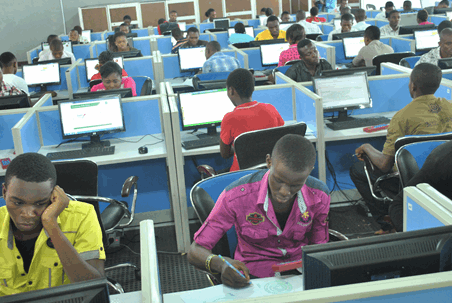 The Joint Admission and Matriculation Board (JAMB) has reduced the cut off mark for students seeking admission into universities to 120 while that for Polytechnics and Colleges of Education is pegged at 100and that of Innovative Enterprising Institutes is 110.


