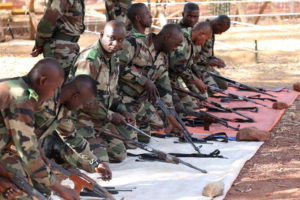
Following an ambush by suspected Islamist militants in the West African nation’s desert north of Mali, no fewer than 10 soldiers have been reported to be missing.
The Malian Army spokesman, Diarran Kone, said today, Monday that a convoy of soldiers was attacked on the road between the towns of Gao and Menako on Sunday.
“This is a region increasingly under threat from resurgence of militant groups, some with links to al Qaeda.We were ambushed, we have about 10 missing soldiers and we lost four vehicles. We are taking stock of the situation,” Mr. Kone said.
Militant groups took control of Mali’s north in 2012 though French-led forces pushed them back a year later.
Maintaining peace in the remote desert region had proved difficult and jihadists continue to launch attacks on Malian soldiers and UN peacekeepers.
African countries launched a multi-national military force to tackle Islamist militants in the Sahel region on June 2, as violence spread beyond north Mali to neighbouring states.
On June 19, militant groups linked to al Qaeda killed at least five people at a luxury resort popular with Westerners just outside the capital Bamako, in the southern part of the country generally considered more secure.
Meanwhile, fighting flared up on July 7 between rival Tuareg clans, unsettling the Kidal region in the far north.
On Friday, clashes pitting the pro-government platform coalition, led by the GATIA militia, and the separatist Coordination of Azawad Movements (CMA) led to casualties, although the government was unable to specify how many.
On July 1, French President Emmanuel Macron attended a security summit in Mali to boost support for the creation of a regional counter-terror force.
President of Dangote Group, Alhaji Aliko Dangote, via his Foundation, put smiles on the faces of 220 victims of the recent Yoruba and Hausa communal clash in Ile-Ife, Osun state with donation of millions of naira to them to cushion the effect of the violence. At a ceremony held at the palace of the Ooni of Ife, Oba Adeyeye Ogunwusi and witnessed by the Emir of Kano, Mohammed Sanusi, as well as other notable Yoruba Obas, both Yoruba and Hausa beneficiaries praised Aliko Dangote who initiated the gestures. Access bank staffers were on hand to convert the cheques to cash for the beneficiaries who wanted immediate cash value. Speaking at the occasion, the Ooni praised Dangote for his magnanimity in providing succor to the victims, adding that the generosity of Alhaji Dangote is unparalleled.
“Dangote is touching the people’s lives in so many ways either through his array of products or through his employment generation efforts. Now he has added humanitarian assistances to it, giving back to the society and doling out money to help Nigerians in need “Our youths are jobless and 70 percent of our population is youths and Dangote is helping the youths. I appeal to our youths to embrace peace. Those who engage in hate speech and threat of war should stop it. When there is violence, the executors are youths and the victims will be youths “Let us come together and channel positive cause for ourselves and say enough is enough. I have surrendered my life to the cause of the youths and so also the Emir of Kano and several other monarchs. So I challenge other wealthy Nigerians to emulate Alhaji Dangote. And I enjoin the youths to please pray for him.” Also, the Emir of Kano, Mohammed Sanausi regretted that the people engaged in violence which ought not to be noting that peace should be desired by all because no development can happen without peace. He praised the Ooni over the manner he handled the incidence when it broke out saying he briefed both himself and Sultan of Sokoto on the development and action taken so far and that both of them were convinced that the Ooni did the right thing at that material time to not only douse the tension but 3 sure peace reign continually. Sanusi said that the violence was regretted and that with measures put in place, they pray it never happen again either in Ife or any part of Nigeria. “I implore those spreading hate speeches not to set Nigeria up in flames. War would not do anybody any good. “Those beating the drums or war seeking cessation should take a look at the map of Africa and see how war has torn into pieces countries like Ruwanda, Somalia, Sudan, etc “I would like to thank Alhaji Dangote for his constant response to distress calls for assistances whenever there is problem in any part of Nigeria. What we witnessed that day, we pray such would never happen again.” In her comment, the Chief Executive Officer of the Aliko Dangote Foundation, Mrs Zouera Youssoufou sad the clash between the Hausa and Yoruba was touchy to Alhaji Dangote and then promised that he was going to do something as a relief measure to the victims of the violence clash. “Alhaji Dangote was disturbed at the clash and wondered why communities who have been living together wold allow a minor disagreement to tear them apart to the extent of killing themselves and destroying their properties. “So he has decided to cushion the effect by identifying the victims who are still alive but suffer destruction of their properties and means of livelihood. So today we have screwed 220 victims who will benefit from the donation according to their losses.” Youssoufou said the gesture was meant to help them resettle and come back to life “as what happened was not wished for in the first place.” [myad]
In governance, like in the field of play, the electorates are the best players. They have all kind of ideas, they pontificate brilliant ideas. But let us reverse the role. Invite some of them into government, the trouble begins. They become docile and bereft of ideas. They lost their articulate memories and vibrant voices. They now see less and become colourless in their pontification. That is why often times, the “governor” and the “governed” are never on the same page.
This preamble is necessary and it leads to the topic, a topic that is gradually assuming “a national discourse.”
The Presidential Villa – is the place cursed? That was a pertinent question which an erudite communicator, Dr. Reuben Abati, former Special Adviser to Ex-President Goodluck Jonathan on Media and Publicity eloquently posed in his article in November 2016.
When that question was initially posed about eight months ago, I just flipped over it but I remember Femi Adesina, the current Special Adviser to the President on Media & Publicity did attempt to give a reply, a reply that was laced with diplomacy.
Mr. Femi Adesina, another brilliant media personality, who commands so much respect and displays proficiency so effortlessly, made non-issue of that article that touched the very essence of this Administration – the abode of most ranking personalities, including that of the President himself, is not one to be so toyed with or over-looked with disdained. However, today, the truth stares at us, gradually dawns and we are beginning to appreciate the intrinsic fact in Dr Abati’s article.
The health of our President should pose concern to every serious minded Nigerian adult. Therefore, it has become necessary to revisit Dr Reuben Abati’s exposition on the Presidential Villa and try to sieve out some basic facts for our proper understanding of Aso Rock (as it is called), and in doing so, let us have a mental picture of our President before he assumed office in May 2015 and juxtapose it with his present physical appearance. Does it convey any message?
For this narrative to be properly understood, let us make Dr Reuben Abati’s exposition our guide. I shall quote copiously from that article titled: Rituals, Blood and Death: The spiritual side of Aso Villa.
Dr. Reuben Abati wrote and I quote thus:
“Sometimes, they wonder if something has not gone wrong with the thinking process at that highest level of the country. I have heard people insist that there is some form of witchcraft at work in the country’s seat of government”.
“I’ll start with a personal testimony. I was given an apartment to live in inside the Villa. It was furnished and equipped. But when my son, Michael arrived, one of my brothers came with a pastor who was supposed to stay in the apartment. But the man refused claiming that the Villa was full of evil spirits and that there would soon be a fire accident in the apartment. He complained about too much human sacrifice around the Villa.”
“The day I hosted family friends in that apartment and they slept overnight, there was indeed a fire accident. The guests escaped and they were so thankful. ..Not long after, the president’s physician living two compounds away had a fire accident in his home. He and his children could have died. He escaped with bruises.” ….“Even some of the women became merchants of dildo because they had suffered a special kind of death in their homes (I am sorry to reveal this) and many of the men complained about something that had died below their waists too. The ones who did not have such misfortune had one ailment or the other that they had to nurse.”
“I recall the example of one particular man, an asset to the Jonathan presidency who practically ran away from the Villa. He said he needed to save his life. He was quite certain that if he continued to hang around, he would die. I can’t talk about colleagues who lost daughters and sons, brothers and uncles, mothers and fathers, and the many obituaries that we issued”.
And now to the big one. Let us read Dr Reuben Abati further:
“……His wife (meaning President Goodluck Ebele Jonathan’s wife, popularly known as), Mama Peace was in and out of hospital at a point, undergoing many surgeries. You may have forgotten, but after her husband lost the election and he conceded victory, all her ailments vanished, all scheduled surgeries were found to be no longer necessary and since then she has been hale and hearty”.
Enough from Dr. Reuben Abati’s article.
Let us go back to 2006, during Chief Olusegun Obasanjo’s Presidency.
Around October 24 or so, the nation was woken to the sad news of Chief Mrs Stella Obasanjo’s death in faraway Puerto Banus, Marbella, Spain in October 23, 2006 under a mysterious circumstance. We were told :…(Chief Mrs)Stella Obasanjo, a healthy woman who had had the very best of life, died as a result of complications arising from a cosmetic surgery to remove fat from her stomach…” (culled from an article written by Chika Ezeanya in October 5, 2012). Of course, the entire nation was thrown into mourning of a colourful, elegant and flamboyant First Lady. A day before, the nation was plunged into mourning arising from a plane crash and where many innocent souls were painfully perished. Note, Chief Mrs Stella Obasanjo, euphemistically speaking, was the chief occupant of Aso Rock, been the wife to the ‘landlord’ of the ‘Rock’.
It is important to add this. Chika Ezeanya in his October 5, 2012 article alluded thus:
“… attacked by some demonic forces that began to inhabit Aso Rock since the days of the fetish googled General..”
Before President Umaru Musa Yar’Adua became landlord in Aso Rock, he had been ill but that illness did not defy medication. However, on his arrival at the Villa, the demonic forces in “Rock” took over. His health rapidly deteriorated until his glorious exit on May 5, 2010. No, I am not giving to superstitious belief. I am proudly a Catholic, and maintained puritanical streak in that regard.
These are weighty revelation from an insider that should not be treated with levity. In my considered view, the Presidential villa is such an egregious abode, yet this is where far-reaching and sensitive decisions are taking, decisions that shape and impact on the lives of most, if not all, Nigerians. Such a place should not wear this kind of unholy toga considered to be demonic.
I see this as a serious challenge to our Spiritual leaders and fathers in the Lord from both sides of the religion (Christians and Muslims alike) and indubitably calls for our sense of patriotism in this respect. The place needs total cleansing and consequently make the Villa a safe haven for its occupants.
In view of the above, I respectfully suggest that Mr. President and his worthy family, in the best interest of his heath, relocate to the Defence Guest in Maitama by MTN District office. That place is spacious, secured enough in terms of security and fits into Mr. President’sspartan life style.
The entire presidential villa should be brought down, and re-built, after total spiritual cleansing exercise. This is my humble submission please.
God shall grant our President speedy recovery and good health subsequently.
Bernard Balogun writes from Wuse District in Abuja, 0803.787.9275. [myad]
Government, everywhere, is a continuum, just as the building of a nation-state, which is on a perpetual voyage to Utopianism. Therefore, no government or nation-state is perfect on its own and by itself without the reinforcing goodness of the citizens. But because citizens are always disparate in their world views, it becomes pretty difficult to fairly accurately identify with the ideal of perfection within the limits of an elusive universal concept of good and bad. Thus, perfection has become a rare attribute in governance across dispensations and territories.
In the profound surmising of C. JoyBell C., female thinker, writer and author of various books on Soul Alchemy, Esoterica, Poetry, Philosophy of Mind, Parenting and Fiction, the totality of human actions is seemingly deliberately shorn of perfection and this has resulted in the creation of a crippled race or humanity, of which Nigeria is a part and parcel.
One will be deluding oneself to rationalise that because God’s creation is perfect, the nation-states established by man within the spheres of creation, are perfect. Validation: man is eternally prone to errors. Jean Jacques Rousseau, a Francophone Genevan philosopher, writer and composer of the 18th Century, once said: “Everything is good when it leaves the hands of the Creator; everything degenerates in the hands of man.” Alexander Pope, in his Essay on Man, posited: “Know then thyself; presume not God to scan; the proper study of mankind is man.”
Man is prone to errors and foibles. A vast majority of leaders, sometimes, act and react imprudently. For his error to acknowledge the sovereignty of the Almighty God, Nebuchadnezzar, the King of Babylon, was turned into an animal and lived in the bush for seven years, feeding on grasses and leaves. He returned to his throne humbled before the Creator of the heaven and the earth.
The first King of Israel, Saul, disobeyed God’s instructions to completely wipe out the Amalekites. He told Samuel that the fat cattle he spared were for the purpose of sacrificing unto God. For his error of disobedience, the kingdom was taken away from him and given to David.
With all his God-given wisdom, King Solomon allowed his heart to long after strange women. A great blunder! He ended up with three hundred wives and seven hundred concubines who turned his heart to strange gods.
I can continue through time and space to reference rulers and governments that committed egregious errors. However, coming down to our nation, a few examples would suffice.
As Head of State from 1983 to 85, Muhammadu Buhari made the strategic mistake of clamping down on the political class and moving against the forces in the military that enthroned him, thus becoming very unpopular. He also failed to act proactively having reportedly got a wind of the coup plot against him. Was he in a position to take no prisoners? Maybe not!
The claim then was that he did not control the troops nor enjoy loyalty of officers in charge of strategic military commands. The men who controlled the command structures pulled the rug from under his feet and his 30-month reign came to a sudden end on August 27, 1985.
Ibrahim Babangida, who took over from him, set the nation on the most expensive and dilatory transition programme, yet, in the annals of Nigeria. He annulled the June 12, 1993 presidential election won by the late M.K.O. Abiola and for which he has lost the vindication of history and posterity.
Sani Abacha unleashed terror on the nation, took out prominent Nigerians who were opposed to his self-perpetuation agenda, which he almost perfected through his dubious transition programme in which the nation’s five political parties, as of then, had already adopted him as their sole presidential candidate before he suddenly passed away.
Olusegun Obasanjo’s historical gaffe was the ill-fated Third Term agenda. He remains the greatest beneficiary ever of the fourth republic democratic dispensation, coming out of prison via a presidential pardon that was made possible by the then Head of State, Abdulsalami Abubabakar, to become the presidential candidate of the Peoples Democratic Party (PDP).
For Goodluck Jonathan, his inability to exercise fully the powers of his office was one blunder. His decision to seek a second term in office was another. Had he allowed a northerner to emerge as PDP’s candidate, Buhari would not have emerged the president of Nigeria. Holding down the PDP ticket, it became much easier for Buhari who had emerged as the “sole candidate” of the north with the support of the southwest zone to win the 2015 presidential election.
President Buhari’s first mistake is the selective fight against corruption. The targeting of opposition party leaders and members has robbed the anti-corruption war of the critical integrity capital. Second mistake: the administration claims to run one presidency; but it allows cabals to take undue advantage of Buhari’s ill-health to create tendencies that have portrayed the administration as divided.
Outside the presidency, the attempt to demystify a national leader of the APC, Bola Ahmed Tinubu, such that his nominees for ministerial jobs were not appointed and his preferred governorship candidate in Ondo state was defeated through the conspiracy of some Abuja politicians, as well as the battle against Bukola Saraki’s emergence as senate president and his Code of Conduct Tribunal trial, remains a strategic mistake. Today, Tinubu and Saraki’s political bases and networks are intact and rock solid. This is against their claim of a united party and government.
The attempt to undermine the acting president, Professor Yemi Osinbajo, whose popular governance style had rattled the cabals while Buhari was away, the first time, on medical vacation in London, was a mistake. Just as the cabals that held the nation hostage under Umaru Yar’Adua when he became incapacitated due to ill-health before he eventually died on May 5, 2010, the neo-cabals in Buhari’s presidency have kept the president and his health status away from Nigerians, and have been manipulating the development to their selfish advantage.
And just as Jonathan, who was the then vice president, was undermined before and during his acting presidency, Osinbajo is having his share of mortification in the hands of the cabalistic elements in the presidency. First, they couched Buhari’s letter to the National Assembly transmitting power to Osinbajo when he (Buhari) was proceeding on his second and present medical vacation in such a way that portrayed him as a mere coordinator of government activities while the president would be away.
Although Osinbajo has already signed the budget and a number of executive orders that should prove his exercise of full presidential powers, a good number of Nigerians still believe that Osinbajo is hamstrung and tentative.
During the Eid-el-Fitri celebrations, the handlers of Buhari messed up with the recorded Sallah voice message to Nigerians, which was in the Hausa language. That is one. Second, I consider that message unnecessary since the acting president was in charge. Osinbajo’s message to Nigerians on behalf of the government would have sufficed since he personifies the government. They created the division against their claim of one presidency.
Perhaps, the greatest mistake so far that the Buhari/Osinbajo/APC government has made is its reluctance to climb on the bandwagon of restructuring of the federation despite being a critical promise on which it hinged its electioneering for the 2015 presidential poll. Therefore, Osinbajo’s cautious response that government was merely taking notes of the conversation beggars belief. Nigerians expect the APC federal government to walk its talk and expeditiously fulfill its promised restructuring of the country.
“Failure is not a single, cataclysmic event. You don’t fail overnight. Instead, failure is a few errors in judgment, repeated every day.”- Jim Rohn
The Central Bank of Nigeria (CBN) has again, pumped a total of $142.5 million into the inter-bank foreign exchange, days after intervening in the retail segment of the market with the sum of $254.3 million.
A breakdown of the intervention today, Monday, indicates that the Bank offered the sum of $100million to dealers in the wholesale segment, while it allocated the sum of $23 million to the Small and Medium Enterprises (SMEs) segment.
Those requiring foreign exchange for invisibles such as tuition fees, medical payments and Basic Travel Allowance (BTA) received $19.5 million.
Confirming the latest round of forex intervention, the spokesperson of the apex Bank, Isaac Okorafor, said the CBN will continue to carry out its regular mediation in the market so as to keep the market liquid and guarantee the international value of the naira in line with its mandate.
While reiterating the Bank’s resolve to intervene in the market based on bids received from dealers on behalf of their respective customers, Okorafor said the CBN will not relent in ensuring transparency and efficiency in the sale of forex. According to him, this commitment prompted the Bank to mandate dealers to make public their forex utilization. He therefore urged all stakeholders to continually play their roles to guarantee transparency in the market.
It will be recalled that the CBN last Friday intervened in the retail segment of the forex market to the tune of $254.3m following bids received from forex dealers by the apex Bank. The figure sold by the Bank was for companies in the raw materials, agricultural, airline and petroleum industry.
Meanwhile, the naira maintained its stand at the Bureau de Change (BDC) segment of the forex market, exchanging at an average of N364/$1 in Lagos, Abuja and Kano. [myad]
“And many of us fought for him and he came out. Look, Kanu is not an Igbo leader. So he should cool down otherwise he will lose his relevance. He is not an Igbo leader.
“He did not see the civil war, so I’m not happy with him. I am bitter with Kanu because those who fought for him and those who spoke out on his behalf, he has not even visited some of us. Rather he is talking rubbish somewhere else.”
These were the complaints of the Head of the Enugu Province of the Anglican Communion, Archbishop Emmanuel Chukwuma when he spoke in an interview with The Sun newspaper.
Archbishop Chukwuma said: “we don’t want anybody to put us into war. We must come to discuss and he must be cautioned to mind what he is saying sometimes. Because as far as I am concerned most of us are talking on his behalf but he has not come. Rather he is going to profess himself to be a Jew or whatever. Was it Judaism that saved him?
“We prayed for him. We talked about him. Many of us were given bad names but up till now he hasn’t even come to pay homage and for us to advise him.
“So whatever he is saying he is saying it on his own. It is his followers and all these people who are now listening to him, particularly even some of the Igbo in the Diaspora that may be sponsoring him. They should be careful and stop disrupting our peace here and giving us a bad name.
“These youths are becoming, somehow, very much unscrupulous. Our youths are also not controlling their own temper. And they are people of today.
“We don’t throw away what the youths are saying but we must caution them, because if you hear what the people on Radio Biafra are saying, they are insulting even the elders in the East, which is not good.
“They should control their statements and they should respect elders. I have said it before, even among our people that we have to respect ourselves.
“We must also have a political and economic base before we can begin to take off. Put our home in order and love ourselves; we should shun arrogance and pomposity among our people.
“The politicians must know that they also have a duty to perform to serve their constituencies.”
Britain has made it clear that it would not support any group that is agitating for the break-up of Nigeria as a country.
The British High Commissioner to Nigeria, Paul Arkwright, who made this position known when he spoke in Ilorin, Kwara state capital, stressed that Britain is in support of the unity of Nigeria and the present Nigerian Government.
Mr. Arkwright, who was in Ilorin to pay a visit on the speaker of the state house of assembly, said that Nigeria is important to Britain and that it strongly believes in one Nigeria.
“We have nothing to do with any agitation aimed at the break-up of Nigeria. We strongly support the unity of Nigeria. We strongly support the Federal Government and that is the position the British government has held consistently.
“So, we have absolutely no interest in stirring up any agitation and anybody who claims that the British Government is involved in any way in any of that is completely wrong.”
”The rate at which girls are spending time on the social network is worrisome and this poses an imminent danger to our society.”
The Sultan of Sokoto, Alhaji Sa’ad Abubakar III, who spoke today, Sunday, in Sokoto, at the closing ceremony of the 6th National Edition of the Quranic Recitation Competition said: “there is a disturbing development where the attention of students is being diverted from their studies. This is through the use of various social media like Facebook, Twitter, Whatsapp, 2Go and Instagram, among others.”
Speaking specifically on the effect of social media to the girls, the Sultan said: “girls are the nerve centre of our moral and societal development and if they derail, the whole society will be in danger because they are our mothers and caregivers.”
The traditional called on girls to stop spending too much time on social media at the expense of other engagements that would add more values to their life.
He also advised parents to ensure that their daughters spend more time on meaningful things, like reciting the Holy Qur’an, saying: “doing so will make them better mothers and caregivers.”
The Sultan advised Muslims to desist from doing things capable of tarnishing the image of their religion even as he congratulated the winners of the competition ans donated N10, 000 to each of the 89 participants, while the overall winner, Husna Nura from Katsina State, got N100,000.
The Sultan promised to host the 7th edition of the competition in 2018.
Meanwhile, Governor Aminu Tambuwal of Sokoto state said at the occasion that the competition would encourage girls to memorise the whole sixty chapters of the Holy Qur’an.
Represented by the Secretary to the State Government (SSG), Professor Bashir Garba, governor Tambuwal announced a gift of Hajj seat to the overall winner of the competition in addition to N150, 000 and a deep freezer, among other gifts.
Other winners also went home with deep freezers and cash among other items.
Twenty-two states participated in the competition which was dedicated for non-Arabic Girls’ Secondary Schools. It was hosted by the Sokoto State Government.
The Vice Chairman, Presidential Committee on the North-East Initiative, Alhaji Tijjani Tumsah has said that it may take a minimum of ten years for any appreciable progress to be made in rebuilding the North-East.
Tijjani Tumsah, who spoke at a Forum said that the challenges in the North-East are multi-sectoral and that rebuilding a better and safer North-East requires a specialized approach.
“The issues in the North East are long term. In my opinion, it would take a minimum of ten years before appreciable progress is made and people are able to return to normalcy. The three-year time frame given to the committee is in the first instance.
“We have engaged with the private sector on a variety of issues, including fundraising, the private sector has indicated a lot of interest to provide quite a bit of resource for the engagement.
“The physical nature of the intervention will begin to become more obvious before the year runs out. For now, we are set. We have the framework for intervention and strategy; we have all the partners on the same page and now there will be less acrimony and it would become obvious to the whole Nigerians.
“This plan which is the strategic framework for implementation for the recovery of the North-East is the Buhari Plan. The document synthesises all these studies and distills them into programmes that are implementable to the situation in the North-East,” Tumsah said.
Tumsah said that in less than a year, the committee has recorded a huge success in achieving its three “Rs’’ mandate of reconstruction, rehabilitation and rebuilding the North-East.
He explained that although a lot of people would recount the success of rebuilding the region in building physical structures it goes beyond that, as a lot is needed to be tackled before putting up structures.
The Vice Chairman said that to carry out its task effectively, the PCNI designed and adopted a strategic framework of action which is the “Buhari Plan’’, a blueprint to guide its intervention for success.
Tumsah said that the Buhari plan contains a holistic approach to addressing the root causes of the insurgency which afterwards could also be a global module for post conflict and economic recovery development.
He said that the Buhari plan is a five-year time framework which is divided into three components for immediate implementation which are: the short term (immediate), intermediate and long term.
He explained that the Buhari plan was further distilled with the immediate and intermediate components to be executed under its high impact programme.
Tumsah said that the areas of priority under the plan include: a boost in humanitarian assistance, improved health care, resumption and strengthening of agricultural production, education transformation by reconstructing schools, recruiting and training teachers.
He said that under the Buhari Plan, over 21,000 projects have been listed for implementation by MDAs, States Government, development partners, International and Local NGOs.
According to Tumsah, amidst scarce resources for the enormous task, the committee will judiciously use the scarce resources available to ensure a better and safer North-East.
PCNI was inaugurated by President Muhammadu Buhari on Oct. 26, 2016, with a three-year time frame to recover and rebuild a better and safer North-East.
He appointed Gen. Theophilus Danjuma (rtd.) to serve as Chairman of the Committee.
Members of the Committees include the National Emergency Management Agency, the National Commission for Refugees, Migrants and Internally Displaced Persons (NCFRMI).
Others are the six North-East States, Office of the National Security Adviser, relevant MDAs and UN agencies, International Organisations and NGO, local NGOs, the Victims Support Fund (VSF) amongst others.
The government of the Federal Capital Territory (FCT) of Nigeria has announced the move it is making to effect urban renewal projects in selected communities, including Jikwoyi, Dutse Alhaji, Gwagwalada and Kuje under a soft loan arrangement from African Development Bank (ADB) and UN-Habitat.
The Executive Secretary, Federal Capital Development Authority (FCDA) Engr. Umar Gambo Jibrin, who dropped this hint in a chat with newsmen, recently said that the FCT Administration has also concluded plan of complete viable ongoing projects in the City and shift emphasis to the development of the outskirts. T
Also, the Director of Satellite Town Development Department, (STDD), Arc Victoria Imande, said that the Administration had submitted proposals to African Development (ADB) and UN-Habitat on the projects, saying that prequalification conditions which include project identification, detailing of scope of work and identification of major problems have been met.
He said that under the arrangement, FCT would contribute $300 million syndicated loan by both institutions at an interest rate of between 1 to 1.5 percent and that the facility would be channelled to address the dearth of modern infrastructure among the poor communities.
According to Arc Imande, over one million people are projected to benefit from the life improvement projects, adding that some of the facilities that would be provided include water pipelines, electricity, roads, sewage and other basic utilities.
He said that the Administration is working with the Nigeria Infrastructure Advisory Facility (NIAF), consultants to the international agencies, to ensure that due diligence is complied with in the procurement process.
NIAF, the Director revealed, is already working on the development of the concept note, environmental and social management framework and tentative scope of the project. [myad]
We use cookies on our website to give you the most relevant experience by remembering your preferences and repeat visits. By clicking “Accept”, you consent to the use of ALL the cookies.
This website uses cookies to improve your experience while you navigate through the website. Out of these, the cookies that are categorized as necessary are stored on your browser as they are essential for the working of basic functionalities of the website. We also use third-party cookies that help us analyze and understand how you use this website. These cookies will be stored in your browser only with your consent. You also have the option to opt-out of these cookies. But opting out of some of these cookies may affect your browsing experience.
Necessary cookies are absolutely essential for the website to function properly. This category only includes cookies that ensures basic functionalities and security features of the website. These cookies do not store any personal information.
Any cookies that may not be particularly necessary for the website to function and is used specifically to collect user personal data via analytics, ads, other embedded contents are termed as non-necessary cookies. It is mandatory to procure user consent prior to running these cookies on your website.


 President of Dangote Group, Alhaji Aliko Dangote, via his Foundation, put smiles on the faces of 220 victims of the recent Yoruba and Hausa communal clash in Ile-Ife, Osun state with donation of millions of naira to them to cushion the effect of the violence.






Against Their Claims, By Sufuyan Ojeifo
Government, everywhere, is a continuum, just as the building of a nation-state, which is on a perpetual voyage to Utopianism. Therefore, no government or nation-state is perfect on its own and by itself without the reinforcing goodness of the citizens. But because citizens are always disparate in their world views, it becomes pretty difficult to fairly accurately identify with the ideal of perfection within the limits of an elusive universal concept of good and bad. Thus, perfection has become a rare attribute in governance across dispensations and territories.
In the profound surmising of C. JoyBell C., female thinker, writer and author of various books on Soul Alchemy, Esoterica, Poetry, Philosophy of Mind, Parenting and Fiction, the totality of human actions is seemingly deliberately shorn of perfection and this has resulted in the creation of a crippled race or humanity, of which Nigeria is a part and parcel.
One will be deluding oneself to rationalise that because God’s creation is perfect, the nation-states established by man within the spheres of creation, are perfect. Validation: man is eternally prone to errors. Jean Jacques Rousseau, a Francophone Genevan philosopher, writer and composer of the 18th Century, once said: “Everything is good when it leaves the hands of the Creator; everything degenerates in the hands of man.” Alexander Pope, in his Essay on Man, posited: “Know then thyself; presume not God to scan; the proper study of mankind is man.”
Man is prone to errors and foibles. A vast majority of leaders, sometimes, act and react imprudently. For his error to acknowledge the sovereignty of the Almighty God, Nebuchadnezzar, the King of Babylon, was turned into an animal and lived in the bush for seven years, feeding on grasses and leaves. He returned to his throne humbled before the Creator of the heaven and the earth.
The first King of Israel, Saul, disobeyed God’s instructions to completely wipe out the Amalekites. He told Samuel that the fat cattle he spared were for the purpose of sacrificing unto God. For his error of disobedience, the kingdom was taken away from him and given to David.
With all his God-given wisdom, King Solomon allowed his heart to long after strange women. A great blunder! He ended up with three hundred wives and seven hundred concubines who turned his heart to strange gods.
I can continue through time and space to reference rulers and governments that committed egregious errors. However, coming down to our nation, a few examples would suffice.
As Head of State from 1983 to 85, Muhammadu Buhari made the strategic mistake of clamping down on the political class and moving against the forces in the military that enthroned him, thus becoming very unpopular. He also failed to act proactively having reportedly got a wind of the coup plot against him. Was he in a position to take no prisoners? Maybe not!
The claim then was that he did not control the troops nor enjoy loyalty of officers in charge of strategic military commands. The men who controlled the command structures pulled the rug from under his feet and his 30-month reign came to a sudden end on August 27, 1985.
Ibrahim Babangida, who took over from him, set the nation on the most expensive and dilatory transition programme, yet, in the annals of Nigeria. He annulled the June 12, 1993 presidential election won by the late M.K.O. Abiola and for which he has lost the vindication of history and posterity.
Sani Abacha unleashed terror on the nation, took out prominent Nigerians who were opposed to his self-perpetuation agenda, which he almost perfected through his dubious transition programme in which the nation’s five political parties, as of then, had already adopted him as their sole presidential candidate before he suddenly passed away.
Olusegun Obasanjo’s historical gaffe was the ill-fated Third Term agenda. He remains the greatest beneficiary ever of the fourth republic democratic dispensation, coming out of prison via a presidential pardon that was made possible by the then Head of State, Abdulsalami Abubabakar, to become the presidential candidate of the Peoples Democratic Party (PDP).
For Goodluck Jonathan, his inability to exercise fully the powers of his office was one blunder. His decision to seek a second term in office was another. Had he allowed a northerner to emerge as PDP’s candidate, Buhari would not have emerged the president of Nigeria. Holding down the PDP ticket, it became much easier for Buhari who had emerged as the “sole candidate” of the north with the support of the southwest zone to win the 2015 presidential election.
President Buhari’s first mistake is the selective fight against corruption. The targeting of opposition party leaders and members has robbed the anti-corruption war of the critical integrity capital. Second mistake: the administration claims to run one presidency; but it allows cabals to take undue advantage of Buhari’s ill-health to create tendencies that have portrayed the administration as divided.
Outside the presidency, the attempt to demystify a national leader of the APC, Bola Ahmed Tinubu, such that his nominees for ministerial jobs were not appointed and his preferred governorship candidate in Ondo state was defeated through the conspiracy of some Abuja politicians, as well as the battle against Bukola Saraki’s emergence as senate president and his Code of Conduct Tribunal trial, remains a strategic mistake. Today, Tinubu and Saraki’s political bases and networks are intact and rock solid. This is against their claim of a united party and government.
The attempt to undermine the acting president, Professor Yemi Osinbajo, whose popular governance style had rattled the cabals while Buhari was away, the first time, on medical vacation in London, was a mistake. Just as the cabals that held the nation hostage under Umaru Yar’Adua when he became incapacitated due to ill-health before he eventually died on May 5, 2010, the neo-cabals in Buhari’s presidency have kept the president and his health status away from Nigerians, and have been manipulating the development to their selfish advantage.
And just as Jonathan, who was the then vice president, was undermined before and during his acting presidency, Osinbajo is having his share of mortification in the hands of the cabalistic elements in the presidency. First, they couched Buhari’s letter to the National Assembly transmitting power to Osinbajo when he (Buhari) was proceeding on his second and present medical vacation in such a way that portrayed him as a mere coordinator of government activities while the president would be away.
Although Osinbajo has already signed the budget and a number of executive orders that should prove his exercise of full presidential powers, a good number of Nigerians still believe that Osinbajo is hamstrung and tentative.
During the Eid-el-Fitri celebrations, the handlers of Buhari messed up with the recorded Sallah voice message to Nigerians, which was in the Hausa language. That is one. Second, I consider that message unnecessary since the acting president was in charge. Osinbajo’s message to Nigerians on behalf of the government would have sufficed since he personifies the government. They created the division against their claim of one presidency.
Perhaps, the greatest mistake so far that the Buhari/Osinbajo/APC government has made is its reluctance to climb on the bandwagon of restructuring of the federation despite being a critical promise on which it hinged its electioneering for the 2015 presidential poll. Therefore, Osinbajo’s cautious response that government was merely taking notes of the conversation beggars belief. Nigerians expect the APC federal government to walk its talk and expeditiously fulfill its promised restructuring of the country.
“Failure is not a single, cataclysmic event. You don’t fail overnight. Instead, failure is a few errors in judgment, repeated every day.”- Jim Rohn
Ojeifo contributed this piece from Abuja via ojwonderngr@yahoo.com [myad]