The House of Representatives has asked Acting President Yemi Osinbajo to, within seven days from today, Tuesday, swear-in the two ministerial nominees who have been confirmed by the Senate since May.
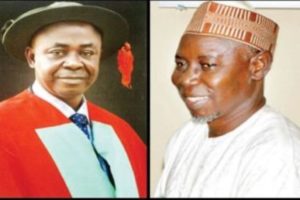
The ministers are Stephen Ocheni, from Kogi State and Suleiman Hassan, from Gombe State. While Ocheni is to replace the late James Ocholi, Hassan, is to replace Amina Mohammed, who joined the United Nations last year. They were screened by the Senate in May.
The motion asking Osinbajo to swear-in the ministers was moved by a member from Kogi State, Karimi Sunday, who complained that Kogi had been without a minister for nearly two years now.
“These two states are not represented at the Federal Executive Council. This is a breach of the 1999 Constitution.
“The prayer of this motion is that the Acting President should swear in them in and allocate portfolios to them within one week.”
The resolution was endorsed in a unanimous voice vote. [myad]
Minister of Finance, Kemi Adeosun has said that the federal government has shelved the earlier plan to seek for an additional $1.5 billion from international debt markets.
“We cannot borrow anymore. We just have to generate funds domestically enough to fund our budget. Mobilize revenue to fund the necessary budget increase.”
Adeosun, who spoke today, Tuesday, at a business forum in Abuja, insisted that Nigeria must not borrow more to fund its budget but would raise money through other means.
Nigeria is in the middle if its first recession in 25 years, and had planned to borrow extensively from overseas, to fund a record budget aimed at helping the country get its way out of its economic doldrums. [myad]
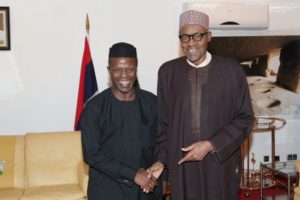
Acting President Yemi Osinbajo was in London earlier today, Thursday, to meet ailing President Muhammadu Buhari.
Osinbajo’s sudden trip to London was announced by his spokesman, Laolu Akande in a Twitter with no reason given.
He wrote: “AgP Osinbajo meeting with President Buhari in London today, and returning to Abuja immediately afterwards.”
The Acting President jetted out of Abuja soon after presiding over the Quarterly Presidential Business Forum today, Tuesday, morning at the Presidential Villa, Abuja.
Akande said that Osinbajo would return to Abuja the same day and expected to preside over the meeting of the Federal Executive Council (FEC) meeting tomorrow, Wednesday. [myad]
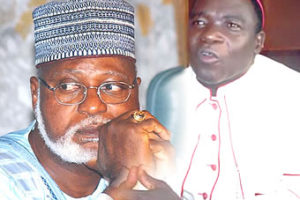
The National Peace Committee headed by former Military Head of State, retired General Abdulsalami Abubakar, and Bishop Matthew Kukah, have blamed the current agitation by various groups across the country for new nation on bad governance.
The two, who are co-chairmen of Peace Committee, made it clear too, in a statement which was jointly signed by the co-chairmwn, that politicians who failed to deliver dividends of democracy to their people are behind the clamour for secession, which they condemned.
The two leaders stressed that the manifestation of rising discontent among the populace was an indication that there was bad governance in Nigeria.
“In this regard, the National Peace Committee acknowledges that the drums of rising division also reflect the perceptions by our citizens that there is poor governance in Nigeria today.
“Politicians who have failed in delivering on the mandate of the electorate for better livelihoods and neighbourhoods have, instead, found common cause with advocates of division and hate.
“In many parts of the country, young people who have been left without means of livelihood or hope in their future have become converts to radicalisation preached by demagogues in various guises including ethnicity and religion.” [myad]
Nigeria is so ‘serious’ a nation that satire is as bad a ‘crime’ as treason. Counting the torrents of condemnation against Mrs. Aisha Buhari’s harmless satirical comment to the satirical post of Senator Shehu Sani, one could see why there’s always little energy left to deal with serious issues.
The Senator wrote about a satirical Animal Kingdom where the King; traditionally the lion, was away and the Hyenas and Jackals of the kingdom were having a ball hoping the King will be away forever. Mrs. Buhari picked it from there and commented that, though the ‘king’ – the lion – is away, he’s soon to be back and the party is going to be short lived. That’s all of it and all hell was let loose.
Nothing could be cheaper than Nigeria’s negative emotions which could be provoked to boiling point by mere satire expressed in a clear metaphorical background. One is left mesmerised that, with all the different kinds of prefixes attached to names of our leaders, big men, practicing and dormant wannabes who are constantly and consistently trying to outdo themselves in the art of pretentious claim to intellectual sophistication, the literature value of the combined metaphorical and satirical expressions as contained in Mrs. Buhari’s comment was either mischievously ignored or entirely lost.
Whereas ‘metaphor’ is a figure of speech containing an implied comparison, in which a word or phrase ordinarily and primarily used for one thing are applied to another while ‘satire’ is a way of using humour to depicts a situation or describe a person using words. So, what’s Mrs. Buhari’s crime for using literature to respond to literature? Are people in position of authority exempted from such privileges?
In case it’s a crime, why is Mrs. Buhari, a non-statutory factor in Nigeria’s power equation, isolated for punishment even it’s obvious she only participated in solving the equation while the Senator Shehu Sani, a statutory factor and author of the satire was left off the hook? Was it because the name ‘Buhari’ was part of the equation? I think that’s the most sensible explanation. President Buhari was himself a victim of antsy opposition. His metaphorical expression of “dogs and baboon” is still being held, even by the smartest dudes on the other side, with the seriousness of hanging to a life raft in a raging sea on moonless night.
So, let’s do it the elementary way. Is Nigeria an ‘Animal kingdom’? To you, may be, but certainly Mrs. Buhari is the last person to assume so for the simple reason that she went round the country with her husband and interfaced with Nigerians to know it’s a nation of good albeit, shortchanged people who she feels for to the point of supporting her retiree husband to jump back into the ring to slug it out for them.
Is President Buhari a ‘lion’? Yes, he is a metaphorical lion that kept metaphorical jackals and hyenas away from the waterholes of a metaphorical Animal Kingdom called Nigeria for the survival of the weak metaphorical animals of the kingdom.
The irony of it, all the debate on Mrs. Buhari’s metaphorical expression went on while few people care to partake in the debate to save a critical sector of the Nigerian economy, the National Health Insurance Scheme (NHIS). While some people where debating the ‘Animal Kingdom’, some good minded Nigerians were debating why Professor Usman Yusuf, the Executive Secretary of the scheme was suspended on trumped up allegations just after he exposed a Ponzi scheme in the NHIS through which over N300bn meant for the healthcare of the weaker ‘animals’ of the kingdom was stolen from the scheme without questions asked. Give your brain a sense of value and join the NHIS debate rather than burn brain fat debating literature.
One of the leading digital money transfer service, WorldRemit and Huawei have announced a partnership, making WorldRemit’s international money transfer service available to all partners of Huawei’s mobile money service platform across Africa. a statement by Huawei said that the partnership, which was announced at the GSMA’s Mobile 360 conference in Dar es Salaam, would enable it to add a ready-made solution for remittances to its existing suite of services.
The statement added that by enabling WorldRemit to connect to over 100 million mobile accounts currently using Huawei’s platform, the deal will improve access to mobile money remittance for millions of people. It said that WorldRemit is the first international remittance company to partner directly with Huawei, adding that the deal is expected to accelerate WorldRemit’s technical integrations with new mobile money operators.
It stressed that Technical integration is frequently a barrier to offering international remittances for mobile network operators (MNO’s), to the GSMA. Together, WorldRemit and Huawei are lowering that barrier, enabling all Huawei partners to swiftly switch on this service. according to the Vice President of Huawei in South Africa, David Chen: “international remittance is a very important mobile money service in Africa, and our partnership with WorldRemit will bring international remittances directly to Huawei’s customers across the continent..
“Huawei is committed to providing advanced mobile money platforms and technologies to global mobile money operators.”
Also, Founder and Chief Executive Officer (CEO) of WorldRemit, Ismail Ahmed said:: “we are delighted to add our remittance offering to Huawei’s extensive range of services for mobile money providers. By making it easier to connect to our service, our partnership will accelerate our ability to introduce our safe, fast and low-cost remittance service to millions of people.” The statement said that Huawei built its mobile money services platform to help deliver basic banking transactions in developing countries.
It said that the technology is not restricted, and that because it works on both smartphones and basic handsets, it has been particularly successful in developing markets. It added that WorldRemit is the leading global provider of remittances, processing 74% of all international transfers to mobile money accounts coming from money transfer operators.
WorldRemit makes sending money as easy as sending an instant message. [myad]
Chi Onwurah, the Member of Parliament representing Newcastle Central in the UK House of Commons and my former colleague at the State House, Molara Wood, met recently at the 2017 Caine Prize for African Writing award ceremony. When Molara informed Chi that her re-election along with six others had caused so much excitement in Nigeria and even produced official letters of congratulation from both the Federal Government and Abike Dabiri, the Senior Special Assistant to the President on Diaspora Affairs, Onwurah’s sharp retort was: “I’m British, not Nigerian.”
This has generated so much debate in Nigerian social media, but most of the comments do not really go to the heart of the matter. The place to begin is to break down Chi Onwurah’s comment. She seems to be saying: “why would my re-election be of such importance to Nigerians and the Nigerian government, I am not one of you”. Or something like: “What is my business with Nigeria?” Or: “Come on, Nigeria! Yes my father is from there, but I-am-British!”.
Chi Onwurah MP probably did not get a copy of the letter of congratulations sent to her. I wouldn’t be surprised if nobody had enough presence of mind to ensure actual delivery of the letters, despite the media show-off. She may not even be aware of the excitement here over the June 8 parliamentary elections in the UK. The issue for Nigerians was not Brexit, not Theresa May’s troubled political fortunes, but the fact that seven persons of Nigerian descent are MPs in the UK, namely Chi Onwurah, (Newcastle Central), Kate Ofunne Osamor (Edmonton), Kemi Badenock (Saffron Walden), Chuka Umunna (Streatham), Bim Afolami (Hitchin and Harpenden), Fiona Onasanya (Peterborough) and Helen Grant (Maidstone and the Weald).
No one among this group of seven with Nigerian ancestry is a tyro in British politics, nor is there anyone of them that is a product of the Nigerian educational and cultural system either. They are not immigrants, not been-tos, but products of the British system. One of them, Fiona is in fact aspiring to become Britain’s first black female Prime Minister. It would be interesting to know how the sextet that Molara Wood did not meet would have reacted to their being confronted with their Nigerian connection. They probably would also have responded in the same manner in typical British accent: “I’m British, not Nigerian.”
The key message in the letters by the Federal Government and Abike Dabiri is that the group of “British-Nigerian seven” in the UK parliament has individually and collectively made Nigeria proud. A few weeks earlier, another Nigerian in the UK, Anthony Oluwafemi Joshua had won the World Boxing Heavyweight unified Championship. Joshua, whose mother is from Sagamu, not only identified with Nigeria, his kinsmen staged an elaborate street party. They are also preparing to welcome him home anytime soon. But Chi, Bim, Kate, Kemi, Chuka, Fiona, and Helen are not identifying directly with us. The Nigerian government and people have not done anything wrong getting excited over their achievement, though. The famous seven are entitled to Nigerian citizenship by virtue of the relevant provisions in the Nigerian Constitution. Should they go to the Nigerian High Commission in the UK today and ask for a Nigerian passport, they are perfectly entitled to it.
The relevant portions of the 1999 Constitution state expressly that one is a citizen of Nigeria provided such a person was born in Nigeria before the date of independence, either of whose parents or any of whose grandparents belongs or belonged to a community indigenous to Nigeria -Section 25 (1)(a); every person born in Nigeria after the date of independence either of whose parents or any of whose grandparents is a citizen of Nigeria – Section 25(1)(b) and every person born outside Nigeria either of whose parents is a citizen of Nigeria – Section 25 (1)(c). Sections 26 and 27 thereof deal with citizenship by registration and naturalization respectively. However, citizenship is about privileges, rights and obligations and the relationship between a person and the state. It is the basis for patriotism or the opposite, in other words it is tied to the politics of belonging and the ethics of being established. How does a person feel about a country, to be so emotionally attached to it to such an extent that he or she will be willing to defend, promote and honour that country- that is what it is all about.
This attachment defines whether a person holds on to and cherishes the citizenship of a country or renounces it. In 2016, 5, 411 Americans, 26% more from 2015, renounced their citizenship of the United States, most of them for tax avoidance reasons. In May 2017, 335 foreigners, from Lebanon, Syria, Pakistan, Rwanda, Cape Verde and other African countries opted for Nigerian citizenship, most of them for business and marital reasons. But whereas Nigeria recognizes dual nationality (Section 28, 1999 Constitution), there are Nigerians in diaspora who for economic reasons have had to renounce their Nigerian citizenship, or others who due to near-absolute disconnection with the Nigerian system have never bothered to affirm their Nigerianness and are hence “lost” to Nigeria.
Culturally, Africans are attached to their children wherever they may be in the world. When they do well, they want to claim them and identify with them. The other side of this is that due to economic migration, exodus into exile, the fact of globalization, and the difficult conditions at home, many Nigerians in diaspora are almost completely alienated from home. There is also a growing generation of Nigerian children abroad who qualify to be Nigerian citizens but who will insist that they are not Nigerian because they have no sense of place or home that connects them to their original roots.
Chi Onwurah is actually Chinyelu Onwurah. Chinyelu in Igbo means “abundant gift of God.” With her numerous achievements, she is truly an abundant gift from God. She was born in Newcastle, and was brought to Awka, Nigeria in 1965 as a baby. When the civil war broke out in Eastern Nigeria, her father joined the Biafran army. She and her siblings and their mother would later return to Britain as refugees in 1967. If Chinyelu had ever returned to Nigeria since then, or speaks Igbo or has any close relationship with her Nigerian relations, she doesn’t quite say. In her profile, she reports: “I was born in Wallsend, grew up on Hillsview Avenue in Kenton and went to Kenton School before studying Electrical Engineering in London. I have lived in many different cities around the world, without ever for a moment forgetting where I am from: Newcastle. My values and beliefs were formed in Newcastle based on the people I grew up with and my own experiences.
“My maternal grandfather was a sheet metal worker in the shipyards of the Tyne during the depression. My mother grew up in poverty in Garth Heads on the quayside. In the fifties she married my father, a Nigerian student at Newcastle Medical School. In 1965, I was born, whilst they were living in Long Benton where my father had a dental practise. I was still a baby when my father took us to live in Awka, Nigeria. But two years later the Biafran Civil War broke out bringing famine with it and, as described vividly in an Evening Chronicle article in 1968, my mother, my brother and sister and I returned as refugees to Newcastle, whilst my father stayed on in the Biafran army.
“This early experience of the impact of war on ordinary families left me with a strong sense of my own good fortune in living in a peaceful parliamentary democracy where it is possible to bring about change without taking up the gun or the sword. I am not a pacifist; I believe that our country is worth defending and fighting for.”
This interesting narrative should be underlined in parts. Her strongest memory of Nigeria is the civil war. But she talks about her “good fortune” of growing up in peaceful Britain, and when she refers to “our country”, the country of reference is not Nigeria but Britain and the city of her choice is not Awka, but Newcastle, which she says she cannot forget for a moment. There are many persons of Nigerian descent of her type who do not feel a sense of attachment to Nigeria. They belong elsewhere, to a country of their own not the country of their parents. The likes of President Barack Obama and Anthony Joshua who continue to identify with their ancestral roots are in the minority. In a post-modern society, identity is not exclusively constructed by ethnicity, religion, name and naming, or sexual orientation, but by a complexus of subjective and objective factors.
People identify with a place or home, or culture when there is a sense of shared space, or shared values or experience. This sense of closeness/identification limits that sense of “otherness” or alienation, and forms the core of a person’s self-definition. Hence Chinyelu Onwurah tells us: “My values and beliefs were formed in Newcastle based on the people I grew up with and my own experiences.” Unfortunately, over the years, Nigeria has developed a culture, through negligence, ignorance and poor governance, a culture of neglecting its people, and treating them shabbily. Countries that build their peoples into a community across borders, at home and be they in diaspora are countries driven by people-oriented values. I can bet that until the British-Nigerian Seven in the UK Parliament became newsmakers, the Nigerian High Commission in the UK most likely never had any contact with them. Nobody there may even have their phone numbers.
And if the fault is not that of our High Commission, let us return to the point about identity politics then. How many successful Nigerians in diaspora would even readily identify with other Nigerians or with Nigeria? With many Nigerians involved in crime or one scam or the other and grabbing negative headlines, you cannot really complain too much about the Uncle Tomism of many of the successful ones in diaspora and their complete distanciation from all things Nigerian. There is also that other crowd that feels cheated by Nigeria whose attitude is far worse than that of the culturally and socially alienated.
There have been reports for example, of persons, especially athletes, who have renounced their Nigerian citizenship and have become winners of medals for other countries. In Bahrain alone, we have quite a number of Nigerian athletes who have since turned their backs on Nigeria. They include Endurance Essien Udoh (now Iman Isa Jassim), Lolade Sodiya (now Basira Sharifa Nasir), Abbas Abubakar, Femi Ogunade, Kemi Adekoya and Aminat Yusuf Jamal. One other athlete, Gloria Anozie (Sydney Olympics medallist) was so angry with Nigeria, she is now a citizen of Spain.
I hope no one will make the mistake of insisting that Nigeria would like to honour the seven British-Nigerians in the UK parliament. They may not be too excited; for them their Nigerian identity is perhaps at best, an ascribed identity. They are happy to belong, like Chinyelu Onwurah, to a “peaceful parliamentary democracy” where there are no kidnappers like Evans who break the law and resort to blackmail, dancing, singing and jollofing Senators who are interested in power struggle rather than making laws for good governance, a government that enjoys breaking the law and the legs of the opposition, and a country that is determinedly adrift, politically and economically. The British deserve their Chinyelu just as she deserves the Britain of her choice. But if she ever remembers her Nigerianness and would like to return home someday, I have no doubt that Nigeria will welcome her with open arms. [myad]
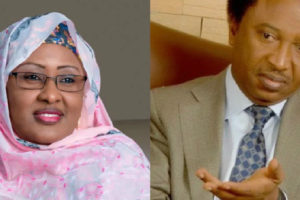
Aisha, wife of President Muhammadu Buhari and Senator Shehu Sani from Kaduna State, have engaged in what can be called ‘speaking in tongue’ about the health and wellness of the ailing President Buhari in London.
Aisha, in a Facebook post she shared today, Monday, apparently responded to Senator Sani’s earlier post on July 6, in which he suggested that hyenas and jackals were scheming to take over “the kingdom” from the lion king.
His post reads: “Prayer for the absent Lion King has waned; Until he’s back then they will fall over each other to be on the front row of the palace temple. Now the hyenas and the jackals are scheming and talking to each other in whispers; still doubting whether the Lion King will be back or not.
“Now the Lion King is asleep and no other dare to confirm if he will wake up or not. It’s the wish of the Hyenas that the Lion King never wakes or come back so that they can be kings. It’s the Prayers of the weaker animals that the Lion King comes back to save the Kingdom from the Hyenas, the wolves and other predators.”
Responding, Aisha, who travelled to London to see her husband recently said that the hyenas and jackals would soon be sent out of the kingdom.
“God has answered the prayers of the weaker animals, The hyenas and the jackals will soon be sent out of the kingdom.
“We strongly believe in the prayers and support of the weaker animals. Long live the weaker animals, Long live Nigeria,” she wrote on Monday.
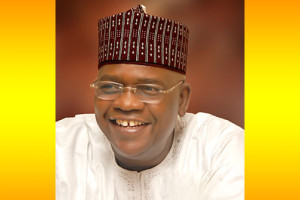
Lagos State House of Assembly is obviously angry with Senator Danjuma Goje (APC-Gombe Central), for what it called his insult on the members in the process of cross-firing with the minister of Power, Works and Housing, Babatunde Fashola.
Senator Goje who is the chairman of the Senate Committee on Appropriation, was reported to have asked the minister on July 5, not to see the National Assembly as an institution he could control the way he controlled the Lagos Assembly. Senator was responding to Fashola over issues bothering on the 2017 budget.
The Speaker of the Lagos State House of Assembly, Mudashiru Obasa, who reacted to Goje’s remark today, Monday, directed the Clerk of the House, Sanni Azeez, to write a protest letter to the Senate over such a comment by Goje.
This followed a motion moved by the Chairman, House Committee on Information and Strategy, Tunde Braimoh, in respect of a statement credited to Goje (APC-Gombe Central) against the House.
Braimoh said that the matter was reported in the national newspapers edition of July 6, 2017.
“The senator derogatorily referred to the Lagos State House of Assembly by saying that the National Assembly was not Lagos State House of Assembly. The statement is derogatory, uncomplimentary and it is an insult on the Assembly.
“The constitution does not give the senate power to superintend the state assembly. All the newspapers reported the story and it is an uncomplimentary and disparaging as well as an unparliamentary statement. The context in which the statement was made was slanderous.”
According to him, the statement had brought the House to public ridicule and it made people to feel that the House is a rubber stamp.
“Goje ought to be more civil with words with his status.”
In his contributions, Rotimi Olowo, the Chairman, House Committee on Budget and Economic Planning, said Lagos Assembly is an institution that people of other climes appreciate, adding that if Goje has issues with Fashola, he should sort it out rather than insulting the assembly.
He, however, said that the house should write the Senate to reprimand the senator on the matter.
In his remarks, Yinka Ogundimu, the Chairman, House Committee on Finance, described the statement as provocative.
Also, Tobun Abiodun, the Chairman, House Committee on Works and Infrastructure, said that there were certain expectations from lawmakers based on ethics of the office.
“What Goje said is an insult on the leadership of this House. We demand an apology from Goje and the senate,” he said.
The House later adjourned the plenary session until tomorrow, Tuesday. [myad]
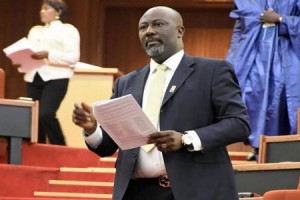
The Independent National Electoral Commission (INEC) has taken one more step towards the recall of Senator Dino Melaye back to his village by people of his Kogi West Senatorial area by pasting notice of verification.
In the notice which was pasted at the commission’s office in Lokoja, capital of Kogi state today, Monday, INEC said that the verification would hold across all polling units in the senatorial district on August 19.
The notice which was signed by the INEC chairman, Mahmood Yakubu and dated July 10, 2017, reads: “In accordance with section 69 of the constitution of the Federal Republic of Nigeria 1999 (as amended) notice is hereby given that the verification for the recall of the member representing Kogi West senatorial district shall hold on the 19th August, 2017.”
The notice was issued even as a Justice of a Federal High Court in Abuja, asked the electoral body and Melaye to maintain “status quo” pending the hearing of a motion filed by the Senator to seek an interlocutory injunction.
Tsoho had fixed September 29 for the hearing of the motion. [myad]
We use cookies on our website to give you the most relevant experience by remembering your preferences and repeat visits. By clicking “Accept”, you consent to the use of ALL the cookies.
This website uses cookies to improve your experience while you navigate through the website. Out of these, the cookies that are categorized as necessary are stored on your browser as they are essential for the working of basic functionalities of the website. We also use third-party cookies that help us analyze and understand how you use this website. These cookies will be stored in your browser only with your consent. You also have the option to opt-out of these cookies. But opting out of some of these cookies may affect your browsing experience.
Necessary cookies are absolutely essential for the website to function properly. This category only includes cookies that ensures basic functionalities and security features of the website. These cookies do not store any personal information.
Any cookies that may not be particularly necessary for the website to function and is used specifically to collect user personal data via analytics, ads, other embedded contents are termed as non-necessary cookies. It is mandatory to procure user consent prior to running these cookies on your website.