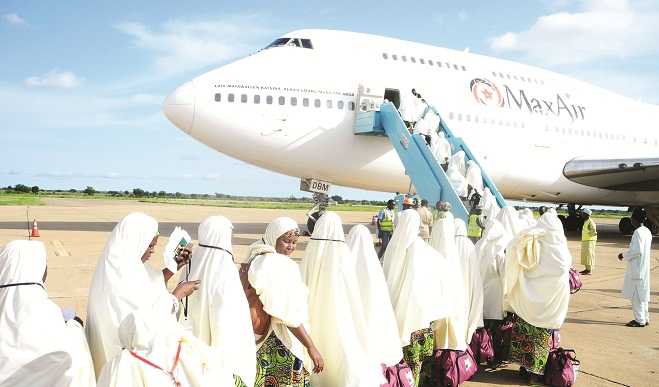
Pilgrims from Nigeria, who performed this year’s Hajj in Makkah and Medina, Saudi Arabia, have started their journey back home today. Report reaching us at Greenbarge Reporters online newspaper indicated that Air peace flight APK 7901 departed Jeddah today, June 22, to Abuja, Nigeria’s Federal Capital at about 14:50 hours with 310 FCT pilgrims and seven Officials. The information came from the Command and Control Center of the National Hajj Commission of Nigeria (NAHCON).
Most of the pilgrims left for the Holy land nearly a month ago and completed the Hajj rituals on June 19, 2024. There are about 60,000 Nigerian Muslims that participated in this year’s Hajj. Nearly two millions came from all over the world for the Hajj.
A human rights lawyer, Femi Falana has accused Justice Muhammed Liman, of the federal high court, who delivered judgment on the current tussle in the Kano Emirate, of violating the Supreme Court rules. Speaking in an interview on Arise TV today, June 21, Falana said that the supreme court had ruled that federal high courts do not have jurisdictions on chieftaincy matters. Describing the judgment as “a bit confusing,” the Senior Advocate of Nigeria (SAN), said that the supreme court had issued two separate judgments limiting the powers of the federal high court on traditional institutions. The human rights lawyer said that the judgments of the supreme court are binding on all authorities in the country. Falana said that the apex court had ruled that being a chief is not a fundamental right and issues of chieftaincy should not be entertained by a federal high court. “The order is a bit confusing. But what is important, which the learned judge did not address in his ruling, is the convenient way in which two solid judgments of the supreme court on the limitation of the power of the federal high courts to interfere in the affairs of traditional institutions. “It cannot be done via fundamental rights application. I listened to him, his lordship was talking about the need to respect the rule of law. “In any country that loudly claims to pronounce and operate under the rule of law, the judgments of the supreme court are binding on all authorities. “It is a mockery of the rule of law, if the high court judge decides to ignore or overrule the judgments of the supreme court.” Justice Muhammad Liman had yesterday, June 20, nullified the decisions of Abba Yusuf, governor of Kano State, taken on May 23, 2024. The judge held that the defendants were aware of an interim order previously granted by the court but ignored it and implemented the Kano Emirates Council Law 2024. He however, ruled that his order did not affect the validity of the emirate law passed by the state house of assembly. Recall that on May 23, the Kano State governor announced the reinstatement of Muhammadu Sanusi as Emir of Kano.
The Editor-in-chief/Chief Executive Officer of Greenbarge Media and Communications Limited, publisher of Greenbarge Reporters online newspaper and hardcopy magazine in Abuja, Yusuf Ozi-Usman, was one of the 605 communication experts that were inducted into the Nigeria Institute of Public Relations (NIPR) today, June 20 in Abuja. Yusuf Ozi-Usman, a member of the Guild of Corporate Online Publishers (GOCOP) had, besides being a veteran journalist/editor, spanning four and half decades, also served as Corporate Affairs Offer of Media Trust Limited, publisher of Trust Group of newspapers and was Secretary of the Trust Annual Dialogue among others.
From right – Yusuf Ozi-Usman, Hassan Gimba, Danlami Nmodu mni (Deputy President of GOCOP) and Max Amuchie (Vice President of GOCOP).
The programme for the induction of Yusuf Ozi-Usman and others, which is one of the special activities lined up for the celebration of the 60 years anniversary of the NIPR, was held at the premises of the Nigeria Television Authority, Abuja. The induction was conducted by the President and chairman of the Council of the Institute, Dr. Ike Meliaku, supported by the Vice President and Vice Chairman of the Council, Professor Emmanuel S. Dandaura as well as the Registrar of the Institute, Uzoma Onyegbadue.
from right: Yusuf Ozi-Usman (GOCOP electoral chairman); Maureen Chigbo (President of GOCOP) and James Umeh (Vice President of GOCOP) In attendance were the information minister, Mohammed Idris, represented by the Director General of the Voice of Nigeria; the Director General of the Federal Radio Corporation of Nigeria, Managing Director of the News Agency of Nigeria, Ali M. Ali; Chief Executive Officer of Daar Communications Limited, Chief Raymond Paul Dokpesi Jr; President of the Nigeria Union of Journalists (NUJ) and President of the Guild of Corporate Online Publishers (GOCOP), Maureen Chigbo amongst others.
The candidate of the Social Democratic Party (SDP) in the November 11 Governorship election in Kogi State, Alhaji Muritala Yakubu Ajaka has taken the case to Appeal Court, insisting that he won the election. Ajaka and SDP asked the Appeal Court to set aside the decision of the tribunal that affirmed the victory of Ahmed Usman Ododo of All Progressives Congress (APC). They wanted the court to void Ododo’s victory and declare Ajaka the winner of the election. Their requests are contained in a notice of appeal they filed against the May 27 judgment of Justice Ado Yusuf Birnin Kudu-led Kogi State Governorship Election Petition Tribunal, which sat in Abuja. In the appeal filed by their lawyer, Pius Akubo (SAN), the appellants are contending among others, that the tribunal’s judgement was a serious miscarriage of justice. In a 31-ground notice of appeal, Ajaka and his party insist that they won the November 11, 2023 governorship election and should be declared the rightful winners. They want the appellate court to issue an order restoring the testimony of their first witness (PW1) as well as all the documents they tendered, but which the tribunal expunged from its records. The appellants also want the Appeal Court to hold that Ododo was not even qualified to have contested the election into the office of Governor of Kogi State and that all votes ascribed and or allocated to him and the APC are wasted votes. They are praying for an order granting the reliefs sought by the appellants in the petition and thereupon declaring the first appellant (Ajaka) as the duly elected Governor of Kogi State In faulting the tribunal’s judgment, the appellants noted that although the tribunal agreed that their petiton was filed within time and that there was over voting, the tribunal proceeded to uphold the election. “In their confusion, they (members of the tribunal’s three-member panel) ruled that PW1 who displayed the documents with which they agreed there was over voting is not clear to them. They claimed they did not know if he was INEC staff or not. “It was the tribunal that ordered INEC to provide the BVAS and someone who will power and display the BVAS in court and that PW1 came to the court with a certified letter from INEC stating that he was indeed the representative of INEC. ”PW1 was in the court with his identity card and other supporting documents to show he is INEC staff. “Recall further that when the PW1 absented from the court, the tribunal ordered INEC to produce him or produce another person and they did comply to produce him yet, the tribunal members said they do not know him. What a contradictive judgement.” The appellant argued that “the election of November 11, 2023 in Kogi State was not conducted in substantial compliance with the Electoral Act. 2022 as well as manual and guidelines involving the conduct of elections having regards to the numerous instances of over voting.” The appellants claimed to have demonstrated in a graphic and tabular form, before the tribunal, that they scored the majority of lawful votes in the election and not the second and third respondents (Ododo and the APC). The appellants also claimed to have led evidence to the effects that, if the votes affected by over-voting are deducted from the overall votes, the appellants and not the second and third respondents will have majority of lawful votes. The SDP and Ajaka added that clearly and unambiguously, they tendered all the necessary election forms and documents which completely demonstrated that the second respondents did not score the majority of lawful votes cast as held by the tribunal.
A Federal High Court in Kano has technically restored Emir Of Kano and other Emirs dethroned recently by Governor Abbas Yusuf as it set aside all steps taken by state government to repeal the Kano Emirates Council Law. In a judgment today, June 20, Justice Abdullahi Muhammad Liman set aside the action of Kano government, ordering parties to maintain status quo. The judge held that the defendants were aware of the interim order granted by the court but chose to ignore it and went ahead with implementation of the law. The judge held that he would assume his coercive powers to enforce compliance with his order. However, the judge transferred the case to Justice Simon Amobeda for continuation in view of his elevation to the Court of Appeal. The Kano House of Assembly had repealed the law after which Governor Abba Kabir Yusuf implemented it by dethroning Alhaji Aminu Ado Bayero as Emir of Kano. The governor also reversed the creation of four emirates, Bichi, Rano Karaye and Gaya, and sacked the Emirs appointed by his predecessor, Dr. Abdullahi Umar Ganduje. The law was also relied upon to re-appoint the 14th Emir of Kano, Muhammadu Sanusi II, who was dethroned by Ganduje in 2020, as the 16th Emir of Kano. But a kingmaker in the former Kano emirate, Aminu Babba Danagundi, the Sarkin Dawaki Babba, challenged the propriety of the law and asked the court, through his counsel, Chikaosolu Ojukwu (SAN), to declare it null and void.
Bauchi State Governor, Senator Bala Mohammed is angry with the National Hajj Commission of Nigeria (NAHCON) over alleged poor manner of the 2024 hajj operations in Saudi Arabia. The Governor, who was interacting with the state pilgrims at Mina, the city of tents in Mecca today, June 29, called for the decentralization of most of the Hajj operations in a manner that would allow state governments to take full control of Hajj affairs. He said that the decentralization would ensure adequate welfare of the pilgrims from States who paid for Hajj seats through their respective States’ Pilgrims Welfare Boards. He said that in this year’s Hajj exercise, pilgrims were subjected to untold hardships due to the unfavourable policies introduced by NAHCON and relevant stakeholders. The Governor specifically made reference to the provision of less than 500 US dollars as a Basic Travelling Allowance (BTA) to each pilgrim despite the exorbitant charges of over N8m paid for a Hajj seat. Governors Bala Mohammed assured that the state governors would work collectively to break the monopoly of Hajj Affairs by NAHCON if measures are not taken to address the challenges identified. The Governor donated the sum of 300 Saudi Riyals to each of the 2,680 Bauchi state pilgrims as Sallah gifts. He asked them to continue to pray for the peace and stability of Nigeria, particularly the success of government policies and programmes. This was even as the Chairman of NAHCON, Alhaji Jalal Ahmad Arabi told State contingents that the challenges are beyond the control of the Commission. He commended the pilgrims for their patience and understanding towards achieving success in the Hajj exercise, assuring that the Federal Government will look into all the complaints and work towards addressing the issues before the next exercise.
No fewer than 550 pilgrims were reportedly killed mainly by heatstroke during the just concluded hajj in Saudi Arabia, according to Diplomats. This situation is a result of what has been described as “the gruelling nature of this year’s pilgrimage” which unfolded in scorching temperatures this year. Report said that at least 323 of those who died were Egyptians, most of them succumbing to heat-related illnesses. The two Arab diplomats coordinating their countries’ responses told AFP that all of them (the Egyptians) died because of heat except for one who sustained fatal injuries during a minor crowd crush. One of the diplomats said that the total figure came from the hospital morgue in the Al-Muaisem neighbourhood of Mecca. The report said that at least 60 Jordanians also died, which was an addition to the earlier official figure of 41. The new deaths bring the total reported so far by multiple countries to 577, according to an AFP tally. The diplomats said that the total at the morgue in Al-Muaisem, one of the biggest in Mecca, was 550. Earlier yesterday, June 18, Egypt’s foreign ministry said that Cairo was collaborating with Saudi authorities on search operations for Egyptians who had gone missing during the hajj. A statement by the ministry said: “a certain number of deaths” had occurred, but did not specify whether Egyptians were among them. Saudi Arabian authorities have reported treating more than 2,000 pilgrims suffering from heat stroke but have not updated that figure since Sunday and have not provided information on fatalities. Pilgrimage is one of the five pillars of Islam and all Muslims with the means must complete it at least once. The pilgrimage is increasingly affected by climate change, according to a Saudi study published last month, saying that temperatures in the area where rituals are performed were rising 0.4 degrees Celsius (0.72 degrees Fahrenheit) each decade. Temperatures hit 51.8 degrees Celsius (125 Fahrenheit) at the Grand Mosque in Mecca on Monday, June 17, according to the Saudi national meteorology. AFP journalists in Mina, outside Mecca, on Monday saw pilgrims pouring bottles of water over their heads as volunteers handed out cold drinks and fast-melting chocolate ice cream to help them keep cool. Saudi officials had advised pilgrims to use umbrellas, drink plenty of water and avoid exposure to the sun during the hottest hours of the day. But many of the hajj rituals, including the prayers on Mount Arafat which took place on Saturday, involve being outdoors for hours in the daytime. Some pilgrims described seeing motionless bodies on the roadside and ambulance services that appeared overwhelmed at times. About 1.8 million pilgrims took part in the hajj this year, out of which 1.6 million of them were from abroad, according to Saudi authorities. Each year tens of thousands of pilgrims attempt to perform the hajj without securing official hajj visas in order to save money, a more dangerous undertaking because these off-the-books pilgrims cannot access air-conditioned facilities provided by Saudi authorities along the hajj route. One of the diplomats who spoke to AFP yesterday said that the Egyptian death toll was “absolutely” boosted by a large number of unregistered Egyptian pilgrims. Earlier this month, Saudi officials said they had cleared hundreds of thousands of unregistered pilgrims from Mecca ahead of the hajj. Other countries to report deaths during the hajj this year include Indonesia, Iran and Senegal. Most countries have not specified how many deaths were heat-related. Hosting the hajj is a source of prestige for the Saudi royal family, and King Salman’s title includes “Custodian of the Two Holy Mosques” in the cities of Mecca and Medina. Saudi Health Minister, Fahd bin Abdul Rahman Al-Jalajel said yesterday that health plans for the hajj had “been successfully carried out,” preventing major outbreaks of disease and other public health threats, the official Saudi Press Agency reported. A virtual hospital “provided virtual consultations to over 5,800 pilgrims, primarily for heat-related illnesses, enabling prompt intervention and mitigating the potential for a surge in cases.” Source: AFP.
Former President Muhammadu Buhari has sympathized with the former President of the Senate, Abubakar Saraki over the death of his mother, Chief (Mrs.) Florence Morenike Saraki. Late Chief Florence Saraki was also the mother of the former minister of state for transportation and later solid minerals development under Buhari’s government, Senator Gbemisola Ruqayyat Saraki. In a condolence message, the Senior Special Assistant on Media and publicity in his Government, Malam Garba Shehu quoted Buhari as saying: “I’am saddened by the demise of Chief Florence Saraki, a strong pillar of the Saraki dynasty and a mother firmly committed to family values and the welfare of the less privileged. “The commitment and resilience she had shown as she supported the family following the death of the patriarch, Senator Abubakar Olusola Saraki, and Waziri of Ilorin is praiseworthy.
“She was a hardworking and people-friendly community leader whose kindness and thoughtfulness towards others is an inspiration. “She will sorely be missed by many in Kwara state and at the centre. “My thoughts and prayers are with the former senate president and my noteworthy minister, for whom their mother meant so much. He May her soul rest in peace.”
Former Nigeria’s military Head of State, retired General Yakubu Gowon has dismissed the notion in some quarters that the country is just a geographical expression. Receiving in audience yesterday, June 18, the President of the Nigerian Institute of Public Relations (NIPR), Ike Neliaku, General Gowon commended the institute for debunking such notion by being committed to national unity and cohesion since its establishment in 1963. “I am happy for the efforts your Institute is making and the support you are rallying to make sure that people believe in Nigeria, which shows that Nigeria is not just a geographical expression as some people have assumed.” General Gowon said that he wanted to see Nigeria as a nation where everyone will work together like the NIPR to keep it together in peace and security. Ike Neliaku, who is also the Chairman of Council of the NIPR, said that the visit to former Head of State was part of his administration’s initiatives to engage critical stakeholders on issues of nation-building. He said that the institute would engage with SNECOU Group in line with the Institute’s efforts towards fostering mutually beneficial relationship with the private sector. He said that the Institute’s forthcoming Diamond Anniversary scheduled to hold on 27th June, 2024, at Transcorp Hilton, Abuja will be a platform to celebrate outstanding Nigerians, who have contributed immensely to the success story of the country. This was even as the Chairman of SNECOU Group, Senator Nicholas Ukachukwu, expressed satisfaction with the quality of the current leadership of the Institute since inauguration in August, 2023. Senator Ukachukwu, a real estate developer and investor said he that was willing to partner with the NIPR on a number of projects, including construction of a befitting office complex for the Institute. The Senator had earlier received the NIPR delegation in his Corporate Headquarters in Abuja.
Immediate past Governor of Kaduna State, Malam Nasir El-Rufai has said that the fall of his successor, Governor Uba Sani is predictable.
According to him, the fall of governor Uba Sani will be as bad as a candy falling from the hands of a kid. El-Rufai, who addressed his associates that paid him Sallah visit in his Kaduna residence today, June 18, said that he is not perturbed by the ongoing probe of his administration by the Kaduna State House of Assembly. He stressed that Sani’s administration may not succeed, even as he advised his associates not to engage in a war of words with the governor’s aides. “Support the governor and his cabinet members with prayers for them to do the right thing. “Don’t feel hurt with what’s going on. When he’s done, he will fall like a candy falling from the hands of a kid.” Source: Eagle online.
We use cookies on our website to give you the most relevant experience by remembering your preferences and repeat visits. By clicking “Accept”, you consent to the use of ALL the cookies.
This website uses cookies to improve your experience while you navigate through the website. Out of these, the cookies that are categorized as necessary are stored on your browser as they are essential for the working of basic functionalities of the website. We also use third-party cookies that help us analyze and understand how you use this website. These cookies will be stored in your browser only with your consent. You also have the option to opt-out of these cookies. But opting out of some of these cookies may affect your browsing experience.
Necessary cookies are absolutely essential for the website to function properly. This category only includes cookies that ensures basic functionalities and security features of the website. These cookies do not store any personal information.
Any cookies that may not be particularly necessary for the website to function and is used specifically to collect user personal data via analytics, ads, other embedded contents are termed as non-necessary cookies. It is mandatory to procure user consent prior to running these cookies on your website.





 from right: Yusuf Ozi-Usman (GOCOP electoral chairman); Maureen Chigbo (President of GOCOP) and James Umeh (Vice President of GOCOP)


 “She was a hardworking and people-friendly community leader whose kindness and thoughtfulness towards others is an inspiration. “She will sorely be missed by many in Kwara state and at the centre.