Former Nigerian minister of education, Professor Babalola Borishade died today, Wednesday, in London at the age of 71, after a brief illness.
He was initially rushed to Reddington Hospital in Lagos last week from where he was taken to London. The cause of his death was traced to lung and heart –related.
Borishade an electrical engineer, who was a teacher and political strategist, was born in Usi- Ekiti on March 7, 1946 into the Ebi Ilotin family. He served as a minister for four times between 1999 and 2011. Between February 2001 and May 2003, he served as the Minister of Education.
In recognition of his contributions to Education in Nigeria, Africa and the World at large, Borishade was elected the Vice- Chairman of the E9 Group of the United Nations, President of the UNESCO International Conference on Education, as well as Chairman Education for All (EFA) Forum of African Ministers of Education.
In 2004, Borishade was appointed as Minister of State, Power and Steel.
He initiated the ‘Gas to Power Project (G2P), a World Bank sponsored project designed to ensure sustained gas development and availability for power production to meet Nigerian electricity demands.
Between July 2005 and November 2006, Borishade was Minister of Aviation, during which a Civil Aviation Bill was passed to replace the 1964 Act and the direct flight between Nigeria and the United States of America was restored.
His initiation of various reforms and development in the aviation sector resulted in Nigeria scoring 93 per cent in the ICAO Universal Audit which made Nigeria a benchmark to African Aviation Industry.
That not all Nigerians accept corruption as a way of life and that the majority even abhors it is not in doubt; this has been demonstrated in the acceptability and efficacy of the whistle-blowers’ policy recently introduced by the federal government. Many are prepared to collaborate with the government to reduce corruption to the barest minimum, and even expose their ogas and relations engaged in corrupt practices, especially in lieu of the financial rewards attached to such exposés.
Buoyed by the success of the Economic and Financial Crimes Commission (EFCC) in recovering looted funds with the help of the new policy, the FG is considering expanding its scope to deal with the illegal possession of arms and ammunition. Arms proliferation has added a frightening dimension to the country’s security challenges, as Nigeria is known as a destination for illicit arms.
The whistle blowers’ policy was conceptualised by the Ministry of Finance to encourage the populace to report stolen or looted funds kept outside the banking system. Since the government began the implementation of the TSA and BVN, there has been no comfort zone for those who emptied the treasury, enriched themselves and rendered the country broke. Now, the federal government wants to replicate and extend the same to those in the illegal possession of arms for nefarious purposes.
One cannot blame the federal government; the APC-led administration has been in dire straits since it took over the mantle of leadership in 2015. The foreign reserves had been depleted considerably by the previous government and country’s stock of foreign exchange, depending on oil receipts for replenishment had falling to a very low level due to the massive plunge in oil price at the international markets, besides the pipeline vandalism and disturbances attendant upon the restiveness in the Niger-Delta region, largely resulting from the activities of the Niger-Delta Avengers. With this myriad of problems, the nation’s economy came to near comatose. An ingenious way of tackling the the various problems with the economy – particularly driven by corruption – became needed, hence the birth of the whistle bowers’ policy.
Originally, the skeptical public who had endured the government’s lack-lustre performance in fulfilling its campaign promises did not consider the novel policy capable of any success. However, the big break came with the EFCC’s discovery of looted monies (or alleged gifts) hidden in a decrepit building in a run down location in the Sabo Tasha suburb of Kaduna State, which was allegedly owned by the former Group Managing Director of NNPC. In quick succession, other monies were also found at the Kaduna airport and a market in Lagos, with the biggest of them located in a flat in a luxury highrise on Osborne Road, Ikoyi, Lagos, where over N13 billion was recovered.
Eager to shore up its sagging image and loss of popularity, the federal government is latching onto the workability of that process to expand the frontiers of the policy to include reining in on illegal weapons. The National Security Adviser, Major General Babagana Monguno (rtd) is said to have initiated a template for the discovery and recovery of illegal arms circulating illicitly in the country. According to the Senior Special Assistant to the President on Media and Publicity, Mallam Garba Shehu, Monguno’s approach would focus on gun control. The mechanism, according to them, would also help to eradicate and prevent the illegal ownership of small arms and light weapons, which criminals maximise in terrorising or getting even with presumed enemies without recourse to the due process of litigation. Ditto with politicians who harbour arms for election-day violence, and who equally arm their thugs with weapons to harass their opponents. Meanwhile, arms are commonplace because our borders are porous and the provision of the law on them are either not sufficient, archaic or weak. The 1959 firearms act is yet to be amended despite our practise of civil rule in the past more than 17 years and being in the fourth democratic republic.
By far, this is about the most successful policy ever initiated by this government. On the economic front, the administration has failed woefully. In conjunction with the central bank, the federal government’s economic policy has been a resounding failure; it has only succeeded in pauperising Nigerians, as most families are unable to meet their basic needs. The costs of food have risen astronomically without a concomitant rise in citizens’ personal finances.
The government has been unable to manage its success after winning the 2015 election. Although Boko Haram was fought to a standstill, its vestiges still remain. Only last week the terrorist group sacked an army battalion and killed several soldiers and officers, not to talk of their attack on soft targets, through teenage suicide bombing. The party in power is in disarray. Instead of a cohesive party working in sync for the good of the people, what we see is a conclave of aggrieved members carving their own niche for the advancement of their interests.
The whistle blowing policy on illegal arms and weapons may be explosive and daunting. Although there is apprehension regarding whether it will work or not, in my own opinion, it is worth trying and it will work if government has the will to implement it, and is transparent about its operation.
The technical details that will go into the planning of the policy, how it would work, who will pay the whistle blower and the training of security personnel to handle such sensitive matters are not difficult to fix in the interest of the nation, if the government is determined to do it and the legal framework is clearly spelt out, such as the protection for the whistle blower and monetary inducement. The policy should be all encompassing without prejudice to political affiliation, status or ethnic consideration.
The Professional Excellence Foundation of Nigeria (PEFON) has conferred a Distinguished Fellowship Award on the former minister of Aviation, Mr. Osita Chidoka.
Chidoka was also the Corps Marshal of the Federal Road Safety Corps (FRSC), where he transformed the agency to an award winning organization. The FRSC under his leadership won various international awards and became a model for other road safety organizations across Africa.
Chidoka, with a traditional title of the Ike Obosi, obtained a Bachelor of Science Degree in Management from the University of Nigeria, Nsukka and a Masters of Public Policy degree from the prestigious School of Public Policy at George Mason University in the United States of America.
He has a Certificate in Global Strategy and Political Economy from Oxford University, UK and a Graduate Diploma in Maritime and Ports Management from the National University of Singapore.
The induction of Chidoka will take place at The Hotel Victoria Palace, Victoria Island, Lagos on Thursday (April 27, 2017).
PEFON, a non-profit and a Non-Governmental Organization, was established primarily to mitigate the dire shortage in the supply of professionally qualified and competent manpower for the various sectors of Nigerian economy.
The Foundation was an initiative of Dr. Dipo Bailey and it is an off shoot of Bailey Professional Training and Development Center, which was established in 1998.
The Foundation is governed by a Board of Trustees made up of distinguished professionals, including Engr. Edet Amana, Alhaji Mohammed Hayatudeen, Akinbayo Adenubi and Dr. Stella Okoli.
The Board is headed by Prince Julius Adelusi Adeluyi. [myad]
The three tiers of the Nigerian government in Nigeria: Federal, States and Local Governments have shared a total of N467.81 billion for the month of March.
The sharing was concluded today, Tuesday after the Federation Accounts Allocation Committee (FAAC) meeting in Abuja.
The Accountant General of the Federation (AGF), Ahmed Idris, who spoke to news men shortly after the meeting said that gross revenue for the month is about N331.6 billion, against N290.16 billion realized the previous month.
Ahmed Idris said that the figure was about N41.42 billion or 14.28 per cent more than what was realized in February, adding that despite the increase in average unit crude oil price from $44.74 per barrel to $52.86, the federation export sales dropped by about $6.4 million.
He attributed the drop in crude oil revenue to the decrease in crude oil export volume, with production suffering significant cuts during the period due to leakages in pipelines.
The leakages followed sabotage activities in the Niger Delta, shut down of export terminals for routine turn around maintenance (TAM) and force majeure declared at Forcados and Brass terminals.
The Accountant General said that significant revenue increases came from oil royalty, companies income tax (CIT), import and excise duties and value added tax (VAT).
Details of the distributable revenue included statutory revenue of N299.9 billion; N6.33 billion refund by the Nigerian National Petroleum Corporation (NNPC) to the Federal Government for the N450 billion unremitted oil revenue since 2011; excess petroleum profit tax (EPPT) of N22.26 billion and exchange gain of N66.97 billion.
At the end of the meeting, the federal government got N136.51 billion, or 52.68 per cent; states, N69.24 billion, or 26.72 per cent; local government N53.38 billion, or 20.6 per cent, while the oil mineral states got N25.13 billion as 13 per cent derivation.
The share of the VAT distribution was: federal government, N11.33 billion or 15 per cent; states, N37.75 billion or 50 per cent; and local governments, N26.43 billion or 35 per cent. [myad]
The All Progressives Congress ( APC) in Lagos has described the leader of the Indigenous People of Biafra (IPOB), Nnamdi Kanu and his fellow agitators as a bunch of illiterates that are out simply to dupe people, saying that their agitation was hopeless.
The party’s Publicity Secretary in the state, Mr. Igbokwe said in a statement today, Tuesday that Nnamdi Kanu and his co-agitators are just wasting their time and energy, adding that the leaders of IPOB are only using the Biafra agitation to dupe gullible ones of their money.
“Now that he has been granted bail, he should just quietly go home and rest. We are not a candidate of Biafra. They are just dissipating their energy for nothing. I just hope he will just go home quietly and stop disturbing the peace of the country”.
“We are not for Biafra. We can’t build Nigeria for others.The so-called Biafra is too small for us. Nigeria provides a big stage for us. We own this country. We are a major ethnic group in this country. How can you go for a small pond when you have Atlantic Ocean?”
“So Nnamdi Kanu should go home quietly. He should stop his reckless and stupid agitation. The agitation has no political or economic sense”.
“It is a hopeless agitation that we are not interested in. They are just using it to make money from gullible ones. It is a collection of illiterates.” [myad]
Minister of the Federal Capital Territory (FCT), Malam Muhammad Musa Bello has given marching order to the Inland Revenue Service (IRS) to end the regime of multiple taxation in the territory.
The minister, who spoke today, Tuesday when he recieved a delegation of the Nigerian Employers Consultative Association (NECA), in his office, said that the quick wins expected from the reconstituted IRS will be the elimination of multiple taxations in the Territory and harmonization of all taxes payable to government.
Musa Bello said that the issue of multiple taxations has been of great concern to various business entities in the FCT, including NECA, adding that eliminating the menace would enhance the ease of doing business.
The Minister expressed optimism that the initiative by the FCT Administration to create a one-stop window for all taxes would key into the Federal Government’s programme of improving the position of Nigeria on the World Bank’s “Ease of Doing Business Index.”
“While we partner with the Chambers of Commerce, Manufacturers Association, and other stakeholders, we will also include you in the team that is working on this harmonization.”
Musa Bello commended the group for its contributions towards the making of Abuja, saying that the history of Abuja cannot be written without acknowledging the efforts of all your members.
Speaking earlier, the leader of the NECA, Alhaji Mahmud Othman said that the body has been in existence for over 60 years.
He commended the minister for the noticeable progress which FCT has been recording since his assumption of office, advising him to keep up the good works.
Alhaji Mahmud Othman however expressed concern over the multiplicity of vehicle stickers which are being produced by different Area Councils in the Territory. He appealed to the minister to harmonize these form of taxes. [myad]
The Central Bank of Nigeria (CBN) has commenced interventions in the new Investors’ and Exporters’ FX Window with the sale of $25 million to customers through authorized dealers.
This was made known today, Tuesday by the apex bank’s spokesman, Isaac Okorafor, who reiterated that the window was established to boost liquidity in the forex market and ensure timely execution and settlement for eligible transactions.
According to him, transactions under the new window include invisible transactions such as loan repayments, loan interest payments, Dividends/Income Remittances, Capital Repatriation, Management Service Fees, Consultancy fees, Software subscription fees, Technology Transfer Agreements, Personal Home Remittances and any such other eligible transactions, including ‘miscellaneous Payments’ as detailed under Memorandum 15 of the CBN Foreign Exchange Manual. It, however, excludes international airlines ticket sales’ remittances.
On the role of the apex bank in the market, Okorafor said the CBN would be a market participant at the window to promote liquidity and professional market conduct.
Meanwhile, interventions of the CBN in the investors’ and exporters’ forex window appear to have impacted positive on the Nigerian stock market with stocks recording spikes.
Industry watchers believe that the new CBN window for investors and exporters will boost production with its attendant net effect of employment.
The CBN also announced that authorized foreign exchange dealers were unable to subscribe fully to the $150 million offered by the Bank at the forex auction in the interbank wholesale window on Monday, April 24.
According to Okorafor, the authorized dealers were only able to subscribe to the sum of $96.37 million in the inter-bank market on Tuesday, April 25, 2017.
While confirming the development, Okorafor did not disclose reasons for the inability of the authorized dealers to fully subscribe to the CBN offer in the inter-bank market. However, industry sources attributed the situation to another spell of surfeit of forex in the financial system
Market reports across Lagos, Abuja and Kano today, Tuesday, also indicate that the naira sustained its value in the forex market, selling at N379 to the United States dollar. [myad]
Leader of the Indigenous People of Biafra (IPOB), Nnamdi Kanu is reported to have rejected the bail granted to him today, Tuesday by Justice Binta Nyako on health grounds and vowed to remain in Kuje prisons with his co-accused persons.
A source close to the detained Biafran Republic agitator said: ”I just finished speaking with Kanu. He has vowed to remain at Kuje prisons pending when his co-accused persons are granted bail.
“He made it clear that these other three persons were arrested because of him (Nnamdi) and as such he can’t abandon them there; that he is ready to stay and die at Kuje Prisons.”
The judge who granted Kanu bail, refused the same bail for his co-accused persons – Mazi Chidiebere Onwudiwe, Mazi Benjamin Madubugwu and David Nwawuisi.
Meanwhile, a statement by the Media and Publicity Secretary of the group, Comrade Emma Powerful reacting to the bail conditions, the IPBO described them as childish, adding that they were designed by politicians.
“The indigenous people of Biafra, IPOB and it’s leadership worldwide commend those who put pressure on Nigerian Government and her judiciary to release our leader, Mazi Nnamdi Kanu, who has been in detention illegally since October 2015.
“The bail conditions which are most probably designed by politicians who are afraid of our leader’s popularity is too inhuman, childish and stringent.
“The oppressors are afraid of leader’s popularity and they hope to cage him through this funny bail condition, we are not excited, we demand the release of our members detained alongside him.
“It is unacceptable to the entire members of IPOB worldwide that the presiding judge Hon. Justice Binta Nyako attached condition towards the release of our leader Mazi Nnamdi Kanu.
“The Federal Government and their judiciary through justice Binta Nyako banned Mazi Nnamdi Kanu not to grant press interview, not to sit with more than 10 people or have any gathering.
“However, granting conditional release to our is unacceptable to us because he committed any crime against humanity or Nigerian state, we wondered why Binta Nyako would prefer to attach conditional release him.
“Again, justice Binta Nyako refused to grant Mazi Chidiebere Onwudiwe, Mazi Benjamin Madubugwu and David Nwawuisi bail who has been detained with our leader Mazi Nnamdi Kanu since almost two years.
“We also thank the civilise Nations in United Nations, Amnesty International, Human Rights Watch, American Government, Israeli Government, Russian Government, European Union and others who prevail upon the Nigerian Government and her judiciary to grant our leader bail.
“We also want them to pressure on Nigerian Government and her judiciary to release other three members who are still in Kuje prison Abuja.” [myad]
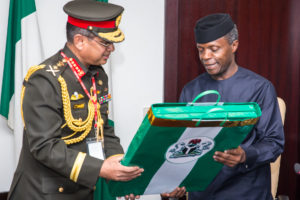
Nigeria’s Vice President, Professor Yemi Osinbajo presents a gift on behalf of President Muhammadu Buhari to Bangladesh Chief of Amy Staff, Gen. Abu Muhammad, during his courtesy visit at the Aso Rock Presidental Villa, Abuja, Nigeria, today, Tuesday. Photo by Novo Isioro. [myad]
Despite conceding defeat in the 2015 Presidential election, former President Goodluck Jonathan has finally made it clear that he was disappointed with the way the then chairman of the Independent National Electoral Commission (INEC), Professor Attahiru Jega handled it.
In an advance copy of a book written by the chairman of THISDAY editorial board, Segun Adeniyi and titled: ‘Against the Run of Play,’ Dr. Jonathan said: “I was disappointed by Jega because I still cannot understand what was propelling him to act the way he did in the weeks preceding the election.
“As at the first week in February 2015 when about 40 percent of Nigerians had not collected their PVCs, Jega said INEC was ready to conduct an election in which millions of people would be disenfranchised.”
Ex President Jonathan said that he had a meeting with Jega to express his reservations about the preparedness of INEC for the exercise, but that he insisted that the election would go ahead.
“Of course, the Americans were encouraging him to go ahead yet they would never do such a thing in their own country.
“How could we have cynically disenfranchised about a third of our registered voters for no fault of theirs and still call that a credible election?
“The interesting thing was that the opposition also supported the idea of going on with the election that was bound to end in confusion.”
The election was scheduled for February 14, 2015, but the Jonathan government shifted it by six weeks. The action was greeted by strong criticism from Nigerians.
In the book, Jonathan also defended his decision to postpone the election, saying it was for security reasons.
“When the military and security chiefs demanded for more time to deal with the insurgency, the reasons were genuine,” he said.
“As at February 2015, it would have been very difficult to vote in Gombe, Adamawa, Borno and Yobe states.
“But moment all the arms and ammunition that had been ordered finally arrived, the military was able to use them to degrade the capacity of Boko Haram to the level in which they posed the threat to the election.”
The book recounts how an incumbent lost a presidential election in Nigeria. It is due for launch on Friday this week. [myad]
We use cookies on our website to give you the most relevant experience by remembering your preferences and repeat visits. By clicking “Accept”, you consent to the use of ALL the cookies.
This website uses cookies to improve your experience while you navigate through the website. Out of these, the cookies that are categorized as necessary are stored on your browser as they are essential for the working of basic functionalities of the website. We also use third-party cookies that help us analyze and understand how you use this website. These cookies will be stored in your browser only with your consent. You also have the option to opt-out of these cookies. But opting out of some of these cookies may affect your browsing experience.
Necessary cookies are absolutely essential for the website to function properly. This category only includes cookies that ensures basic functionalities and security features of the website. These cookies do not store any personal information.
Any cookies that may not be particularly necessary for the website to function and is used specifically to collect user personal data via analytics, ads, other embedded contents are termed as non-necessary cookies. It is mandatory to procure user consent prior to running these cookies on your website.




 Minister of the Federal Capital Territory (FCT), Malam Muhammad Musa Bello has given marching order to the Inland Revenue Service (IRS) to end the regime of multiple taxation in the territory.



Whistle-Blowing In An Economic Recession, By Zainab Suleiman Okino
That not all Nigerians accept corruption as a way of life and that the majority even abhors it is not in doubt; this has been demonstrated in the acceptability and efficacy of the whistle-blowers’ policy recently introduced by the federal government. Many are prepared to collaborate with the government to reduce corruption to the barest minimum, and even expose their ogas and relations engaged in corrupt practices, especially in lieu of the financial rewards attached to such exposés.
Buoyed by the success of the Economic and Financial Crimes Commission (EFCC) in recovering looted funds with the help of the new policy, the FG is considering expanding its scope to deal with the illegal possession of arms and ammunition. Arms proliferation has added a frightening dimension to the country’s security challenges, as Nigeria is known as a destination for illicit arms.
The whistle blowers’ policy was conceptualised by the Ministry of Finance to encourage the populace to report stolen or looted funds kept outside the banking system. Since the government began the implementation of the TSA and BVN, there has been no comfort zone for those who emptied the treasury, enriched themselves and rendered the country broke. Now, the federal government wants to replicate and extend the same to those in the illegal possession of arms for nefarious purposes.
One cannot blame the federal government; the APC-led administration has been in dire straits since it took over the mantle of leadership in 2015. The foreign reserves had been depleted considerably by the previous government and country’s stock of foreign exchange, depending on oil receipts for replenishment had falling to a very low level due to the massive plunge in oil price at the international markets, besides the pipeline vandalism and disturbances attendant upon the restiveness in the Niger-Delta region, largely resulting from the activities of the Niger-Delta Avengers. With this myriad of problems, the nation’s economy came to near comatose. An ingenious way of tackling the the various problems with the economy – particularly driven by corruption – became needed, hence the birth of the whistle bowers’ policy.
Originally, the skeptical public who had endured the government’s lack-lustre performance in fulfilling its campaign promises did not consider the novel policy capable of any success. However, the big break came with the EFCC’s discovery of looted monies (or alleged gifts) hidden in a decrepit building in a run down location in the Sabo Tasha suburb of Kaduna State, which was allegedly owned by the former Group Managing Director of NNPC. In quick succession, other monies were also found at the Kaduna airport and a market in Lagos, with the biggest of them located in a flat in a luxury highrise on Osborne Road, Ikoyi, Lagos, where over N13 billion was recovered.
Eager to shore up its sagging image and loss of popularity, the federal government is latching onto the workability of that process to expand the frontiers of the policy to include reining in on illegal weapons. The National Security Adviser, Major General Babagana Monguno (rtd) is said to have initiated a template for the discovery and recovery of illegal arms circulating illicitly in the country. According to the Senior Special Assistant to the President on Media and Publicity, Mallam Garba Shehu, Monguno’s approach would focus on gun control. The mechanism, according to them, would also help to eradicate and prevent the illegal ownership of small arms and light weapons, which criminals maximise in terrorising or getting even with presumed enemies without recourse to the due process of litigation. Ditto with politicians who harbour arms for election-day violence, and who equally arm their thugs with weapons to harass their opponents. Meanwhile, arms are commonplace because our borders are porous and the provision of the law on them are either not sufficient, archaic or weak. The 1959 firearms act is yet to be amended despite our practise of civil rule in the past more than 17 years and being in the fourth democratic republic.
By far, this is about the most successful policy ever initiated by this government. On the economic front, the administration has failed woefully. In conjunction with the central bank, the federal government’s economic policy has been a resounding failure; it has only succeeded in pauperising Nigerians, as most families are unable to meet their basic needs. The costs of food have risen astronomically without a concomitant rise in citizens’ personal finances.
The government has been unable to manage its success after winning the 2015 election. Although Boko Haram was fought to a standstill, its vestiges still remain. Only last week the terrorist group sacked an army battalion and killed several soldiers and officers, not to talk of their attack on soft targets, through teenage suicide bombing. The party in power is in disarray. Instead of a cohesive party working in sync for the good of the people, what we see is a conclave of aggrieved members carving their own niche for the advancement of their interests.
The whistle blowing policy on illegal arms and weapons may be explosive and daunting. Although there is apprehension regarding whether it will work or not, in my own opinion, it is worth trying and it will work if government has the will to implement it, and is transparent about its operation.
The technical details that will go into the planning of the policy, how it would work, who will pay the whistle blower and the training of security personnel to handle such sensitive matters are not difficult to fix in the interest of the nation, if the government is determined to do it and the legal framework is clearly spelt out, such as the protection for the whistle blower and monetary inducement. The policy should be all encompassing without prejudice to political affiliation, status or ethnic consideration.
zainabsule@yahoo.com, www.zainabokino.blogspot.com [myad]