The Central Bank of Nigeria,(CBN) has made it clear that customers without Bank Verification Number (BVN) linked to their bank accounts will not be allowed to make withdrawal from those accounts, as from August 1.
The apex bank said that the measure becomes necessary as the absence of a unique identifier in the banking industry is a major challenge inhibiting the effectiveness of the Know Your Customer (KYC) principle.
A letter to all Other Financial Institutions (OFI) by the Director of the OFIs Supervision Department, Mrs. Tokunbo Martins, obtained from CBN website today Tuesday, said that it has become necessary to extend the BVN enrollment to customers of OFIs, especially as some OFIs are located in the rural areas and have customers that may not have enrolled with commercial banks.
“In view of the foregoing, all OFIs are required to enroll their customers on or before July 31, 2017; conspicuously display notices sensitizing customers on BVN in the banking hall; ensure that all new customers have BVN and forward to the Director, OFIs Supervision Department schedule of customers’ accounts with BVN on Auguast 7, 2017.
“The BVN is expected to minimise the incidence of fraud and money laudering in the financial system as well as enhance financial inclusion. The BVN enrollment will support the achievement of the zero default credit targets set for the Participating Financial Institutions (PFIs) in the Micro, Small and Medium Enterprises Department Fund (MSMEDF). It will also open opportunities for credit to millions of Nigerians without a standard means of identification.
“To address this challenge (absence of a unique identifier) and complement the existing means of identification of customers, which include driver’s licence; international passport; National Identity Card and the Permanent Voter’s Card, the CBN, in collaboration with the Bankers’ Committee, launched the BVN project in February 2014.
“The implementation of the BVN initiative, which started with the customers of Deposit Money Banks (DMBs) has been very successful. However, to avoid a broken identification link in the banking system, it has become necessary to extend the BVN enrolment to the customers of OFIs, especially as some OFIs are located in the rural areas and have customers that may not have enrolled with the DMBs.” [myad]
The Nigerian police have arrested a notorious Niger Delta Avenger Militant and Kidnapper, Anthony Pepple, popularly known as Urban Gorrilla and other members of his kidnapping syndicate. They are known for targeting Medical Doctors and Pharmacists in Port-Harcourt, Rivers state.
After several reported cases of kidnapping in Port Harcourt, IGP Ibrahim K Idris instructed the Intelligence Response Team (IRT) to bring an end to the menace of this syndicate. a statement from the police said that on April 1, at about 15 00 hours, after diligent and painstaking Intelligence gathering and analysis and Technical support from TIU, Operatives of IGP- Intelligence Response Team IRT deployed to Port-Harcourt, arrested one Saheed Adekunle aka ‘Black Devil’ 27 years of Ede south local government area of Osun State. “‘Black Devil’ who resides in Port-Harcourt confessed to be introduced into Kidnapping by one Tony in 2016 and gave valuable information that led to the arrest of the Overall Gang leader Anthony Pepple aka ‘Urban Gorilla’ 42 years of Bonny local government area of Rivers state, a very educated former staff of SAIPEM, a Multinational Oil Servicing Company, “He worked with the Company both in Nigeria and Abu-Dabi UAE. Upon his arrest, Anthony Pepple confessed to being a key member of the Niger Delta Avengers.
“He revealed to the police that he was actively involved in blowing pipelines and responsible for masterminding the cold-blooded murder of one Soboma George a militant commander in 2009. “He also confessed to being the Kingpin of a kidnap Syndicate that was known for targeting Medical Doctors and Pharmacist amongst other unsuspecting innocent members of the public in Port-Harcourt since 2015 collecting his ransoms in tens of millions of Naira.
“Pepple told investigators that he had a score to settle with Soboma over the death of his uncle. “Sobomo killed my uncle” he said. Narrating the series of events that occurred on the day of George’s murder, he said;
“On Saturday, while he was playing football, we were at the field and monitored him. I had an earpiece with me, which was connected to my phone. It made it easier for me to communicate with Ayi and Blackee. Luckily, Soboma picked up an injury and was carried out of the pitch. His girlfriend, younger brother and four of his boys were with him. They came to where I was standing; I called Ayi and told him that Soboma was out of the pitch. I told them to strike. His girlfriend said she wanted to eat banana with groundnut. They stopped in front of a woman selling it. “The groundnut seller sighted the car trailing Soboma and told him but he said his boys were inside the car. I pretended as if I was urinating; I called Ayi and told him that the woman selling banana was about spoiling the show. I told them to act fast. “They drove to where Soboma was; the first person to come out with a gun was Ayi. “When Soboma saw him, he tried to run, but the men opened fire on him and his girlfriend. The groundnut seller sustained bullet wounds. The girlfriend’s brother jumped into the gutter, while four of his boys, who were his guards, fled. I took a motorcycle and left the scene. “Ayi and Blackee didn’t wear face masks, so everyone saw their faces. “After the operation, they called and told me they were leaving Rivers State for Lagos. I started working on how to get my papers to travel overseas. While in Lagos, they called me again. They said Lagos wasn’t safe for them. “They left for Ondo State, where they were eventually arrested. I met Ayi when he came to Port Harcourt. I was also processing my papers to travel overseas to work. After a short while, my uncle’s wife fell ill and died.” [myad]
The Police Service Commission (PSC) has approved the promotion of former Commissioner of Police in the Imo Command, Taiwo Lakanu to the rank of Assistant Inspector-General of Police and 24 other senior officers to their next ranks. A statement by the head of the PSC Public Relations, Ikechukwu Ani, said that Taiwo Lakanu was also former deputy commissioner of police, Delta Command, before he was promoted commissioner of police in the Ekiti Command.
The statement said that other officers promoted include three assistant commissioners of police to deputy commissioners, one chief superintendent of police to assistant commissioner and two superintendents of police to chief superintendents.
Others are four deputy superintendents of police to superintendents, six assistant superintendents of police to deputy superintendents and eight inspectors of police to assistant superintendents.
It added that the commission also considered and upheld the promotion appeals of eight senior officers and approved their promotion to the next rank.
The affected officers included one assistant commissioner of police, one superintendent of police, three deputy superintendents of police and three assistant superintendents of police.
The statement quoted the Chairman of the commission, Mike Okiro, as asking the officers to continue to rededicate themselves to the service of their fatherland.
It said that Okiro reiterated the commission’s commitment to the promotion of officers and men based on merit, seniority and availability of vacancies.
The commission’s decision has been conveyed to the Inspector- General of Police, Ibrahim Idris, for implementation.
The Federal High Court in Abuja has granted bail to the detained leader of the Indigenous People of Biafra (IPOB), Nnamdi Kanu, who is facing charges bordering on treasonable felony.
Kanu can only go on bail if he can produce highly respected and a recognized jewish leader, a highly placed person of Igbo extraction such as a Senator and a highly respected person who is resident and owns landed property in Abuja with each depositing N100 million (making it N300 million).
The trial Judge, Justice Binta Nyako, who delivered the judgment on the bail application today, Tuesday, said that her decision to release Kanu on bail was based on health grounds.
She held however that the bail would be consummated only after Kanu has produced the three sureties and the N100 Million each as prescribed, including other conditions such as being barred from attending any rally or granting any form of interview as part of his conditions for bail
“I must stress it here that the defendant must not attend any rally. He must not be in a crowd exceeding 10 persons,” the Judge warned.
Justice Nyako insisted that Kanu who has been in detention since October 14, 2015, when he was arrested by security operatives upon his arrival to Nigeria from the United Kingdom, must sign an undertaken to make himself available for trial at all times.
Kanu was ordered to surrender his Nigerian and British international passports, even as the court compelled the federal government to return to him, his wedding ring and reading glasses.
Kanu’s co-defendants, Chidiebere Onwudiwe, Benjamin Madubugwu and David Nwawuisi were denied bail by the court which has fixed July 11 and 12 to commence their trial.
Meanwhile, Kanu has been returned to Kuje Prison pending perfection of his bail conditions. [myad]
Following an allegation that the Ekiti state governor, Ayodele Fayose has ordered the demolition of some Mosques, a group, known as Muslim Rights Concern (MURIC), has warned the governor not to provoke Muslims across the country.
In a statement, the group’s Director, Ishaq Akintola said that if the directive of the governor is carried out, it would amount to removing all Islamic landmarks in the state, adding that would mean that the governor is plotting to set Nigeria ablaze.
Akintola said that such action of the governor is capable of causing breach of peace, saying: “for reasons best known to him, Fayose wants to set Nigeria on fire. He knows that his action is capable of causing breach of peace yet he appears determined to go ahead.
“This move is not only irrational but also highly provocative. Governor Fayose is deliberately provoking Muslims in Ekiti state and by inference, in Yorubaland and the country as a whole.
“Fayose has a phobia for Muslims and an allergy for seeing any Islamic monument in their neighbourhood. Fayose is determined to uproot every single Islamic landmark on Ekiti soil before his tenure expires in 2018.”
MURIC threatened violence if the governor goes ahead with the demolition, saying: “nobody should blame Muslims for any breakdown of law and order if those mosques are demolished.
“We are bewildered that the chief security officer of a state can be hell-bent on stoking religious riot in a country heavily beleaguered with religious conflicts.
“Fayose’s belligerence and open display of hostility towards his Muslim citizens belies the perceived atmosphere of peaceful coexistence between Christians and Muslims in south-western Nigeria.
“Many people, including foreigners in the country, are under the impression that religious intolerance exists only in the northern part of the country.
“Nay, the truth of the matter is that Muslims in the region have been patiently bearing a long-drawn repression and denial of their Allah-given fundamental human rights.
“The reality on ground is that while a handful of Christians may be amenable to the idea of religious tolerance, many others like Fayose have a phobia for Muslims and an allergy for seeing any Islamic monument in their neighbourhood.
“MURIC calls the attention of leaders of the Christian Association of Nigeria (CAN) to Fayose’s aggression against Muslims. We appeal to Western diplomats in the country to spare a little time to study the religious landscape in Yorubaland,” Akintola said.
“We charge leaders of the national assembly, lawmakers from Ekiti state and all men of goodwill to make Fayose see reason. We invite notable traditional rulers in Yorubaland, particularly the much revered Ooni of Ife and the Alaafin of Oyo to intervene in the matter before it gets out of hand.
“Finally, we warn that the fragile peace and one-sided religious ‘tolerance’ being enjoyed in the south-west may come under severe threat if Fayose carries out his threat to destroy those mosques.” [myad]
The PUNCH newspaper company has demanded a full and unqualified apology from the Chief Security Officer (CSO) to President Muhammadu Buhari in the person of Bashir Abubakar for expelling its correspondent, Olalekan Adetayo from the Aso Rock Presidential Villa, Abuja.
The company also demanded apology from the presidency for the same reason, and the unconditional restoration of the reportorial access and privileges withdrawn from Adetayo.
“The apology should be addressed to our reporter and our newspaper.”
In a statement titled: ‘Aso Villa Expulsion: Our Stand,’ The PUNCH made it clear that the humiliated reporter will neither attend the meeting planned for today (Tuesday) nor subject himself to yet another Kangaroo trial.
“We hold that besides presidential introspection, what this situation requires is not a soft landing for a security operative who acted beyond his brief. What Abubakar deserves is a stinging reprimand from his superiors, heavy censure from his principal and the outrage of all right thinking members of the society.”
The company commended the reaction of what it called ‘saner and less-emotive heads within the presidency’ to convene a parley to resolve the issue, even as it said that the sordid event would have been comical if not for its tragic implications for our democracy, the freedom of the press and the inalienable right of every Nigerian citizen to the freedom of expression.
The full text of the statement goes thus:
Aso Villa Expulsion: Our Stand
On Monday, President Muhammadu Buhari’s Chief Security Officer, Bashir Abubakar, conducted a bizarre, one-sided summary trial in his office.
Abubakar was the complainant, prosecutor and the judge. The defendants were The PUNCH and its State House Correspondent, Olalekan Adetayo, whom Abubakar accused of writing a ‘sponsored story’ and penning an ill-motivated opinion article on the President’s health.
It was in vain that Adetayo tried to explain to the CSO that the said story, Fresh anxiety in Aso Rock over Buhari’s poor health, and his column, Seat of power’s event centres going into extinction, were done in the ordinary course of his duties, and without any ulterior motive.
Thereafter, events took a strange turn. The CSO left the dock where he was the complainant, donned the wig of a prosecutor and levelled more false allegations against our reporter. Then he quickly adorned himself in the robe of a judge and pronounced, with misguided magisterial flair, that our reporter should be thrown out of the Villa.
Abubakar’s judgement was then enforced by one of his minions who seized our reporter’s State House pass, marched him to the gate of the Villa and paraded him before a platoon of security operatives who were ordered to bar him from entering the Villa in the future.
Abubakar’s harassment and humiliation of our reporter are unwarranted, unjustified and, therefore, condemnable. His reckless display of power is an abuse of his office and an affront to our newspaper.
This sordid event would have been comical if not for its tragic implications for our democracy, the freedom of the press and the inalienable right of every Nigerian citizen to the freedom of expression.
As our paper went to bed last night, we were made aware of the efforts of saner and less-emotive heads within the presidency to convene a parley to resolve the issue.
We are happy to inform the authorities that our reporter will neither attend the meeting planned for today nor subject himself to yet another Kangaroo trial.
We hold that besides presidential introspection, what this situation requires is not a soft landing for a security operative who acted beyond his brief. What Abubakar deserves is a stinging reprimand from his superiors, heavy censure from his principal and the outrage of all right thinking members of the society.
We are aware that, only recently, Abubakar usurped some of the functions of the President’s battery of media aides and convened a meeting where he sought to teach State House correspondents how to slant, spin and scribble stories on the President and the Presidency.
Our demands are simple: a full and unqualified apology from Abubakar and the presidency, and the unconditional restoration of the reportorial access and privileges withdrawn from our reporter. The apology should be addressed to our reporter and our newspaper.
In this dispensation, vindictive and overbearing security operatives, like Abubakar, ought to bear three things in mind as they carry out their duties. One, Nigeria is a democracy, the martial antecedents of its current president notwithstanding. Two, those who hold positions of authority do so at the pleasure of the public. Three, public servants, no matter how influential, are mere tenants in the corridors of power. [myad]
A medical doctor, whose name was given simply as Dr. Ade, has been arrested in connection to the death of Senator Isiaka Adeleke. The doctor was identified as the one treated the Senator when he complained of leg pain early Sunday morning, shortly before he died.
This is even as the Senate has suspended sitting in honour of Senator Adeleke, who until his death was their colleague
An aide to the deceased confirmed to news men yesterday, Monday, that Dr. Ade has been arrested and is being interrogated by the police.
He said the doctor was arrested following the report that Adeleke died as a result of an overdose of medications he administered on him. This is as the report of the post mortem is being awaited.
DAILY POST gathered that the result will not be made public anytime soon due to the sensitive nature of the situation.
Many still believe that the late politician was poisoned, insisting he was hale and hearty on Saturday during the social functions he attended. He was said to have received guests until around 2:00am on Sunday before he slept.
However, the police in Osun State are yet to confirm or refute report of the doctor’s arrest.
The motion for the adjournment of sitting by the Senate was moved by Senator Ahmed Lawan at today’s plenary through order 43.
Senator Ahmed Lawan reminded his colleagues that it was a tradition that respect be given to the departed for his contribution to the National development.
“Mr. President, distinguished colleagues, I rise through order 43 of our rules to announce the death of our colleague, Senator Isiaka Adetunji Adeleke who died on Sunday, 23rd April, 2017.
“It is the practice and conviction of National Assembly to show respect to the departed for us to adjourn plenary to the next legislative day,” he said.
The Senate President, Bukola Saraki upheld the motion and said that valedictory speeches of late Adeleke would be taken tomorrow even as he appealed to the Senators to be available.
Late Adeleke, a former governor of Osun state, was a second timer to the Senate on the platform of the All Progressives Congress (APC). He was Chairman, Senate Committee on Capital markets. [myad]
Aisha, wife of President Muhammadu Buhari has acquired 20 rice mills and 25 fish driers for use by women farmers across the country. The mills were acquired through the Aisha Buhari Foundation.
A statement by the Director of Information to the wife of the President, Suleiman Haruna said that Aisha Buhari’s intervention is in line with her belief that women need to be economically empowered if they are to play their important part in socio-economic development, especially those that have no formal education and those that have dropped out of school.
He quoted the President’s wife as saying that acquisition of these equipment is part of a larger strategy to uphold the dignity of women through education and empowerment, which has recently led to her Foundation engaging with appropriate federal authorities to revive community learning centers across the country.
The statement said that the rice mills are those with capacity to process 20 tons per day and those with 10 tons per day.
“Seven states are to receive 10 mills with 10 ton capacity, while 8 states will receive 10 of those with 20 ton capacity. The 25 fish driers, with capacity for 20 units per hour will go to 13 states across the country.
“The acquired equipment forms the first tranche of what will be distributed nationwide, and are to be in custody of the wives of the governors of the beneficiary states. Women are to access and use the equipment for free.”
Aisha Buhari said she is confident that whenever women are given such an opportunity, they would use it to grow themselves and their families, especially in terms of improving their livelihood. [myad]
When last week, President Muhammadu Buhari decided to suspend the Secretary to the Government of the Federation, Babachir Lawal, and the Director General of the Nigeria Intelligence Agency, Ambassador Ayo Oke in order to allow unfettered investigations of both public officers, the most striking immediate reaction was the SGF asking: who is the Presidency? State House correspondents had accosted the then SGF as he left a meeting with the Vice President. It is standard practice at the State House for correspondents to lay ambush. Babachir Lawal obviously did not know that he had been suspended from office.
If the Vice President knew, he did not tell him. Again, that is how the Nigerian Presidency works. Once you fall out of line or favour due courtesies may not be extended to you. I was instructed on many occasions to wait until certain persons left the Villa, before issuing their sack statements. I once announced the disengagement of an important public official from the Presidential wing of the airport, as our aircraft taxied on the runway en route France.
In Babachir Lawal’s case, he was asked to react to something he knew nothing about. When he sought clarifications, the correspondents told him that the Presidency had suspended him from office. Anybody in his shoes would have been just as shocked as he was. He was right there in the Villa, and nobody told him there was a knife at his back. Besides, he occupies a very strategic office. The SGF’s office is the engine room of the Presidency.
The Chief of Staff may be the political, administrative head of the State House, but the engine of the Presidency is in the office of the SGF. He is in charge of Council meetings, the Ministers must interface with him, the civil service also, and he is directly in charge of more than 30 government agencies and parastatals. No key government event or appointment can take place without that office. Presidential power is delegated and distributed. The office of the SGF arguably has a larger share, in other words, in real terms, that office is probably more influential than every other office in the Executive arm of government.
The problem with privileged people in government, holding political appointments, however, is that they often get carried away. They forget that they are mere agents, exercising delegated authority. The illusion of power and the delusion of agents constitute one of the major threats in the corridors of power. But the delusion of relatives, associates and wayfarers is even worse. I have seen ordinary relatives of the President threatening to be powerful, and mere acquaintances claiming to be in charge of the Presidency. It got so interesting at a point that a colleague, who had a First Class and whose only dream was to get a Ph.D in his lifetime, kept insisting that he would devote his doctoral thesis to a study of the impact of informal agents on Presidential powers and authority. If waka-pass characters in the corridors of power can lay so much claim to power, there can be no doubt that privileged persons with big egos would be worse.
At that moment therefore when Babachir Lawal asked the question: who is the Presidency?, he must have thought of all the powers and influence in his custody and imagined himself as being indeed the main engine of the Presidency. His response to the correspondents was actually a retort: “who will dare take such a decision behind my back? I am the Presidency and I have just held a meeting with the VP. You reporters don’t know anything. You are telling the Presidency that the Presidency has suspended him from office?” By now, a week later, Babachir Lawal must have learnt one basic lesson about power.
The lesson is simply that it is power that gives power, when power withdraws power, what is left is powerlessness. For example, another person has since taken Babachir Lawal’s place in acting capacity and there is nothing he can do about that. Some other politicians are also already being positioned to take over that office eventually, so far three names have been mentioned- Ogbonnnaya Onu, Adams Oshiomhole and Olorunnimbe Mamora and it looks like there is a serious hustle for that office. Nobody is likely to reject the job if Babachir Lawal loses it. Meanwhile, the Presidency continues to move on while Babachir Lawal is under interrogation. In the last week alone, the suspended SGF should also have learnt a few more lessons about human beings. He may no longer ask that question: who is the Presidency? He is more likely to be asking: who is Babachir Lawal?
But that is a private question. No matter how concerned we may be, we can’t answer it for him. It is a kind of question, manifesting in form of a cross which every person must carry at certain critical moments in their lives. When he asked that other question however: who is the Presidency?, Babachir Lawal, beyond his egoistic slip, threw up something anagnoristic, which is of significant public interest. I offer to attempt an answer to the question.
The simple answer is that the President is the Presidency – office, power and system unified in one person. Under the type of Presidential system that we run, the President of Nigeria is more or less a unilateral person. He is Head of State, Head of Government, and Commander-in-Chief of the Armed Forces. His powers are derived from the Constitution, under which he is elected and which he swears to uphold and defend, and it is also subject to it, that he is expected to exercise his powers. The idea of our American-styled Presidential system is further hinged on the doctrine of the separation of powers.
This makes the President the custodian of Executive powers and provides constitutional checks and balances on those powers through the legislature and the judiciary. The Constitution requires the President for example to seek the National Assembly’s approval for appropriation and certain appointments, and grants the legislature the powers to impeach the President or pass a vote of no confidence, although this oversight power is hardly exercised. The Judiciary is constitutionally independent, and whereas the Executive approves the appointment of judges, it is not granted the powers to dictate to the judiciary. There are also certain independent bodies like the Electoral Commission, the Federal Civil Service Commission, the National Judicial Council and the Code of Conduct Bureau, which in the eyes of the law are required to be free from partisan control. The President also cannot take certain decisions without consultation. He consults such bodies as the Nigeria Police Council, the National Defence Council, and the Council of State, even if their advice is not binding on him. In making appointments he is also required to respect the Federal Character principle as stated in Sections 14(3) and 147(3).
The sum effect of the constitutional powers of the President under the 1999 Constitution in addition to the residual and implied powers of that office is that what we have in Nigeria at the moment is an imperial Presidency, far more imperial than the imperialism of the American Presidency contemplated and analysed in Arthur M. Schlesinger Jr’s book of the same title. Sections 5, 11, 157, 158, 215, 216, 218, 231, 305, and 315 of the 1999 Constitution grant the President of Nigeria enough powers to compromise the authority and impact of the other two tiers of government.
The exercise of so-called residual and implied powers makes the situation worse. The President can hire and fire, enter into covenants on behalf of the country, send police men onto the streets, send troops to war and seek legislative approval later, he can give national honours, grant pardon, spend money and seek approval within a time-frame, insist on the declaration of an emergency, and act as he may wish in the national interest.
This imperialism is a throwback to the monarchical nature of primeval societies. It is sustained sadly by contemporary myths, the thinking that the President is a mythical repository, a superhero- the man who has all the answers and who can do all things. Other players within the system at all levels, be it the legislature or the judiciary, the private sector or the civil society, also actively promote this myth and concede to it. The result is that power becomes centripetal. The people unwittingly submit their sovereignty. The idea of the President as a savior is a sad re-imagining of our democracy, which in full flight over-extends the symbolism and powers of the Presidency and threatens to make the legislature and the judiciary irrelevant and thus displaces the people from being partners into consumers of government propaganda and tyranny.
By regarding their Presidents or Heads of states as super-heroes, Nigerians place them above democracy and short-change themselves. This has been our dilemma since 1960. Tafawa Balewa, Nigeria’s first and only Prime Minister was the super hero who received the instruments of independence from the British colonialists, but by 1966, he had led the country into trouble. Yakubu Gowon, a soldier, took over. He was the super hero who led the country through a civil war and held it together, but he was soon shoved aside by another super hero, Murtala Muhammad, also a soldier. From Muhammad to Obasanjo, the military held sway until 1979 when the military returned power to a civilian “super hero”, Shehu Shagari. Shagari’s task was to prove that civilians could take charge of their own affairs, but the civilians messed up and the soldiers returned: Buhari, Babangida, Abacha, Abdusalami Abubakar, all super heroes who deployed power in different ways. Fast-forward to 1999 and the return to civilian rule since then.
What seems clear is that the extent to which every Head of State and Head of Government exercises Executive powers is a function of personality and the surrounding myths and circumstances. President Olusegun Obasanjo was such a total embodiment of Presidential powers every knee bowed before him. Those who resisted him regretted doing so in one form or the other. If he had actually insisted on a Third term in office, he could have possibly gotten away with it. He understood the full extent of his powers as President and he was not afraid to put those powers to test. He was succeeded by Umaru Yar’Adua who became President primarily because some powerful persons didn’t want some other people in that office and merely to pacify certain interests but eventually illness and death truncated President Yar’Adua’s potential.
President Goodluck Jonathan became acting President and later President also as a superhero. Nigerians used him to remind the North that in a Federation, no single region is “born to rule,” and that all Nigerians have full rights under the Constitution. The North never forgave Jonathan. In his case, he seemed to have played into the hands of his opponents by refusing to use Presidential powers to their fullest extent. He publicly declared on more than one occasion that power should not be wielded like a whip. He conceded a lot, some say too much to God, and to the opposition, and for this reason, many courtesans of power in Nigeria have also not forgiven him especially for being humble and for allowing power and office to go in the opposite direction.
His successor is a war-hero, a former soldier, who is not shy about being a Nigerian super-hero. He is wielding power and using it. The only problem is that a fully imperial Presidency creates its own contradictions, most of which the subject teaches us, is internal and therefore far more damaging to the system and democracy itself. Under no circumstance should an elected leader appear more powerful than the people, and the checking and balancing systems so vulnerable. The note-taking on this and the long-term dangers in the context of Nigeria’s democratic process and experience is, for now, a work in progress… Babachir Lawal, I hope I have answered your question. I hope you now know who and what the Presidency is. [myad]
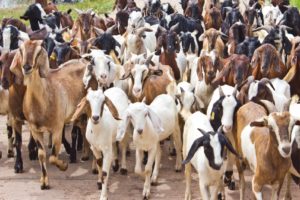
It is now a law in Zimbabwe for schools to accept goats, sheep and other domestic animals, including the provision of labour as school fees from parents who have no cash to dispense. Some schools are said to be accepting livestock as payments already.
According to the country’s education minister, Lazarus Dokora, schools will have to show flexibility when it comes to demanding tuition fees from parents, and that they should accept not only livestock, but also services and skills.
“If there is a builder in the community, he/she must be given that opportunity to work as a form of payment of tuition fees,” pro-government Sunday Mail newspaper quoted him as saying.
The minister stressed: “parents of the concerned children can pay the fees using livestock. That is mostly for rural areas, but parents in towns and cities can pay through other means; for instance, doing certain work for the school.”
It follows a move last week where Zimbabwe allowed people to use their livestock, such as goats, cows and sheep, to back bank loans. Under legislation introduced in parliament this week, borrowers would be allowed to register “movable” assets, including motor vehicles and machinery, as collateral.
According to the Bulawayo24 news portal, Zimbabwe’s worsening cash crisis means that people frequently spend hours queuing at banks to withdraw cash. The government says the shortage is due to people taking hard currency out of the country, but critics say it’s due to lack of investment and rising unemployment.
Social media has met the goats-for-fees idea with a mixture of scorn and gallows humour. Zimbabwean novelist, Tsitsi Dangarembga tweeted: “If we had been told in 1970 ‘We are fighting to introduce cattle and goats as currency. Please help & die for this’ what would we have said?”
Another Twitter user says: “recognising the fact that not all farm animals are born equal – asked Can I get a job as a goat evaluator?”
We use cookies on our website to give you the most relevant experience by remembering your preferences and repeat visits. By clicking “Accept”, you consent to the use of ALL the cookies.
This website uses cookies to improve your experience while you navigate through the website. Out of these, the cookies that are categorized as necessary are stored on your browser as they are essential for the working of basic functionalities of the website. We also use third-party cookies that help us analyze and understand how you use this website. These cookies will be stored in your browser only with your consent. You also have the option to opt-out of these cookies. But opting out of some of these cookies may affect your browsing experience.
Necessary cookies are absolutely essential for the website to function properly. This category only includes cookies that ensures basic functionalities and security features of the website. These cookies do not store any personal information.
Any cookies that may not be particularly necessary for the website to function and is used specifically to collect user personal data via analytics, ads, other embedded contents are termed as non-necessary cookies. It is mandatory to procure user consent prior to running these cookies on your website.