


Borno To Mark The Fall Of Sambisa Forest Every December 22; Build Museum

Borno State government has announced that it would mark the fall of Sambisa forest to the Nigerian soldiers every December 22. It said that the day would be declared Sambisa Memorial Day, with public holiday even as it plans to build a museum for the study of the Sambisa phenomenon.
According to the state governor, Kashim Shettima, the Memorial Day would be held every year in honour of the victims of Boko Haram insurgents, celebrate the victory recorded by the Nigerian Military and the remembrance of fallen soldiers and volunteers who sacrificed their lives fighting Boko Haram since 2009 in different parts of Borno State.
The governor, who spoke at the opening of the Nigerian Army Small Arms Championship today, Monday, inside the Sambisa Forest at the said that December 22 has been chosen for the annual public holiday because it was on December 22, 2016 that the Nigerian Armed Forces took over the Sambisa Forest from Boko Haram insurgents after a tough battle.
Shettima also announced his plans to seek partnership with the Federal Ministry of Defence and the Federal Ministry of Information and Culture to collaborate in building a National Museum and Research institution in Borno State that would collate all de-classified information, materials recovered by the military in relation to the fight against the insurgents to document history of insurgents, their victims, fallen soldiers and relevant materials in order to preserve lessons learnt from the crisis and to attract local and foreign tourists.
“The Borno State Government will from this year, begin to declare the 22nd December of every year, as SAMBISA MEMORIAL DAY. This day, which will be marked as public holiday in Borno State is for the purpose of celebrating the strength and victory of our armed forces; for the purpose of remembering victims of the Boko Haram insurgency and the families they left behind. It will also be for the purpose of remembering members of the Nigerian Armed Forces and Volunteers who gave their lives in the course of fighting the Boko Haram in Borno State. “The fall of Sambisa is both symbolic and memorable and this is why as a Government, we are taking steps to preserve the history behind the fall of Sambisa Forest and to spectacularly document the roles played by everyone from the Commander In Chief, our service chiefs, commanders of troops and our soldiers.
“Very soon, the Borno State Government will respectfully request for partnership with the Federal Ministry of Defence and the Federal Ministry of Information and Culture towards working together to construct a National Museum that we might call SAMBISA FALL & INTERNATIONAL RESEARCH CENTRE, for the purpose of documenting all de-classified information, to preserve valuable materials recovered by the military in relation to the fight against Boko Haram insurgency and to document history of the crisis from the days of the Taliban to Boko Haram.
“Importantly also, our aim is to document responses by successive political and military leadership and the eventual fall of Sambisa Forest under the administration of President Muhammadu Buhari. We hope that such a Museum will become a global custodian of information and valuable materials on issues relating to the Boko Haram and the role played by the Nigerian Military and multi national forces.
“We will propose that the museum should have A HALL OF FALLEN HEROES which should bear names and pictures of notable officers and men of the Nigerian Army, Air Force, Navy, Police, DSS, all para-military agencies, the civilian JTF and hunters who paid the supreme price in helping to free us from the Boko Haram.
“We will also propose that the Museum should have a HALL OF FAME to document the patriotic contributions of leaders like President Muhammadu Buhari, our current service chiefs, past and present military and other security heads and commanders of troops who meritoriously served within and outside the northeast in the fight against the Boko Haram.
“We will propose that the Museum should have a MEMORIAL HALL that would permanently bear names of notable civilians killed by insurgents. The whole idea is to preserve history so that we keep memories alive, so that we remember and salute our heroes and most importantly, for us and the future generation to learn from the unfortunate Boko Haram experience.”
The Governor paid tribute to the armed forces for their successes in suppressing the Boko Haram noting the people of Borno State will remain indebted to all those who made contributions to addressing the Boko Haram crisis and its effects.
The Minister of Defence, General Mansur Mohammed Dan Ali, represented President Muhammadu Buhari at the opening of the Championship.
The Chief of Army Staff, Lieutenant General Tukur Buratai hosted the event while National Assembly members dealing with the armed forces were also at the Sambisa Forest to mark the event.
There were ceremonial shooting by the Minister of Defence, Chief of Army Staff and National Assembly members who all wore military camouflages. [myad]







The Wonder Of UCH Ibadan…..It Is Scary To Be Old, By Folu Olamiti
Though the processes of growing, maturing and dying are natural phenomena, yet, the fear of managing old age marks the beginning of wisdom for many mortals. And the fear is not misplaced. Growing old is indeed scary. With my experience seeing my beloved parents growing old, and with me also climbing the age ladder gradually, I can confidently attest to the fact the process is very scary.
In fact, to enjoy old age, one needs the grace of the Creator; God.
First, you wake up one day and you suddenly realise that you are 50; and you begin to notice funny changes in your physiognomy, as well as your internally structure. The changes may begin with some twitting pains at your joints, knees and waist. At first, you may be thinking it is as a result of those long hours at work or stressful activities you subjected your body to. Then, you resort to self-medication, swallowing all sorts of pains-relieving tablets. Yes, they worked but just for a brief period. And, pronto, the pains are back!
You may be lucky to manage off and on pains in your 50s; but when you hit 60, it becomes a different ball game. At this age, the bones are becoming weaker by the day; the eyes are getting dimmer and giving you all kinds of problems. You may either not be seeing well or you start seeing cobwebs. A check at eye clinic may reveal early symptoms of glaucoma or cataracts. If you are lucky, you may get the reprieve of recommendation for reading and sight glasses. If you are not, it may be the beginning of a life-long treatment for glaucoma; a degenerative eye disease dreadfully termed the ‘Big G’. It is dreadful because glaucoma is a silent thief of the sight.
Again, from 60, you may be finding it difficult to flush urine out of your bladder. A check may reveal what your doctor may diagnose as prostate problem; either the benign form or beginning of prostate cancer. Unknown to many, especially men, no one is immune to prostate problems. In fact, from age 40, doctors recommend periodic checks of the bladder.
From 70, you are on your own. If you fall into the category of those with rough life styles, your bones may start getting brittle, your movement may begin to wobble; and you may begin to feel as if you are railing against gravity. Then, if you are unlucky, something may happen and you are confined to wheelchair. But for those who manage aging with regular exercises and periodic medical checks, those who manage to keep their elements intact, there may be not much to fear. Indeed, this special breed are usually still healthy and mentally alert enough to hold public offices and perform well.
The most damaging and frustrating aging problem is dementia -a severe impairment or loss of intellectual capacity and personality integration due to the loss or damage to neurons in the brain. It’s so devastating that it often makes its victims vegetable and deletes their memories. The victim neither remembers anything nor recognizes even his or her children and grandchildren. Though he can see, his brain is blank.
I have gone this far in my narrative so that you, my dear readers, can understand what lies ahead even as we pray for long life. I can tell you that it is not cheap to manage an aging body. Old age comes with a heavy price. You may be lucky to have health insurance but those who do not often pay through their noses. Those who are lucky to have children abroad who help them to cope with and manage old age-related issues still have some problems to contend with. They complain of feeling homesick and, in some cases, not getting the right treatment.
At a point in my life, I could no longer afford the soaring cost of medical checks abroad. It was at this point that someone introduced me to Chief Tony Anenih Geriatric Centre at the University College Hospital, UCH, Ibadan.
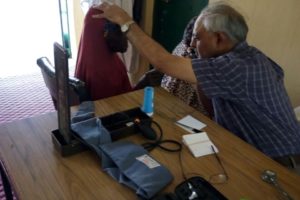
I was driven to the centre by my niece, Dr. Atinuke Akinmoladun. Behold, it was a sight to behold. I started seeing familiar faces of retired Vice Chancellors, Professors drawn from virtually every part of the country, aged politicians, businessmen, clergymen and aged peasants of all sorts. Some could barely walk and were in wheelchairs.
The environment was sparkling, made beautiful with well- manicured gardens, gardens brimming with aromatic flowers. Everything the aged needed was provided. It is optional to bring your aides for assistance. The centre provides for uniformed aides to move you around and attend to all your needs for a token. It has an electronic record system . From the beginning till the time the patient leaves you don’t have to carry notes around. Everything is electronically done.
Professor Ben Humphrey could not hold his excitement. He said: “This is the best thing to have happened in Nigeria. I have spent all my life savings abroad for yearly medical check-ups, some of them routine, before I learnt of this centre two years ago. I am getting, here, twice the attention I was getting abroad.”
Mama Adewole , mother of Nigeria’s current Minister of Health, was full of praises for the doctors and nurses: “They are just wonderful,” she enthused. “I am getting the best of treatments here. I’m tired of exposing myself to the biting cold abroad, and the fact that you are always by yourself whenever my siblings go to work. You are home alone.” Chief Anike Agbaje-Williams, veteran newscaster, jokingly said: “You can see I’m regaining my youthfulness. Knowing this place is a big blessing. It saves me the millions of naira usually expended traveling abroad for medicare.”
Pa Joseph Adebara, a 90-year-old grandpa, has this to say:
“May the Lord bless the founder of this centre. I gave up hope of living a year ago when I asked my children to start preparing for my funeral. But they said, No way! And, they wheeled me to this centre. Now, I’m on my two legs, walking unaided! Not only that, the founder of this centre gives me a yearly gift of new dresses. He gives not only me but to all the patients.”
Upon investigation, I learnt that the centre is the brainchild of the politician popularly known as “Mr. Fix It”; Chief Tony Anenih. The man had hitherto been fixing virtually every political jigsaw in Nigeria’s current democracy but at some point, he decided to fix better life for the aged. I give him kudos. He deserves a big applause from all well-meaning Nigerians.
I equally learnt that he started ploughing back the seeds realized in politics to build this centre to cater for the aged way back in 2012;and from then, he has never looked back as he keeps the centre going with regular funding; and he does so single-handedly. Chief Anenih picks the bills on anything and everything that has to do with the centre. He sets up a Social Health Insurance Scheme for all the clients at N18,000 annually, which gives the beneficiaries access to health care of up to N500,000 yearly. Here, fees payable for clinical services are pegged at 50% of normal hospital fees.
What is more, the centre is the first and only training hub for geriatric medicine under the Faculty of Family Medicine, and the first purpose built geriatric centre in Africa, and has become a model for Africa and parts of Europe. The services offered include: general clinical services, surgical services, ophthalmic services, geriatric psychiatric services, memory loss clinic, family life style, dental services, rheumatology services, medical school services and physiotherapy.
Folu Olamiti Media Consultant writes from Abuja. [myad]