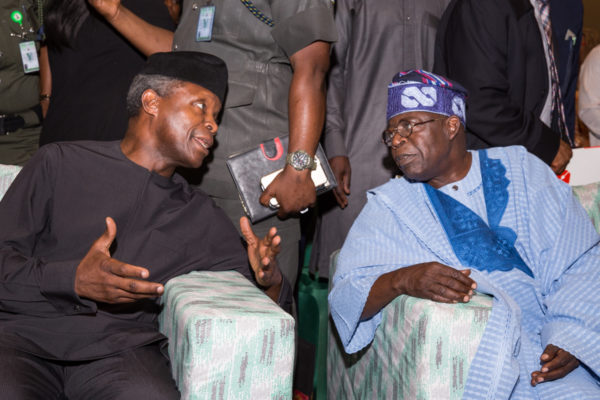
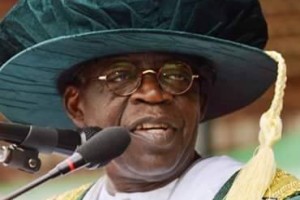
Vice President Yemi Osinbajo seems to be confessing to the national leader of the ruling All Progressives Congress (APC), Asiwaju Bola Ahmed Tinubu in whose honour a 9th Colloquium was held today, Tuesday 28, to mark his 65th birthday, that governing Nigeria, as complex and diverse as it is, is not an easy task. Osinbajo was in charge as acting President of the country for the 50 days President Muhammadu Buhari was away in London for medical attention. [myad]
Senators Mao Ohuabunwa representing Abia North Senatorial District, has clashed with Senator Godswill Akpabio over the release of both the detained leader of the Indigenous People of Biafra, (IPOB), Nnamdi Kanu and former National Security Adviser (NSA), retired Colonel Sambo Dasuki
While senator Ohuabunwa is leading some of his colleagues in the campaign for the release of the duo, senator Akpabio opposed Ohuabunwa’s motion to free Kanu and Dasuki, on the ground that it was out of order for Ohuabunwa to introduce the motion.
Akpbio insisted that the release of the duo had nothing to do with the debate on the appearance of Comptroller General of Customs, retired Colonel Hameed Ali in uniform.
Ohuabunwa had asked the Senate to prevail on the Attorney General of the Federation to advice President Muhammadu Buhari to free both Kanu and Dasuki the same way he (Malami) advised the Customs boss to ignore Senate invitation.
Senator Ohuabunwa argued that the continued detention of the IPOB leader and the former NSA despite court orders asking the Federal Government to free them was a gross violation of the fundamental human rights of the duo .
He said that some concerned senators who he is privileged to lead, have decided to join other Nigerian leaders in asking for the release of Kanu and Dasuki.
“I still stand by my prayers last week on the floor of the Senate that the Attorney General of the Federation should advice the president to release Kanu and Dasuki the same way he advised the Customs boss to ignore Senate invitation on the ground that the matter was in court.”
He said that the continued detention of Kanu and Dasuki amounted to disobedience of court orders, adding that he is already discussing the matter with some senators to formally draw the attention of the Senate to the long detention of the duo.
“We should have respect for rule of law and I support the call for the immediate release of Kanu and Dasuki.” [myad]
“My Lord, I wish I did not marry Tolade; may be things would have been better for me today. Tolade is frustrating and troubling me. Arrogance is her watchword as I mean nothing to her. Not only does she disrespect me, Tolade is also rude to everybody around me.
“Worst still, she is highly disobedient to me because she does not take instructions from me. She also accused me of preventing her from having access to the children.
“My Lord, Tolade recently brought three policemen to arrest me, accusing me of forcefully entering into my own house and moving out my property. She has since September 2016 parked out from my house and there is no more love between us.”
These were the narrations of Opeyemi Aremu who resides at Orita-Aperin when he sought for divorce from his wife, Tolade, after 16 years in marriage with four children to show for it.
Opeyemi told Ademola Odunade, the President of a Customary Court sitting in Mapo, Ibadan, who later went on to dissolve the marriage, that his wife was arrogant and insolent
The court, which granted the custody of the four children of the marriage to Opeyemi, said: “he has demonstrated that he has capacity to take care of them.”
Odunade said he decided to dissolve the union as a result of lack of love between them.
But, Tolade, a trader, objected to the divorce, saying: “I still love Opeyemi.
“My lord, there is no dispute between Opeyemi and I. My observation is that some women in the church we attend have been bringing food for him and he has since stopped eating my food.
“The senior pastor of our church is the major problem between Opeyemi and I because he wanted him to part ways with me.
“Later on, the pastor asked us to move into an apartment within his residence where he started misleading my husband.
“In fact, that pastor dissuaded Opeyemi from performing his ‘conjugal duties’ to me.”
Many Senators appeared to have embarked on protest against President Muhammadu Buhari on his refusal to sack the acting chairman of the Economic and Financial Crimes Commission (EFCC), Ibrahim Magu after the Senate rejected his confirmation at two different times.
The protest took the form of the Senate suspending the confirmation hearings of the 27 Resident Electoral Commissioners (RECs) of the Independent National Electoral Commission (INEC) who were earlier nominated by President Buhari.
The Senators wondered why Magu is still at the helms of affairs at the EFCC, with Senator Nwaoboshi (PDP Delta) saying at the plenary today that Senate may step down the Confirmation since they are acting and President Buhari’s appointees are disrespecting the Senate.
Senator Uroghide said that the request for the confirmation of RECs be stand down, citing Magu’s case. He said that after their decision he is still acting Chairman of the EFCC.
“If the Senate is ridiculed our institution has been ridiculed, we will try as much as possible to promote this institution,” Senator Anyanwu
Senator Francis Alimikhena said that the Senate must insist on hear from the president on Magu’s case, saying “Magu is terrorising us because we disqualified him.”
The Deputy Senate President, Ike Ekweremadu said that there is a time frame to stand down the confirmation, even as he asked the senate president to convey their feelings to the President.
Senate President, Bukola Saraki sought the opinion of the fellow senators who insisted on stepping down the Confirmation of INEC REC for two weeks. [myad]
Minister of the Federal Capital Territory (FFC), , Malam Muhammad Musa Bello has asked all those who have plots of land in serviced areas of Karshi Satellite Town to develop them or have them revoked forthwith.
The minister spoke today, Tuesday when he paid an unscheduled visit to Karshi Satellite Town to assess some of the ongoing projects.
Muhammad Bello is sad that while the FCT Administration had spent several billions of Naira to provide engineering infrastructure to service those plots, those who were allotted the plots have left them undeveloped.
According to him, most of the allocation papers to such plots of land have ended up in briefcases, insisting that notice to them to end the speculation and free the plots for development is very necessary.
“As you can see based on our inspection, the primary infrastructure in the Karshi township layout has all been completed, but nobody has put up any building there. The whole idea of opening new areas is for development to take place.”
“So, we have extant regulations that once primary infrastructure is in a location and there is no development, plots in that location will be revoked.
“I want to use this medium to advise all those who have allocations in Karshi town centre where the primary infrastructure has since been completed to commence development or else, we are going to revoke the plots and allocate to the teeming millions of Nigerians who really want to develop them.”
The Director of Satellite Towns Development Department, Mrs. Victoria Imande led the Minister and members of his entourage round the project site. [myad]
“Today, we must ask a most fundamental question: Is our political economy structured for the benefit of man or have we reduced man to be subservient to the impersonal political economy?
“The political economy should be for the benefit of man. In reality, we do not first try to reshape the economy to realize optimal benefit for the people. Instead, we have been conditioned to demand that the people contort themselves to fit the dictates of what the economy is or what it isn’t.
“I reject this harsh path. It violates the tenets of morality and of sustainable economics itself. We must begin and end our pursuit of economic balance with the precious things this nation produces.”
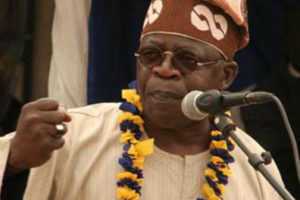
These postulations were advanced today, Tuesday, by the former two-term governor of Lagos State, Asiwaju Bola Ahmed Tinubu in a lecture he delivered at the 9th Colloquium in his honour as he clocked 65 years.
Speaking specifically on the nation’s economy, Tinubu said that more than any hour in the nation’s recent history, Nigeria has been standing at what he called “a defining juncture.”
According to him: “our challenges are manifold and profound. But so are our collective abilities and talents. The balance will then tip in favor or against us as our commitment and political will to succeed dictate.”
The celebrant noted that Nigeria is a prolific manufacturer and that it has produced 170 million of the most adaptive, industrious economic units on earth.
He insisted that it is not just enough for the citizenry to lament their great numbers but to reform the political economy in a manner that puts them to productive work.
“The old model upon which this economy has so long sputtered, has crashed right before our eyes. We must retool ourselves. A new outlook is needed.
“Even at the best of times and with the highest of oil prices, widespread poverty, gross inequality and high unemployment of man, machinery and material described our condition.
“The decline in oil prices turned our extant economic model into rubble overnight. If we do nothing to reform it, we have done nothing less than enter into an economic suicide pact with ourselves.
“Fortunately, the current government has begun the sometimes painful process of salvage and reform.”
Asiwaju Tinubu then offered a few personal insights which he hoped might be of some help in this vital economic reformation.
On diversification and industrial policy, the national leader of the ruling All Progressives Congress (APC) noted that no populous modern nation with a significant urban population has attained prosperity without creating an industrial base capable of employing great numbers of the urban population and of manufacturing goods for domestic consumption and export.
He wanted Nigeria to learn from England which barred the export of textile looms at dawn of the Industrial Revolution, from the high tariffs America imposed for over 150 years after its independence. He also wanted Nigeria to learn from China which implemented a most comprehensive protectionist regime to become the world’s most prolific manufacturer.
“These three nations represent the past, present and immediate future of economic achievement. Yet we depart from what has proven effective. The manuals of mainstream economics tell us not to do as these nations did. We oddly choose to believe falsehoods written in the books at the expense of the truth on the ground.
“We must press forward with a national industrial policy fostering development of strategic industries that create jobs and spur further economic growth.
“As part of this plan, government should institute a policy of tax credits, subsidies and the insulation from the negative impact of imports critical for these sectors.
On infrastructure and power, Tinubu that it is important for the government to closely complement the industrial plan, saying: “we need a national infrastructure plan. New structures need to be built and existing ones enhanced so that we enjoy a coherently planned and integrated infrastructural grid. A national economy cannot grow beyond the capacity of the infrastructure that serves it.
“Of utmost importance, we must conquer the political and bureaucratic bottlenecks preventing affordable, reliable electrical power.
“This impediment places us literally and figuratively in the dark regarding our economic condition.
“The problems are not technical in nature as reliable electricity is a staple of economic life in nations less endowed than Nigeria.
“We must persuade and convince those factors that currently impede our national quest for reliable power to move aside so that we can achieve this crucial precursor to economic vitality.”
On credit, mortgages and interest rates, the former Lagos governor said that modern economies are built on credit and that credit for business investment and consumer spending is too costly in Nigeria to be of much help.
He advised that consumer credit mechanisms should be more accessible to the average consumer.
According to him, the prevailing custom still requires a consumer to purchase in one lump sum a house, a car, a refrigerator, describing it as “oppressive. It defeats the average consumer and dampens economic activity.”
He stressed that this systemic credit malpractice fosters corruption and that hardly people can save so much that they are able to pay for a house or car all at once.
“To acquire the lump sum amounts, decent people are tempted to do what they would not even consider if consumer credit was practically at hand.
We have to revamp our government-backed home mortgage system. Mortgage loan agencies need to be better funded, they must liberalize eligibility requirements so more people qualify and they should provide longer-term mortgages with manageable interest rates.”
On agricultural reform, Tinubu stressed the need for the government to summon the heart and courage to implement ideas that have consistently proven themselves in other countries.
“If we try, these measures will ably acquit themselves here.
“In conclusion, one additional thought shall suffice. Here I add a third part to this year’s theme. Not only must we use what we make and make what we use. We must make what the world values.
“A nation does itself better by manufacturing a good and affordable appliance or car than in cultivating a sublime mango or perfect banana. We must not allow our present comparative disadvantage in manufacturing to keep us from pursuing a tomorrow where that disadvantage is abolished.
“We stand at a moment where history will be made for better or worse. Consequently, we must use our creative insight to peer into tomorrow to see what the rest of the world may want to buy, then devote ourselves to making these products.
“Neither Japan nor South Korea had significant iron ore deposits. Yet they built steel industries as the foundation for their impressive rise in car manufacturing.
“Nigeria must act in similar fashion. We must remember nothing that another nation can do is beyond our grasp even if we do not currently have the thing in hand. This is the change that we can and must achieve.” [myad]
The Central Bank of Nigeria (CBN), has again crashed the rate at which it sells forex to Bureaux De Change (BDCs) in Nigeria to N360 even as it directed the BDCs to sell to end users at not more than N362/$1.
This is coming barely 24 hours after the apex bank’s directive to Deposit Money Banks (DMBs) in the country to sell foreign exchange obtained from it to retail end-users at not more than N360/$1 for invisibles.
The CBN Acting Director of Corporate Communications, Isaac Okorafor, confirmed the directive in Abuja on Tuesday, disclosing that the CBN, under the new policy, will sell forex to the licensed BDCs at the rate of N360/$1, while they will in turn sell to customers at a rate not more than N362/$1.
Okorafor said that the objective of the new forex sale policy was to ensure a convergence of the rates in the interbank and BDC, stressing that the CBN remained committed to ensuring transparency in the market as well as fairness to end-users, many of who hitherto experienced challenges in accessing foreign exchange.
He urged licensed BDCs to play by the rule, cautioning that the CBN would not hesitate in sanctioning any erring dealer.
The CBN spokesman also disclosed to newsmen that the sum of $100 million offered to authorized FOREX dealers in the interbank wholesale window to meet the requests of genuine wholesale customers was fully subscribed at the auction on Tuesday, March 28, 2017.
Okorafor said that his call to all stakeholders to play their respective roles in ensuring a smooth running of the foreign exchange market for the benefit of the Nigerian economy. [myad]
Liliane Bettencourt of France has emerged again as the world’s wealthiest woman, according to Forbes’ recently released list.
According to Forbes, Bettencourt has a net worth of $39.5 billion, making her the richest woman in the world. Nearly all her wealth comes from owing a third of the cosmetic company L’Oreal, which her father founded in 1907.
The French heiress is followed by Alice Walton, the only daughter of Sam Walton, the founder of Walmart. Walton, who boasts of a whopping $33.8 billion, retains her number two spot from 2016, though her wealth has grown by $1.5 billion this year.
Jacqueline Mars, the granddaughter of the famed candy maker, Frank Mars, comes in as number three at $27 billion, the same ranking she held last year.
Others are:
Maria Franca Fissolo, Net worth: $25.2 billion
Susanne Klatten, Net worth: $20.4 billion
Laurene Powell Jobs (Steve Jobs wife), Net worth: $20 billion
Gina Rinehart, Net worth: $15 billion
Abigail Johnson, Net worth: $14.4 billion
Iris Fontbona, Net worth: $13.7 billion
Beate Hesiter, Net worth: $13.6 billion (LIB)
The release of the wealthiest women in the world was made to mark the celebration of Mother’s day yesterday. [myad]
President Muhammadu Buhari has taken a look back at how the national leader of the ruling All Progressives Congress (APC), Asiwaju Bola Ahmed Tinubu built political consensus that led to unseating of an incumbent President in 2015.
He said that Tinubu’s foray into politics “ushered in a better understanding of building consensus to achieve historical feats, like unseating an incumbent government.”
President Buhari, in a message to congratulate Tinubu who was former two-term governor of Lagos State on his 65th birthday, described the celebrant as a great leader.
The President emphasised that Tinubu was able to raise the bar for many political leaders across the country as a two-term governor of Lagos State, who bequeathed a style of leadership that completely altered the landscape of the commercial capital.
Buhari recalled his pleasant and intellectually enriching encounters with “the Jagaban of Borgu Kingdom over the years,” and confirmed that the nation has benefitted a lot from the personal sacrifices, political experience and intellectual foresight of the APC chieftain, and still stands to gain more.
He congratulated the APC leader on behalf of all members of the APC, his political and business associates, his friends and family, describing his 65th birthday as “another milestone” even as he prayed to God to grant the Asiwaju good health, longer life and more wisdom to serve his country and humanity. [myad]
I once wrote about Nigeria’s “children of anger”, but the country seems to have progressed from anger to clinical depression, resulting in a rise not merely in social aggressiveness, but a determination by certain individuals to escape from it all. The percentage of Nigerians seeking escape through suicide nonetheless remains small relative to the size of the population, but the sharp increase in the number and frequency of reported suicides in the last two years alone speaks to a certain dysfunctionality requiring closer inquiry.
Suicide is an act of self-destruction, an escape from the self, an act of self-defeat. Whether the suicide is anomic or fatalistic, due to loss of job, broken relationships, dis-inhibition, economic deprivation, environmental factors, disability or psychosis, it usually arises from an awareness of the inadequacy of the self. What Germans call “weltschmerz”, that is, a discrepancy between personal expectations and the reality of personal space, which for many may result in anger, aggressiveness, a feeling of rejection, isolation, inadequacy and ultimately a revolt against the self.
It is often assumed that poverty is synonymous with this resolve to deconstruct the self but the highest suicide rates are actually found in countries with wealth, and better environment, and all ten of the most popular spots for suicide in the world are in developed countries. What is certain however regardless of the place and time, is that human beings decide to abbreviate their own mortality when they resolve that they can no longer live with the discrepancy between what they are and what they would like to be, or what they have been and what they have suddenly become or what they expect and what happens to them eventually, all of this basically in the context of the imagined stigma, shame, disgrace or disappointment.
What is instructive in our own circumstance, however, is that suicide has always been frowned upon in our society: It is forbidden by law, religion, society and tradition, to the extent that in local communities, persons who commit suicide are not given any decent burial, they are thrown into the evil forest to serve as a deterrence to others, and the affected family is stigmatized. It is for this reason perhaps that suicide cases used to be very few in our land. Besides, Nigerians are known for their optimism and resilience.
We were once described as one of the happiest people on earth, and one Dictionary describes a segment of our population, the Yoruba as the “fun-loving people of the South West part of Nigeria.”
Nigerians love life so much they describe virtually every funeral as a “celebration of life” and every life, including the poorest is advertised in funeral posters as “a life well spent.” The cemetery is seen as a desolate, lonely, outside corner of the social space where no one is in a hurry to go. But all that has changed; or appears to be changing, for in the last two years, suicide seems to have become fashionable among seemingly ordinary folks.
I use the phrase “seemingly ordinary folks” advisedly, because the other kind of suicide that is known to Nigerians remains even surprising, and I refer here to the terrorism, religious fundamentalism-inspired suicide attempts of the likes of Umar Farouk Abdulmutallab and Boko Haram agents. When the news broke in 2009, that the former had been uncovered as a suicide bomber, Nigerians were shocked. The reaction then was that it was impossible for a Nigerian to willingly decide to die for, of all reasons, ideological or religious reasons. We were soon proven wrong when Boko Haram began to deploy both male and female, mature and teenage, suicide bombers who turned Nigeria into an extension of the killing fields of al-Qaeda. This trend continues, with the hope within the larger society, that it is something that would end someday.
What the emerging literature shows is that the conditions for every suicide vary in time and space, but in Nigeria, the reported cases point to too many cases of self-deconstruction on the basis of economic deprivation, loss of status, debt, helplessness. The responsibility of government is to ensure the security and welfare of the people. There has been a great failing in this regard, with the people driven further below their perceived reality, which reinforces the causative principle earlier defined. Some of the recently reported cases are as follows: a man ended it all because he could not give his wife “chop-money”, another woman chose to die because she could not pay off her debts, in one week in Lagos, a doctor, two women and an elderly man chose the Lagoon as their death-spot. With the way the Lagos Lagoon has suddenly become a popular spot for suicide in Nigeria, it may well in due course, become one of the most popular suicide spots in the world.
It is noteworthy, if I must say so, that the ten most popular suicide spots on earth are associated with the sea, and bridges, with perhaps the sole exception of the Aokigahara Forest-Mount Fuji in Japan where suicide rate is as high as 100 per year. The Japanese may tolerate suicide and consider it supernatural, but here in Nigeria, it is a growing trend that should be discouraged. Some priests have said the Lagos Lagoon is angry and that is why it has been attracting persons to jump into it: if indeed whatever spirit that controls the Lagoon is hungry, the Oba of Lagos and his chiefs should hurry up and feed that spirit with whatever it eats. I assume that this would be a more useful venture than the partisan declaration by the Oba of Lagos that nobody should contest against the incumbent Lagos State Governor in 2019! But how about the other unreported causes of suicide, far away from the Lagoon? This is where the dilemma lies and where our constructive social theory, and the admissibility of every piece of evidence, empirical and customary, meets a brick-wall.
As a country, society and government, we would always have to deal with deviant behaviour, into which category suicide – the ultimate act of violence and rebellion against self and society falls in this particular context, what is crucial is society’s level of preparedness to reduce the scope and range. In Nigeria, we are not prepared at all. When people fall into depression in other countries, they visit counselors and psychiatrists. In Nigeria, a prominent leader once dismissed psychology as a useless course that should be removed from the curriculum. Graduates of psychology end up doing something else, or they end up offering pro bono counseling on social media like my in-law, Joro Olumofin, but with people dying for no just reasons and jumping into the river or hanging themselves or killing their spouses and family members, this is a country in urgent need of professional counselors. Psychiatry is another relevant discipline that has been utterly neglected.
I once gave a keynote address at the Psychiatric Hospital, Aro in Abeokuta and I was again Keynote Speaker at the 100th anniversary of Psychiatry in Nigeria. Nothing has changed since then. We don’t have enough psychiatric doctors or hospitals in Nigeria. The few psychiatric hospitals are poorly funded, psychiatric doctors are poorly treated, the discipline is disregarded, and yet this is a country of psychotic cases at all levels, the more serious cases are in government, making decisions that create more problems of bipolar disorder in the larger society. Nigeria is a victim, like many other developing countries, of a one-sided embrace of globalization and its gains and evils. People watch TV and they are socialized into a new form of thinking that is disconnected with local values and culture. They become anti-heroes in the process. Suicide or attempted suicide has not fetched any one or any family any kind of honour in our society.
Given this sociology, greater attention needs to be paid to the increasing incidence of suicide, in the North and the South particularly, with the most vulnerable states properly identified and strategic intervention measures put in place. A preliminary observation indicates that the most affected persons in the North are radical Islamic extremists used as pawns by the Boko Haram, while in the 10 most affected states in the South, the cause is basically existential. This observation is based on reported cases, but with the increasing frequency, it is safe to hazard a guess that there are many more unreported cases, which may provide additional or different sociological conclusions.
Whatever the case may be, this rise of despair in the country needs to be managed. Suicide prevention hotlines have been announced, but the thought of suicide should be discouraged in the first place, through better governance, opportunities for professional counseling, and better management of mental health. Most Nigerians don’t even know who to go to, or talk to when they are depressed! And if they know, they don’t want their private secrets to be known. When the suicide succeeds or fails, the relatives are in need of help: they will need counseling, to deal with the frustration and the shame.
I believe that suicide-related problems can be fixed. The challenge is to convert the people’s pessimism into optimism through people-centred governance and to deliver the much-expected, much-trumpeted change in their circumstances. Disappointment leads to frustration, to anger, to despondency, to losses, to despair and ultimately to self-destruction for the weak-hearted. But suicide is not a solution. And to those who doubt this, Teebliz, Tiwa Savage’s husband is a living testimony. Not too long ago, he wanted to jump into the Lagoon. He said his wife, the award- winning singer, had disappointed him. He accused her of many better-unmentioned-again-thing s. He could not take it anymore and he wanted to self-destruct.
His suicide attempt was more or less televised, because it was everywhere on social media – it is not every suicide that is so televised- eventually he was prevented from taking the plunge, and he raved and ranted afterwards and then went quiet. Months later, he has been shown taking photographs with the same woman for whom he wanted to play a Romeo without a Juliet. In their most recent outings, they have been shown with their son, Jamil who looks like his father’s twin, and last weekend, the boy had his Christening at a church in Lekki. Teebliz has been pictured bonding with his son and beaming with fatherly pride.
If he had jumped into the Lagoon when he wanted to do so, he would have been long dead and forgotten. But Teebliz looks much happier now, and deep within him, he must be grateful to the persons who did not allow him to jump. He must be particularly happy seeing his son growing up into a fine young kid. There is nothing in this life that cannot be fixed and there lies the futility of suicide. [myad]
We use cookies on our website to give you the most relevant experience by remembering your preferences and repeat visits. By clicking “Accept”, you consent to the use of ALL the cookies.
This website uses cookies to improve your experience while you navigate through the website. Out of these, the cookies that are categorized as necessary are stored on your browser as they are essential for the working of basic functionalities of the website. We also use third-party cookies that help us analyze and understand how you use this website. These cookies will be stored in your browser only with your consent. You also have the option to opt-out of these cookies. But opting out of some of these cookies may affect your browsing experience.
Necessary cookies are absolutely essential for the website to function properly. This category only includes cookies that ensures basic functionalities and security features of the website. These cookies do not store any personal information.
Any cookies that may not be particularly necessary for the website to function and is used specifically to collect user personal data via analytics, ads, other embedded contents are termed as non-necessary cookies. It is mandatory to procure user consent prior to running these cookies on your website.