A Lagos housewife whose name was given simply as Mrs. Bassey, has allegedly inserted a stick of broom mixed with pepper in the private part of a nine year old boy, named Promise, who is under her guardianship, having accused him of stealing N2,000 from her bag.
Mrs. Bassey, a mother of four children, was arrested by the Police when the neighbours reported her brutality to the Iponri Police Station over the continuous brutalization of Promise.
One of the neighbours said that Promise is Mrs. Bassey’s nephew, and that he has been living with her since he lost his parents over five years ago. It was learnt that Mrs. Bassey had been abusing the boy for a long time now.
The Police Public Relation Officer, Dolapo Badmos, confirmed that officials of the Lagos State Office of the Public Defender have taken custody of Promise, while Mrs. Bassey has been remanded in prison. He said that the suspect has been charged to court. [myad]
Worried by the proposal for six week closure of the Nnamdi Azikiwe International Airport, Abuja, the nation’s Senate has resolved to invite the Ministers of Transportation, that of State on Aviation; Works, Power & Housing, Federal Capital Territory (FCT), Chief of Air staff, managing director of Federal Airport Authority of Nigeria (FAAN) and Nigerian Airspace Management Agency (NAMA), to provide it with details on the said closure.
The senate said that the ministers are expected to explain the circumstances leading to the closure, which takes effect from March 6, this year and what measures are being taken to lessen the negative effects of such exercise.
A motion, which was sponsored by Senator Hope Uzodinma and five other Senators noted with concern, the decision of FAAN to close the Airport for six weeks for the purpose of carrying out repairs. The upper chamber is worried that a 6-week outright closure of a major and the only airport in the FCT can trigger untold hardships on air travelers.
The Senate said that it is determined to explore all other possible options that can avert the planned total closure of a strategic National port for six weeks.
The Deputy Senate President, Ike Ekweremadu, who seconded the motion, admitted that there is need to repair the runway but said “I don’t agree with closure of the airport. Many countries have repaired airports without closure and many lives have been lost on Kaduna road”
In his contribution, the Deputy Majority Leader, Senator Bala Ibn N’Allah said: “I am disappointed with the approval of the closure. We should make necessary consultations and find alternative solutions to it.”
Barnabas Gemade, representing Benue Central, suggested that the government should take the shutdown in piece meal, saying: “we can do repairs 36 hours in a week or on Saturdays.”
Senator Dino Melaye, who represents Kogi West, admitted that such action will embarrass the country and that it will also affect the country economically, politically and socially.
“Our Aviation intellectuals must think.”
Senator Shehu Sanni from Kaduna, in his own comment, said: “the elites are running away from the problems they created. They have created hell and want to live in paradise. If the road is bad they do not want to go there.” [myad]
Compulsion is not the nature of God, and it’s not in His character to force one into doing His will. Many people are ignorant of the curse the devil lays on them by most of those chain messages they receive; and they are asked to resend the message, if not something negative will happen to them. Some of the messages end with curse tags like, if you don’t send it to at least ten of your contacts; you are not a child of God; you don’t love God; you could experience some misfortune; you will die; etc. and unsuspecting people keep resending them. These messages are on Facebook, Whats App and other social sites. The truth is that those messages are an evil means of spreading curses and laying heavy burdens on unsuspecting Christians and other people.
Another wrong message spread across is one claiming to come from Whats App’s CEO and that whoever does not resend it will have his Whats App blocked. It is false. Such messages have codes that can be decoded by occult members. Those in the occult use those messages to pass across their information to members worldwide and by spreading such messages; you are being used as a courier.
When you receive those chain messages, delete them and educate the sender on the true nature of such messages. Always remember that God would never threaten you into doing something. And God doesn’t just bless you because you have sent the message to a certain number of people within a few minutes, etc.; it’s the devil posing like an angel of light. God blesses those who obey His word (Deuteronomy 28).
Don’t spread curses or be a courier for the occult, please just delete such messages. [myad
Former Chairman of the Board of Trustees (BoT) of the Peoples Democratic Party (PDP), Chief Tony Anenih, has said that Niger State without the former governor, Engineer Abdulkadir Kure is politically unexciting.
In a condolence message to the family of the Abdulkadir Kure, who died on Sunday and government of Niger State, Anenih said his sudden transition had created a big vacuum in the politics of the state. Anenih, in the condolence letter which was delivered to the wife of the late former governor, Senator Zaynab Kure, expressed shock at the death, which he described as sudden.
Anenih said: “his death came at a time his wealth of experience as a former governor of Niger state, an accomplished public servant and astute politician, was most needed to assist in giving direction to his state and the nation. “Engr. Kure’s Sojourn as governor for eight years, from 1999 to 2007, showed a man who worked tirelessly for the development of infrastructure in Niger State. “His transition to the great beyond has indeed left a big vacuum in the politics of his state that may be difficult to fill.” Anenih described Kure as a courageous man and consensus builder who never shied away from expressing his views on critical national issues, while working with others in government for the overall peace of the nation. “He therefore merited and earned an appointment as member of the Board of Trustees of the Peoples Democratic Party (PDP), which I chaired at various times.” Anenih said Kure’s political wisdom would be sorely missed by the PDP, Niger State and Nigeria’s political landscape. He prayed that the widow, his entire family and the good people of Niger State would be granted the fortitude by God to “bear the great loss of this very good man, and grace to fill the void created by his demise.” He advised them to take solace in the fact that Kure left “a legacy of posterity, worthy of emulation,” [myad]
The Chief of Staff to the President, Abba Kyari, has made it clear that he paid for all his medical bills during his recent visit for emergency medical treatment. A statement today, Monday, by Senior Special Assistant to President Buhari on media and publicity, Garba Shehu, said that Kyari did not use the funds of the Nigeria High Commission in London to pay the bills as erroneously published by an online news medium, which he said are totally incorrect, misleading and a fabrication. He stressed that the Nigeria High Commission in London did not at any time ever settle his medical bills or any other bills for that matter as he personally took responsibility for paying his own bills. “This is by the Chief of Staff’s choice. He pays for his medicals, his taxi and accommodation in the U.K in spite of the high office he occupies, even when there is no rule that says he cannot be catered for by government. “For the records, Kyari was rushed out of Nigeria for an emergency medical treatment on the fateful December 1st, 2016. To receive him on arrival, the Wellington Hospital needed to have cash deposited, or in the absence of this, a letter of guarantee. “In order to meet this condition, the Nigeria High Commission in London wrote the Letter of Guarantee to the hospital for treatment to commence. The role of the High Commission didn’t involve financial commitments on behalf of Kyari. “The Letter of Guarantee from the High Commission was meant to meet the routine requirements of the Wellington Hospital since the patient in question (Kyari) didn’t possess the UK National Health Insurance. “Apart from senior government officials, other reputable Nigerians are issued with such guarantee letters to hospitals. A guarantor is not liable unless there is a default, but this wasn’t the case with Abba Kyari who paid all his medical bills by himself as he had done on previous occasions. “Hospital records are available for verification to show that the Nigeria High Commission in London didn’t spend a penny on Kyari, as its involvement didn’t go beyond the issuance of the letter of guarantee to the Wellington Hospital.” [myad]
President Muhammadu Buhari has sacked the Executive Secretary of the Financial Reporting Council of Nigeria (FRN) and reconstitution of the board immediately. Chairman and new Executive Secretary have already been appointed for the council. A statement by the Senior Special Assistant to the President on media and publicity, Malam Garba Shehu said that new Council has Mr Adedotun Sulaiman, as Chairman. The statement said that Adedotun Sulaiman was a former Managing Partner/Director of Arthur Anderson and later, Accenture. He is a Chartered Accountant and a product of the University of Lagos and Harvard Business School. The statement said that the President has also approved the appointment of Mr. Daniel Asapokhai as the Executive Secretary of the Council. He is a partner and a Financial Reporting Specialist at the PricewaterHouseCoopers (PWC), Nigeria. He is a product of the University of Lagos and the University of Pretoria. The statement saod that Buhari instructed the Minister of Industry, Trade, and Investment to invite the nineteen ministries, departments and agencies of the Federal Government and private sector organizations specified in the FRC Act to nominate members to the board of the council.[myad]
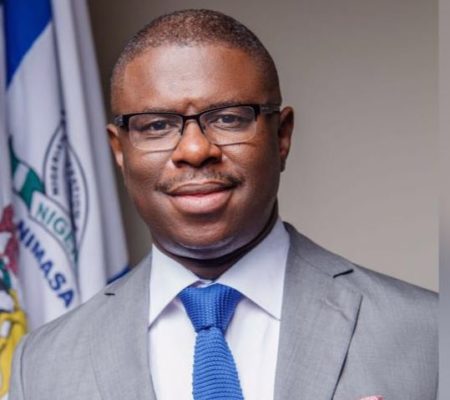
The Director General of the Nigerian Maritime Administration and Safety Agency (NIMASA) Dr. Dakuku Peterside has effected a major shake up in the Agency with the redeployment of some senior Management staff of the Agency. According to the Director General, the new postings are meant to reposition the Agency towards meeting its statutory mandate as enshrined in the NIMASA Act and other enabling instruments. The redeployment exercise has Mr. Ibrahim Jibril as the Director, Strategic Management in the Office of the Director General, Hajia Lami Tumaka, who was the former Head, Corporate Communications as the Director, Special Duties also in the Director General’s office; Abiodun Akinyosoye takes over as the Director of Administration and Human Resources while Mrs. Aishatu Jumai Musa is the Director, Planning Research & Data Management Services Department and Audu Abdulsalam is now the Director, Legal Services. Others include, Hassan El-Yakub Director, NIMASA Eastern Zone and Olayemi Abass Director, Western Zone, Anthony Ogadi Head, Shipping Development and Engr. Abel Femowei as the Coordinator, Central Zone, Warri. Also, Captain Sunday Umoren is now Head of the Maritime Safety and Seafarers Standards Department of the Agency while Isichei Osamgbi is the new Head, Corporate Communications. The redeployment came on the heels of the recent promotion which saw to the elevation of eight Deputy Directors as Directors, 15 Assistant Directors to Deputy Directors while 56 grade level 14 officers were promoted to their next grade of Assistant Directors. The Director General had at several fora, reiterated the commitment of the Agency to the repositioning and restructuring of the Agency for greater efficiency and productivity. [myad]
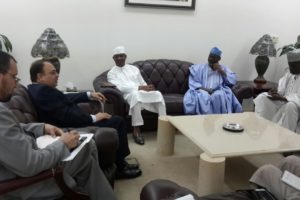
Chairman, Chief Executive Officer of the National Hajj Commission of Nigerian (NACON), Barrister Abdullahi Mukhtar (in white, middle), discusses with the Pakistani Ambassador in Riyahd, Saudi Arabia, as part of the preparation for the 2017 pilgrimage. [myad]
“The tears never dry, the ache is in our hearts. But hope remains constant, eternal, and we believe our pains will be assuaged. Our hopes will not be shattered, and our hearts will leap for joy, as more and more of our daughters return. It is a goal we remain steadfastly committed to.”
These were the thoughts of President Muhammadu Buhari as Nigeria commemorates the 1,000th day of the abduction of schoolgirls from Government Secondary School, Chibok, Borno State.
The President he vowed that his government is committed to securing the release of the remaining girls still in captivity, expressed gratitude to God that “we are not completely in the depths of despair, but buoyed with hope that our daughters will yet rejoin their families and loved ones. Three of them have been recovered by our diligent military, while the freedom of 21 others was secured through engagement with their captors. We are hopeful that many more will still return as soon as practicable.”
Buhari emphasized that his government would not spare any effort to reunite the girls with their families even as he salutes the fortitude of the distraught parents. “As a parent also, I identify with their plight. Days turned to weeks, weeks turned to months, months turned to years, and today, it is 1,000 days. On the occasion of the 1,000 days, President Buhari commends all who have been in the vanguard for the recovery of the girls, both nationally and internationally, stressing:
“Someday soon, we will all rejoice together. Our intelligence and security forces are unrelenting, and whatever it takes, we remain resolute. Chibok community, Nigeria, and, indeed, the world, will yet rise in brotherhood, to welcome our remaining girls back home. We trust God for that eventuality.” [myad]
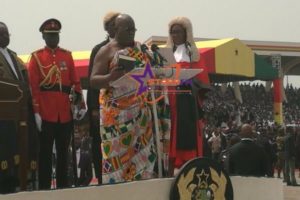
The newly sworn-in President of the Republic of Ghana, Nana Akufor-Addo has apologized for plagiarizing portions of inauguration speeches of two former American presidents: George Bush and Bill Clinton in his inaugural speech on Saturday.
The Director of communication to President Akufor-Addo, Eugene Arhin said that the speech was not deliberate and was an oversight.
“My attention has been drawn to references being made to a statement in the speech delivered by the President of the Republic. I unreservedly apologize for the non-acknowledgement of this quote to the original author. It was a complete oversight, and never deliberate,” read an apology note.
As Akufor-Addo was sworn as the 54th president of Ghana on Saturday, he described Ghana as a country of “gold standard for democracy in Africa” taking over from John Dramani Mahama.
Critics said the president’s inauguration speech was directly lifted from former US presidents Bill Clinton’s 1993 and George Bush’s 2001 inaugural speeches.
Bush had in his speech said: “I ask you to be citizens: citizens, not spectators; citizens, not subjects; responsible citizens building communities of service and a nation of character.”
The same words Nana used in his inauguration.
Nana further said: “Though our challenges are fearsome, so are our strengths. Americans have ever been a restless, questing, hopeful people. And we must bring to our task today the vision and will of those who came before us.”
These words were quoted by Bill Clinton in his speech at the 1993 inauguration. [myad]
We use cookies on our website to give you the most relevant experience by remembering your preferences and repeat visits. By clicking “Accept”, you consent to the use of ALL the cookies.
This website uses cookies to improve your experience while you navigate through the website. Out of these, the cookies that are categorized as necessary are stored on your browser as they are essential for the working of basic functionalities of the website. We also use third-party cookies that help us analyze and understand how you use this website. These cookies will be stored in your browser only with your consent. You also have the option to opt-out of these cookies. But opting out of some of these cookies may affect your browsing experience.
Necessary cookies are absolutely essential for the website to function properly. This category only includes cookies that ensures basic functionalities and security features of the website. These cookies do not store any personal information.
Any cookies that may not be particularly necessary for the website to function and is used specifically to collect user personal data via analytics, ads, other embedded contents are termed as non-necessary cookies. It is mandatory to procure user consent prior to running these cookies on your website.





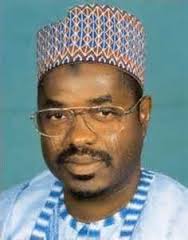 Former Chairman of the Board of Trustees (BoT) of the Peoples Democratic Party (PDP), Chief Tony Anenih, has said that Niger State without the former governor, Engineer Abdulkadir Kure is politically unexciting.
 The Chief of Staff to the President, Abba Kyari, has made it clear that he paid for all his medical bills during his recent visit for emergency medical treatment.