Home Blog Page 1707

Nigeria Requires $25 Billion Annually For 10 Years To Attain Full Infrastructure – Osinbajo
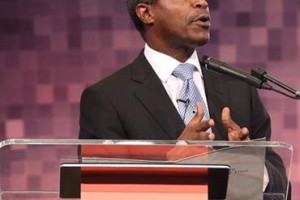
Vice President Yemi Osinbajo

Vice-President Yemi Osinbajo has said that that Nigeria requires about $25 billion annually for the next 10 years to grow its infrastructure to sustainable levels.
He stressed that the N1.84 trillion which the federal government proposed to spend on capital projects in the 2016 budget, representing about 30 percent of the entire budget was grossly inadequate.
Osinbajo, who spoke at the African Development Bank Knowledge Sharing Forum in Abuja today, Thursday, explained that the federal government has decided to invest heavily in infrastructure because it is convinced that the effort would translate into economic growth for the country.
The Vice-President, who was represented by the Special Adviser to the President on the Economy, Dr. Yemi Dipeolu said that there is a positive relationship between infrastructure and growth in the economy, adding that Nigeria stands to experience growth given the commitment of the present administration to invest hugely in infrastructure.
”There are also various estimates about the impact of infrastructure on growth but the broad consensus is that the relationship is a positive one if the example of countries like China is anything to go by. Accordingly, given its significant infrastructure deficit, Nigeria is most likely to experience growth if significant investment is made in the building of roads, bridges, railways, ports, airports, housing, dams, telecommunications facilities and electric power.”
The Vice President said that the government of President Muhammadu Buhari has made investment in infrastructure a major priority and policy focus.
“In the 2016 budget, government has proposed to spend N1.84 trillion on capital projects, amounting to about 30% of the entire budget. Even though this is unprecedented in recent times, there is a realization that this figure is still way below what the country should ideally be investing in infrastructure.”
The Vice President said that said that the infrastructure cannot be funded entirely by the public sector “which brings the Public-Private Partnerships (PPPs) model to the forefront of our considerations.”
Meanwhile, the Minister of Finance, Mrs. Kemi Adeosun on the occasion restated the commitment of the administration to improve the operation of the Public, Private Partnership arrangement.
According to the Minister, the Federal Government believes that Public Private Partnership is extremely important to the drive to restore and resolve the infrastructure of this country, saying that solving the nation’s infrastructure problem would unlock the potential of the economy and get Nigeria out of the current challenges.
“As far as our financial strategy is concerned, we are very committed to PPP and for us, the way to accelerate it is for the Federal Government to de-risk the involvement of the private sector and gradually, introduce the private sector to the PPP. This is because if we wait for every law to be changed and regulations to be amended, we will really not get any single project done.”
She disclosed that the Federal Government plans to start with a number of transactions in 2017, and that it will use the federal guarantee to simply take the risk away from the risky avarices of the projects of, for example, road projects which is risky. “So we will de-risk; we will guarantee and will allow private money to crowd in to these transactions. It is something we must crack because clearly, our infrastructure deficit is so large that even if we spend our entire budget on infrastructure for the next five years, we cannot bridge the gap, so we must be able to get private money,” she stated. [myad]
Women Will Never Be Catholic Priests, Pope Francis Vows

Pope Francis
Pope Francis

Leader of the Catholic Church Worldwide, Pope Francis, has insisted that women will never be Catholic priests.

He said that the restriction on women becoming priests will not be lifted.

The Pope made this known while speaking during a press conference on-board his papal plane to the Argentine.

He said: “on the ordination of women in the Catholic Church, the Pope referred to an apostolic letter written by Pope John Paul II in 1994, which holds that ordaining women was not possible because Jesus chose only men as his apostles. It was given by St. John Paul II, and this stands.

“Forever, forever, never!

“If we read carefully the declaration by St John Paul II, it is going in that direction,” Pope Francis added. [myad]

Osinbajo To Sultan Sa’ad: You Are True Son Of Your Fore-Fathers

Sultan

Vice President Yemi Osinbajo has described the Sultan of Sokoto, Alhaji Sa’ad Abubakar III as a worthy son of his fore-fathers.

Osinbajo who spoke in Sokoto today, Thursday, when he declared open an International Symposium on the Sokoto Caliphate said: “the Sokoto Caliphate was founded over 200 years ago on the sterling principles of honesty, piety, good governance and truthfulness, among others.

“The intellectual endeavours of the founding fathers of the caliphate on theology and jurisprudence, among others, were relevant now as they were then.

“They had left legacies of wealth of resources in their books premised on the principles of good governance and social justice.”

The vice president stressed the need for social justice, saying that its absence always lead to chaos.

Osinbajo therefore urged leaders to always protect public treasuries and not to loot them.

The vice president noted that the Sultan has continued in the path of his fore-fathers, urging him not to relent.

He also noted that the reign of the Sultan, who is also the President-General, Nigerian Supreme Council for Islamic Affairs, came at a challenging time for Nigeria.

“But the Sultan has handled them with pragmatism and graciousness.

“Leadership is a privilege and the leaders must set moral and ethical tones for the society,” he added.

Gov. Aminu Tambuwal of Sokoto State also described the Sultan as an intellectually-endowed leader.

Tambuwal commended the Sultan for his sustained moral and royal support to his administration.

“You are not only a bridge builder, but the bridge itself,” Tambuwal said.

The Chairman of the occasion, Prof. Shehu Galadanchi, pioneer vice chancellor, Usmanu Danfodiyo University, Sokoto, commended the Sultan for consistently working for peace, unity and development.

The Chairman, Main Organising Committee and Emir of Kano, Alhaji Muhammadu Sanusi II, said: “The symposium was organised to reflect on the past, ponder on present and transform the future’’.

The keynote Speaker, Prof. Murray Last, Professor Emeritus, University College, London, said that the celebration of the Caliphate was to recognise its crucial importance.

He said: “The Caliphate has been an institution in Northern Nigeria that possesses an extraordinary phenomenon.

“The caliphate has strengths which we need to understand, not as political scientists but as Nigerians.

“For without the Caliphate, Nigeria might never have existed. It would have been more like Northern Ghana, a Burkina or a Mali.

“Celebrating the Caliphate and recognising its importance is truly a great pleasure.”

The celebrant, the Sultan advocated a national security summit of all stakeholders to brainstorm on most of the contemporary challenges affecting Nigeria.

These, he said, include insurgency, militancy, kidnapping, armed robbery, cattle rustling and farmers-herdsmen clashes.

However, Abubakar III, who is also the President, Jamaatul Nasril Islam (JNI), said that these burning challenges should be discussed at the proposed summit, as they were threatening the corporate existence of Nigeria.

Besides, the Sultan underscored the need for Nigerians to continue to live peacefully with one another irrespective of their various religious, political and ethnic leanings.

(NAN). [myad]

Budget Deficit: African Dev. Bank Rescues Nigeria With $600 Million Loan

Akinwunmi Adesina

The African Development Bank has approved a $600 million loan in a bid to plug Nigeria’s gaping $7 billion budget deficit.

The loan is the first tranche of a $1 billion budget support plan between the bank and Africa’s largest economy, which has fallen into its first recession in 20 years as a result of the collapse in oil prices.

Militant attacks on oil pipelines have also carved a substantial hole in the oil profits that the government relies on for 70% of its revenue.

The AfDB hopes the loan will help to counter myriad issues in Nigeria, despite it filling barely 15% of the government’s shortfall. Nigeria has only raised cash to cover $3bn worth of the deficit.

“We must think through innovative solutions to support our member countries in crisis situations like this,” AfDB president Akinwumi Adesina said. “We must also provide them with the knowledge products to get them back on track.”

The AfDB said the first tranche is aimed at creating fiscal space for the government to implement reforms, combat corruption and diversify the economy away from oil, as well as ensure social spending is targeted at the most vulnerable.

The bank also hopes it will aid the government’s efforts to build a buffer of foreign exchange reserves, which the country has depleted, and ease pressure on the exchange market and stabilise the Naira.

In addition, it continued, the resources will contribute to opening up fiscal space for Nigeria to scale up its infrastructure investments, which made up 30% of this year’s record budget, worth $30bn at the time (before a substantial devaluation of the naira).

Signed before the recession was confirmed, the budget tripled capital expenditure in hopes of stimulating the economy and avoiding a contraction. However, with negative growth now firmly established – output is expected to contract by 1.6% in 2016 – the country is struggling to foot the bill.

The government hopes to raise as much as $15bn through asset sales and is also planning heavy borrowing, especially from abroad. Nigeria has one of the lowest debt to GDP ratios on the continent, at 13.2% of GDP.

That plan suffered a setback earlier in the week when reformist President Muhammadu Buhari, recently had his $30bn borrowing plan blocked by the country’s senate, reportedly due to lack of information.

He can expect more from the AfDB, however, which plans to lend Nigeria $4.1bn in total over the next two years, and $10bn by 2019.

It said yesterday that a prolonged recession in Nigeria has the potential to severely affect the economies of neighbouring countries in West and Central Africa.

The AfDB also praised Nigeria’s economic programme for its planned expenditure controls, which it said should result in a further reduction in wage bill growth and debt service costs. It should also boost efficiency, transparency, accountability and revenues.

The programme will also strengthen PFM by, for example, creating a bigger tax base and increasing the efficiency of revenue collection and public expenditure, improving energy market competitiveness and fostering social inclusion.

Also this week, the AfDB approved a $995m loan to support industry and energy in Algeria, another oil-based African economy struggling with declining revenues. [myad]

Man Allegedly Rapes 6 Year Old Inside Church, Gets N1 Million Bail

Man sex daughterA 33 year old church worker, Roland Olise, who allegedly raped a six-year-old girl in church, has been granted one million naira bail by the Surulere Chief Magistrates’ Court.

Roland Olise pleaded not guilty to a one-count charge of defilement.

The Chief Magistrate, Ipaye Nwachukwu, in the ruling, ordered the accused bail of one million naira and to provide two sureties in like sum.

“One of the sureties must be a property owner in Lagos State, while the other must be a civil servant on grade level 14.

“The sureties must provide evidence of tax payments to the government.” Nwachukwu said.

The Prosecutor, Sgt. Anthonia Osayande, told the court that the accused committed the offence at a church in Ajah-Lekki Area of Lagos at about 6.00 p.m on October 21.

“The accused, who was a church worker, was in church when he saw the six-year-old girl passing and called her into the church where no one was around and defiled her.

“The girl knew the man as the church was their family church and that was why she comfortably entered the church with him.‎”

The offence contravened Sections 137 of the Criminal Law of Lagos State 2011. [myad]

Wole Soyinka Vows To Tear Off His US Green Card If Trump Wins

Professor Wole Soyinka

Nigeria’s Nobel Prize laureate, Professor Wole Soyinka has vowed to tear off  his green card if Donald Trump emerges as winner of the US presidential election. The green card is a permanent residence permit for the US – prized by many African immigrants to the US.

His comments emerged in the video of a conversation with students at Oxford University in the UK.

The famous author appears to be taking a swipe at Trump over his radical stance on immigration.

American voters go to the polls next Tuesday and latest polls show the two candidates are neck and neck.

Trump is famous for his promise to build a wall to keep Mexican immigrants out of the US if he makes it to the White House.

Image copyright AFP Image caption Donald Trump: Not a fan of illegal immigrants

Under his hard-line proposals, every illegal immigrant currently in the US would be subject to deportation if he wins the election.

He says there will be no pathway to citizenship or even legal status for them unless they leave the country and get in line with everyone else who wants to enter the US, subject to the normal immigration procedures.

Soyinka said he feared the Republic candidate would ask all green-card holders to reapply to come back into the US.

“Well, I’m not waiting for that,” the Nigerian author told his student audience.

“The moment they announce his (Trump’s) victory, I will cut my green card myself and start packing up,” he added. [myad]

Poverty Reduction, Inclusive Development Are Very Close To My Heart – Buhari

new-york-and-buhariPresident Muhammadu Buhari has said that poverty reduction and inclusive development are the pillars of his government and “very close to my heart.”
The President today, Thursday, spoke at a Presidential parley with the senior executive No. 38 (2016) Of the National Institute for Policy and Strategic Studies, Kuru, at the Presidential.
Buhari said that in the last one and half years of his government, the economy has experienced some tough times, particularly with the decline in oil revenues, which has some harsh impacts on Nigerians at the grassroots.
He argued that the economic recession is not the making of his government, “but rather a consequence of bad management of the economy in the past couple of decades. Nor is recession limited to Nigeria – there are far, far worse cases than Nigeria.
“Whatever the scale of the problem. the important thing is how one tackles it. Accordingly, this administration is committed to finding lasting solutions to our economic structural imbalance. Let us have faith in our great nation that we will come out of this recession vibrant and strong. I am glad that the report presented today has given us reason to keep faith in our ability to overcome our challenges.
“There is no doubt that poverty for decades has been a major challenge to us as a nation despite the country’s enormous wealth. Several policies and programmes that have been implemented over the years, as rightly observed by the Report, have not broken the cycle of poverty in Nigeria. From the findings of the research by the Participants, it is evident that strengthening our institutions is key to reducing poverty and engendering inclusive development.”
President Buhari said that it is impossible for the government to ignore the poor who made great sacrifice to bring us to government, saying that more than any other government in the history of Nigeria, he government is a people’s government.
“We therefore must and we will keep faith with the people.
“It is in this light that I wish to declare the commitment of this administration to the “Sustainable Development Goals, most especially to ending extreme poverty in Nigeria.  It is not going to be easy, but we are committed to dealing with the challenges in a decisive manner. Fortunately, the Report of the Participants has prescribed some concrete measures on how to reduce poverty in the country.”
The President commended the efforts of the National Institute for keeping faith and moving the nation towards a better society.
Buhari recalled that a year ago, during the Presidential Parley with the Participants of the Senior Executive Course 37 of the National Institute for Policy and Strategic Studies, he saddled the Management of the National Institute with the responsibility of looking at Strengthening Institutional Mechanisms for Poverty Reduction and Inclusive Development in the 2016 Course.
“I am glad that the Participants of the Senior Course 38 took up the challenge and today presented the Report of the Study.
“I have carefully noted the report, most especially its findings and policy recommendations. I recall with pleasure that when I was giving this task, six months after this administration came into office, the selection of the theme was not only apt but also timely.
I am very pleased that the Participants, through the able leadership of the National Institute of Management and the faculty members, have taken the task seriously, as is evident in the report presented. I congratulate you for painstakingly committing your time and energy to produce such a valuable policy-oriented report that will guide this administration.
I have looked forward to receiving this report because it touches on one of the fundamental problems confronting our nation. The Report comes at a time when our economy is experiencing a downturn and all efforts are being made by this administration to get our country moving again.
On behalf of the Government and people of Nigeria, let me congratulate you on your patriotic efforts.”
The President said that even with the limited resources, the Institute was able to come up with such a policy-oriented research findings, assuring it that the Federal Executive Council will carefully study the Report and implement all the practical recommendations. [myad]

No Online Application Required For The N5,000 for Most Vulnerable Nigerians – Presidency

Laolu Akande of VP MediaThe Presidency has clarified the issue surrounding the proposed monthly N5,000 Conditional Cash Transfer of the Buhari Social Investment programmes for the poorest and most vulnerable Nigerians, saying that there are no online applications required.
In a statement today, Thursday, Senior Special Assistant on Media in the Office of the Vice President, Mr. Laolu Akande, described the social media report on the issue as misleading.
The said that media reports are based on a recent debate and resolution on a motion in the Senate, titled: “The Need to Avoid the Mismanagement of the N500B Social Intervention Funds.”
Akande said: “while we understand the need for an ongoing public discussion of this unprecedented budgetary allocation in favor of the Nigerian people especially the poorest and the most vulnerable, it is not correct to claim any form of mismanagement  or marginalization whatsoever.”
“There has not been any disbursement from the allocated fund not to talk of any kind of mismanagement at all. While it is true that funds are being released for the social investment programmes, it is rather preposterous for now to say there is no evidence where the funds have gone to. As an administration noted for its transparency, we intend to fully keep Nigerians posted of all financial expenditure in line with extant laws of the country.”
The Presidential Spokesperson explained that of the series of social investment programmes we have outlined, only the job creation scheme-N-Power requires an online registration from unemployed graduates and non-graduate youths.
He said that the Conditional Cash Transfer, which would pay N5000 monthly to the most vulnerable and the poorest Nigerians-a total of one million in the first year-“no online registration of any kind is required.
Akande justified the requirement for online registration for the hiring of 500,000 unemployed graduates,  adding: “it is important to explain, again, for the benefit of clarity, that the requirement for online application for the N-Power job scheme makes absolute sense considering that all together the Federal Government is planning to hire half a million unemployed Nigerian graduates.
“We are all witnesses to the calamity that occurred in the past when a manual effort was made to hire large number of Nigerian youths. It led to needless deaths and outright chaos.
“Asking university graduates, for instance, to apply online is not such a cumbersome or unattainable requirement considering that JAMB, NECO, WAEC applications have all been done online for a while now in this country.
“What online applications do is to afford us as a government an efficient and effective means to process the applications and select the graduates and non-graduate youths for the N-Power job and training programmes.”
On the claim that Borno State has no online facility and that therefore, the N-Power process discriminates against people in the state for whom the programmes are designed, Akande said: “almost 15,000 Nigerians from Borno State applied in the first application series of N-Power schemes online.
“It is also not tenable to argue that people in Maiduguri for instance which today plays hosts to tonnes of international NGOs cannot apply online or are denied internet access.”
He said that in states like Enugu, there were over 20,000 applications online for N-Power, disclosing that states with the lowest numbers like Zamfara and Bayelsa had over 6,000 and 7,000 applications respectively.
“In any case we are aware that in several parts of the country, there are reported instances where local leaders of goodwill ensured that the people-unemployed graduates and youths – who did not readily have access to the internet were adequately taken care of in different ways including creating online registration points and outlets.”
He said that the selection process for the first batch of 200,000 Nigerians to be engaged in the N-Power process has now been completed and that their official engagement is now awaiting the completion of BVN verification so that they would be paid directly.
On how the selection was done, Akande said; “Presidency officials collaborated actively with the Ministries of Agriculture & Natural Resources, Health and other government agencies all through the process. There were no foreign consultants involved, nor is one needed.” He further explained that to make up the selection of the first 200,000, there were three criteria thus: 40% selected based on the number of applications per state, a special mark-up for the 6 states of the Northeast and a discretionary addition for states with low numbers of applicants.” [myad]

African Information Society Group Elects Nigeria’s Remmi Nweke Vice President

remmy-nwekeA 175-member continental organization, the African Civil Society on the Information Society (ACSIS) has elected the Lead Strategist, DigitalSENSE Africa Media group, Mr. Remmy Nweke, as its Vice President for the next four years.

This is coming as another Nigerian, Mr. Akinremi Peter Taiwo emerged the West Africa sub-regional coordinator for ACSIS, alongside eight others to be led by Senegalese, Dr. Cisse Kane as President till 2020.
Others are Adjidjatou Barry Baud (Guinea) who was elected Treasurer; Tijani Mahamat Adoum (Chad) – Coordinator Central Africa; Evelyn Namara (Uganda) – Coordinator Eastern Africa; Christminfa Gbenou Sagbohan (Benin) – Coordinator African Diaspora; Aicha Jeridi (Tunisia) – Coordinator Northern Africa; and Chenai Chair (Zimbabwe) – Coordinator Southern Africa.
The chairperson of the ACSIS Electoral Committee, and former President of ACSIS, Nana Delphine Mekounte, commended the sincerity of purpose, patience and cooperation throughout the electoral process which lasted for three days online to enable members across the African continent to exercise their civic rights.
“Thank you for your choice of leaders for the next 4 years, this is a citizen’s duty,” she declared, even as he asked any member who is in doubt to revisit the online ballot link earlier shared with members to see for themselves records of the exercise.
She said that 175 voters were registered for the 2016 election, while the actual number of vote cast was 78, which amounts to 45 per cent participation.
Nana Delphine noted that earlier, majority of voters had agreed that the single candidate positions should not be placed in competition, which the Electoral Committee endorsed.
This, she said, left the Committee to place in contest the post of the Vice President and Treasurers, which had two and three candidates respectively.
She said that for the post of Vice President, were Mr. Remmy Nweke and Mr. Michel Tchonang Linze, whereas the Treasurer position had Ms. Addjidja Tou Barry Baud, Mr. Ade Bada and Ms Sende Dora. Eventually, she said, Nweke, was elected with the total of 49 votes against 25 votes garnered by Michel, just as Addjidja got 45 votes to emerge Treasurer.
At present, Remmy Nweke as the Lead Strategist cum Group Executive Editor, coordinates the information analytics at DigitalSENSE Africa Media, the organisers of the Nigeria DigitalSENSE Forum Series on Internet Governance for Development (NDSF-IG4D) and Nigeria Internet Protocol version Six (IPv6) Roundtable since 2011 and publishers of international multiple award-winning ITRealms, NaijaAgroNet and DigitalSENSE Business News.
The pioneer secretary, Lagos branch of the Cyber Security Experts Association of Nigeria (CSEAN), Nweke, lately, served as Executive Board member of the Nigeria Internet Registration Association (NIRA) where he presided over the Communications and Publicity Committee as well as a member of the Local Multi-stakeholders Advisory Group (LMAG) of the Nigeria Internet Governance Forum (NIGF); Justice, Development and Peace Commission (JDPC) – the social arm of the Catholic Church; and associate member, Nigeria Red Cross.
Nweke, a former Publicity Secretary, Nigeria Internet Group (NIG) and outreach sub-committee member of the At-Large Advisory Committee (ALAC) of the Internet Corporation for Assigned Names and Numbers (ICANN), holds MA degree in Contemporary Diplomacy from the University of Malta and is a graduate of Advanced Journalism with over 19-year experience in media practice and online information management certifications from across the world.
Remmy Nweke is the author of ‘A Decade of ICT Reportage in Nigeria … The Award-winning Series” and public speaker on new media, web 2.0+ and cyber information advisory to Information and Communication Technology (ICT) interest groups and companies, is also a member of Non Commercial Stakeholder Group (NCSG) of ICANN and as a member, Civil Society Selection Committee for the High-level meeting on World Summit on the Information Society (WSIS+10) he affiliates with the African Civil Society on the Information Society (ACSIS) serving in various committees. He was recently named the chairman, Communication and Advocacy Committee (CAC) of IPv6 Council, Nigeria, among others.
Africa Civil Society for the Information Society (ACSIS) was formed in June 2003, on the heels of the first phase of the World Summit on the Information Society (WSIS) in Geneva to promote inclusive information society in Africa. [myad]

In Search For Religious Peace In Africa, AU, KAICIID Plan Second Interfaith Dialogue In Abuja

african-union-commission-chairman-jean-ping

The Citizens and Diaspora Directorate (CIDO) of the African Union Commission and the International Dialogue Centre (KAICIID) based in Vienna, Austria, have planned the second Interfaith Dialogue to promote peace inter-religious peace in Africa.
The Dialogue, scheduled to hold in Abuja, the Federal Capital Territory (FCT) from November 10 to 11, is also aimed at enhancing social cohesion on the African continent.

According to a statement by KAICIID, the Forum will, among other things, enhance partnerships between the African Union and religious leaders in AU Member States, enable the creation of a safe space for dialogue, add an interfaith dimension to the joint efforts towards achieving the Africa Agenda 2063 which is an AUC’s flagship initiative and serve as both a working meeting and an opportunity to set up a united front in peace building.
The event, the statement said, will provide an opportunity for participants, drawn from national interreligious councils of AU Member States, including African traditional religions and other affiliations, representatives of interfaith organizations, scholars and women, to repudiate violence committed in the name of religion in all regions of Africa, with a declaration of an unequivocal statement in support of diversity, featuring new and diverse voices in a follow-up declaration to the Abuja Declaration of 2010; and oversee the establishment of a permanent Steering Committee, which will link policy makers with religious leaders and institutions.
It said that in a bid to evolve a structured partnership between the African Union and religious leaders for advancing justice, peace, security and development in Africa, “the African Union in partnership with African religious leaders had launched the 1st AU-Interfaith Dialogue Forum in Abuja, Nigeria, in June 2010 to develop an inclusive, practical and sustainable working relationship between the African Union and faith-based organizations capitalizing on their shared values and mutual interests.” [myad]

Advertisement ADVERTORIAL
WP2Social Auto Publish Powered By : XYZScripts.com
