

What Mrs. Aisha Buhari Said In BBC Interview

Almost two years after President Muhammadu Buhari was elected into this government, it appears as if things are not going well, the people are complaining. Where do you think the problem is?
From my own observation, being a housewife, I think security wise, we have relatively achieved more than 100 per cent. Being someone that comes from the North East, I knew when almost nobody sleeps in his or her house. But now, people sleep with their two eyes closed. The hardship that people are going through now was anticipated, knowing what we inherited. It is not going to be a smooth journey; but I think so far so good. The only thing that almost everybody is not happy with, including myself, is on those that really suffered for this journey and now people who do not even have registration cards are guiding us, which is so unfair and unfortunate for the journey that we started more than 13 years ago.
But some will say whenever you are elected into government, you have to bring in professionals, experts who know how to do the job and not just politicians….
Yeah; but if you look at the journey that we had, after the merger, we didn’t call it merger or APC again, we called it a movement because it was a collective effort of millions of people, only for us to find out that the government is being operated by a few people. Very few, in the sense that we have may be four to six people that really started the journey with us in the system. Unfortunately, the people that are occupying the seats, I don’t think they have any expertise that our supporters in APC do not have. We have supporters all over the world. Those who really supported APC and felt that enough is enough, let us have sanity in the society; it was a real collective effort. Nobody will say that ‘it was as a result of my hard work that I brought this government’; it was a real team work and we wish that the team work should continue. Everybody knows what my husband wants to achieve in four years. But having new set of people on board that were not part of us, they don’t really know what we promised Nigerians and that is the thing we are facing now.
Who are these four to five people you are talking about?
People like Ogbonnaya Onu, (Rotimi) Amaechi, (Babatunde) Fashola, after the merger it was a huge group that came together and started the struggle again. It is sad that very few are in the system now. Though I heard that they are about to announce like 3,000 names as Board members, we feel that those that have started the struggle should not be limited to Board members. They should be in positions like heading agencies that will impact positively on the lives of Nigerians. Knowing what we have campaigned for, only for us to bring people that are busy telling people that they are not politicians but they are occupying seats that were brought in by politicians. This is a huge disrespect for politicians. Knowing that we are just starting, we have not got to 2017, talk less of 2018 and then 2019 for us to go back to the polls. You understand what I mean?
Who are these very few people as you said surrounding President Muhammadu Buhari, and have you spoken to him about this?
Yeah. Not only me in person, because after receiving complaints upon complaints, I decided to tell him. But all the same, a lot of people have been coming on their own and also collectively to tell him that things are not going the way it should when it comes to putting people in certain positions. Because most of those that are occupying positions in agencies, nobody knows them and they themselves don’t know our party manifesto; what we campaigned for; they were not part of us completely. People were sitting down in their houses, folding their arms only for them to be called to come and head an agency or a ministerial position. They don’t have a mission or vision of our APC. You understand what I mean?
Whose fault is this?
It’s the fault of 15.429 million people because they are the ones that brought in the government. It’s their fault!
But theirs is just to elect APC and President Muhammadu Buhari and he is the one that is supposed to be in charge. Is he not?
Because they elected him, that’s why he is here. If they can stand firm and strengthen the party and tell everybody that ‘No! We can’t take this, we can’t take you because you are not a card carrying member, you don’t know what we want to achieve within so and so time’. Fifteen point something million people is a huge number that can control a country.
Somebody listening to this will feel like President Muhammadu Buhari is not in charge of this government….
It is left for the people to decide whether he is in charge or he is not in charge. People actually accepted his ideology and decided to follow him for the past 13 years. That is what brought him to this current position.
As his wife, what will be your advice to him going forward?
My advice is to the whole people that voted for him. They should strengthen the party and whoever is not part of the party should not have control over fifteen point something million people. We are in a democracy and not military era, so we have to play it well and leave a legacy.
What you are saying is that if things continue like this, you will not leave any legacy?
As a person, I have my right to say how I feel about something. If it continues like this, me I am not going to be part of any movement again, because I need to work with the people that we started the journey with collectively so that we can achieve what we want to achieve, so that he would leave a legacy.
Have you told your husband all these?
Yeah! He knows! At my own level, I have done it personally. I have also listened to people’s complaints and I tried to tell him what they are coming to tell me so that if there is anything to be corrected; it can be corrected.
 German Chancellor, Angela Merkel, has sympathized with Nigeria over the economic crisis that has led to many of its citizens migrating to other countries.
 President Muhammadu Buhari has, for the first time, made reference to the multi-million Dollar Rolls Royces car which a Senator representing Kogi West, Dino Melaye was said to have acquired recently.
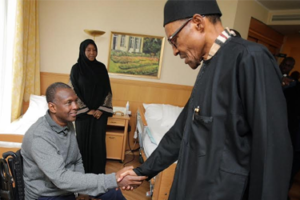 President Muhammadu Buhari took time off today, to visit, in Berlin, German, a serving Nigeria soldier, Brigadier General Mohammed Sani Aliyu, who was flown to that country for medical attention after a ghastly auto crash in Nigeria.
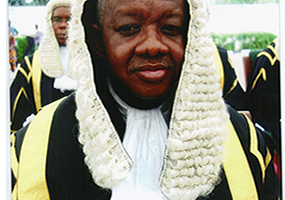 Adeniyi Ademola, a judge of the federal high court Abuja whose home was raided twoo weeks ago by the Department of State Services (DSS) has accused the Attorney General of the Federation and minister of Justice, Abubakar Malami of personal revenge and vendetta

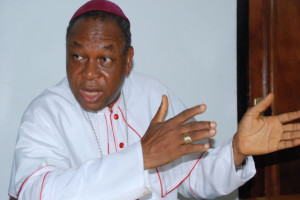


Still On The Matter Of The Arrested Judges, Joey Terna Agor
In the 16 years since it first met (2000-2016) aggrieved members of the public have filed 1808 petitions against judicial officers. Of this number, the NJC reprimanded 82 judicial officers, recommended the compulsory retirement of 38 others and dismissal of 12. In other words, out of 1808 judicial officers petitioned, only a total of 50 (38+12) were forced out of the judicial system through retirement or dismissal.
Going by this record, the following may be inferred: statistically, there is a 1 in 47 chance that a judicial officer petitioned will be retired. 1 in 150 chance that he will be dismissed, 1in 36 chance that he will be retired or dismissed, 1 in 22 chance that a judicial officer petitioned will be reprimanded and a 1 in 13 chance that a petition will merit any action at all and not get tossed out entirely.
These are sobering statistics. The low probability of sanction impression suggested by the NJC figures is more likely to embolden rather than deter judicial officers inclined to corrupt conduct. A wholistic picture is this: out of 1808 petitions treated by NJC in 16 years only 132 merited some form of disciplinary action (reprimand, retirement or dismissal) and the remainder, a whopping 1676 petitions were tossed out or trashed. Clearly, anyway you slice it, specific action categories or wholistically, the picture that emerges doesn’t look good.
The 1676 petitioners who lost out will feel despondent and will spread negative vibes in the public space about the NJC and the Judiciary. The 1676 Judges who survived any form of disciplinary action from those petitions will likely gloat about the frivolity of public petitions. Either of these likely scenarios ought not be the take home point from NJC’s disciplinary action or inaction but rather a feeling that justice has been served in each individual case by the winners and losers alike.
A disciplinary system that routinely tosses out petitions without any form of disciplinary action will not command public trust and respect. The truth is that fellow Judges, Judiciary workers, lawyers and public stakeholders know the few bad eggs amongst them that are corrupt. They are talked and murmured about in hushed and not so hushed tones. An effective NJC disciplinary system will be a huge relief and big service to the overwhelming majority of good, upright Judges who unfortunately and unfairly walk in the dark, tainted shadow of a “corrupt Judiciary” that is cast over them by the few bad ones.
Regrettably, rather than view the DSS anti-corruption arrest of some Judges as a learning experience and opportunity to review its “comfort zone” modus operandi, the lengthy NJC statement adopted a defensive posture, asserting its exclusive disciplinary powers and jurisdiction turf as well as upholding its administrative procedures as a basis for charging the DSS with violation and breach of its exclusive powers and procedures.
Unlike the US Constitution which did not expressly provide for judicial review in Article 3 and it took the courage and creative genius of Chief Justice John Marshall to assert and read that exclusive review power into the US Constitution in the now locus classicus case of Marbury v. Madison, 5 U.S. 137 (1803), our Constitution on the other hand makes plenary provisions on judicial powers, Chapter 1, Part II, Section 6(6).
It is clear that the DSS arrests will end up in court where the allegations of substantive violations and procedural breaches asserted by NJC in its statement will be examined judicially, so why didn’t the NJC wait to have the courts set it straight in this matter? Wouldn’t a subsequent judicial decision upholding the NJC’s position be viewed negatively as self-serving or self-preservatory?
The public mood in Nigeria right now is decidedly anti-corruption. All arms of government especially the judicial arm as well as private business and the citizenry ought to key into this mood. One more historical example from the US will help in this regard. President Franklin D. Roosevelt enacted “New Deal” legislation aimed at getting the US out of the Great Depression but was being obstructed by a conservative Supreme Court that upheld Laissez faire economic philosophy (unregulated freedom of contract, exploitation of child labor, onerous contract terms, exploitative wages, etc environment) and consistently struck down New Deal legislation that were challenged, which sought to regulate labor and business practices (child labor, minimum wage, work hours, etc laws and regulations).
Fed up with the court’s obstructionism President Roosevelt moved to sidetrack it by sending to Congress a Court-reform bill (that became known as the Court-packing bill) which would have authorized him to increase the number of Supreme Court Justices from 9 to 15 and thus pack it with Justices who would have neutralized the conservative block in the Court. Sensing that impending fate the Court made a dramatic jurisprudential switch to avoid it (a switch that became known as “The switch that saved the Nine) in the now famous case of West Coast Hotel Co. v. Parrish, 300 U.S. 379 (1937) in which the Court against a long consistent record of routinely striking down New Deal legislation that was challenged upheld it instead.
As it was in America in 1937 with the New Deal so it is in Nigeria now with anti-corruption. The public mood is not sympathetic to the usual comfort zone, business as usual obstructionism and if the President is compelled to pursue reforms to overcome it there will be a huge reservoir of public support for them. The better and preferable approach in my sincere opinion therefore, is for pertinent arms and agencies of government to make the necessary switch to fall in step with the anti-corruption fight by reviewing weak laws, regulations and procedures that negate the waging of an effective fight against corruption.
Agor, a corporate attorney, writes from Abuja. [myad]