

Alliance: How We Fumbled In 2011, But Succeeded In 2015, Tinubu Narrates
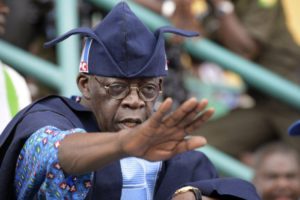
National leader of the All Progressives Congress (APC), Asiwaju Bola Ahmed Tinubu has recalled how the then opposition political parties fumbled in their move to form an alliance for the 2011 general elections, but with determination of people like Muhammadu Buhari, the parties later succeeded against all odds, resulting in the electoral victory for the APC in 2015.
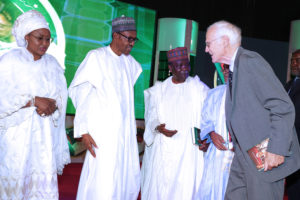
Tinibu, who spoke today, Monday, at the launching of a book titled: Muhammadu Buhari: Challenges of Leadership in Nigeria, at the International Conference Center (ICC), Abuja said: “the formation of the All Progressives Congress (APC) is an important event that the book addresses. The merger was the result of teamwork, belief in the democratic will of the people and a commitment to national purpose.
“Many of us invested ourselves, our heart, body, mind and soul in this project for national salvation. Many did not want it to happen and fought to undermine the good we sought to accomplish. Many others straddled the sidelines, neither completely in nor completely out, but waiting to see how the prevailing winds might blow before making their move.
“Muhammadu Buhari never wavered for one moment on this journey. Proving to be a focused leadership, he acted with single-minded determination that showed no fear or doubt in the rightfulness of the cause we pursued. I know this for an unassailable fact because I was there with him, every step of the way, to fight against, what the realists told us, were un-surmountable odds. Yet, our determination for reform beat their smart calculations. The desire for a better country was more powerful than their incumbent might.
“So many people made contributions that made the historic merger possible. It would be impossible to give each person the accolades they deserve in a concise work such as this one. However, it is an account that we must begin to chronicle fully, and with care, for it is the story of when reform came to the land. Here, I must say that this book makes a good initial contribution toward this objective.
“Indeed, the APC is a party born of the quest for democratic good governance. In essence, the party is the embodiment of a democratic promise made between its members as well as a democratic vow made to the public. The APC genesis is truly a historic and an engaging one.
“I, therefore, crave your indulgence here to give a bit more insight.
“In forming the ‘new’ party, we had three challenges. The first was learning the right lessons from the aborted attempt at political cooperation in 2011. Fortunately, both the ACN and CPC regretted our inability to conclude a pact in 2011. We agreed that there would be no recrimination over what did not happen before. We agreed there would be an intensified effort to forge the united effort that eluded us in 2011.
“In 2011, both parties wanted cooperation, but became stuck whether that should take the form of an alliance or outright merger. This difference gave rise to another one, regarding how the Vice Presidential candidate, who would run with the Presidential Candidate, Muhammadu Buhari, would be selected.
“Despite numerous good-faiths demonstrated in attempts to resolve these issues, time ran out on finding a solution. In retrospect, we all were perhaps a bit too inflexible and did not realize the extent to which cooperation and flexibility were needed to establish the reform we all wanted. “The result: each party went its own way in 2011. However, the talks of 2011 would foreshadow the discussions, beginning in 2013, which led to the successful merger forming the APC.
“Talks mainly between the CPC, led by Buhari, and the ACN, led by myself, later joined by the ANPP and the progressive wing of APGA, would go more smoothly and would reach the desired finish-line this time. There would be a merger and there would be a presidential candidate agreeable to all. A winning combination had been joined.
“It would give the PDP, which had boasted of 60 continuous years in power, more than it could handle.
“After the successful merger and the birth of APC, it was time to pick a flag bearer. At the Lagos convention, President Buhari emerged as the new party’s choice in a transparently-honest process. His speech to the convention was greeted with ovation, even by those who had opposed him.
“In that speech, he said to the delight of all who heard, and I quote him: “I can’t give you a pocketful of dollars or naira to purchase your support. Even if I could, I would not do so. The fate of this nation is not up for sale. What I will give you, and this nation, is all of my strength, commitment, sweat and toil in the service of the people. What I can give you is my all”.
“This set the tone for the campaign to come. But first, there was the sticky issue of selecting a running mate. After careful study and discussion, it was agreed that we should field a religiously-balanced ticket given the sensitivities of the moment”, he said.
Tinubu therefor appealed to the government to introduce history as subject of study in Nigeria’s secondary schools to reflect most important times in the history of Nigeria.”
Tinibu who reviewed the book said that Buhari would fix the economy which he said was ruined by the government of People’s Democratic Party (PDP).
He said that the book explores how Buhari’s professional career, personal life and prior experiences in government shaped and prepared him for the momentous assignment he now has. “From the book’s pages, we see a man who has lived his life on assignments that always intersected with vital moments in the nation’s history.
He was a man on assignment, when, in the military, he served bravely in a civil war to keep Nigeria united.
“He was on national assignment when he became military head of state in a well-intentioned effort to straighten things out, and set Nigeria on a better path. When he ventured into politics and competed for the Presidency, culminating in his 2015 election victory, he was still on assignment, showing that there was no other way for this nation to go but the way of democracy, no matter how difficult the path may be.
“Now, as sitting President, he is on an assignment, against time, to undo the wrongs of nearly two decades of bad governance. “Such is the life of this man. Always in the public eye, doing things in his different, disciplined and Spartan way. From this compelling narrative, neatly demarcated into three parts and 24 chapters, the reader is able to glean the quintessential Buhari.” [myad]
 They are just visible on the white stone entrance: the outlines of letters that once spelled out “Fatih University,” removed after the attempted coup.
 The second Criminal Court in the southern province of Hatay has rejected an indictment prepared about the Fethullah Gülen Terrorist Organization (FETÖ), a term used by the Turkish government to describe the Gülen movement, saying that there is no such a terrorist organization officially identified.
 It was Edmund Burke, an Irish statesman that said: “the only thing necessary for the triumph of evil is for good men to keep silent.”



Corruption And The Audacity Of Patience Goodluck, By Gbenro Olajuyigbe
Nigeria’s complex crises are difficult to understand without accepting corruption as a specie of violence. A people bounded by Boko Haram in the North, Avengers in the South-South, Biafra in the East, herdsmen on rampage, kidnappers on the loose, and robbers on the roads have a lot to understand about evolution of violence. They need to know all forms of violence work together for worse for any society that loves oppression, embraces injustice and promotes inequality. They need to know that the persistent ubiquitous violence is sub-cultural reaction to the Twin Towers of Evil of Unjust Wealth and Unjust Poverty that corruption has built! Corruption destroys the basis for equality and equity, weakens institutions and structure in order to enthrone and sustain perversion of justice. Corruption shrinks resources available for development. It makes access to education difficult. It blocks the road to healthcare and frustrates path to security and welfare. It replaces government with Mafia and rights with might. It re-configures a state and imposes on it a Pyramid of disaster. When a country becomes a pyramid where tiny conical top are occupied by few who corner all available resources leaving the broad base of the pyramid to the many who are condemned to poverty and misery, such a country is ripe for any form of violence; whether of economic or of value!
The state prepares crime that violence perpetrators merely commit. When you open the window for corruption, you inevitably shut the door against peace. Corruption negotiates people out of existence. It creates a new world where self-help is attractive by manufacturing people that will use all means to fight back at a society that has taken them off the radar of equal opportunity and enforced the de-marketization of their citizenship. Corruption humiliates its victims, who often are the poor who become poorer and make a society ripe for committing violent crimes. It provides the motivation, the opportunity and the environment that violence needs to thrive.
If we want peace, we must steer away our country from this entanglement.
We cannot afford or sustain a country where people draw inspiration from their own callous oppressors; a nation where thieves are heroes; and blood thirsty criminals are mentors!
A nation that can no longer differentiate between evil and good; between righteousness and sin! A nation that uses the prism of tribe to determine who is just or unjust; a nation whose scale of justice stands on ‘mudus’ of corruption. A nation whose people are being stripped naked!
In saner climes, crime suspects hardly want to go to courts. In Nigeria, they want to be swiftly charged to court because they know that our courts are often citadels of corruption-propelled injustice! We cannot continue to have a ruling class using corruption to weaken all apparatuses of social and legal justice, destroying the capacity of judges to dispense appropriate justice and damage a whole legal system of a country; and worse still, turning around to benefit from its own willful incapacitation of justice administration architecture under the guise of human rights.
James Ibori was discharged and acquitted under our corruption–damaged legal process only to be convicted for the same offense in the UK. President Buhari must never again allow our country to be so ridiculed under his watch. Not even with the ‘human rights’ blackmail that has become the battle cry for the liberty of the lawless.
A nation cannot continue to build the barometer to measure human rights on what happens to those that are too defended and too protected to uphold national trust. Doing that amounts to isolating legal justice from social justice. It is not what happens to the out-of-control power merchants that counts. The truest form of justice seeks to protect the weak from the strong; not a cannon fodder for cruel violators of all that is decent about humanity.
Economy, security and corruption are still issues on the front burner of Buhari’s agenda. While the war against corruption is catching global attention with a noticeable margin of success at home, the same cannot be said about the economy and national security. Buhari must design his war against corruption in a way that ensures that recovered loot breathes life into the comatose economy.
Buhari’s inaugural speech a year ago assured justice to all. A pledge to be loyal and faithful to all without owing allegiance to anybody or cabal. It struck the core of national depreciation and ignited a vow for redemption and remediation. Based on it, we can say that we have a president who is not unmindful of the national challenges and the travails of Nigerians but also willing to protect the integrity of his oath. He must make the country work for all, especially the poor who have become the nation’s traditional burden bearers. He must stop listening to the ‘witches’ and their sorrowful songs. All the witches must be hunted down. It’s in my Bible that we should ‘suffer not the witch to live’. If you have stolen Nigeria’s money, you are a witch that must be hunted down. Your witchcraft has led to the death of many on the bad roads and in ill-equipped hospitals, among others! Buhari must not submit to blackmail. It is not in the Constitution that fighting corruption is a subject for Federal Character. It is neither a gender issue nor a party affair. The question is, did you steal or not? Great that Nigerians are increasingly owing the war against corruption. They are now speaking against their oppressors. Their oppressors are tagging their arrest and prosecution, ‘witch-hunt’ as if ‘witch-hunt’ is a defense in law. They are emotionally blackmailing the government that put them on trial under legitimate legal process and procedure. We must ignore them and focus on taking back our country. No state buys gun for her police if the intention is not to hunt down her witches; the vampires that criminally suck the blood out of her economy, and invariably her citizens, among others. A state that has been turned to a criminopolis by larger-than-life vampires must adopt all available strategies, including witch-hunting, to vanquish the nest of her witches. Let those who called their criminal trial political know that It is not for joke that Aristotle called man ‘a political animal’! Where there is politics of mindless stealing, there must be proportional politics of ruthless consequence. We must make it clear to people that we can end terrorism and other extreme violence and crime, not with a barrel of bullets, but when we build a country where no single person takes what belongs to millions of people; a nation that gets worried when individuals and groups are growing taller than law and fatter than justice. To achieve this country, change begins with Patience Jonathan! [myad]