President Muhammadu Buhari has proposed N6.866 trillion as the 2017 budget, at a pegged oil benchmark of $42.5 per barrel with 2.2 million oil production per day.
The budget, according to the Medium Term Expenditure Framework (MTEF), is with debt servicing proposed at N1.6 trillion. The MTEF which was read on the floor of the Senate today, Tuesday indicated that the production is projected to be 2.2 million barrels per day and an exchange rate of N290 to a dollar. According to the MTEF, N65 billion will be spent on the Amnesty programme compared to N20 billion budgeted for the same project in 2016. N350 billion will also be spent on Special Intervention Programmes in 2017 compared to N300 billion earmarked in 2016. The MTEF reads in part: “Provision in the MTEF are drawn from the government’s development priorities over the medium term, and more specifically, driven by its fiscal strategy and reflect the broad aggregates of the government’s annual budget over the period. “The aggregates revenue to the fund the 2017 Budget is projected to increase over the 2016 estimates of N3.855 trillion by about 8 percent (or about N313 billion). 33 percent of this is to come from oil sources while the balance is derivable from non-oil sources – in consonance with the government renewed focus on diversification of its revenue base. “The planned aggregates expenditure is estimated to exceed the provision of N6.6 trillion in the 2016 budget by 13.3 percent (or about N806 billion).” [myad]
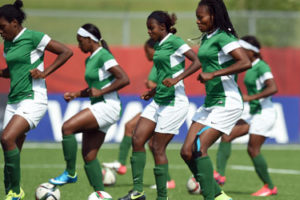
Nigeria’s Flamingoes and England played out a goalless draw today, Tuesday in Group C’s second Match Day in Al Zarqa at the FIFA U-17 Women’s World Cup in Jordan.
In spite of goal scoring chances created by both teams, neither side was able to break the deadlock.
Rasheedat Ajibade, who looked lively in attack for Nigeria, enjoyed the first opportunity on 16 minutes but goalkeeper Ellie Roebuck was on hand to deny her.
England’s Georgia Stanway then saw her chance on 24 minutes tipped away for a corner kick. From the resulting set-piece, the ball fell to Hannah Cain inside the area, but her effort was blocked and cleared by Abidemi Ibe.
England came close to opening the scoring on 32 minutes at the Prince Mohammed International Stadium, through Stanway’s powerful free-kick, but it went nowhere near being a goal.
Nigeria defender, Catherine Kenneth nearly caught Roebuck off guard with an audacious effort in 40 minutes, but the England shot-stopper held on to the tricky bouncing ball.
After the break, Cain capitalized on a defensive error before racing through on goal but saw her close-range effort go wide.
Also, Nigeria’s Folashade Ijamilusi worked her way into the box before seeing her shot deflected out for a corner kick by Hollie Olding.
Nigeria continued to put the Young Lionesses under pressure throughout the second half. Mercy Omokwo twice went close and Mary-Ann Ezenagu showed great composure to work her way into the box before seeing her effort at the near post cleared by Connie Scofield.
Ezenagu’s threatening delivery on 85 minutes was collected by Roebuck, while England’s Stanway had the chance to snatch a late winner, but saw her powerful 90th-minute effort sail over. [myad]
Nigeria’s Federal Government has set up N25 billion revolving loan scheme for transport companies in the country to access funds for purchase of mass transit vehicles.
The Minister of Industry, Trade and Investment, Mr. Okechukwu Enelamah, who spoke today, Tuesday, in Abuja at the opening of a two-day national workshop for chief executives of mass transit companies, said that the initiative is aimed at boosting the country’s mass transit system as well as encouraging local patronage of local vehicle assembly plants.
According t him, the loan would be administered through the Infrastructure Bank at zero percent interest rate.
“Government is determined to develop the automotive industry because of its extensive linkages, impact on job creation, technology transfer as well as foreign exchange savings and earnings.
“The response by investors has been encouraging and we have brought back vehicle assembly and are now focussing on local content development. Many of the new assembly plants produce buses and mini-buses. I hereby call on all Nigerians to patronize the products of these assembly plants.”
Enelamah advised the workshop participants to come up with innovative solutions for the development of an efficient and affordable mass transportation system in the country.
The Minister of Transportation, Chief Rotimi Amaechi, said that the mass transit sector is one of the major engines driving the nation’s socio-economic and cultural development even as he said that in spite of this, the sector is facing huge challenges, including low operational capacity, broken down vehicles, obsolete facilities and poor maintenance culture.
The minister said that a vibrant local automotive industry would significantly address those challenges while at the same time depending on the mass transit sector for patronage.
“This workshop is, therefore, organised to appraise the mass transit perspective of the Nigeria Automotive Policy. It is a platform for stakeholders to meet and exchange ideas on the effective implementation of the policy and make recommendations for realising a sustainable mass transport agenda for Nigeria.
“The dynamic leadership of President Muhammadu Buhari is poised to address the challenges facing the transport sector. The Federal Government is willing to invest heavily in this sector.
“We are already seeing practical efforts in that regard, especially with the rail transportation system.”
The workshop was organized by the National Automotive Design and Development Council in collaboration with the Nigerian Institute for Transport Technology, Zaria.
The theme of the workshop is: “Nigeria Automotive Policy: A National Agenda for Sustainable Mass Transit Operation Development.”
Government of Sierra Leone has announced austerity measures, including huge cut in public spending across the board and freezing of all government projects. The government said that the aim is to stabilize its finances following a prolonged economic slump.
A meeting today, Tuesday, chaired by President Bai Ernest Koroma announced the austerity measures aimed at addressing a depreciating foreign exchange rate, lower prices of minerals such as iron ore and a poor tax compliance rate.
“These measures will be implemented up to the first half of 2017 in order to stabilise the current situation,” Koroma told cabinet ministers.
“If we are able to fight Ebola, we should be able to put up a fight that will turn around the economic fortunes of the country.”
Under the austerity measures the purchase of new cars and office equipment has been banned and domestic and international travel budgets slashed. Paid overtime has also been scrapped even as the government is also likely to consider addressing fuel subsidies after the International Monetary Fund (IMF) said that elevated levels of spending on petrol could leave it unable to pay civil servants salaries. The the austerity measures are expected to bring in savings of 309 billion leones ($69 million), targeted within six months by cutting into ministry budgets, and enforcing more stringent revenue gathering.
The economic shock of the Ebola crisis and difficulties faced by the country’s key commodities sector have led the government to undertake the seven-month review of its finances. [myad]
The Economic Community of West Africa State (ECOWAS) Court has ordered immediate release of former National Security Adviser, retired Colonel Muhammadu Sambo Dasuki, from detention. The court held that the detention of Dasuki violated both national and international laws on the right of persons and citizens to freedom of liberty. In a judgment by the court and delivered by Justice Friday Chijioike Nwoke, the ECOWAS Court imposed a fine of N15 million against Nigeria as compensatory damages to the former NSA for the deprivation of his freedom to liberty and the deprivation of his properties. In a judgment that lasted over one hour, the regional court dismissed the allegations of unlawful possession of firearms and economic crimes allegedly committed by Dasuki, adding that the Nigerian Government missed the track because the applicant applied before the court for the enforcement of his breached and contravention of fundamental right. Justice Nwoke said that even if the applicant had committed a crime, the law still has it that due process of the law must be observed in his trial, adding that it is an established fact that the applicant was put on trial in three different Nigeria High Courts and was granted bails by the courts. The court said that the action of the Nigerian Government in subjecting the ex-NSA to detention without trial is condemnable because criminality has not been established against him. Justice Chijioke further said that the Nigerian Government took laws into its hands and made mockery of the rule of law by arresting the applicant without warrant of arrest or warrant of detention when he had legally been granted bail by the appropriate courts. According to the court, a detention order must be made in writing and must be delivered to the detainees, adding that in this case, none of such was obtained and delivered to Dasuki by the Federal Government before arresting him and forcefully taking away properties of the applicant in his house in Abuja and Sokoto. The court also dismissed the claim of the Federal Government that Dasuki was arrested and detained in his own interest, adding that the claim was an assault to the Nigerian Constitution and other international laws because there was no iota of evidence placed before the court that the applicant applied for security protection. Beside, the ECOWAS Court said that the claim of Nigerian Government that Dasuki was detained in his own interest was against the claim made by the same government that the applicant was arrested and detained because he constituted a security threat to the Nigerian nation and having also committed some economic crimes. The court held that the claim that Dasuki was detained in his own interest was unreasonable and that Nigeria, being under a democratic government where the rule of law is expected to be protected, ought to act within the ambit of the law since every nation is subject to the rule of law. The Judge said: “Having perused the case before us, we have come to the conclusion that the re-arrest and detention of the applicant after he had been granted bail by three courts since last year make mockery of the rule of law. Executive arm should not interfere with the judiciary. “Even if the applicant has committed crimes of whatever nature, the principle of innocence must be respected and the fact that he has been charged to court does not disentitled him to freedom of liberty… Court must rise to their responsibilities and prevent executive lawlessness. “It is the applicant today; it could be anybody tomorrow. There is no legal basis for the re-arrest of the applicant other than to circumvent the bails granted by courts. We have no difficulty in coming to the conclusion that the purported search warrant claimed to have been obtained by the Nigerian government was an afterthought aimed at perverting the cost of justice because the so-called search warrant was not certified and to worsen the case the defendant claimed that it could not serve the same search warrant on the applicant. “For the avoidance of doubt, anybody who commit crimes must be put on trial before an appropriate court but in doing so, the state must respect local and international laws in the prosecution of such persons.” The court therefore declared that the arrest, detention and the continued detention of Dasuki since December 2015 without warrant of arrest was unlawful, arbitrary and done in contravention of both local and international laws, especially Article 5 and 6 of the African Charter on People’s and Persons’ Rights to freedom of Liberty. The court also ordered that the invasion of Dasuki’s house in Abuja and Sokoto and forceful removal of his personal properties violated all the relevant laws, especially the Constitution of Nigeria under Section 37 and 44. The court therefore ordered the immediate release of Dasuki and payment of N15 million as compensation to him for his unlawful arrest and detention. Dasuki had in March 2015 dragged the Federal Government before the Economic Community of West African States Court of Justice over his continued detention without trial since December 2015. Dasuki, who was rearrested by operatives of the Department of State Security Service shortly after perfecting the third bail conditions granted him by three Nigerian Courts, asked the ECOWAS Court to enforce his fundamental right as enshrined in the African Charter on the People and Human Rights. In the legal action, the former NSA had asked the ECOWAS Court to declare as unlawful and unconstitutional and breached of his fundamental right his arrest since last year without a lawful court order. The applicant had also prayed the court to declare the action of government in keeping him in a dehumanising condition after the bails as unlawful and violation of his right to dignity of human person, privacy and family life guaranteed and protected right under Section 34 and 37 of the Nigerian Constitution and Article 17 of the International Covenant on Civil and Political Right and Article 12 of the Universal of Human Right. He had also asked the ECOWAS Court to declare the invasion of his privacy, home, and correspondence at his Abuja and Sokoto homes between July 16 and 17, 2015 during Ramadan fasting and forceful and unlawful seizures of his properties without any lawful order or warrant of a court, constituted a gross violation of his fundamental right under Section 44 of the Nigerian Constitution and other relevant laws. Dasuki had therefore prayed for an order for his release and that of his properties during the invasion of his houses. Apart from seeking for his release to face charges against him in courts, Dasuki also demanded a compensatory damage of N500 million against the government for its egregious violations of his right as guaranteed under the law. Reacting to the ruling, Wale Balogun, who stood for Dasuki in court, expressed optimism that the Federal Government, being a major stakeholder and signatory to the protocol of the ECOWAS Court, will obey and implement the orders issued by the court. [myad]
President Muhammadu Buhari has insisted on stronger global alliance in intelligence and information sharing to stop terror activities that currently haunt both developing and developed countries.
The President made the call today, Tuesday when he received Letters of Credence from the Ambassadors of the Republic of Tunisia, Mr. Jalel Trabelsi; Federal Republic of Germany, Dr. Bernhard Stephen Schlagheck; Kingdom of Sweden, Mrs. Inger Ultvedt and the High Commissioner of Canada, Mr. Christopher Thornley, at separate meetings, at the Presidential Villa, Abuja.
President Buhari told the Canadian High Commissioner that countries must always be on alert and be willing to share information on activities of terrorists.
He commended the support Nigeria has received from several countries to fight Boko Haram insurgents in the northeast after the invitation to the G-7 meeting in Germany in 2015, saying that it led to the country recording remarkable progress in degrading the group and saving many lives.
“The terrorists are all over the place; and we must be more watchful. If a developed country like France can be attacked by terrorists to the point of killing about 130 people, then what more of developing countries?
“We need to build and keep increasing our capacities to network and stay ahead. We need to build these capacities across borders because terrorists operate across borders,” he said.
The President also expressed happiness that the rehabilitation of Internally Displaced Persons (IDPs) in the northeast also received attention from some countries, who were quick to render services and material support to alleviate the humanitarian crisis following the degrading of Boko Haram.
Buhari said his administration had instituted reforms in various sectors of the Nigerian economy to ensure stability and integrity in operations, promising to create a more enabling environment for new partnerships and attractions for Foreign Direct Investments (FDI).
In his remark, Thornley said the reforms in the Nigerian economy were necessary to build global confidence and deeper relationships that will benefit the country.
“We want you to know that Canada stands by you as a friend to Nigeria and your government,” the Ambassador said. [myad]
So, Nigeria is 56? Just a speck of time in the life of a nation! But 56 years is sufficient a time to show where the pendulum will swing to. If the past is anything to be deduced from, those who inherited the Brit’s creation have shown less capacity to make the country work. If our colonialists’ intention was to make Nigeria serve their interests, those who took the baton of power after independence only struggled to establish regional and ethnic domination.
At 56, Nigeria is still battling forces of Boko Haram that has killed no fewer than 10,000, apart from declaring a caliphate and taking control of over half of Borno State in 2015. In the same state, no fewer than 600 teachers have been slaughtered by the militant sect, with many schools turned into Internally Displaced Person (IDP) camps. No less than one million children face hunger, and nearly five million displaced in the North-east.
Angels of death called suspected herdsmen have murdered thousands in the states of Kaduna, Taraba, Nasarawa, Plateau, Benue, Kogi and Niger. Attacks by these herdsmen, previously restricted to the North, has extended to Enugu and Ondo state, sparking outrage over cavernous plots by government to implement a contentious grazing reserve scheme in the country. With smokes of insurgency and gruesome killings still raging in the North, Niger Delta militants, whose fiery disposition had their edge taken off by the administrations of late President Umaru Musa Yar’Adua and former President Goodluck Jonathan, are back to the trenches and incinerating oil pipelines and putting the country’s economy on death throes. Biafran secessionists, defeated over 46 years ago, have resurfaced, sending scary signals that the ghost of disunity is yet to be exorcised.
In some parts of Nigeria, mostly in the North, apprehension rules the day, while at night people go to sleep with an eye open and one hand holding onto something to confront the dangers of darkness. Daily challenges of living have turned Nigerians into doubters of their nation’s greatness and potentials. The gulf of ethnic and religious divide has widened, with many calling for the restructuring of the country. The president may have done much in tackling the menace of Boko Haram, but his seemingly lack-lustre disposition in tackling the bloodshed perpetrated by suspected herdsmen has become an issue of concern. Critics of the government are quick to point at the launching of a military operation in Zamfara State to combat cattle rustling, while ignoring calls to set up similar military outfits in Southern Kaduna, Benue State and other states where thousands have been murdered.
On the economy, the government is yet to achieve any breakthrough, as there seems to be clear economic policy for the government. While critics of government are saying that the recession has been caused by fear of uncertainties and lack of economic policy, the government kept blaming the recession on falling prices of crude in the global market and renewed militancy in the Niger Delta that has cut down revenue by nearly 50 per cent. The economy is still gasping for survival and with foreign investors fleeing the country; the depression may not leave us for a long time to come. Mass unemployment among youths looms and remains a time bomb. The power sector has resumed its dismal performance, having realised that the more things change in the country, the more they remain unchanged. Inflation is now on a daily flight; with exchange rates of the naira with other international currencies assuming an unprecedented flight. Informed analysts predict that the dollar may be sold for N1, 000 in December. A minister was recently quoted as saying that a bag of rice may soon be sold for N40, 000. Closure of businesses is now part of the change mantra, just as no fewer than 4.8 million Nigerians have so far lost their jobs in 2016, and still counting.
Nigeria now stands on the bank of the Red Sea, where the afflictions suffered in the hands of Egyptians (Peoples Democratic Party) now seem lighter. Buhari has succeeded in dislodging the old system, but creating a new system for the promised change has become a mirage. It is either the cabinet is too afraid to tell our president the truth or the General has refused to shed off his toga of “uncompromising disposition.” With floods of frustration and hopelessness sweeping across the land, the man, who returned to the corridors of power after 30 years, is fast loosing the tremendous goodwill he once enjoyed.
If the promised change must be realised, Buhari must part the Red Sea for Nigerians to walk through into a prosperous future. Leadership is best seen in times of challenges. Late Nelson Mandela once declared: “It is in times of crisis that the leader is seen.” Our Moses who defeated an incumbent government must walk his talk and deal with issues, not from a sectional perspective, but from a nationalist point.
Presently, Nigeria seems more divided and floating on a conflict-ridden sea of fear-provoking uncertainties. In these times that try the patience of Nigerians, our president should be seen embracing all sections of the country, no matter religion and ethnic group. Since assuming the reins of power, it is on record that Buhari has not paid a state visit to any of the oil-rich states. The president should be seen to be carrying everyone and not give an impression that his government is against any section. As for terror attacks from Boko Haram and other forms of militancy, it is too early for the government to sing the victory song. The best weapon against terror attacks is eternal vigilance by all and putting security agencies on red alert at all times. Negotiation for the release of Chibok girls should continue to ensure their safe return.
The economy is still far from resuscitation and its managers are lost in the wilderness of confusion. Experts should be brought in to assist and find lasting solution. Not all programmes of the PDP are flawed. Government should continue with programmes of the past that were designed for development. Nearly two years into his mid-term, our president should effect a change in his team and seek for help from whatever quarters to resuscitate the economy. If the past is anything to go by, Buhari should be wary of calls for sale of national assets to fund the budget. We are witnesses to privatisation of national assets in the past, and we are now wiser for it. No reasonable father sells his properties in hard times and hopes to build enduring prosperity for his children.
Amidst the dark peril of uncertainties that stares the ordinary citizens; Buhari must rise to the occasion and stem the tide. He was elected to take us to the Promised Land. President Buhari must stop agonizing over the past and chart the way forward in order to take us out of our tight spot. He must unite the various factions in the All Progressives Congress (APC) into a formidable force and not allow the politics of 2019 derail him. Our president should know that having good intentions is not good enough. Shakespeare in ‘King Lear’ says, “We are not the first who with the best of intentions have incurred the worst.” To avoid the worst for the country, our former military leader now a repentant democrat should unlearn his past and embrace the art of compromise through rallying relevant political and economic forces to salvage the country from the present furnace of affliction it finds itself. Anything short of this cannot be good enough.
National leader of the All Progressives Congress (APC), Asiwaju Bola Ahmed Tinubu has recalled how the then opposition political parties fumbled in their move to form an alliance for the 2011 general elections, but with determination of people like Muhammadu Buhari, the parties later succeeded against all odds, resulting in the electoral victory for the APC in 2015.
Tinibu, who spoke today, Monday, at the launching of a book titled: Muhammadu Buhari: Challenges of Leadership in Nigeria, at the International Conference Center (ICC), Abuja said: “the formation of the All Progressives Congress (APC) is an important event that the book addresses. The merger was the result of teamwork, belief in the democratic will of the people and a commitment to national purpose.
“Many of us invested ourselves, our heart, body, mind and soul in this project for national salvation. Many did not want it to happen and fought to undermine the good we sought to accomplish. Many others straddled the sidelines, neither completely in nor completely out, but waiting to see how the prevailing winds might blow before making their move.
“Muhammadu Buhari never wavered for one moment on this journey. Proving to be a focused leadership, he acted with single-minded determination that showed no fear or doubt in the rightfulness of the cause we pursued. I know this for an unassailable fact because I was there with him, every step of the way, to fight against, what the realists told us, were un-surmountable odds. Yet, our determination for reform beat their smart calculations. The desire for a better country was more powerful than their incumbent might.
“So many people made contributions that made the historic merger possible. It would be impossible to give each person the accolades they deserve in a concise work such as this one. However, it is an account that we must begin to chronicle fully, and with care, for it is the story of when reform came to the land. Here, I must say that this book makes a good initial contribution toward this objective.
“Indeed, the APC is a party born of the quest for democratic good governance. In essence, the party is the embodiment of a democratic promise made between its members as well as a democratic vow made to the public. The APC genesis is truly a historic and an engaging one.
“I, therefore, crave your indulgence here to give a bit more insight.
“In forming the ‘new’ party, we had three challenges. The first was learning the right lessons from the aborted attempt at political cooperation in 2011. Fortunately, both the ACN and CPC regretted our inability to conclude a pact in 2011. We agreed that there would be no recrimination over what did not happen before. We agreed there would be an intensified effort to forge the united effort that eluded us in 2011.
“In 2011, both parties wanted cooperation, but became stuck whether that should take the form of an alliance or outright merger. This difference gave rise to another one, regarding how the Vice Presidential candidate, who would run with the Presidential Candidate, Muhammadu Buhari, would be selected.
“Despite numerous good-faiths demonstrated in attempts to resolve these issues, time ran out on finding a solution. In retrospect, we all were perhaps a bit too inflexible and did not realize the extent to which cooperation and flexibility were needed to establish the reform we all wanted. “The result: each party went its own way in 2011. However, the talks of 2011 would foreshadow the discussions, beginning in 2013, which led to the successful merger forming the APC.
“Talks mainly between the CPC, led by Buhari, and the ACN, led by myself, later joined by the ANPP and the progressive wing of APGA, would go more smoothly and would reach the desired finish-line this time. There would be a merger and there would be a presidential candidate agreeable to all. A winning combination had been joined.
“It would give the PDP, which had boasted of 60 continuous years in power, more than it could handle.
“After the successful merger and the birth of APC, it was time to pick a flag bearer. At the Lagos convention, President Buhari emerged as the new party’s choice in a transparently-honest process. His speech to the convention was greeted with ovation, even by those who had opposed him.
“In that speech, he said to the delight of all who heard, and I quote him: “I can’t give you a pocketful of dollars or naira to purchase your support. Even if I could, I would not do so. The fate of this nation is not up for sale. What I will give you, and this nation, is all of my strength, commitment, sweat and toil in the service of the people. What I can give you is my all”.
“This set the tone for the campaign to come. But first, there was the sticky issue of selecting a running mate. After careful study and discussion, it was agreed that we should field a religiously-balanced ticket given the sensitivities of the moment”, he said.
Tinubu therefor appealed to the government to introduce history as subject of study in Nigeria’s secondary schools to reflect most important times in the history of Nigeria.”
Tinibu who reviewed the book said that Buhari would fix the economy which he said was ruined by the government of People’s Democratic Party (PDP).
He said that the book explores how Buhari’s professional career, personal life and prior experiences in government shaped and prepared him for the momentous assignment he now has. “From the book’s pages, we see a man who has lived his life on assignments that always intersected with vital moments in the nation’s history.
He was a man on assignment, when, in the military, he served bravely in a civil war to keep Nigeria united.
“He was on national assignment when he became military head of state in a well-intentioned effort to straighten things out, and set Nigeria on a better path. When he ventured into politics and competed for the Presidency, culminating in his 2015 election victory, he was still on assignment, showing that there was no other way for this nation to go but the way of democracy, no matter how difficult the path may be.
“Now, as sitting President, he is on an assignment, against time, to undo the wrongs of nearly two decades of bad governance. “Such is the life of this man. Always in the public eye, doing things in his different, disciplined and Spartan way. From this compelling narrative, neatly demarcated into three parts and 24 chapters, the reader is able to glean the quintessential Buhari.” [myad]
Governor David Umahi of Ebonyi State has expressed concern over the rising number of fake pastors and advised the state chapter of the Christian Association of Nigeria (CAN) to identify and stop the activities of such pastors as they constitute a threat to true Christian worship.
Governor Umahi, who spoke at an interdenominational thanksgiving service to mark this year’s 56th Independence Day celebration and 20th anniversary of the creation of Ebonyi State at the Assemblies of God Church, Abakaliki, said: “let me appeal to the church, during the last election, there were some so-called churches that were destroying the name of the Lord. I know that they and their pastors still exist. I therefore ask CAN to check them. It is not everybody that calls the name of the Lord that is actually of God. I will be ready to join you to check their activities.”
Umahi, who listed the categories of people to be recognized during the next Independence Day celebration and Ebonyi at 21, thanked the church for supporting his administration through supplications.
He mentioned those to be recognized on October 1 next year to include the family of the late Gen. Sani Abacha and Chief Authur Mbanefo. The late Abacha created Ebonyi 21 years ago while Mbanefo headed the committee that recommended its creation.
Umahi said: “Next October, we will be looking at those that made the creation our dear state possible. These are people like Sani Abacha that God used, Mbanefo, who was the chairman of the committee that recommended the creation of Ebonyi State and some founding fathers of the state.
“So, we will like to recognize them, including the Abacha family. But we are also going to review the founding fathers. We are going to set up a committee to honour them.”
“We are going to start this year or early next year, to renovate the palace of Akanu Ibiam, the man who also played a central role in the creation of this state before he died.” The governor paid glowing tributes to the members of the state Legislature, the Judiciary and the Executive Council for their individual and collective sacrifices towards the promotion of good governance and ideal democracy in the state. He also called on the churches to preach hard work and reiterated that his administrator would soon ask the Legislature to enact a law against idleness. “Soon we are going to make a law to ensure that nobody is idle in this state because an idle person is a devil workshop. If there are idle people in the state, we will have a collection center where they can go and eat free and from there, we will take them farms.”
In a sermon, the chairman of CAN in the state, Rev. Emmanuel Nshiiden said that obedience to God is the antidote to the present social economic and security challenges in the country even as he advised Nigerians to seek the face of God and stop blaming one another on the woes facing the country.
Intercessory prayers were offered for the sustenance of peace and good governance in Nigeria. [myad]
Former Nigeria military President, Dr. Yakubu Gowon has described President Muhammadu Buhari as a fighter and a man of destiny.
Gowon, who chaired the launching of a book today, Monday, titled: Muhammadu Buhari: Challenges of Leadership in Nigeria at the International Conference Center (ICC), Abuja said that Buhari is a dogged fighter and man of destiny
The book was written by an accomplished American academic, Professor John Paden. It is a chronology of the life’s and times of president Buhari both in the military and civilian governments.
The civilian war military Head of State said that the book on Buhari captured the real personality of President Buhari, adding: “I do not expect the book to be anything less than as it has been described. More so, as everyone created by God particularly in a position of leadership is a story waiting to be told.
“Buhari deserves every word of praise as well as criticism. I can say without fear of Favour that president Buhari is a fighter and a man of destiny. As a Hong officer, he did so well during several assignments and operations within and without Nigeria that called my attention and that of other leadership and that is the reason why he was catapulted to the top within a short time.
“As a combat politician, he fought many battles to take charge of Nigeria from Aso Villa in spite of being told several times that he would never see the inside of the Villa.
“His election in 2015 as president in a free and fair election is therefore an affirmation of the notion that persistence pays. His like the Irish man, third time lucky but not for their term.
“It is however being his lot to lead Nigeria in an extra ordinary difficult times when the economy needed to be quickly rescued. True to tell, Mr. President has been doing his best to get things going to ensure that the economy is restored to good health and the suffering of the masses is taken care of.”
Also speaking at the launching, the Guest of Honour and also former President of Nigeria, Chief Olusegun Obasanjo told a story of Buhari’s credibility during his time as a federal commissioner. He said that despite their disagreement on issues, they had not lost their affinity with each another.
“Not too long ago, we had a direct opposition at the ballot box. But even then, it did not affect our relationship. Fortunately, we didn’t have to look at each other through the barrel of our guns and I thank God for that.”
Meanwhile the author of the book, Professor Paden said that the proceeds of the book would be given to charity and the internally displaced persons in north east.
“This books seeks to answer the questions: who’s president Buhari and how’s grappling with the many challenges of Nigeria. My initial motivation was to introduce President Buhari to the international audience on the assumptions that Nigerians already knew their president. But increasingly, I came to feel that, perhaps, Nigerians might find it useful to review Buhari’s challenges in and out of the office, his military training in UK and elsewhere, his roles in military regime, including his time as military head of state for 20 months, his detention, his reemergence as a civil society leader and his eventual engagement in politics in the 4th republic since 1999.
“Let me note that over the years, I witness the emergence of president Buhari as a charismatic figure to millions of young people. Since taken office, I have also witnessed his emergence as an internal statesman. I tried to remain objective since over years I have worked with Nigerians on all points of political spectrum.
“I dedicate this book to the unity of Nigeria. Second challenge is stemming corruption. The third challenge is economic meltdown. The fourth challenge is democratic federalism. One of the reasons why Nigeria has gained new international status has been the peaceful transfer of power from the previous administration to the current one.
“I have decided that all the proceeds of this book launch will go charity including humanitarian help for the internally displaced persons at the north east.”
The book launched attracted Presidents of Chad, Cameroon and Benin republics with many Nigeria public officials past and president, including Vice President Yemi Osinbajo and former Vice President Namadi Sambo as well as several state governors and chairman and publisher of Vanguard Newspapers, Mr. Sam Amuka. [myad]
We use cookies on our website to give you the most relevant experience by remembering your preferences and repeat visits. By clicking “Accept”, you consent to the use of ALL the cookies.
This website uses cookies to improve your experience while you navigate through the website. Out of these, the cookies that are categorized as necessary are stored on your browser as they are essential for the working of basic functionalities of the website. We also use third-party cookies that help us analyze and understand how you use this website. These cookies will be stored in your browser only with your consent. You also have the option to opt-out of these cookies. But opting out of some of these cookies may affect your browsing experience.
Necessary cookies are absolutely essential for the website to function properly. This category only includes cookies that ensures basic functionalities and security features of the website. These cookies do not store any personal information.
Any cookies that may not be particularly necessary for the website to function and is used specifically to collect user personal data via analytics, ads, other embedded contents are termed as non-necessary cookies. It is mandatory to procure user consent prior to running these cookies on your website.







What Buhari Should Do Now! By Musa Simon Reef
At 56, Nigeria is still battling forces of Boko Haram that has killed no fewer than 10,000, apart from declaring a caliphate and taking control of over half of Borno State in 2015. In the same state, no fewer than 600 teachers have been slaughtered by the militant sect, with many schools turned into Internally Displaced Person (IDP) camps. No less than one million children face hunger, and nearly five million displaced in the North-east.
Angels of death called suspected herdsmen have murdered thousands in the states of Kaduna, Taraba, Nasarawa, Plateau, Benue, Kogi and Niger. Attacks by these herdsmen, previously restricted to the North, has extended to Enugu and Ondo state, sparking outrage over cavernous plots by government to implement a contentious grazing reserve scheme in the country. With smokes of insurgency and gruesome killings still raging in the North, Niger Delta militants, whose fiery disposition had their edge taken off by the administrations of late President Umaru Musa Yar’Adua and former President Goodluck Jonathan, are back to the trenches and incinerating oil pipelines and putting the country’s economy on death throes. Biafran secessionists, defeated over 46 years ago, have resurfaced, sending scary signals that the ghost of disunity is yet to be exorcised.
In some parts of Nigeria, mostly in the North, apprehension rules the day, while at night people go to sleep with an eye open and one hand holding onto something to confront the dangers of darkness. Daily challenges of living have turned Nigerians into doubters of their nation’s greatness and potentials. The gulf of ethnic and religious divide has widened, with many calling for the restructuring of the country. The president may have done much in tackling the menace of Boko Haram, but his seemingly lack-lustre disposition in tackling the bloodshed perpetrated by suspected herdsmen has become an issue of concern. Critics of the government are quick to point at the launching of a military operation in Zamfara State to combat cattle rustling, while ignoring calls to set up similar military outfits in Southern Kaduna, Benue State and other states where thousands have been murdered.
On the economy, the government is yet to achieve any breakthrough, as there seems to be clear economic policy for the government. While critics of government are saying that the recession has been caused by fear of uncertainties and lack of economic policy, the government kept blaming the recession on falling prices of crude in the global market and renewed militancy in the Niger Delta that has cut down revenue by nearly 50 per cent. The economy is still gasping for survival and with foreign investors fleeing the country; the depression may not leave us for a long time to come. Mass unemployment among youths looms and remains a time bomb. The power sector has resumed its dismal performance, having realised that the more things change in the country, the more they remain unchanged. Inflation is now on a daily flight; with exchange rates of the naira with other international currencies assuming an unprecedented flight. Informed analysts predict that the dollar may be sold for N1, 000 in December. A minister was recently quoted as saying that a bag of rice may soon be sold for N40, 000. Closure of businesses is now part of the change mantra, just as no fewer than 4.8 million Nigerians have so far lost their jobs in 2016, and still counting.
Nigeria now stands on the bank of the Red Sea, where the afflictions suffered in the hands of Egyptians (Peoples Democratic Party) now seem lighter. Buhari has succeeded in dislodging the old system, but creating a new system for the promised change has become a mirage. It is either the cabinet is too afraid to tell our president the truth or the General has refused to shed off his toga of “uncompromising disposition.” With floods of frustration and hopelessness sweeping across the land, the man, who returned to the corridors of power after 30 years, is fast loosing the tremendous goodwill he once enjoyed.
If the promised change must be realised, Buhari must part the Red Sea for Nigerians to walk through into a prosperous future. Leadership is best seen in times of challenges. Late Nelson Mandela once declared: “It is in times of crisis that the leader is seen.” Our Moses who defeated an incumbent government must walk his talk and deal with issues, not from a sectional perspective, but from a nationalist point.
Presently, Nigeria seems more divided and floating on a conflict-ridden sea of fear-provoking uncertainties. In these times that try the patience of Nigerians, our president should be seen embracing all sections of the country, no matter religion and ethnic group. Since assuming the reins of power, it is on record that Buhari has not paid a state visit to any of the oil-rich states. The president should be seen to be carrying everyone and not give an impression that his government is against any section. As for terror attacks from Boko Haram and other forms of militancy, it is too early for the government to sing the victory song. The best weapon against terror attacks is eternal vigilance by all and putting security agencies on red alert at all times. Negotiation for the release of Chibok girls should continue to ensure their safe return.
The economy is still far from resuscitation and its managers are lost in the wilderness of confusion. Experts should be brought in to assist and find lasting solution. Not all programmes of the PDP are flawed. Government should continue with programmes of the past that were designed for development. Nearly two years into his mid-term, our president should effect a change in his team and seek for help from whatever quarters to resuscitate the economy. If the past is anything to go by, Buhari should be wary of calls for sale of national assets to fund the budget. We are witnesses to privatisation of national assets in the past, and we are now wiser for it. No reasonable father sells his properties in hard times and hopes to build enduring prosperity for his children.
Amidst the dark peril of uncertainties that stares the ordinary citizens; Buhari must rise to the occasion and stem the tide. He was elected to take us to the Promised Land. President Buhari must stop agonizing over the past and chart the way forward in order to take us out of our tight spot. He must unite the various factions in the All Progressives Congress (APC) into a formidable force and not allow the politics of 2019 derail him. Our president should know that having good intentions is not good enough. Shakespeare in ‘King Lear’ says, “We are not the first who with the best of intentions have incurred the worst.” To avoid the worst for the country, our former military leader now a repentant democrat should unlearn his past and embrace the art of compromise through rallying relevant political and economic forces to salvage the country from the present furnace of affliction it finds itself. Anything short of this cannot be good enough.
Reef, a media practitioner, wrote this from Abuja, and can be reached via: simonreef927@gmail.com. [myad]