

President Buhari Describes Niger Delta Militants As Senseless Thugs
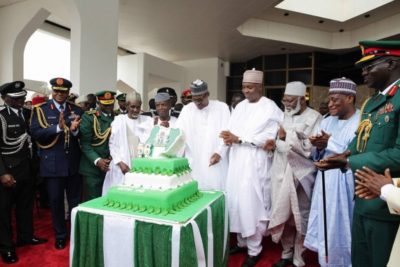
President Muhammadu Buhari has described the Niger Delta militants who emerged shortly after he assumed the leadership of Nigeria to begin to blow up gas and oil pipelines in Nigeria as senseless thugs, vowing that his government will not allow these mindless groups to hold the country to ransom.
The President, in his October 1st Independence broadcast to the Nation today, Saturay asked: “what sense is there to damage a gas line as a result of which many towns in the country including their own town or village is put in darkness as a result? What logic is there in blowing up an export pipeline and as a result income to your state and local governments and consequently their ability to provide services to your own people is reduced?
“The damage perpetrated by Niger Delta thugs on pipelines sometimes reduced Nigeria’s production to below One million barrels per day against the normal two point two million barrels per day. Consequently, the naira is at its weakest, but the situation will stabilize.”
Emphasising that no group can unlawfully challenge the authority of the Federal Government and succeed, President Buhari stressed that his government is in touch with the State Governments and leaderships of the region.
Buhari sympathised with the plight of the good people of Niger Delta, assuring that the clean-up of the Ogoniland and infrastructural projects financed by the Federal Government and post amnesty programme financing will continue.
He further assured that his government will continue to dialogue with all groups and leaders of thought in the region to bring lasting peace.
The full text of President Buhari Independence broadcast goes thus:
ADDRESS BY PRESIDENT MUHAMMADU BUHARI ON 56TH INDEPENDENCE ANNIVERSARY. OCTOBER 1ST 2016
Today – 1st October is a day of celebration for us Nigerians. On this day, 56 years ago our people achieved the most important of all human desires – freedom and independence. We should all therefore give thanks and pray for our founding fathers without whose efforts and toil we would not reap the bounties of today.
- I know that uppermost in your minds today is the economic crisis. The recession for many individuals and families is real. For some It means not being able to pay school fees, for others it’s not being able to afford the high cost of food (rice and millet) or the high cost of local or international travel, and for many of our young people the recession means joblessness, sometimes after graduating from university or polytechnic.
- I know how difficult things are, and how rough business is. All my adult life I have always earned a salary and I know what it is like when your salary simply is not enough. In every part of our nation people are making incredible sacrifices.
- But let me say to all Nigerians today, I ran for office four times to make the point that we can rule this nation with honesty and transparency, that we can stop the stealing of Nigeria’s resources so that the resources could be used to provide jobs for our young people, security, infrastructure for commerce, education and healthcare.
- I ran for office because I know that good government is the only way to ensure prosperity and abundance for all. I remain resolutely committed to this objective.
- I believe that this recession will not last.
- Temporary problems should not blind or divert us from the corrective course this government has charted for our nation. We have identified the country’s salient problems and we are working hard at lasting solutions.
- To re-cap what I have been saying since the inception of this administration, our problems are security, corruption and the economy, especially unemployment and the alarming level of poverty.
- On Security, we have made progress. Boko Haram was defeated by last December – only resorting to cowardly attacks on soft targets, killing innocent men, women and children.
- Nigerians should thank our gallant men of the Armed Forces and Police for rescuing large areas of the country captured by insurgents. Now, residents in Borno, Yobe and Adamawa States, as well as several neighbouring states go about their daily business in relative safety. People can go to mosques, churches, market places in reasonable safety.
- Commuters can travel between cities, towns and villages without fear. Credit for this remarkable turn-round should go to our Armed Forces, the Police, various sponsored and private vigilante groups, the local traditional leaders. Security is a top to bottom concern and responsibility.
- Besides Boko Haram, we are confronting other long-running security issues, namely herdsmen vs farmers, cattle rustling, kidnappings. This Administration is firmly resolved to tackle these challenges and to defeat them.
- A new insurgency has reared up its head in the shape of blowing up gas and oil pipelines by groups of Niger Delta Militants. This Administration will not allow these mindless groups to hold the country to ransom.
- What sense is there to damage a gas line as a result of which many towns in the country including their own town or village is put in darkness as a result? What logic is there in blowing up an export pipeline and as a result income to your state and local governments and consequently their ability to provide services to your own people is reduced?
- No group can unlawfully challenge the authority of the Federal Government and succeed. Our Administration is fully sympathetic to the plight of the good people of Niger Delta and we are in touch with the State Governments and leaderships of the region. It is known that the clean-up of the Ogoniland has started. Infrastructural projects financed by the Federal Government and post amnesty programme financing will continue.
- We have however, continued to dialogue with all groups and leaders of thought in the region to bring lasting peace.
- Corruption is a cancer which must be fought with all the weapons at our disposal. It corrodes the very fabric of government and destroys society. Fighting corruption is Key, not only to restoring the moral health of the nation, but also to freeing our enormous resources for urgent socio-economic development.
- In fighting corruption, however, the government would adhere strictly by the rule of law. Not for the first time I am appealing to the judiciary to join the fight against corruption.
- The Third Plank in this Administration’s drive to CHANGE Nigeria is re-structuring the economy. Economies behaviour is cyclical. All countries face ups and downs. Our own recession has been brought about by a critical shortage of foreign exchange. Oil price dropped from an average of hundred USD per barrel over the last decade to an average of forty USD per barrel this year and last.
- Worse still, the damage perpetrated by Niger Delta thugs on pipelines sometimes reduced Nigeria’s production to below One million barrels per day against the normal two point two million barrels per day. Consequently, the naira is at its weakest, but the situation will stabilize.
- But this is only temporary. Historically about half our dollar export earnings go to importation of petroleum and food products! Nothing was saved for the rainy days during the periods of prosperity. We are now reaping the whirlwinds of corruption, recklessness and impunity.
- There are no easy solutions, but there are solutions nonetheless and Government is pursuing them in earnest. We are to repair our four refineries so that Nigeria can produce most of our petrol requirements locally, pending the coming on stream of new refineries. That way we will save ten billion USD yearly in importing fuel.
- At the same time, the Federal Ministry of Agriculture and the Central Bank have been mobilized to encourage local production of rice, maize, sorghum, millet and soya beans. Our target is to achieve domestic self-sufficiency in these staples by 2018.
- Already farmers in thirteen out of thirty six states are receiving credit support through the Central Bank of Nigeria’s Anchor Borrowers Programme. Kebbi state alone this year is expected to produce one million tonnes of locally grown rice, thanks to a favourable harvest this year. As part of the 13 states, Lagos and Ogun are also starting this programme. Rice alone for example costs Nigeria two billion USD to import.
- The country should be self-sufficient in basic staples by 2019. Foreign exchange thus saved can go to industrial revival requirements for retooling, essential raw materials and spare parts. It is in recognition of the need to re-invigorate agriculture in our rural communities that we are introducing the LIFE programme.
- Government recognises that irrigation is key to modern agriculture: that is why the Ministries of Agriculture and Water Resources are embarking on a huge programme of development of lakes, earth dams and water harvesting schemes throughout the country to ensure that we are no longer dependent on rain-fed agriculture for our food requirements.
- In addition, government is introducing Water Resources Bill encompassing the National Water Resources Policy and National Irrigation and Drainage Policy to improve management of water and irrigation development in the country. We are reviving all the twelve River Basin Authorities, namely;
- Anambra – Imo
- Benin – Owena
III. Chad Basin
- Cross River
- Hadejia – Jama’are
- Lower Benue
VII. Lower Niger
VIII. Niger Delta
- Ogun – Osun
- Sokoto – Rima
- Upper Benue
XII. Upper Niger
- The intention is eventually to fully commercialise them to better support crop production, aqua –culture and accelerated rural development.
- This Administration is committed to the revival of Lake Chad and improvement of the hydrology and ecology of the basin. This will tune in with efforts to rehabilitate the thirty million people affected by the Boko Haram insurgency in the Lake Chad basin countries.
- The second plank in our economic revival strategy is centred on the Ministry of Power, Works and Housing. The Ministry will lead and oversee the provision of critical infrastructure of power, road transport network and housing development.
- Power generation has steadily risen since our Administration came on board from three thousand three hundred and twenty four megawatts in June 2015, rising to a peak of five thousand and seventy four megawatts in February 2016.
- For the first time in our history the country was producing five thousand megawatts. However, renewed militancy and destruction of gas pipelines caused acute shortage of gas and constant drop in electricity output available on the grid.
- There has been during the period June 2015 to September 2016 big improvement in transmission capacity from five thousand five hundred megawatts to the present seven thousand three hundred megawatts.
- There were only two system collapses between June and December 2015, but due to vandalism by Niger Delta militants the over-all system suffered 16 system collapses between March and July 2016 alone. As I have said earlier, we are engaging with responsible leadership in the region to find lasting solutions to genuine grievances of the area but we will not allow a tiny minority of thugs to cripple the country’s economy.
- In the meantime, government is going ahead with projects utilizing alternate technologies such as hydro, wind, and solar to contribute to our energy mix. In this respect, the Mambilla Hydro project, after many years of delay is taking off this year. Contract negotiations are nearing completion with Chinese firms for technical and financial commitments.
- The project is to be jointly financed by Nigeria and the Chinese-Export-Import Bank. In addition, fourteen Solar Power Projects have had their power purchase agreements concluded. Hence the plan to produce one thousand two hundred megawatts of solar electricity for the country would be realized on schedule.
- And in line with the objective of government to complete all abandoned projects across the country, the Rural Electrification Agency’s projects needing completion are provided for in the 2016 Budget. Bringing electricity to rural areas will help farmers, small scale and cottage industries to integrate with the national economy.
- Roads Construction and Rehabilitation has taken off. The sum of twelve billion naira was allocated to this sector in the 2015 Budget, not enough even to pay interest on outstanding unpaid claims.
- Notwithstanding the budgetary constraints, the current budget allocated two hundred and forty billion naira for highway projects against twelve billion naira in 2015. Many contractors who have not been paid for three years have now remobilized to sites. Seven hundred and twenty point five billion naira has so far been released this budget year to capital projects.
- The Ministry of Power, Works and Housing has received one hundred and ninety seven point five billion naira. Work on the following highways has now resumed.
- Dualization of Calabar – Itu Road in Cross River/Akwa Ibom States.
- Dualization of Lokoja – Benin Road, Ehor – Benin city, Edo State.
- Re-construction of outstanding sections of Benin – Shagamu Express way, Edo/Ogun States.
- Expansion works on Lagos – Ibadan Dual carriageway, Ogun/Oyo States
- Rehabilitation of Onitsha – Enugu Expressway, Anambra/Enugu States.
- Rehabilitation and Reconstruction of Enugu – Port Harcourt Dual carriageway, Abia/Rivers States.
- Rehabilitation of Hadejia – Nguru Road, Jigawa State.
- Dualization of Kano – Katsina Road, Kano State.
- Dualization of Kano – Maiduguri Road, Borno State.
- Dualization of Azare – Potiskum Road, Azare – Sharuri Road, Bauchi State.
- Rehabilitation of Ilorin – Jebba – Mokwa – Birnin Gwari Road, Kwara State.
- Construction of Oju/Lokoja – Oweto Bridge over River Benue, Benue State.
- Other major highways are in the queue for rehabilitation or new construction.
- Already contractors have recalled about nine thousand workers laid off and Government expects that several hundreds of thousands of workers will be reengaged in the next few months as our public works programme gains momentum.
- On railways, we have provided our counterpart funding to China for the building of our standard gauge Lagos -Kano railway. Meanwhile, General Electric is investing two point two billion USD in a concession to revamp, provide rolling stock, and manage the existing lines, including the Port Harcourt-Maiduguri Line. The Lagos-Calabar railway will also be on stream soon.
- We have initiated the National Housing Programme. In 2014 four hundred million naira was voted for Housing. In 2015 nothing. Our first budget this year is devoting thirty five point six billion naira. Much of the house building will be private – sector led but Government is initiating a pilot housing scheme of two thousand eight hundred and thirty eight units uniformly spread across the 36 states and FCT.
- We expect these units to be completed within 4 – 6 months. These experimental Nigeria House model Units will be constructed using only made in Nigeria building materials and components. This initiative is expected to reactivate the building materials manufacturing sector, generate massive employment opportunities and develop sector capacity and expertise.
- The programmes I have outlined will revive the economy, restore the value of the naira and drive hunger from our land.
- Abroad, Nigeria’s standing has changed beyond belief in the last 18 months. We are no longer a pariah state. Wherever I go, I have been received with un-accustomed hospitality. Investors from all over the world are falling over themselves to come and do business in Nigeria. This government intends to make business environment more friendly because we can not develop ourselves alone.
- All countries, no matter how advanced, welcome foreign investments to their economy. This is the essence of globalization and no country in the 21st century can be an island. Our reforms are therefore designed to prepare Nigeria for the 21st century.
- Finally, let me commend Nigerians for your patience, steadfastness and perseverance. You know that I am trying to do the right things for our country.
- Thank you and may God bless our country. [myad]





56th Independent Day: Time For Sober Reflection, By Bobboi Kaigama
I extend warm greetings to Nigerians around the world on this occasion of our 56th anniversary as a country.
My thoughts turn first towards the founding fathers of our nation. I applaud their sacrifice and the legacy they have left behind. Yes, we are politically free but still constrained economically to the apron strings of erstwhile colonial masters. Ours is a tale of a country that has been hijacked by the Brettonwood institutions and an insignificant few in terms of number, who now manipulate the system to their own personal aggrandizement. The politicians collude with the big players in the economy to rape the treasury, leaving the people prostrate, hopeless and frustrated.
We are clearly embittered seeing Nigerians lose their jobs in droves and the people in charge are doing nothing in terms of initiating stimulus economic policies other than the clamour for sale of national assets. The cabal have long infiltrated the polity. In fact, virtually every bill passed in the National Assembly today is to the advantage of these few Nigerians.
Nigeria is the sixth oil-producing country in the world yet the poorest. Are we heading in the right direction? No. The backbone of every democracy is a vibrant parliament or National Assembly (as it is in our own case), unbiased judiciary, media and active organized labour/civil society. Unfortunately, out of all these only labour and its civil society ally appear to be interested in the development and growth of the country. Profligacy has become the order of the day, especially the Eight Assembly. At first it was the issue of salary and allowances; exotic and bulletproof cars for lawmakers and their wives, budget padding, etc. They play politics without principles, amass wealth without work. “We are patriots and we feel your pains”, they say, but their actions speak otherwise.
I wish to assess the following areas:
POLITICS:
A lot has been said about our style of politicking in my introduction, but I have a few more things to add. The political terrain is a battlefield. Put differently, politics has become a do-or-die instead of a service to the people. We are a people blessed with human and natural resources but cursed with bad leadership. Our leaders care less and never give a hoot about nation-building. India, Nigeria, China, Malaysia were in the league of third world countries a few decades ago but now they have created a niche for themselves in the global economy.
It is our resolve that blame and counter-blame will do us no good. It hurts that the country is in a recession, but hurts more that even in the midst of the untold hardship the lawmakers are busy dwelling on inconsequential. The ministers and other government agencies are not left out of these blames. We are distraught by the fact that federal government and most state governments refuse to remit our deducted pension and the promised new minimum wage and palliatives meant to cushion the pain caused by the last deregulation has not been implemented. At inauguration at all levels of government, their speeches presented a wind of hope to Nigerians. But no sooner were they sworn in that they made national interest optional, dashing our hope again. Why the leadership of the Senate and some of his colleagues called for the sale of performing national assets still beats our imagination. It is a shame!
ECONOMY:
There is no gainsaying the fact that all sectors of our economy have collapsed, and our most cherished naira bows every hour to foreign currencies. As at yesterday the naira exchanged for between N480 and N492 per US dollar. The Central Bank of Nigeria (CBN) appears hopeless, not knowing what to do. Many companies have close shops while others are fleeing the country, a situation that has lead to millions of job losses. Our economy has been hijacked by the International Monetary Fund (IMF) and a few wealthy Nigerians and the society is the worse for it.
The challenge before the country is the few greedy Nigerians who see the country as their personal property. They use our commonwealth to buy our viable national assets only to turn them to warehouses. They are paid upfront to fix the refineries that never worked; they increase the price of fuel to N145 per litre; canvass for the sale of LNLG, Airports, Sea Ports, etc. They have a common goal, which is to loot.
The report from Nigerian Bureau of Statistics (NBS), in its Second Quarter released at the beginning of September 2016, noted that the fortune of the economy has dwindled by 2.06 per cent which has never happened in the last three decades. We have been assured that the recession will soon be over; we agree but it is important government look beyond the ruling party to source for capable hands that can help save our economy. All hands must be on deck to ensure that we become economically free by exporting more than we import and by patronising made in Nigeria goods.
INSECURITY
The Congress appreciates the military for their effort so far at maintaining peace in the country. We also share their pains and that of families who lost their loved ones in the North-east and Niger Delta while trying to stall the activities of the militants. Be that as it may, what the military is doing at the moment in those regions can best be described as “addressing the symptoms”. The main causes of the unrest itself must be looked into – unemployment, poverty, etc.
The saying, an idle hand is the devil’s workshop is the case here. Where there is good leadership there would be development; where there is development there would be jobs; and when there are jobs there would be no youths in the street waiting to be used for political thuggery.
SALE OF NATIONAL ASSETS
In our race to come out of the recent recession that has bedevilled the country, caution should be taken to ensure we do not auction our life-wire to people as being suggested by Nigerian governors during the National Economic Council (NEC) meeting and a few other Nigerians. The consequences of such action would be disastrous. Tell me of any asset sold in this country without hundreds of people losing their jobs! Did they even tell us what they did with the proceeds?
Truly, we are experiencing increasing economic complexities, but that does not mean we should sell our birthright for a mussel of porridge. If only those canvassing this will pay their appropriate taxes and the economy well diversified we wouldn’t be complaining by now. Let us remember that if those who invested in the assets had sold them, the current administration would not have been able to bailout some state governments when they cried for help some months ago. The recommendation of the sale is hasty, unreasonable and we suspect foul play. Our challenge as a country is not paucity of resources, but rather the inability (or deliberate refusal) of successive governments to convert the “blessings” for the general good of all.
OIL AND GAS
The oil and gas industry is the country’s cash cow. Sadly, governments, like those in the past, do not even know how many barrels of oil the country produces. They told us deregulation was the only way to go; they have deregulated yet the status-quo remains. Meanwhile prices of commodities have sky-rocketed. We urge government to de-militarize the Niger Delta and seek peace so that the country can recover fast.
It suffices to say here that we are disappointed in the Ministry of Petroleum and Petroleum Products Pricing Regulatory Agency (PPPRA). The poor performance of PPPRA is not a surprise to us because we had expected it. Government skillfully shoved labour out of PPPRA so it can have reason to justify the deregulation. Such a step is dangerous for a nation that is economically gasping for breath.
We call on government to commence the process of making the sector more viable. It should also encourage local refining processes. The Congress is convinced that the oil and gas workers can successively manage the sector if government stops unnecessary interference. They are capable of making it vibrant enough to fund a large percentage of the national budget. We also call for the passage of the Petroleum Industry Bill (PIB). The bill would address the insurgency situation in the Niger Delta as their demands are duly taken care of in the bill. Losing over N61trn according the Nigerian Extractive Industries Transparency Initiative (NEITI) report to non-passage of PIB at this time makes us look unserious before the international community. The cost of fighting the insurgents is not inclusive in the amount cited above. What about the lives of our soldiers that are dying on a daily basis? This is a needless war!
CENTRAL BANK OF NIGERIA
The Central Bank of Nigeria has not got it right on a number of policies. First is the conscious devaluation of the naira. Today, the naira is not only unpredictable but also subservient to virtually all foreign currencies. We are a mono-economy now battered by the combined forces of devaluation and inflation. Growing an economy is about local production/investment directed at massive development. We expect that managers of the economy should know that, regrettably they prefer to dance to the turn of International Monetary Fund (IMF) and World Bank.
In addition, the CBN should shun this conspiracy and romance with the Bureau De Change and banks to manipulate the exchange rate while neglecting its core duties, which include: determination of foreign exchange rate for the naira and to maintain appropriate external reserve. The apex bank has been found wanting in these areas. We urge the Federal Government Economy Team and the CBN to appreciate the fact that growing an economy is about local production/investment, no more no less.
CORRUPTION
Unbridled greed and corruption are like Siemens twins. These two evils are responsible for the country’s abysmal under-development. The scourge is flourishing in the polity and the economic cycle. Painfully the more you try to fight it the more it fights back, apology to politicians.
In 2013, Transparency International declared Nigeria as the 144th in Corruption Perception Index out of the 177 countries. While our politicians have since perfected the act of election-rigging and passing of anti-people laws their partners in crime and big players in the economy are awarded contracts for Turn-Around-Maintenance (TAM) of the refineries, roads, etc. It will be recalled that the money meant for arms procurement for the prosecution of the Boko Haram war was misappropriated; likewise all the people awarded contracts to develop the Niger Delta region. It has always been the pattern and we will be deceiving ourselves to think corruption is not taking place under this administration. It is disheartening to know that some privileged individuals are diverting grains meant for Internally Displaced Persons (IDPs). This is regrettable! We advocate that state of emergency be declared on corruption. It has to be fought without vendetta or favor; and people must be convicted. Is this too much to ask?
Where have they ever got it right? The education sector is in a sorry state. In fact, our best university is not even among the best 1000 in Africa, talkless of the world. The government has never implemented the 26.5 percent of annual budget mandated by UNESCO. All their policies in the sector are never implemented.
LESSON FROM SAUDI ARABIA GOVERNMENT
The cost of servicing our presidential system of government is too grave to bear. It is an institutional problem. Politics is big business in Nigeria and we urge the executive, legislature and judiciary to lead by example by slashing their salaries and allowances just like the Saudi Arabia government has done. This is one way to tell Nigerians that they truly feel our pain as they profess.
Thank you! [myad]