Former Nigeria Vice President and chieftain of All Progressives Congress (APC) Atiku Abubakar, has taken side with the national leader of the All Progressives Congress (APC), Asiwaju Bola Ahmed Tinubu who recently asked the party’s national chairman, Chief John Odigie Oyegun to resign.
Atiku, on his ppart, decried the decision of Oyegun to jettison the recommendation of Ondo Appeal Panel in favour of Chief Rotimi Akeredolu, saying “It was wrong for the APC to have set aside a resolution it had reached aimed at resolving the crisis in our party in Ondo State. It is a recipe for acrimony and division.”
In a statement issued in Abuja on Wednesday by Atiku Media Office, the former vice President said: “the party leadership should always be guided by respect for the rules, fairness, equity, neutrality and respect for democratic consensus.”
Atiku said that it is imperative for the national leadership of the party to live by the rules of internal democracy and respect for democratic consensus, warning that “you cannot break your own rules without creating problems.”
According to him, since the APC found veritable reasons to review the outcome of the gubernatorial primary election it conducted in Ondo State, and was able to establish valid grounds to cancel that election and call for a fresh one, the decision to deviate from its own resolution is a negation of due process and an unfashionable hollow in democratic best practices.
The former Vice President said that pretending a problem doesn’t exist won’t make that problem go away, and therefore, advised the leadership of the party to do a soul searching and address why this problem arose and escalated.
The APC chieftain charged the party to promote the rule of law and due process in the conduct of its affairs, adding that they are germane to the unity and stability of the party.
He, however, urged the aggrieved members of the APC in the Ondo election to exercise restraint in seeking redress to the crisis, while also urging the leadership of the party to retrace its steps and do the needful to restore confidence among the conflicting parties in the state for the overall benefit of the ruling party. [myad]
Former Governor of the Central Bank of Nigeria (CBN), Chukwuma Soludo, has described a Lagos lawyer and Senior Advocate of Nigeria (SAN) as an ignorant who does not know the difference between loan and deposit, even as he demanded an apology from him for accusing him wrongly.
“I can’t believe that the learned and respected Senior Advocate of Nigeria does not know the difference between a bank LOAN and a bank DEPOSIT,” Mr. Soludo said.
Falana had called for Mr. Soludo’s probe, accusing the former bank chief of doling out $7 billion to commercial bankers while he was in office. The Senior Advocate claimed that the loan was never returned by the beneficiary banks.
Reacting to the allegation, Soludo said that it was never a loan, but deposits placed in the appropriate banks by the federal government and: “none of the 14 Nigerian banks needed a loan or requested for a loan, and the CBN did not grant any loan with our foreign reserves.”
Full text of Soludo’s statement reads:
FEMI FALANA CONTINUES TO LIE: I INSIST ON HIS APOLOGY
I have just read further statement from Femi Falana in response to mine and his position that he does not need to apologize to me but that instead I may wish to direct my demand for apology to Mr. Festus Odoko (then head of corporate affairs at the CBN). I hereby further wish to state as follows:
When I read Falana’s original statement, claiming that he had “evidence”, that I ‘dolled out’ $7 billion of foreign reserves to banks as a LOAN, I denied the charge and challenged him to publish such evidence. His “evidence” turns out to be a newspaper report quoting the announcement by CBN through Mr. Odoko that “deposits worth $7 billion representing the apex bank’s share of the foreign reserves estimated at about $38 billion has been released to the consortium of bankers” (The Guardian newspaper of 5/10/2006). The same newspaper report noted that the Investment Committee of the CBN (charged with responsibility for deciding where and how our foreign reserves should be kept) approved the decision to allow 14 Nigerian banks with capital base of more than $500 million to be part of the consortium of banks that hold our foreign reserves as deposits.
In all honesty, I can’t believe that the learned and respected Senior Advocate of Nigeria does not know the difference between a bank LOAN and a bank DEPOSIT, and there is no way I would have imagined that he was referring to the deposits with banks as LOAN. As I stated in my earlier response, Nigeria’s foreign reserves are required by law to be kept in foreign currency abroad. This has been kept either as deposits in banks or invested in sovereign instruments such as the US treasury bill. Before 2006, none of the Nigerian banks was considered big enough or with the infrastructure to manage our foreign reserves. Consequently, our reserves were kept with a consortium of other countries’ banks such as JP Morgan Chase, USA, UBS of Switzerland, Citibank, USA, Bank for International Settlement (BIS), Switzerland, etc. Indeed, in much of the 1990s especially under Gen. Abacha, our reserves were almost exclusively kept with BIS Switzerland.
After the consolidation of banks by December 2005 and as part of our long term vision that Nigerian banks should ultimately take charge and manage Nigeria’s entire foreign reserves, the CBN took the patriotic step of allowing the biggest of our banks to join the consortium of other countries’ banks holding our reserves as deposits. The CBN decided as a first step to give the biggest Nigerian banks a small portion of our reserves, $7 billion as deposits, while the remaining $31 billion as at that date remained with other countries’ banks as deposits and other investments.
It is interesting that Femi Falana would refer to the deposits held by Nigerian banks as LOAN while saying nothing about the other deposits with other countries’ banks.
Let me state that none of the 14 Nigerian banks needed a loan or requested for a loan, and the CBN did not grant any loan with our foreign reserves. As I stated in my earlier statement, the CBN Act does not allow the CBN to grant loans with our reserves to banks, and no loan was ever made. Chief Falana is therefore looking for a repayment of a LOAN by banks that never existed in the first instance. Under my tenure, Nigeria’s foreign reserves grew from $10 billion to all time high of over $62 billion and due to our efficient management, Nigeria never lost a penny of it.
Finally, I must say that I don’t believe any of the conspiracy theories flying around, including those who question the motive, timing, and content of his bogus claims, and some even allude to it as a hatchet job. Going into the archives to fish out a newspaper report of 10 years ago about deposits and making up a fantasy story around it to become a loan, could give anyone cause for suspicion. Even several of the allegations against my successor, Emir Sanusi, are laughable and betray a lack of most elementary knowledge of how a bank such as the CBN works. As one of his admirers, I want to believe that this is one of those cases he is proving to be human after all and therefore could get his facts completely wrong. It may be challenging for him to admit his error and apologize, but if he is not on a mission, it is the only honourable thing for him to do. [myad]
Minister of Agriculture, Chief Audu Ogbe has commended the chairman of the Nigeria AgricBusiness Group (NABG), Sani Dangote for his contribution towards the development of the agricultural sector in the country. Sani Dangote is the Vice President of the Africa’s foremost conglomerate, Dangote Group.
Speaking at the AGRIKEXPO/NABG Conference in Abuja, AuduOgbe said that Dangote’s NABG and Dangote Group are making farming attractive and wooing investors at the same time even as the Dangote Group has invested enormously and created jobs across the value chain.
He regretted that despite the fact that the agricultural sector is the biggest employer of labour and largest contributor to the GDP, the country is yet to maximize its potentials as less than 40 percent of the arable lands are being cultivated.
The Minister said that the theme of the three-day conference: ‘From Food Oil to Crude Oil’, was apt in the light of the need to diversify the economy.
The Federal Government, he said, will soon recapitalize the Bank of Agriculture (BOA) and strengthen it so that it would be able to extend credit facilities to Small and Medium Scale farmers at around 7 percent interest rate.
The Minister said that in about 30 years time the Nigerian population would be in the region of 500million people, while the world’s population would hit 10billion, adding that there was need to prepare ahead.
He said that the government was planning a Farmers Day where farmers will be appreciated and rewarded, just as he announced that the government was collaborating with relevant international agencies to bring back Extension Services.
This was even as Sani Dangote said that the NABG is an association for all associations and stakeholders in the agricultural sector, saying that it is interacting with the public sector to revive the sector.
He asked Nigerians to look at the current economic problem as an opportunity to invest in the agricultural sector.
The Coordinator of the NABG, Emmanuel Ijewere said that it is possible for Nigeria to retrace its steps back to agriculture while the NABG as a private sector group is trying to ensure that the entire value chain is carried along.
“Everybody needs everybody in the agriculture value chain,” he said.
Also, the Group Managing Director of the Dangote Sugar Refinery (DSR) Plc, Engr. Abdullahi Sule said that the Dangote’s sugar master plan is aimed at producing sugar from various locations across Nigeria, including Savannah Sugar Company Limited, in Numan Adamawa State.
“The plan is aimed at producing 1.5 million tons of refined white sugar annually from locally grown sugarcane. In view of the current economic situation, we have broken the projects implementation in phases. Our focus is on Savannah, Lau/Tau and the Niger State project sites.” [myad]
Governor Ifeanyi Ugwuanyi of Enugu State has shut the door on those he described as portfolio contractors who he accused of being in the habit of doing shoddy jobs for the state government. Ugwuanyi, while presenting school furniture to the Enugu State Universal Basic Education Board (UBE), said that only seasoned contractors would henceforth be engaged to work in the state. The governor, who was represented by his deputy, Cecelia Ezeilo, reiterated his appeal to contractors to deliver quality assured jobs in line with agreed specifications. He said that the state government would no longer tolerate contractors who abandon projects after mobilization, insisting that contractual terms must be met. Ugwuanyi said that he was moved to donate the school furniture due to the situation and challenges in the public schools, where pupils study under unfriendly circumstances. He said that his administration would embark on massive turnaround of infrastructure in public schools in the state, promising that the situation would never be the same again. The governor expressed satisfaction with the ongoing reconstruction of 370 classroom blocks in the state, which he said, had attained 90 per cent completion. “We are committed to ensuring that our children are comfortable in their classrooms in order to make the job of teaching easier for the teachers. “We shall continue to respond to the needs of these children in schools because their comfort and safety today guarantee the comfort and safety of our future.” Ugwuanyi said that education remained a priority in his reform agenda, being the fulcrum for sustainable development. Responding, the Chairman of ENSUBEB, Chief Ikeje Asogwa, said the gesture would help to boost the morale of pupils and teachers, adding that the furniture would be equitably shared to benefitting schools across the state. He urged the education secretaries to generate the list of the beneficiaries in line with their scale of need. [myad]
The Director-General of the Nigerian Maritime Administration and Safety Agency (NIMASA), Dr. Dakuku Peterside, has appealed to the people in Niger Delta region to embrace peace, security and sanity to grow the economy. Peterside, who had a meeting with stakeholders of the Agency in Warri, Delta state, said that the management of the agency would not relent in its core functions of safety of vessels and personnel on Nigerian territorial waters.
The Director-General, who is from Niger Delta, said that there is need to address insecurity in the Niger Delta region for business to flourish.
he announced: “Presently, over 2,000 Nigerians are undergoing training in seafaring. We recorded few piracy attacks this year compared to last year as a result of Nigeria’s compliance with the International Ship and Port Facility Security Code (ISPS) code due to the activities of NIMASA.
“If the Nigerian waters were safe, that would encourage more vessels to come into the country. We must acknowledge that NIMASA is working very hard to achieve its mandate.’’
The NIMASA boss said that his management visited Delta State for three functions: checking the state of Warri and Koko ports; interacting with members of staff to know their challenges; and to also monitor theoperations of stakeholders.
Peterside called on the stakeholders to have a change of attitude in doing things, adding that NIMASA is concerned with the enforcement of Cabotage.
“If Cabotage act is properly implemented, it will override oil and gas or work side by side with oil and gas in terms of revenue generation.
“All the people using flagged vessels to trade in our waters should have rethink because the end has come as NIMASA has zero tolerance on any vessel flouting our laws.
“There is a new lease of life in NIMASA and maritime industry is full of opportunities. We invite those who may not know to come and join us,’’ Peterside said.
In his welcome address, the Coordinator, Central Zone of NIMASA, Capt. Kunle Olayiwola said the Central Zone had 77 staff including the coordinator, two assistant directors and so on.
“There are five central zonal operations offices such as Ports office in Delta Port, Maritime safety office in Warri; Cabotage Enforcement office in Sapele; Escravos office in Oporoza town; and maritime Labour Service located in Delta.
“Being the first director- general to visit the zone, we have assurance that we have not forgotten and abandoned you and we have rekindled the hope of staff by giving the opportunity to interact with management.
“The zone needs attention to reposition it for higher productivity,’’ NAN quotes Olayiwola as saying.
Mr. Dickson Unogu, a stakeholder and a member of the Chartered Institute of Logistics and Transport (CILT), urged the management of NIMASA to dredge the channel in Warri Port to allow bigger vessels to berth.
A staff of Shipping and Dredging Root Services, Mr Obioma Ochulo, urged NIMASA to engage in electronic operations to reduce the burden of staff coming to Lagos for clearance. [myad]
Special Adviser to Aliko Dangote, the richest man in Aarica, Engineer Joseph Makoju has made it clear that diversification and the deployment of state-of-the-art facilities are things Nigeria needs to grow the economy and for the Group to grow its vision.
Makoju, who spoke at the just concluded conference of the Nigeria Institute of Management (NIM) in Abuja that said that the best way the business can grow is to invest in different sectors at the same time.
Aliko Dangote is known to be championing the growth of entrepreneurship among the youth in the continent.
The conference tagged: “Building a New Nigeria: Strategic Options and Policy Imperatives” was majorly sponsored by the Dangote Group.
At the conference, Chairman of the NIM’s Council, Professor Munzali Jibril commended Dangote for his sponsorship and unalloyed commitment to the Nigerian economy.
He said that the Group has moved Nigerian economy from cement importer to exporter, while earning a huge foreign exchange for the country.
He said that when the Dangote Refinery comes on stream in 2019, it would permanently put an end to the petroleum crisis faced by the country. [myad]
It is now official that the Nigerian economy is in recession and the federal government is in dire need for solutions to salvage the economy. Last week, President Muhammadu Buhari and his team met with economic experts and private sector operators as part of efforts to discuss steps being taken to get the economy out of recession. At the end of the meeting, one obvious thing that came out was that the government must spend to get out of the current bad economic situation.
In the 2016 budget, the federal government had intended to borrow N1.8 trillion from both domestic and foreign markets to finance the deficit in the over N6trillion earmarked to run the country this year. The dwindling oil revenue has compelled the government to significantly rely on borrowing to fund the budget. Hence the government had intended to borrow about N1.8 trillion from both domestic and foreign markets to fund the deficit. However, with the recession, it has become obvious that more money would be borrowed, a development economic experts and government officials have confirmed.
Speaking on how to come out of the recession, the Managing Director/Chief Executive Officer of Financial Derivatives Company Limited (FDC), Mr. Bismarck Rewane, said for the federal government to overcome the economic recession, it must borrow and sell assets to raise funds that would be injected into the economy. According to him, since there is a fall in oil revenue, the government has to increase the deficit plan for 2016.
“The government must inject funds into the system and the executive is fully engaged because they kwon they cannot hide they have to deal with the problem. And given the fall in oil revenue, you have to increase the deficit plan for the recovery. You must borrow and President Muhammadu Buhari has said we will borrow at least $5 billion externally. We must sell some assets because when you are in this kind of situation, you have to sell some assets,” Rewane said.
The Minister of Budget and National Planning, Senator Udoma Udo Udoma last Friday confirmed that government would borrow more in foreign currency, disclosing that between $10 to $15 billion is being targeted.
“We are targeting to raise about $10 to $15 billion. We are looking for this because what we need to charge this economy is foreign currency. Foreign currency shortage is largely responsible for were we are today. So we have to look for foreign currency and we have a plan already. We have a prepared bill because we want to fast track some of these processes in order to get the money,” he explained.
According to him, the government has been able to spend one quarter of what it had intended to spend on capital projects, adding that the country recorded a N1trillion loss in the first half of the year due to the unrest in the Niger Delta.
Udoma said: “The 2016 budget as far as the recurrent expenditure has been fully implemented. The emoluments have been paid in full. We have released all the money so that nobody at the federal level is being owed. All salaries have been released.
“We have also met all debt service in full. With regards to overheads, we have not met that in full, but we are almost there. The problem is capital expenditure. In the capital budget we planned to spend about N1.8 trillion but we have only spent about N400 billion.”
Before Udoma’s disclosure, the Minister of Finance, Mrs. Kemi Adeosun had said the executive council had approved a three-year rolling external borrowing plan. According to her, the loans would come from agencies such as the World Bank, African Development Bank, China Exim Bank, and other development agencies like the Japanese International Cooperation Agency (JICA).
She said the plan to borrow externally was in line with government’s strategy to focus on concessional debts, low cost loans particularly from multi-lateral agencies, noting that the loans would be applied to develop strategic sectors which government believed would help revive the economy.
She said the power sector would receive a significant amount of the loan to take care of projects militating against efficient power generation. “The largest beneficiary of our borrowing is agriculture because it is equally strategic and we have programmes by the minister, some of which he inherited and is going to restructure and reform and some are new to the ministry. ”
Adeosun emphasised that the economy must be diversified, saying, “there are too many of us to keep on relying on oil. We can all see what happened at the output data of the oil and gas sector. What’s happening in the Niger Delta has dragged down the GDP of the entire economy. We’re too dependent on oil. We have to invest in capital projects.”
Having realised the need to borrow more, all eyes are now on the Debt Management Office (DMO), which has the mandate to borrow on behalf of the government and ensures efficient management of the country’s debts. Although there have been some criticism by some stakeholders on the level of the country’s debts in recent times, some other stakeholders have said what the government actually needs is borrowing for capital expenditure and productive purposes as against for recurrent expenditure in the past.
The Director General of DMO, Dr. Abraham Nwankwo had that at below 20 per cent debt-to-gross domestic ratio, Nigeria is very much still in the comfort zone to borrow more. Also, another expert who believes Nigerian can still borrow for productive purposes is Mr. Odlim Enwegbara, a development economist. Comparing the debt-to-GDP ratio of some countries, Enwegbara said Japan’s stands at 224 per cent; Italy’s at 128.50 per cent; the United States at 107 per cent; France’s at 95 per cent; the United Kingdom’s at 89.80 per cent; South Africa 44 per cent; India’s 66 per cent; Brazil’s 60.8 per cent; Kenya’s 50 per cent; Ghana’s 67.50 per cent.
“With Nigeria at 17 per cent, the country has the opportunity to raise funds that are projects specific to fast-track the infrastructural development of the nation,” Enwegbara. However, one big question that many would want to be answered is the capacity of DMO to successfully raise the funds that are needed to move the country out of the economic recession.
A financial market analyst, Femi Adelaja said given the track record of DMO and the commitment of the management of staff of the agency, raising the funds would not be a big problem.
“What I think we should be talking about is the efficient utilization of the funds by the government so that we won’t repeat the mistakes of the past where funds were diverted from the original purposes for which they were borrowed,” Adelaja said.
Having resuscitated the domestic bond market, DMO has also facilitated access to the international capital market (ICM) for Nigerian corporate players and government. That journey to the ICM began in 2011 when DMO issued $500 million Sovereign Eurobond in 2011.
This was followed with $1 billion dual-tranche Eurobonds in July 2013, thus creating benchmarks for corporate borrowers. In 2014, DMO issued FGN Bonds in Global Depository Note (GDN) format for the first time aimed at diversifying the investor base and attract foreign investors to the domestic securities market.
By December the country is expected to return to the ICM to begin the foreign capital raising exercise. Some analysts have expressed confidence that with the track record of the Nwankwo-led DMO, the economic potential, and the commitment of the government to return Nigeria back to its leading position in Africa, the country will have a successful capital raising exercise. [myad]
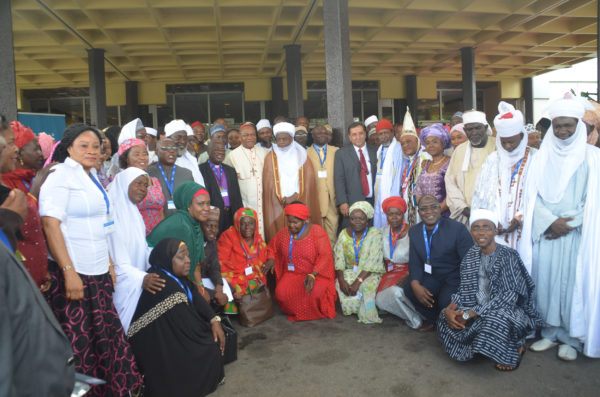
Sultan of Sokoto, Alhaji Saad Abubakar 111, Archbishop of Abuja, Cardinal John Onaiyekan (middle), in a group photo with participants at the Opening Ceremony of the National Inter-Faith Dialogue, organized by ICPR and International Dialogue center (KAICIID) in Collaboration with the interfaith Mediation center, IMC in Abuja today, Tuesday.
L-R: Mr. Patrice Brodeur; representative of CAN President, Rev. Dr. Testimong Onifade, the Sultan of Sokoto, Alhaji Sa’ad Abubakar 111, Archbishop of Abuja, Cardinal John Onaiyekan, representative of the Director-General of International Centre for Interreligious and Inter-Cultural Dialogue, Professor Mohammed Abu Nimer and Sheikh Muhammad Murayn Ashafa at the opening Ceremony of the National Inter-Faith Dialogue meeting organized by ICPR and International Dialogue center (KAICIID) in Collaboration with the interfaith Mediation Center (IMC), in Abuja. [myad]
The Sultan of Sokoto, His Eminence, Alhaji Sa’ad Abubakar III has accused politicians of polluting religions in the country with filthy money and turning religious leaders into cahs-and-carry people. Sultan Abubakar, who spoke today, Tuesday, at the opening of a programme organized by International Dialogue Centre (KAICIID), which focus on Intra-religious Understanding in Nigeria, said: “we have seen crisis and heard that some churches were given billions. We have seen scenarios where Islamic clergy were invited for a programme and given transport money by politicians.
“We must use our religious book to settle our differences. God almighty cannot be wrong in choosing a leader at any time. We have just stated the process of fostering unity among different religions.”
Sultan Abubakar who said Nigeria is going through difficult times economically, said that both Christians and Muslims need to come together to fulfill God plans for the country. “I am happy to see both Christians and Muslims here today. I am also happy that I am here. As Muslims, when we preach to our followers, we must tell them the truth. And as Christians, when we preach to our followers, we must do what we preach. If it is negative, it will affect us. It is important we hold our religions in a sincere manner. We must stand up and fight what divide us. “We must ensure that we return to the Nigeria Inter-religious Council (NIREC) which was formed by Methodist Prelate emeritus, Very Rev. Sunday Nbang and Sultan Machido.” Speaking on the herdsmen killings in some parts of the country, the Sultan insisted that any Fulani man found with guns should be treated as a terrorist. “The Fulani people we see in the villages hold no guns; they hold stick. Any Fulani man you see with gun, treat him as a terrorists. Those who take revenge, whether they do it proportionately, it is wrong to take a life.
“The people killed can be Igbo, Hausa, Fulani, Yoruba or anyone. Most of the herdsmen holding guns might not be Nigerians. If they are Nigerians, they are criminals and we must treat them as such.” The President of the Christian Association of Nigeria (CAN), Rev. Ayo Olasugbo, represented by Rev. Oluwoye Oyesoji, said that the agreement between Christians and Muslims to come together to foster unity is commendable, adding that the relationship between the two must be strengthen. “Whatever the organizers want CAN to do for peace, we will do it without any reservation. Since the people sitting here are not holding guns, we must go back and re-oriented our people not to carry arms.” The Director General of KAICIID, Fahad Abualnasr, in a visual message presented through a power point, said that the organization wants to address the problem facing the world which is global extremism and violence. International Dialogue Centre KAICIID Senior Adviser, Mohammed Abu-Nimer, said that they have been preparing for a very long time to bridge the gap between policy makers and the different components of the society. “In many parts of the world, people are not immune to religious violence. This is what we intend to address,” he said. The Director General (DG), Institute for Peace and Conflict Resolution, Professor Oshita O Oshita said that it took them one year to organize the programme in partnership with International Dialogue Centre. He said that they are looking for a framework for sustainability which has always been the problem on inter-religious peace building. [myad]
The Archbishop of Abuja, Cardinal John Onaiyekan has described those who are killing in the name of religion in Nigeria as satans.
Onaiyekan, who spoke today, Tuesday in Abuja at a programme organized by International Dialogue Centre (KAICIID), which focus on Intra-religious Understanding in Nigeria, said: “we have been hearing of Boko Haram and Niger-Delta militants for some years now and I am saying that guns cannot solve the problem. We must sit and talk. Killing in the name of God is Satanic.” The clergy man insisted that the culture of dialogue must become acceptable in the lives of all Nigerians, adding that there have been many efforts and initiatives for religious by the religious leaders.
According to him, things would have been worse if the leaders of various religions have not come together, saying: “our relationship depends so much on the people. In the market, in our places of work and in the neighbourhood, it is our duty as a people and leaders to promote good relationship between Christians and Muslims.”
On the controversies about the sale of the national assets, Onaiyekan advised the political players to study the options very carefully. “There must be a good reason to sell national assets. But my answer is neither yes nor no. The reason for selling national assets should not be done so as to give food to hungry people. “The demand is that things should be studied very properly. There are many national assets that are not really the business of the government but I cannot pass judgment on what happen to the natural gas because I am not an expert. “Any asset which really the government shouldn’t have been involved in its running the first place, the government should remove it’s hand from it and allowed it to be run properly.” [myad]
We use cookies on our website to give you the most relevant experience by remembering your preferences and repeat visits. By clicking “Accept”, you consent to the use of ALL the cookies.
This website uses cookies to improve your experience while you navigate through the website. Out of these, the cookies that are categorized as necessary are stored on your browser as they are essential for the working of basic functionalities of the website. We also use third-party cookies that help us analyze and understand how you use this website. These cookies will be stored in your browser only with your consent. You also have the option to opt-out of these cookies. But opting out of some of these cookies may affect your browsing experience.
Necessary cookies are absolutely essential for the website to function properly. This category only includes cookies that ensures basic functionalities and security features of the website. These cookies do not store any personal information.
Any cookies that may not be particularly necessary for the website to function and is used specifically to collect user personal data via analytics, ads, other embedded contents are termed as non-necessary cookies. It is mandatory to procure user consent prior to running these cookies on your website.




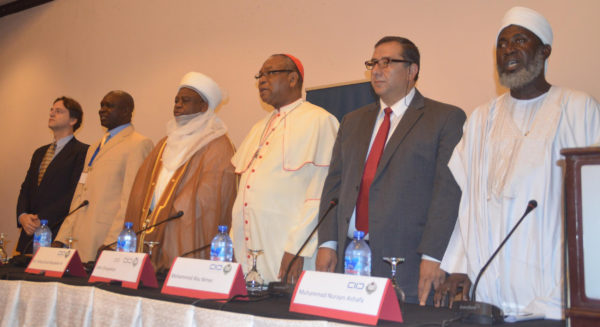 L-R: Mr. Patrice Brodeur; representative of CAN President, Rev. Dr. Testimong Onifade, the Sultan of Sokoto, Alhaji Sa’ad Abubakar 111, Archbishop of Abuja, Cardinal John Onaiyekan, representative of the Director-General of International Centre for Interreligious and Inter-Cultural Dialogue, Professor Mohammed Abu Nimer and Sheikh Muhammad Murayn Ashafa at the opening Ceremony of the National Inter-Faith Dialogue meeting organized by ICPR and International Dialogue center (KAICIID) in Collaboration with the interfaith Mediation Center (IMC), in Abuja. [myad]
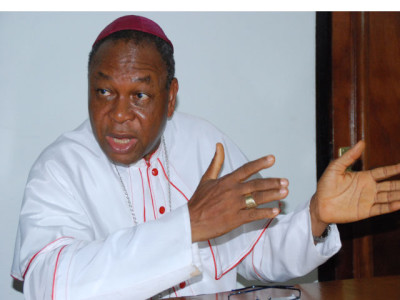 The Archbishop of Abuja, Cardinal John Onaiyekan has described those who are killing in the name of religion in Nigeria as satans.

Economic Recession: All Eyes On Debt Management Office, By Goddy Egene
It is now official that the Nigerian economy is in recession and the federal government is in dire need for solutions to salvage the economy. Last week, President Muhammadu Buhari and his team met with economic experts and private sector operators as part of efforts to discuss steps being taken to get the economy out of recession. At the end of the meeting, one obvious thing that came out was that the government must spend to get out of the current bad economic situation.
In the 2016 budget, the federal government had intended to borrow N1.8 trillion from both domestic and foreign markets to finance the deficit in the over N6trillion earmarked to run the country this year. The dwindling oil revenue has compelled the government to significantly rely on borrowing to fund the budget. Hence the government had intended to borrow about N1.8 trillion from both domestic and foreign markets to fund the deficit. However, with the recession, it has become obvious that more money would be borrowed, a development economic experts and government officials have confirmed.
Speaking on how to come out of the recession, the Managing Director/Chief Executive Officer of Financial Derivatives Company Limited (FDC), Mr. Bismarck Rewane, said for the federal government to overcome the economic recession, it must borrow and sell assets to raise funds that would be injected into the economy.
According to him, since there is a fall in oil revenue, the government has to increase the deficit plan for 2016.
“The government must inject funds into the system and the executive is fully engaged because they kwon they cannot hide they have to deal with the problem. And given the fall in oil revenue, you have to increase the deficit plan for the recovery. You must borrow and President Muhammadu Buhari has said we will borrow at least $5 billion externally. We must sell some assets because when you are in this kind of situation, you have to sell some assets,” Rewane said.
The Minister of Budget and National Planning, Senator Udoma Udo Udoma last Friday confirmed that government would borrow more in foreign currency, disclosing that between $10 to $15 billion is being targeted.
“We are targeting to raise about $10 to $15 billion. We are looking for this because what we need to charge this economy is foreign currency. Foreign currency shortage is largely responsible for were we are today. So we have to look for foreign currency and we have a plan already. We have a prepared bill because we want to fast track some of these processes in order to get the money,” he explained.
According to him, the government has been able to spend one quarter of what it had intended to spend on capital projects, adding that the country recorded a N1trillion loss in the first half of the year due to the unrest in the Niger Delta.
Udoma said: “The 2016 budget as far as the recurrent expenditure has been fully implemented. The emoluments have been paid in full. We have released all the money so that nobody at the federal level is being owed. All salaries have been released.
“We have also met all debt service in full. With regards to overheads, we have not met that in full, but we are almost there. The problem is capital expenditure. In the capital budget we planned to spend about N1.8 trillion but we have only spent about N400 billion.”
Before Udoma’s disclosure, the Minister of Finance, Mrs. Kemi Adeosun had said the executive council had approved a three-year rolling external borrowing plan.
According to her, the loans would come from agencies such as the World Bank, African Development Bank, China Exim Bank, and other development agencies like the Japanese International Cooperation Agency (JICA).
She said the plan to borrow externally was in line with government’s strategy to focus on concessional debts, low cost loans particularly from multi-lateral agencies, noting that the loans would be applied to develop strategic sectors which government believed would help revive the economy.
She said the power sector would receive a significant amount of the loan to take care of projects militating against efficient power generation.
“The largest beneficiary of our borrowing is agriculture because it is equally strategic and we have programmes by the minister, some of which he inherited and is going to restructure and reform and some are new to the ministry. ”
Adeosun emphasised that the economy must be diversified, saying, “there are too many of us to keep on relying on oil. We can all see what happened at the output data of the oil and gas sector. What’s happening in the Niger Delta has dragged down the GDP of the entire economy. We’re too dependent on oil. We have to invest in capital projects.”
Having realised the need to borrow more, all eyes are now on the Debt Management Office (DMO), which has the mandate to borrow on behalf of the government and ensures efficient management of the country’s debts.
Although there have been some criticism by some stakeholders on the level of the country’s debts in recent times, some other stakeholders have said what the government actually needs is borrowing for capital expenditure and productive purposes as against for recurrent expenditure in the past.
The Director General of DMO, Dr. Abraham Nwankwo had that at below 20 per cent debt-to-gross domestic ratio, Nigeria is very much still in the comfort zone to borrow more. Also, another expert who believes Nigerian can still borrow for productive purposes is Mr. Odlim Enwegbara, a development economist. Comparing the debt-to-GDP ratio of some countries, Enwegbara said Japan’s stands at 224 per cent; Italy’s at 128.50 per cent; the United States at 107 per cent; France’s at 95 per cent; the United Kingdom’s at 89.80 per cent; South Africa 44 per cent; India’s 66 per cent; Brazil’s 60.8 per cent; Kenya’s 50 per cent; Ghana’s 67.50 per cent.
“With Nigeria at 17 per cent, the country has the opportunity to raise funds that are projects specific to fast-track the infrastructural development of the nation,” Enwegbara.
However, one big question that many would want to be answered is the capacity of DMO to successfully raise the funds that are needed to move the country out of the economic recession.
A financial market analyst, Femi Adelaja said given the track record of DMO and the commitment of the management of staff of the agency, raising the funds would not be a big problem.
“What I think we should be talking about is the efficient utilization of the funds by the government so that we won’t repeat the mistakes of the past where funds were diverted from the original purposes for which they were borrowed,” Adelaja said.
Having resuscitated the domestic bond market, DMO has also facilitated access to the international capital market (ICM) for Nigerian corporate players and government. That journey to the ICM began in 2011 when DMO issued $500 million Sovereign Eurobond in 2011.
This was followed with $1 billion dual-tranche Eurobonds in July 2013, thus creating benchmarks for corporate borrowers. In 2014, DMO issued FGN Bonds in Global Depository Note (GDN) format for the first time aimed at diversifying the investor base and attract foreign investors to the domestic securities market.
By December the country is expected to return to the ICM to begin the foreign capital raising exercise. Some analysts have expressed confidence that with the track record of the Nwankwo-led DMO, the economic potential, and the commitment of the government to return Nigeria back to its leading position in Africa, the country will have a successful capital raising exercise. [myad]