Economic crunch in Nigeria has taken its toll on Yobe state Pilgrims’ Welfare Board as it has suspended the traditional Amirul Hajj team for this year’s Hajj pilgrimage to Saudi Arabia even as a total of 421 seats out of the total seats allocated to the state could not be filled by the impoverished Muslims.
Chairman of the Board, Alhaji Ibrahim Al-Arab, who spoke to news men in Damaturu on Friday, confirmed that 1,800 intending pilgrims had paid their fares fully out of the 2,231 seats allocated to the state.
“The commission could not exhaust its allocation like other states due to the economic crunch facing the country and indeed Yobe.”
He said that the hajj team was also suspended on the same of ground of paucity of funds and the need to save costs.
The chairman said that the first flight from the state, which was initially scheduled for Friday, was delayed due to non-availability of Basic Traveling Allowance (BTA) for the intending pilgrims.
“We are yet to receive BTA from the Central Bank of Nigeria (CBN) which is very important and critical to the welfare of pilgrims.”
Alhaji Al-Arab gave assurance however that the Board is committed to the welfare of pilgrims from the state to Saudi Arabia and back home, adding: “Yobe Government has provided supplement for accommodation and the commission has acquired hotel close to the holy mosque for them to perform the five daily prayers at the grand mosque.”
He appealed to the intending pilgrims to be good ambassadors of the state and country at large while in the holy land. [myad]
The United Nations Children Education Fund (UNICEF) has described the latest outbreak of wild polio in part of Borno state as a sobering news. The Fund said that the two children that were paralyzed by wild poliovirus in northeastern Nigeria underscores the urgency of eradicating the disease in conflict-affected areas. UNICEF Polio Eradication Director, Reza Hossaini said: “we cannot deny the connection between conflict and the continued threat of polio. The two new cases mean children across the Lake Chad region are now at particular risk. With our partners, we will not stop until we reach every child with polio vaccination.” The Government of Nigeria and the World Health Organization, on Thursday, confirmed an outbreak of wild poliovirus in conflict-ridden Borno state, where children are already facing dangerously high levels of malnutrition. The two cases were discovered in parts of Borno that have recently become accessible, but large areas of the state remain unreachable. Nigeria and the continent, had its last confirmed polio case two years ago and was within a year of being certified polio-free, thanks to a massive mobilization by the government, partners and local health providers. The Federal Ministry of Health, supported by WHO, UNICEF and partners of the Global Polio Eradication Initiative, are rolling out an emergency immunization campaign, starting in the accessible parts of Borno state. [myad]
Turkey Government is still hunting for supporters of the July failed coup attempt, with warrant of arrest issued on 648 court judges and arrest of 35,022 people. Out of the people arrested 17,740 of them have been formally arrested under court orders. A government official said 5,685 people remain in detention, waiting to see a judge even as some others have been released. Information has it that the government has continued to purge the state bureaucracy of alleged supporters of Fethullah Gulen, the US-based Turkish Islamic cleric accused of plotting the coup, charges he denies. In the latest move, warrants were issued for 648 judges and prosecutors. The state-run Anadolu news agency reported that nearly 3,500 members of the judiciary have been suspended since the July 15 failed putsch. About 65,000 civil servants in total have been suspended or fired, with the government accusing all of having links to Gulen. In addition, 21,000 teachers have lost their licenses. President Recep Tayyip Erdogan, who was once allied with Gulen, has vowed to continue the purges until the state is “cleansed” of his rival’s followers. dpa/NAN. [myad]
The Chairman, Independent National Electoral Commission (INEC), Professor Mahmood Yakubu, has given reasons why there have been inconclusive elections in the country’s recent electoral history. One of the reasons, he said is what he called electoral impunity by Nigerian politicians. Professor Yakubu who spoke at the official launch and public presentation of the National Human Rights Commission’s “End Electoral Impunity” Project Report, held at the conference hall of Commission’s headquarters, Abuja, asked Nigerians to put a stop to impunity in the system. The INEC Chairman who was represented by the National Commissioner in charge of the Voter Education and Publicity Committee, Prince Solomon Adedeji Soyebi, said that electoral impunity has caused the nation a whole lot of setback in terms of material resources, development of democracy and human lives. Professor Yakubu insisted that there is need for the country to establish Electoral Offences Tribunal (EOT), to be saddled with the full responsibility of prosecuting electoral offenders and bringing them to book as deterrent to others. The INEC boss decried the use of sophisticated arms by politicians to intimidate electoral officials, saying that such violence has made it very difficult for INEC to conclude six out of the eighty elections conducted by the Commission since he assumed office. He pleaded with politicians to stop making elections do or die affairs. [myad]
Nigeria Federal Government has taken a step towards the concessioning of the eastern and western lines of the Nigeria Railways, with the inauguration by Vice President Yemi Osinbajo on Friday, of a Steering Committee to get the job done promptly.
The committee, headed by the minister of Transport, Chief Chibuike Rotimi Amaechi, has been described as a means to fast-track the transformation of the railway infrastructure in the country.
Inaugurating the committee, Vice President Osinbajo, said that the purpose of the committee is to create a one-stop shop for the concession, fast track the process and beat the redtape & bureaucratic bottlenecks.
He said that the steering committee on the concession of the nation’s railway headed by the Transportation Minister, Mr. Chibuike Rotimi Amaechi, should be innovative, urging the members to remove whatever obstacles that stand in the way of a smooth concessioning process, hoping that the committee will meet its deadlines and end up “to be an example of how it should be done.”
He quarreled with the usual bureacratic bottlenecks in the public service delivery system, which he said the Buhari administration is determined to overcome it.
“I think this steering committee is extremely important, because we have tried to bring together everybody that should be involved in this (concessioning) project in order to see to it that we deliver quickly and efficiently in a manner that justifies Federal Government’s expense in the project.
“The whole idea of the steering committee raises the issue we are trying to address, to have a one-stop shop for all approvals, objections or problems so that we can realize our target.”
Minister of Transport said after the inauguration that the committee would ensure that the concession of the nation’s railway is made easy, assuring that the committee will submit its report within six months.
The 20-Member Committee is composed of officials and individuals from relevant public and private sector agencies & firms.
The Terms of Reference for the committee are as follows:
– To advise the National Council on Privatisation (NCP) on policy issues that impact on stakeholders interest;
– To advise the Bureau of Public Enterprises (BPE) on efforts at improving stakeholders relations;
– To advise BPE and Federal Ministry of Transportation on planning, coordination and implementation of Nigeria Railway Corporation;
– To review existing legislations, reports, studies and any other relevant information on the railway sector and provide guidance on policy issues;
– To review economic and financial viability of the project and recommend the level of Federal Government of Nigeria (FGN) investment;
– To review the concession framework developed by the Project Delivery Team;
– To review the technical, financial and legal framework for the successful preparation and concession of the project;
– To review the activities of the Project Delivery Team that would facilitate the concession, guide the project delivery team in the concession process, assist the concessionaire to obtain all clearances, approvals and permit as may be necessary;
– To assist in organisation of workshops, and public awareness campaigns on the concession process;
– To brief the NCP and Federal Executive Council (FEC) from time to time on the activities of the Steering Committee; and to carry out any other function that will facilitate the delivery. [myad
President Muhammadu Buhari commended the national chairman of the All Progressives Congress (APC), Chief John Odigie Oyegun for his leadership acumen even as he clocked 77 on August 12.
The President is particularly impressed by the his patriotism, hardwork and leadership in managing the affairs of the governing party through the period and in the aftermath of the historic 2015 elections.
Buhari celebrates with the APC boss for another year of good health and strength, adding that he has shown uncommon dedication to the peace, progress, stability and development of Nigeria.
The President also commended Chief Oyegun’s dedication to noble causes and democratic ideals which has endeared him to many Nigerians that will continue to draw inspiration from his legacies to offer their best for the country.
President Buhari prayed to God to grant him many more years of happiness and good health to see a better and prosperous Nigeria. [myad]
In some other countries of the world, a bronze medal at the Olympics is not something to be talked about or celebrated. Not even silver is satisfactory sometimes, just remember that look on Russian athlete Yulia Efimova’s face as her arch-rival, Lilly King of the United States took the gold in 100m women’s breastroke swimming. Nothing but gold is good enough – afterall, the Olympics is the biggest showcase of human talent on the planet and a demonstration of man’s capacity to express himself or herself to the limits and excel. In the US for example, there is an obsession with gold at the Olympics, this being an extension of the average America’s patriotism-driven belief that the United States is the centre of the universe. The US has the largest number of gold medals in Olympics history.
“Go for Gold” is the classic Olympics slogan, but we have also seen in the on-going Rio Olympics, episodes after episodes and tales of human ingenuity in addition to memorable events: so much hardwork and dedication – Michael Phelps winning three gold medals and still counting, so far bringing his total Olympic gold medals to a record 21, Uzbekistan’s 41-year old Oksana Chusovitina participating in her seventh Olympics as the oldest gymnast on parade, and making it to the finals, 19-year old American Simon Biles putting pure genius on display in the gymnastics, team refugees participating for the first time in the Olympics, Kosovo winning its first Olympic medal (gold!), a marriage proposal on the field showing love is more important than gold, well, an Egyptian, Sara Ahmed won a trail-blazing historic bronze in weightlifting, the mighty falling – Novak Djokovic, Serena Williams and Venus Williams crashing out of tennis, Chris Froome coming up short in cycling, and on the side lines, BBC female presenter, Rebecca Adlington reaching out under the table to squeeze Mark Foster’s thigh, and on the minus side, the organisers getting China’s flag wrong, mixing up national anthems including Nigeria’s, complaints about living conditions at the Rio Olympics village, and on the streets, a marvelous opening ceremony, and a generous display of Brazilian female nudity, and on the dark side: young Brazilian hoodlums, robbing visitors of valuables with such unpatriotic brazenness. It is less than a week, so far, but the tales are of characteristically intriguing and historic dimensions.
But again, we must not forget this: the Olympics is about the victory, and about national glory and pride. To win the gold, a country must be prepared, and its athletes must be prepared to show the excellence, the resilience and the courage that is the hallmark of the event. When the issue is not about gold however, it is about, on the humanistic side, the kind of courage in the face of adversity demonstrated by British athlete Derek Redmond at the 1992 Barcelona Games, when he tore his hamstring and simply refused to give up, reaching the finish line of the semi-finals, hanging on his father’s shoulder. The Olympics since the first modern one in 1896, has been about the human being and the many possibilities of human aspiration in the face of challenge.
Nigeria has participated in the Olympics (the Summer Olympics) 15 times, 1952 -2016. And over that period, this country of over 180 million people, has been able to win 3 gold medals (Chioma Ajunwa, 1996, Dream Team 1996 Atlanta Olympics, Men’s 4 x 400 metre relay team, 2000 Sydney Olympics), 8 silver, and 12 bronze medals, making a total of 23 Olympic medals. No cause for despair. After all, we are better than some 73 countries, which have never won a single Olympic medal, countries like Somalia, Chad, Swaziland, Oman, Palau, Benin, Belize, Cape Verde, American Samoa, Equitorial Guinea, Central African Republic, Congo, Malawi, Mali, Palestine, Nauru, Lesotho and Oman. My take however is that we could have done much better, if this had been a different country, if successive governments had paid more attention to sports as a tool for international glory and achievement.
Our poor record is the cumulative effect of the failure of the Nigeria Olympics Committee, the lack of political will in government at all levels to promote individual talent in sports on a sustainable basis, and the Nigerian disease: last-minute syndrome which means everything is done at the last minute, things that other countries spend years and resources preparing for, we wade in at the last minute and expect that miracles would happen. Major breakthroughs in sports in Nigeria as in everything have been either through miracles or individual sacrifice. Our sports community, active and retired, is made up therefore of angry and frustrated men and women who feel that they have been used and forgotten by their country, the serving ones are so poorly treated they even sometimes wonder why they are still wearing Nigeria’s caps. At the Rio 2016 Olympics, there is a Lawrence Okolie and a Christine Ohuruogu on Team Great Britain and yet another Nigerian running up and down for Italy. Nigeria has got talent. Point.
But we do not know how to use, nurture or encourage those talents. There are probably thousands of Michael Phelps in the Niger Delta who can swim from creek to creek, Olympic style, but who are busy carrying guns and looking for cheap wealth; if you go to the Mid-West, there are probably hundreds of girls who can swim better than Lilly King, Yulia Efimova and Katinka Hosszu put together, but all that talent is probably being wasted in a thigh-raising whorehouse in Benin or a city in Italy, because the Ogbe stadium is ruined and nobody has bothered about discovering the natural flying fishes in that part of the country. When I see the Olympic gymnasts doing their thing, I think of the many talented young girls in Nigeria, who due to lack of opportunities are busy putting their lithe, capable sporty bodies to other uses. Developing the sports sector does not require too much imagination: you just need to start, catch them young, groom them, give them opportunity. That is why a 16-year old from Chile can stand out in archery, and a 19-year old teenager from America, Simone Biles, can be an embodiment of human perfection. We have the people, the potentials but…
We are most certainly not prepared for big events that require state planning. It is particularly ironic that we have done much better as a country in the Paralympics – 22 Gold, 11 Silver, 12 Bronze since 1992. You can interpret that literally, I don’t want to spell it out and offend the valiant men and women who have done us proud in that alternative Olympics. What is painful is that Segun Toriola, seven times Nigerian Olympian had warned us quite early that the preparation for this year’s Olympics is the “worst Team Nigeria in Olympics history.” Underline the word, “worst”, and it looks like he is right. Before the Olympics, we heard the embarrassing story that Nigerian athletes going to the Olympics- 78 of them, 49 male, 29 female, participating in eight events (we seem trapped here!) had been asked to go and fund themselves, cap in hand. To worsen matters, the Sports Minister, the Sports Ministry and just about anyone who needed to use their brains, started sounding like Emperors.
The Nigerian soccer team, called Dream Team VI was stranded in Atlanta, Georgia, USA, and the Minister’s informed response was “who send them there?” The teams trip to Brazil was postponed from Friday to Monday, to Tuesday and to Wednesday, no money, no support. The Dream Team eventually arrived in Brazil on the wings of charity: Delta Airlines had to airlift them free. They arrived a few hours to their opening match, jet-lagged, without allowances, hungry, and with a coach, Samson Siasia, who had also not been paid for five months, and yet the boys went ahead, to beat Japan, 5-4. That is the spirit of the Olympics. Dream Team VI, (we really like to dream!) has since qualified for the quarter-finals, and they may well surprise the world. No one expects that they would, maybe the Nigerian government (which likes to reap where it has not sown), but whatever happens, those boys and their coach are heroes already, and should they manage to win any medal, that medal should be presented to Delta Airlines, not Nigeria, and when that is happening, Solomon Dalung must not be anywhere near the room. Well, they say he has apologized, but must we run Nigeria’s international appearances on the basis of apology?
That is what we are doing. Better-focused countries are celebrating gold medals, we are here celebrating courage in the face of adversity: the biggest story we would probably take out of the Rio Olympics. Besides the Dream Team VI, I have seen very enthusiastic comments about how Segun Toriola is a seventh time Olympian in table tennis, and how Nigeria has produced the first African to qualify for the Quarter Finals in table tennis in the person of Aruna Quadri, and the first Nigerian rower, Chierika Ukogu. Ms Ukogu had to sponsor herself to the Rio Olympics. She had to beg for funds, and travelled on the wings of charity too. She qualified for the quarter finals and got Semi-finals C/D ranking and we are now all so proud of her, but deep in her heart, she would know that the country she promoted so much at the Rio Olympics, does not really care for her. And that is sad. There was also the Nigerian basketball team. They put up a valiant fight for love of country, but I doubt if any one of them is home-made. When will Nigeria begin to make its own athletes and geniuses, and not leave its responsibility to pure chance and accidents?
I salute the courage of all the badly treated and frustrated 78 Nigerian athletes currently fighting for our country at the Rio Olympics. They are patriots and they are all deserving of our appreciation for their faith in Nigeria despite the odds, representing Nigeria, in badly sewn track-suits. They may not win any medal- we understand! We would still be proud of them. It is their type that reminds us that indeed, there is still a country and for that alone, we must be grateful. [myad]
Do you know Ann LePage? She’s the (third) wife of Paul LePage, the right-wing weirdo, out-of-control and ever controversial governor of Maine, a man with an inspiring story of growing up on the streets after running away from an abusive step-dad at the age of 11 and who in spite of all odds went on to college, became a company executive and then a governor.
As customary in the West, Paul took a sharp pay cut for transitioning from the private to public sector. According to the US Census data, the average yearly income for a married-couple family in Maine is about $87,000. As the lowest paid governor in the country, LePage gets a salary of $70,000, a figure that has remained unchanged in the state since 1987 which Paul unsuccessfully attempted to double for his successor, starting in 2019, after which his term would have ended.
Ann has dreams, goals and aspiration and like any woman with a knack for good taste, she has her eyes set on getting a new SUV – Toyota RAV4 which costs around $24,350, as one of her immediate dreams. Having given up her a job to wholly put herself behind her husband and knowing full well that Paul’s income – the family’s only – cannot support this dream, she knew she had to do something about it. Full-time job was not an option because of her Stately commitments. Candidly, $70,000 is too little for a governor in America, more so for a man with the need to support his five children – four biological from his two previous marriages and one adopted son, the son of his former caddy in Jamaica.
Many governors and even the US president would tell you that living in the State House doesn’t necessarily come cheap. Like in a luxury hotel, at the end of each month, the president or a governor receives bills for their food and incidental expenses. It can be really frustrating for some of them.
Nancy Reagan didn’t hide her surprise at this practice when an usher presented her first bill in 1981, saying, “Nobody ever told us the president and his wife are charged for every meal, as well as incidentals like dry cleaning, toothpaste, and other toiletries.”
Similarly, former first lady Laura Bush wrote in her post-White House memoir – “Spoken from the Heart” – that “the presidential room, as it were, is covered, but not the board……it is more than fair that they pay for personal items like every American household…..There were some costs that I was not prepared for……..I was amazed by the sheer number of designer clothes that I was expected to buy, like the women before me, to meet the expectations for a first lady.” Bush wrote that a bill came monthly, itemising everything she and her family owed, including food, dry cleaning and hourly wages for waiters and cleanup crews at private parties. Little wonder the Bushes often found it far cheaper to eat meals outside the White House.
Not everything is free for the First families. They even have to pay to take family members or friends who are outside the official delegation for any official trip.
What Did(n’t) Ann do?
Ann wanted the car badly but she couldn’t and wouldn’t go the easy ways that could be self-destructing. The easiest options are not necessarily the best! She wouldn’t coerce her husband to ‘goatify’ the state’s ‘yam’, a parlance for illicitly digging hands in public treasury by government officials in spite of her husband overseeing a $6.7b (N2.13 trillion) budget that is more than a third of Nigeria’s Federal government budget notwithstanding that Maine, a state with 1.33m population ended the 2015/16 financial year with $93 million (N29.6b) budget surplus.
Ann wouldn’t take kickbacks from state contractors and lobbyists who might want to curry her favour and she wouldn’t take gift from affluent friends who would be pleased to associate with the State’s first family.
Apart from the honour and glamour of office, politics can be financially rewarding as well but this usually happens after leaving office when opportunities like book deals, commercial endorsement, boardroom participation and public speeches abound. Public servants are usually forbidden to use their positions for financial gains while still in office because of conflict of interest.
Ann chose to go the honourable way. She laid down pride, took a part-time job as a waitress in a local restaurant by following in the footsteps of her stepdaughter as described here by Paul, her husband: “My daughter last year, she’s in law school, she made $28 an hour working in Boothbay as a waitress, server. She did so well, my wife, the first lady, to supplement the governor’s salarymen is waitressing this summer. I’m kidding — not kidding really” – Governor LePage
Ann LePage has proven that there’s dignity of labour, a philosophy that all types of jobs are to be respected equally. If you by any chance go to McSeagull’s restaurant in Boothbay Harbor this summer, there is a likelihood that the first lady will be your your waiter.
Also, last week, the internet was awash with the story of Sasha, the younger daughter of US President Barack Obama being spotted taking some time off from the comforts of the White House to work at Nancy’s, a seafood joint on Martha’s Vineyard at Cape Cod in Massachusetts where the family is currently having their summer vacation. Regardless of their positions, the Obamas teach their children the simple ways of life, hard work and the dignity of labour.
Last year elder daughter Malia also did a summer job at the set of HBO’s “Girls.” with Lena Dunham. She is currently taking a “gap year” off schooling most probably to do some voluntary work before attending Harvard University (like her parents, who both attended Harvard Law School) in 2017.
From these stories and for the benefit of all, I hope Nigerians, especially politicians can learn to always eschew corruption, live within their legitimate means and do the honourable, and also teach their children hard work and humility so that they can grow up to be useful members of the society.
Oteniy, a public affairs commentator can be reached on oteniyark@hotmail.com. [myad]
Despite the fall in crude oil prices, which has made it imperative for government to source for funds, experts argue that borrowing locally to meet long and short-term needs is inappropriate. The alternative is to seek foreign facility because of the rising interest rate, which has raised the cost of domestic loans. With loans available to private sector affected by public borrowing, these are indeed tough times, writes COLLINS NWEZE.
Just when many Nigerians were beginning to cheer the rising prices of crude oil, where the country derives over 85 per cent of her revenues, the prices slumped to a new low last week.
Oil prices had crossed $50 per barrel late July, before dropping significantly last week to $41.80 per barrel. Fueling the oil price decline is the worry that the net Chinese oil imports will weaken this year, and with global and domestic demand for oil on the decline, the prices of crude oil are bound to fall.
Rebalancing the oil market has proved to be long and frustrating as oil-exporting countries, including Nigeria, are hit hardest by the 2014 and 2015 price slump. The countries are counting their losses.
Oil prices had declined by more than 70 per cent from about $115 in June 2014 to $27 in February, this year. Since 1973, this reverse oil shock is matched only twice: in the 1980s,when oil prices fell below $10; and in 2008 to 2009, when it fell from about $147 to about $40, but proved short-lived.
With oil prices still down, the impact on revenues, the government’s ability to deliver on major developmental projects remains challenging. The way out remains to borrow from the right places to fix Nigeria’s infrastructure needs.
The Debt Management Office (DMO) Director-General, Dr. Abraham Nwankwo, believes borrowing to fix the country’s infrastructure should come from outside.
He explained that in contrast to external borrowing, domestic borrowing would not be appropriate because of some reasons. First, Nwankwo says, is high average cost of domestic debt, which is significantly higher than the average cost of external debt.
He said in the public debt portfolio, the domestic debt ratio against external debt ratio of about 85:15 needed to be changed towards 60: 40 mix.
According to him, such mix is appropriate in Nigeria’s Medium-Term Debt Management Strategy formulated by the DMO.
“Significant additional domestic borrowing would exacerbate the domestic debt service revenue ratio, which has already become unacceptably high. To avoid crowding out the private sector, the government domestic borrowing should be minimised. Specifically, as the government provides the policy and infrastructure environment for rising economic activity, the private sector is expected to respond by playing the lead role in direct production in the real sector,” he said.
Eurobonds
According to DMO, beyond the more attractive multilateral and bilateral borrowing sources, the quantum of money required and the various projects to be financed dictate that Nigeria should also establish a programme for issuing Eurobond in the international capital market, to tap the market repeatedly over the next three to five years.
Nwankwo explained that although global market conditions and local economic challenges have become quite tough since mid-2014, the country can still take advantage of its experience of successfully issuing Eurobonds in 2011 and 2013.
The debt to GDP ration with the proposed additional borrowing will be about 17.8 per cent by the end of next year. More importantly, because of the long-tenor and low interest on the external debts, the new borrowing will not impact significantly on the debt service-revenue ratio.
On the other hand, significant additional domestic borrowing would push the debt service burden over the cliff. Therefore, overall, it could be recommended that an additional $15 billion per year could be sustainably borrowed over the next four years to build a strong economy.
Moreover, in the context of financing a de-recession and structural transformation programme of an economy, distinction should be made between conventional debt sustainability, which is essentially static, and structural debt sustainability which is based on a forward view of the economy.
For many weak economies forced into recession by exogenous commodity-based or other shocks, and in need of recovery, it would be expected that their public debts are not sustainable; hence it would not be reasonable to expect that with sizeable additional borrowing, their debts would be sustainable, when the assessment is based on the macroeconomic indicators.
West African Institute for Financial and Economic Management (WAIFEM), Director-General Prof. Akpan Ekpo argues that with declining government revenues from oil, budgetary allocations alone may not be enough to finance the infrastructure deficit in the country.
Prof. Ekpo admitted that the debt option is still the most viable at this time. He said Nigeria’s rebased $510 billion Gross Domestic Product (GDP) economy gives it more room to borrow more to bridge infrastructure gap.
To Ekpo, Nigeria could borrow up to 40 per cent of its GDP externally, adding that the DMO has in the past, demonstrated good negotiation skills in dealing with the country’s debt matters, either with internal or external creditors.
He believes the viable option for the government to take is to borrow from the World Bank or African Development Bank (AfDB) to fund the key developmental projects. The government can also borrow internally to achieve the feat, but disclosed that internal borrowing is short term while external borrowing has longer tenor.
Besides, the Nigeria Trust Fund with the AfDB can be used as a leverage while borrowing from the bank, adding that borrowing from the International Monetary Fund (IMF) will be expensive because Nigeria is classified as a Middle Income Country on the Fund’s list.
Funding projects with borrowed funds
The DMO captures the benefits of using debts to fund projects more succinctly. “If you want to build a railway from Lagos to Aba, there are two options. Firstly, you can save up the money for 10 years, before starting the project. The second option is to borrow and build the railway, and within 10 years, generate enough revenues to offset the debt,” DMO’s Head, Policy Strategy and Risk Management, Joe Ugolala said.
He sees the second option as more plausible as it captures the benefits of borrowing to build infrastructure that is in the interest of the economy. He explained that for one to borrow, there must be that inherent capacity to repay, whether the debt came from internal or external sources.
He explained that the Federal Government has the capacity to borrow from outside to fund budget, and support specific projects including infrastructure.
He said that despite challenges with external and internal economic volatility, the DMO is committed to supporting opportunities for employment generation. “We are more than ever committed to doing what we know how to do best, democritisation of public debt. We need to use debt to tackle poverty. We are committed to employment generation. Now that things are tight, we need to show that we are resilient people,” he said. “We need to reassure ourselves that we have what it takes to achieve a sustainable growth”.
Deployment of funds
According to Nwankwo, the proceeds of the external loans will be used for capital projects (physical and social infrastructure), programmed to achieve turnaround, generate self-sustaining growth with maximum employment, and guarantee repayment of the debts. Rigorous prioritisation, sequencing and justification guide will determine the capital allocation.
He explained that given the size of the borrowing required, the coverage and mix of prospective lenders, and the need to ensure that the loan proceeds are available as programmed, the loan negotiation efforts will need backing at the highest level of the political leadership.
Besides, Nigeria’s diplomatic capabilities and instruments will need to be deployed to complement the financial and technical efforts towards obtaining the loans. Therefore, the Ministries of Finance, Industry, Trade and investment, National Planning and Foreign Affairs will need to work closely. [myad]
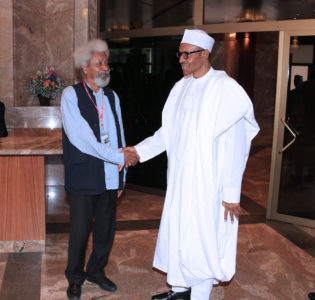
Nobel Laureate, Playwright, Poet, Author, Teacher and Political activist, Professor Akinwande Oluwole Soyinka; Wole Soyika for short, was on Thursday in Aso Rock where he had a private audience with President Muhammadu Buhari. Buhari sees him off after some minutes meeting. [myad]
We use cookies on our website to give you the most relevant experience by remembering your preferences and repeat visits. By clicking “Accept”, you consent to the use of ALL the cookies.
This website uses cookies to improve your experience while you navigate through the website. Out of these, the cookies that are categorized as necessary are stored on your browser as they are essential for the working of basic functionalities of the website. We also use third-party cookies that help us analyze and understand how you use this website. These cookies will be stored in your browser only with your consent. You also have the option to opt-out of these cookies. But opting out of some of these cookies may affect your browsing experience.
Necessary cookies are absolutely essential for the website to function properly. This category only includes cookies that ensures basic functionalities and security features of the website. These cookies do not store any personal information.
Any cookies that may not be particularly necessary for the website to function and is used specifically to collect user personal data via analytics, ads, other embedded contents are termed as non-necessary cookies. It is mandatory to procure user consent prior to running these cookies on your website.



 The United Nations Children Education Fund (UNICEF) has described the latest outbreak of wild polio in part of Borno state as a sobering news.
 Turkey Government is still hunting for supporters of the July failed coup attempt, with warrant of arrest issued on 648 court judges and arrest of 35,022 people.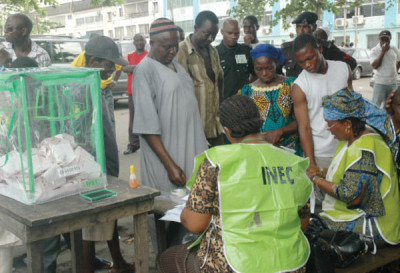



Lessons From The First Families, By Rufus Kayode Oteniya
Do you know Ann LePage? She’s the (third) wife of Paul LePage, the right-wing weirdo, out-of-control and ever controversial governor of Maine, a man with an inspiring story of growing up on the streets after running away from an abusive step-dad at the age of 11 and who in spite of all odds went on to college, became a company executive and then a governor.
As customary in the West, Paul took a sharp pay cut for transitioning from the private to public sector. According to the US Census data, the average yearly income for a married-couple family in Maine is about $87,000. As the lowest paid governor in the country, LePage gets a salary of $70,000, a figure that has remained unchanged in the state since 1987 which Paul unsuccessfully attempted to double for his successor, starting in 2019, after which his term would have ended.
Ann has dreams, goals and aspiration and like any woman with a knack for good taste, she has her eyes set on getting a new SUV – Toyota RAV4 which costs around $24,350, as one of her immediate dreams. Having given up her a job to wholly put herself behind her husband and knowing full well that Paul’s income – the family’s only – cannot support this dream, she knew she had to do something about it. Full-time job was not an option because of her Stately commitments. Candidly, $70,000 is too little for a governor in America, more so for a man with the need to support his five children – four biological from his two previous marriages and one adopted son, the son of his former caddy in Jamaica.
Many governors and even the US president would tell you that living in the State House doesn’t necessarily come cheap. Like in a luxury hotel, at the end of each month, the president or a governor receives bills for their food and incidental expenses. It can be really frustrating for some of them.
Nancy Reagan didn’t hide her surprise at this practice when an usher presented her first bill in 1981, saying, “Nobody ever told us the president and his wife are charged for every meal, as well as incidentals like dry cleaning, toothpaste, and other toiletries.”
Similarly, former first lady Laura Bush wrote in her post-White House memoir – “Spoken from the Heart” – that “the presidential room, as it were, is covered, but not the board……it is more than fair that they pay for personal items like every American household…..There were some costs that I was not prepared for……..I was amazed by the sheer number of designer clothes that I was expected to buy, like the women before me, to meet the expectations for a first lady.” Bush wrote that a bill came monthly, itemising everything she and her family owed, including food, dry cleaning and hourly wages for waiters and cleanup crews at private parties. Little wonder the Bushes often found it far cheaper to eat meals outside the White House.
Not everything is free for the First families. They even have to pay to take family members or friends who are outside the official delegation for any official trip.
What Did(n’t) Ann do?
Ann wanted the car badly but she couldn’t and wouldn’t go the easy ways that could be self-destructing. The easiest options are not necessarily the best! She wouldn’t coerce her husband to ‘goatify’ the state’s ‘yam’, a parlance for illicitly digging hands in public treasury by government officials in spite of her husband overseeing a $6.7b (N2.13 trillion) budget that is more than a third of Nigeria’s Federal government budget notwithstanding that Maine, a state with 1.33m population ended the 2015/16 financial year with $93 million (N29.6b) budget surplus.
Ann wouldn’t take kickbacks from state contractors and lobbyists who might want to curry her favour and she wouldn’t take gift from affluent friends who would be pleased to associate with the State’s first family.
Apart from the honour and glamour of office, politics can be financially rewarding as well but this usually happens after leaving office when opportunities like book deals, commercial endorsement, boardroom participation and public speeches abound. Public servants are usually forbidden to use their positions for financial gains while still in office because of conflict of interest.
Ann chose to go the honourable way. She laid down pride, took a part-time job as a waitress in a local restaurant by following in the footsteps of her stepdaughter as described here by Paul, her husband: “My daughter last year, she’s in law school, she made $28 an hour working in Boothbay as a waitress, server. She did so well, my wife, the first lady, to supplement the governor’s salarymen is waitressing this summer. I’m kidding — not kidding really” – Governor LePage
Ann LePage has proven that there’s dignity of labour, a philosophy that all types of jobs are to be respected equally. If you by any chance go to McSeagull’s restaurant in Boothbay Harbor this summer, there is a likelihood that the first lady will be your your waiter.
Also, last week, the internet was awash with the story of Sasha, the younger daughter of US President Barack Obama being spotted taking some time off from the comforts of the White House to work at Nancy’s, a seafood joint on Martha’s Vineyard at Cape Cod in Massachusetts where the family is currently having their summer vacation. Regardless of their positions, the Obamas teach their children the simple ways of life, hard work and the dignity of labour.
Last year elder daughter Malia also did a summer job at the set of HBO’s “Girls.” with Lena Dunham. She is currently taking a “gap year” off schooling most probably to do some voluntary work before attending Harvard University (like her parents, who both attended Harvard Law School) in 2017.
From these stories and for the benefit of all, I hope Nigerians, especially politicians can learn to always eschew corruption, live within their legitimate means and do the honourable, and also teach their children hard work and humility so that they can grow up to be useful members of the society.
Oteniy, a public affairs commentator can be reached on oteniyark@hotmail.com. [myad]