President Bola Tinubu who is the Commander-In-Chief of the Nigerian Armed Forces has commanded Defence Headquarters and the Chief of Defence Staff to act decisively in dealing with those involved in killing 16 soldiers, including officers on a peace keeping operation to Okuoma Community in Delta State. The President, who expressed grief over the unexpected killing of the officers, asked the military authorities to do justice to the perpetrators of the sad development. In a statement today, March 17, President Tinubu said: “On Saturday morning, the Nigerian people and I woke up to the dreadful news of the unprovoked killing of our brave military personnel during a rescue mission to Okuoma Community, Ughelli South Local Government Area of Delta State. “The incident occurred on Thursday 14 March, 2024 when our troops, responding to a crisis between Okuama and Okoloba communities in Delta State were ambushed. A Commanding Officer, two Majors, one Captain and twelve soldiers sadly lost their lives. One civilian was also killed. “As the Commander-in-Chief, I join all well-meaning Nigerians and the men and women of our armed forces to mourn and express my profound grief over the needless death of our gallant soldiers. “I extend my profound condolences to the families of these fallen soldiers, their colleagues and their loved ones. The military high command is already responding to this incident. The cowardly offenders responsible for this heinous crime will not go unpunished. “This incident, once again, demonstrates the dangers faced by our servicemen and women in the line of duty. I salute their heroism, courage and uncommon grit and patriotism. “As a nation, we must constantly remember and honour all those who have paid the ultimate price to keep our country safe, strong and united. “The officers and men who died in Okuama community have joined the pantheon of great men and women who gave their all, with honour, in the service of our fatherland. “Members of our armed forces are at the heart and the core of our nationhood. “Any attack on them is a direct attack on our nation. We will not accept this wicked act. “The Defence Headquarters and Chief of Defence Staff have been granted full authority to bring to justice anybody found to have been responsible for this unconscionable crime against the Nigerian people. “My government will not relent until we achieve peace and tranquillity in every part of Nigeria. “May God continue to bless the Federal Republic of Nigeria and keep the members of our armed forces safe.” Bola Ahmed Tinubu President & Commander-in-Chief of the Armed Forces of the Federal Republic of Nigeria. 17th March, 2024
“The government must take decisive measures to prevent such atrocities from recurring. The culprits, especially the youths involved, must be swiftly brought to justice. The traditional rulers overseeing this tragedy must face the consequences for their negligence.” This is the position canvassed by the Alumni of the National Institute for Policy and Strategic Studies (NIPSS), in a statement reacting to the killing of 16 military personnel in Delta State on March 14. NIPSS described the killing which was carried out by youths when the soldiers responded to a distress call over the clash between Okuama and Okoloba communities, as an “unforgivable affront to our nation’s values.” The statement by the NIPSS President, Emmanuel Okafor, demanded that the perpetrators, including the community leaders, must face the law. The statement read: “The Alumni Association of the National Institute vehemently condemns the spine-chilling assault on our brave troops of the 181 Amphibious Battalion, Bomadi LGA, Delta State. This is an unforgivable affront to our nation’s values, therefore our hearts bleed for the families of these fallen heroes and all Nigerians. “Consequently, this despicable act of barbarism must not be swept under the rug. We demand swift and decisive action from both the Federal and Delta State governments. The perpetrators, including the community leaders, must face the full force of the law. “No one who dares to spill the blood of our defenders and attack Nigeria should escape justice. The perpetrators must face swift justice, with no leniency shown to those who dare to spill the blood of our beloved soldiers for whatever reason.” The NIPSS alumni feared that the attack could discourage future peace efforts, urging the government to prevent a recurrence of the incident. “This cowardly attack not only dampens our spirits but also threatens future peace efforts as it strikes at the heart of our nation’s resolve for peace.” NIPSS is a policy formation centre for bureaucrats, private sector leaders, military officers and medium – rank and senior civil servants.
On March 14, 2024, a community launched a senseless assault on the troops of the 181 Amphibious Battalion of the Nigerian Army in Bomadi Local Government Area of Delta State.
This attack resulted in the tragic loss of Lt. Colonel Ali, two Majors, one Captain, and 12 soldiers who were committed to brokering peace between warring communities. Lt. Col. Abdullahi Hassan Ali, a valiant and results-driven officer, had a distinguished career marked by courage, focus, and unwavering dedication to his duty. From his early days with the 198 Special Forces Battalion to his leadership in successful operations in the Northeast and beyond, Lt. Col. Ali exemplified the qualities of a true military leader. His leadership was tested in challenging missions, such as the operation in the Timbuktu Triangle and the retaking of Dikwa and Marte from terrorists. With each operation, Lt. Col. Ali displayed extraordinary bravery and strategic acumen, leading his troops to victory while securing critical objectives. Beyond the counterinsurgency operations in the North East, Lt. Col. Ali demonstrated his valor in combating bandits and stabilizing troubled regions in Kaduna and Niger States. His unwavering commitment to his duty, his men, and the mission resulted in numerous successes against criminal elements threatening the peace and security of the region. Lt. Col. Abdullahi Hassan Ali’s legacy is one of bravery, professionalism, and unwavering dedication to serving his country. His meticulous attention to detail, commitment to the welfare of his officers and soldiers, and relentless pursuit of excellence set him apart as a true hero worth honoring. Lt. Col. Ali’s tragic end at the hands of those he swore to protect serves as a stark reminder of the sacrifices made by brave men and women in uniform. His story, along with that of his fallen comrades, resonates with the profound impact of their service and the ultimate price they paid in the line of duty. As we reflect on the life and service of Lt. Col. AH Ali and his brave comrades, let us remember their courage, selflessness, and unwavering commitment to defending their fellow countrymen. Their sacrifices shall not be forgotten, and their legacy will continue to inspire future generations of soldiers and leaders. In a world marked by uncertainties and dangers, it is the resilience and valor of individuals like Lt. Col. Ali that shine as beacons of hope and strength. May their memory be honored, their deeds celebrated, and their sacrifices remembered as a testament to the enduring spirit of service and sacrifice that defines the noble profession of arms.
The gallantry of Lt Col Abdullahi Hassan Ali
The story of the hard-fighting, ever-focused, result-oriented Lt Col Ali has not been told before now. An officer of great courage, focus and determination with an uncompromising disposition, Lt Col Ali’s article of faith as a leader of his troops is the encouragement to be courageous in operations and to ensure that successes are achieved while all assigned tasks are accomplished. Taken on the strength of 198 Special Forces Battalion on the 6th of October, 2020, Lt Col Ali is acclaimed for his commendable sense of responsibility in training, operation, administration and welfare of his troops. His success-oriented style of command has always been his guiding philosophy while leading his unit in various successful clearance operations in the Northeast and down to the North Central region where he has operated. On the very first day of January 2013, Lt Col Abdullahi Hassan Ali led his unit into the once notoriously impenetrable Timbuktu Triangle under the auspices of Op TURA TAKAI-BANGO. The mission was the total destruction of Boko Haram/ISWAP terrorists’ enclaves which included Gorgi, Kafa, Abagajiri, Dusula, Buk, Manguzum, Gorgore Forest, among others. The operation in which his unit was complemented by troops of 134 Special Force Battalion, 199 Special Force Battalion and 402 Special Force Brigade, saw the total obliteration of the targeted enclaves, killing of scores of the terrorists and capture of assorted weapons including Gun trucks, General Purpose Machine Guns, etc. In continuation of Op TURA TAKAI-BANGO, 402 Special Force Brigade was on 21 February, 2021, tasked to retake Dikwa and Marte from Boko Haram/ISWAP terrorists. In that operation, Ali exhibited extraordinary leadership, bravery and gallantry that ultimately led to the overwhelming success which saw the elimination of scores of the terrorists and capture of assorted weapons. Of course the ultimate mission of the operation which was the retaking of Marte was achieved. Less than two weeks later, precisely on the 6 March, his unit alongside the Brigade cleared Missense and Chukun Gudu of terrorist elements while capturing over 20 AK 47 rifles, gun trucks, FN rifles and so on. A few days later he proceeded with his troops to clear Krenoa, Chukun Gudu and environ. In furtherance of the Army’s offensive tactics, the 402 Special Forces Brigade was tasked on the 8 March 2021 to conduct clearance operations in Sambisa Forest. The indefatigable Ali was to yet again bring to bear his high sense of courage which he knew he needed to increase the morale of his advancing troops who were advancing to summarily destroy various BHTs/ISWAP enclaves. By the time the smoke of their superior firepower died down, enclaves such as Alafa 1 and 2, Njimia, Parisu, Somalia, Kuraba, Sabil Huda, Gobara and Dure, were cleared. Ali also showed heroic impacts in the other exploits which included the destruction of ISWAP fighters at Bulabulin and Alagarno in the general area of Damasak on 24 April 2021. The officer was also tasked to recapture Kanama from Boko Haram/ISWAP fighters and to reinstate the unit in conjunction with 402 Brigade and 199 Special Force Battalion. Lt Col AH Ali’s heroic exploits were not limited to the counterinsurgency operations in the north east. Having noted his exceptional bravery and brilliant command style, Ali was directed to conduct the movement of his troops to Kaduna and Niger States on 13 July 2021. The mission of the operation was to combat and clear some Bandit Camps and kidnappers’ hideout under the auspices of Op DOMINION STORM in 1 Division of Nigerian Army area of responsibility. The officer and his gallant troops conducted a clearance operation along Rijana and other Bandit camps, neutralizing several bandits in the process while a number of weapons including AK 47 rifles and 120 rustled cattle were recovered. This brings to mind, the intricate tapestry of life, with its twists and turns, highs and lows, moments of joy and sorrow, and contrasts between humility and arrogance, which lead our paths to either sweet or bitter ends. Life, as described in the Holy Book, is fleeting. Fashioned from clay, we shall all return to dust, leaving behind only memories of the moments, good or bad, that we crafted in our time on earth. In this fleeting existence, where we chase power, wealth, and ego-driven pursuits, there is one universal truth that binds us all – death. It comes spontaneously, without regard for status or position – a sobering reminder of our mortality. Nigerians, and indeed the world, are familiar with the harrowing tales of attacks on Nigerian troops by Boko Haram/ISWAP terrorists in the northeast. However, the story of an attack on Nigerian troops by the very community they were deployed to protect is a rare and tragic occurrence. Zagazola @ZagazOlaMakama
Residents of Okuama community in Ughelli South Local Government Area of Delta State are said to have deserted the community after the youths killed 26 soldiers, some of who are highranking. The residents, whose houses were completely razed down by fire yesterday, migrated to neighboring Ughelli for fear of a reprisal by the soldiers who have been patrolling the creeks. There are allegations that some angry soldiers may have perpetrated the act razing the community with fire after their colleagues were killed. This is even as the manhunt for the killers of the soldiers, a commanding officer, two majors, one captain and 12 soldiers, is still ongoing and some arrests have also been made by the soldiers, led by the General Officer Commanding 6 division Nigerian Army, Major General Jamal Abdussalam. Fourteen lifeless bodies of killed soldiers were in the early hours of yesterday , March 16, recovered by soldiers of the joint task force under the supervision of the General Officer Commanding 6 division Nigerian Army, Major General Jamal Abdussalam, at Okuama community, in the Ughelli South Local Government Area of Delta State. Some of the recovered corpses were said to have been beheaded, while the stomachs and hearts of others were ripped off. At the NDDC jetty in the coastal Delta community, the bodies of the commanding officer and the two killed majors were seen floating by the river bank as others were separated on land. The Chief of Defence Staff, Christopher Musa, has ordered a probe into the tragic killing of four senior officers and 12 soldiers. It was gathered that the slain military personnel responded to a distress call after the communal crisis between the Okuama and Okoloba communities, both in Delta State, before they were killed on Thursday, March 14. Confirming the incident in a statement on Saturday, the Acting Director of Defence Information, Brigadier General Tukur Gusau, said the victims were surrounded by some community youths when troops of the 181 Amphibious Battalion were on a peace mission in the Bomadi Local Government Area of the state. “The unfortunate incident occurred when the troops responded to a distress call after the communal crisis between the Okuama and Okoloba communities both in Delta State.” “The reinforcement team led by the commanding officer was also attacked, leading to the deaths of the commanding officer, two majors, one captain, and 12 soldiers.” The defence spokesman said that the incident has been reported to the Delta State Government, adding that the CDS has also directed that the culprits be unmasked. According to him, some suspects have been arrested in connection with the incident. He reiterated the commitment of the military to its mandate of maintaining peace and security in various parts of the country. “The Chief of Defence Staff ( CDS), General Christopher Gwabin Musa, has directed the immediate investigation and arrest of those involved in the heinous crime. The occurrence has been reported to the Delta State Government. “However, the military remains focused and committed to its mandate of maintaining peace and security in the country. So far, a few arrests have been made while steps in place to unravel the motive behind the attack.” Source: Channels Television.
Two students of the Ahmadu Bello University (ABU), Zaria in Kaduna State, Ahmad Abdullahi and Adam Isa Adam, have emerged overall global winner in the Artificial Intelligence (AI) competition, with focus on computer engineering, in far away China. While Ahmad Abdullahi hails from Babura local government area, Adam Isa hails from Roni local government area, and are currently level five Computer Engineering students of ABU, Zaria. Here, Governor Umar Namadi of Jigawa State, receives the winners with handshake. The world competition was organised by the Huawei ICT Innovation Competition in China. The winners were part of a 3-member team who represented Nigeria and emerged the overall global winner in the Artificial Intelligence (AI) Competition, with focus on machine learning. Ahmad Abdullahi, in particular, made three exceptional inventions: built a floods detection robot, a cancer detection machine as well a guiding goggle that can guide a blind person navigate the road as well as convert text into spoken words.
The board overseeing Immigration, Correctional, NSCDC, and Fire Service recruitment has clarified that recruitment is only ongoing for the Federal Fire Service (FFS).
In a statement today, March 16, the Secretary of the Board, Mr. Ja’afaru Ahmed, refuted rumors circulating on social media regarding recruitment into immigration, NSCDC, or Correctional services.
Ahmed assured FFS applicants of timely notification via provided phone numbers and email addresses. The board emphasized that online publications about recruitment in their services are false and cautioned the public against fake recruitment schemes.
President Bola Tinubu has given a strong indication that his government is still battling with beneficiaries of the fuel subsidy which he removed on assumption of office in May last year.
He said: “all those who falsified records and became losers with the subsidy (on petroleum products) removal, they will fight back.
“As we are fighting corruption, smugglers, and old subsidy beneficiaries, they most certainly will fight back.
“But we will defend our people. The treasury belongs to the people, and that sacred trust must not be abused.”
President Tinubu, who spoke at a meeting with the Forum of State Chairmen of the All Progressives’ Congress (APC) at the State House in Abuja on Friday, gave assurance that he is “working hard, day and night, even though some agents of destabilization are present in the polity. “Nigerians, with our focused support, shall defeat them.”
He said that his government would continue to touch on areas with significant impact on the welfare of Nigerians, assuring that his government is working hard to improve their living conditions.
He asked leaders at the grassroots level to encourage citizens to get their National Identification Number (NIN) for planning, structuring interventions and to achieve their full integration into various relief programmes.
“The programme of our government will be truly progressive; student loans, a national consumer credit system, and social welfare for the unemployed, as well as graduates. Every Nigerian will find a place of belonging in our country. In the eye of even the biggest hurricane, we will find that place of tranquility and prosperous harmony for the benefit of all. Nigerians will all partake on this national journey to prosperity.”
President Tinubu told state party chairmen, led by the National Chairman of the APC, Dr. Abdullahi Ganduje, that his government has already drawn up a blueprint for large-scale livestock farming, which will be activated soon.
“We are bringing mechanized farming to the fore. Yesterday’s crisis will become today’s opportunity. Fertilizers are being supplied to farmers as we speak. Agriculture and economic diversification provide the answers to our problems. We will not continue to import food. “We know how to turn lack into abundance, and the world will watch us do it again.”
President Tinubu said that the repositioning of the economy is a top national priority as he urged party members not to wait for an appointment before bringing good governance and exemplary civic engagement to the doors of Nigerians.
“I urge the state chairmen that regardless of party affiliation, let us help citizens by mobilizing them for NIN registration. Not just PVCs. Some are poor Nigerians who have not experienced formal education and have no understanding of what NIN is and how it will benefit their lives. We must teach them. We must care for them.
“Without NIN, we cannot embark on social security interventions for the vulnerable. We will be making faulty moves without accurate data and iron-clad, digital intervention structures.
“I have established a committee of governors, and it is headed by the Vice President, Senator Kashim Shettima. It is working on what must be done to further lift our people.
“We need to give hope, and we are giving it to the country and our citizens.
APC National Chairman, Dr. Abdullahi Ganduje said that the party is nearly set to establish the Progressive Institute of Policy and Development for the benefit of its members and Nigerian public.
The Nigerian military authorities have confirmed the loss of one commanding officer, two majors, one captain and 12 soldiers to Delta State community youths.
In a statement today, March 16, the acting Director in the Defence Information, Brigadier General Tukur Gusau narrated that the soldiers had gone on peace mission to OkUOMA community in BOMADI Local Government Area of Delta State.
He said that some community youths surrounded the troops of
181 Amphibious Batallion on Thursday, 14 March, when the troops responded to a distress call after the communal crisis between the Okuama and Okoloba communities both in Delta State.
“The reinforcement team, led by the Commanding officer, was also attacked, leading to the death of the Commanding officer, two Majors, one Captain and 12 Soldiers.
“So far, a few arrests have been made while steps is in place to unravel the motive behind the attack.”
Tukur Gusau said that the Chief of Defence Staff ( CDS), General Christopher Gwabin Musa has directed the immediate investigation and arrest of those involved in the heinous crime.
“The occurrence has been reported to the Delta State Govt.
“However, the military remains focused and committed to its mandate of maintaining peace and security in the country.”
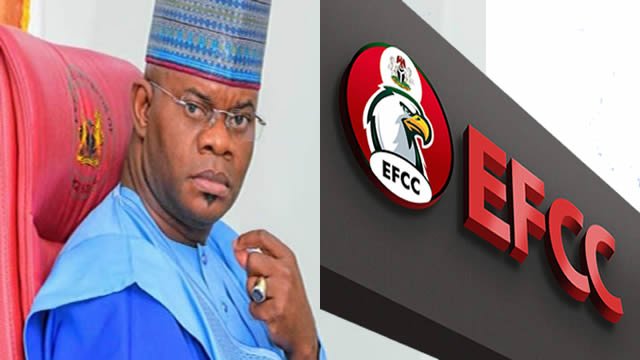
The Kogi State Government has issued a stern call to the Economic and Financial Crimes Commission (EFCC), urging it to cease what it perceives as a targeted campaign against the state’s immediate past Governor, Alhaji Yahaya Bello.
In a statement today, March 15, the Commissioner for Information and Communications, Kingsley Fanwo, said that the state government vehemently rejected what it described as the EFCC’s attempts to falsely accuse Kogi State of misappropriating funds.
The statement emphasized the state government’s commitment to anti-corruption efforts inherited from the previous administration and highlighted various measures taken to combat corruption effectively.
It condemned what it deemed as unfounded allegations and politicized charges orchestrated to tarnish the reputation of the former Governor and his administration.
The government called for transparency, accountability, and adherence to the rule of law. The statement further underscored the state government’s belief in transparent governance and its commitment to preserving the integrity of its administration.
It urged President Bola Ahmed Tinubu to investigate the situation in Kogi State before the EFCC is influenced by political interests aiming to discredit Alhaji Yahaya Bello and the state. Emphasizing the importance of a fair and lawful approach to the anti-corruption crusade, the government expressed confidence in the judiciary to uphold justice and protect the state’s name.
The Chief of Defence Staff, General Christopher Musa has urged the Economic and Financial Crimes Commission, EFCC to go after those financing terrorism activities in the country.
The Defence Chief, made this plea to the anti-graft agency at Defence Headquarters today, March 15, while playing host to the EFCC Chairman, Ola Olukoyede. He emphasized the importance of tracking terrorism funding as non-kinetic approach to combating terrorism, aligning with the military’s existing efforts. Acknowledging EFCC’s role, Musa praised their innovative use of technology in fighting corruption and economic crimes. He urged EFCC to collaborate with stakeholders to uphold good governance and security Olukoyede reiterated the necessity of collective effort, emphasizing that corruption has severely impacted Nigeria’s economy and tarnished its reputation.
He stressed the urgency of decisive action to prevent further deterioration, stating that the nation’s future is at stake. Recognizing the pivotal role of the military and other security agencies, Olukoyede underscored the importance of joint efforts in combating corruption effectively. He emphasized the need for a unified approach, urging all stakeholders to prioritize the fight against corruption as a national imperative.
We use cookies on our website to give you the most relevant experience by remembering your preferences and repeat visits. By clicking “Accept”, you consent to the use of ALL the cookies.
This website uses cookies to improve your experience while you navigate through the website. Out of these, the cookies that are categorized as necessary are stored on your browser as they are essential for the working of basic functionalities of the website. We also use third-party cookies that help us analyze and understand how you use this website. These cookies will be stored in your browser only with your consent. You also have the option to opt-out of these cookies. But opting out of some of these cookies may affect your browsing experience.
Necessary cookies are absolutely essential for the website to function properly. This category only includes cookies that ensures basic functionalities and security features of the website. These cookies do not store any personal information.
Any cookies that may not be particularly necessary for the website to function and is used specifically to collect user personal data via analytics, ads, other embedded contents are termed as non-necessary cookies. It is mandatory to procure user consent prior to running these cookies on your website.



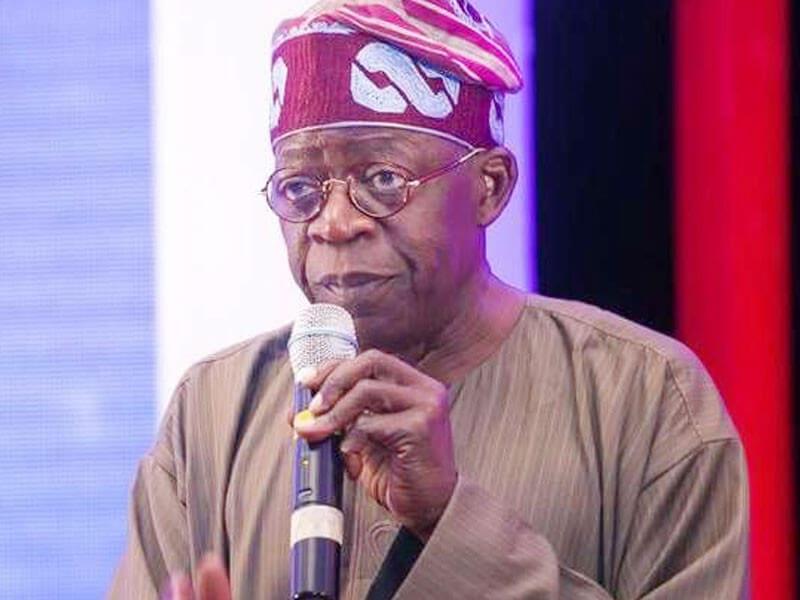


 The Nigerian military authorities have confirmed the loss of one commanding officer, two majors, one captain and 12 soldiers to Delta State community youths.