The General Overseer of The Lord’s Chosen Charismatic Revival Movement, Pastor Lazarus Muoka, has said that the Church does not need monetary contributions as offerings and tithes from cultists, armed robbers, women on trousers, prostitutes and kidnappers.
The Cleric who spoke at the headquarters of the church at Ijesha, Lagos state during a two-day crusade programme over the weekend, said God is not interested in ill-gotten wealth and riches.
“If you are here and you are an armed robber, a kidnapper, cultist, adulterer, among others and you don’t want to repent, please we urge you not to give offering, tithe or pledge because we are here to lead people to Christ and not money.
“The God who called us is always with us and we know that God will supply all our needs including money to finance the church.
“We may not know you but God knows you and will judge you if you go against his will,” the Cleric said. [myad]
No fewer than 100 suspected looters have been arrested by security agents during fire outbreak which gutted the famous Sabon Gari Market in Kano on Saturday. The state Commissioner of Police, Muhammad Katsina told Governor Abdullahi Ganduje who visited the market yesterday that the suspects were apprehended by security personnel deployed to the market to ensure security of lives and property following the fire outbreak. Muhammad Katsina said that the suspects were arrested in different locations of the market while trying to escape with their loots. He said the suspects would be charged to court as soon as investigation was completed. “The suspects are presently in our custody and as soon as investigation is concluded, they will be charged to court,” Katsina said. In his remarks, the governor said the state government had taken measures aimed at preventing future occurrence. Ganduje commiserated with the victims of the disaster and commended security personnel for ensuring adequate security during the incident. He also thanked various private companies who supported the state Fire Service in putting out the inferno.
Meanwhile the National Emergency Management Agency (NEMA) has announced that at least 3,800 shops were destroyed by Saturday’s fire incident at the Sabon Gari Market, Kano. Its Director-General, Alhaji Muhammad Sani-Sidi, told newsmen at the scene of the incident in Kano that the interim assessment of the situation indicated that more than 90 per cent of the market had been destroyed by the fire. Sani-Didi said: |It is unfortunate that from the record more than 90 per cent of the market has been burnt. “Base on the report, more than 3, 800 shops and quite a number of buildings were razed by the inferno.” The director-general explained that no fewer than 15 persons sustained various degrees of injury during the incident. Sani-Sidi, however, said the injured were already receiving treatment at the hospital. He said the agency was working closely with the state government to ensure that the victims received proper treatment at the hospital. “Assessment is still ongoing and the state government has mobilised over 100 trucks to clear the rubble,” Sani-Sidi said. He said that lack of access roads made it slightly difficult for fire fighting vehicles to have easy access to the market, while the fire was raging. “The incident was unprecedented and overwhelming and can negatively affect the economy of the country,” he said. [myad]
In writing this piece, I tried to search online the character of the people you can genuinely call the Change Agents and ways of the change Agents or what makes them what they are. I found out that a Change Agent has a clear vision, he is patient and yet persistent, he asks tough questions, he is knowledgeable and leads by example and he maintains strong relationships built on trust. My findings say a Change Agent lives in future, not the present. Regardless of what is going on today, a change Agent has a vision of what could or should be done and uses that as the governing sense of action. To a large extent, change agents are dissatisfied with what they see around them, in favour of a much better vision of the future. Without drive, change agents can lose their way. A change agent is fueled by passion and inspires passion in others. Change is hard work. It takes a lot of energy. A change agent has a strong ability to self-motivate. There will be many days when every one around does not understand and will not offer props. The change agents need to find it within themselves to get up everyday and come to work and risk being misunderstood and misappreciated, knowing that the real validation may be far in the future and may be claimed by someone else. A change agent must understand people. At the end of the day change is all about people. If you change everything but the people, I doubt you will be effective as a change agent. A change agent has the ability to continue striving toward high and challenging objectives regardless of the circumstances. He has the ability to convince and persuade others about the vision. He can touch minds and hearts and influence without authority. What about the ability to connect the dots? Can you determine what really matters and put together a vision that makes sense, one that others can follow? Can you keep your feet on the ground and see possibilities at same time? Now enter Asiwaju Bola Ahmed Tinubu who is one of the greatest Change Agents in Nigeria today, the builder and the motivator of men. To document Asiwaju Bola Ahmed Tinubu’s exploits as Change Agent since the 90s will take more than a three thousand page book on a conservative estimate. His deep involvement in the struggle for the de-annulment of June 12 1993 Presidential election won by the late Chief Moshood Abiola earned him a place of honor as a hero of democracy in my Book, Heroes of Democracy published in 1999. In 1999 Asiwaju BAT became the Executive Governor of Lagos State and in eight years this Avatar, this game changer, and great scholar in the finest tradition laid a solid foundation that has led Lagos to become the fastest growing city in Africa whose economy is bigger than those of Cameroun, Ghana, Cote de Voire, Senegal etc. When this icon set up a 40man Committee in 1999 to fashion out a template for Lagos State development, many did not know what was on his mind but today we know better, as Lagos has become a huge melting point in the face of Nigerian dwindling opportunities. In 2003, only one State, Lagos was left for the Progressives in Nigeria after the PDP finished its boisterous rigging in that year’s election. But with dint of hard work and power of constructive engagement, Asiwaju led his large army of bridge builders to move from AD to AC, AC to ACN and ACN to APC. Today APC is in control of the Federal Government and 22 States of Nigeria. Time and space will not permit me to dig into the preparations, the all nights of engagements, building extensive networks, making tremendous sacrifices, giving up positions, setting aside political differences, building alliances, committing both human and material resources, setting aside primordial sentiments and ethnic preoccupation that led to the uprooting of the octopus and behemoth called PDP. Asiwaju BAT’s infinite capacity to lift great number of men and women across this country irrespective of tribe or tongue has made this man a giant in Nigeria. He sacrificed his personal comfort, family comfort and the comfort of his extended family members by throwing his gates open to all and sundry, the rich and the poor at any given time without discrimination. Asiwaju’s impeccable character to forgive his adversaries and political enemies has put him thousands of miles ahead of his rivals. If anybody had told me that Asiwaju BAT will find a place in his heart to forgive some newspaper houses, AIT and others who preached hate (if you have an idea of what they did) in the course of 2015 elections I would not have believed it. Only Asiwaju Bola Ahmed Tinubu can show this kind of magnanimity and forgiveness. A friend, Barrister Sadiq a chieftain of APC Lagos told me that this is the reason why he will live long. Asiwaju tried in 2011 with other like minds to build an alliance to dislodge PDP but it suffered a great set back. PDP survived. In 2014 the bubble burst for PDP. How the Jagaban of Borgu managed to deploy his deep connection and extensive huge network to work with like minds across Nigeria to form APC will remain a case study for political science departments in Nigeria. Like I said earlier, the story of Asiwaju BAT remains a powerful testimony of a great bridge builder, giver, organizer, mobilizer, facilitator, motivator, actor, mediator, peace maker, and change agent. In doing his service for humanity, the Asiwaju of Africa, Jagaban Borgu and Omenife Awka has made many friends and have also attracted many enemies. While genuine friends celebrate their hero and pray to God to keep the man that has added values to their life the enemies look for ways to tear down the colossus. They hang every negative thing on his shoulder. They blame him for bad weather, they blame him for political and economic setbacks. They blame him for every problem under the sun. Asiwaju’s meteoric political success has bred mortal enemies and petty jealousies, envies and deep seated fear amongst the political liliputs and minions who kiss the dust in the midst of his many political victories. Today, Asiwaju is perhaps the most feared and dreaded political leader in the country. His enemies are consumed by petty envy at his giant political strides but their fear-induced pettiness has neither bothered nor held back Asiwaju. For those haters Asiwaju BAT has these words for them: “I set my goals and objectives in accordance with my vision. I study them and strategically execute them. My detractors discuss my successes and failure becausethey have nothing to execute. I am in the news more because I’m working, Nigerians discuss active men in the field. Mentioning any negative news about me will double the wealth of any news media that published it. My name today is a financial market for journalist. Not even elected politicians get the publicity I am enjoying. My comrades , go and work till mentioning your name becomes a source of increased wealth for someone. Even my weakness create wealth for vendors” —I REMAIN, ASIWAJU BOLA TINUBU–
Kogi State experienced the strangest thing that ever happened in the Nigeria political landscape. It becomes the talk of the scholars and inquisition of the wise. The highest novelty to the political gladiators in the political quest. By this singular happening, the darkest form of political conspiracy of all times was brought to the fore and to the consternation of the sane. The end result of the heinousness of the political rascality and gangsterism in Kogi State are best explained by the sordid state the State finds itself. The political gangsters succeeded in violently raping the State and left it gasping for life. Before now, thugery and all kinds of political vices are the fastest means of making a “good” living. This is the more reason, the present administration is facing the crudest attacks of all time. Kogi State has never experienced relieve than now. Once upon a time, disappointment, regrets and betrayal were the order of the day. The gospel truth is, a glitter of hope is permeating the body polity of Kogi State under the leadership of Governor Yahaya Bello. But, curiously, some people have suddenly found their calling in the ministry of critics. It is alright to be a critic and to criticize when things are going amiss but most people parading themselves as critics so far, are nothing but political rabble-rousers who are only coherent in spewing out hate speech and raw stupidity. The saddest thing of all is to see a youth squandering his youthfulness in ugly enterprise of political gangsterism. One wonder, if some of them are victims of dysfunctional upbringing. To see a youth attacking the sensitivity of the people he polarized in the fault line of tribe, political affiliation and region is to encounter a young fellow dealing with early personal crisis. A case of unfortunate “visitation from the gods.” The nay sayers have tried by all means to turn Kogi State to a “theater of absurdity” and hotbed of political rigmarole. But, let it be of interest to all that, politics in Kogi State is receiving a healthy fresh blood. The nascent political dimension in Kogi State is a plus to the Nation and the leadership of Governor Yahaya Bello is birthing the best form of political engagement and resuscitating the economy. At the end of the day, the devil’s advocates shall be silenced and the chosen of God shall fulfill his divine mission.
Barr. Omeiza Shadrach, E. is the PRO l for the Fairwin and can be reached on0 8032465324. [myad]
The Niger State Governor, Alhaji Abubakar Sani Bello, has requested the civil servants and heads of Ministries, Departments and Agencies (MDA) to join him in manifesting a new Niger State of his dream or simply check out before it is too late.
The governor said: “We want to see a new Niger State where all Nigerlites can access qualitative and affordable basic amenities such as education, health, good roads and security and I strongly believe that with determination and commitment of all of you here today, we shall not only deliver on our promises but take the state to higher height.” The governor who spoke at a closed door meeting with all Executive Council members, Permanent Secretaries and heads of parastatals, emphasized: “We promised our people change and we cannot continue to operate like before if this change must be made real. We promised the people based on the mandate given to us to positively affect their lives and we have no excuse not to deliver.”
Sani Bello expressed deep concern over the lackadaisical attitude of some government officials to work and called for attitudinal change on the part of the state work force, adding that leaders of the MDAs, which is the platform for service delivery in the state, must be productive and brace up to enable effective implementation of government policies that are designed to bring positive change to the state. He reaffirmed his decision for strict adherence to due process in the execution of government projects and warned public officers in the state not to hide under this to hamper or delay projects. He urged them to always follow up on their presentations and submissions in order to ensure logical and speedy conclusion of government programmes and projects. “Despite our dwindling resources, government cannot afford to slow down. We must improve our pace. We must be ready to do our work with caution and within the time frame. “I don’t want to run a government that is just talking but that is about service delivery. I want our work to speak for us and let Almighty Allah judge us. “Whatever we decide to do, it must be in the interest of the people.” The meeting had all commissioners, the Secretary to the State government, Head of Service, Chief of Staff, Permanent Secretaries and heads of government agencies in attendance. [myad]
Governor Mohammed Abdullahi Abubakar has signed into law, the 2016 appropriation bill of over 135 billion naira. Tagged “The Budget of Revival” has been formulated in line with the manifesto of the All Progressives Congress (APC) to make life easy for the common man as promised during campaign. The 135, 303, 100, 010 budget in the 2016 fiscal year, has capital expenditure of N70, 407, 990, 843 and recurrent expenditure od N64, 895, 109, 167. The Governor assured of judicious implementation of the budget in accordance with the re-branding programme of his administration in clear departure from the culture of the past. Governor Mohammed Abubakar thanked the Legislature for the speedy passage of the bill into law, adding that such action further confirms the Assembly’s concern for the plights of the people and the determination of the law makers to support the executive to improve the life of the common man. The appropriation bill, which is the first by the administration of Governor Mohammed Abubakar was presented to the Bauchi State House of Assembly early in the year and was just passed into law last week. [myad]
Senior Special Assistant to the President of Media and Publicity, Malam Garba Shehu, has said that when his boss came to power on May 29 last year, his intention was not to sack any of the civil servants he inherited from his predecessors.
He said that the president believed that all the civil servants should amend themselves to the change mantra, but regretted that a lot of them simply would not want to accept change.
Garba Shehu who spoke to newsmen at the Presidential Villa, Abuja today was specific about the National Orientation Agency (NOA), which he said had remained unconcerned about its main role of enlightening Nigerians on the activities of the government.
“We have an agency like NOA with 773 offices nationwide, each has not less than 5-7 staff, well equipped but you know also, sometimes democracy has its own dark side.
“The President came and he wanted to really be fair to every Chief Executive if he wanted to fire people on assumption he would have done it and he would not have violated any rule, but he decided to give everyone a chance to see whether they would imbibe the change mantra, or they prepared to come along.
“I will say with all sincerity that I know that the NOA had worried us in government, the people and the leadership never believe in what we are doing, they never believe in change, they just fold their arms and watch us from all this period 8-9 months when they are there, I believe the new leadership would begin to formulate things for agencies like that.”
Garba Shehu revealed that Buhari government would soon embark on what he called direct conversations with Nigerians through town hall meetings nationwide.
“I know that there is a plan that Professor Osinbajo the Vice President would start town hall meetings in zones and then it would be broken down to the state and so on. The government realizes that there is a need to take information to the people and there are steps that are been taken in order to ensure that is done.” [myad]
Minister of the Federal Capital Territory (FCT), Malam Muhammad Musa Bello has directed police to arrest on sight anybody trying to cause political trouble ahead of the re-scheduled April 9 Area Council elections.
The directive is coming on the heels of the recent political violence in Gwagwalada Area Council, which the minister condemned in strong term. The violence occurred yesterday morning during a political rally.
The Minister warned that security breach in whatever manner is not acceptable in the FCT, even as he made it clear that politics need not be taken as a do or die affair.
Musa Bello said that political violence has no place in the history of the capital city, adding that he had already directed that all perpetrators be arrested and brought to book.
The Minister asked the political gladiators not test the will power of the government, assuring that his government would not condone this barbaric behavior from any body however highly placed in the society.
“The Security Agents must fish out perpetrators of this violent attack and be made to face the full wrath of the law because nobody is above the law.”
Musa Bello assured the residents of the FCT that the security agencies are on top of the situation and therefore advised them to go about their lawful businesses.
It was reported that in Dobi village, Gwagwalada Area Council, supporters of the current Chairman of the Gwagwalada Area Council and that of his political god father, all belonging to the All Progressives Congress (APC) had a violent clash leading to the death of one Haruna Adamu. [myad]
A 12 year old girl, called simply as Queen, has narrated to Operation Rescue (OPER), a human rights group, led by Princess Elizabeth Egbe, how her father, Mr. Bamekpa impregnated her after several sexual escapades and caused the four-month pregnancy to be aborted.
Queen;s father, a native of Imiringi in Ogbia Local Government Area of Bayelsa State, allegedly started to defile her at the age of 11. He was alleged to have serially raped and eventually impregnated her and then he forced her to abort the through a crude process that currently threatens her life.
Queen told the human rights group that she ran away from the house when she could no longer bear her father’s devilish craving, adding: “there was nobody to help me. He kept doing it despite my efforts to stop him. It was a painful and violent experience. I ran away from home because there was a time I bled so much from my private part.”
Queen continued in sob: “when I became pregnant and he heard about it, he handed me over to a lady who took me through an unsuccessful process of abortion. I have been suffering series of health issues after the abortion.”
Queen’s uncle, David Apigi, confirmed her story which he said shocked him, saying: “my niece told me the trauma she has been passing through in father’s house and how her father has been using her, turning her to his second wife.
“She said he had sex with her to the extent that he aborted her four-month-old pregnancy. She ran to me and begged me not to allow her to return to her father’s house because she was tired. I decided to accommodate her. The father started looking for her without knowing she was with me.”
He said that he reported the matter to the Kolo Police Station but asked them to hold on to enable him make some investigations, adding that after his investigations, he called his cousin, Rex Ogboku, in Abuja who reported the matter to the Federation of Women Lawyers (FIDA).
But FIDA was sluggish in the way it handled the matter, Apigi noted, saying: “my cousin, Rex Ogboku, in Abuja called FIDA to inform them about the situation. But the way FIDA was going about the issue was too sluggish for my liking. I decided to contact the Operation Rescue.
“We went back to the police and the Otuasiga Police Station arrested the man. The process through which the Otuasiga Police Station was handling the case was not satisfactory. “Imagine a situation where somebody was arrested and while in detention he was still having access to his phone, making calls. He even called me. He called my uncle, trying to plead with him for settlement. I moved the case to Kolo Police Station.”
He said his niece’s father was notorious for sexual perversion, alleging also that he had slept with his biological sisters and that the suspect repeatedly had carnal knowledge of his cousin’s daughter and forced her to commit abortion five times. He said some of his victims were ready to testify against him.
Egbe also lamented the condition of the girl and called on the society to protect the girl-child. “Our investigations showed that the little girl had been perpetually raped by her father who impregnated her and forced her through abortion that has left her with so many health problems. “When the girl was pregnant, she did not know. Her stepmother discovered she was pregnant and informed the father. The father handed her over to a lady who took her to a quack doctor for an abortion.
“After the abortion, the girl came back home and discovered she was bleeding from her private part. The father took her to that same lady who then took her to other places. The girl is still in pains and highly traumatized. She has been going through series of medical treatments.
“We want the police to really investigate this matter and get to the root of the case. We want the doctor to be arrested, and we want everybody that is involved to be arrested and prosecuted to serve as deterrent to other people who are involved in this act of perpetual evil against the girl-child. The girl-child is tender and has a lot to contribute to nation-building.”
Our neighbours to the West, the Republic of Benin, have just concluded a Presidential election, which has been considered free, fair and peaceful, from the first round, to the run-off which produced businessman Patrice Talon as winner and next President of that country of about 10 million people. Commentators have noted with delight the manner in which incumbent Prime Minister and Talon’s main challenger, Lionel Zinsou, graciously admitted defeat even before the release of final, official results, and congratulated the winner. Zinsou has been compared to former Nigerian President, Goodluck Jonathan. In a continent threatened by a renewed appetite for sit-tightism by its leaders, it is exciting that some politicians are setting good examples. In the last one year, we have had the example of Jonathan in Nigeria. And now Zinsou, in the Republic of Benin. We hope that there will be more of their kind.
For, indeed, Africa has been raising some anxiety about the prospects of democratic consolidation. In Burkina Faso, the President had to be chased away after 27 years of corrupt and ineffective leadership. In Congo Brazaville, which held its election the other Sunday, President Dennis Sassou Nguesso is sitting tight. The February 2016 election in Uganda saw Yoweri Museveni’s forces brutalizing the main opposition leader, Kizza Besigye. Two women politicians were also stripped naked and publicly humiliated for daring to decamp from the ruling National Resistance Movement (NRM) to Besigye’s Forum for Democratic Change (FDC). In Rwanda, President Paul Kagame had to change the Constitution so he can have a third term in 2017.
In Burundi, the incumbent President Pierre Nkurunziza waged a similar war against the people, leaving over 400 dead, and he remains in office by force. In Equitorial Guinea, Gambia, Cameroon and Zimbabwe, the maximum rulers in power are determined to die in office. The people of the Republic of Benin deserve to be congratulated for further raising our hopes about the power of the people and the prospects of democracy in Africa. They were the true winners. But for me, the hero is the incumbent President, Thomas Boni Yayi. When he steps down on April 6, and hands over power after completing two terms as President, he will be greatly missed by his fans and perhaps derided almost to the same degree by those who have accused him of running a government that promoted cronyism, corruption, clientelism, media repression and official opaqueness. But my bet is on him being well-remembered in the long run, for his services to his nation, the sub-region and the continent. He also did not try to change the constitution or manipulate the process.
Patrice Talon, Yayi’s arch-enemy, who did not pull punches during the campaigns has accused Boni Yayi of creating a “banana Republic” which has become “the laughing stock of the world.” Talon is wrong; he is guilty of that newly discovered disease called Trumpism, named after the first host of the virus: a certain fellow currently seeking to be President of the United States called Donald Trump. Elected President in 2006, Boni Yayi was again re-elected in 2011, and although he faced much opposition, including assassination attempts, he has managed to survive the various intrigues that dogged his Presidency. He has also successfully organized elections and ensured a smooth succession.
Zinsou is a member of the ruling party but there was no evidence that his party or the incumbent President tried to subvert the people’s will, despite Yayi’s undisguised support for him. Domestically, President Yayi may not have fulfilled all the promises he made to the people in 2006 and 2011, but he is leaving behind a country that is much better today than he met it. The Republic of Benin used to be a communist enclave, which has gone through many transitions, from communist dictatorship to a Presidential multi-party system. Under Yayi’s watch, the country’s profile rose. Benin is far from being a banana republic. Yayi gave his country a new bounce, a stronger voice and presence within the international community, and greater stability within its borders.
President Boni Yayi is also Nigeria’s very good friend. Nigeria’s relationship with her Francophone neighbours is a major plank of her foreign policy process. The closeness of those Francophone countries to France and the dominant influence of France in their affairs has always been part of the sub-text of our interaction within the sub-region. Benin is particularly strategic: close to half of its population boasts of historical and cultural connections with Nigeria, making the geographical boundaries, largely artificial. Long before Boni Yayi became President, the relationship with Benin Republic was not always smooth. The trigger areas included ideological differences at the time Benin was a communist enclave under Mathieu Kerekou. During the civil war also, there were allegations that Benin provided a support base for the defunct Republic of Biafra.
Nigeria is Benin Republic’s main export market. But it is also the biggest smuggling route into Nigeria. With the Lagos port not functioning efficiently, and our customs tariffs so high, Nigerian businessmen found solace in the Cotonou port, creating a revenue crisis for Africa’s largest economy, and informal trade link that has not been properly measured. Anything that could be smuggled into Nigeria went through the Cotonou port. It still happens. Across the land border between the two countries, the Beninoise gendarmes constituted themselves into a threat to Nigerian communities. They still pose a threat, but just occasionally now. Due to the factor of proximity, Nigeria’s biggest challenge with its immediate neighbours has always been one of security. Criminals have turned trans-border organized crime into a major source of economic leakage and basic insecurity. There was the case of one Hamani Tijani based in Benin Republic who operated across the border. Nigerian criminals also commit atrocities inside the country and they slip into neighbouring Benin. The borders between both countries have been porous forever.
There are many Nigerians living in Benin Republic and vice versa due to linguistic and cultural affinity. But whereas in Nigeria, we accommodate our neighbours living among us, Nigerians living in Benin Republic have not always had it easy. In one instance, Nigerians in Benin were repatriated in their thousands. What has been demonstrated is that Benin Republic’s closeness to and seeming dependence on Nigeria could pose a threat to Nigeria’s security. For example, petrol smuggled from Nigeria finds a ready market in Benin Republic. In 2003, former President Olusegun Obasanjo had to close down the border between the two countries. Benin’s economy went into instant coma.
In 2006, Boni Yayi assumed office as President. In fairness to him, he took Nigerian-Benin relations far more seriously than did his predecessors. As spokesman to President Jonathan, I had the privilege of watching him closely. President Yayi was always a delightful visitor. He referred to President Jonathan always as his “elder brother”, and his own country, the Republic of Benin as “Nigeria’s 37th state.” He didn’t just say it. He meant it. And he repeated that phrase at every turn. Of course, he wasn’t asking Nigeria to annex his country. It was his way of emphasizing the strategic importance of good relations between both countries.
Throughout his tenure as President, he has managed to build a strong, personal relationship with every Nigerian President, starting with President Obasanjo whom he refers to as “his father.” In his position as Chairperson of the African Union, and as mediator on many issues within ECOWAS, President Boni Yayi always supported the Nigerian interest. No other Francophone country or leader within the sub-region has tried as much to build a stronger relationship with Nigeria. It should therefore not be surprising that under Boni Yayi’s watch, the frictions that used to affect Nigeria-Benin relations were reduced to the barest minimum.
The lesson of this is that country-to-country or government-to-government relations are often influenced by the chemistry between the leaders of the respective countries. Boni Yayi has proven himself to be a great diplomat within the sub-region and a forthright marketer of his country’s interests. It was indeed proper that President Muhammadu Buhari not only attended Benin Republic’s 55th independence anniversary last August but that the government also provided logistics support to ensure the success of this month’s Presidential elections in that country. The principle of reciprocity requires that we support countries, which extend the hands of fellowship and co-operation towards us. The only problem with our foreign policy process is that we often do not know where to draw the line and act in enlightened self-interest. We must keep an eye on Patrice Talon as he assumes office as the President of the Republic of Benin. He seems to have a talent for the melodramatic.
It will be in his interest to learn from President Boni Yayi and seek to sustain a tradition of amity and brotherliness that has resulted in better Nigeria-Benin relations since 2006. Patrice Talon may be tempted to embark on an internal mission of vengeance, and extend that arrogance beyond the borders. His supporters are already suggesting that as soon as Boni Yayi loses his immunity on April 6, Talon who was once accused of being part of a plot to poison President Yayi (he was pardoned in 2014) should take his pound of flesh. The “King of cotton” as he is called, should resist the likely temptation to follow the script of the sycophants who are now getting ready to call the tunes of his Presidency.
The people of the Republic of Benin by voting for an opposition candidate have spoken clearly that they want change. The change that they seek cannot be the humiliation or the harassment of Boni Yayi. They want a different kind of change. Despite post-communist era stability, Benin remains one of the poorest countries in the world. The people want greater prosperity, they want the challenges of energy and infrastructure and access to education further addressed; they want a more productive economy, they want jobs, they want national progress. Focusing on these priorities will move Benin Republic closer to the people’s expectations, and indeed beyond the politics of vendetta which seems to be a growing sore point in Africa’s politics of succession. [myad]
We use cookies on our website to give you the most relevant experience by remembering your preferences and repeat visits. By clicking “Accept”, you consent to the use of ALL the cookies.
This website uses cookies to improve your experience while you navigate through the website. Out of these, the cookies that are categorized as necessary are stored on your browser as they are essential for the working of basic functionalities of the website. We also use third-party cookies that help us analyze and understand how you use this website. These cookies will be stored in your browser only with your consent. You also have the option to opt-out of these cookies. But opting out of some of these cookies may affect your browsing experience.
Necessary cookies are absolutely essential for the website to function properly. This category only includes cookies that ensures basic functionalities and security features of the website. These cookies do not store any personal information.
Any cookies that may not be particularly necessary for the website to function and is used specifically to collect user personal data via analytics, ads, other embedded contents are termed as non-necessary cookies. It is mandatory to procure user consent prior to running these cookies on your website.


 The General Overseer of The Lord’s Chosen Charismatic Revival Movement, Pastor Lazarus Muoka, has said that the Church does not need monetary contributions as offerings and tithes from cultists, armed robbers, women on trousers, prostitutes and kidnappers.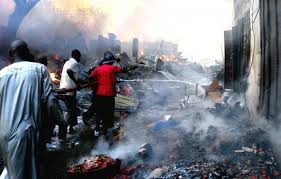




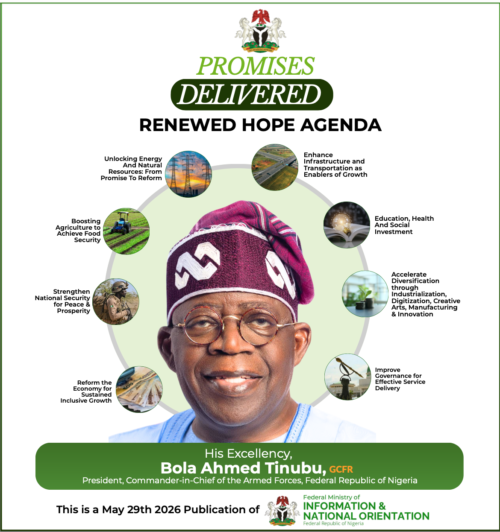
Asiwaju Bola Tinubu, The Change Agent @64, By Joe Igbokwe
A change agent must understand people. At the end of the day change is all about people. If you change everything but the people, I doubt you will be effective as a change agent. A change agent has the ability to continue striving toward high and challenging objectives regardless of the circumstances. He has the ability to convince and persuade others about the vision. He can touch minds and hearts and influence without authority. What about the ability to connect the dots? Can you determine what really matters and put together a vision that makes sense, one that others can follow? Can you keep your feet on the ground and see possibilities at same time?
Now enter Asiwaju Bola Ahmed Tinubu who is one of the greatest Change Agents in Nigeria today, the builder and the motivator of men. To document Asiwaju Bola Ahmed Tinubu’s exploits as Change Agent since the 90s will take more than a three thousand page book on a conservative estimate. His deep involvement in the struggle for the de-annulment of June 12 1993 Presidential election won by the late Chief Moshood Abiola earned him a place of honor as a hero of democracy in my Book, Heroes of Democracy published in 1999. In 1999 Asiwaju BAT became the Executive Governor of Lagos State and in eight years this Avatar, this game changer, and great scholar in the finest tradition laid a solid foundation that has led Lagos to become the fastest growing city in Africa whose economy is bigger than those of Cameroun, Ghana, Cote de Voire, Senegal etc. When this icon set up a 40man Committee in 1999 to fashion out a template for Lagos State development, many did not know what was on his mind but today we know better, as Lagos has become a huge melting point in the face of Nigerian dwindling opportunities.
In 2003, only one State, Lagos was left for the Progressives in Nigeria after the PDP finished its boisterous rigging in that year’s election. But with dint of hard work and power of constructive engagement, Asiwaju led his large army of bridge builders to move from AD to AC, AC to ACN and ACN to APC. Today APC is in control of the Federal Government and 22 States of Nigeria. Time and space will not permit me to dig into the preparations, the all nights of engagements, building extensive networks, making tremendous sacrifices, giving up positions, setting aside political differences, building alliances, committing both human and material resources, setting aside primordial sentiments and ethnic preoccupation that led to the uprooting of the octopus and behemoth called PDP.
Asiwaju BAT’s infinite capacity to lift great number of men and women across this country irrespective of tribe or tongue has made this man a giant in Nigeria. He sacrificed his personal comfort, family comfort and the comfort of his extended family members by throwing his gates open to all and sundry, the rich and the poor at any given time without discrimination. Asiwaju’s impeccable character to forgive his adversaries and political enemies has put him thousands of miles ahead of his rivals. If anybody had told me that Asiwaju BAT will find a place in his heart to forgive some newspaper houses, AIT and others who preached hate (if you have an idea of what they did) in the course of 2015 elections I would not have believed it. Only Asiwaju Bola Ahmed Tinubu can show this kind of magnanimity and forgiveness. A friend, Barrister Sadiq a chieftain of APC Lagos told me that this is the reason why he will live long.
Asiwaju tried in 2011 with other like minds to build an alliance to dislodge PDP but it suffered a great set back. PDP survived. In 2014 the bubble burst for PDP. How the Jagaban of Borgu managed to deploy his deep connection and extensive huge network to work with like minds across Nigeria to form APC will remain a case study for political science departments in Nigeria.
Like I said earlier, the story of Asiwaju BAT remains a powerful testimony of a great bridge builder, giver, organizer, mobilizer, facilitator, motivator, actor, mediator, peace maker, and change agent. In doing his service for humanity, the Asiwaju of Africa, Jagaban Borgu and Omenife Awka has made many friends and have also attracted many enemies. While genuine friends celebrate their hero and pray to God to keep the man that has added values to their life the enemies look for ways to tear down the colossus. They hang every negative thing on his shoulder. They blame him for bad weather, they blame him for political and economic setbacks. They blame him for every problem under the sun. Asiwaju’s meteoric political success has bred mortal enemies and petty jealousies, envies and deep seated fear amongst the political liliputs and minions who kiss the dust in the midst of his many political victories. Today, Asiwaju is perhaps the most feared and dreaded political leader in the country. His enemies are consumed by petty envy at his giant political strides but their fear-induced pettiness has neither bothered nor held back Asiwaju. For those haters Asiwaju BAT has these words for them:
“I set my goals and objectives in accordance with my vision. I study them and strategically execute them. My detractors discuss my successes and failure becausethey have nothing to execute. I am in the news more because I’m working, Nigerians discuss active men in the field. Mentioning any negative news about me will double the wealth of any news media that published it. My name today is a financial market for journalist. Not even elected politicians get the publicity I am enjoying. My comrades , go and work till mentioning your name becomes a source of increased wealth for someone. Even my weakness create wealth for vendors” —I REMAIN, ASIWAJU BOLA TINUBU–
Joe Igbokwe wrote in from Lagos. [myad]