The Inspector-General of Police, Solomon Arase, has said that he is waiting for advice of the Attorney General of the Federation and Minister of Justice before enforcing the resolution of the National Assembly to seal off the Kogi House of Assembly complex.
Arase who spoke to newsmen in Abuja during an exercise tagged ‘Walk Against Crime’ organized as part of activities to mark the police week, said the position of the Senate had been sent to the minister for his advice on the matter.
“What I have done is to send the papers to the minister of Justice for his advice. I am a police officer; I also need the advice of a legal expert to actually know the way forward. Once I get the response of the minister, I will be able to take a decision,” he said.
The Senate had directed the IGP to seal the Kogi Assembly complex, pending the resolution of the political crisis in the house. Arase
On the exercise, the Inspector General said that it is part of the police week aimed at connecting with other Nigerians.
According to him, the mental and physical health of a police officer determines his or her level of work he or she can do.
The walk took off from the Force Headquarters to the Unity Fountain in Maitama, and back to the Force Headquarters.
Those who participated were the Controller-General of the Federal Fire Service, representatives of the Chief of Naval Staff, NSCDC, FRSC, Musicians and Sports men among others. [myad]
Suspected kidnappers, today, abducted a senior military officer serving with the Nigerian Army School of Infantry, Jaji, near Kaduna, Colonel Samaila Inusa in Kaduna.
A statement by the spokesman of the One Division of the Nigerian Army, Kaduna, Colonel Usman Abdul, said Inusa was abducted yesterday at about 7:30pm along Kamazo road, near NNPC junction, Kaduna.
Inusa, who was said to have been driving in his car with his wife inside, were said to have been blocked by the abductors who pulled the wife out of the car, took over his car and drove off with him towards Abuja road.
Colonel Usman said: “the abductors dropped off his wife and left with him in his car. They car headed towards Abuja. Anybody with useful information or assistance should please assist in tracking these abductors. They are in a Mercedes Benz GLK Black colour with registration number Abuja, KUJ 154 TZ.
“This happened at about 7:30pm on Saturday 26 March 2016.”
The statement requested members of the general public to assist in fishing out the abductors by providing any useful information through the following phone numbers: 08033865572,
08030489203, 08023445961, 07038025282 and 08058130703.
The abduction of the army officer came one week after President of the United Church of Christ in Nigeria, Rev. Emmanuel Dzigau and two other clergies were abducted on Monday last week along Abuja Road.
The clergy men are yet to regain their freedom as their abductors who had earlier demanded for N100 million ransom later reduced their demand to N50 million and threatened to kill them if the money was not paid in time. [myad]
A house wife with three children, Kemi Dayo Kamorudeen has narrated how an Islamic spiritualist, known as Alfa hypnotized her and turned her into sex slave for many years now without the knowledge of her husband.
Kemi told newsmen that while she and her husband were living at Akute, a border town between Ogun and Lagos states, she had a dream one day and that since her husband was away at work at the time, she had to turn to Alfa Shehu Lukman for help.
“The dream was frightening. I narrated the dream to him and he told me that a spirit husband was behind my problem. He said the problem required an urgent solution so that the spirit husband would not be able to kill me.
“He told me that after I had taken my bath the following day, I should call him and he would come with the medicine. The following morning, I took my bath and called him.
“When he came, he brought out a razor and some medicine he had prepared and said he would need to make an incision on my private part. I asked why he couldn’t just explain how it would be done so that my husband could do it for me when he came back from work but he said that it was a taboo for husbands to handle such medicine.
“He told me that to ward off the spirit husband, the incision was just the preliminary treatment. He said the medicine would be rubbed on the incision after it had been made.
“I agreed to it and he was making the incision when he suddenly grabbed my neck and forced himself on me. He raped me on the three-seater couch in our sitting room.”
Kemi explained that after Lukman had had his way with her, he brought out some drugs and a Qur’an and told her that if she dared to disclose what he did to anybody, her husband and children would die while she would run mad.
She said as she was visibly shaking in fright, he made her swear to secrecy with the Qur’an.
The 45-year-old artisan said, “He told me not to worry and that the spirit husband would leave me alone so far as I heeded his instructions. I asked why he would do such a terrible thing to me when he knew my children and husband.
“He said what was done was done. He said he used a medicine on me while raping me and that he would leave me to my problem if I decided to make a scene. He said I would simply run mad.
“He said another condition that would make me to retain my sanity was that anytime he needed sex and he called me, I must always heed his call wherever I was and that I must not tell anyone.”
“I have been his sex slave for the past two years because of this. He calls me anytime he wants sex. Sometimes he sleeps with me in our house when my husband is away, sometimes he demands that I should come to his house in Akute.”
Asked if Lukman’s wife and children were not usually around when he slept with her, she said he has a dedicated room where he slept with her.
Asked how she did not summon the courage to tell her husband in the last two years, she said she was just too afraid that Lukman might make good his threat.
Kemi said she was also afraid that Lukman could reverse a spiritual help he rendered to her youngest child, who is now 22 years old.
“There was a time my daughter woke up and was complaining of some problems. I took her to the Alfa and he said she needed a spiritual bath. That was before he first forced himself on me. He took her for the spiritual bath and she became well,” she said.
Asked if she followed the spiritualist and her daughter to the spot where the spiritual bath took place, she said Lukman forbade her from following.
Kemi’s husband said he simply could not believe that his wife was going through such a thing without telling anyone.
“I told her that she must not go that day and that if he was indeed as powerful as he claimed to be, he should kill me before the next day,” Kamorudeen said.
Kamorudeen said one of their children, a university undergraduate, was travelling to school and had accident that affected her legs few years ago.
“My last born, who introduced the Alfa (Lukman) to us, was undergoing Qur’anic studies under him at the time. While we were in Ife for her elder sister’s treatment, she was alone at home.
“She said she was sleeping in the sitting room one afternoon when the Alfa came visiting to sympathise with us on the accident. She said when she told him that we were not around, he suddenly grabbed her neck and attempted to molest her but she quickly raised the alarm.
“Our landlady at the time came out when she heard the noise but the Alfa quickly told the woman that he was just trying to continue the Qur’anic studies and she was proving stubborn. He used that opportunity to escape that day. My daughter too could not tell the woman what actually happened.”
Kamorudeen said he could recall that since they left Akute two years ago, his wife had visited the place more than 30 times.
When contacted at Otun Abule, few kilometres from Akute area in Ogun State where he carries out his spiritual consultations, Alfa Lukman, said he is 52 years old and an indigene of Abeokuta, Ogun State expressed shock about everything the woman had said against him.
“There is no quarrel between us, so I don’t know where all these rape allegations are coming from. I am really shocked but truly, they consult with me regularly on spiritual issues.
“I am a spiritual doctor to the woman and her children. It is true that I made incisions on her, but it was not on her private part. It was just beside her private part, on the inner part of her thighs.
“I have been a spiritualist for more than 30 years and I do not lie. It is true that I also did a treatment for her daughter which required a spiritual bath. There is nothing strange in that. There is a stream not far from here where she had the bath.
“I knew the girl first when she was my pupil. She then introduced me to her parents. Her mother consults me all the time and so do the children. But I never slept with or raped the woman before. I also never attempted To Molest her daughter.”
Asked if he ever called Kemi in recent times, he said he only called her about two weeks ago to find out if she was visiting the area.
“She had told me before that she was attending an event around here. So, I called two weeks ago to know about the event.”
Likman insisted that he was fund of checking on her welfare, saying:“before that last call, I had not even spoken with her for about four months.”
The husband of the woman, 50-year taxi driver, Kamorudeen, who reached out to activist, Esther Ogwu, of the Esther Child Rights Foundation, for help, said he wants justice but does not know the appropriate step to take.
The case has yet to be reported to the police, but Ogwu said the authorities would be notified when necessary.
“People should be careful the kind of people they turn to for help. At this point, I can only advise people who may be in a similar situation to always confide in a third party.
“I believe Kemi. He probably simply preyed on her fears. It is also possible that this Alfa might be doing the same thing to other people in that community. They should seek help because whatever he is feeding them is just lies to keep them enslaved.”
Personal assistant to Danladi Umar, chairman of the Code of conduct Tribunal (CCT), Ali Abdullahi is facing a case of alleged bribe involving the sum of N10 Million.
Ali Abdullahi is facing a two-count charge for allegedly providing false information to the EFCC during the commission’s investigation of a case of false asset declaration by a former official of the Nigerian Customs Service, Rasheed Owolabi.
Abdullahi told the EFCC that N1.8 million collected from Owolabi was meant to assist his (Abdullahi’s) father’s medication, but during a cross-examination, Owolabi said he paid the money to Umar who demanded N10 million to influence his case before the tribunal.
He claimed that he paid the money to the tribunal’s chairman, Danladi Umar, through a Zenith Bank account belonging to Abdullahi, with the account number: 1002849471.
The charges proffered against him read : “That you Ali Gambo Abdullahi, sometimes in August 2013 at Abuja within the judicial division of the court did make a statement to one Abdulmajeed Ibrahim, a detective with the EFCC, while in the course of the exercise of the duty of his office that the sum of N1.8m paid into your Zenith Bank Account Number 1002849471 on December 12, 2012 by one Rasheed Owolabi was a payment made to assist you to settle your father’s hospital bill; which statement you knew to be untrue and thereby committed an office contrary to section 39(2)(a) of the EFCC Act, 2004 and punishable under section (39) (2) (b) of the same act.”
“That you Ali Gambo Abdullahi, sometimes in August 2013 at Abuja within the judicial division of the court did make a statement dated 13th August 2013 pertaining to N1.8m paid into your bank account by one Rasheed Taiwo, which is inconsistent with the statement you made on August 12th, 2013 to one Abdulmajeed Ibrahim, a detective with EFCC while in the course of the exercise of the duty of his office and thereby committed an offence contrary to section (39) (2) (b) of the EFCC Act 2004.” [myad]
A man has narrated how a Lagos State Customary Court Judge snatched his wife by taking advantage of small understanding between him and his wife, and then went ahead to marry the woman. This is even as the judge has been suspended by the Lagos state government. The man, Razak Adeyeri, Ayeni alleged that the judge, Ishola Adeyeri, hurriedly dissolved his marriage and later married his wife, Doyin, when they started having marital problems and approached his court to resolve the issue. Adeyeri and Doyin got married at the Orile Agege registry in Lagos on December 31, 2015. Ayeni, who runs an education advisory company in Egbeda, Lagos, had initially called for help to get custody of his two children, whom he said were taken away from him and made to live in the house of the judge. He said: “when I married my wife, I invested N5 million in her school business. But the success of the business caused problem. I could not control her again. “She had to move out of the house and rented an apartment in our area. After 10 months, I took her to court, thinking I would be able to resolve the matter through an alternative dispute resolution. But the judge, Dr. Ishola Adeyeri, hurriedly dissolved my marriage and impregnated her three months after the dissolution of my marriage. “What really pained me was that the ruling was obnoxious. He denied me access to my children. He ordered that I could only see the children in the school premises once in a week. He took over the business I started with the woman. He still wanted to send me to jail. He had been using the police to harass me. He brought the police to my house and I was detained at Abbattoir Police Division.” It was learnt that Ayeni was later arrested in February and charged to court for alleged assault and planning to kill Adeyeri. He said that he spent two days behind bars at the Kirikiri Prison after he was remanded. He was again charged for assault in another court. The day after he was released, he said the police again came for him and he had to flee his home because he feared for his life. “He used his office to destroy my marriage. He dissolved my marriage in February 2015 and my ex-wife gave birth to his child in March 2016. That shows he impregnated my wife just three months after he dissolved our marriage,” Ayeni had said. But he has finally got custody of his children. However, Adeyeri could only respond to the allegation through a text message saying: “I am sorry, I am not obliged to talk to the press.” This was even as the controversial wife, Doyin, who is the founder of Greatest Kiddies Foundation, a private school in Egbeda, Lagos, alleged that Ayeni did not get the custody of his children legally but that he invaded her school and took the children forcibly. The woman said that there was no truth in the claims that her ex-husband invested N5 million in her school business. She said: “We got married about seven years ago, but my school has been in existence for 12 years. He did not pay a dime in my business. “He lied by saying I took his children to another man. He was the one who threw me out of his house with the children, saying they were bastards. “We started having problems when I had a miscarriage and he beat me afterwards. He said I had used the unborn child for rituals. He also took me to court and asked for divorce.” But when asked if it was the same judge, who ordered their marriage dissolution that she remarried, she said, “don’t I have the right to remarry whoever I like after he divorced me? If I was impregnated by the judge, was it when I was still in his house? We had separated since 2013. We were formally divorced February 2015. I remarried in December 2015. I have freedom to marry whoever I chose to marry. “He has continued to threaten my life. People in the neighbourhood can testify to this. I am away from the school now because on March 1, he came to beat me up in the school. I landed in the hospital. I was forced to labour on March 8. The very day he wanted to send me out of his house, he beat me. I have never had a rest of mind since 2013. “What else does he really want from me? After all, he said he was not interested in the relationship again. Since he came to forcibly take the children from the school, I have not set my eyes on my children.” It was gathered that the Lagos Judicial Commission has suspended Adeyeri after a complaint was lodged against him. The commission was said to have summoned him and Ayeni, before deciding that the judge had taken an action that amounted to misconduct. There are unconfirmed reports that he has been finally sacked. The spokesperson for the commission, Moses Akinniyi, said that he was not in a position to either confirm or deny the dismissal of the judge. He, however, said that the case was indeed brought before the commission.
The recent visit of President Jacob Zuma of South Africa to Nigeria presented an opportunity to rehash the view that Nigeria has not been given its due recognition in Africa. Of course, as expected, Mr. Zuma in his speech to the joint session of Nigeria’s National Assembly did touch on Nigeria’s role in the fight against Apartheid and its historical role in Africa. According to Mr. Zuma, “The people of Nigeria provided unwavering support and solidarity to the people of South Africa to unseat the last bastion of colonialism in Africa and enable us to attain our freedom.”
In what appears to be a veiled reference to attacks on Nigerians in South Africa he noted, “I would like to remind especially the youth in our two countries, of the role that Nigeria played in the struggle for liberation in South Africa. Nigeria was very instrumental in establishing, in the 1960s and the chairing, for 25 years, the United Nations Special Committee Against Apartheid, and further hosted a UN anti-apartheid conference in 1977. From the mid-70s, Nigeria and its people also hosted some of the exiled freedom fighters from South Africa, with numbers increasing after the Soweto Student Uprising in 1976.”
It appears, however, that beyond these formal platforms and speeches eulogizing Nigeria, the image of the country as a “powerhouse” deserving of respect, particularly in Africa, is simply lacking. We must again refer to the repeated xenophobic attacks against Nigerians in South Africa and, of course, the way Nigerians are perceived and treated in other African countries.
This brings us to the other side of the debate: whether Nigeria has asserted herself enough to be taken seriously in Africa much less the world. This is what a new book, The Media Imagination in Nigerian Foreign Policy seeks to address. Written by Adagbo Onoja, a former media aide to Sule Lamido, Nigeria’s foreign affairs minister between 1999 and 2003, the author weaves three aspects of his persona into this book – journalist, academic, and participant-observer in Nigeria’s foreign policy – to highlight what Nigeria has still not explored: the postmodern media.
Described on the blurb by one of the academic assessors as “empirically rich, pugnacious here and there”, it would be interesting to see how the myriad of its potential readers react to this book. And they would range from newsrooms across the world assessed on their coverage of Nigerian foreign policy to the civil society that has a whole chapter in the work and then to African statesmen, the great powers, former ministers of foreign affairs and other key actors in Nigerian foreign policy as well as those called “intellectuals of statecraft”.
It would be interesting to see too what readers also make of sharp assertions as the one by Professor Sam Egwu of the University of Jos (UNIJOS) who remarked in the Foreword that “The critical role of the media in the projection of great nations historically provides a warning that the media imagination matters and that the foreign policy elite ignore the media imagination as a power resource only at the perils of the country.”
In many respect, this book is a welcome development not just in media discourse but in framing a comprehensive and workable foreign policy for the country. When it comes to Nigeria, the expectations are really high – both within and outside the country: “The Giant of Africa”, “the most populous country in Africa”, “the largest concentration of Black people in the world”. Unfortunately, the country and its leaders have not come anywhere close to fulfilling the potentials of the country.
Divided into three parts with seven chapters, the book focuses on two main issues: “what the media does to Nigeria’s image and how Nigeria might derive strategic advantage from the media imagination”. Contrary to the generalized belief that Nigeria’s media image is all negative, this work shows that there is also the idea of Nigeria as “the pivot on which Africa and much of the world turn”, a discourse with tremendous constitutive implications which Nigeria has not explored.
Subsequently, the image of a looted and mismanaged country afflicted by a litany of woes: corruption, high degree of poverty, HIV/AIDS infection, a dysfunctional society, authoritarian democracy, criminality, and scams, has overwritten the positive possibilities. Essentially, the author is saying that our foreign policy has underachieved partly because Nigeria has left the discursive articulation of herself unattended by way of her engagement with the media as a power resource. While Nigeria does not seek to dominate other countries, as the author noted, its “asymmetrical diplomacy” or the articulation of foreign policy objectives on the terms of externally framed meaning of the world has left gaps between foreign policy and domestic interests or needs.
For me, this focus by the author on the media imagination in Nigerian foreign policy is the kernel of the book; that is, the strength of the book is the understanding and application of the power of the media in pushing a narrative of Nigeria within which other foreign policy interests can be realized. This is a refreshing perspective that the framers of Nigeria’s foreign policy may do well to listen to. Very few writers and academics in Nigeria have bothered to explore this angle in foreign policy discourse. The work is equally authoritative. As Comrade John Odah, one of those who needled the author to complete the book, was reported in the acknowledgement, very few people with critical orientation have had the opportunity to ply the Nigerian foreign pitch at the level of a close political rather than career aide of the ministers of foreign affairs.
The question emanating from Onoja’s critical ability and close contact with the implementers of Nigeria’s foreign is: how systematically has Nigeria seized the media imagination as a power resource? In answering this question, the author argues that the media as a power resource in Nigeria’s foreign policy can at best be described as work in progress. He concludes by noting that the Nigerian State has not deployed the media the way it deploys the military, diplomacy, intelligence and similar instruments of state power.
The solutions: deliberate development of media infrastructure “with capacity to tell the Nigerian story on a global scale”, taking advantage of the advances in media and information technology, and building a crop of media practitioners with an “Afrocentric appreciation of history”. I think these are brilliant interventions. The shortcoming, if any, of this book is how to put some of these ideas into practice or better still why have these ideas not started taking roots after more than two decades since the postmodern media became a reality? How, for example, can Nigeria build a crop of media practitioners with an “Afrocentric appreciation of history” when history is not taught in Nigerian schools, much less an Afrocentric sense of it?
But beyond our disdain for history is a more fundamental question of the character of the Nigerian nation or state which the author ignores. The author’s lack of attention, considering his pedigree as a progressive scholar and activist, to the fact that Nigeria is an “unformed entity” and that this has a direct bearing of its foreign policy is difficult to fathom. It is not just for nothing that Nigeria has no coherent and workable foreign policy. I think there is a way in which the geo-politics of Nigeria has impacted the way Nigeria projects itself or responds to international issues. There can’t be any genuine understanding of what ails Nigeria, including its foreign policy woes, without a focus or an understanding of the nature of our federation.
In all, this is a provocative book and if we want to understand why Nigeria remains an African paper tiger, then we must turn to the 228-page The Media Imagination in Nigerian Foreign Policy, just published by the Centre for Information Technology and Development (CITAD).
This book will stir interest and debates and I think it should. As Dr. Chijioke Uwasomba of the Dept. of English, Obafemi Awolowo University notes on the blurb, it provides “students of international politics, foreign policy analysts, diplomacy, media practitioners and the sensitive general reader a critical entry point into the media in foreign policy formulation and implementation in a post-colonial state like Nigeria”.
*Onumah is Coordinator of the African Centre for Media & Information Literacy (AFRICMIL), Abuja, Nigeria. He is the author of Time to Reclaim Nigeria (2011) and Nigeria is Negotiable (2013). He can be reached at conumah@hotmail.com; Twitter: @conumah. [myad]
President Muhammadu Buhari has asked Nigeria to have faith in his ability to gradually take Nigeria out of the socio-economic and political woods into which they have been led by the past governments. “Faith, belief and the fulfilment of expectations,” the President said in his Easter message to Nigerians “are also key themes of the Easter celebration. I urge you all therefore, to continue to have faith in the future greatness of our country and to believe that the CHANGE my administration promised will surely come to fruition. That CHANGE, which we all yearn for, will certainly occur more rapidly if we all place the love of our country above selfish personal and group interests.” President Buhari expressed happiness that the National Assembly has just passed the 2016 budget, assuring Nigerians that he will do his utmost best to ensure that the budget, the first since his election as President, is efficiently and successfully implemented towards achieving his objective of faster economic growth and development. “I thank the vast majority of Nigerians for their patience and understanding in the first ten months of this administration. “As we go forward, I assure you all that we are working very hard to overcome the challenges we encountered on assumption of office. “We are moving on with an unshaken resolve and determination to deliver on the mandate you gave us on March 28, last year.” The full text of the President message is reproduced here: Fellow Nigerians, I rejoice with you all, especially our Christian brothers and sisters, as we celebrate Easter. For Christians all over the world, this celebration is in commemoration of the supreme sacrifice which Jesus Christ made for the salvation of mankind. The Gospels also tell us that during his earthly ministry, Jesus Christ repeatedly urged his disciples and followers to “love one another as I have loved you”. As we celebrate Easter this year, I sincerely believe that it will serve our dear nation very well if we all imbibe this essential message of Jesus Christ and truly learn to love our countrymen and women as we love ourselves. Indeed, we will surely make faster progress towards the achievement of the peaceful, united, strong, progressive and prosperous country we all desire if, as a nation, we eschew all divisive, parochial, ethnic and religious sentiments and rivalries, and begin to live more harmoniously with our compatriots, as Jesus Christ and the founders of the world’s other great religions enjoined mankind. Our unfortunate notoriety in recent years as a country where the blood of men, women and children are wantonly and callously shed in frequent orgies of criminal, political, ethnic and religious violence has become very embarrassing and utterly unacceptable. My administration is determined to achieve greater peace and security across our nation by ending the avoidable conflicts and crises that hinder our national progress. I ask for greater support from all Nigerians in this regard. We must put a stop to politically motivated killings. Our communities must be made safe again for all inhabitants to live together in peace and harmony. Our armed forces, police and other security agencies are being progressively reformed, repositioned and empowered to win the war against terrorism and make mass killings, abductions and other criminal atrocities things of the past in our beloved country. Let us all also play our parts as patriotic citizens and do all that we can to ensure that we make Nigeria a safer, more peaceful and happier place for its people and others. Faith, belief and the fulfilment of expectations are also key themes of the Easter celebration. I urge you all therefore, to continue to have faith in the future greatness of our country and to believe that the CHANGE my administration promised will surely come to fruition. That CHANGE, which we all yearn for, will certainly occur more rapidly if we all place the love of our country above selfish personal and group interests. The National Assembly has just passed the 2016 budget. I assure all Nigerians that we will do our utmost best to ensure that the budget, the first since my election as President, is efficiently and successfully implemented towards achieving our objective of faster economic growth and development. I thank the vast majority of Nigerians for their patience and understanding in the first ten months of this administration. As we go forward, I assure you all that we are working very hard to overcome the challenges we encountered on assumption of office. We are moving on with an unshaken resolve and determination to deliver on the mandate you gave us on March 28, last year. I wish you all very happy Easter celebrations.
While accepting the platinum award by the forum of former Senators and House of Representatives from 1st to 4th republics forum, Bauchi state Governor, Mohammed Abdullahi Abubakar has made it clear that he would not allow himself to be intimidated and that he is determined to bring real development to the state. He stressed that some criticisms against his administration’s only 10 months in office by those who are used to the former administration’s style of leadership would not deter him. The governor spoke when he was conferred with an award for excellence performance from the National Convention/Conference of Forum of Former Senators and House of Representatives from 1st to 4th republics, headed by Senator Joseph Wayas. Governor Abdullahi Abubakar emphasised that he would remain resolute in his restoration drive, and that the change mantra is working in Bauchi state. “Let me reiterate here that I remain resolute and committed to changing Bauchi state and no amount of intimidation will deter me. “I consider this award different from others; it shows that whatever we do we are being observed and therefore is a big challenge for us to remain committed and strive to double our efforts and do more to improve the lives of our people through the change mantra of our party, the All Progressives Congress (APC).” He commended the Speaker and Members of the Bauchi State House of Assembly whom he said support the change and restoration agenda of his administration, adding that one of the areas the administration is focusing attention on is the area of taxing surface activities of solid mineral resources. He said that his government is also harnessing the tourism potentials of the state and revitalizing agriculture, all of which are geared towards improving internally generated revenue of the State. The Governor appealed for continued public understanding and support even as he assured that results of the sacrifices “we all have to make for our administration’s policies which are reflections of those of President Muhammadu Buhari and the APC manifesto, will be reaped bountifully.” Meanwhile, an elder statesman and Danmasanin Kano, Dr. Yusuf Maitama Sule has commended governor Abdullahi Abubakar for making huge investment in education and health, even as he asked other northern governors to emulate him. Dr. Yusuf Maitama Sule described education and health as the main engine of human development, saying that it is in view of this that the United Nations Educational Scientific and Cultural Organization, UNESCO recommended the provision of 26% of annual budgets of all developing nations to the development of education sector. According to him, what governor Mohammed Abubakar has started in the area of education and health is commendable and that other governors, especially those in the northern states to emulate him. “We must give education priority attention because all developed nations are so developed because they have given sufficient attention to the development of that important sector.” He stressed that with proper investment in education, half of the problems of all nations are solved. According to the forum, Governor Abubakar was conferred with the award because of his exemplary efforts to development feducation, health, agriculture, infrastructure and job creation. [myad]
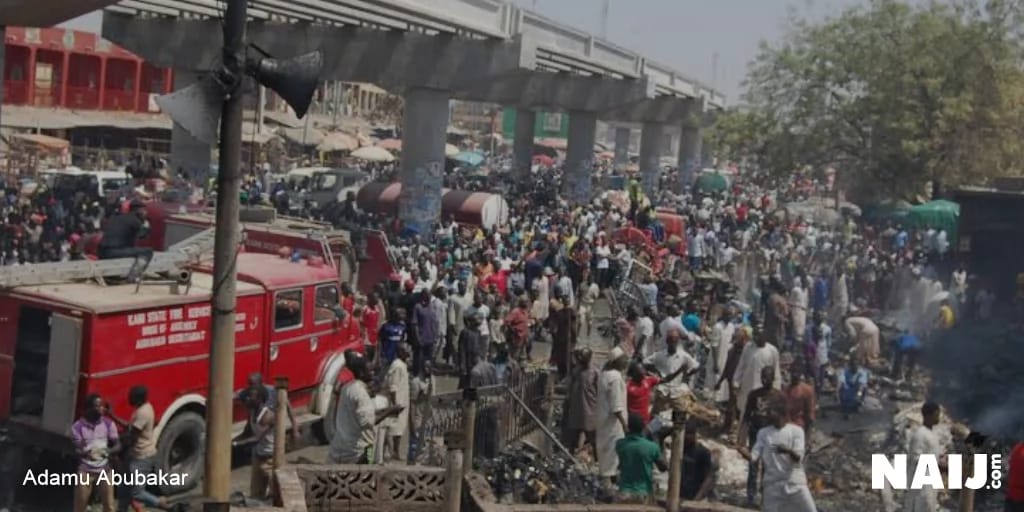
President Muhammadu Buhari has expressed sympathy for the victims of the fire incidents in Sabon Gari Market, Kano State and Birnin Kebbi Central Market, Kebbi State which occurred early today.
A statement by senior special assistant to the President on media and publicity, Malam Garba Shehu said the President was particularly grieved by huge losses incurred by the traders and other business establishments in the markets.
President Buhari said that he shared in the pain of the victims knowing that the two fire incidents had created major setbacks for all those that had business outfits in the markets, thereby affecting the livelihood of their families and setting back economic activities in the states.
The President advised the Kano and Kebbi State Governments to find out the immediate and remote causes of the fire disasters in order to forestall future occurrences.
Apart from investigations, President Buhari also called for strict adherence to precautionary standards in buildings and operations of markets to avoid fire out breaks.
He prayed that the Almighty God will comfort and replenish all those that incurred losses in the incidents. [myad]
Easter is a time to reflect, a time to re-commit, a time to celebrate, NOT a time to mourn. To fully understand this, it is important that we know or at least have an idea of the socio-political environment at the time of crucifixion, what happened, the role of our Master Jesus the Christ and the message of Easter. At the time of the crucifixion the Roman conquerors ruled the Jews. Even though they ruled, they were in a state of fear and tumult because they realised that without the cooperation of the subjected race and the Council of the Sanhedrin, those in authority before they conquered the Jewish race, they could not hold down the conquered. Jesus was therefore seen as a threat to the State. The trial of Jesus was a celebrated trial in the history of the world at that time. He was accused and regarded as a political agitator and a religious reformist who must be dreaded. At that period, crucifixion was the means of military execution by the governing body – the Romans. Unknown to them but known to our Lord Jesus the Christ, the crucifixion was according to the spiritual law and necessary for Jesus to fulfill his mission. The events before, during and after the crucifixion gave the Master Jesus of Nazareth the opportunity to fulfill the great mission of the Master Christ in the world which is to embed that spirit of LOVE in the heart/bowels of the earth. That physical emblem of crucifixion was also used to bring a great knowledge to the world. The knowledge that the earth is not our home and that death does not exterminate us, because we are one with the force that gave us life. That was the message that the death on the cross signifies. What was it that Paul preached? ” I preach that He arose, that Christ is risen and that there is no death,” Jesus Christ demonstrated that physically by appearing before many people including his followers to prove to others that there is no death, that as Son of Man with the Christ within you, you cannot die. That Christ which is life, light, love and truth dwells in all God’s creation. So, the message of Easter is for all humanity regardless of your religion. There were no Christians then, so it couldn’t have been for Christians alone. It has implications for all. As we celebrate the fulfillment of the mission of our Master Divine, Jesus the Christ, let us use this period to reflect on the true meaning of selfless love and to re-commit ourselves to loving our neighbours as ourselves and God above all. In practice this means we should love, care and think of our fellow man before self. This is the beginning of Wisdom. Imagine a home, a family, a State, a country, a world where Man loves, cares and thinks about others before Self. Just imagine it – there will be no wars, no Boko Haram, no ISIS, no creed, no malice, no hatred, no absolute poverty, no oppression, no religious and tribal tensions, Government policies and actions will always be in the interest of the governed because leaders will understand that they are privileged and elected to serve. Service to God and humanity will be our valuable coin. Just imagine. That is why Divine Love is the thread that ties all religions together under the same and one God. Divine Love is the only answer to Nigeria’s problems. Can we create such a society? Ofcourse we CAN and we WILL. May the spirit of Easter inspire us to love one another and God above all.
God bless Nigeria. Happy Easter!!! Bro Lee. House of Light, Lagos. [myad]
We use cookies on our website to give you the most relevant experience by remembering your preferences and repeat visits. By clicking “Accept”, you consent to the use of ALL the cookies.
This website uses cookies to improve your experience while you navigate through the website. Out of these, the cookies that are categorized as necessary are stored on your browser as they are essential for the working of basic functionalities of the website. We also use third-party cookies that help us analyze and understand how you use this website. These cookies will be stored in your browser only with your consent. You also have the option to opt-out of these cookies. But opting out of some of these cookies may affect your browsing experience.
Necessary cookies are absolutely essential for the website to function properly. This category only includes cookies that ensures basic functionalities and security features of the website. These cookies do not store any personal information.
Any cookies that may not be particularly necessary for the website to function and is used specifically to collect user personal data via analytics, ads, other embedded contents are termed as non-necessary cookies. It is mandatory to procure user consent prior to running these cookies on your website.



 The Inspector-General of Police, Solomon Arase, has said that he is waiting for advice of the Attorney General of the Federation and Minister of Justice before enforcing the resolution of the National Assembly to seal off the Kogi House of Assembly complex.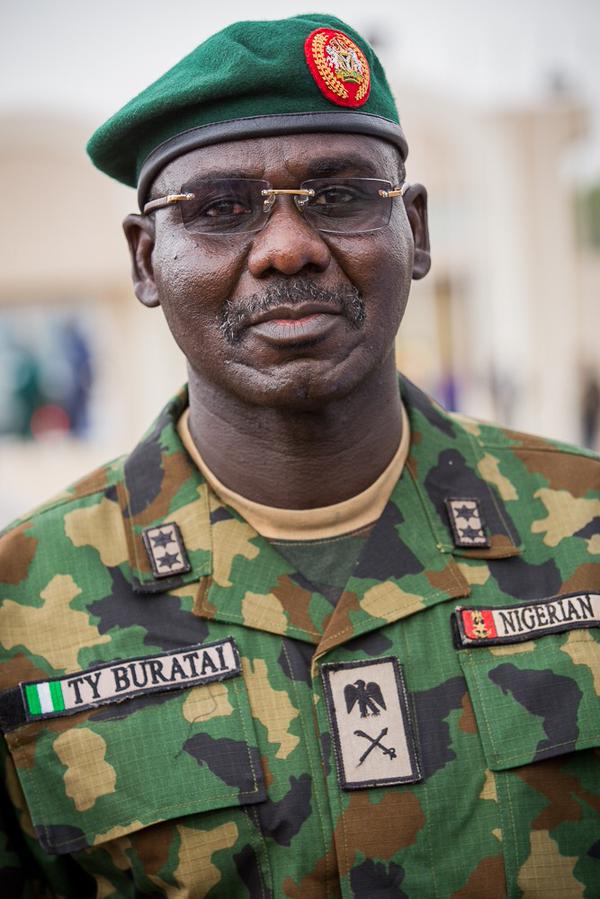





Welcoming The Media Imagination In Nigerian Foreign Policy, By Chido Onumah
In what appears to be a veiled reference to attacks on Nigerians in South Africa he noted, “I would like to remind especially the youth in our two countries, of the role that Nigeria played in the struggle for liberation in South Africa. Nigeria was very instrumental in establishing, in the 1960s and the chairing, for 25 years, the United Nations Special Committee Against Apartheid, and further hosted a UN anti-apartheid conference in 1977. From the mid-70s, Nigeria and its people also hosted some of the exiled freedom fighters from South Africa, with numbers increasing after the Soweto Student Uprising in 1976.”
It appears, however, that beyond these formal platforms and speeches eulogizing Nigeria, the image of the country as a “powerhouse” deserving of respect, particularly in Africa, is simply lacking. We must again refer to the repeated xenophobic attacks against Nigerians in South Africa and, of course, the way Nigerians are perceived and treated in other African countries.
This brings us to the other side of the debate: whether Nigeria has asserted herself enough to be taken seriously in Africa much less the world. This is what a new book, The Media Imagination in Nigerian Foreign Policy seeks to address. Written by Adagbo Onoja, a former media aide to Sule Lamido, Nigeria’s foreign affairs minister between 1999 and 2003, the author weaves three aspects of his persona into this book – journalist, academic, and participant-observer in Nigeria’s foreign policy – to highlight what Nigeria has still not explored: the postmodern media.
Described on the blurb by one of the academic assessors as “empirically rich, pugnacious here and there”, it would be interesting to see how the myriad of its potential readers react to this book. And they would range from newsrooms across the world assessed on their coverage of Nigerian foreign policy to the civil society that has a whole chapter in the work and then to African statesmen, the great powers, former ministers of foreign affairs and other key actors in Nigerian foreign policy as well as those called “intellectuals of statecraft”.
It would be interesting to see too what readers also make of sharp assertions as the one by Professor Sam Egwu of the University of Jos (UNIJOS) who remarked in the Foreword that “The critical role of the media in the projection of great nations historically provides a warning that the media imagination matters and that the foreign policy elite ignore the media imagination as a power resource only at the perils of the country.”
In many respect, this book is a welcome development not just in media discourse but in framing a comprehensive and workable foreign policy for the country. When it comes to Nigeria, the expectations are really high – both within and outside the country: “The Giant of Africa”, “the most populous country in Africa”, “the largest concentration of Black people in the world”. Unfortunately, the country and its leaders have not come anywhere close to fulfilling the potentials of the country.
Divided into three parts with seven chapters, the book focuses on two main issues: “what the media does to Nigeria’s image and how Nigeria might derive strategic advantage from the media imagination”. Contrary to the generalized belief that Nigeria’s media image is all negative, this work shows that there is also the idea of Nigeria as “the pivot on which Africa and much of the world turn”, a discourse with tremendous constitutive implications which Nigeria has not explored.
Subsequently, the image of a looted and mismanaged country afflicted by a litany of woes: corruption, high degree of poverty, HIV/AIDS infection, a dysfunctional society, authoritarian democracy, criminality, and scams, has overwritten the positive possibilities. Essentially, the author is saying that our foreign policy has underachieved partly because Nigeria has left the discursive articulation of herself unattended by way of her engagement with the media as a power resource. While Nigeria does not seek to dominate other countries, as the author noted, its “asymmetrical diplomacy” or the articulation of foreign policy objectives on the terms of externally framed meaning of the world has left gaps between foreign policy and domestic interests or needs.
For me, this focus by the author on the media imagination in Nigerian foreign policy is the kernel of the book; that is, the strength of the book is the understanding and application of the power of the media in pushing a narrative of Nigeria within which other foreign policy interests can be realized. This is a refreshing perspective that the framers of Nigeria’s foreign policy may do well to listen to. Very few writers and academics in Nigeria have bothered to explore this angle in foreign policy discourse. The work is equally authoritative. As Comrade John Odah, one of those who needled the author to complete the book, was reported in the acknowledgement, very few people with critical orientation have had the opportunity to ply the Nigerian foreign pitch at the level of a close political rather than career aide of the ministers of foreign affairs.
The question emanating from Onoja’s critical ability and close contact with the implementers of Nigeria’s foreign is: how systematically has Nigeria seized the media imagination as a power resource? In answering this question, the author argues that the media as a power resource in Nigeria’s foreign policy can at best be described as work in progress. He concludes by noting that the Nigerian State has not deployed the media the way it deploys the military, diplomacy, intelligence and similar instruments of state power.
The solutions: deliberate development of media infrastructure “with capacity to tell the Nigerian story on a global scale”, taking advantage of the advances in media and information technology, and building a crop of media practitioners with an “Afrocentric appreciation of history”. I think these are brilliant interventions. The shortcoming, if any, of this book is how to put some of these ideas into practice or better still why have these ideas not started taking roots after more than two decades since the postmodern media became a reality? How, for example, can Nigeria build a crop of media practitioners with an “Afrocentric appreciation of history” when history is not taught in Nigerian schools, much less an Afrocentric sense of it?
But beyond our disdain for history is a more fundamental question of the character of the Nigerian nation or state which the author ignores. The author’s lack of attention, considering his pedigree as a progressive scholar and activist, to the fact that Nigeria is an “unformed entity” and that this has a direct bearing of its foreign policy is difficult to fathom. It is not just for nothing that Nigeria has no coherent and workable foreign policy. I think there is a way in which the geo-politics of Nigeria has impacted the way Nigeria projects itself or responds to international issues. There can’t be any genuine understanding of what ails Nigeria, including its foreign policy woes, without a focus or an understanding of the nature of our federation.
In all, this is a provocative book and if we want to understand why Nigeria remains an African paper tiger, then we must turn to the 228-page The Media Imagination in Nigerian Foreign Policy, just published by the Centre for Information Technology and Development (CITAD).
This book will stir interest and debates and I think it should. As Dr. Chijioke Uwasomba of the Dept. of English, Obafemi Awolowo University notes on the blurb, it provides “students of international politics, foreign policy analysts, diplomacy, media practitioners and the sensitive general reader a critical entry point into the media in foreign policy formulation and implementation in a post-colonial state like Nigeria”.
*Onumah is Coordinator of the African Centre for Media & Information Literacy (AFRICMIL), Abuja, Nigeria. He is the author of Time to Reclaim Nigeria (2011) and Nigeria is Negotiable (2013). He can be reached at conumah@hotmail.com; Twitter: @conumah. [myad]