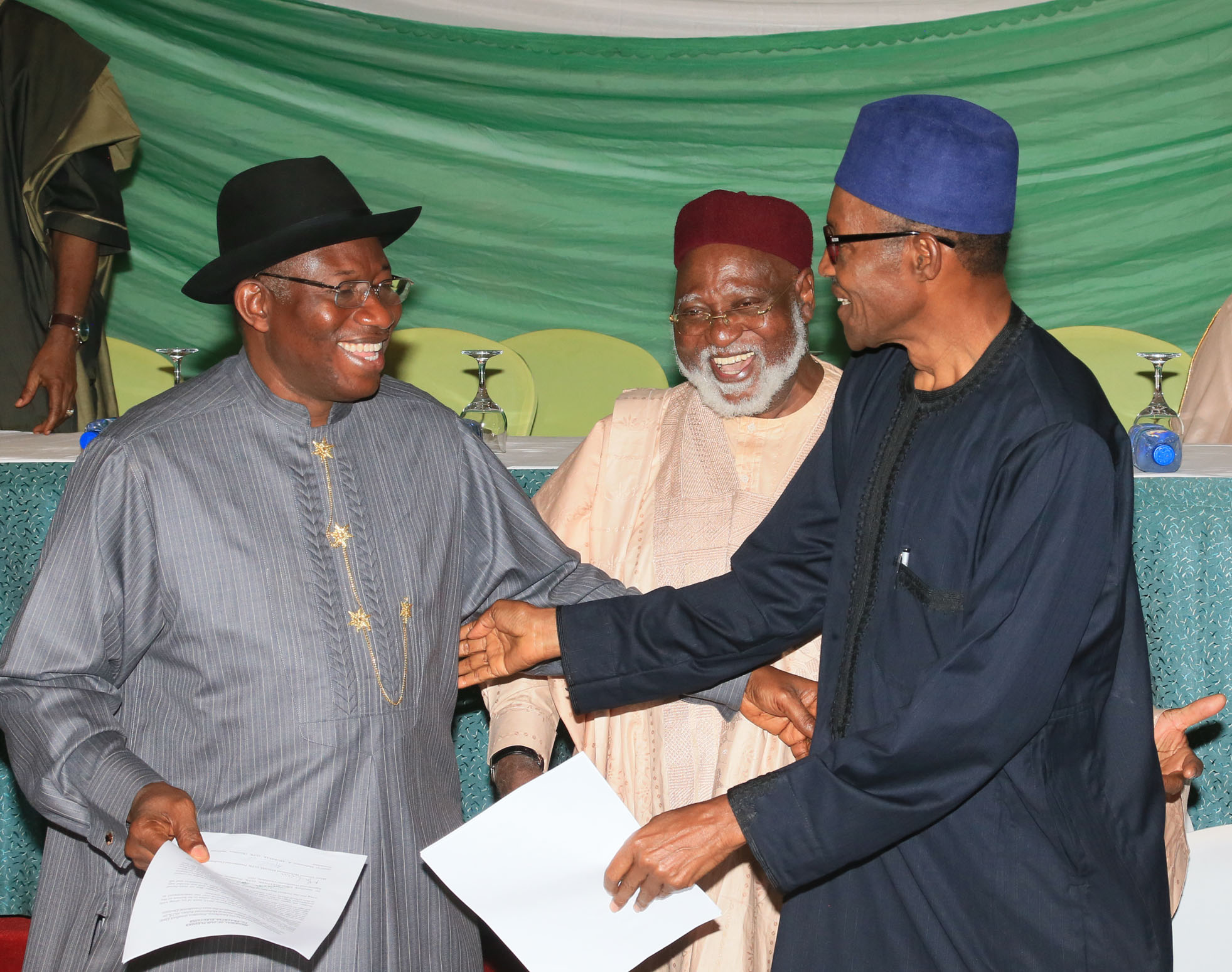
The Executive Director of the Centre for Humanitarian Dialogue, David Harland has told President Muhammadu Buhari that the centre brought peace among the inter-ethnic and inter-religious people in Plateau state. He said that the Centre is looking forward to deploying such initiative to facilitating the settlement of another inter-ethnic and inter-religious conflicts in Kaduna State. Harland who led a delegation of the Centre, an organization active in the promotion of peace in Nigeria said that the techniques used in bringing peace to Plateau State can soon be deployed also to deal with the Boko Haram insurgency and other conflicts in Nigeria. This was even as President Buhari identified poverty, injustice and the lack of job opportunities as being responsible mainly for inter-communal and intra-communal conflicts in the country. He said that to achieve enduring peace in the country, greater effort must be made to eradicate poverty and injustice. The President described ethnic and religious conflicts in parts of the country as outward manifestations of underlying problems of joblessness, injustice and poverty. On conflicts between farmers and herdsmen, President Buhari said that a plan to map out grazing areas will soon be presented to the Nigerian Governors Forum as a temporary solution to the frequent conflicts until cattle owners are persuaded to adopt other means of rearing their cattle. The President commended the Centre for Humanitarian Dialogue for the relative peace that had returned to Plateau State as well as their on-going activity in Southern Kaduna. He agreed with the Centre that dialogue is always preferable to the use of law and order mechanisms and force in the resolution of conflicts. [myad]
The House of Representatives Committee on Diaspora has said that effective collaboration between the Debt Management Office and members of the House of Representatives, particularly the House Committee on Diaspora, would go a long way in opening the frontiers of public debt management knowledge. Chairman of the House of Representatives Committee on diaspora Matters, Hon. Rita Orji, made this known when members of her committee paid a working visit to the Debt Management Office. She said that it was important that her Committee familiarizes itself with the activities of the DMO and to also identify areas of collaboration that will benefit Nigerians and the economy as a whole. Hon. Rita Orji, who led members of the Diaspora Committee, enlightened the DMO management on the Committee’s activities which are aimed at active engagement with Nigerians in Diaspora to create better opportunities that would harness valuable potentials to address Nigeria’s socio-economic challenges in the years ahead. “DMO and other relevant stakeholders should put efforts together to cater for the welfare, mobilize and pro-actively engage the Nigerian Diaspora Community for nation-building and development.” According to he, Nigerians in Diaspora are willing to participate in any means necessary to uplift the economic fortunes of the country. She commended the management of the DMO, led by Dr. Abraham Nwankwo, even as she said that DMO has been living up to its constitutional mandate, especially at the time like this when Nigeria and the rest of the world is grappling with financial difficulties and economic challenges. Responding, the Director-General of Debt Management Office (DMO), Dr. Abraham Nwankwo, expressed the desire of his office to enlighten the committee on the activities of the DMO as it concerns Public Debt Management and sovereign issuance in the international capital market. According to him, DMO has been involved in what he called democratization of public debt management, saying that such approach has repositioned Nigeria in the world financial map as continental role-model in public debt management operations. He also reeled out the achievements recorded by the Office and how it has contributed to Sub-National Debt Management developments. He highlighted the ongoing efforts to issue a Nigerian Diaspora Bond in the International Capital Market even as he sought the support of the House Committee on Diaspora in this regard. In line with the objectives of the Committee, the Diaspora bond would serve as a channel for Nigerians in Diaspora to access the economy and contribute to Nigeria’s development by investing in critical infrastructure and other sectors of the economy and, at the same time, earn relatively good returns on their investments. [myad]
The Nigerian government, the World Bank, the European Union and the United Nations are set to launch a Recovery and Peace Building Assessment (RPBA) of the North Eastern region of the country in the aftermath of the Boko Haram insurgency. A statement from the office of Vice President Yemi Osinbajo said that the initiative will be conducted within the framework of the Joint EU-UN-WB Declaration on international crisis recovery cooperation with the North-East States of Borno, Adamawa, Yobe, Gombe, Taraba and Bauchi. The RPBA, the statement added, will build upon existing initiatives and body of work on the North East produced at the Federal and State levels, including the Presidential Initiative for the North East (PINE) and the North East States Transformation Strategy (NESTS). “These assessment efforts will provide a credible framework for coordinated and coherent support from humanitarian and development partners to complement series of Federal Government efforts towards restoring normalcy to these affected states. “It will also form the basis for planning a broad-based public sector recovery program for the NE, as well as leverage, synchronize and inform the financing initiatives and projects of Nigeria’s development partners, civil society organizations, private sector groups and organizations. “This assessment is expected to strengthen local capacity, enable direct participation and come up with results that would be useful in developing a plan to meet the needs of the states. “Such a plan will also appropriately and adequately cater for the IDPs, the rebuilding and reconstruction programmes of their respective states.” President Mohammadu Buhari had during his visit to the United States in July, 2015 met with the World Bank President, Jim Yong Kim and representatives of other donor agencies where he secured the commitment of the bank in supporting Federal Government’s efforts in the North-East. This high-level collaboration between the Government of Nigeria and donor partners- the World Bank, European Union and the United Nations culminated in the setting up of the Recovery and Peace Building Assessment (RPBA). [myad]
A United Kingdom housewife, Sondra Earle-Kelly has allegedly battered her husband because he refused to have sex with her.
According to Metropolitan police in the UK, the 51-year-old Kelly hurled ceramic figurines at her husband when he refused to stop watching TV and make love to her. She was said to have proceeded to beat him with a pair of nunchucks.
Police were said to have found blood on the walls of the couple’s apartment when they arrived. Earle-Kelly, who was also said to have taken a tranquilizer tablets over the course of the evening, was charged with aggravated domestic violence and spent the night in a Charlotte, South Carolina police cell.
It’s a day in British tradition dedicated to opening boxes of gifts received at Christmas, and that is why it’s called Boxing Day.
But what the Adesina family got this last December 26 was a crushing blow, the type Mike Tyson, in his heyday, handed out to his opponents in the ring. It was a blow to the solar plexus: painful, sad, traumatic, leaving an impact that not even time heals. Such pain lasts forever.
President Muhammadu Buhari, whom I am privileged to serve as Special Adviser on Media and Publicity, had told me at a private meeting before Christmas that since I was a Christian, I could take some days off during the Yuletide season to be with my family. That was why Boxing Day found me in Lagos, and at about 4 p.m, I left the house to attend a special church programme billed for 5 p.m. The day was bright and beautiful.
At 4.30 p.m, a few meters to my destination, my phone rang. It was my immediate elder brother, Tayo, a Professor of History at the University of Ibadan. The news he gave fouled up the hitherto cheery atmosphere, and even the sun seemed to have fled from the sky.
An official of the Federal Road Safety Commission (FRSC) had called him to say our sister, Foluke, a Professor of Dramatic Arts, at the Obafemi Awolowo University, Ile-Ife, had been involved in an accident along the Lagos/Ibadan Expressway. Of the four people in the car, two were certified dead.
The next half an hour was probably the longest I’d ever spent in my life. I made a detour for the house, and continued to communicate with the FRSC official, whose number I had collected from my brother. Later, I contacted Mr Bisi Kazeem, spokesman of the commission and a long time friend, asking him to help with precise information. It came almost at the speed of light. Two people were truly dead, and they were my sister, and her brother-in-law, who was visiting from America. It was him that was being taken to Lagos from Ibadan, to catch a flight back to the U.S that night.
Now, he had boarded a last flight to eternity. Very sad! Tragic!
For the seven Adesina brothers and sisters, this was trauma in the true sense of the word. Five brothers and two sisters, and now, one of the sisters was gone. Like George Orwell wrote in his work, ‘A Hanging,’ “We were a party of men walking together, seeing, feeling, understanding the same world. But with a sudden snap, one of us was gone. One mindless, one world less.”
From Lagos to London, Ibadan to Abeokuta, where the Adesinas are based, it was a festival of tears.
Raindrops fell endlessly from our eyes. Was it not just a little over two years earlier that we buried our mother? Don’t we still miss her keenly, though she died at 75? Yes, she could have lived to be 80, and even more.
Foluke became the automatic mother, keeping everyone under her wings. From her base in University of Botswana, where she was a visiting professor, on sabbatical from OAU, Ife, she was the rallying point for everybody. She was merely home for Christmas, and was to return to Botswana on January 22. Now she was dead, at just 53 years old, a latest victim of famished Nigerian roads.
A lifetime of study and research, gone. All the knowledge, wasted. There are only 10 female professors of Dramatic Arts in Nigeria. Now, one of them was gone, consumed by rapacious Nigerian roads. One mindless, one world less.
The Adesina family of Ipetumodu, in Ife North Local Government Area of Osun State had a patriarch in John Oyebade Adesina, an educationist, who was the first African principal of St Charles Grammar School, Osogbo, in the 1960s. The school was easily the best in the then Western Region, producing students who shone like stars in the West African School Certificate of Education.
From there, the dyed-in-the-wool educationist was transferred to Notre Dame College, Usi-Ekiti. He retired from there to his Ipetumodu homestead in 1971, where his seven children were brought up under what was akin to a ‘military regime.’ He ran the home just exactly as he ran the school.
All of us grew up together, and became quite close, finding succour in one another, and in our mother, whenever our father whipped us till we saw stars. The patriarch passed on in 1985 (we had come to appreciate the discipline imbued in us by then), the matriarch followed in 2013, but the children remained inseparable.
At any given time, you could have three or four Adesina siblings in different parts of the world, pursuing one professional thing or the other. Only Yewande, my immediate younger sister, lives in the U.K permanently, with her family. But we were always in touch. Foluke had created an email group of all seven of us, and we communicated at the touch of a button. There was no separating us. Till the blow of Boxing Day. Now, it is one mindless, one world less.
In 1982, Foluke (by the way, all seven of us are on first name basis, because we were brought up that way, and it is convenient for us) had gone to serve at NTA Minna, in Niger State, after graduating from the then University of Ife. She came back the following year, a completely changed person. We were a religious family, of the Roman Catholic stock, but in Minna, Foluke had met with the Pentecostals, and had become born again.
She has become an S.U, we screamed in mortification!
What are you doing in the midst of people who cry when they pray, who wear long faces, and go about gently? Are you the one that killed Jesus? Our questions were endless. Such people were called S.U, meaning members of the Scripture Union. They believed in patterning their lives scrupulously after the words of the Holy Bible, and were considered rather stuffy by other kind of Christians.
We needled Foluke endlessly, and did all we could to test the quality of her conversion. She held on to her newfound faith, through master’s degree, marriage, Ph.D, professorship, and all the days of her life. No looking back. She had just left the annual retreat of the Deeper Life Bible Church, a day before she met her death. She had spoken with me on getting home, with me not knowing it was valedictory.
But what happened to all her scoffing brothers and sisters over the 32-year period in which Foluke was a born again Christian?
Hear our youngest brother, Dr Olubiyi Adesina, a consultant endocrinologist, in a tribute paid to our sister at her burial in Ibadan last weekend: “I remember the early 80s when my older siblings used to make fun of your newfound S.U status. To me as a young boy, S.Us must have been goblins. To now imagine that all that laughed then are now all S.Us. You started the revolution in the family. Thank you for being a good example.”
Foluke faithfully served the Lord she loved dearly for 32 years, using her skills as a dramatist for evangelism. Even as an academic, she took part in many stage plays, films and concerts, all to expand the Kingdom of God on earth. She was also Fellow of many associations in Nigeria and abroad. She became a professor in 2011, a position backdated by five years.
Time, like an ever rolling stream, has borne her daughter away. But she would not fly forgotten as a dream, which dies at the opening of day. Foluke will always be remembered by her siblings: Wunmi, Tayo, Femi, Yewande, Yemi, and Biyi. Her son, Oluwaseun, her husband, Engineer Segun Ogunleye, and scores of others on whose lives she made great impact, will never forget her.
It is said that as mere mortals, we must never ask God questions. Yes, God is sovereign, but one would not stop wondering why Heaven was so much in a hurry, as to take Foluke now. If Heaven had waited for 20 or 30 years more, would she not have come home one day? Heaven, you needn’t be in such haste, for we shall all come. But let it be in due times and seasons.
I grieved deeply for my sister. I still ache and mourn. As the funeral service held at the Deeper Life Bible Church in Ibadan last weekend, it was as if the service should never end. The fact that her corpse was in the casket inside the church still gave some sort of cold comfort. But the service must inevitably end. And ended it did.
As the casket was borne out, and knowing that interment was only few minutes away, I broke down completely. I wept. Yes, didn’t Jesus also weep? I broke down, and when Dr Yemi Ogunbiyi, former Head of Department of Dramatic Arts in Ife, and Foluke’s former teacher, came to console me, he had a hard job of getting me to stop crying. He ushered me into a vehicle, and that was where eminent virologist, and former oil minister, Prof Tam David-West came to pay his condolence.
The man too was weeping, and I conveniently joined him. It was simply a festival of tears, as many sympathizers could not hold their emotions in check. When Foluke and Tayo had been named professors within a week of each other, I had hosted them to a reception in Ibadan. Prof David-West had been chairman of the event, he gave the professorial charge, so he knew my sister well.
A week before the burial, journalist, pastor and activist, Richard Akinnola, had given me a book written by Ukraine-based Pastor Sunday Adelaja. The book is titled “Myles Munroe: Finding Answers To Why Good People Die Tragic And Early Deaths.” I read the 192-page book, and I must confess that it gave me a lot of relief.
Myles Munroe, a great Christian preacher had died in tragic circumstances in 2014, and the author used him, supported by Scripture, to show that death is really gain. The manner of death, he submitted, does not matter. What matters, according to him, was to fulfill our purpose in life, “and die empty.”
But Foluke still had a lot to give to the academia, to scholarship, to society, to her family, even to Christendom. Can one say she died empty? Well, questions abound. We do not understand it all. The things that are revealed are for men, while the ones that are hidden are for God. We will understand it better by and by.
Messages of condolence came from all corners of the land, and even beyond, to the Adesina family. President Buhari, Vice President Yemi Osinbajo, former presidents, clerics, illustrious Nigerians, and people from all walks of life, sympathized with us.
I thank you all.
The Good Book says it is through much afflictions and trials that we will enter into the Kingdom of God. But this one was sure too hard on us. It would be hard on anybody.
“We were a party of men (and women) walking together, seeing, feeling, understanding the same world. But with a sudden snap, one of us was gone. One mind less, one world less.” Seven has now become six. Very sad.
At times, while crying at the loss of my sister, I remember our parents, particularly my mother. She left just two years and five months ago. And I then understand why God took her when He did. If my mother had been around to witness the death of any of her children, it would have been too hard on her. She had died happy in 2013, knowing that all her children were accounted for.
When I wept, therefore, it was partly in thankfulness that Mama was gone without her eyes seeing evil. God knew what was to happen on December 26, 2015, and so took her ahead of time. But then, couldn’t God have stopped the crushing blow of Boxing Day? He could. So, why didn’t He? I stop, before I land in a theological labyrinth, from which I can’t extricate myself.
Foluke, sleep well. I am sure our father’s clock, which used to rouse all of us at 4.45 a.m, would not chime in Heaven. Sleep all you want, till the day of resurrection. The old educationist wouldn’t be whipping you out of bed, like in those days of yore, for refusing to respond to the alarm bell at the height of harmattan.
* Adesina is the Special Adviser on Media and Publicity to President Muhammadu Buhari. [myad]
The Governorship Election Petitions Tribunal in Kogi State has ruled that it could not stop the inauguration of Alhaji Yahaya Bello as governor of Kogi state on Wednesday, January 27 as requested by the outgoing state governor, Captain Idris Wada.
Wada of the Peoples Democratic Party (PDP) had asked the Tribunal to stop the inauguration of Bello of the All Progressives Congress (APC) on the ground that he didn’t have what he called a valid running mate at the December 5 supplementary governorship election.
The Chairman of the tribunal, Justice Halima Mohammed, dismissed the motions on the ground that the issues related to governorship election were already before the tribunal.
“Various petitions on the governorship election will have no effect if the tribunal decided to stop the inauguration. However, the tribunal in its wisdom will grant accelerated hearing to all the petitions before it for fair and timely justice.” [myad]
A former Wealth Manager in the Asset Resources Management, Nneka Ararume, has told a Federal High Court in Abuja how he transferred $2 million to Olisa Metuh’s investment portfolio from his Dextral Nigeria Limited in December 2014.
Ararume who testified in her evidence-in-chief as the Economic and Financial Crimes Commission (EFCC) opened a case of money laundering against Metuh, the embattled National Publicity Secretary of the Peoples Democratic Party (PDP), said that he (Metuh) had invited her to his house to hand her $2 million in cash for the transaction. “The owner of Dextral, Metuh, with whom the company manages his portfolio called me to his house and handed me $2 million cash with instruction that the cash be converted into naira and paid into his account with us. “I took the money and gave $1 million each to two Bureau De Change operators, Mr. Sie Iyenome and Mr. Kabiru Ibrahim, to sell. My company had managed Metuh’s portfolio long before I joined it in April 2011.” Ararume, who was under cross examination by Onyechi Ikpeazu (SAN), told the court that the transaction was not illegal. When asked whether Asset Resources Management had access to Metuh’s bank accounts, the witness said the company had kept account files of all its clients. She further said: “The company has no direct access to bank accounts of the client except instructed to do so by the client for specific reason. “The singular reason which gives room to such access is when the client is paying in funds or asked for the liquidation of his investment.” In his testimony, Iyenome, one of the Bureau De Change operators, said Ararume had sought for the sale of $1 million from him. “I did contact the Capital Field Investment and Trustees and one Tonye to sell the $1 million that she gave me. “After due diligence, I gave them $500,000 each to sell. We got a total of N183 million from the sale of the $1 million. The money was immediately paid into the Asset Resources Management account and Ararume brought the $1 million after she confirmed receipt of the N183 million.” Under cross examination on the legality of the deal, the witness said he had always done a legitimate business, and that the transaction was not different. Iyenome said he acted as a broker in the transaction by connecting those who sold the money. However, when re-examined by Silvanus Tahir, the prosecuting counsel, on the legally of approved amount of dollars to be transacted in a day, Iyenome said only $4,000 was approved for an individual. He said the approval limit for a business entity per day stood at $5,000. The judge adjourned hearing in the case to tomorrow for the continuation. Earlier, Ikpeazu had brought an application for the variation of Metuh’s bail condition. Ikpeazu argued that the conditions were difficult to be met by his client. The application was, however, opposed by the prosecution, who said the initial decision of the court should be upheld. Okon fixed January 29 to deliver ruling on that application. The PDP spokesman was accused of collecting N400 million from a former National Security Adviser, retired Colonel Sambo Dasuki. The money was part of the $2.1 billion arms procurement fund allegedly misappropriated by Dasuki. [myad]
Ridding a corrupt country like Nigeria of corruption will take a little while, but it has to start from somewhere and by someone. Corruption is a complex social, political and economic phenomenon that affects all countries. It undermines democratic institutions, slows down economic development and contributes to governmental instability. Corruption attacks the foundations of democratic institutions by distorting electoral processes and conducts, perverting the rule of law and creating bureaucratic quagmires whose only reason for existing is for soliciting bribes. Economic progress is stunted because foreign direct investment is discouraged and small businesses within the country often find it impossible to overcome the “start-up costs” required because of corruption. Corruption threatens our national security and gives rise to a safe haven for terrorist. This is the scenario we find ourselves as a nation. It was on the ground of ridding the country of corruption that President Buhari came into power. And since his ascension to the highest position in the land, his greatest efforts and strength have been channeled to defeating the Boko Haram insurgency and fighting against corruption. Both efforts seem to be yielding results, as to some extent, one can say that the Boko Haram insurgency has been incapacitated even though not completely defeated while the fight against corruption is just but taking shape. Nevertheless, corruption is a symptom of deep-seated and fundamental economic, political and institutional weaknesses of a country. The fight against corruption will be effective, when measures against it address the underlying causes and not just the symptoms. President Buhari must move beyond the fighting against corruption, and build lasting institutions that will live on after he is out of office. Emphasis must not just be placed on fighting corruption but also be placed on preventing corruption by tackling the root causes that give rise to it through undertaking economic, political and institutional reforms. The Treasure Single Account (TSA) is a valuable initiative, but it is just one of the many initiatives needed to prevent corruption. Anti-corruption enforcement measures such as oversight bodies, a strengthened police force, more efficient laws and reliable law courts amongst others, are needed to genuinely curb and prevent corruption. This is because corruption and institutional weaknesses are linked together and they feed on each other. So, getting rid of corruption helps a country to overcome other institutional weaknesses, just as reducing other institutional weaknesses helps to curb corruption. One of the fights against corruption since the inception of this administration has been the thorough investigation into how the funds meant for arms procurement were spent and those involved in the spending. Quite a number of people have been arrested in connection to the illegal spending of the arms procurement fund and the “latest man” on the roll is the spokesman of the opposition party, Chief Olisa Metuh. Olisa Metuh is the current spokesman of the onetime biggest political party in Nigeria and in Africa at large. He was not so vocal a spokesman; he was not even vocal enough as his counterpart, Lai Mohammed, when he was the spokesman of the then opposition party. Nonetheless, one thing is sure; he defended his party to the last and spoke always positively about his party. And to him, there was no time his party was wrong. Unfortunately for him, officials of the Economic and Financial Crimes Commission (EFCC) on Tuesday, January 5, 2016, stormed his Abuja home, took him away to their custody and since then, his life has never remained the same. He was remanded in Kuje Prison by an order of a Federal High Court in Abuja with respect to charges of money laundering involving N400m, part of money meant for procurement of arms, which he collected from the Office of the National Security Adviser in November 2014. He was later produced in court by prison officials and was granted bail to the sum of N400m as bail bond. Not too bad of a bail condition! But you see, you need not have to run when nothing and no one is pursuing you, and fear no guilt if your hands are clean. But for Metuh, while in the custody of the EFCC, he was alleged to have destroyed the evidence against him and again, re-arraigned before a Federal High Court in Maitama, Abuja, which ordered that he be remanded over two counts of destruction of evidence and mischief preferred against him by the EFCC. And on Friday, 22nd January, 2016, for the second time in just two days, he was granted bail in the sum of N300m with two sureties in like sum. The total bail sum now N600m. Putting the two bail conditions together, the spokesperson of the People`s Democratic Party, Chief Olisa Metuh, will need a total of N1 billion to secure is bail from Kuje prison while his case continues. Pathetically, now that the Deputy National Publicity Secretary of his party, Alhaji Abdullahi Jalo, had said that it would be wrong for anyone to be expecting the party to provide sureties for Metuh when the party did not benefit from the money he allegedly collected from the former National Security Adviser, Lt Col. Sabo Dasuki (retd.). It means Olisa Metuh is on his own and has a long way to go. But to me, it seems his journey has not even started. The point is, will Olisa risk getting his bail with a bond of N1 billion when it`s not even sure of winning the case? Would it be better he stays in Kuje and seek for a speedy hearing of his case so his fate can be quickly decided? Well, whatsoever happens to Metuh, and those involved in the arms procurement scandal should teach the rest of us that power is transient and the greatest gift a true leader can give to his people is selfless leadership, that is devoid of greed and wickedness. Less than a month in Nigerian prison, Olisa has grown older than what he`d be in 5 years time. He has grown grey beards and not really looking like the Metuh we used to know- looking skinny and perhaps already experiencing the other part of the world. Before now; the evil that men do live after them, but now the evil they do live with them. Those that are standing with Metuh should better stand right with him with all their might. Else, he becomes Methuselah in Nigerian prison. God Bless Nigeria. . Ogundana Michael Rotimi is a Nigerian Biochemist, Socio-economic and Political Commentator, and Public Speaker. He tweets @MickeySunny. [myad]
Following the outbreak of Lassa fever in some parts of Nigeria, no fewer the Lagos State chapter of the Environmental Health Officers Association of Nigeria have killed no fewer than 4,400 rats at six major markets in the state under its de-rat market programme. The President of the Association, Samuel Akingbehin, told the News Agency of Nigeria that his association carried out the exercise at Onigongbo, Oshodi, Oke-Odo, Ikotun Idanwo, Ojuwoye and Mile 12 Markets. Akingbehin said that de-rating the markets was part of the association’s efforts to curb the spread of Lassa fever in the state, adding: “the exercise is strategic in our effort toward the prevention of communicable diseases.” Akingbehin appealed to traders from across the state to show an understanding toward the efforts of the association to rid the markets of rats and rodents. He said that the plan was to de-rat markets in one local government area per day, starting from 5pm. Akingbehin said: “We also decided to put the exercise in the evening due to the nocturnal nature of rodents and our members had recorded successes in the markets visited till date. “It took us about three hours to cover the Oshodi Market when our members went there for the exercise. “Today, Monday, we will be visiting Suru-Alaba Market in Orile-Ifelodun LCDA by 5pm with about 400 EHOs to de-rat it. We are still calling on all other executive secretaries of the local government areas to assist us toward the elimination of rodents in our markets and our environments.”
The association decided on this time to allow traders and buyers transact their legitimate businesses. Lassa fever has so far killed no fewer than 76 out of over 200 cases that have been reported in 17 out of the 36 states of the federation. [myad]
They have always ganged up against him. But somehow, he had always survived the gang up. David Bonaventure Alechenu Mark is his name. Some hate him, others love him. But what many did not know, is that like most Nigerian names, whose meanings appear to be a factor in the life of the bearer, Mark’s native name, Alechenu, may have also played a prominent role in shaping his destiny and political journey. Alechenu in Idoma literarily means “a surprise or the unexpected.” His first election as a Senator was no doubt a surprise to many Idoma people. While in exile, Idoma people had queued behind Chief Steven Lawani, the immediate past Benue deputy governor, after rejecting the leadership of former Senate President, Chief Ameh Ebute, who had represented the area in the Senate, during the defunct NRC/SDP era. Lawani, had won the Senatorial seat of the area under the defunct UNCP, and was even getting set to take another shot at it on the platform of the then APP, when suddenly Mark returned to a heroic welcome from self exile. Once he returned, the PDP offered him the platform and without any political bargain, Lawani chickened out of the race. And even though Ebute attempted to stop him on the platform of the APP, Mark was obviously the preferred choice of the people. He was elected Senator in 1999. 2003: But before the 2003 polls, he had fell out with some prominent stalwarts of the PDP, especially within Zone C, his immediate Senatorial district and the larger Benue PDP. Against all odds, he backed Akume for a second term in office, on the understanding that Akume would pave the way for an Idoma governor in 2007. Although, attempt was made to pull him down at the poll, as most Idoma big names then moved to the UNPP, Mark again triumphed. 2007: However, before the 2007 poll, he had again fallen out with Akume, a thing that never gave him the opportunity to pull the bargain he had with Akume through. In spite of that however, he attempted forcing an Idoma governorship candidate on the PDP, since he was in firm control of the State’s party structure, as Akume had fallen out with Obasanjo. But his instruction that no Idoma man should participate in the party’s governorship primary, organised by the Akume group, a thing that would have made him had his way was not heeded by the Idoma governorship aspirants. At the Senate primary too, Mark faced a formidable opposition in General Lawrence Onoja (rtd). At the end, although Mark had the highest number of votes, he did not score the required percentage to be declared winner. While Onoja was hoping and waiting for a re-run between them, the party headquarters in Abuja, gave Mark the ticket. The contest at the General election was fierce. Mark was not only battling with his opponent, Alhaji Usman Abubakar Maishanu aka Young Alhaji of the now defunct ANPP, but was also battling with forces both from within the PDP in the State, and outside the State, but within the North-Central zone. Eventually he won, but not without some controversies, which later ended in the Appeal court, in Jos, where he was adjudged to have won the poll in the first instance. Contest for Senate Presidency in 2007: If Mantu had succeeded in winning a re-election in 2007, it would certainly have been difficult for Mark to vie for the Senate Presidency, let alone win, as such Mantu’s loss, became Mark’s gain. But even at that the forces within the North-Central zone of the PDP, linked up with other like minds outside the zone, with a view to stopping Mark from emerging as the Senate President. Curiously, Chief Tony Anenih, who was bitter with Obasanjo then, was the arrow head of the group. In spite of the fact that PDP announced Mark as its candidate, Senators Nuhu Aliyu, Akume, Gbemi Saraki and former Governors Kure, all from PDP North-Central zone, including Aliero and Yerima among others, met and insisted that “Obasanjo’s candidate must be blocked at all cost.” This, made Akume to run against Mark, against the Senate Standing Rule, after Senator Aliyu and Gbemi, in that order, stepped down for Akume. But again, Mark triumphed, beating Akume silly at the end of the contest. 2011:Like in 2007, Onoja again in 2011, tried to contest the PDP ticket with Mark at the primary. But unlike in 2007, where Mark failed to make it at the first ballot, this time around, Mark trounced Onoja at the party primary, before Onoja, moved to the ACN, to pick the party’s ticket. Again, at the poll, Mark was returned as the duly elected Senator for Zone C, for another four year term, a victory that gave him the opportunity to offer himself once more for the position of the Senate President, a contest; he won unopposed, despite the obstacles initially placed on his path. 2015:He did not get the party’s ticket on a platter of gold. But he emerged unopposed, following the withdrawal of his major challenger, at the eleventh hour. The withdrawal was made possible through the intervention of the respected Och’Idoma. At the General election, he emerged victorious. But the Appeal court nullified his election. And by February 13, 2016, he will be returning to the polls. Mark himself is like a mystery. He had in the past survived series of conspiracies against him; therefore I don’t think this one will be an exception. Like in the past, this time too, the forces against him are beyond the Idoma land, but like I said, he would survive it. Let me also hasten to add that Mark is the voice the Idoma people needs today. He may not have done much in terms of physical infrastructure, but he has done a lot in terms of Human Capital development. And evidences are all over. However, let me also warn, God forbid, if anything should happen and the forces against Mark succeed, the Idoma people should know that they would have been sentenced permanently to a political siberia. A word, they say, is enough, for the wise.
We use cookies on our website to give you the most relevant experience by remembering your preferences and repeat visits. By clicking “Accept”, you consent to the use of ALL the cookies.
This website uses cookies to improve your experience while you navigate through the website. Out of these, the cookies that are categorized as necessary are stored on your browser as they are essential for the working of basic functionalities of the website. We also use third-party cookies that help us analyze and understand how you use this website. These cookies will be stored in your browser only with your consent. You also have the option to opt-out of these cookies. But opting out of some of these cookies may affect your browsing experience.
Necessary cookies are absolutely essential for the website to function properly. This category only includes cookies that ensures basic functionalities and security features of the website. These cookies do not store any personal information.
Any cookies that may not be particularly necessary for the website to function and is used specifically to collect user personal data via analytics, ads, other embedded contents are termed as non-necessary cookies. It is mandatory to procure user consent prior to running these cookies on your website.
Before Metuh Becomes Methuselah, By Ogundana Michael Rotimi
Ridding a corrupt country like Nigeria of corruption will take a little while, but it has to start from somewhere and by someone.
Corruption is a complex social, political and economic phenomenon that affects all countries. It undermines democratic institutions, slows down economic development and contributes to governmental instability. Corruption attacks the foundations of democratic institutions by distorting electoral processes and conducts, perverting the rule of law and creating bureaucratic quagmires whose only reason for existing is for soliciting bribes.
Economic progress is stunted because foreign direct investment is discouraged and small businesses within the country often find it impossible to overcome the “start-up costs” required because of corruption. Corruption threatens our national security and gives rise to a safe haven for terrorist. This is the scenario we find ourselves as a nation.
It was on the ground of ridding the country of corruption that President Buhari came into power. And since his ascension to the highest position in the land, his greatest efforts and strength have been channeled to defeating the Boko Haram insurgency and fighting against corruption. Both efforts seem to be yielding results, as to some extent, one can say that the Boko Haram insurgency has been incapacitated even though not completely defeated while the fight against corruption is just but taking shape.
Nevertheless, corruption is a symptom of deep-seated and fundamental economic, political and institutional weaknesses of a country. The fight against corruption will be effective, when measures against it address the underlying causes and not just the symptoms. President Buhari must move beyond the fighting against corruption, and build lasting institutions that will live on after he is out of office. Emphasis must not just be placed on fighting corruption but also be placed on preventing corruption by tackling the root causes that give rise to it through undertaking economic, political and institutional reforms. The Treasure Single Account (TSA) is a valuable initiative, but it is just one of the many initiatives needed to prevent corruption.
Anti-corruption enforcement measures such as oversight bodies, a strengthened police force, more efficient laws and reliable law courts amongst others, are needed to genuinely curb and prevent corruption. This is because corruption and institutional weaknesses are linked together and they feed on each other. So, getting rid of corruption helps a country to overcome other institutional weaknesses, just as reducing other institutional weaknesses helps to curb corruption.
One of the fights against corruption since the inception of this administration has been the thorough investigation into how the funds meant for arms procurement were spent and those involved in the spending. Quite a number of people have been arrested in connection to the illegal spending of the arms procurement fund and the “latest man” on the roll is the spokesman of the opposition party, Chief Olisa Metuh.
Olisa Metuh is the current spokesman of the onetime biggest political party in Nigeria and in Africa at large. He was not so vocal a spokesman; he was not even vocal enough as his counterpart, Lai Mohammed, when he was the spokesman of the then opposition party. Nonetheless, one thing is sure; he defended his party to the last and spoke always positively about his party. And to him, there was no time his party was wrong.
Unfortunately for him, officials of the Economic and Financial Crimes Commission (EFCC) on Tuesday, January 5, 2016, stormed his Abuja home, took him away to their custody and since then, his life has never remained the same. He was remanded in Kuje Prison by an order of a Federal High Court in Abuja with respect to charges of money laundering involving N400m, part of money meant for procurement of arms, which he collected from the Office of the National Security Adviser in November 2014. He was later produced in court by prison officials and was granted bail to the sum of N400m as bail bond. Not too bad of a bail condition!
But you see, you need not have to run when nothing and no one is pursuing you, and fear no guilt if your hands are clean. But for Metuh, while in the custody of the EFCC, he was alleged to have destroyed the evidence against him and again, re-arraigned before a Federal High Court in Maitama, Abuja, which ordered that he be remanded over two counts of destruction of evidence and mischief preferred against him by the EFCC. And on Friday, 22nd January, 2016, for the second time in just two days, he was granted bail in the sum of N300m with two sureties in like sum. The total bail sum now N600m.
Putting the two bail conditions together, the spokesperson of the People`s Democratic Party, Chief Olisa Metuh, will need a total of N1 billion to secure is bail from Kuje prison while his case continues.
Pathetically, now that the Deputy National Publicity Secretary of his party, Alhaji Abdullahi Jalo, had said that it would be wrong for anyone to be expecting the party to provide sureties for Metuh when the party did not benefit from the money he allegedly collected from the former National Security Adviser, Lt Col. Sabo Dasuki (retd.). It means Olisa Metuh is on his own and has a long way to go. But to me, it seems his journey has not even started.
The point is, will Olisa risk getting his bail with a bond of N1 billion when it`s not even sure of winning the case? Would it be better he stays in Kuje and seek for a speedy hearing of his case so his fate can be quickly decided? Well, whatsoever happens to Metuh, and those involved in the arms procurement scandal should teach the rest of us that power is transient and the greatest gift a true leader can give to his people is selfless leadership, that is devoid of greed and wickedness.
Less than a month in Nigerian prison, Olisa has grown older than what he`d be in 5 years time. He has grown grey beards and not really looking like the Metuh we used to know- looking skinny and perhaps already experiencing the other part of the world.
Before now; the evil that men do live after them, but now the evil they do live with them. Those that are standing with Metuh should better stand right with him with all their might. Else, he becomes Methuselah in Nigerian prison.
God Bless Nigeria.
. Ogundana Michael Rotimi is a Nigerian Biochemist, Socio-economic and Political Commentator, and Public Speaker. He tweets @MickeySunny. [myad]