Soldiers have arrested the leader of the Shiit Islamic Movement of Nigeria, Sheikh Ibrahim El-Zakzaky, has been arrested by soldiers. This came after heavy clash between the sect and the soldiers yesterday in Zaria.
The heave clash resulted in the loss of several lives with the Nigeria Army claimed that the Shiite Muslim group attacked the convoy of the Chief of Army Staff, Lt. General Tukur Buratai, with the intent to assassinate him.
But El-Zakzaky’s group denied the army’s version of the incidence, claiming that the soldiers launched what they called unprovoked attack on defenceless people.
Heavy fighting broke out late night which dovetailed into the early hours of today after the troops returned to El-Zakzaky’s residence in Gyallesu area of Zaria at about 11pm.
The return of the troops was to effect the arrest the leader of the movement, but this was resisted by his members – resulting in the exchange of heavy gunfire and chants by members of the movement in the area, lasting for over two hours. [myad]
Minister of information, Alhaji Lai Mohammed has accused the government of former President Goodluck Jonathan of turning Central Bank of Nigeria (CBN) into ATM machine or piggy bank of a few people. He also accused Jonathan government of having presided over the frenzied mop-up of dollars, either for ‘armsgate’ or for slush fund purposes, from the CBN to a point where it almost ran out of the hard currency.”
Lai Mohammed, who reacted to the comments credited to Deputy Senate President, Ike Ekweremadu, that businesses may collapse in the next six months because the Buhari administration has mismanaged the economy, said: ”If there was still any honour left among thieves, there is no way the leaders of a party under whose watch the nation’s economy suffered a monumental mismanagement and would still have the temerity to insult a government that is working hard to turn things around or the citizens who are bearing the brunt of such mismanagement.
”It is now clear to all Nigerians that if the PDP had won the last general elections, Nigeria’s economy would not have survived one more month, considering the battering it received under the immediate past administration. It is therefore unconscionable that those who should show contrition and hunker down to avoid public opprobrium are the same ones pointing an accusing finger at the Buhari Administration.”
The Minister said that even though the Buhari administration met an economy that was in coma, it had refused to use that as an excuse for inaction, hence has been working hard on measures that will turn the economy around and greatly offer relief to Nigerians by lifting millions, not thousands, of people out of poverty through a massive social intervention policy.
“The outcome of the months of hard work will manifest soon in the 2016 national budget that will give succour to millions of Nigerians who are reeling from fallout of the solecism of the immediate past Administration that turned the country into a cash bazaar.”
The Minister advised the leaders of the PDP and members of the immediate past administration who are involved in the emerging cases of looting binge to urgently return to government coffers, the funds they have squirreled out of the commonwealth.
”They are lucky that Nigerians are not as incautious as they are, otherwise they would not be able to walk around freely, not to talk of having the effrontery to fire darts at the government that inherited their rot or the people who are suffering the consequences.
”They looted the billions of Naira that were allocated for the fight against insurgency, causing many innocent and patriotic soldiers to die needlessly, yet they are not remorseful. They looted the treasury to influence the last elections, doling out money as if it was going out of fashion, yet they continue to grandstand.
”In the latest revelation, a Minister under the immediate past dispensation admitted to sharing 600 million Naira to six Chairmen of the Contact and Mobilization Committee of the PDP for the last general elections, 300 million Naira to an account given by a former PDP chairman, 200 million Naira to a PDP governorship candidate and 100 million Naira to a former PDP governor. This is just one case out of many, yet these revelations are but a tip of the iceberg of what Nigerians will hear in the days ahead.”
Lai. Mohammed assured that despite the mind-boggling revelations about looting and the mismanagement by self-styled economic wizards, the economy will bounce back under the watch of President Muhammadu Buhari, who is bringing probity and transparency back into governance. [myad]
I have been reading some depressing stories about the state of the Obafemi Awolowo University, formerly University of Ife, which provide an equally depressing metaphor for the state of higher education in Nigeria. Great Ife as that university is known to its staff, students and alumni, is probably Nigeria’s first model university in every respect. Its major competitors were the University of Ibadan, the University of Lagos, Ahmadu Bello University, Zaria and the University of Nigeria, Nsukka. But Ife was far ahead in terms of the beauty of its environment and the facilities made available to staff and students. Built with Cocoa money (not petro-dollar!) by the Western Region Government, that university was a perfect illustration of the idea of the university and it managed to produce generations of scholars and students, known for nothing but distinction.
I studied at the University of Calabar (Malabites!), and at the time, I took time out to visit all the universities I mentioned earlier. In those days, the top universities in Nigeria were tourism destinations. Ibadan and ABU had the best bookshops anyone could think of, and the bookshop in UNILAG was also professionally run. UNN students insisted that they attended the University of Nigeria! But Ife had the most beautiful campus. It was the only university that had a special publication titled “Ife University in Pictures.” I remember receiving copies of that publication as a gift at different times from my friends: Kola Ogunleye, Akeem Adewuyi, and Kayode Ajala who served in the university as a youth corps member.
Whenever UNIFE students spoke about their university, you would think it was a little piece of heaven that had been converted to a university. They spoke about beauty, excellence, intellect and great scholarship. Every lecturer on the campus was painted like an Oracle at Delphi. So much mythology mixed with tales of absolute excitement attracted other students to the university. Curiousity once took the better part of me also, and I went on a visit to see the marvellous depiction of a campus in physical reality. I was not disappointed. Great Ife was great. I did not go to the classrooms, but my friends took me round. The University had just opened a Bukateria at the time, where everything was available. Driving into the campus itself was a delight; well-manicured flowers at both ends, long, comforting, welcoming drive.
We moved from one hall of residence to the other, where the students felt as if they were God’s special creations, lucky to be receiving education in one of the brightest spots on planet earth. I didn’t like the arrogance of the typical Ife student or graduate, even the girls had a special bounce to their gait, even if less pretty than our girls in Calabar, and I always quipped that flowers and beauty do not make a university, rather it is the intellectual content, but even in this regard, Ife was well-regarded. It boasted of some of the brightest guys in academia: that was in those days when Nigerian universities were centres of excellence, knowledge, discipline and distinction. Let’s add culture, for truly culture matters, and in educational matters, culture is perhaps everything, and there were scholars in Ife who had grown to become cultural icons in their respective fields.
The visits to Ife as expected always ended up at the newly launched Bukateria. Good food. Great ambience. And from the Bukateria Complex, there was a place we always visited for palm wine. I think they called it Old Bukka, close to the theatre. The halls of residence – Awolowo, Fajuyi, Moremi, Angola, Mozambique were exciting too; the students behaved as if each hall was a country unto itself, with each student having a permanent badge of identity. The students had quadrangles in every Faculty, and a Sports Complex, where my friend Akeem ended up with a black belt in Karate in addition to a degree in Architecture. Indeed, the University of Ife that I describe could compete at the time with any top university in the world. I have been to quite a few as a regular or executive student, there is no doubt that the university environment, where the gown is a special symbol, is meant to be a combination of everything that is excellent, to impart knowledge in a friendly environment where the student is groomed to become great citizens in society and for knowledge to be produced for the advancement of mankind. That is the ideal!
This is why it is particularly tragic that the same Great Ife is now a shadow of its former self. These days, more than 30 years after that glorious era that I describe, students of Obafemi Awolowo University, are now reported to be protesting over dilapidated halls of residence and terrible facilities. That bad? There was even a picture in the newspapers of OAU students fetching water from a stream! And I read one columnist calling on the university’s alumni to hurry up and rescue their alma mater. Please, is it that bad? But the story of this tragedy is the larger story of the Nigerian education system. My generation (waoh, man don dey old oh) went to school in this same country, and from kindergarten to doctorate, we can only recall in comparison with emergent realities, good memories. Once upon a time, our secondary schools were like higher institutions, but today our universities, with a few exceptions, are no better than secondary schools, and the secondary schools are no better than poultries. In those days, there were school principals who were more famous than state governors, commissioners, and traditional rulers, because they were known for their ability to manage schools and produce excellent students. There were government schools, there were mission schools, there were private schools, but there were standards, competition and quality.
A whole generation of students has now passed through the Nigerian education system without any memory of those good old days. What they know is the story of distracted teachers who sell handouts or beg for money from parents. What they know is the tragedy of a school system where teachers are perpetually protesting about lack of pay, lack of facilities and the inadequacy of everything. What they know are lecherous male teachers asking for sex in exchange for marks. What they know are ugly campuses, with no toilet facilities, no water, no light. When they hear about the gown, what they imagine is a gown in tatters, now terribly disconnected from the town. In our time, companies and government departments came to campuses or the NYSC camp to recruit staff, the school-to-work transition was so smooth and certain that even nurses and midwives upon graduation were sure of a decent future.
As an undergraduate, our room was cleaned, our beds were laid, and the cafeteria fed us well at cheap rates; we had water, we had uninterrupted electricity supply, our teachers were smart and committed, life was good. There were students in Nigerian universities from all parts of the world; the ones from Southern Africa were even sponsored by the Nigerian government and they were happy to be here, so happy some of them focused on our girls and caused problems each time they got drunk. But today, who will send a student to Nigeria?
Everything changed the moment government went mad, and till date that madness has not been cured. That madness started in 1984 with the removal of education subsidy. My point is: the present administration must see the need to properly define the role of government in the education sector, and further work out the details about sustainable development. The rot of past decades is so deep, the crisis so bad, as has been described, and the marks are still evident, only sustained intervention can make the difference. And if I may say so, this is one sector where government subsidy will be a good idea.
It is of course clear that President Buhari in his second coming wants to be remembered as the man who fixed Nigeria. He tried it in his first coming but he didn’t have a definite mandate. Now, he has the people’s mandate, plus extra-ordinary goodwill, and he is still determined to achieve his original objective. He wants to catch thieves. Fine. The only irony is that even General Sani Abacha did exactly the same thing, but other governments came and rewrote the narrative. Thief-catching is certainly okay! Perfect. It will excite the mob, extract vengeance, and may be promote justice, but President Buhari must begin to look to the future and build his own concrete legacy. His record in Nigeria in the long run, will be his legacy, but it must be that kind of legacy that cannot be re-written by revisionists.
So, what then, is his legacy project? I believe he can capture the society at the younger level: by investing in the historians of tomorrow and making their today better; by re-creating the future of Nigeria, by atoning for the past, by using public funds to secure the future of Nigerian children. Those young boys and girls in Nigerian public schools who are being poorly served, sitting in badly shaped classrooms, being taught by unpaid teachers; those undergraduates in higher institutions who graduate and have to be re-schooled by their employers before they can be found manageable; those graduates who learn research and science by simulation and who cannot compete in the international arena of skills; those unhappy teachers in our schools who are busy looking for other jobs on the side; all the children in special schools who have been forgotten by government, all the Nigerian children who are out of school, all those boys and kids who graduate from university but know nothing – they all need President Buhari. And time is not on his side. And he cannot do it alone. Many state Governors have shown that they take their cue from him: most of them refused to appoint Commissioners, until he appointed Ministers. They should be part of this legacy project.
The President should launch an aggressive restoration programme in the education sector that takes off from where the Jonathan administration signed off. The rot is so age-long, so deep, that no Nigerian President in many years to come can ever have enough time to fix all the problems with Nigeria. But every President that comes along can either leave a scratch, a mark, or a legacy. It is up to President Buhari to make his choice. Asalaam. [myad]
The governor of Kaduna state, Malam Nasir Ahmad El-Rufai appropriately described the revelations going on in respect of how public officers, entrusted with our commonwealth, shared such wealth amongst themselves and their cronies as ‘stranger than fiction.’ Of course, the manner in which the big masquerades had cleverly hidden themselves from the point of view of all their atrocities against not only the poor masses of Nigeria but against humanity, as accusing fingers were being pointed at the other petty thieves (those who stole miserable millions), brought out the ingenuity of the first class. It shows the bigger masquerades as people who obviously grew up inside the thieving system and in high places. And that stealing has been the way through which they have been thriving and flourishing. As things stand now, the former National Security Adviser (NSA), Sambo Dasuki, in particular, has stood out like a sore thumb, as the focal point on whom all the corrupt allegations, running into billions, revolve. He has been fingered as either receiving huge amounts of money; in Dollars, Naira and so on, or giving out to those in whom he was well pleased. In other words, the accusation against Dasuki have painted a vivid picture of a man that really played God: omnipotence, omnipresence, super distributor, clearing, forwarding and ‘backwarding’ agent, and in deed, all such attributes of God, (God forbid)! He has been painted as the de-facto President of the country, as the real Commander-In-Chief of all the uniformed people in Nigeria, as Accountant General of the Federation, as finance minister, as Governor of the Central Bank of Nigeria, as National chairman of the then vibrant Peoples Democratic Party (PDP), as the party’s media chief, as the party’s National Treasurer, as the Director General of the PDP’s Presidential Campaign Council, as the media chief of the Council. He virtually performed the roles of all those people combined. Dasuki has also been painted as the giver of happiness to whom he would and sadness or pain to whom he would. He was painted as alpha and omega. This one man! Every other person that has so far been pinned down for investigation or being investigate over the disappearance of huge national financial resources: from the owner of AIT, Raymond Dokpesi to the former Sokoto state governor, Attahiru Bafarawa, to the former minister, Yuguda, to the publisher of ThisDay newspaper, Nduka Obaigbena, to the medium size or down-stream thieves (receivers), such as ThisDay, Vanguard, The Sun, The Nation, New Telegraph, Daily Trust, People’s Daily, Leadership, Daily Independent, Tribune, Guardian and Business Day, pointed toward his direction. Even the former minister of Finance, Ngozi Okonjo-Iweala could not hold back information about how Dasuki arm-twisted her, former President Goodluck Jonathan, former justice minister, Bello Adoke combined, to allegedly collect the sum of $322 Million recovered General Sani Abacha’s loot. A case of looter looting the loot! It is a shame for a man, a prince, who can lay claim to be the potential Sultan of Sokoto and leader of the entire Muslims in Nigeria to have so engaged with things of this world, so much that his actions and inaction can be traced to thousands of lives that have been lost to Boko Haram insurgents. This is in addition to thousands others that have sustained various degrees of injuries, and of course, many soldiers who were killed because of lack of adequate weapons to fight the insurgency war. Remember that the large chunk of the money Dasuki shared to those he intended to use for his future ambition, was meant to procure arms and ammunition for the soldiers in the battle ground in the North East, to prosecute the war. The soldiers, who were denied the pleasure of modern armoury, resorted to using archaic, old fashioned and in deed, toy-like arms, against the sophisticated ones used by members of Boko Haram who started as rag-tag street beggars. To say that Dasuki has committed mass murder, of the nation’s soldiers, innocent civilians that have been bombed out of life and other atrocities, is to say the bare truth. There is no kinder word other than to adjudge Dasuki, from the mere confessions of Dokpesi, Nduka and the former director in his office, who confessed that he gave him Dollars loaded in 11 suit cases, as being guilty. In a saner society, Sambo Dasuki would be shot at the stake in full glare of traumatised Nigerians, or confined to the zoo for generations yet unborn to come and see the man who knowingly and sadly rose against the development of Nigeria for a dangerously selfish purpose. It is as serious as that. [myad]
President Muhammadu Buhari, today, declared the Kaduna Music Festival (KADAMFEST) open. This was even as he formally expressed his gratitude and that of the APC for the tremendous contributions artistes made to the party’s victory in this year’s general elections. President Buhari said that the story of the 2015 elections could not be honestly told without acknowledging the great contribution of some artistes to the APC’s success. “Many were the efforts made to build a strong party and persuade people that an alternative exists to the incompetence of the PDP. We politicians did our best. But the story of 2015 cannot be honestly told without acknowledging the contributions of creative people to the APC’s success. “Many actors, musicians and writers – from different strands and in various styles- drew Nigerians to the banner of change. In speaking the language of the people, enlightening and mobilising them with words and images they could understand, I doubt if any politician surpassed the likes of Dauda Rarara and other musicians. “You – our artists gave hope to our people and persuaded them to believe that things could really change. Musicians and actors across the length and breadth of Nigeria mobilized the citizenry to stand up for peaceful, orderly and transparent elections. You preached both peace and hope leading to democratic change. “This application of creative talent to the cause of political change in a dire moment for our country deserves eternal gratitude. As President, I say a formal thank you today on behalf of myself, the APC and our victorious candidates. “In appreciating talent, we have a duty to ensure that we do not turn our backs, or reduce the creative sector to something that we engage only during elections. We who have been inspired or benefited in other ways from creative talent owe an obligation to help ensure that the talented can live on their gifts. Those who identified with us, sang, danced and rapped for us when we were seeking office have earned the right to our recognition. “It is in this spirit that I commend the Kaduna State Government for organising the Kaduna Annual Music Festival (KADAMFEST) which offers a platform to acknowledge musicians from all over the country for helping to make 2015 the year of change. “KADAMFEST also reflects the Kaduna State Government’s approach to giving momentum to the growth of the creative industry in the state. In creating jobs, government often has to provide funds and facilities to catalyse the opportunities. “It is noteworthy, however, that the Kaduna State Government has attracted private sector sponsorship for this festival, and did not have to put in its own resources.” President Buhari thanked the sponsors of the festival and urged other companies to do more to support his administration’s efforts to boost employment in the country. [myad]
President Muhammadu Buhari has advocated the teaching of entrepreneurial skills in all schools and tertiary institutions to expose the youths to basics and rudiments of starting and sustaining their own businesses. According to the President: “one of the ways we can achieve this is through the reorientation of our youths towards an entrepreneurial mindset. We must therefore promote and enhance the teaching and learning of entrepreneurial skills in all schools and tertiary institutions, thereby exposing our youth to the basics and rudiments of starting and sustaining their own businesses.” Speaking at the 2nd Convocation ceremony of the Kaduna State University which had “Entrepreneurship for Development” as its theme, President Buhari said that job creation will remain one of the top most priorities of his administration’s economic agenda. This is because, he said, it is vital for the attainment of the government’s other objectives of improved security and poverty reduction. He emphasised that his government will give the fullest possible support to all efforts at creating more jobs through the reorientation of the youths towards an entrepreneurial mindset. “This administration will ensure that youths in the country are gainfully employed and youth restiveness curtailed. “One of the focal points of this administration is job creation. Job creation will help in the achievement of other objectives of the government such as poverty reduction. Insecurity cannot be divorced from unemployment and poverty because an idle mind, they say, is the devil’s workshop. “With declining internally generated revenue and over dependence on equally declining oil revenues, there is need to seek other ways of diversifying the economy so as to boost revenue.” The President said that he would encourage and assist youths to move from being job seekers to job creators, even as he said that his government will sustain and improve ongoing programmes by the Central Bank of Nigeria (CBN), the Small and Medium Enterprises Development Agency of Nigeria (SMEDAN), the Bank of Industry, the Bank of Agriculture and other Federal agencies to grant them start-up loans at concessionary rates. President Buhari advised the private sector to also do more to support government’s efforts to boost youth entrepreneurship and the development of micro, small and medium scale enterprises in the country. He thanked the University for conferring an honourary doctorate degree of letters on him.
Chairman and CEO of the Daily Trust Newspape, Kabiru Abdullahi Yusuf
Media Trust Limited, publisher of Daily Trust and Sunday Trust newspapers has confirmed receiving the sum of N9 Million out of the N670 Million which the publisher of ThisDay newspaper, Nduka Obagbena confessed receiving from the former National Security Adviser (NSA), Sambo Dasuki. The management of the Trust, in a reaction to Nduka’s claim that he gave the Trust N10 Million, said that the N9 Million represented what it lost as a result of the siege on the newspapers by the security operatives. The statement which was signed by the Editor-In-Chief, Mannir Dan-Ali, said that Nduka deducted one million from the total amount meant for the logistics of the Newspaper Proprietors Association of Nigeria (NPAN), which he heads. “Our attention has been drawn to publications suggesting that Daily Trust may have benefited from some monies paid out from the office of the former National Security Adviser through the Newspaper Proprietors’ Association of Nigeria, NPAN.” The Management of the Trust went on to give an account of what it knows about the payment of compensation made to it through the association. “You may recall that from 6th to 10th of June 2014, the military authorities seized copies of our newspapers printed on those days just as our distribution vans were setting out to different towns and cities in the country. According to the then Director of Defence Information, Major General Chris Olukolade, the action came after they received “intelligence reports indicating movement of material with grave security implications across the country, using the channel of newsprint related consignments. “Even when the military authorities found nothing incriminating in any of the vans, the newspapers were never allowed to be sold as some of our distand they repeated this over several days. Following some intervention and especially the widespread condemnation of the action, the seizures stopped. But having suffered huge losses in revenue, our board considered the option of going to court to challenge the illegal action of the military and to seek for compensation. “We were however prevailed upon by President of NPAN, Mr. Nduka Obaigbena, who had intervened to reach out to the security services when the siege was going on, suggesting that working through the newspaper proprietors’ body, he can convince the authorities to compensate his members even without going to the courts. “He later told a meeting of NPAN that the military authorities were remorseful about their illegal actions especially as it could affect their relationship with the media at a time the military was engaged with the Boko Haram insurgency. He also added that the authorities have agreed to pay compensation for the loss caused by their action and asked each of the affected newspaper houses to submit its claim. “Media Trust Limited submitted a modest claim of N10,345,367 based on the direct production cost of the exact copies lost to the illegal siege. The NPAN President thereafter told us that N10 million was approved to be paid to us, but that since the payment was as a result of the intervention of NPAN which was battling to raise funds for its own operations, one million Naira was deducted for the use of the association. “So we were only compensated for the direct losses, as we did not make claims for associated losses including psychological trauma suffered by our staff and distribution agents, as well as third party liabilities we incurred as a result of the five-day illegal disruption of our business operation.” [myad]
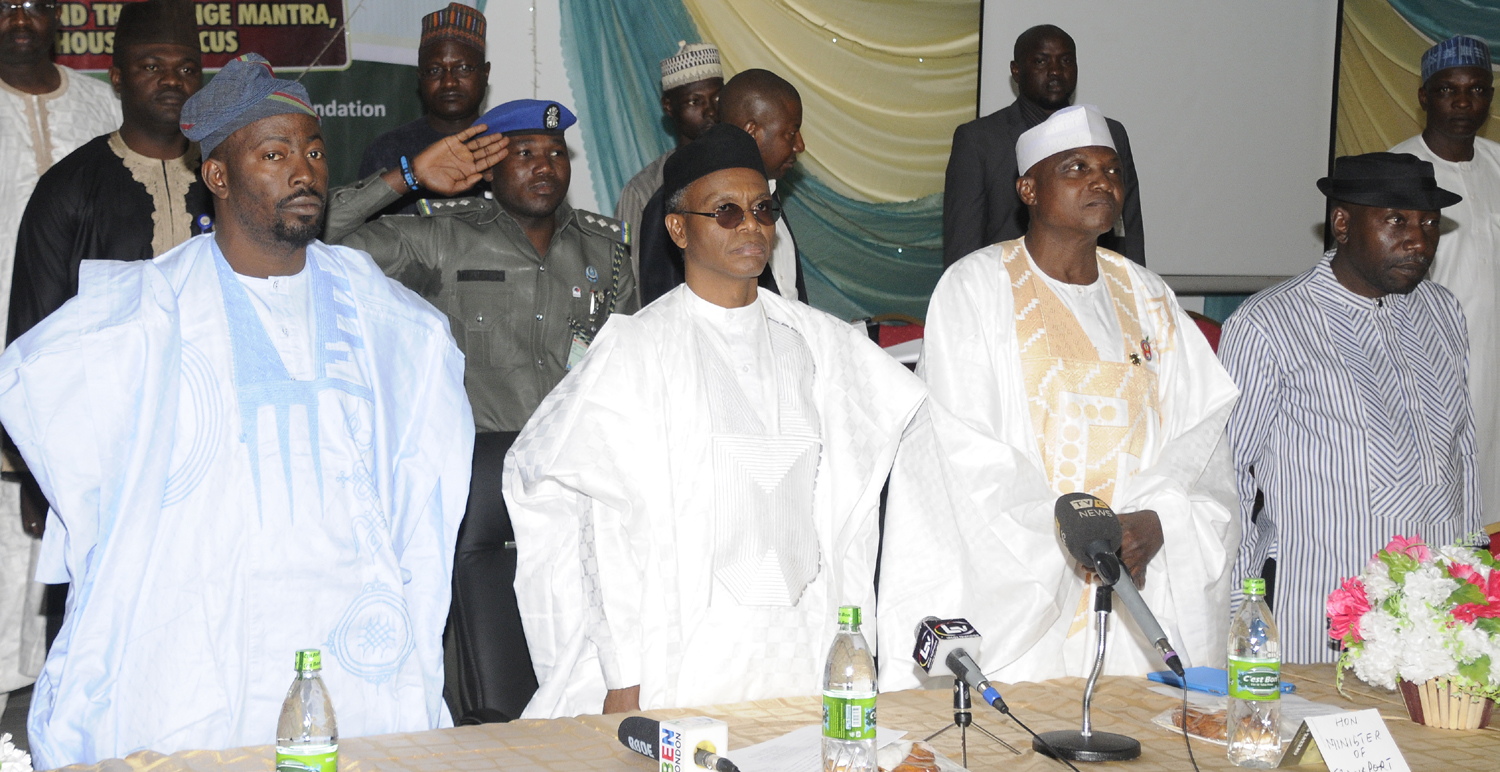
L-R, Member Kaduna state house of Assembly Hon. Yusuf Danlami, Kaduna state governor, Malam Nasir Ahmed El-Rufai, Senior Special Adviser to the President on media and publicity Malam Shehu Garba and the Chairman State House Correspondents Mr. Kehinde Amodu at the opening of a 3 day Retreat for State House Correspondents Abuja, hosted by the governor of Kaduna state with the Theme: Journalism and the change Mantra, state house in focus; at Sir, Ahmadu Bello Memorial Foundation Kaduna on Saturday 11/12/2015.
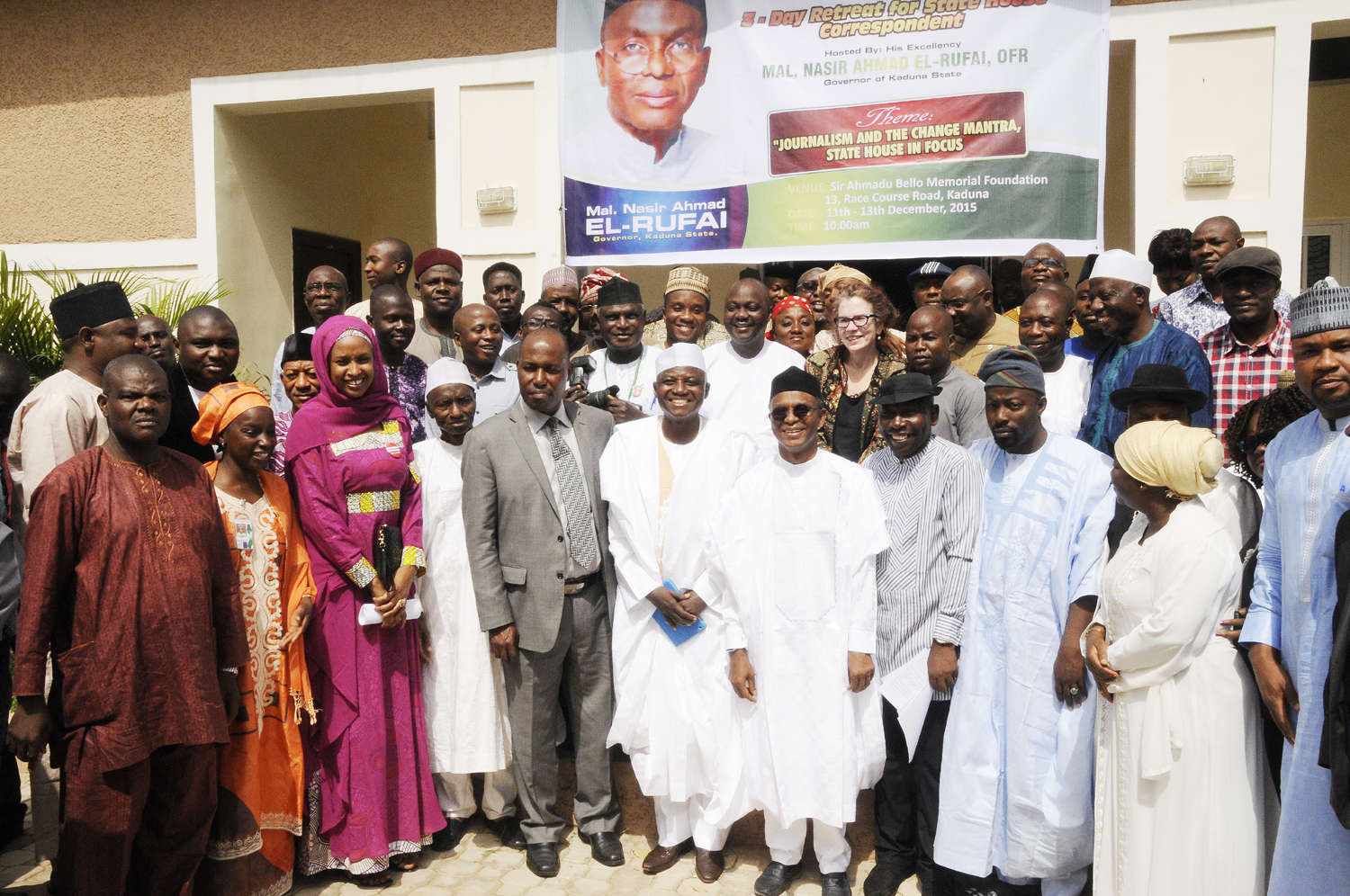
L-R, Editor of the Guardian Newspaper Mr. Martis Oloja, Senior special Assistant to the on Media Mallam Shehu Garba, Governor of Kaduna state Mal. Nasir Ahamad EL-Rufai,Chairman State House Correspondents Mr. Kekinde Amodu and Member Kaduna state house of Assembly Hon. Yusuf Damlami in group photograph with cross section of members of the opening of a 3 day Retreat for State House Correspondents Abuja hosted by the governor of Kaduna state with the Theme;Journalism and the change Mantra, state house in focus; at Sir, Ahmadu Bello Memorial Foundation Kaduna. [myad]
Officers and men of the Rivers State Police Command have cried out over alleged non-payment of their four months salaries by the police authorities.
Findings revealed that over 500 police officers and men of the command have not received their September, October and November salaries and no reasons have been given for the nonpayment of the salaries.
A top police source who spoke on the condition of anonymity said that the development is already creating discontent among the rank and file of the Force
“It is sad that we have not been paid salaries since September this year and nobody is telling us the reasons why the salaries are been withheld,” the source said.
He added that the Rivers State Command has requested the affected officers and men to come for physical verifications and that they should present their bank statements and payslips and yet there has been no positive result.
This is believed to be rubbing off on the welfare and morale of the officers who are groaning under current economic down turn in the economy.
Meanwhile, several efforts made by our correspondent to reach the Force Police Public Relations Officer, Bisi Kolawole, an Assistant Commissioner of Police (ACP) have failed as she would not pick calls nor respond to text messages.
However, an officer in the finance department of the Rivers State Command denied the story, claiming that there was no policeman in the command that was being owned any salary.
In a telephone chat today, the source said that the policemen could not have been planning to go on strike as no police man or officer under the command “is being owed any salary.
“ By the grace of God, we are not being owed salaries. At least I can speak for myself and my Command. It is only December Salary that is outstanding.” [myad]
The Publisher of ThisDay Newspaper, Mr. Nduka Obaigbena, has narrated how he too procured the sum of N670 Million from the embattled former National Security Adviser (NSA), Sambo Dasuki, saying the money was given to him as part of the payment was for compensation for the bombing of ThisDay offices in Abuja and Kaduna by the Boko Haram in April 2012.
Nduka, who has been invited to questioning by the Economic and Financial Crime Commission (EFCC), in a letter to the Commission, said that he had written a letter to the former President, Goodluck Jonathan seeking for compensation for the bombing of the company and that part of the payments was also for compensation to newspaper companies, following a crackdown on the press by the military which led to seizures and disruption of circulation of newspapers in Abuja in the wake of frequent Boko Haram attacks.
He named the newspapers as “ThisDay, Vanguard, The Sun, The Nation, New Telegraph, Daily Trust, People’s Daily, Leadership, Daily Independent, Tribune, Guardian and BusinessDay.”
Obaigbena is currently the President of the Newspapers Proprietors Association of Nigeria (NPAN).
This was even as the meantime, the management of Thisday Newspapers Group has denied allegation by the EFCC that it received suspicious funds from the Office of NSA during the tenure of Sambo Dasuki, adding that all funds received from the office of the NSA “are payments for compensation to mitigate the dastardly Boko Haram twin bombings of the Thisday Newspapers offices in Abuja and Kaduna on Thursday April 26, 2012.”
In its response to a letter of invitation from the EFCC dated 8th November 2015, which was received in its Abuja office on the 8th of December 2015, the management of Thisday Newspapers Group said that during the attack, “four innocent Nigerian lives were lost. Our buildings were destroyed and we lost full colour Goss printing towers and three (3) pre-press Computer-to-Plate and anxiliary equipment and other (in) valuable property valued at over N2.5 billion.”
The response letter to the EFCC invitation signed by Nduka Obaigbena, Chairman and Editor-in-Chief of Thisday Newspapers Group and dated December 9, 2015, said that N150,000,000 + N150,000,000 and N250,000,000 respectively were received in August, November and February 2014 as compensation to mitigate the dastardly Boko Haram twin bombings of its offices as approved by the Federal Government.
Obaigbena who is currently in the United States of America said in the letter to the Executive Chairman of the EFCC that the N100,000,000 and N20,000,000 received in March 2015 was for The Newspapers Proprietors Association of Nigeria (NPAN) and 12 newspapers “who demanded compensation for the brutal and unlawful seizure of newspapers and stoppage of circulation by armed soldiers in Abuja and several cities. As President of the NPAN, it was my duty to lead media leaders to hold discussions with President Goodluck Jonathan to avert a class action lawsuit against the Armed Forces and the Federal Government of Nigeria.”
“On both occasions, President Jonathan said he did not wish to lay precedence and in our case, he specifically said there were many victims of Boko Haram. I had to confront President Jonathan on the issue when I learnt of approvals for the reconstruction of the Abuja United Nations Building, since we were the second major organisation to be attacked by Boko Haram after the UN attack. He therefore directed me to meet the National Security Adviser who processed the 3 payments in question.
“Please find attached a copy of our letter to President Jonathan as well as correspondence with the then NSA on the Newspapers’ payment. I will make my way to Nigeria to meet with you should you require further information.” [myad]
We use cookies on our website to give you the most relevant experience by remembering your preferences and repeat visits. By clicking “Accept”, you consent to the use of ALL the cookies.
This website uses cookies to improve your experience while you navigate through the website. Out of these, the cookies that are categorized as necessary are stored on your browser as they are essential for the working of basic functionalities of the website. We also use third-party cookies that help us analyze and understand how you use this website. These cookies will be stored in your browser only with your consent. You also have the option to opt-out of these cookies. But opting out of some of these cookies may affect your browsing experience.
Necessary cookies are absolutely essential for the website to function properly. This category only includes cookies that ensures basic functionalities and security features of the website. These cookies do not store any personal information.
Any cookies that may not be particularly necessary for the website to function and is used specifically to collect user personal data via analytics, ads, other embedded contents are termed as non-necessary cookies. It is mandatory to procure user consent prior to running these cookies on your website.


 Soldiers have arrested the leader of the Shiit Islamic Movement of Nigeria, Sheikh Ibrahim El-Zakzaky, has been arrested by soldiers. This came after heavy clash between the sect and the soldiers yesterday in Zaria.






Great Ife And The Failure Of The Gown, By Reuben Abati
I studied at the University of Calabar (Malabites!), and at the time, I took time out to visit all the universities I mentioned earlier. In those days, the top universities in Nigeria were tourism destinations. Ibadan and ABU had the best bookshops anyone could think of, and the bookshop in UNILAG was also professionally run. UNN students insisted that they attended the University of Nigeria! But Ife had the most beautiful campus. It was the only university that had a special publication titled “Ife University in Pictures.” I remember receiving copies of that publication as a gift at different times from my friends: Kola Ogunleye, Akeem Adewuyi, and Kayode Ajala who served in the university as a youth corps member.
Whenever UNIFE students spoke about their university, you would think it was a little piece of heaven that had been converted to a university. They spoke about beauty, excellence, intellect and great scholarship. Every lecturer on the campus was painted like an Oracle at Delphi. So much mythology mixed with tales of absolute excitement attracted other students to the university. Curiousity once took the better part of me also, and I went on a visit to see the marvellous depiction of a campus in physical reality. I was not disappointed. Great Ife was great. I did not go to the classrooms, but my friends took me round. The University had just opened a Bukateria at the time, where everything was available. Driving into the campus itself was a delight; well-manicured flowers at both ends, long, comforting, welcoming drive.
We moved from one hall of residence to the other, where the students felt as if they were God’s special creations, lucky to be receiving education in one of the brightest spots on planet earth. I didn’t like the arrogance of the typical Ife student or graduate, even the girls had a special bounce to their gait, even if less pretty than our girls in Calabar, and I always quipped that flowers and beauty do not make a university, rather it is the intellectual content, but even in this regard, Ife was well-regarded. It boasted of some of the brightest guys in academia: that was in those days when Nigerian universities were centres of excellence, knowledge, discipline and distinction. Let’s add culture, for truly culture matters, and in educational matters, culture is perhaps everything, and there were scholars in Ife who had grown to become cultural icons in their respective fields.
The visits to Ife as expected always ended up at the newly launched Bukateria. Good food. Great ambience. And from the Bukateria Complex, there was a place we always visited for palm wine. I think they called it Old Bukka, close to the theatre. The halls of residence – Awolowo, Fajuyi, Moremi, Angola, Mozambique were exciting too; the students behaved as if each hall was a country unto itself, with each student having a permanent badge of identity. The students had quadrangles in every Faculty, and a Sports Complex, where my friend Akeem ended up with a black belt in Karate in addition to a degree in Architecture. Indeed, the University of Ife that I describe could compete at the time with any top university in the world. I have been to quite a few as a regular or executive student, there is no doubt that the university environment, where the gown is a special symbol, is meant to be a combination of everything that is excellent, to impart knowledge in a friendly environment where the student is groomed to become great citizens in society and for knowledge to be produced for the advancement of mankind. That is the ideal!
This is why it is particularly tragic that the same Great Ife is now a shadow of its former self. These days, more than 30 years after that glorious era that I describe, students of Obafemi Awolowo University, are now reported to be protesting over dilapidated halls of residence and terrible facilities. That bad? There was even a picture in the newspapers of OAU students fetching water from a stream! And I read one columnist calling on the university’s alumni to hurry up and rescue their alma mater. Please, is it that bad? But the story of this tragedy is the larger story of the Nigerian education system. My generation (waoh, man don dey old oh) went to school in this same country, and from kindergarten to doctorate, we can only recall in comparison with emergent realities, good memories. Once upon a time, our secondary schools were like higher institutions, but today our universities, with a few exceptions, are no better than secondary schools, and the secondary schools are no better than poultries. In those days, there were school principals who were more famous than state governors, commissioners, and traditional rulers, because they were known for their ability to manage schools and produce excellent students. There were government schools, there were mission schools, there were private schools, but there were standards, competition and quality.
A whole generation of students has now passed through the Nigerian education system without any memory of those good old days. What they know is the story of distracted teachers who sell handouts or beg for money from parents. What they know is the tragedy of a school system where teachers are perpetually protesting about lack of pay, lack of facilities and the inadequacy of everything. What they know are lecherous male teachers asking for sex in exchange for marks. What they know are ugly campuses, with no toilet facilities, no water, no light. When they hear about the gown, what they imagine is a gown in tatters, now terribly disconnected from the town. In our time, companies and government departments came to campuses or the NYSC camp to recruit staff, the school-to-work transition was so smooth and certain that even nurses and midwives upon graduation were sure of a decent future.
As an undergraduate, our room was cleaned, our beds were laid, and the cafeteria fed us well at cheap rates; we had water, we had uninterrupted electricity supply, our teachers were smart and committed, life was good. There were students in Nigerian universities from all parts of the world; the ones from Southern Africa were even sponsored by the Nigerian government and they were happy to be here, so happy some of them focused on our girls and caused problems each time they got drunk. But today, who will send a student to Nigeria?
Everything changed the moment government went mad, and till date that madness has not been cured. That madness started in 1984 with the removal of education subsidy. My point is: the present administration must see the need to properly define the role of government in the education sector, and further work out the details about sustainable development. The rot of past decades is so deep, the crisis so bad, as has been described, and the marks are still evident, only sustained intervention can make the difference. And if I may say so, this is one sector where government subsidy will be a good idea.
It is of course clear that President Buhari in his second coming wants to be remembered as the man who fixed Nigeria. He tried it in his first coming but he didn’t have a definite mandate. Now, he has the people’s mandate, plus extra-ordinary goodwill, and he is still determined to achieve his original objective. He wants to catch thieves. Fine. The only irony is that even General Sani Abacha did exactly the same thing, but other governments came and rewrote the narrative. Thief-catching is certainly okay! Perfect. It will excite the mob, extract vengeance, and may be promote justice, but President Buhari must begin to look to the future and build his own concrete legacy. His record in Nigeria in the long run, will be his legacy, but it must be that kind of legacy that cannot be re-written by revisionists.
So, what then, is his legacy project? I believe he can capture the society at the younger level: by investing in the historians of tomorrow and making their today better; by re-creating the future of Nigeria, by atoning for the past, by using public funds to secure the future of Nigerian children. Those young boys and girls in Nigerian public schools who are being poorly served, sitting in badly shaped classrooms, being taught by unpaid teachers; those undergraduates in higher institutions who graduate and have to be re-schooled by their employers before they can be found manageable; those graduates who learn research and science by simulation and who cannot compete in the international arena of skills; those unhappy teachers in our schools who are busy looking for other jobs on the side; all the children in special schools who have been forgotten by government, all the Nigerian children who are out of school, all those boys and kids who graduate from university but know nothing – they all need President Buhari. And time is not on his side. And he cannot do it alone. Many state Governors have shown that they take their cue from him: most of them refused to appoint Commissioners, until he appointed Ministers. They should be part of this legacy project.
The President should launch an aggressive restoration programme in the education sector that takes off from where the Jonathan administration signed off. The rot is so age-long, so deep, that no Nigerian President in many years to come can ever have enough time to fix all the problems with Nigeria. But every President that comes along can either leave a scratch, a mark, or a legacy. It is up to President Buhari to make his choice. Asalaam. [myad]